Simulations from the University of Glamorgan Karen Counsell, Senior Lecturer, Law School kmcounse@glam.ac.uk
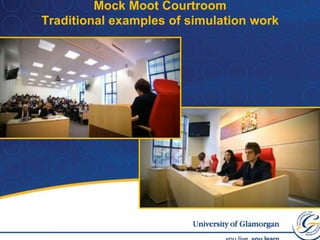
Mock Moot CourtroomTraditional examples of simulation work
Using Simulations In LawLaw School at Glamorgan part of the SIMPLE project – Simulated Professional Education. You can find out more about the project itself at:	 http://130.159.238.105/First used with year one students on the LLB then with undergraduate and postgraduate computer science students taking a law option. Now in our third year.
How we drew up the plansWe “re-purposed” a personal injury scenario developed by Glasgow Graduate School of Law for their Legal Practice Course.Changed to suit the needs of an academic based course.Takes place over 8 weeks in term 2 with 15 teams representing a claimant, another 15 representing the defendant.Staff play non-player roles.We had a large lead in time because of the project.
How we approached itWe were given the existing documents from GGSL and an idea of the story.(Sometimes, inspiration is itself very helpful!)Decided what objectives we wanted to achieve.Switched the story to a south Wales location, created new characters, populated the town/directory appropriately, changed relevant documents.We did not have any IT support in house but you should not let that concern you.
Approach – continuedTeam of three met regularly to review, write, we took responsibility for each stage of the story.We drew up supporting documentation for the students and arranged sandbox training for them.Students were informed at the start of the year how the assessment would run.Since the first year, set up etc is very fast.
The Simulation Story – LLB studentsBased on a fictional Welsh University called Cwmfelin.Estates worker suffers a fall at work and blames his employer – so very similar scenario to the Glasgow personal injury simulation.Students worked through four stages/states in dealing with the various issues based on established work in computer gaming. Students took on board the idea of stages very well and it aided their learning.
Stages One & TwoThese involved the student teams making decisions regarding which parties they needed to contact, researching the academic legal issues.Applying their work to the scenario.Forming an overall opinion of the strength of their clients case.These stages were cumulative – work for stage two was built on their preparation of stage one. Students understood they could not move on until their Senior Partner signed them off.Staff supervised their work throughout in the role of Senior Partner, we also undertook other electronic and face to face roles.
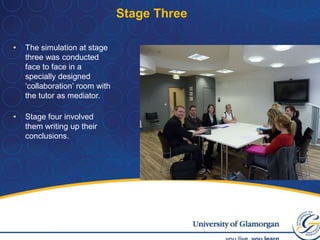
Stage ThreeThe simulation at stage three was conducted face to face in a specially designed ‘collaboration’ room with the tutor as mediator.
Stage four involved them writing up their conclusions.Student Attainment and feedback for the LLB module.We found the students had a much better submission rate for the course work.They really cared about their work and became very involved with the issues. Their examination performance improved with problem questions. During the second year, essay questions also improved.The overall module results improved by 10%.The students enthused about this method of learning – they enjoyed the practical application, the opportunity for constant feedback and feed forward, working at their own pace.
Why re-use an existing simulation?Obvious point is that it can save on staff time in terms of preparation.
The scenarios can inspire you  to adapt a simulation to suit your own context e.g. the level of study, the degree discipline, your location.
You can improve on someone else’s work and in turn they could benefit too.
You can learn from the experience of colleagues.Why? - continuedShare your work with other staff who might not have the resources to develop these materials e.g. HE Institution staff with high teaching loads.
Save costs in term of development of ideas, resources etc. We can achieve a great deal by working together and sharing ideas.
Why soldier on alone if there is a good idea out there which you could use? Inspiration! Computing StudentsThe work with torts students inspired me to move on to use simulations with computer science students.All conducted on line.Students then deal with issues of cyber squatting. Also used with Hong Kong  MSC Computer science students.
Computer Science BScI ran a domain name dispute with third year Bsc Computer science students and major minor students coming through a variety of degree paths.Choose domain name disputes because of the subject’s appeal to students.I had to buy a domain name myself in order to aid realism of the simulation.Improvement in completion rates, module marks much higher.Computing students undertook simulation early on the module which boosted their confidence.No issues of plagiarism – as yet….
I re-purposed again!Impressed with the results I decided to re-purpose my own simulation for post graduate computer science students.I had to change the learning outcomes, make the tasks more appropriate and adapt the story.The simulation supported in the classroom with these students being taken through a legal presentation in the Moot Court room.It allowed me to keep in touch with the Hong Kong students even after I returned to the UK. Again, very good results.
continuedResults were impressive, particularly with the overseas students.Emboldened by this outcome I adapted this simulation for Hong Kong Msc Students – obviously I had to adapt to that jurisdiction and its own way of dealing with domain name disputes.
Re-purposing – in houseSo, you can re-purpose a good simulation for own use depending on the student cohort.I have now used the domain name simulation with third year LLB students, again adapted for their own context. (At their request!)You have already completed the hardest part – thinking up the story, the structure and your basic learning outcomes already.
The future?Law School intends to work engage directly with other computer science modules on the Msc in Computer Security and Msc in Mobile Telecommunications. ‘Servicing’ teaching always a challenge in terms of delivering relevancy to the students of the module.Yet another example of repurposing of ideas – a similar cross disciplinary simulation running at another institution inspired me to approach another Faculty in order to collaborate.

Simulations from the University of Glamorgan

  • 1.
    Simulations from theUniversity of Glamorgan Karen Counsell, Senior Lecturer, Law School kmcounse@glam.ac.uk
  • 2.
    Mock Moot CourtroomTraditionalexamples of simulation work
  • 3.
    Using Simulations InLawLaw School at Glamorgan part of the SIMPLE project – Simulated Professional Education. You can find out more about the project itself at: http://130.159.238.105/First used with year one students on the LLB then with undergraduate and postgraduate computer science students taking a law option. Now in our third year.
  • 4.
    How we drewup the plansWe “re-purposed” a personal injury scenario developed by Glasgow Graduate School of Law for their Legal Practice Course.Changed to suit the needs of an academic based course.Takes place over 8 weeks in term 2 with 15 teams representing a claimant, another 15 representing the defendant.Staff play non-player roles.We had a large lead in time because of the project.
  • 5.
    How we approacheditWe were given the existing documents from GGSL and an idea of the story.(Sometimes, inspiration is itself very helpful!)Decided what objectives we wanted to achieve.Switched the story to a south Wales location, created new characters, populated the town/directory appropriately, changed relevant documents.We did not have any IT support in house but you should not let that concern you.
  • 6.
    Approach – continuedTeamof three met regularly to review, write, we took responsibility for each stage of the story.We drew up supporting documentation for the students and arranged sandbox training for them.Students were informed at the start of the year how the assessment would run.Since the first year, set up etc is very fast.
  • 7.
    The Simulation Story– LLB studentsBased on a fictional Welsh University called Cwmfelin.Estates worker suffers a fall at work and blames his employer – so very similar scenario to the Glasgow personal injury simulation.Students worked through four stages/states in dealing with the various issues based on established work in computer gaming. Students took on board the idea of stages very well and it aided their learning.
  • 8.
    Stages One &TwoThese involved the student teams making decisions regarding which parties they needed to contact, researching the academic legal issues.Applying their work to the scenario.Forming an overall opinion of the strength of their clients case.These stages were cumulative – work for stage two was built on their preparation of stage one. Students understood they could not move on until their Senior Partner signed them off.Staff supervised their work throughout in the role of Senior Partner, we also undertook other electronic and face to face roles.
  • 9.
    Stage ThreeThe simulationat stage three was conducted face to face in a specially designed ‘collaboration’ room with the tutor as mediator.
  • 10.
    Stage four involvedthem writing up their conclusions.Student Attainment and feedback for the LLB module.We found the students had a much better submission rate for the course work.They really cared about their work and became very involved with the issues. Their examination performance improved with problem questions. During the second year, essay questions also improved.The overall module results improved by 10%.The students enthused about this method of learning – they enjoyed the practical application, the opportunity for constant feedback and feed forward, working at their own pace.
  • 11.
    Why re-use anexisting simulation?Obvious point is that it can save on staff time in terms of preparation.
  • 12.
    The scenarios caninspire you to adapt a simulation to suit your own context e.g. the level of study, the degree discipline, your location.
  • 13.
    You can improveon someone else’s work and in turn they could benefit too.
  • 14.
    You can learnfrom the experience of colleagues.Why? - continuedShare your work with other staff who might not have the resources to develop these materials e.g. HE Institution staff with high teaching loads.
  • 15.
    Save costs interm of development of ideas, resources etc. We can achieve a great deal by working together and sharing ideas.
  • 16.
    Why soldier onalone if there is a good idea out there which you could use? Inspiration! Computing StudentsThe work with torts students inspired me to move on to use simulations with computer science students.All conducted on line.Students then deal with issues of cyber squatting. Also used with Hong Kong MSC Computer science students.
  • 17.
    Computer Science BScIran a domain name dispute with third year Bsc Computer science students and major minor students coming through a variety of degree paths.Choose domain name disputes because of the subject’s appeal to students.I had to buy a domain name myself in order to aid realism of the simulation.Improvement in completion rates, module marks much higher.Computing students undertook simulation early on the module which boosted their confidence.No issues of plagiarism – as yet….
  • 18.
    I re-purposed again!Impressedwith the results I decided to re-purpose my own simulation for post graduate computer science students.I had to change the learning outcomes, make the tasks more appropriate and adapt the story.The simulation supported in the classroom with these students being taken through a legal presentation in the Moot Court room.It allowed me to keep in touch with the Hong Kong students even after I returned to the UK. Again, very good results.
  • 19.
    continuedResults were impressive,particularly with the overseas students.Emboldened by this outcome I adapted this simulation for Hong Kong Msc Students – obviously I had to adapt to that jurisdiction and its own way of dealing with domain name disputes.
  • 20.
    Re-purposing – inhouseSo, you can re-purpose a good simulation for own use depending on the student cohort.I have now used the domain name simulation with third year LLB students, again adapted for their own context. (At their request!)You have already completed the hardest part – thinking up the story, the structure and your basic learning outcomes already.
  • 21.
    The future?Law Schoolintends to work engage directly with other computer science modules on the Msc in Computer Security and Msc in Mobile Telecommunications. ‘Servicing’ teaching always a challenge in terms of delivering relevancy to the students of the module.Yet another example of repurposing of ideas – a similar cross disciplinary simulation running at another institution inspired me to approach another Faculty in order to collaborate.