Oculogyric Crises
Summarized from:
Slow EJ, Lang AE. Oculogyric crises: a review of phenomenology, etiology,
pathogenesis, and treatment. Movement Disorders. 2017 Feb;32(2):193-202.
Outline:
 Introduction
 Etiology
 Pathophysiology
 Diagnostic Criteria
 Differential diagnosis
 Diagnostic Approach
 Treatment
 Summary
Introduction
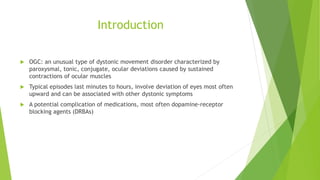
 OGC: an unusual type of dystonic movement disorder characterized by
paroxysmal, tonic, conjugate, ocular deviations caused by sustained
contractions of ocular muscles
 Typical episodes last minutes to hours, involve deviation of eyes most often
upward and can be associated with other dystonic symptoms
 A potential complication of medications, most often dopamine-receptor
blocking agents (DRBAs)
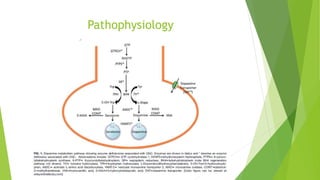
Pathophysiology
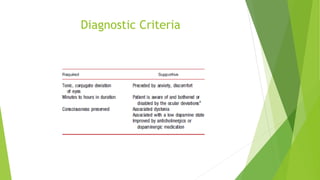
Diagnostic Criteria
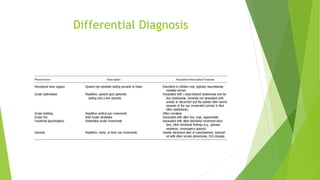
Differential Diagnosis
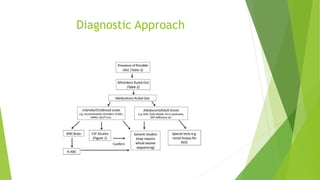
Diagnostic Approach
Treatment
 Anticholinergics are the mainstay of treatment in drug-induced OGC
 One theory is that the hypodopaminergic state results in a relative cholinergic
overactivity
 Intravenous anticholinergics or diphenhydramine are recommended
treatments in acute distonic reactions, typically working quickly (often
minutes) to ameliorate the symptoms
 Benzodiazepines, including diazepam and clonazepam, may also be of benefit
in OGC caused by neuroleptics
 In the neurometabolic disorders, dopamine replacement can completely
abolish the occurrence of OGC over time
Summary
 A rare acute dystonic reaction
 Tonic upward gaze
 Due to DRBA / neuroleptic agent or neurometabolic disorders
 Deficiency of dopamine metabolism enzymes
 Hypodopaminergic  relative hypercholinergic
 Treatment: Anticholinergics (diphenhydramine)
Oculogyric Crises

Oculogyric Crises

  • 1.
    Oculogyric Crises Summarized from: SlowEJ, Lang AE. Oculogyric crises: a review of phenomenology, etiology, pathogenesis, and treatment. Movement Disorders. 2017 Feb;32(2):193-202.
  • 2.
    Outline:  Introduction  Etiology Pathophysiology  Diagnostic Criteria  Differential diagnosis  Diagnostic Approach  Treatment  Summary
  • 3.
    Introduction  OGC: anunusual type of dystonic movement disorder characterized by paroxysmal, tonic, conjugate, ocular deviations caused by sustained contractions of ocular muscles  Typical episodes last minutes to hours, involve deviation of eyes most often upward and can be associated with other dystonic symptoms  A potential complication of medications, most often dopamine-receptor blocking agents (DRBAs)
  • 5.
  • 6.
  • 7.
  • 8.
  • 9.
    Treatment  Anticholinergics arethe mainstay of treatment in drug-induced OGC  One theory is that the hypodopaminergic state results in a relative cholinergic overactivity  Intravenous anticholinergics or diphenhydramine are recommended treatments in acute distonic reactions, typically working quickly (often minutes) to ameliorate the symptoms  Benzodiazepines, including diazepam and clonazepam, may also be of benefit in OGC caused by neuroleptics  In the neurometabolic disorders, dopamine replacement can completely abolish the occurrence of OGC over time
  • 10.
    Summary  A rareacute dystonic reaction  Tonic upward gaze  Due to DRBA / neuroleptic agent or neurometabolic disorders  Deficiency of dopamine metabolism enzymes  Hypodopaminergic  relative hypercholinergic  Treatment: Anticholinergics (diphenhydramine)