Deep Ocean Mining

   Has the time come for this?
Exploration, technology, resources,
             spin-offs.
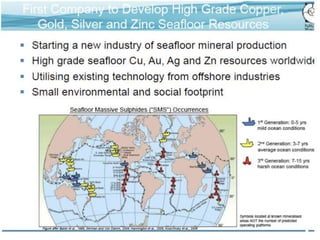
Target – VMS ore deposits
• VMS – volcanogenic massive sulfide ore deposits
  (metal sulfide deposits)
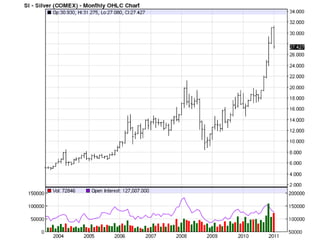
   – Copper, zinc, lead, gold, silver
   – By-products include cobalt, sulfur, manganese, barium, tin,
     cadmium, indium, tellurium
      • Basically anything that dissolves in molten sulfur
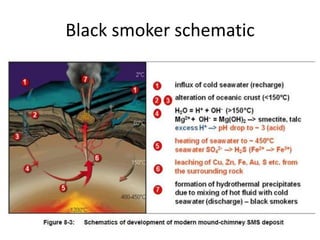
• Formed by volcanic openings in ocean floor
   – Superheated water + sulfur borne metals wells out forming
     a cone (black smokers / fumeroles)
   – Deposits the above metals
   – Very hot highly acidic local conditions while active
      • Hard to find when dormant
Black smoker schematic
An old idea
• Explored a lot in 70s timeframe
   – Many studies, papers and equipment/process inventions
• More or less considered uneconomical then
   – Lower resource prices
   – Lower tech
   – Missing inventions
• Maganese modules were mined in 70s and 80s
   – Rich in nickel and copper covering larger areas
   – Ultimately aborted as too expensive at the time
      • Drop in metal prices at time combined with energy cost spike
• Easier to mine through 2000 m of water than of earth and
  stone
Environmental aspects
• Concern for the unique and possibly quite useful life extremophile life
  forms
    – Some of the mineralization may be caused or aided by some of the micro-
      organisms present
• Overall impact is likely significantly less than land based mining
    – No acid drainage
         • But care with acidic water cycling is required
    – No waste-rock piles
    – No permanent structures
• Other worries
    – Sediment plumes
         • Especially serious near surface
    – Near surface acidity increase
         • Though surface water is highly alkaline so that would take a LOT of pumping without
           return
Resource shortages
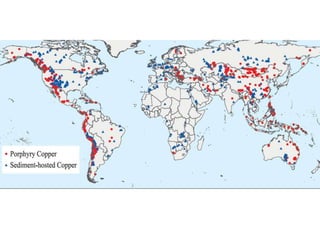
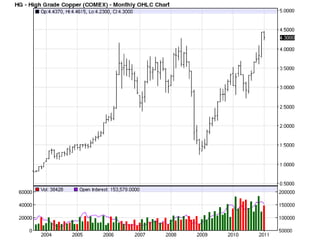
• Copper
  – High demand
  – Some loss production, little new major sources
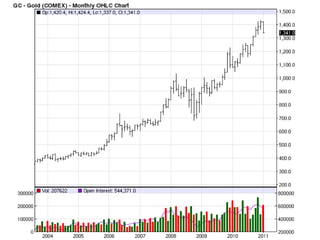
  – Very tight supply, booming prices
  – Expensive enough to be commonly stolen
  – Fairly long lag for new equipment, permits,
    infrastructure
  – Asian increased demand is tightening supply of
    copper and many other resources
Raw Material Shortages..
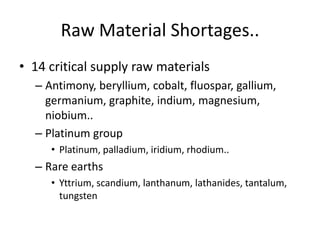
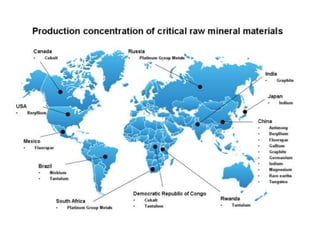
• 14 critical supply raw materials
  – Antimony, beryllium, cobalt, fluospar, gallium,
    germanium, graphite, indium, magnesium,
    niobium..
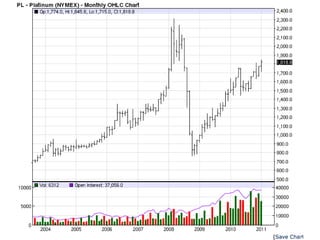
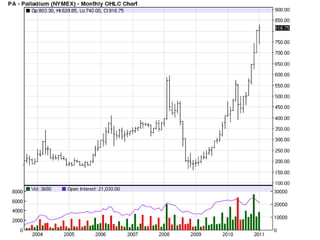
  – Platinum group
     • Platinum, palladium, iridium, rhodium..
  – Rare earths
     • Yttrium, scandium, lanthanum, lathanides, tantalum,
       tungsten
Afghanistan to the rescue?
• Over $1 trillion in untapped mineral deposits
   – Now you know another reason US is pounding dirt there
• Huge veins of iron, copper, cobalt, gold, lithium,
  niobium
   – “Saudi Arabia of lithium” - pentagon
• Country could become one of the most important
  mining centers in the world
   – The Soviets figured this out back in the 80s..
• China may seek more control of this area
• Starting from nearly nothing it will take decades to
  develop these resources
Deep ocean mining
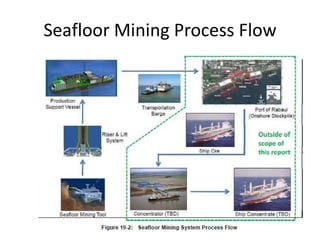
Deposits extracted by 100 ton machines
   – Mostly developed for deep sea oil work
   – Mix of water and material brought to surface ship
      • Water is very acidic – separated and pumped back down
• Single deposit could weigh in at 100 million tons
• Most of the deep sea vents are in international waters
   – Some UN treaty may be limiting factor
      • 1982 Law of the Sea treaty
      • US hasn’t signed yet and is a bit blocked by international law
Solwara 1 Project
• Nautilus company
• After gold and copper
    – $70 per ton production cost
    – $1000 per ton value
•   $383 million in equipment (funded)
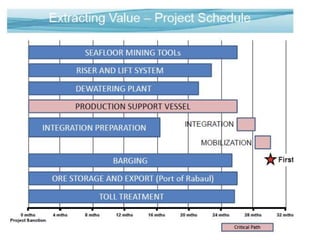
•   30 month build schedule to 1.2 million tons/year
•   Expected first ore at end of 2012.
•   Depth: 1600 meters
•   Samples contained copper and gold concentrations
    several times higher than typical in mines on land
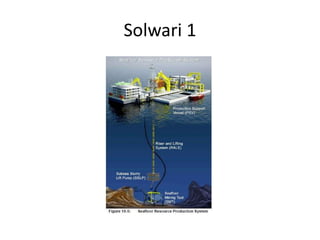
Solwari 1
Seafloor Mining Process Flow
Ocean floormining

Ocean floormining

  • 1.
    Deep Ocean Mining Has the time come for this? Exploration, technology, resources, spin-offs.
  • 2.
    Target – VMSore deposits • VMS – volcanogenic massive sulfide ore deposits (metal sulfide deposits) – Copper, zinc, lead, gold, silver – By-products include cobalt, sulfur, manganese, barium, tin, cadmium, indium, tellurium • Basically anything that dissolves in molten sulfur • Formed by volcanic openings in ocean floor – Superheated water + sulfur borne metals wells out forming a cone (black smokers / fumeroles) – Deposits the above metals – Very hot highly acidic local conditions while active • Hard to find when dormant
  • 3.
  • 4.
    An old idea •Explored a lot in 70s timeframe – Many studies, papers and equipment/process inventions • More or less considered uneconomical then – Lower resource prices – Lower tech – Missing inventions • Maganese modules were mined in 70s and 80s – Rich in nickel and copper covering larger areas – Ultimately aborted as too expensive at the time • Drop in metal prices at time combined with energy cost spike • Easier to mine through 2000 m of water than of earth and stone
  • 5.
    Environmental aspects • Concernfor the unique and possibly quite useful life extremophile life forms – Some of the mineralization may be caused or aided by some of the micro- organisms present • Overall impact is likely significantly less than land based mining – No acid drainage • But care with acidic water cycling is required – No waste-rock piles – No permanent structures • Other worries – Sediment plumes • Especially serious near surface – Near surface acidity increase • Though surface water is highly alkaline so that would take a LOT of pumping without return
  • 6.
    Resource shortages • Copper – High demand – Some loss production, little new major sources – Very tight supply, booming prices – Expensive enough to be commonly stolen – Fairly long lag for new equipment, permits, infrastructure – Asian increased demand is tightening supply of copper and many other resources
  • 13.
    Raw Material Shortages.. •14 critical supply raw materials – Antimony, beryllium, cobalt, fluospar, gallium, germanium, graphite, indium, magnesium, niobium.. – Platinum group • Platinum, palladium, iridium, rhodium.. – Rare earths • Yttrium, scandium, lanthanum, lathanides, tantalum, tungsten
  • 15.
    Afghanistan to therescue? • Over $1 trillion in untapped mineral deposits – Now you know another reason US is pounding dirt there • Huge veins of iron, copper, cobalt, gold, lithium, niobium – “Saudi Arabia of lithium” - pentagon • Country could become one of the most important mining centers in the world – The Soviets figured this out back in the 80s.. • China may seek more control of this area • Starting from nearly nothing it will take decades to develop these resources
  • 16.
    Deep ocean mining Depositsextracted by 100 ton machines – Mostly developed for deep sea oil work – Mix of water and material brought to surface ship • Water is very acidic – separated and pumped back down • Single deposit could weigh in at 100 million tons • Most of the deep sea vents are in international waters – Some UN treaty may be limiting factor • 1982 Law of the Sea treaty • US hasn’t signed yet and is a bit blocked by international law
  • 17.
    Solwara 1 Project •Nautilus company • After gold and copper – $70 per ton production cost – $1000 per ton value • $383 million in equipment (funded) • 30 month build schedule to 1.2 million tons/year • Expected first ore at end of 2012. • Depth: 1600 meters • Samples contained copper and gold concentrations several times higher than typical in mines on land
  • 18.
  • 20.

Editor's Notes

  • #16 http://www.nytimes.com/2010/06/14/world/asia/14minerals.html?_r=1&pagewanted=all