What are coral reefs?
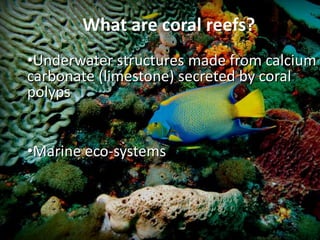
•Underwater structures made from calcium
carbonate (limestone) secreted by coral
polyps


•Marine eco-systems
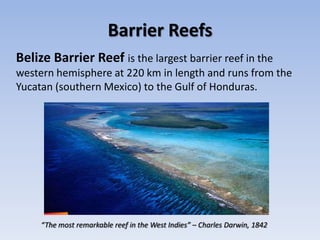
Barrier Reefs
Belize Barrier Reef is the largest barrier reef in the
western hemisphere at 220 km in length and runs from the
Yucatan (southern Mexico) to the Gulf of Honduras.


     “The most remarkable reef in the West Indies” – Charles Darwin, 1842
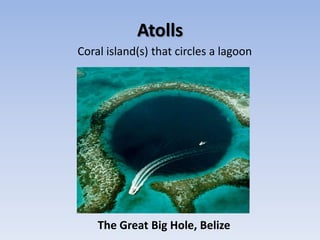
Atolls
Coral island(s) that circles a lagoon


    The Great Big Hole, Belize
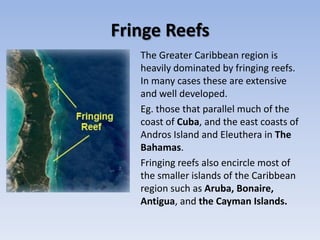
Fringe Reefs
   The Greater Caribbean region is
   heavily dominated by fringing reefs.
   In many cases these are extensive
   and well developed.
   Eg. those that parallel much of the
   coast of Cuba, and the east coasts of
   Andros Island and Eleuthera in The
   Bahamas.
   Fringing reefs also encircle most of
   the smaller islands of the Caribbean
   region such as Aruba, Bonaire,
   Antigua, and the Cayman Islands.
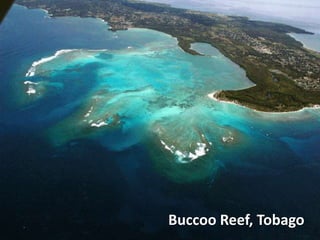
Buccoo Reef, Tobago
Destruction of Coral Reefs
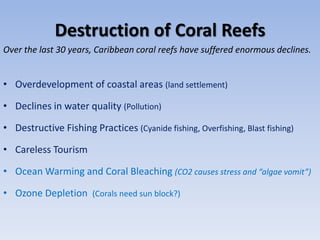
Over the last 30 years, Caribbean coral reefs have suffered enormous declines.


• Overdevelopment of coastal areas (land settlement)

• Declines in water quality (Pollution)

• Destructive Fishing Practices (Cyanide fishing, Overfishing, Blast fishing)

• Careless Tourism

• Ocean Warming and Coral Bleaching (CO2 causes stress and “algae vomit”)

• Ozone Depletion (Corals need sun block?)
Coral Reefs and Society & Culture
             Why should we care?


Coastal Protection – Reefs fend off hurricanes!

Sustainability of Fishing Industry

Recreation & Tourism

Heritage

Science & Research
CXC CAPE CARIBBEAN STUDIES 2009
             Paper 2 Q1

  Explain three measures that Caribbean
“ can implement to minimize the
countries


                                       ”
danger posed to coral reefs the region.
Answer
• “Coral reefs are an integral part of the ecology of the
  Caribbean and the identity of the region.”
• Examples of the dangers posed to coral reefs

Measures to minimize these dangers:
 • Education – fisher folk, hoteliers, citizens, tourists
 • Official Intervention - Creation of marine-protected areas
 • Official Intervention - Laws against damage, criminalization
 • Official Intervention - Authorities to protect reefs
 • Adoption of a regional approach, central policy
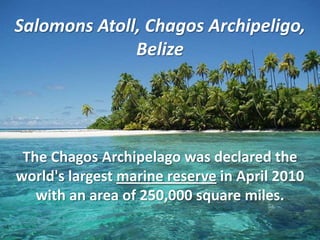
Salomons Atoll, Chagos Archipeligo,
              Belize


 The Chagos Archipelago was declared the
world's largest marine reserve in April 2010
   with an area of 250,000 square miles.
As of 2008, there are about 500 Marine
Protected Areas (MPAs) in the region.

Coral Reefs are the best represented.
More...
Caribbean Studies for CAPE Examinations - Jennifer Mohammed

              http://www.coral-reef-info.com

                http://reefgis.reefbase.org/

                http://www.mytobago.info/

                    http://www.wri.org/

Coral reefs

  • 2.
    What are coralreefs? •Underwater structures made from calcium carbonate (limestone) secreted by coral polyps •Marine eco-systems
  • 3.
    Barrier Reefs Belize BarrierReef is the largest barrier reef in the western hemisphere at 220 km in length and runs from the Yucatan (southern Mexico) to the Gulf of Honduras. “The most remarkable reef in the West Indies” – Charles Darwin, 1842
  • 4.
    Atolls Coral island(s) thatcircles a lagoon The Great Big Hole, Belize
  • 5.
    Fringe Reefs The Greater Caribbean region is heavily dominated by fringing reefs. In many cases these are extensive and well developed. Eg. those that parallel much of the coast of Cuba, and the east coasts of Andros Island and Eleuthera in The Bahamas. Fringing reefs also encircle most of the smaller islands of the Caribbean region such as Aruba, Bonaire, Antigua, and the Cayman Islands.
  • 6.
  • 7.
    Destruction of CoralReefs Over the last 30 years, Caribbean coral reefs have suffered enormous declines. • Overdevelopment of coastal areas (land settlement) • Declines in water quality (Pollution) • Destructive Fishing Practices (Cyanide fishing, Overfishing, Blast fishing) • Careless Tourism • Ocean Warming and Coral Bleaching (CO2 causes stress and “algae vomit”) • Ozone Depletion (Corals need sun block?)
  • 9.
    Coral Reefs andSociety & Culture Why should we care? Coastal Protection – Reefs fend off hurricanes! Sustainability of Fishing Industry Recreation & Tourism Heritage Science & Research
  • 10.
    CXC CAPE CARIBBEANSTUDIES 2009 Paper 2 Q1 Explain three measures that Caribbean “ can implement to minimize the countries ” danger posed to coral reefs the region.
  • 11.
    Answer • “Coral reefsare an integral part of the ecology of the Caribbean and the identity of the region.” • Examples of the dangers posed to coral reefs Measures to minimize these dangers: • Education – fisher folk, hoteliers, citizens, tourists • Official Intervention - Creation of marine-protected areas • Official Intervention - Laws against damage, criminalization • Official Intervention - Authorities to protect reefs • Adoption of a regional approach, central policy
  • 12.
    Salomons Atoll, ChagosArchipeligo, Belize The Chagos Archipelago was declared the world's largest marine reserve in April 2010 with an area of 250,000 square miles.
  • 13.
    As of 2008,there are about 500 Marine Protected Areas (MPAs) in the region. Coral Reefs are the best represented.
  • 14.
    More... Caribbean Studies forCAPE Examinations - Jennifer Mohammed http://www.coral-reef-info.com http://reefgis.reefbase.org/ http://www.mytobago.info/ http://www.wri.org/