OCEAN MINING
AND
DEEP SEA MINERALS
- a new frontier
by k.samson
INTRODUCTION
 Mineral exploration on land has reached a satuaration
point.open seas provide limitless opportunities. seabed mining
can meet increased demands from industry.
 During the 19th century there was a strong interest in
determining what forms of life existed in the ocean’s deepest
reaches.
 To find out, nets and dredges were lowered several
kilometers, some of which returned not only with interesting
organisms but also with seafloor deposits. Dark, potato-sized
nodules, for instance, regularly showed up in deep-sea
samples.
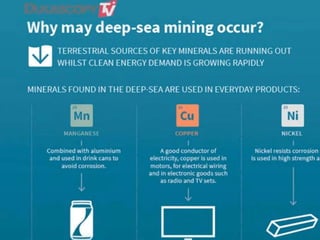
 By definition, Deep Sea Minerals (DSM) occur in the deeper-
water (400 – 6,000 meters) where minerals are deposited by
natural processes as iron-manganese (or ferromanganese)
nodules and crusts, massive sulfide, phosphates, and
What is deep sea mining?
The basics.
• Deep sea mining is a mineral retrieval process that takes place on the
ocean floor through (remote operated excavators). The deepest parts
of the world’s ocean feature ecosystems found nowhere else on Earth.
• They provide habitats for multitudes of species, many yet to be named.
In these vast, lightless regions are also found deposits of valuable
minerals in rich concentrations.
• Deep sea extraction technologies may soon develop to the point where
exploration of seabed minerals can give way to active exploitation.
• The International Seabed Authority (ISA) is charged with formulating and
enforcing rules for all seabed mining that takes place in areas beyond
national jurisdiction.
• These rules are now under development. Environmental regulations,
liability and financial rules, oversight, and enforcement protocols all must
be written and approved within three to five years.
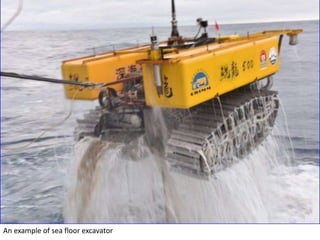
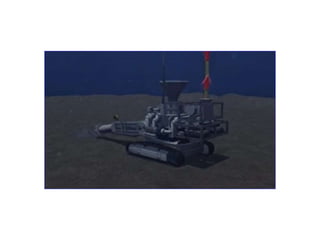
An example of sea floor excavator
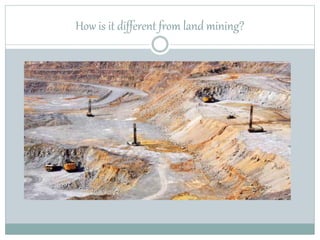
How is it different from land mining?
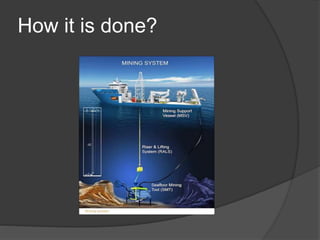
How it is done?
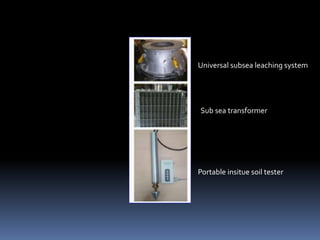
Portable insitue soil tester
Sub sea transformer
Universal subsea leaching system
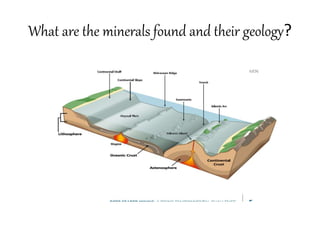
What are the minerals found and their geology?
1.The deep sea contains five major physiographic zones:
(A.) continental slopes,
(B.) Abyssal plains
(C.) mid-ocean ridges,
(D.) seamounts,
(E.)deep ocean trenches .
2. Along the continental slope the seafloor rapidly descends to depths of
between 4,000 and 6,000 m, to level off into immense, sediment- covered areas
known as abyssal plains.
3.These, in turn, are interrupted by mid-oceanic ridges, which encircle the entire
globe, and seamounts, undersea extinct volcanoes that rise high above the
seafloor.
4.Trenches, in contrast, are deep ocean depressions generally reaching
depths beyond 6,000 m.
5. Understanding the formation of these zones and its effect on the
distribution of their mineral deposits requires an understanding of the
process of plate tectonics.
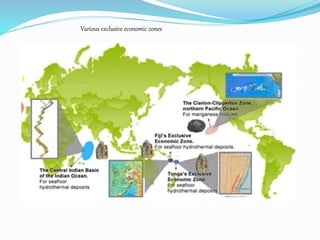
Various exclusive economic zones
Deep Sea Mining Cycle: from Prospecting to
Exploitation
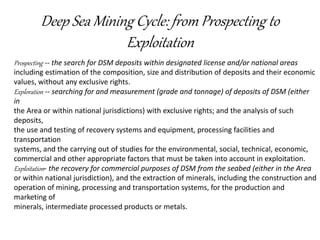
Prospecting -- the search for DSM deposits within designated license and/or national areas
including estimation of the composition, size and distribution of deposits and their economic
values, without any exclusive rights.
Exploration -- searching for and measurement (grade and tonnage) of deposits of DSM (either
in
the Area or within national jurisdictions) with exclusive rights; and the analysis of such
deposits,
the use and testing of recovery systems and equipment, processing facilities and
transportation
systems, and the carrying out of studies for the environmental, social, technical, economic,
commercial and other appropriate factors that must be taken into account in exploitation.
Exploitation- the recovery for commercial purposes of DSM from the seabed (either in the Area
or within national jurisdiction), and the extraction of minerals, including the construction and
operation of mining, processing and transportation systems, for the production and
marketing of
minerals, intermediate processed products or metals.
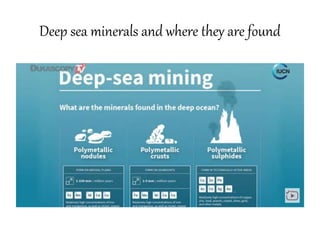
Deep sea minerals and where they are found
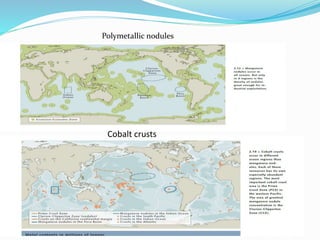
Polymetallic nodules
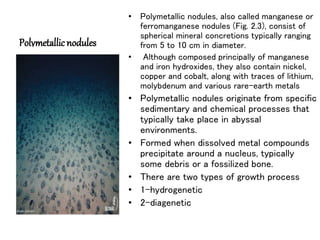
• Polymetallic nodules, also called manganese or
ferromanganese nodules (Fig. 2.3), consist of
spherical mineral concretions typically ranging
from 5 to 10 cm in diameter.
• Although composed principally of manganese
and iron hydroxides, they also contain nickel,
copper and cobalt, along with traces of lithium,
molybdenum and various rare-earth metals
• Polymetallic nodules originate from specific
sedimentary and chemical processes that
typically take place in abyssal
environments.
• Formed when dissolved metal compounds
precipitate around a nucleus, typically
some debris or a fossilized bone.
• There are two types of growth process
• 1-hydrogenetic
• 2-diagenetic
High-grade nodules generally form below the Calcium Carbonate Compensation Depth
(CCD), i.e., the depth at which carbonates dissolve as a result of low temperatures
and high pressure, resulting in lower sedimentation rates.
The most extensive field of nodules is located in the Clarion-Clipperton Fracture Zone
(CCZ) in the central Pacific a region that has been of interest to mining companies
Polymetallic crusts
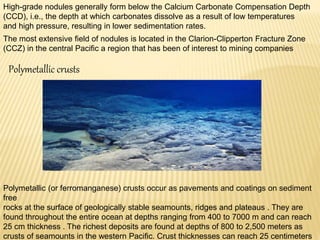
Polymetallic (or ferromanganese) crusts occur as pavements and coatings on sediment
free
rocks at the surface of geologically stable seamounts, ridges and plateaus . They are
found throughout the entire ocean at depths ranging from 400 to 7000 m and can reach
25 cm thickness . The richest deposits are found at depths of 800 to 2,500 meters as
crusts of seamounts in the western Pacific. Crust thicknesses can reach 25 centimeters
Seafloor massive sulphide deposits
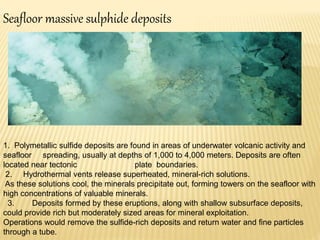
1. Polymetallic sulfide deposits are found in areas of underwater volcanic activity and
seafloor spreading, usually at depths of 1,000 to 4,000 meters. Deposits are often
located near tectonic plate boundaries.
2. Hydrothermal vents release superheated, mineral-rich solutions.
As these solutions cool, the minerals precipitate out, forming towers on the seafloor with
high concentrations of valuable minerals.
3. Deposits formed by these eruptions, along with shallow subsurface deposits,
could provide rich but moderately sized areas for mineral exploitation.
Operations would remove the sulfide-rich deposits and return water and fine particles
through a tube.
1.Massive sulphide deposits are the result of seawater circulation within the oceanic
crust.
2. High pressure forces cold seawater deep into the seafloor, causing the water to
superheat and accumulate metal sulphides from the surrounding rock
3. The resulting hot fluid decreases in density and is pushed upwards to the seafloor
where it is expelled from hydrothermal vents.
Distribution
Two major regions include the western Pacific, with its numerous back-arc basins,
and the slow-spreading Mid-Atlantic Ridge.
1. The mid-ocean ridges in the Indian Ocean are characterized by slow and ultra-slow
spreading, which makes them a third potential site for commercially significant
quantities
of seafloor massive sulphide deposits.
2 .The Red Sea is considered an area of particular interest due to a slow-spreading
tectonic in which metal-bearing muds are deposited directly on the
seafloor
3 .It is one of the most important hydrothermal deposit sites known and contains
millions of tons of ores with commercially significant quantities of zinc, copper and
silver
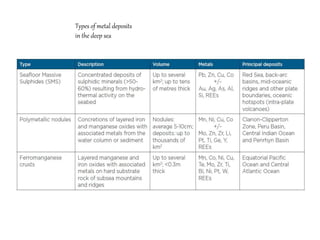
Types of metal deposits
in the deep sea
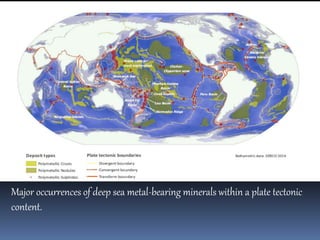
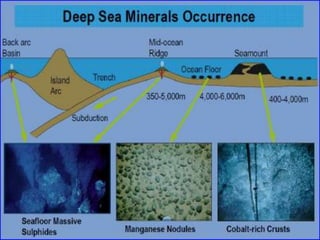
Major occurrences of deep sea metal-bearing minerals within a plate tectonic
content.
Manganese nodules
Cobalt crusts
Polymetallic nodules
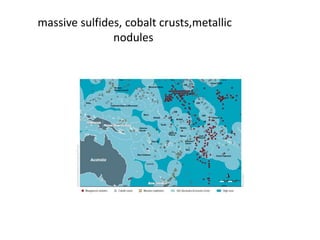
massive sulfides, cobalt crusts,metallic
nodules
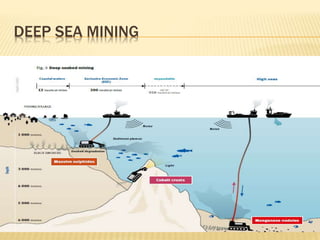
DEEP SEA MINING
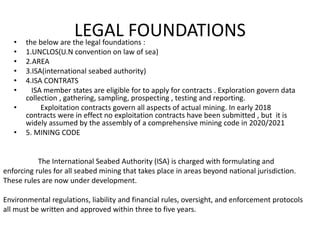
LEGAL FOUNDATIONS
• the below are the legal foundations :
• 1.UNCLOS(U.N convention on law of sea)
• 2.AREA
• 3.ISA(international seabed authority)
• 4.ISA CONTRATS
• ISA member states are eligible for to apply for contracts . Exploration govern data
collection , gathering, sampling, prospecting , testing and reporting.
• Exploitation contracts govern all aspects of actual mining. In early 2018
contracts were in effect no exploitation contracts have been submitted , but it is
widely assumed by the assembly of a comprehensive mining code in 2020/2021
• 5. MINING CODE
The International Seabed Authority (ISA) is charged with formulating and
enforcing rules for all seabed mining that takes place in areas beyond national jurisdiction.
These rules are now under development.
Environmental regulations, liability and financial rules, oversight, and enforcement protocols
all must be written and approved within three to five years.
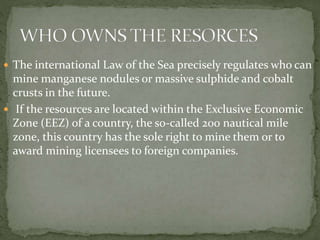
 The international Law of the Sea precisely regulates who can
mine manganese nodules or massive sulphide and cobalt
crusts in the future.
 If the resources are located within the Exclusive Economic
Zone (EEZ) of a country, the so-called 200 nautical mile
zone, this country has the sole right to mine them or to
award mining licensees to foreign companies.
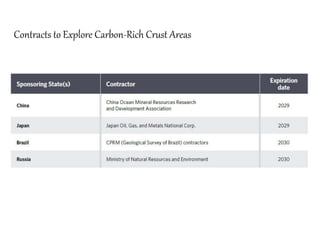
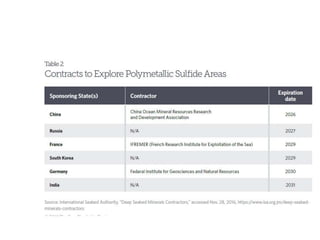
Contracts to Explore Carbon-Rich Crust Areas
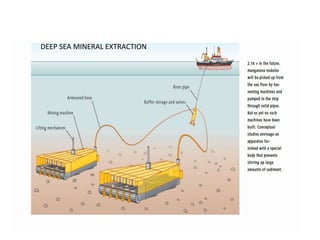
DEEP SEA MINERAL EXTRACTION
EXCAVATIONING DSM
• Whether at sea or on land, there are four basic ways to mine for a mineral deposit:
1.scraping it from the surface
2. excavating it by digging a hole ,
3. tunneling to a deposit
4.beneath the surface;
5.or directly drilling into it.
Once the resource is obtained through one of these methods, it must then be
transported, processed, and refined into a marketable product.
As refinement usually calls for the raw material to be reduced in size multiple times,
the remaining unneeded materials need to be disposed of or, if possible, used for
other purposes.
Deep-sea mining poses new challenges as it must be conducted deep beneath the
ocean’s surface in extreme environmental conditions using remote technology.
To meet these challenges, modern deep-sea mining methods are being designed
including ocean cable-laying, offshore diamond mining, dredging, and offshore oil
and gas extraction.
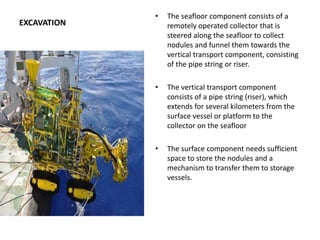
EXCAVATION
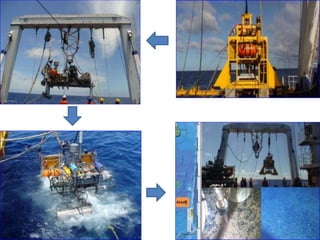
• The seafloor component consists of a
remotely operated collector that is
steered along the seafloor to collect
nodules and funnel them towards the
vertical transport component, consisting
of the pipe string or riser.
• The vertical transport component
consists of a pipe string (riser), which
extends for several kilometers from the
surface vessel or platform to the
collector on the seafloor
• The surface component needs sufficient
space to store the nodules and a
mechanism to transfer them to storage
vessels.
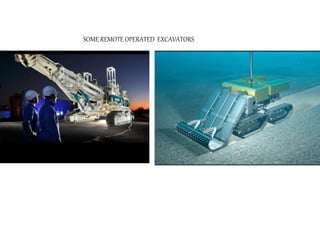
SOME REMOTE OPERATED EXCAVATORS
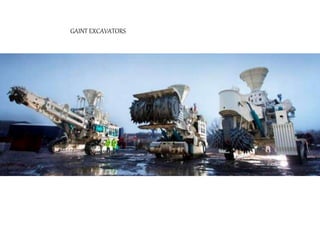
GAINT EXCAVATORS
Case study : nautilus
mining system
this is the first sea bed mine
located in Papua new guinea .
THIS PROJECT HAD GIVEN
EXPLOITATION RI
GHTS BY ISA
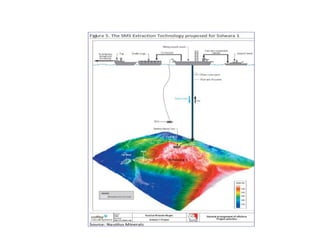
 The current mining approach for the Solar site is based on remotely
operated equipment to crush using a continuous cutting process, not
unlike bulk mining equipment used on land.
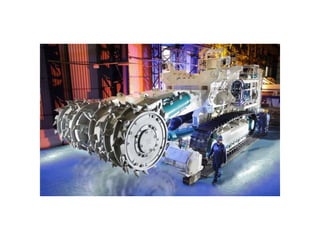
 Three different excavating machines will be used: the auxiliary cutter, a
bulk cutter and a collector .
 The Auxiliary Cutter (AC) consists of a boom-mounted cutting head
designed to disaggregate the rocks on rough terrain.
 Once it has done so, the material is further disaggregated by the Bulk
Cutter (BC).
 The crushed deposits are then gathered by the Collecting Machine
(CM), which mixes the ore fragments with seawater .
 And sends the slurry to the Riser and Lifting System.
 The Riser and Lifting system is designed to transport the slurry to the
surface
using a subsea lift pump attached to its base and a vertical riser system
linked to the surface vessel.
 Once the slurry reaches the ship it passes through a dewatering process
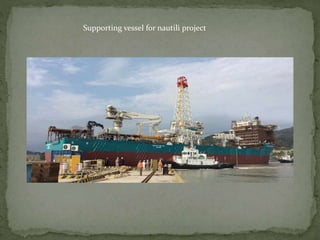
Supporting vessel for nautili project
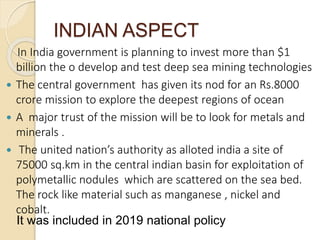
INDIAN ASPECT
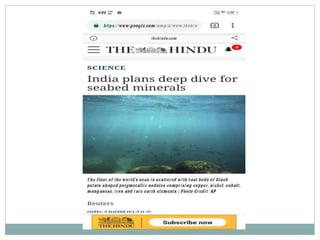
In India government is planning to invest more than $1
billion the o develop and test deep sea mining technologies
 The central government has given its nod for an Rs.8000
crore mission to explore the deepest regions of ocean
 A major trust of the mission will be to look for metals and
minerals .
 The united nation’s authority as alloted india a site of
75000 sq.km in the central indian basin for exploitation of
polymetallic nodules which are scattered on the sea bed.
The rock like material such as manganese , nickel and
cobalt.
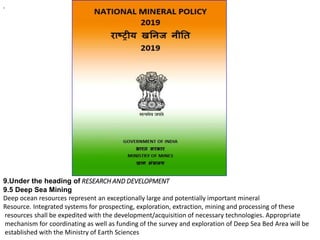
It was included in 2019 national policy
.
9.Under the heading of RESEARCH AND DEVELOPMENT
9.5 Deep Sea Mining
Deep ocean resources represent an exceptionally large and potentially important mineral
Resource. Integrated systems for prospecting, exploration, extraction, mining and processing of these
resources shall be expedited with the development/acquisition of necessary technologies. Appropriate
mechanism for coordinating as well as funding of the survey and exploration of Deep Sea Bed Area will be
established with the Ministry of Earth Sciences
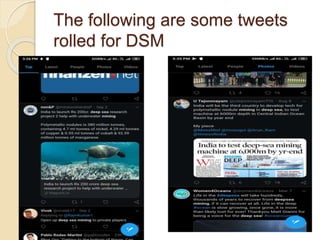
The following are some tweets
rolled for DSM
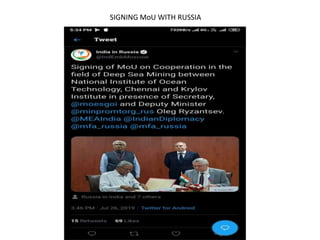
SIGNING MoU WITH RUSSIA
Environmental issues
• Seafloor disturbance is one of the most important
environmental impacts resulting from deep seabed mining
because it causes the direct loss of habitats and the possible
loss of a variety of organisms.
• The fauna and flora of unexplored ocean floor will have a
direct impact on their existance.since most of the alien
species we don’t know reside on underwater floor.
• so for as mining considered that we(miners) are a new
frontier, the technology should be innovated by us to make it
acceptable by all
Conclusion ;a new frontierfor miner
• We are exploring mars and we are exploring the moon .
• Why don’t we explore our oceans.
• The worlds oceans are rich of rare metals as global demand continues to grow
,more more countries are eyeing the oceans as a source of raw materials
• Some of these minerals are scattered on the sea floor.
• Ocean sea bed is a new frontier for reserve extraction in the 21th century.UNO has
DECLARED 2020’S TO THE DECADE OF OCEAN SCIENCE FOR SUISTAINABLE DEV
ELOPMENT
Deepsea mining concessions have been leased by several nations and the
international seabed authority for the the atlantic Indian & pacific oceans.
• Barely a decade before humankind step foot moon .but we still know much less
about sea floor. Around a 500 people had gone into space but only 3treached the
ocean deepest points.
• The whole of ovcean is unexplored….
Thank you

OCEANMINING ppt.hyd.pptx

  • 1.
    OCEAN MINING AND DEEP SEAMINERALS - a new frontier by k.samson
  • 2.
    INTRODUCTION  Mineral explorationon land has reached a satuaration point.open seas provide limitless opportunities. seabed mining can meet increased demands from industry.  During the 19th century there was a strong interest in determining what forms of life existed in the ocean’s deepest reaches.  To find out, nets and dredges were lowered several kilometers, some of which returned not only with interesting organisms but also with seafloor deposits. Dark, potato-sized nodules, for instance, regularly showed up in deep-sea samples.  By definition, Deep Sea Minerals (DSM) occur in the deeper- water (400 – 6,000 meters) where minerals are deposited by natural processes as iron-manganese (or ferromanganese) nodules and crusts, massive sulfide, phosphates, and
  • 3.
    What is deepsea mining? The basics. • Deep sea mining is a mineral retrieval process that takes place on the ocean floor through (remote operated excavators). The deepest parts of the world’s ocean feature ecosystems found nowhere else on Earth. • They provide habitats for multitudes of species, many yet to be named. In these vast, lightless regions are also found deposits of valuable minerals in rich concentrations. • Deep sea extraction technologies may soon develop to the point where exploration of seabed minerals can give way to active exploitation. • The International Seabed Authority (ISA) is charged with formulating and enforcing rules for all seabed mining that takes place in areas beyond national jurisdiction. • These rules are now under development. Environmental regulations, liability and financial rules, oversight, and enforcement protocols all must be written and approved within three to five years.
  • 4.
    An example ofsea floor excavator
  • 5.
    How is itdifferent from land mining?
  • 6.
    How it isdone?
  • 8.
    Portable insitue soiltester Sub sea transformer Universal subsea leaching system
  • 10.
    What are theminerals found and their geology?
  • 11.
    1.The deep seacontains five major physiographic zones: (A.) continental slopes, (B.) Abyssal plains (C.) mid-ocean ridges, (D.) seamounts, (E.)deep ocean trenches . 2. Along the continental slope the seafloor rapidly descends to depths of between 4,000 and 6,000 m, to level off into immense, sediment- covered areas known as abyssal plains. 3.These, in turn, are interrupted by mid-oceanic ridges, which encircle the entire globe, and seamounts, undersea extinct volcanoes that rise high above the seafloor. 4.Trenches, in contrast, are deep ocean depressions generally reaching depths beyond 6,000 m. 5. Understanding the formation of these zones and its effect on the distribution of their mineral deposits requires an understanding of the process of plate tectonics.
  • 12.
  • 13.
    Deep Sea MiningCycle: from Prospecting to Exploitation Prospecting -- the search for DSM deposits within designated license and/or national areas including estimation of the composition, size and distribution of deposits and their economic values, without any exclusive rights. Exploration -- searching for and measurement (grade and tonnage) of deposits of DSM (either in the Area or within national jurisdictions) with exclusive rights; and the analysis of such deposits, the use and testing of recovery systems and equipment, processing facilities and transportation systems, and the carrying out of studies for the environmental, social, technical, economic, commercial and other appropriate factors that must be taken into account in exploitation. Exploitation- the recovery for commercial purposes of DSM from the seabed (either in the Area or within national jurisdiction), and the extraction of minerals, including the construction and operation of mining, processing and transportation systems, for the production and marketing of minerals, intermediate processed products or metals.
  • 14.
    Deep sea mineralsand where they are found
  • 15.
    Polymetallic nodules • Polymetallicnodules, also called manganese or ferromanganese nodules (Fig. 2.3), consist of spherical mineral concretions typically ranging from 5 to 10 cm in diameter. • Although composed principally of manganese and iron hydroxides, they also contain nickel, copper and cobalt, along with traces of lithium, molybdenum and various rare-earth metals • Polymetallic nodules originate from specific sedimentary and chemical processes that typically take place in abyssal environments. • Formed when dissolved metal compounds precipitate around a nucleus, typically some debris or a fossilized bone. • There are two types of growth process • 1-hydrogenetic • 2-diagenetic
  • 16.
    High-grade nodules generallyform below the Calcium Carbonate Compensation Depth (CCD), i.e., the depth at which carbonates dissolve as a result of low temperatures and high pressure, resulting in lower sedimentation rates. The most extensive field of nodules is located in the Clarion-Clipperton Fracture Zone (CCZ) in the central Pacific a region that has been of interest to mining companies Polymetallic crusts Polymetallic (or ferromanganese) crusts occur as pavements and coatings on sediment free rocks at the surface of geologically stable seamounts, ridges and plateaus . They are found throughout the entire ocean at depths ranging from 400 to 7000 m and can reach 25 cm thickness . The richest deposits are found at depths of 800 to 2,500 meters as crusts of seamounts in the western Pacific. Crust thicknesses can reach 25 centimeters
  • 17.
    Seafloor massive sulphidedeposits 1. Polymetallic sulfide deposits are found in areas of underwater volcanic activity and seafloor spreading, usually at depths of 1,000 to 4,000 meters. Deposits are often located near tectonic plate boundaries. 2. Hydrothermal vents release superheated, mineral-rich solutions. As these solutions cool, the minerals precipitate out, forming towers on the seafloor with high concentrations of valuable minerals. 3. Deposits formed by these eruptions, along with shallow subsurface deposits, could provide rich but moderately sized areas for mineral exploitation. Operations would remove the sulfide-rich deposits and return water and fine particles through a tube.
  • 18.
    1.Massive sulphide depositsare the result of seawater circulation within the oceanic crust. 2. High pressure forces cold seawater deep into the seafloor, causing the water to superheat and accumulate metal sulphides from the surrounding rock 3. The resulting hot fluid decreases in density and is pushed upwards to the seafloor where it is expelled from hydrothermal vents. Distribution Two major regions include the western Pacific, with its numerous back-arc basins, and the slow-spreading Mid-Atlantic Ridge. 1. The mid-ocean ridges in the Indian Ocean are characterized by slow and ultra-slow spreading, which makes them a third potential site for commercially significant quantities of seafloor massive sulphide deposits. 2 .The Red Sea is considered an area of particular interest due to a slow-spreading tectonic in which metal-bearing muds are deposited directly on the seafloor 3 .It is one of the most important hydrothermal deposit sites known and contains millions of tons of ores with commercially significant quantities of zinc, copper and silver
  • 19.
    Types of metaldeposits in the deep sea
  • 20.
    Major occurrences ofdeep sea metal-bearing minerals within a plate tectonic content.
  • 21.
  • 23.
    massive sulfides, cobaltcrusts,metallic nodules
  • 24.
  • 25.
    LEGAL FOUNDATIONS • thebelow are the legal foundations : • 1.UNCLOS(U.N convention on law of sea) • 2.AREA • 3.ISA(international seabed authority) • 4.ISA CONTRATS • ISA member states are eligible for to apply for contracts . Exploration govern data collection , gathering, sampling, prospecting , testing and reporting. • Exploitation contracts govern all aspects of actual mining. In early 2018 contracts were in effect no exploitation contracts have been submitted , but it is widely assumed by the assembly of a comprehensive mining code in 2020/2021 • 5. MINING CODE The International Seabed Authority (ISA) is charged with formulating and enforcing rules for all seabed mining that takes place in areas beyond national jurisdiction. These rules are now under development. Environmental regulations, liability and financial rules, oversight, and enforcement protocols all must be written and approved within three to five years.
  • 26.
     The internationalLaw of the Sea precisely regulates who can mine manganese nodules or massive sulphide and cobalt crusts in the future.  If the resources are located within the Exclusive Economic Zone (EEZ) of a country, the so-called 200 nautical mile zone, this country has the sole right to mine them or to award mining licensees to foreign companies.
  • 28.
    Contracts to ExploreCarbon-Rich Crust Areas
  • 30.
    DEEP SEA MINERALEXTRACTION
  • 31.
    EXCAVATIONING DSM • Whetherat sea or on land, there are four basic ways to mine for a mineral deposit: 1.scraping it from the surface 2. excavating it by digging a hole , 3. tunneling to a deposit 4.beneath the surface; 5.or directly drilling into it. Once the resource is obtained through one of these methods, it must then be transported, processed, and refined into a marketable product. As refinement usually calls for the raw material to be reduced in size multiple times, the remaining unneeded materials need to be disposed of or, if possible, used for other purposes. Deep-sea mining poses new challenges as it must be conducted deep beneath the ocean’s surface in extreme environmental conditions using remote technology. To meet these challenges, modern deep-sea mining methods are being designed including ocean cable-laying, offshore diamond mining, dredging, and offshore oil and gas extraction.
  • 32.
    EXCAVATION • The seafloorcomponent consists of a remotely operated collector that is steered along the seafloor to collect nodules and funnel them towards the vertical transport component, consisting of the pipe string or riser. • The vertical transport component consists of a pipe string (riser), which extends for several kilometers from the surface vessel or platform to the collector on the seafloor • The surface component needs sufficient space to store the nodules and a mechanism to transfer them to storage vessels.
  • 34.
  • 35.
  • 37.
    Case study :nautilus mining system this is the first sea bed mine located in Papua new guinea . THIS PROJECT HAD GIVEN EXPLOITATION RI GHTS BY ISA  The current mining approach for the Solar site is based on remotely operated equipment to crush using a continuous cutting process, not unlike bulk mining equipment used on land.  Three different excavating machines will be used: the auxiliary cutter, a bulk cutter and a collector .  The Auxiliary Cutter (AC) consists of a boom-mounted cutting head designed to disaggregate the rocks on rough terrain.  Once it has done so, the material is further disaggregated by the Bulk Cutter (BC).  The crushed deposits are then gathered by the Collecting Machine (CM), which mixes the ore fragments with seawater .  And sends the slurry to the Riser and Lifting System.  The Riser and Lifting system is designed to transport the slurry to the surface using a subsea lift pump attached to its base and a vertical riser system linked to the surface vessel.  Once the slurry reaches the ship it passes through a dewatering process
  • 39.
    Supporting vessel fornautili project
  • 40.
    INDIAN ASPECT In Indiagovernment is planning to invest more than $1 billion the o develop and test deep sea mining technologies  The central government has given its nod for an Rs.8000 crore mission to explore the deepest regions of ocean  A major trust of the mission will be to look for metals and minerals .  The united nation’s authority as alloted india a site of 75000 sq.km in the central indian basin for exploitation of polymetallic nodules which are scattered on the sea bed. The rock like material such as manganese , nickel and cobalt. It was included in 2019 national policy
  • 41.
    . 9.Under the headingof RESEARCH AND DEVELOPMENT 9.5 Deep Sea Mining Deep ocean resources represent an exceptionally large and potentially important mineral Resource. Integrated systems for prospecting, exploration, extraction, mining and processing of these resources shall be expedited with the development/acquisition of necessary technologies. Appropriate mechanism for coordinating as well as funding of the survey and exploration of Deep Sea Bed Area will be established with the Ministry of Earth Sciences
  • 42.
    The following aresome tweets rolled for DSM
  • 44.
  • 45.
    Environmental issues • Seafloordisturbance is one of the most important environmental impacts resulting from deep seabed mining because it causes the direct loss of habitats and the possible loss of a variety of organisms. • The fauna and flora of unexplored ocean floor will have a direct impact on their existance.since most of the alien species we don’t know reside on underwater floor. • so for as mining considered that we(miners) are a new frontier, the technology should be innovated by us to make it acceptable by all
  • 46.
    Conclusion ;a newfrontierfor miner • We are exploring mars and we are exploring the moon . • Why don’t we explore our oceans. • The worlds oceans are rich of rare metals as global demand continues to grow ,more more countries are eyeing the oceans as a source of raw materials • Some of these minerals are scattered on the sea floor. • Ocean sea bed is a new frontier for reserve extraction in the 21th century.UNO has DECLARED 2020’S TO THE DECADE OF OCEAN SCIENCE FOR SUISTAINABLE DEV ELOPMENT Deepsea mining concessions have been leased by several nations and the international seabed authority for the the atlantic Indian & pacific oceans. • Barely a decade before humankind step foot moon .but we still know much less about sea floor. Around a 500 people had gone into space but only 3treached the ocean deepest points. • The whole of ovcean is unexplored….
  • 47.

Editor's Notes

  • #5 An example of sea floor excavator
  • #9 Universal subsea leaching system
  • #13 Various exclusive economic zones
  • #22 occurrence
  • #31 DEEP SEA MINERAL EXTRACTION
  • #35 SOME REMOTE OPERATED EXCAVATORS
  • #36 GAINT EXCAVATORS
  • #40 Supporting vessel for nautili project
  • #41 It was included in 2019 national policy
  • #45 SIGNING MoU WITH RUSSIA