VASHI
NARULA
(Final Year)
OBTURATION (American Association of Endodontics)
Obturation is the method used to fill and
seal a cleaned and shaped root canal using
a root canal sealer and a core filling
material.
It is done to eliminate all portals of entry
between the periodontium and the root
canal.
IDEAL REQUIREMENTS for a ROOT
CANAL FILLING MATERIAL -
GROSSMAN
• Easily manipulated
• Seal completely (laterally and apically)
• Adequate physical properties
Insertion Removal
Set slowlyNo shrinkage
Impervious to moisture
• Biological properties
• Sterile or easily sterilized before insertion
• Radiopaque
Does not stain the tooth
Biocompatible
Discourage bacterial
growth
WHEN TO OBTURATE?
• Reasonably dry canal
• No “weeping” of fluids
• Blood or serous
• Optimal shaping and cleaning--- Extra care to be
taken with necrotic and infected pulp
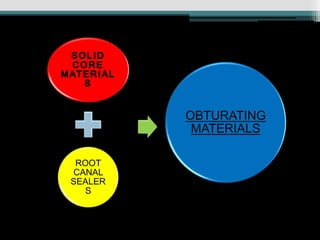
ROOT
CANAL
SEALER
S
OBTURATING
MATERIALS
SOLID CORE
OBTURATING
MATERIALS
CURRENTLY
USED
MTARESILON
GUTTA-
PERCHA
HISTORICAL
SILVER
CONES
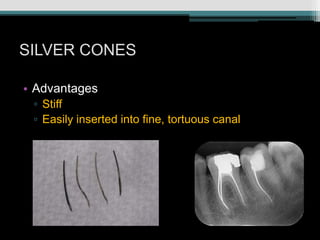
SILVER CONES
• Advantages
▫ Stiff
▫ Easily inserted into fine, tortuous canal
• Disadvantages
▫ Corrosion with saliva and periradicular fluids
▫ Toxic products- failure
▫ Stieglitz forceps needed to retrieve
GUTTA-PERCHA –BOWMAN, 1867
• COMPOSITION (FRIEDMAN)
▫ GUTTA-PERCHA 20% matrix
▫ ZINC OXIDE 66% filler
▫ HEAVY METAL SULPHATES 11%
radiopacifier
▫ WAXES OR RESINS 3% plasticizer
Characteristics
• Rigid natural latex- Palaquium gutta
• Trans isomer of polyisoprene
▫ α phase
▫ β phase
heating shrinks 65° slow cooling
β α solid mass melts β
(tacky and
flowable)
α phase- thermoplasticized techniques
β phase- lateral condensation
PROPERTIES
• Easily sterilized before insertion
• No shrinkage after insertion
• Does not encourage bacterial growth
• Radiopaque, non staining, impervious to
moisture
• Removed easily, if required
• Biocompatible
SIZES
• Extra fine
• Fine
• Medium fine
• Fine medium
• Medium
• Large
• Extra large
• Matches file size
CONVENTIONAL
STANDARDIZED
TAPER
• ISO 2%- 15-140
• 4-6%
• Variable
RESILION
• Polyurethane
• Lateral compaction, warm vertical compaction,
thermoplasticized (150°C)
• Adhesive properties
Composition
• Polycaprolactone core
• Difunctional methacrylate
• Bioactive glass
• Bismuth and barium salts
• Pigments
MINERAL TRIOXIDE AGGREGATE
• Indications –Bogen et al
▫ Combined with root resection
▫ Open apices
▫ Retreatment with MTA obturation
▫ Internal resorption
▫ Dens in dente
• Limitations
▫ Difficult retreatment, curved canals
▫ Discolouration
ROOT CANAL
SEALERS
• Root canal sealers are used in conjunction with
biologically acceptable semisolid or solid obturation
materials to establish an adequate seal of the root canal
system
• CLASSIFICATION
▫ Zinc oxide eugenol based
 Grossman’s formula
 Roth’s 801
 Tubliseal
▫ Calcium hydroxide based
 Sealapex
 Apexit
▫ Glass ionomer based
▫ Resin based
 AH plus
 AH26
 Epiphany
 Diaket
Ideal Root Canal Sealer -Grossman
• Excellent seal
• Adhesion, Cohesion
• Radiopaque
• Nonstaining
• Dimentionally stable
• Easily mixed and introduced in canals
• Insoluble in tissue fluids
• Discourages bacterial growth
• Non irritating to periradicular tissues
• Sufficient working time
ZINC OXIDE EUGENOL BASED
• POWDER/BASE- zinc oxide
• LIQUID/CATALYST- eugenol (Canada balsam may
be added)
• GROSSMAN’S CEMENT-
▫ POWDER
 Zinc oxide
 Staybelite resin
 Bismuth subcarbonate
 Barium sulfate
 Anhydrous sodium borate
▫ LIQUID
 Eugenol
▫ Hardens in 2 hours at 37degrees 100% relative
humidity
▫ Set in root canal- 10-30mins
▫ 2-3 drops liquid+p0wder increments- smooth,
creamy mix
 String out for an inch before breaking
 Cling to inverted spatula for 10-15 secs
▫ Spatulation- 1 min/drop
• Canal should be dry
• Master cone, lentulo spiral used for coating the
canals
• Lateral or rotary motion
CALCIUM HYDROXIDE BASED
• Modification of ZoE based sealers
▫ Antimicrobial
▫ Osteogenic-Cementogenic properties
• Sealapex
▫ Base-
 Zinc oxide
 Calcium hydroxide
 Butyl benzene
 Sulphonamide
 Zinc stearate
▫ Catalyst
 Resin
 Isobutyl salicylate
 Barium sulphate
 Titanium oxide
 Aerosol
GLASS IONOMER BASED
• Dentin bonding ability
• Difficult to remove during retreatment
• Solvents are ineffective against them
RESIN BASED
• AH 26
▫ Epoxy resin based
▫ Radiopaque (bismuth oxide)
▫ Strong adhesive properties
▫ Contracts slightly on hardening
Releases formaldehyde
• AH plus
• PASTE A
▫ Epoxy resin
▫ Calcium tungstate
▫ Zirconium oxide
▫ Silica
▫ Iron oxide
PASTE B
▫ Adamantaneamine N
▫ Calcium tungstate
▫ Zirconium oxide
▫ Silica-silicone oil
Does not release formaldehyde
Advantages
• Good sealing ability
• Biocompatible
• Moderate antimicrobial properties
• Dentinal adhesion
• Long working time
• Ease of manipulation
REACTIONS TO OBTURATION
MATERIALS
• Irritable to periradicular tissue- reduce healing
by 25%
• Zinc oxide based sealers more irritating-
eugenol
• Epoxy resin sealers- most biocompatible
Extrusion into the periradicular tissue should be
avoided
Obturation materials

Obturation materials

  • 1.
  • 2.
    OBTURATION (American Associationof Endodontics) Obturation is the method used to fill and seal a cleaned and shaped root canal using a root canal sealer and a core filling material. It is done to eliminate all portals of entry between the periodontium and the root canal.
  • 3.
    IDEAL REQUIREMENTS fora ROOT CANAL FILLING MATERIAL - GROSSMAN • Easily manipulated • Seal completely (laterally and apically) • Adequate physical properties Insertion Removal Set slowlyNo shrinkage Impervious to moisture
  • 4.
    • Biological properties •Sterile or easily sterilized before insertion • Radiopaque Does not stain the tooth Biocompatible Discourage bacterial growth
  • 5.
    WHEN TO OBTURATE? •Reasonably dry canal • No “weeping” of fluids • Blood or serous • Optimal shaping and cleaning--- Extra care to be taken with necrotic and infected pulp
  • 6.
  • 7.
  • 8.
    SILVER CONES • Advantages ▫Stiff ▫ Easily inserted into fine, tortuous canal
  • 9.
    • Disadvantages ▫ Corrosionwith saliva and periradicular fluids ▫ Toxic products- failure ▫ Stieglitz forceps needed to retrieve
  • 10.
    GUTTA-PERCHA –BOWMAN, 1867 •COMPOSITION (FRIEDMAN) ▫ GUTTA-PERCHA 20% matrix ▫ ZINC OXIDE 66% filler ▫ HEAVY METAL SULPHATES 11% radiopacifier ▫ WAXES OR RESINS 3% plasticizer
  • 11.
    Characteristics • Rigid naturallatex- Palaquium gutta • Trans isomer of polyisoprene ▫ α phase ▫ β phase heating shrinks 65° slow cooling β α solid mass melts β (tacky and flowable) α phase- thermoplasticized techniques β phase- lateral condensation
  • 12.
    PROPERTIES • Easily sterilizedbefore insertion • No shrinkage after insertion • Does not encourage bacterial growth • Radiopaque, non staining, impervious to moisture • Removed easily, if required • Biocompatible
  • 13.
    SIZES • Extra fine •Fine • Medium fine • Fine medium • Medium • Large • Extra large • Matches file size CONVENTIONAL STANDARDIZED
  • 14.
    TAPER • ISO 2%-15-140 • 4-6% • Variable
  • 15.
    RESILION • Polyurethane • Lateralcompaction, warm vertical compaction, thermoplasticized (150°C) • Adhesive properties
  • 16.
    Composition • Polycaprolactone core •Difunctional methacrylate • Bioactive glass • Bismuth and barium salts • Pigments
  • 17.
    MINERAL TRIOXIDE AGGREGATE •Indications –Bogen et al ▫ Combined with root resection ▫ Open apices ▫ Retreatment with MTA obturation ▫ Internal resorption ▫ Dens in dente • Limitations ▫ Difficult retreatment, curved canals ▫ Discolouration
  • 18.
  • 19.
    • Root canalsealers are used in conjunction with biologically acceptable semisolid or solid obturation materials to establish an adequate seal of the root canal system • CLASSIFICATION ▫ Zinc oxide eugenol based  Grossman’s formula  Roth’s 801  Tubliseal ▫ Calcium hydroxide based  Sealapex  Apexit ▫ Glass ionomer based ▫ Resin based  AH plus  AH26  Epiphany  Diaket
  • 20.
    Ideal Root CanalSealer -Grossman • Excellent seal • Adhesion, Cohesion • Radiopaque • Nonstaining • Dimentionally stable • Easily mixed and introduced in canals • Insoluble in tissue fluids • Discourages bacterial growth • Non irritating to periradicular tissues • Sufficient working time
  • 21.
    ZINC OXIDE EUGENOLBASED • POWDER/BASE- zinc oxide • LIQUID/CATALYST- eugenol (Canada balsam may be added) • GROSSMAN’S CEMENT- ▫ POWDER  Zinc oxide  Staybelite resin  Bismuth subcarbonate  Barium sulfate  Anhydrous sodium borate ▫ LIQUID  Eugenol
  • 22.
    ▫ Hardens in2 hours at 37degrees 100% relative humidity ▫ Set in root canal- 10-30mins ▫ 2-3 drops liquid+p0wder increments- smooth, creamy mix  String out for an inch before breaking  Cling to inverted spatula for 10-15 secs ▫ Spatulation- 1 min/drop • Canal should be dry • Master cone, lentulo spiral used for coating the canals • Lateral or rotary motion
  • 23.
    CALCIUM HYDROXIDE BASED •Modification of ZoE based sealers ▫ Antimicrobial ▫ Osteogenic-Cementogenic properties • Sealapex ▫ Base-  Zinc oxide  Calcium hydroxide  Butyl benzene  Sulphonamide  Zinc stearate ▫ Catalyst  Resin  Isobutyl salicylate  Barium sulphate  Titanium oxide  Aerosol
  • 24.
    GLASS IONOMER BASED •Dentin bonding ability • Difficult to remove during retreatment • Solvents are ineffective against them
  • 25.
    RESIN BASED • AH26 ▫ Epoxy resin based ▫ Radiopaque (bismuth oxide) ▫ Strong adhesive properties ▫ Contracts slightly on hardening Releases formaldehyde
  • 26.
    • AH plus •PASTE A ▫ Epoxy resin ▫ Calcium tungstate ▫ Zirconium oxide ▫ Silica ▫ Iron oxide PASTE B ▫ Adamantaneamine N ▫ Calcium tungstate ▫ Zirconium oxide ▫ Silica-silicone oil Does not release formaldehyde
  • 27.
    Advantages • Good sealingability • Biocompatible • Moderate antimicrobial properties • Dentinal adhesion • Long working time • Ease of manipulation
  • 28.
    REACTIONS TO OBTURATION MATERIALS •Irritable to periradicular tissue- reduce healing by 25% • Zinc oxide based sealers more irritating- eugenol • Epoxy resin sealers- most biocompatible Extrusion into the periradicular tissue should be avoided