Ola AlSilaimi
OBSERVING LEARNING AND TEACHING
IN THE SECOND LANGUAGE CLASSROOM
Introduction
A
B
This belief may be based on the fact that most successful learners
have had exposure to the language outside the classroom.
Most people would agree that learning a second language in a
non-instructional setting is different from learning in the classroom
Most believe that learning 'on the street' is more
effective.
C
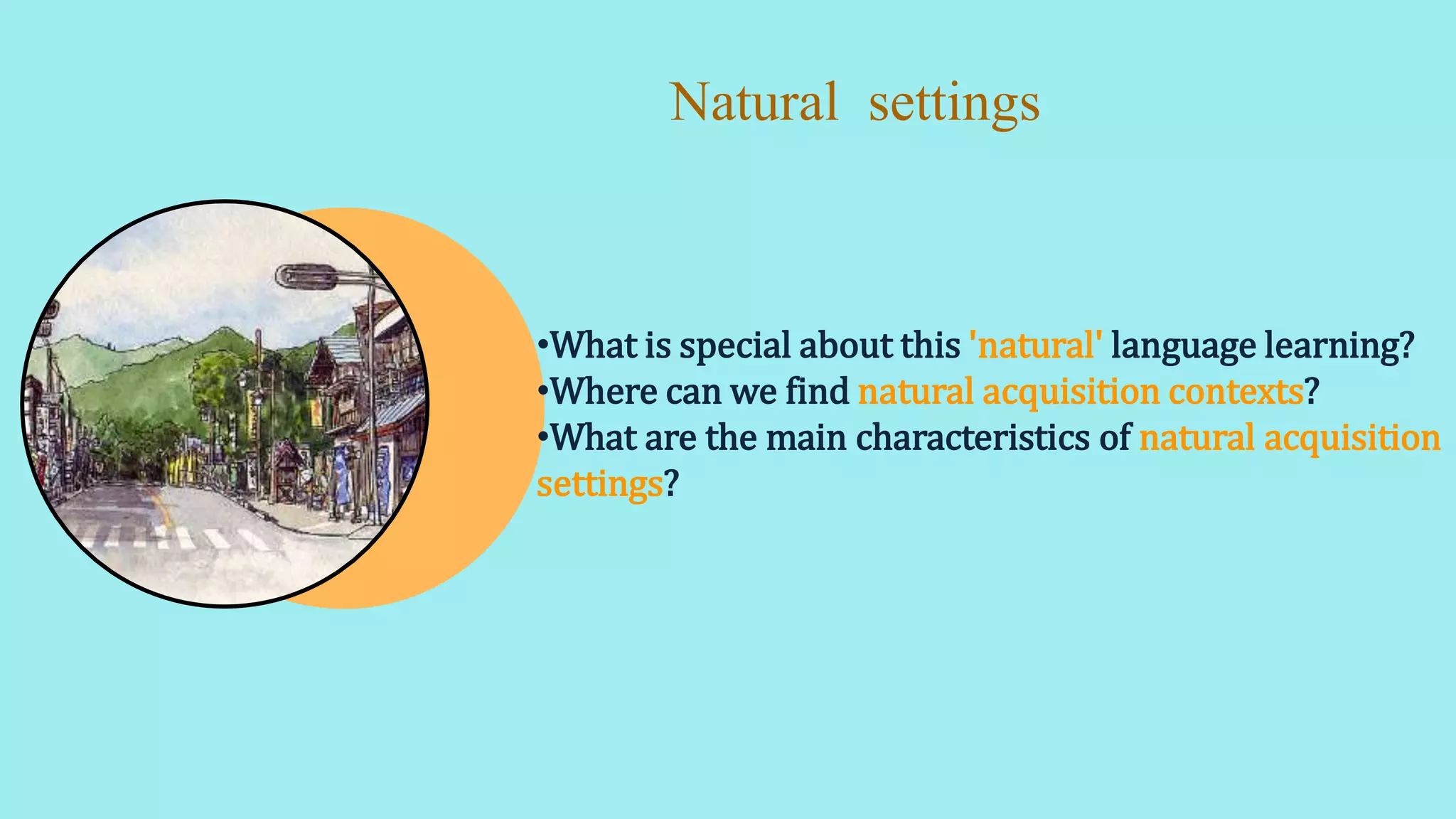
•What is special about this 'natural' language learning?
•Where can we find natural acquisition contexts?
•What are the main characteristics of natural acquisition
settings?
Natural settings
D
D
Where can we find natural acquisition contexts?
When people learn languages at work, in social interaction or
on the playground, their experiences are often quite different
from those of learners in classrooms .
Natural acquisition settings characteristic
•Learning one thingat atime?
 Language is not presented step by step
 The learner is exposed to a wide variety of vocabulary
and structures.
Natural acquisition settings characteristic
•Frequent feedback on error ?
 Learners' errors are rarely corrected.
 If their interlocutors can understand what they are
saying, they do not remark on errors.
 They would probably feel it is rude to do so.
Natural acquisition settings characteristic
•Ample time for learning ?
The learner is surrounded by the language for many
hours each day.
Sometimes the language is addressed to the learner;
sometimes it is simply overheard.
Natural acquisition settings characteristic
•High ratio of native speakers to learners?
The learner usually encounters a number of people who u
se the target language proficiently.
Natural acquisition settings characteristic
•Variety of language and discourse types?
Older children and adults may encounter the written language i
n the form of notices, newspapers, posters, etc.
Learners observe or participate in many different types of langu
age events such as brief greetings, commercial transactions, exch-ange
s of information, arguments, instructions at school or in the workplace.
Natural acquisition settings characteristic
•Pressure to speak?
Learners must often use their limited second language ability to r
espond to questions or get information.
In these situations, the emphasis is on getting meaning across cl
early, and more proficient speakers tend to be tolerant of errors tha
t do not interfere with meaning.
D
D
Thank you for your listening

OBSERVING LEARNING AND TEACHING IN THE SECOND LANGUAGE CLASSROOM

  • 1.
    Ola AlSilaimi OBSERVING LEARNINGAND TEACHING IN THE SECOND LANGUAGE CLASSROOM
  • 2.
    Introduction A B This belief maybe based on the fact that most successful learners have had exposure to the language outside the classroom. Most people would agree that learning a second language in a non-instructional setting is different from learning in the classroom Most believe that learning 'on the street' is more effective. C
  • 3.
    •What is specialabout this 'natural' language learning? •Where can we find natural acquisition contexts? •What are the main characteristics of natural acquisition settings? Natural settings
  • 4.
    D D Where can wefind natural acquisition contexts? When people learn languages at work, in social interaction or on the playground, their experiences are often quite different from those of learners in classrooms .
  • 5.
    Natural acquisition settingscharacteristic •Learning one thingat atime?  Language is not presented step by step  The learner is exposed to a wide variety of vocabulary and structures.
  • 6.
    Natural acquisition settingscharacteristic •Frequent feedback on error ?  Learners' errors are rarely corrected.  If their interlocutors can understand what they are saying, they do not remark on errors.  They would probably feel it is rude to do so.
  • 7.
    Natural acquisition settingscharacteristic •Ample time for learning ? The learner is surrounded by the language for many hours each day. Sometimes the language is addressed to the learner; sometimes it is simply overheard.
  • 8.
    Natural acquisition settingscharacteristic •High ratio of native speakers to learners? The learner usually encounters a number of people who u se the target language proficiently.
  • 9.
    Natural acquisition settingscharacteristic •Variety of language and discourse types? Older children and adults may encounter the written language i n the form of notices, newspapers, posters, etc. Learners observe or participate in many different types of langu age events such as brief greetings, commercial transactions, exch-ange s of information, arguments, instructions at school or in the workplace.
  • 10.
    Natural acquisition settingscharacteristic •Pressure to speak? Learners must often use their limited second language ability to r espond to questions or get information. In these situations, the emphasis is on getting meaning across cl early, and more proficient speakers tend to be tolerant of errors tha t do not interfere with meaning.
  • 11.
    D D Thank you foryour listening