(Ebook) The Rust Programming Language, Second
Edition by Steve Klabnik, Carol Nichols download
https://ebooknice.com/product/the-rust-programming-language-
second-edition-48000090
Download more ebook instantly today at https://ebooknice.com
Instant digital products (PDF, ePub, MOBI) ready for you
Download now and discover formats that fit your needs...
Start reading on any device today!
(Ebook) The Rust Programming Language, 2nd Edition by Steve Klabnik, Carol Nichols
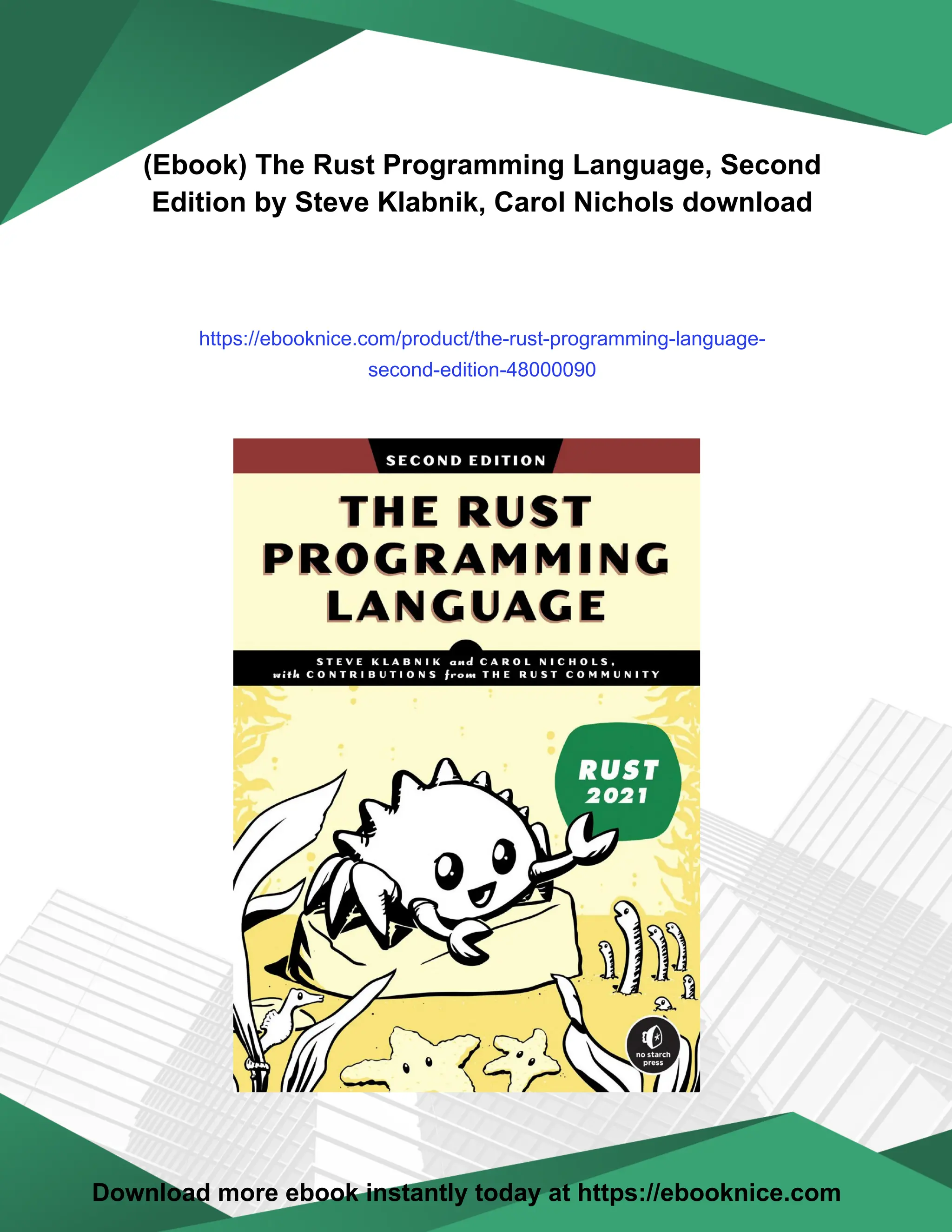
ISBN 9781718503106, 1718503105
https://ebooknice.com/product/the-rust-programming-language-2nd-edition-55957794
ebooknice.com
(Ebook) The Rust Programming Language (Covers Rust 2018) by Steve Klabnik, Carol
Nichols ISBN 9781718500440, 1718500440
https://ebooknice.com/product/the-rust-programming-language-covers-
rust-2018-10473150
ebooknice.com
(Ebook) The Rust Programming Language by Steve Klabnik and Carol Nichols, with
Contributions from the Rust Community
https://ebooknice.com/product/the-rust-programming-language-23358030
ebooknice.com
(Ebook) The Rust Programming Language by Steve Klabnik, Carol Nichols, Rust
Community ISBN 9781593278519, 9781593278281, 1593278519, 1593278284
https://ebooknice.com/product/the-rust-programming-language-9949670
ebooknice.com
(Ebook) The Rust Programming Language by Steve Klabnik; Carol Nichols ISBN
9781593278519, 9781098156817, 9781718503106, 9781718503113, 1593278519, 1098156811,
1718503105, 1718503113
https://ebooknice.com/product/the-rust-programming-language-47528008
ebooknice.com
(Ebook) The Rust Programming Language, 2nd Edition by Steve Klabnik; Carol Nichols
ISBN 9781593278519, 9781718503106, 9781718503113, 9781593278281, 1593278519,
1718503105, 1718503113, 1593278284, 2018014097
https://ebooknice.com/product/the-rust-programming-language-2nd-edition-48950778
ebooknice.com
(Ebook) Rust ■■■■■■ ■■■■■ by Steve Klabnik■Carol Nichols■Rust ■■■■■
https://ebooknice.com/product/rust-36777322
ebooknice.com
(Ebook) Biota Grow 2C gather 2C cook by Loucas, Jason; Viles, James ISBN
9781459699816, 9781743365571, 9781925268492, 1459699815, 1743365578, 1925268497
https://ebooknice.com/product/biota-grow-2c-gather-2c-cook-6661374
ebooknice.com
(Ebook) Black Hat Rust: Applied offensive security with the Rust programming
language by Sylvain Kerkour
https://ebooknice.com/product/black-hat-rust-applied-offensive-security-with-
the-rust-programming-language-47198582
ebooknice.com
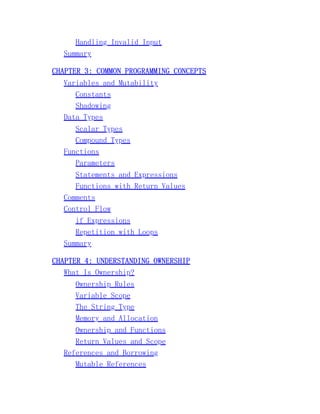
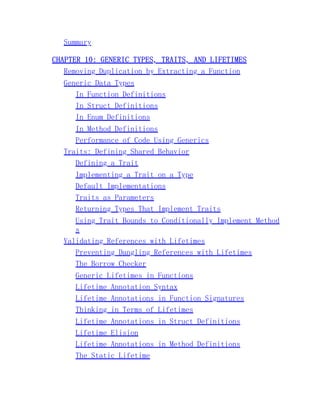
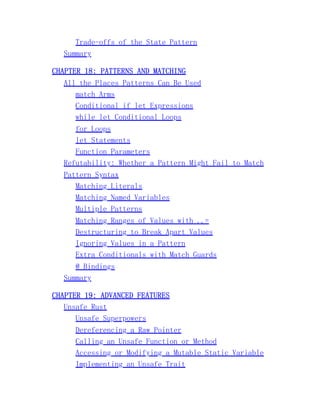
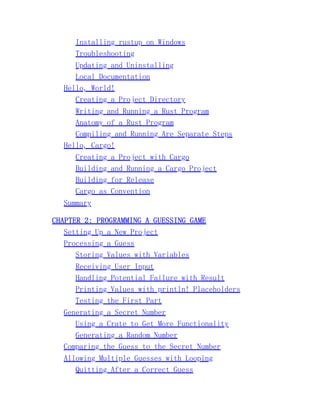
CONTENTS IN DETAIL
TITLE PAGE
COPYRIGHT
ABOUT THE AUTHORS
FOREWORD
PREFACE
ACKNOWLEDGMENTS
INTRODUCTION
Who Rust Is For
Teams of Developers
Students
Companies
Open Source Developers
People Who Value Speed and Stability
Who This Book Is For
How to Use This Book
Resources and How to Contribute to This Book
CHAPTER 1: GETTING STARTED
Installation
Installing rustup on Linux or macOS
Installing rustup on Windows
Troubleshooting
Updating and Uninstalling
Local Documentation
Hello, World!
Creating a Project Directory
Writing and Running a Rust Program
Anatomy of a Rust Program
Compiling and Running Are Separate Steps
Hello, Cargo!
Creating a Project with Cargo
Building and Running a Cargo Project
Building for Release
Cargo as Convention
Summary
CHAPTER 2: PROGRAMMING A GUESSING GAME
Setting Up a New Project
Processing a Guess
Storing Values with Variables
Receiving User Input
Handling Potential Failure with Result
Printing Values with println! Placeholders
Testing the First Part
Generating a Secret Number
Using a Crate to Get More Functionality
Generating a Random Number
Comparing the Guess to the Secret Number
Allowing Multiple Guesses with Looping
Quitting After a Correct Guess
Handling Invalid Input
Summary
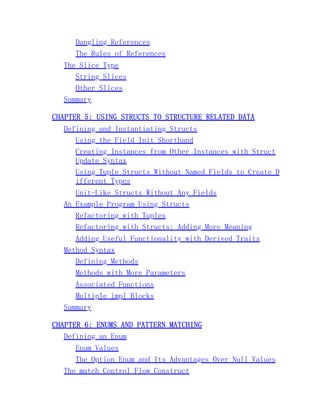
CHAPTER 3: COMMON PROGRAMMING CONCEPTS
Variables and Mutability
Constants
Shadowing
Data Types
Scalar Types
Compound Types
Functions
Parameters
Statements and Expressions
Functions with Return Values
Comments
Control Flow
if Expressions
Repetition with Loops
Summary
CHAPTER 4: UNDERSTANDING OWNERSHIP
What Is Ownership?
Ownership Rules
Variable Scope
The String Type
Memory and Allocation
Ownership and Functions
Return Values and Scope
References and Borrowing
Mutable References
Dangling References
The Rules of References
The Slice Type
String Slices
Other Slices
Summary
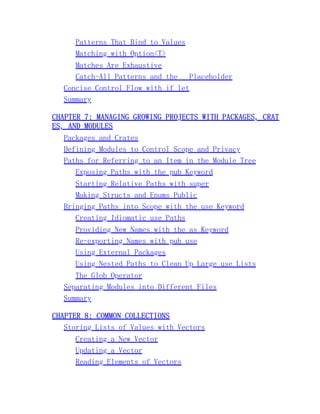
CHAPTER 5: USING STRUCTS TO STRUCTURE RELATED DATA
Defining and Instantiating Structs
Using the Field Init Shorthand
Creating Instances from Other Instances with Struct
Update Syntax
Using Tuple Structs Without Named Fields to Create D
ifferent Types
Unit-Like Structs Without Any Fields
An Example Program Using Structs
Refactoring with Tuples
Refactoring with Structs: Adding More Meaning
Adding Useful Functionality with Derived Traits
Method Syntax
Defining Methods
Methods with More Parameters
Associated Functions
Multiple impl Blocks
Summary
CHAPTER 6: ENUMS AND PATTERN MATCHING
Defining an Enum
Enum Values
The Option Enum and Its Advantages Over Null Values
The match Control Flow Construct
Patterns That Bind to Values
Matching with Option<T>
Matches Are Exhaustive
Catch-All Patterns and the _ Placeholder
Concise Control Flow with if let
Summary
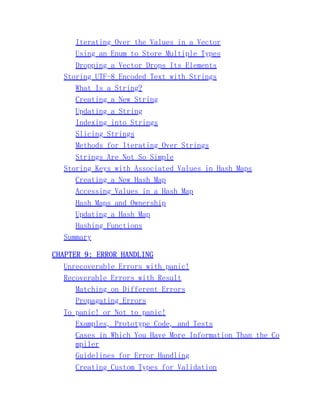
CHAPTER 7: MANAGING GROWING PROJECTS WITH PACKAGES, CRAT
ES, AND MODULES
Packages and Crates
Defining Modules to Control Scope and Privacy
Paths for Referring to an Item in the Module Tree
Exposing Paths with the pub Keyword
Starting Relative Paths with super
Making Structs and Enums Public
Bringing Paths into Scope with the use Keyword
Creating Idiomatic use Paths
Providing New Names with the as Keyword
Re-exporting Names with pub use
Using External Packages
Using Nested Paths to Clean Up Large use Lists
The Glob Operator
Separating Modules into Different Files
Summary
CHAPTER 8: COMMON COLLECTIONS
Storing Lists of Values with Vectors
Creating a New Vector
Updating a Vector
Reading Elements of Vectors
Iterating Over the Values in a Vector
Using an Enum to Store Multiple Types
Dropping a Vector Drops Its Elements
Storing UTF-8 Encoded Text with Strings
What Is a String?
Creating a New String
Updating a String
Indexing into Strings
Slicing Strings
Methods for Iterating Over Strings
Strings Are Not So Simple
Storing Keys with Associated Values in Hash Maps
Creating a New Hash Map
Accessing Values in a Hash Map
Hash Maps and Ownership
Updating a Hash Map
Hashing Functions
Summary
CHAPTER 9: ERROR HANDLING
Unrecoverable Errors with panic!
Recoverable Errors with Result
Matching on Different Errors
Propagating Errors
To panic! or Not to panic!
Examples, Prototype Code, and Tests
Cases in Which You Have More Information Than the Co
mpiler
Guidelines for Error Handling
Creating Custom Types for Validation
Summary
CHAPTER 10: GENERIC TYPES, TRAITS, AND LIFETIMES
Removing Duplication by Extracting a Function
Generic Data Types
In Function Definitions
In Struct Definitions
In Enum Definitions
In Method Definitions
Performance of Code Using Generics
Traits: Defining Shared Behavior
Defining a Trait
Implementing a Trait on a Type
Default Implementations
Traits as Parameters
Returning Types That Implement Traits
Using Trait Bounds to Conditionally Implement Method
s
Validating References with Lifetimes
Preventing Dangling References with Lifetimes
The Borrow Checker
Generic Lifetimes in Functions
Lifetime Annotation Syntax
Lifetime Annotations in Function Signatures
Thinking in Terms of Lifetimes
Lifetime Annotations in Struct Definitions
Lifetime Elision
Lifetime Annotations in Method Definitions
The Static Lifetime
Generic Type Parameters, Trait Bounds, and Lifetimes To
gether
Summary
CHAPTER 11: WRITING AUTOMATED TESTS
How to Write Tests
The Anatomy of a Test Function
Checking Results with the assert! Macro
Testing Equality with the assert_eq! and assert_ne!
Macros
Adding Custom Failure Messages
Checking for Panics with should_panic
Using Result<T, E> in Tests
Controlling How Tests Are Run
Running Tests in Parallel or Consecutively
Showing Function Output
Running a Subset of Tests by Name
Ignoring Some Tests Unless Specifically Requested
Test Organization
Unit Tests
Integration Tests
Summary
CHAPTER 12: AN I/O PROJECT: BUILDING A COMMAND LINE PROG
RAM
Accepting Command Line Arguments
Reading the Argument Values
Saving the Argument Values in Variables
Reading a File
Refactoring to Improve Modularity and Error Handling
Separation of Concerns for Binary Projects
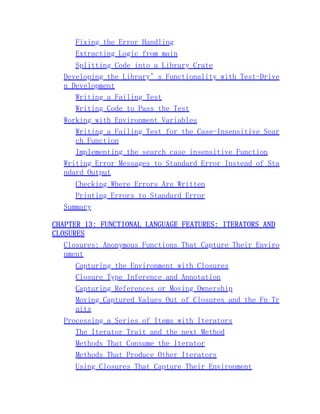
Fixing the Error Handling
Extracting Logic from main
Splitting Code into a Library Crate
Developing the Library’s Functionality with Test-Drive
n Development
Writing a Failing Test
Writing Code to Pass the Test
Working with Environment Variables
Writing a Failing Test for the Case-Insensitive Sear
ch Function
Implementing the search_case_insensitive Function
Writing Error Messages to Standard Error Instead of Sta
ndard Output
Checking Where Errors Are Written
Printing Errors to Standard Error
Summary
CHAPTER 13: FUNCTIONAL LANGUAGE FEATURES: ITERATORS AND
CLOSURES
Closures: Anonymous Functions That Capture Their Enviro
nment
Capturing the Environment with Closures
Closure Type Inference and Annotation
Capturing References or Moving Ownership
Moving Captured Values Out of Closures and the Fn Tr
aits
Processing a Series of Items with Iterators
The Iterator Trait and the next Method
Methods That Consume the Iterator
Methods That Produce Other Iterators
Using Closures That Capture Their Environment
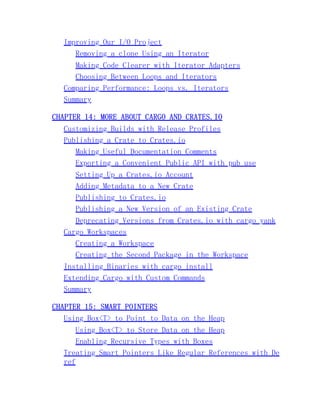
Improving Our I/O Project
Removing a clone Using an Iterator
Making Code Clearer with Iterator Adapters
Choosing Between Loops and Iterators
Comparing Performance: Loops vs. Iterators
Summary
CHAPTER 14: MORE ABOUT CARGO AND CRATES.IO
Customizing Builds with Release Profiles
Publishing a Crate to Crates.io
Making Useful Documentation Comments
Exporting a Convenient Public API with pub use
Setting Up a Crates.io Account
Adding Metadata to a New Crate
Publishing to Crates.io
Publishing a New Version of an Existing Crate
Deprecating Versions from Crates.io with cargo yank
Cargo Workspaces
Creating a Workspace
Creating the Second Package in the Workspace
Installing Binaries with cargo install
Extending Cargo with Custom Commands
Summary
CHAPTER 15: SMART POINTERS
Using Box<T> to Point to Data on the Heap
Using Box<T> to Store Data on the Heap
Enabling Recursive Types with Boxes
Treating Smart Pointers Like Regular References with De
ref
Following the Pointer to the Value
Using Box<T> Like a Reference
Defining Our Own Smart Pointer
Implementing the Deref Trait
Implicit Deref Coercions with Functions and Methods
How Deref Coercion Interacts with Mutability
Running Code on Cleanup with the Drop Trait
Rc<T>, the Reference Counted Smart Pointer
Using Rc<T> to Share Data
Cloning an Rc<T> Increases the Reference Count
RefCell<T> and the Interior Mutability Pattern
Enforcing Borrowing Rules at Runtime with RefCell<T>
Interior Mutability: A Mutable Borrow to an Immutabl
e Value
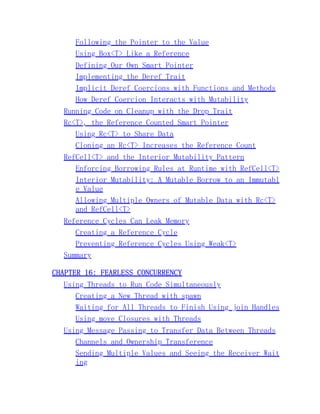
Allowing Multiple Owners of Mutable Data with Rc<T>
and RefCell<T>
Reference Cycles Can Leak Memory
Creating a Reference Cycle
Preventing Reference Cycles Using Weak<T>
Summary
CHAPTER 16: FEARLESS CONCURRENCY
Using Threads to Run Code Simultaneously
Creating a New Thread with spawn
Waiting for All Threads to Finish Using join Handles
Using move Closures with Threads
Using Message Passing to Transfer Data Between Threads
Channels and Ownership Transference
Sending Multiple Values and Seeing the Receiver Wait
ing
Creating Multiple Producers by Cloning the Transmitt
er
Shared-State Concurrency
Using Mutexes to Allow Access to Data from One Threa
d at a Time
Similarities Between RefCell<T>/Rc<T> and Mutex<T>/A
rc<T>
Extensible Concurrency with the Send and Sync Traits
Allowing Transference of Ownership Between Threads w
ith Send
Allowing Access from Multiple Threads with Sync
Implementing Send and Sync Manually Is Unsafe
Summary
CHAPTER 17: OBJECT-ORIENTED PROGRAMMING FEATURES
Characteristics of Object-Oriented Languages
Objects Contain Data and Behavior
Encapsulation That Hides Implementation Details
Inheritance as a Type System and as Code Sharing
Using Trait Objects That Allow for Values of Different
Types
Defining a Trait for Common Behavior
Implementing the Trait
Trait Objects Perform Dynamic Dispatch
Implementing an Object-Oriented Design Pattern
Defining Post and Creating a New Instance in the Dra
ft State
Storing the Text of the Post Content
Ensuring the Content of a Draft Post Is Empty
Requesting a Review Changes the Post’s State
Adding approve to Change the Behavior of content
Trade-offs of the State Pattern
Summary
CHAPTER 18: PATTERNS AND MATCHING
All the Places Patterns Can Be Used
match Arms
Conditional if let Expressions
while let Conditional Loops
for Loops
let Statements
Function Parameters
Refutability: Whether a Pattern Might Fail to Match
Pattern Syntax
Matching Literals
Matching Named Variables
Multiple Patterns
Matching Ranges of Values with ..=
Destructuring to Break Apart Values
Ignoring Values in a Pattern
Extra Conditionals with Match Guards
@ Bindings
Summary
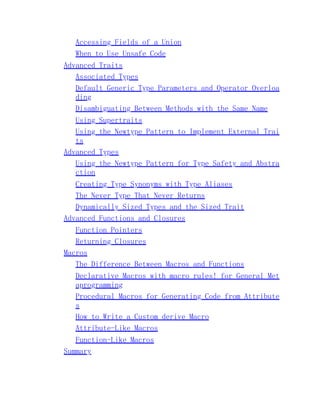
CHAPTER 19: ADVANCED FEATURES
Unsafe Rust
Unsafe Superpowers
Dereferencing a Raw Pointer
Calling an Unsafe Function or Method
Accessing or Modifying a Mutable Static Variable
Implementing an Unsafe Trait
Accessing Fields of a Union
When to Use Unsafe Code
Advanced Traits
Associated Types
Default Generic Type Parameters and Operator Overloa
ding
Disambiguating Between Methods with the Same Name
Using Supertraits
Using the Newtype Pattern to Implement External Trai
ts
Advanced Types
Using the Newtype Pattern for Type Safety and Abstra
ction
Creating Type Synonyms with Type Aliases
The Never Type That Never Returns
Dynamically Sized Types and the Sized Trait
Advanced Functions and Closures
Function Pointers
Returning Closures
Macros
The Difference Between Macros and Functions
Declarative Macros with macro_rules! for General Met
aprogramming
Procedural Macros for Generating Code from Attribute
s
How to Write a Custom derive Macro
Attribute-Like Macros
Function-Like Macros
Summary
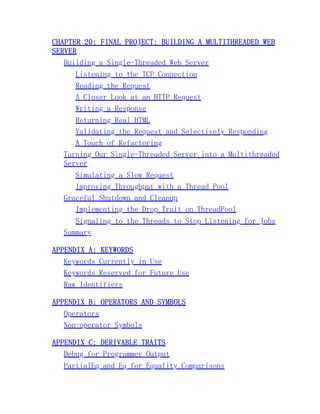
CHAPTER 20: FINAL PROJECT: BUILDING A MULTITHREADED WEB
SERVER
Building a Single-Threaded Web Server
Listening to the TCP Connection
Reading the Request
A Closer Look at an HTTP Request
Writing a Response
Returning Real HTML
Validating the Request and Selectively Responding
A Touch of Refactoring
Turning Our Single-Threaded Server into a Multithreaded
Server
Simulating a Slow Request
Improving Throughput with a Thread Pool
Graceful Shutdown and Cleanup
Implementing the Drop Trait on ThreadPool
Signaling to the Threads to Stop Listening for Jobs
Summary
APPENDIX A: KEYWORDS
Keywords Currently in Use
Keywords Reserved for Future Use
Raw Identifiers
APPENDIX B: OPERATORS AND SYMBOLS
Operators
Non-operator Symbols
APPENDIX C: DERIVABLE TRAITS
Debug for Programmer Output
PartialEq and Eq for Equality Comparisons
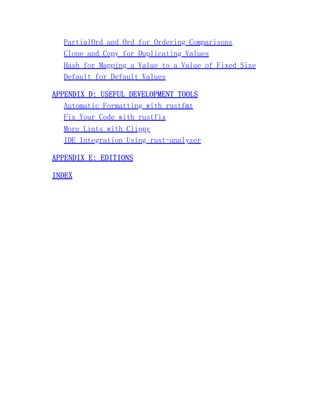
PartialOrd and Ord for Ordering Comparisons
Clone and Copy for Duplicating Values
Hash for Mapping a Value to a Value of Fixed Size
Default for Default Values
APPENDIX D: USEFUL DEVELOPMENT TOOLS
Automatic Formatting with rustfmt
Fix Your Code with rustfix
More Lints with Clippy
IDE Integration Using rust-analyzer
APPENDIX E: EDITIONS
INDEX
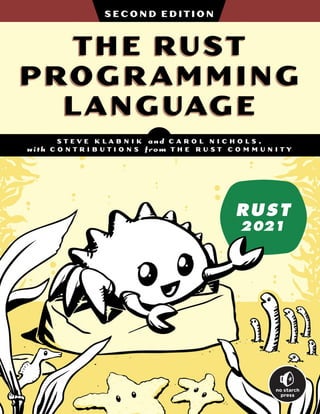
THE RUST PROGRAMMING LANGUAGE
2nd Edition
by Steve Klabnik and Carol Nichols, with
contributions from the Rust Community
THE RUST PROGRAMMING LANGUAGE, 2ND EDITION. Copyright ©
2023 by the Rust Foundation and the Rust Project Developers.
All rights reserved. No part of this work may be reproduced or transmitted in any
form or by any means, electronic or mechanical, including photocopying,
recording, or by any information storage or retrieval system, without the prior
written permission of the copyright owner and the publisher.
Printed in the United States of America
First printing
27 26 25 24 23 1 2 3 4 5
ISBN-13: 978-1-7185-0310-6 (print)
ISBN-13: 978-1-7185-0311-3 (ebook)
Publisher: William Pollock
Managing Editor: Jill Franklin
Production Manager: Sabrina Plomitallo-González
Production Editors: Jennifer Kepler and Katrina Horlbeck Olsen
Developmental Editor: Liz Chadwick
Cover Illustration: Karen Rustad Tölva
Interior Design: Octopod Studios
Technical Reviewer: JT
Copyeditor: Audrey Doyle
Compositor: Jeff Lytle, Happenstance Type-O-Rama
Proofreader: Liz Wheeler
For information on distribution, bulk sales, corporate sales, or translations, please
contact No Starch Press, Inc. directly at info@nostarch.com or:
No Starch Press, Inc.
245 8th Street, San Francisco, CA 94103
phone: 1.415.863.9900
www.nostarch.com
The Library of Congress has catalogued the first edition as follows:
Names: Klabnik, Steve, author. | Nichols, Carol, 1983- eauthor.
Title: The Rust programming language / by Steve Klabnik and Carol Nichols ; with
contributions from
the Rust Community.
Description: San Francisco : No Starch Press, Inc., 2018. | Includes index.
Identifiers: LCCN
2018014097 (print) | LCCN 2018019844 (ebook) | ISBN 9781593278519 (epub) | ISBN
1593278519 (epub)
| ISBN 9781593278281 (paperback) | ISBN 1593278284 (paperback)
Subjects: LCSH: Rust (Computer programming language) | BISAC: COMPUTERS /
Programming / Open Source.
| COMPUTERS / Programming Languages / General. | COMPUTERS / Programming /
General.
Classification: LCC QA76.73.R87 (ebook) | LCC QA76.73.R87 K53 2018 (print) | DDC
005.13/3--dc23
LC record available at https://lccn.loc.gov/2018014097
No Starch Press and the No Starch Press logo are registered trademarks of No
Starch Press, Inc. Other product and company names mentioned herein may be
the trademarks of their respective owners. Rather than use a trademark symbol
with every occurrence of a trademarked name, we are using the names only in an
editorial fashion and to the benefit of the trademark owner, with no intention of
infringement of the trademark.
The information in this book is distributed on an “As Is” basis, without warranty.
While every precaution has been taken in the preparation of this work, neither the
authors nor No Starch Press, Inc. shall have any liability to any person or entity
with respect to any loss or damage caused or alleged to be caused directly or
indirectly by the information contained in it.
About the Authors
Steve Klabnik was the lead for the Rust documentation team and
was one of Rust’s core developers. A frequent speaker and a prolific
open source contributor, he previously worked on projects such as
Ruby and Ruby on Rails.
Carol Nichols is a member of the Rust Crates.io Team and a former
member of the Rust Core Team. She’s a co-founder of Integer 32,
LLC, the world’s first Rust-focused software consultancy. Nichols has
also organized the Rust Belt Rust Conference.
About the Technical Reviewer
JT is a Rust core team member and the co-creator of the Rust error
message format, Rust Language Server (RLS), and Nushell. They
first started using Rust in 2011, and in 2016 joined Mozilla to work
on Rust full-time, helping to shape its direction for widespread use.
These days, they are a freelance Rust trainer and advocate for safe
systems programming.
FOREWORD
It wasn’t always so clear, but the Rust programming language is
fundamentally about empowerment: no matter what kind of code
you are writing now, Rust empowers you to reach further, to
program with confidence in a wider variety of domains than you did
before.
Take, for example, “systems-level” work that deals with low-level
details of memory management, data representation, and
concurrency. Traditionally, this realm of programming is seen as
arcane, accessible to only a select few who have devoted the
necessary years to learning it to avoid its infamous pitfalls. And even
those who practice it do so with caution, lest their code be open to
exploits, crashes, or corruption.
Rust breaks down these barriers by eliminating the old pitfalls and
providing a friendly, polished set of tools to help you along the way.
Programmers who need to “dip down” into lower-level control can do
so with Rust, without taking on the customary risk of crashes or
security holes and without having to learn the fine points of a fickle
toolchain. Better yet, the language is designed to guide you naturally
toward reliable code that is efficient in terms of speed and memory
usage.
Programmers who are already working with low-level code can use
Rust to raise their ambitions. For example, introducing parallelism
in Rust is a relatively low-risk operation: the compiler will catch the
classical mistakes for you. And you can tackle more aggressive
optimizations in your code with the confidence that you won’t
accidentally introduce crashes or vulnerabilities.
But Rust isn’t limited to low-level systems programming. It’s
expressive and ergonomic enough to make CLI apps, web servers,
and many other kinds of code quite pleasant to write—you’ll find
simple examples later in the book. Working with Rust allows you to
build skills that transfer from one domain to another; you can learn
Rust by writing a web app, then apply those same skills to target your
Raspberry Pi.
This book fully embraces the potential of Rust to empower its
users. It’s a friendly and approachable text intended to help you level
up not just your knowledge of Rust, but also your reach and
confidence as a programmer in general. So dive in, get ready to learn
—and welcome to the Rust community!
Nicholas Matsakis and Aaron Turon
PREFACE
This version of the text assumes you’re using Rust 1.62.0 (released
2022-06-30) or later with edition="2021" in the Cargo.toml file of all
projects to configure them to use Rust 2021 edition idioms. See
“Installation” on page 1 for instructions on installing or updating
Rust, and see Appendix E for information on editions.
The 2021 edition of the Rust language includes a number of
improvements that make Rust more ergonomic and that correct
some inconsistencies. On top of a general update to reflect these
improvements, this rendition of the book has a number of
improvements to address specific feedback:
Chapter 7 contains a new quick reference section on organizing
your code into multiple files with modules.
Chapter 13 has new and improved closure examples that more
clearly illustrate captures, the move keyword, and the Fn traits.
We fixed a number of small errors and imprecise wording
throughout the book. Thank you to the readers who reported
them!
Note that any code from earlier renditions of this book that
compiled will continue to compile with the relevant edition in the
project’s Cargo.toml, even as you update the Rust compiler version
you’re using. That’s Rust’s backward-compatibility guarantees at
work!
ACKNOWLEDGMENTS
We would like to thank everyone who has worked on the Rust
language for creating an amazing language worth writing a book
about. We’re grateful to everyone in the Rust community for being
welcoming and creating an environment worth welcoming more
folks into.
We’re especially thankful for everyone who read early versions of
this book online and provided feedback, bug reports, and pull
requests. Special thanks to Eduard-Mihai Burtescu, Alex Crichton,
and JT for providing technical review, and to Karen Rustad Tölva for
the cover art. Thank you to our team at No Starch, including Bill
Pollock, Liz Chadwick, and Janelle Ludowise, for improving this
book and bringing it to print.
Carol is grateful for the opportunity to work on this book. She
thanks her family for their constant love and support, especially her
husband, Jake Goulding, and her daughter, Vivian.
INTRODUCTION
Welcome to The Rust Programming
Language, an introductory book about
Rust. The Rust programming language
helps you write faster, more reliable
software. High-level ergonomics and low-level
control are often at odds in programming language
design; Rust challenges that conflict. Through
balancing powerful technical capacity and a great
developer experience, Rust gives you the option to
control low-level details (such as memory usage)
without all the hassle traditionally associated with
such control.
Who Rust Is For
Rust is ideal for many people for a variety of reasons. Let’s look at a
few of the most important groups.
Teams of Developers
Rust is proving to be a productive tool for collaborating among large
teams of developers with varying levels of systems programming
knowledge. Low-level code is prone to various subtle bugs, which in
most other languages can only be caught through extensive testing
and careful code review by experienced developers. In Rust, the
compiler plays a gatekeeper role by refusing to compile code with
these elusive bugs, including concurrency bugs. By working
alongside the compiler, the team can spend their time focusing on
the program’s logic rather than chasing down bugs.
Rust also brings contemporary developer tools to the systems
programming world:
Cargo, the included dependency manager and build tool, makes
adding, compiling, and managing dependencies painless and
consistent across the Rust ecosystem.
The rustfmt formatting tool ensures a consistent coding style
across developers.
The Rust Language Server powers integrated development
environment (IDE) integration for code completion and inline
error messages.
By using these and other tools in the Rust ecosystem, developers
can be productive while writing systems-level code.
Students
Rust is for students and those who are interested in learning about
systems concepts. Using Rust, many people have learned about
topics like operating systems development. The community is very
welcoming and happy to answer students’ questions. Through efforts
such as this book, the Rust teams want to make systems concepts
more accessible to more people, especially those new to
programming.
Companies
Hundreds of companies, large and small, use Rust in production for
a variety of tasks, including command line tools, web services,
DevOps tooling, embedded devices, audio and video analysis and
transcoding, cryptocurrencies, bioinformatics, search engines,
Internet of Things applications, machine learning, and even major
parts of the Firefox web browser.
Open Source Developers
Rust is for people who want to build the Rust programming
language, community, developer tools, and libraries. We’d love to
have you contribute to the Rust language.
People Who Value Speed and Stability
Rust is for people who crave speed and stability in a language. By
speed, we mean both how quickly Rust code can run and the speed at
which Rust lets you write programs. The Rust compiler’s checks
ensure stability through feature additions and refactoring. This is in
contrast to the brittle legacy code in languages without these checks,
which developers are often afraid to modify. By striving for zero-cost
abstractions—higher-level features that compile to lower-level code
as fast as code written manually—Rust endeavors to make safe code
be fast code as well.
The Rust language hopes to support many other users as well;
those mentioned here are merely some of the biggest stakeholders.
Overall, Rust’s greatest ambition is to eliminate the trade-offs that
programmers have accepted for decades by providing safety and
productivity, speed and ergonomics. Give Rust a try and see if its
choices work for you.
Who This Book Is For
This book assumes that you’ve written code in another programming
language, but doesn’t make any assumptions about which one. We’ve
tried to make the material broadly accessible to those from a wide
variety of programming backgrounds. We don’t spend a lot of time
talking about what programming is or how to think about it. If you’re
entirely new to programming, you would be better served by reading
a book that specifically provides an introduction to programming.
How to Use This Book
In general, this book assumes that you’re reading it in sequence from
front to back. Later chapters build on concepts in earlier chapters,
and earlier chapters might not delve into details on a particular topic
but will revisit the topic in a later chapter.
You’ll find two kinds of chapters in this book: concept chapters
and project chapters. In concept chapters, you’ll learn about an
aspect of Rust. In project chapters, we’ll build small programs
together, applying what you’ve learned so far. Chapter 2, Chapter 12,
and Chapter 20 are project chapters; the rest are concept chapters.
Chapter 1 explains how to install Rust, how to write a “Hello,
world!” program, and how to use Cargo, Rust’s package manager and
build tool. Chapter 2 is a hands-on introduction to writing a
program in Rust, having you build up a number-guessing game.
Here, we cover concepts at a high level, and later chapters will
provide additional detail. If you want to get your hands dirty right
away, Chapter 2 is the place for that. Chapter 3 covers Rust features
that are similar to those of other programming languages, and in
Chapter 4 you’ll learn about Rust’s ownership system. If you’re a
particularly meticulous learner who prefers to learn every detail
before moving on to the next, you might want to skip Chapter 2 and
go straight to Chapter 3, returning to Chapter 2 when you’d like to
work on a project applying the details you’ve learned.
Chapter 5 discusses structs and methods, and Chapter 6 covers
enums, match expressions, and the if let control flow construct. You’ll
use structs and enums to make custom types in Rust.
In Chapter 7, you’ll learn about Rust’s module system and about
privacy rules for organizing your code and its public application
programming interface (API). Chapter 8 discusses some common
collection data structures that the standard library provides, such as
vectors, strings, and hash maps. Chapter 9 explores Rust’s error-
handling philosophy and techniques.
Chapter 10 digs into generics, traits, and lifetimes, which give
you the power to define code that applies to multiple types. Chapter
11 is all about testing, which even with Rust’s safety guarantees is
necessary to ensure your program’s logic is correct. In Chapter 12,
we’ll build our own implementation of a subset of functionality from
the grep command line tool that searches for text within files. For
this, we’ll use many of the concepts we discussed in the previous
chapters.
Chapter 13 explores closures and iterators: features of Rust that
come from functional programming languages. In Chapter 14, we’ll
examine Cargo in more depth and talk about best practices for
sharing your libraries with others. Chapter 15 discusses smart
pointers that the standard library provides and the traits that enable
their functionality.
In Chapter 16, we’ll walk through different models of concurrent
programming and talk about how Rust helps you program in
multiple threads fearlessly. Chapter 17 looks at how Rust idioms
compare to object-oriented programming principles you might be
familiar with.
Chapter 18 is a reference on patterns and pattern matching,
which are powerful ways of expressing ideas throughout Rust
programs. Chapter 19 contains a smorgasbord of advanced topics
of interest, including unsafe Rust, macros, and more about lifetimes,
traits, types, functions, and closures.
In Chapter 20, we’ll complete a project in which we’ll implement
a low-level multithreaded web server!
Finally, some appendixes contain useful information about the
language in a more reference-like format. Appendix A covers Rust’s
keywords, Appendix B covers Rust’s operators and symbols,
Appendix C covers derivable traits provided by the standard
library, Appendix D covers some useful development tools, and
Appendix E explains Rust editions.
There is no wrong way to read this book: if you want to skip ahead,
go for it! You might have to jump back to earlier chapters if you
experience any confusion. But do whatever works for you.
An important part of the process of learning Rust is learning how
to read the error messages the compiler displays: these will guide you
toward working code. As such, we’ll provide many examples that
don’t compile along with the error message the compiler will show
you in each situation. Know that if you enter and run a random
example, it may not compile! Make sure you read the surrounding
text to see whether the example you’re trying to run is meant to
error. In most situations, we’ll lead you to the correct version of any
code that doesn’t compile.
Resources and How to Contribute to This Book
This book is open source. If you find an error, please don’t hesitate to
file an issue or send a pull request on GitHub at https://github.com/
rust-lang/book. Please see CONTRIBUTING.md at https://github.c
om/rust-lang/book/blob/main/CONTRIBUTING.md for more
details.
The source code for the examples in this book, errata, and other
information are available at https://nostarch.com/rust-programmi
ng-language-2nd-edition.
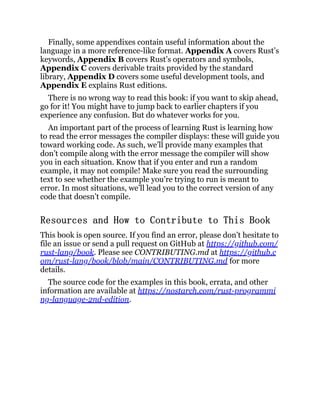
1
GETTING STARTED
Let’s start your Rust journey! There’s a
lot to learn, but every journey starts
somewhere. In this chapter, we’ll
discuss:
Installing Rust on Linux, macOS, and Windows
Writing a program that prints Hello, world!
Using cargo, Rust’s package manager and build system
Installation
The first step is to install Rust. We’ll download Rust through rustup, a
command line tool for managing Rust versions and associated tools.
You’ll need an internet connection for the download.
NOTE
If you prefer not to use rustup for some reason, please see the
Other Rust Installation Methods page at https://forge.rust-l
ang.org/infra/other-installation-methods.html for more
options.
The following steps install the latest stable version of the Rust
compiler. Rust’s stability guarantees ensure that all the examples in
the book that compile will continue to compile with newer Rust
versions. The output might differ slightly between versions because
Rust often improves error messages and warnings. In other words,
any newer, stable version of Rust you install using these steps should
work as expected with the content of this book.
COMMAND LINE NOTATION
In this chapter and throughout the book, we’ll show some
commands used in the terminal. Lines that you should enter in a
terminal all start with $. You don’t need to type the $
character; it’s the command line prompt shown to indicate the
start of each command. Lines that don’t start with $ typically
show the output of the previous command. Additionally,
PowerShell-specific examples will use > rather than $.
Installing rustup on Linux or macOS
If you’re using Linux or macOS, open a terminal and enter the
following command:
$ curl --proto '=https' --tlsv1.3 https://sh.rustup.rs -sSf | sh
The command downloads a script and starts the installation of the
rustup tool, which installs the latest stable version of Rust. You might
be prompted for your password. If the install is successful, the
following line will appear:
Rust is installed now. Great!
You will also need a linker, which is a program that Rust uses to
join its compiled outputs into one file. It is likely you already have
one. If you get linker errors, you should install a C compiler, which
will typically include a linker. A C compiler is also useful because
some common Rust packages depend on C code and will need a C
compiler.
On macOS, you can get a C compiler by running:
$ xcode-select --install
Linux users should generally install GCC or Clang, according to
their distribution’s documentation. For example, if you use Ubuntu,
you can install the build-essential package.
Installing rustup on Windows
On Windows, go to https://www.rust-lang.org/tools/install and
follow the instructions for installing Rust. At some point in the
installation, you’ll receive a message explaining that you’ll also need
the MSVC build tools for Visual Studio 2013 or later.
To acquire the build tools, you’ll need to install Visual Studio 2022
from https://visualstudio.microsoft.com/downloads. When asked
which workloads to install, include:
“Desktop Development with C++”
The Windows 10 or 11 SDK
The English language pack component, along with any other
language pack of your choosing
The rest of this book uses commands that work in both cmd.exe
and PowerShell. If there are specific differences, we’ll explain which
to use.
Troubleshooting
To check whether you have Rust installed correctly, open a shell and
enter this line:
$ rustc --version
You should see the version number, commit hash, and commit
date for the latest stable version that has been released, in the
following format:
rustc x.y.z (abcabcabc yyyy-mm-dd)
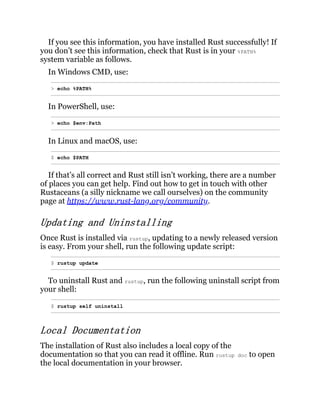
If you see this information, you have installed Rust successfully! If
you don’t see this information, check that Rust is in your %PATH%
system variable as follows.
In Windows CMD, use:
> echo %PATH%
In PowerShell, use:
> echo $env:Path
In Linux and macOS, use:
$ echo $PATH
If that’s all correct and Rust still isn’t working, there are a number
of places you can get help. Find out how to get in touch with other
Rustaceans (a silly nickname we call ourselves) on the community
page at https://www.rust-lang.org/community.
Updating and Uninstalling
Once Rust is installed via rustup, updating to a newly released version
is easy. From your shell, run the following update script:
$ rustup update
To uninstall Rust and rustup, run the following uninstall script from
your shell:
$ rustup self uninstall
Local Documentation
The installation of Rust also includes a local copy of the
documentation so that you can read it offline. Run rustup doc to open
the local documentation in your browser.
Any time a type or function is provided by the standard library and
you’re not sure what it does or how to use it, use the application
programming interface (API) documentation to find out!
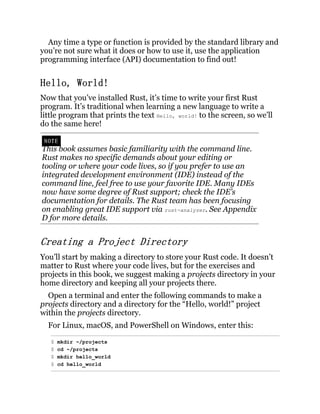
Hello, World!
Now that you’ve installed Rust, it’s time to write your first Rust
program. It’s traditional when learning a new language to write a
little program that prints the text Hello, world! to the screen, so we’ll
do the same here!
NOTE
This book assumes basic familiarity with the command line.
Rust makes no specific demands about your editing or
tooling or where your code lives, so if you prefer to use an
integrated development environment (IDE) instead of the
command line, feel free to use your favorite IDE. Many IDEs
now have some degree of Rust support; check the IDE’s
documentation for details. The Rust team has been focusing
on enabling great IDE support via rust-analyzer. See Appendix
D for more details.
Creating a Project Directory
You’ll start by making a directory to store your Rust code. It doesn’t
matter to Rust where your code lives, but for the exercises and
projects in this book, we suggest making a projects directory in your
home directory and keeping all your projects there.
Open a terminal and enter the following commands to make a
projects directory and a directory for the “Hello, world!” project
within the projects directory.
For Linux, macOS, and PowerShell on Windows, enter this:
$ mkdir ~/projects
$ cd ~/projects
$ mkdir hello_world
$ cd hello_world
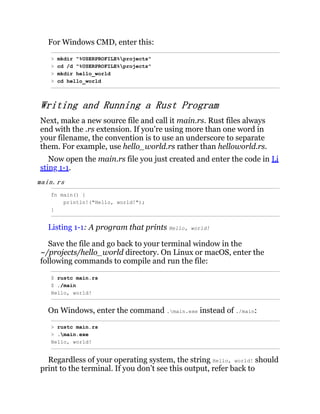
For Windows CMD, enter this:
> mkdir "%USERPROFILE%projects"
> cd /d "%USERPROFILE%projects"
> mkdir hello_world
> cd hello_world
Writing and Running a Rust Program
Next, make a new source file and call it main.rs. Rust files always
end with the .rs extension. If you’re using more than one word in
your filename, the convention is to use an underscore to separate
them. For example, use hello_world.rs rather than helloworld.rs.
Now open the main.rs file you just created and enter the code in Li
sting 1-1.
main.rs
fn main() {
println!("Hello, world!");
}
Listing 1-1: A program that prints Hello, world!
Save the file and go back to your terminal window in the
~/projects/hello_world directory. On Linux or macOS, enter the
following commands to compile and run the file:
$ rustc main.rs
$ ./main
Hello, world!
On Windows, enter the command .main.exe instead of ./main:
> rustc main.rs
> .main.exe
Hello, world!
Regardless of your operating system, the string Hello, world! should
print to the terminal. If you don’t see this output, refer back to
“Troubleshooting” on page 3 for ways to get help.
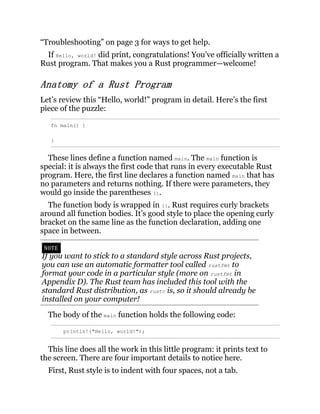
If Hello, world! did print, congratulations! You’ve officially written a
Rust program. That makes you a Rust programmer—welcome!
Anatomy of a Rust Program
Let’s review this “Hello, world!” program in detail. Here’s the first
piece of the puzzle:
fn main() {
}
These lines define a function named main. The main function is
special: it is always the first code that runs in every executable Rust
program. Here, the first line declares a function named main that has
no parameters and returns nothing. If there were parameters, they
would go inside the parentheses ().
The function body is wrapped in {}. Rust requires curly brackets
around all function bodies. It’s good style to place the opening curly
bracket on the same line as the function declaration, adding one
space in between.
NOTE
If you want to stick to a standard style across Rust projects,
you can use an automatic formatter tool called rustfmt to
format your code in a particular style (more on rustfmt in
Appendix D). The Rust team has included this tool with the
standard Rust distribution, as rustc is, so it should already be
installed on your computer!
The body of the main function holds the following code:
println!("Hello, world!");
This line does all the work in this little program: it prints text to
the screen. There are four important details to notice here.
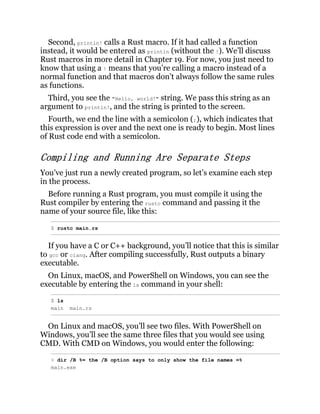
First, Rust style is to indent with four spaces, not a tab.
Second, println! calls a Rust macro. If it had called a function
instead, it would be entered as println (without the !). We’ll discuss
Rust macros in more detail in Chapter 19. For now, you just need to
know that using a ! means that you’re calling a macro instead of a
normal function and that macros don’t always follow the same rules
as functions.
Third, you see the "Hello, world!" string. We pass this string as an
argument to println!, and the string is printed to the screen.
Fourth, we end the line with a semicolon (;), which indicates that
this expression is over and the next one is ready to begin. Most lines
of Rust code end with a semicolon.
Compiling and Running Are Separate Steps
You’ve just run a newly created program, so let’s examine each step
in the process.
Before running a Rust program, you must compile it using the
Rust compiler by entering the rustc command and passing it the
name of your source file, like this:
$ rustc main.rs
If you have a C or C++ background, you’ll notice that this is similar
to gcc or clang. After compiling successfully, Rust outputs a binary
executable.
On Linux, macOS, and PowerShell on Windows, you can see the
executable by entering the ls command in your shell:
$ ls
main main.rs
On Linux and macOS, you’ll see two files. With PowerShell on
Windows, you’ll see the same three files that you would see using
CMD. With CMD on Windows, you would enter the following:
> dir /B %= the /B option says to only show the file names =%
main.exe
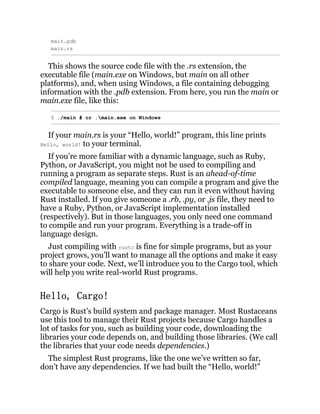
main.pdb
main.rs
This shows the source code file with the .rs extension, the
executable file (main.exe on Windows, but main on all other
platforms), and, when using Windows, a file containing debugging
information with the .pdb extension. From here, you run the main or
main.exe file, like this:
$ ./main # or .main.exe on Windows
If your main.rs is your “Hello, world!” program, this line prints
Hello, world! to your terminal.
If you’re more familiar with a dynamic language, such as Ruby,
Python, or JavaScript, you might not be used to compiling and
running a program as separate steps. Rust is an ahead-of-time
compiled language, meaning you can compile a program and give the
executable to someone else, and they can run it even without having
Rust installed. If you give someone a .rb, .py, or .js file, they need to
have a Ruby, Python, or JavaScript implementation installed
(respectively). But in those languages, you only need one command
to compile and run your program. Everything is a trade-off in
language design.
Just compiling with rustc is fine for simple programs, but as your
project grows, you’ll want to manage all the options and make it easy
to share your code. Next, we’ll introduce you to the Cargo tool, which
will help you write real-world Rust programs.
Hello, Cargo!
Cargo is Rust’s build system and package manager. Most Rustaceans
use this tool to manage their Rust projects because Cargo handles a
lot of tasks for you, such as building your code, downloading the
libraries your code depends on, and building those libraries. (We call
the libraries that your code needs dependencies.)
The simplest Rust programs, like the one we’ve written so far,
don’t have any dependencies. If we had built the “Hello, world!”
project with Cargo, it would only use the part of Cargo that handles
building your code. As you write more complex Rust programs, you’ll
add dependencies, and if you start a project using Cargo, adding
dependencies will be much easier to do.
Because the vast majority of Rust projects use Cargo, the rest of
this book assumes that you’re using Cargo too. Cargo comes installed
with Rust if you used the official installers discussed in “Installation”
on page 1. If you installed Rust through some other means, check
whether Cargo is installed by entering the following in your terminal:
$ cargo --version
If you see a version number, you have it! If you see an error, such
as command not found, look at the documentation for your method of
installation to determine how to install Cargo separately.
Creating a Project with Cargo
Let’s create a new project using Cargo and look at how it differs from
our original “Hello, world!” project. Navigate back to your projects
directory (or wherever you decided to store your code). Then, on any
operating system, run the following:
$ cargo new hello_cargo
$ cd hello_cargo
The first command creates a new directory and project called
hello_cargo. We’ve named our project hello_cargo, and Cargo
creates its files in a directory of the same name.
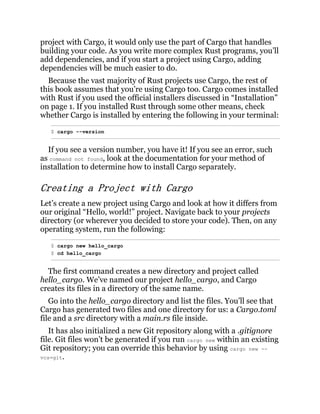
Go into the hello_cargo directory and list the files. You’ll see that
Cargo has generated two files and one directory for us: a Cargo.toml
file and a src directory with a main.rs file inside.
It has also initialized a new Git repository along with a .gitignore
file. Git files won’t be generated if you run cargo new within an existing
Git repository; you can override this behavior by using cargo new --
vcs=git.
NOTE
Git is a common version control system. You can change cargo
new to use a different version control system or no version
control system by using the --vcs flag. Run cargo new --help to
see the available options.
Open Cargo.toml in your text editor of choice. It should look
similar to the code in Listing 1-2.
Cargo.toml
[package]
name = "hello_cargo"
version = "0.1.0"
edition = "2021"
# See more keys and their definitions at https://doc.rust-lang.org/carg
o/reference/manifest.html
[dependencies]
Listing 1-2: Contents of Cargo.toml generated by cargo new
This file is in the TOML (Tom’s Obvious, Minimal Language)
format, which is Cargo’s configuration format.
The first line, [package], is a section heading that indicates that the
following statements are configuring a package. As we add more
information to this file, we’ll add other sections.
The next three lines set the configuration information Cargo needs
to compile your program: the name, the version, and the edition of
Rust to use. We’ll talk about the edition key in Appendix E.
The last line, [dependencies], is the start of a section for you to list
any of your project’s dependencies. In Rust, packages of code are
referred to as crates. We won’t need any other crates for this project,
but we will in the first project in Chapter 2, so we’ll use this
dependencies section then.
Now open src/main.rs and take a look:
src/main.rs
fn main() {
println!("Hello, world!");
}
Cargo has generated a “Hello, world!” program for you, just like
the one we wrote in Listing 1-1! So far, the differences between our
project and the project Cargo generated are that Cargo placed the
code in the src directory and we have a Cargo.toml configuration file
in the top directory.
Cargo expects your source files to live inside the src directory. The
top-level project directory is just for README files, license
information, configuration files, and anything else not related to your
code. Using Cargo helps you organize your projects. There’s a place
for everything, and everything is in its place.
If you started a project that doesn’t use Cargo, as we did with the
“Hello, world!” project, you can convert it to a project that does use
Cargo. Move the project code into the src directory and create an
appropriate Cargo.toml file.
Building and Running a Cargo Project
Now let’s look at what’s different when we build and run the “Hello,
world!” program with Cargo! From your hello_cargo directory, build
your project by entering the following command:
$ cargo build
Compiling hello_cargo v0.1.0 (file:///projects/hello_cargo)
Finished dev [unoptimized + debuginfo] target(s) in 2.85 secs
This command creates an executable file in
target/debug/hello_cargo (or targetdebughello_cargo.exe on
Windows) rather than in your current directory. Because the default
build is a debug build, Cargo puts the binary in a directory named
debug. You can run the executable with this command:
$ ./target/debug/hello_cargo # or .targetdebughello_cargo.exe on Wind
ows
Hello, world!
If all goes well, Hello, world! should print to the terminal. Running
cargo build for the first time also causes Cargo to create a new file at
the top level: Cargo.lock. This file keeps track of the exact versions of
dependencies in your project. This project doesn’t have
dependencies, so the file is a bit sparse. You won’t ever need to
change this file manually; Cargo manages its contents for you.
We just built a project with cargo build and ran it with
./target/debug/hello_cargo, but we can also use cargo run to compile the
code and then run the resultant executable all in one command:
$ cargo run
Finished dev [unoptimized + debuginfo] target(s) in 0.0 secs
Running `target/debug/hello_cargo`
Hello, world!
Using cargo run is more convenient than having to remember to run
cargo build and then use the whole path to the binary, so most
developers use cargo run.
Notice that this time we didn’t see output indicating that Cargo
was compiling hello_cargo. Cargo figured out that the files hadn’t
changed, so it didn’t rebuild but just ran the binary. If you had
modified your source code, Cargo would have rebuilt the project
before running it, and you would have seen this output:
$ cargo run
Compiling hello_cargo v0.1.0 (file:///projects/hello_cargo)
Finished dev [unoptimized + debuginfo] target(s) in 0.33 secs
Running `target/debug/hello_cargo`
Hello, world!
Cargo also provides a command called cargo check. This command
quickly checks your code to make sure it compiles but doesn’t
produce an executable:
$ cargo check
Checking hello_cargo v0.1.0 (file:///projects/hello_cargo)
Finished dev [unoptimized + debuginfo] target(s) in 0.32 secs
Why would you not want an executable? Often, cargo check is much
faster than cargo build because it skips the step of producing an
executable. If you’re continually checking your work while writing
the code, using cargo check will speed up the process of letting you
know if your project is still compiling! As such, many Rustaceans run
cargo check periodically as they write their program to make sure it
compiles. Then they run cargo build when they’re ready to use the
executable.
Let’s recap what we’ve learned so far about Cargo:
We can create a project using cargo new.
We can build a project using cargo build.
We can build and run a project in one step using cargo run.
We can build a project without producing a binary to check for
errors using cargo check.
Instead of saving the result of the build in the same directory as
our code, Cargo stores it in the target/debug directory.
An additional advantage of using Cargo is that the commands are
the same no matter which operating system you’re working on. So, at
this point, we’ll no longer provide specific instructions for Linux and
macOS versus Windows.
Building for Release
When your project is finally ready for release, you can use cargo build
--release to compile it with optimizations. This command will create
an executable in target/release instead of target/debug. The
optimizations make your Rust code run faster, but turning them on
lengthens the time it takes for your program to compile. This is why
there are two different profiles: one for development, when you want
to rebuild quickly and often, and another for building the final
program you’ll give to a user that won’t be rebuilt repeatedly and that
will run as fast as possible. If you’re benchmarking your code’s
running time, be sure to run cargo build --release and benchmark with
the executable in target/release.
Other documents randomly have
different content
道。後來是家兄出主意,叫姓文的吐出來,求上頭保全他的功名。現
在上頭已答應。姓文的銀子,家兄亦業已到手。卻不料已經被他用掉
了九百多兩,歸不得原,上頭堂官跟前就不好交代。倘若為著這九百
多兩銀子弄得姓文的壞官:一來他們令叔面子上不好看;二來家兄騙
他這個九千多銀子出來,原答應他保他無事,現在也不可失信於他。
但是銀子只有九千零幾十兩,堂官不好拿來交還吾兄。愚兄弟有錢的
時候呢,這幾百銀子就替姓文的墊了出來,等他光光臉;只要預先同
老哥說一聲,將來老哥銀子到手之後,把那九百多兩仍舊算還就是
了,連利錢都不要的。大家都是為朋友,有什麼說不明白。無奈愚兄
弟應酬大,錢來不夠用,都弄得前缺後空。一個堂郎中,一個銀庫,
連著九百多銀子都墊不出,說出來人家亦不相信。要不是老哥跟前,
彼此知己,兄弟也不好實說。」唐二亂子道:「笑話!賢昆仲如此出
力,已經當不起,怎麼好再叫賢昆仲帖錢。少掉九百多銀子,兄弟情
願自己吃虧,既不要賢昆仲代認,也決計不要文某人吐出來,一則顧
全福中堂面子,二則我們那裡不拉個朋友。拜求四哥代為稟復貴衙門
的幾位大人,這九百多兩銀子就說我姓唐的情願不要了,務求諸位大
人不必追究此事。」
師四老爺連忙分辯道:「你老哥不在乎這九百多銀子,我們有什麼不
曉得。不過姓文的總得把一萬銀子歸原,由他完完全全交到堂官手
裡,再由堂官完完全全交給老哥,然後大家都有面子,倘若少了一分
一厘,姓文的就不能交代上頭,上頭也不能交還老哥。這是老哥不說
甚麼,勉強收了,終究於敝衙門聲名有礙。現在用了這九百多銀子,
上頭堂官還不曉得是姓文的拉住家兄替他想法子。所以家兄叫小弟過
來代達:不看別的,總看他令叔福中堂分上,由老哥這邊借給他九百
多銀子,等他把一萬之數湊足,交代上頭。好在此款終究是歸老哥
的。將來老哥一同收了回來,彼此不響起。如此辦法,不但成全了姓
文的功名,且顧全了他叔叔福中堂的面子,三則敝衙門也保全聲名不
少。我們敝衙門人沒有一個不感激老哥。至於老哥說甚麼道乏,我們
敝衙門上下已承老哥保全不少,還敢想什麼好處;就是老哥另有賞
賜,家兄及小弟亦決計不敢再領的。」唐二亂子聽了他話,心上盤算
了一回,自言自語道:「面子上叫我拿九百銀子去換九千銀子回來,
而且連那九百也還我,不過他們借去用一用,此事原無不可。但是我
同姓師的才第二回見面,一來人心測摸不定,二來他哥是堂郎中,他
自己又管著銀庫,如此發財的官,連九百多銀子都無處拉攏,這個話
誰能相信。我已一誤再誤,目下不能不格外小心。我與其脫空九百多
銀子,我情願失撇二千銀子:姓文的用掉九百多,總算一千,我不要
他還我;九千當中,我情願再送他昆仲一千道乏。況且這種事情何必
定要煩動堂官,莫妙於大家私下了結。」主意打定,便委宛曲折告訴
了師四老爺。師四老爺也曉得他九百多銀子不肯脫空,然而面子上掉
不過來,便道:「這也怪不得老哥。兄弟同老哥新交,姓文的九千銀
子沒有拿回來,反叫老哥先拿出九百多兩,無論誰不能相信。」唐二
亂子亦忙分辯道:「並不是不相信四哥,為的是大家簡便辦法,省得
堂官知道。」師四老爺道:「這事原是堂上派下來的,怎能夠不稟
復。這事亦是兄弟荒唐,不該應來同老哥商量,先叫老哥墊銀子。現
在不說別的,姓文的用掉的九百多不要他還,兄弟回去同家兄商議,
無論如何為難,總替他想個法兒湊齊這一萬整數,等他在堂官面前交
代過排場。堂官眼前既然老哥不願出面,兄弟同家兄說,將來仍由兄
弟把這一萬銀子的銀票送過來。兄弟也不同老哥客氣,老哥就預備一
張一千銀子的銀票還了兄弟就是了。雖弟雖沾光幾十銀子,拿回去到
堂官跟前替老哥賞賞人也不能少的。至於道乏,萬萬不敢。」
唐二亂子見他說得如此,有何不放心之理,立刻滿口應承。師四老爺
又問:「老哥給姓文的一萬銀子是誰家的票子?」唐二亂子道:「是
恆利家的票子。」師四老爺道:「如此甚好。我們來往的亦是恆利。
明天仍到恆利打張一萬銀子的票子來就是了。」說罷自去。唐二亂子
果然也到恆利划了一張一千銀子的票子,預備第二天換給師四老爺;
另寫了一千,說是人家出了這們一把力,總得道乏的。誰知到了次
日,左等不來,右等不來。唐二亂子心上急的發躁,想:「他說得如
此老靠,斷無不來之理,莫非出了岔子,又有什麼變卦?」左思右
想,反弄得坐立不定。
好容易等到天黑,師四老爺來了。唐二亂子喜得什麼似的,迎了進
來,讓茶讓煙。師四老爺說:「本來早好來了,無奈堂官定要見老哥
一面,反怪老哥許多不是,都是家兄替你抗下來的。現在也不要你去
見了。銀子也拿來,這話也不用提了。為了這件事,兄弟今兒一天沒
有吃飯。」唐二亂子忙說:「我們同去吃館子。」師四老爺道:「兄
弟還有公事,要緊把東西交代了回去,改日再奉擾罷。」唐二亂子一
再挽留,見他不肯,只得罷休。於是師四老爺方在靴頁子裡掏出一大
搭的銀票,從幾萬至幾千,一共約有十幾張,翻來復去,才檢出一張
一萬銀子的票子。剛要遞到唐二亂子手裡,又說:「昨兒說明白要恆
利的票子,這張不是。」於是又收了回去,又在票子當中檢了半天,
檢出一張恆利的一萬票子,交代唐二亂子看過無誤。
唐二亂子見他有許多銀票,心想:「到底內務府的官兒有錢。他昨天
還推頭沒有錢墊,這話哄誰呢。」師四老爺也覺著,連忙自己遮蓋
道:「這都是上頭髮下來給工匠的。兄弟若有這些錢,也早發財了,
不在這裡做官了。」說話之間,唐二亂子也把自己寫好的兩張一千頭
的銀票拿出來交代師四老爺。師四老爺一看是兩張,忙問:「這一千
做什麼用?」唐二亂子道:「令兄大人及四哥公事忙,兄弟連一標酒
都沒有奉請,這個折個干罷。」師四老爺把眉頭一皺,道:「說明白
不要,你老哥一定要費事,叫兄弟怎麼好意思呢。」唐二亂子道:
「這算得什麼!以後叨教之處多著哩。」師四老爺道:「既然老哥說
到這裡,兄弟亦不敢自外,兄弟這裡謝賞了。」說著,一個安請了下
去。請安起來,把銀票收在靴頁子裡,說有要緊公事,匆匆告辭出門
而去。臨走的時候,唐二亂子又頂住問他的住處,預備過天來拜。師
四老爺隨嘴說了一個。
自此唐二亂子得意非凡。過天查三蛋來了,唐二亂子又把這話說給他
聽,面孔上很露出一副得意揚揚之色。查三蛋只是冷笑笑,心上卻也
詫異,說道:「像他這樣的昏蛋,居然也會碰著好人,真正奇怪!」
誰知過了一天出門拜客,趕到師四老爺所說的地方,問來問去,那裡
有姓師的住宅。唐二亂子罵車夫無用。等到回來,又差人到內務府去
打聽堂郎中及銀庫上,那裡有什麼姓師的。唐二亂子這才嚇壞了。連
忙再取出那張一萬頭票子,差個朋友到恆利家去照票。櫃上人接票在
手,仔細端詳了一回,又進去對了一回票根,走出來問:「你這票子
是那裡來的?」去人說:「是人家還來。怎樣?」櫃上人冷笑一聲
道:「這時那裡來的假票子!幸虧彼此是熟人,不然,可就要得罪
了。如今相煩回去拜上令東,請查查這張票子是那裡來的,膽敢冒充
小號的票子!查明白了,小號是要辦人的!」去人一聽這話,嚇得面
孔失色,連忙回來通知了東家。唐二亂子也急得跺腳,大罵姓師的不
是東西,立刻叫人去報了坊官,叫坊官替他辦人。自此以後,唐二亂
子就躲在家裡生氣,一連十幾天沒有出門。查三蛋也曉得了,不過背
後拿他說笑了幾句,卻沒有當面說破。
又過了些時,到了引見日期,唐二亂子隨班引見。本來指省湖北,奉
旨照例發往。齊巧碰著這兩日朝廷有事,沒有拿他召見。白白賠了十
五萬銀子進貢,不過賞了一個四品銜,餘外一點好處沒有。這也只好
怪自己運氣不好,注定破財,須怨不得別人。
閑話少敘。且說唐二亂子領憑到省,在路火車輪船非止一日。路過上
海,故地重臨,少不得有許多舊好新歡,又著實搗亂了十幾天,方才
搭了長江輪船前往湖北。
單說此時做湖廣總督的乃是一位旗人,名字叫做湍多歡。這人內寵極
多,原有十個姨太太,湖北有名的叫做「制台衙門十美圖」。上年有
個屬員,因想他一個什麼差使,又特地在上海買了兩個絕色女子送
他。湍制台一見大喜,立刻賞收,從此便成了十二位姨太太。湖北人
又改稱他為「十二金釵」,不說「十美圖」了。
湍制台未曾添收這兩位姨太太的時候,他十位姨太太當中,只有九姨
太最得寵。這九姨太是天津侯家後窯子裡出身,生得瘦刮刮長攏面
孔,兩個水汪汪的眼睛,模樣兒倒還長得不錯,只是脾氣太刁鑽了
些。天生一張嘴,說出話來甜蜜蜜的,真叫人又喜又愛,聽著真正入
耳;若是他與這人不對,罵起人來,卻是再要尖毒也沒有。他巴結只
巴結一個老爺,常常在老爺跟著狐狸似的批評這個姨太太不好,那個
姨太太不好。起先湍制台總還聽他的話,拿那些姨太太打罵出氣。然
而湍制台雖然糊涂,總有一天明白,而且天天聽他絮聒,也覺得討
厭。
有天這九姨太又說大姨太怎麼不好,怎麼不好。湍制台聽得不耐煩,
冷笑了一笑,隨口說了一句道:「我光聽見你說人家不好,到底你比
別人是怎樣個好法?我總不能把別人一齊趕掉,單留你一個。況且這
大姨太是從前伺候過老太爺、老太太的。就是去世的太太也很歡喜
他。我看死人面上,他就是有不好,也要擔待他三分。你既然多嫌
他,你住後進,他住前院,你不去見他就是了。」九姨太因為湍制台
一向是同他遷就慣的,忽然今兒幫了別人,這一氣非同小可!不等湍
制台說完,早把眉毛一豎,眼睛一瞪,拿出十指尖尖的手朝著自己的
粉嫩香腮,畢畢拍拍一連打了十幾下子,一頭打,一頭自己罵自己
道:「我知道我這話就說錯了!我是什麼東西,好比得上人家!人家
是伺候過老太爺、老太太的!有功之臣,自然老爺要另眼看待!既然
要拿他抬上天去,橫豎太太死了,為什麼不拿他就扶了正?我們一齊
死了讓他!」
湍制台是吃鴉片的,每位姨太太屋裡都有煙家伙。九姨太順手在煙盤
裡撈起一盒子鴉片往嘴裡一送,趁勢把身子一歪,就在地下困倒了;
困在地下又趁勢打了幾個滾,兩只手在地下亂抓,兩只腳卻蹬在地板
上,繃冬繃冬的響;頭上的頭髮也散了,一頭悲翠簪子也蹬成好幾段
了;嘴裡還是哭罵不止。湍制台看了這個樣子,又氣又恨又發急:氣
的是九姨太有己無人,恨的是九姨太以死訛詐;急的是九姨太吞了鴉
片煙,倘若不救,就要七竅流血死的。事到此間,只得勉強捺定性
子,請醫生弄了藥來,拿他灌救。誰知一連弄了多少藥,九姨太只是
咬定牙關,不肯往嘴裡送。湍制台急得沒法,於是又自己賠小心,拿
話騙他說:「把大姨太立刻送回北京老家裡去,不准他在任上。」以
為如此,九姨太總可以不尋死了。豈知仍然還自個不開口。自從頭天
晚上鬧起,一直鬧到第二天下午四點鐘,看看一周時不差只有三個時
辰,過了這三個時辰,便不能救,只好靜等下棺材了。
湍制台被他鬧的早已精疲力倦。一回想到九姨太脾氣不好,不免恨罵
兩聲;一回又想到他倆恩情,不免又私自一人落淚。此時房間裡有許
多老媽子、丫頭圍住九姨太等死,他一個人卻躺在對過房間床上傷
心。正在前思後想,一籌莫展的時候,忽見九姨太的一個帖身大丫頭
進房有事。這丫頭年紀二九,很有幾分姿色,女孩兒家到了這等年
紀,自然也有了心事。碰著這位湍制台又是個色中餓鬼,無人的時
候,見了這丫頭常常有些手腳不穩。這丫頭曉得老爺愛上了他,也不
免動了知己之感,但是懼怕九姨太的利害,不敢如何。口雖不言,偶
然眼睛一眇,就傳出無限深情,湍制台是何等樣人,豈有不領略之
理。且說此時湍制台見他一人進得房來,頓時把痛恨九姨太的心思全
移在他一人身上,便招手將他叫近身邊,借探問九姨太為名,好同他
勾搭。當時說過幾句話,湍制台忽然拿嘴朝著對過房間努了兩努,說
道:「阿彌陀佛!他這個居然也有死的日子!等他一死,我就拿你補
他的缺。你願意不願意?」說著,就伸手要拉這丫頭的手。丫頭見是
如此,恐防人來看見,連忙拿手一縮,道:「你等著罷!你當他眼前
會死?你再等一百年,他亦不會死的!只怕這種煙吃了下去,他的精
神格外好些!」湍制台詫異道:「據你說起來,難道他吃的不是鴉片
煙?然而明明白白,我見他在煙盤子裡拿的。你不要胡說,不是鴉片
是甚麼?」大丫頭道:「我告訴你,你可不許告訴別人。」湍制台一
聽這話,一骨碌從床上爬起,也不下床,就跪在床沿上發咒道:「你
同我說的話,我若是同別人說了,叫我不得好死!」大丫頭道:「為
了這一點點的事,也不犯著發這大的咒。」湍制台也未聽清,但是一
味胡纏,拉著袖子催他快說。
大丫頭道:「不是三個月頭裡九姨太鬧著有喜,說肚子大了起來,老
爺喜的甚麼似的,弄了多少藥給他吃,還有一罐子的益母膏,叫他天
天拿開水沖著吃的?誰知過了兩個月,九姨太肚子也癟了,又說並不
是喜,藥也不吃了,就把剩下來的半罐子益母膏丟在抽屜裡,一直也
沒有人問信。齊巧前天收拾抽屜,把他拿了出來,不料被九姨太瞧
見,奪了過去。昨兒九姨太同大姨太鬥了嘴回來,就把個大姨太恨得
什麼似的,口說:『一定要老爺打發了大姨太;倘若老爺不肯,我就
同他拚命!』後來又說:『我的命沒這們不值錢!我死了,倒等他享
福不成!』一面說,一面就找了個小煙盒子,挑了些益母膏在裡頭,
原是預備同老爺拚命的。九姨太挑這些益母膏的時候,只有我在跟
前。他還囑咐我不准說。所以你老爺發急只是空發急。老實對你說,
九姨太是不會死的。」湍制台聽了,方才恍然大悟,說:「這賤人如
此可惡!原來是裝死,訛詐我的!」還要同大丫頭說什麼,大丫頭已
經掙脫身子,說聲「有事」,去了。湍制台只得眼巴巴望他出去,又
生了一回悶氣。曉得九姨太是裝死,索性不去理他,一個人到外面去
了。
這裡九姨太見湍制台不來理他,只道老爺見他不肯吃藥,無法施救,
索性死心塌地避了出去。弄得事情不能收篷,自己懊悔不迭,卻不料
大丫頭有背後一番言語。想來想去,今日之事總無下場。等了半天,
老爺仍無音信。看看一周時已到,到時不死,反被人拿住破綻。於是
躊躇了半天,只得自己裝作惡心,乾吊了半天,哇的一口,吐出些白
沫,旁邊看守他的人都說:「好了!九姨太把煙吐了出來就不妨事
了。」當時老媽三五個,一個捶背,一個揉胸,又有一個拿飯湯,又
有一個倒開水,鬧得七手八腳,煙霧騰天。又聽得九姨太哇的一聲,
把方才吃的飯湯也吐了出來。自己反說道:「我吞了生煙,等我自己
死,豈不很好!何必一定要救我回來,做人家的眼中釘,肉中刺!」
說著,又嗚嗚咽咽哭起來了。大眾見九姨太回醒轉來,立刻著人報信
給老爺。老媽子又拿了一把苕帚把他吐的東西掃了出去。誰知吐的全
是水,一些煙氣都沒有。
卻說湍制台到前面簽押房裡坐了一回,不覺神思困倦,歪在床上,朦
朧睡去。正在又濃又甜的時候,不提防那個不解事的老婆子,因九姨
太回醒過來,前來報信,倏起把湍制台驚醒,恨的湍制台把老婆子罵
了兩句,又說什麼:「我早曉得他不會死的,要你們大驚小怪!」老
婆子討了沒趣,只得趔趄著退到後面。
九姨太便從這日起,借病為名,一連十幾天不出房門。湍制台亦發脾
氣,一連十幾天止轅,沒有見客,卻也不到上房。畢竟九姨太自己詐
死,賊人心虛,這幾天內反比前頭安穩了許多。不在話下。單說湍制
台自從聽了大丫頭的話,從此便不把九姨太放在心上,卻一心想哄騙
這大丫頭上手。無奈大丫頭懼怕九姨太,不敢造次。湍制台亦恐怕因
此家庭之間越發攪得不安,於是亦只得罷手。但是自從九姨太失寵之
後,眼前的幾位姨太太都不在他心上,不免終日無精打彩,悶悶不
樂。
合當他色運享通,這幾天止衙門不見客,他為一省之主,一舉一動,
做屬員的都刻刻留心,便有一位候補知縣,姓過名翹,打聽得制台所
以止轅之故,原來為此。這人本是有家,到省雖不多年,卻是善於鑽
營,為此中第一能手。他既得此消息,並不通知別人,亦不合人商
量。從漢口到上海只有三天多路,一水可通。他便請了一個月的假,
帶了一萬多銀子,面子上說到上海消遣,其實是暗中物色人材。一耍
耍了二十來天,並無所遇。看看限期將滿,遂打電報叫湖北公館替他
又續了二十天的假。四處托人,才化了八百洋錢從蘇州買到一個女人
帶回上海。過老爺意思說:「孝敬上司,至少一對起碼。」然而上海
堂子裡看來看去都不中意。後首有人荐了一局,跟局的是個大姐,名
字叫迷齊眼小腳阿毛,面孔雖然生得肥胖,卻是眉眼傳情,異常流
動。過老爺一見大喜,著實在他家報效,同這迷齊眼小腳阿毛訂了相
知。有天阿毛到過老爺棧房裡玩耍,看見了蘇州買的女人,阿毛還當
是過老爺的家眷。後首說來說去,才說明是替湖北制台討的姨太太。
這話傳到阿毛娘的耳朵裡,著實羨慕,說:「別人家勿曉得阿是前世
修來路!」過老爺道:「只要你願意,我就把你們毛官討了去,也送
給制台做姨太太,可好?」阿毛的娘還未開口,過老爺已被阿毛一把
拉住辮子,狠狠的打了兩下嘴巴,說道:「倪是要搭耐軋姘頭格,倪
勿做啥制台格小老媽!」又過了兩天,倒是阿毛的娘做媒,把他外甥
女,也是做大姐,名字叫阿土的說給了過老爺。過老爺看過,甚是對
眼。阿毛的娘說道:「倪外甥男魚才好格,不過腳大點。」過老爺也
打著強蘇白說道:「不要緊格。制台是旗人,大腳是看慣格。」就問
要多少錢。阿毛的娘說:「俚有男人格,現在搭俚男人了斷,連一應
使費才勒海,一共要耐一千二百塊洋錢。」過老爺一口應允。將日人
錢兩交。又過了幾天。過老爺見事辦妥,所費不多,甚是歡喜。又化
了幾千銀子制辦衣飾,把他二人打扮得煥然一新,又買了些別的禮
物。諸事停當,方寫了江裕輪船的官艙,徑回湖北。
恰巧領憑到省的湖北候補道唐二亂子剛在上海玩夠了,也包了這只船
的大餐間一同到省。這唐二亂子的管家同過老爺的管家都是山東同
鄉,彼此談起各人主人的官階事業。唐二亂子的管家回來告訴了主
人,竟說過大老爺替湖北制台接家眷來的。唐二亂子初入仕途,惟恐
禮節不周,也不問青紅皂白,立刻叫管家拿了手本,到官艙裡替憲太
太請安,又說:「如果憲太太在官艙裡住的不舒服,情願把大餐間奉
讓。」過大老爺一看手本,細問自己的管家,才曉得大餐間住的是原
來湖北本省的上司,也只得拿了手本過來稟見。彼此會面,唐二亂子
估量他一定同制台非親即故,見面之後,異常客氣。又問:「憲太太
幾時到的上海?」過老爺正想靠此虛火,便不同唐二亂子說真話,但
說得一聲「同來的不是制台大太太,乃是兩位姨太太」。唐二亂子
道:「大太太、姨太太,都是一樣的,不妨就請過來住。兄弟是吃煙
人,到官艙裡倒反便當些。」後來過老爺執定不肯,方始罷休。
唐二亂子因過老爺能夠替制台接家眷,這個分兒一定不小,所以拿他
十分看重。過老爺也因為他是本省道台,將來總有仰仗之處,所以也
竭力的還他下屬禮制。在路非止一日。一日到了漢口,擺過了江,唐
二亂子自去尋覓公館不題。
且說過老爺帶了兩個女人先回到自己家中,把他太太住的正屋騰了出
來讓兩位候補姨太太居住。制台跟前文巡捕,有個是他拜把子的,靠
他做了內線,又重重的送了一分上海禮物,托他趁空把這話回了制
台。這兩月湍制台正因身旁沒有一個隨心的人,心上頗不高興;一聽
這話,豈有不樂之理,忙說:「多少身價?由我這裡還他。」巡捕回
道:「這是過令竭誠報效的,非但身價不敢領,就是衣服首飾,統通
由過令制辦齊全,送了進來。」湍制台聽了,皺著眉頭道:「他化的
錢不少罷?」巡捕道:「兩三萬銀子過令還報效得起。他在大帥手下
當差,大帥要栽培他,那裡不栽培他。他就再報效些,算得甚麼。只
要大帥肯賞收,他就快活死了!就請大帥吩咐個吉日好接進來。」湍
制台道:「看什麼日子!今兒晚上抬進來就是了。」從前湍制台娶第
十位姨太太的時候,九姨太正在紅頭上,尋死覓活,著實鬧了一大
陣,有半年多沒有平復。這回的事情原是他自己不好,湍制台因此也
就公然無忌,倏地一添就添了兩位。九姨太竟其無可如何,有氣癟在
肚裡,只好罵自己用的丫頭、老媽出氣。湍制台亦不理他。
過老爺孝敬的這兩位姨太太:蘇州買的一位,年紀大些,人亦忠厚
些,就排行做第十一,阿土排行第十二。阿土年紀小雖小,心眼極
多。進得衙門,不得半月,一來是他自己留心,二來也是湍制台枕上
的教導,居然一應賣差賣缺,弄銀子的機關,就明白了一大半。此時
他初到,人家還不拿他放在眼裡。除了過老爺之外,他亦並無第二個
恩人,因此便一心只想報答這過老爺的好處。此時湍制台感激過老爺
送妾之情,已經委他辦理文案,又兼了別處兩個差使,暫時敷衍,隨
後出有優差美缺,再行調劑。過老爺倒也安之若素。卻不料這第十二
姨太太,每到無事的時候,便在這些姊妹當中套問人家:「我們做姨
太太的,一年到頭到底有多少進項?」就有人告訴他,從前只有九姨
太有些,脫天漏網的事做的頂多,銀子少了不要,至少五百起碼,以
及幾千幾萬不等。他因此便有心籠絡九姨太,好學九姨太的本事。九
姨太此時是失寵之人,見了這兩位新的,自然生氣。等到阿土前來敷
衍他,卻又把他喜的了不得。畢竟性子爽直,一個不留心,又把自己
的生平所作所為,統通告訴了阿土。阿土大喜,趁空就在湍制台面前
試演起來。頭一個是替過老爺要缺,而且要一個上等好缺。湍制台情
面難卻,第二天就把話傳給了藩台,不到三天,牌已挂出去了。
過老爺自從進來當文案,合衙門上下,不到半個月,統通被他溜熟,
又結交了制台一個貼身小二爺做內線,常常到十二姨太跟前通個信。
此番得缺,就托小二爺暗地送了十二姨太五千銀子的妝敬,小二爺經
手在外,言明只要有缺,每年加送若干銀子。這便是十二姨太開門第
一樁賣買。十二姨太見這宗賣買做得得意,等到過老爺上任去後,又
把衙門裡的委員以及門政大爺勾通了好幾位,只要圖得湍制台心上歡
喜,言聽計從,他們便好從中行事。
此時唐二亂子到省已將一月,照例的文章都已做過。但他是初到省的
人員,兩眼墨黑,他不認得上司,上司也不認得他。彼此雖然見過一
面,不過旅進旅退,上司亦未必就有他在心上。所以凡是初到省的
人,要得到一個差使,若非另有腳路,竟比登天還難!還虧他胸無主
宰,最愛結交。自從路上認得了過老爺,到省之後,他倆便時常來
往。但吃虧頭一個月過老爺自己的事情還沒有著落,如何能夠替人家
說話,好容易熬到十二姨太把過老爺事情弄好,但又是要出赴外任,
不能常在省城。等到稟辭的前兩天,唐二亂子在寓處備了酒席替他餞
行。話到投機,過老爺就把湍制台貼身小二爺這條門路說給了唐二亂
子,自己又替他從中湊合。自此,唐二亂子有些內線,只要不惜銀
錢,差使自然唾手可得。況兼這十二姨太精明強幹,不上兩月,便把
全套本領統通學會,無錢不要,無事不為,真要算得一女中豪杰了。
要知所為之事,且聽下回分解。
第三十七回 繳憲帖老父托人情 補札稿寵姬打官話
話說湖北湍制台從前曾做過雲南臬司,彼時做雲南藩司的乃是一個漢
人,姓劉,名進吉。他二人氣味相投,又為同在一省做官,於是兩人
就換了帖,拜了把兄弟。後來湍制台官運亨通,從雲南臬司任上就升
了貴州藩司,又調任江寧藩司,升江蘇巡撫;不上兩年,又升湖廣總
督,真正是一帆風順,再要升得快亦沒有了。劉進吉到底吃了漢人的
虧,一任雲南藩司就做了十一年半,一直沒有調動。到了第十二年的
下半年,才把他調了湖南藩司,正受湖廣總督管轄。官場的規矩:從
前把兄弟一朝做了堂屬,是要繳帖的。劉藩司陛見進京,路過武昌,
就把從前湍制台同他換的那副帖子找了出來,拿了紅封套套好,等到
上衙門的時候,交代了巡捕官,說是繳還憲帖。巡捕官拿了進去。湍
制台先看手本,曉得是他到了,連忙叫「請」。巡捕官又把繳帖的話
回明。湍制台偏要拉交情,便道:「我同劉大人交非泛泛。你去同他
說,若論皇上家的公事,我亦不能不公辦;至於這帖子,他一定要還
我,我卻不敢當。總而言之:我們私底下見面,總還是把兄弟。」巡
捕官遵諭,傳話出來。劉藩司無奈,只得受了憲帖,跟著手本上去。
見面之後,無非先行他的官禮。湍制台異常親熱。劉藩台年紀大,湍
制台年紀小,所以湍制台竟其口口聲聲稱劉藩台為大哥,自己稱小
弟。
劉藩台一直當他是真念交情,便把繳帖的話亦不再提了。在武昌住了
五日,湍制台又請他吃過飯。接著稟辭過江,坐了輪船徑到上海,又
換船到天津,然後搭了火車進京。藩、臬大員照例是要宮門請安的;
召見下來,又赴各位軍機大臣處稟安。一連在京城應酬了半個月。他
乃是一個古板人,從不曉得什麼叫做走門路,所以上頭仍舊叫他回
任。等到請訓後,仍由原道出京。二次路過武昌,湍制台同他還是很
要好,留住了幾天,方才赴長沙上任。
無奈劉藩台是個上了年紀的人,素來身體生得又高又胖。到任不及三
月,有天萬壽,跟了撫台拜牌,磕頭起來,一個不留心,人家踏住了
他的衣角,害得他跌了一個筋斗。誰知這一跌,竟其跌得中了風了,
當時就嘴眼歪斜,口吐白沫。撫台一見大驚,立刻就叫人把他抱在轎
子裡頭,送回藩台衙門。他有個大少爺,是捐的湖北候補道,此時正
進京引見,不在跟著。衙門裡只有兩個姨太太,幾個小少爺,一個大
少奶奶,兩個孫女兒。一見他老人家中了風,合衙門上下都驚慌了,
立刻打電報給大少爺。大少爺得到電報,幸虧其時引見已完,立刻起
身出京,到了武昌也沒有稟到就趕回長沙老人家任上來了。此時他父
親劉藩台接連換了七八個醫生,前後吃過二十幾劑藥,居然神志漸
清,不過身子虛弱,不能用心。當時就托撫台替他請了一個月的假,
以便將養。誰知一月之後,還不能出來辦事。他心下思量:「自己已
有這們一把年紀,兒子亦經出仕,做了二三十年的官,銀子亦有了。
古人說得好:『急流勇退。』我如今很可以回家享福了,何必再在外
頭吃辛吃苦替兒孫作馬牛呢。」主意打定,便上了一個稟帖給撫台,
托撫台替他告病。撫台念他是老資格,一切公事都還在行,起先還照
例留過他兩次,後來見他一定要告退,也只得隨他了。折子上去,批
了下來,是沒有不准的。一面先由巡撫派人署理,以便他好交卸。交
卸之後,又在長沙住了些時。常言道:「無官一身輕。」劉藩台此時
卻有此等光景。
(萬壽:皇帝的生日。)
(拜牌:牌,萬歲的龍牌、皇帝生日,外省的督、撫官員要率領眾官
員向龍牌行禮朝賀。)
閑話少敘。且說他大少爺號叫劉頤伯,因見老人家病體漸愈,他乃引
見到省的人,是有憑限的,連忙先叩別了老太爺,徑赴武昌稟到。臨
走的時候,劉藩台自恃同湍制台有舊,便寫了一封書信交給頤伯轉呈
湍制台,無非是托他照應兒子的意思。自己說明暫住長沙,等到兒子
得有差使,即行迎養。當時分派已定,然後頤伯起身。等到到了武
昌,見過制台,呈上書信,湍制台問長問短,異常關切。官場上的人
最妒忌不過的,因見制台向劉頤伯如此關切,大家齊說:「劉某人不
久一定就要得差使的。」就是劉頤伯自己亦以為靠著老太爺的交情,
大小總有個事情當當,不會久賦閑的。那知一等等了三個月,制台見
面總是很要好,提到「差使」二字,卻是沒得下文。劉頤伯亦托過藩
台替他吹噓過。湍制台說:「一來誰不曉得我同他老人家是把兄弟,
二來劉道年紀還輕,等他閱歷閱歷再派他事情,人家就不會說我閑話
了。」藩台出來把話傳給了劉頤伯,亦無可如何。
又過了些時,長沙來信,說老太爺在長沙住的氣悶,要到武昌來走
走。劉頤伯只好打發家人去接。誰知老太爺動身的頭天晚上,公館裡
廚子做菜,掉了個火在柴堆上,就此燒了起來。自上燈時候燒起,一
直燒到第二天大天白亮,足足燒了兩條街。這劉進吉一世的宦囊全被
火神收去,好容易把一家大小救了出來。當火旺的時候,劉進吉一直
要往火裡跳,說:「我這條老命也不要了!」幸虧一個小兒子,兩三
個管家拿他拉牢的。這火整整燒了一夜,合城文武官員帶領兵役整整
救了一夜。連撫台都親自出來看火。當下一眾官員打聽得前任藩台劉
大人被燒,便由首縣出來替他設法安置:另外替他賃所房子,暫時住
下;衣服伙食都是首縣備辦的。到底撫台念舊,首先送他一百銀子。
合城的官一見撫台尚且如此,於是大家湊攏,亦送了有個七八百金。
無奈劉進吉是上了歲數的人,禁不起這一嚇一急,老毛病又發作了。
起火之後,曾有電報到武昌通知劉頤伯。等到劉頤伯趕到,他老人家
早已病得人事不知了。後來好容易找到前頭替他看的那個醫生,吃了
幾帖藥,方才慢慢的回醒轉來。又將養了半個月,漸漸能夠起來,便
吵著要離開長沙。兒子無奈,只得又湊了盤川,率領家眷,伺候老太
爺同到武昌。此時老頭子還以為制台湍某人是我的把弟,如今老把兄
落了難,他斷無坐視之理。一到武昌,就坐了轎子,拄了拐杖,上制
台衙門求見。他此時是不做官的人了,自己以為可以脫略形骸,不必
再拘官禮,見面之後,滿嘴「愚兄老弟」,人家聽了甚是親熱,豈知
制台心上大不為然。見了面雖然是你兄我弟,留茶留飯,無奈等到出
了差使,總輪劉頤伯不著。
有天劉進吉急了,見了湍制台,說起兒子的差使。湍制台道:「實不
相瞞,咱倆把兄弟誰不曉得。世兄到省未及一年,小點事情委了他,
對你老哥不起,要說著名的優差,又恐怕旁人說話。這個苦衷,你老
哥不體諒我,誰體諒我呢。老哥盡管放心,將來世兄的事情,總在小
弟身上就是了。」劉進吉無奈,只好隱忍回家。
後來還是同寅當中向劉頤伯說起,方曉得湍制台的為人最是講究禮節
的。劉進吉第一次到武昌,沒有繳回憲帖,心上已經一個不高興,等
到劉頤伯到省,誰知道他的號這個「頤」字,又犯了湍制台祖老太爺
的名諱下一個字:因此二事,常覺耿耿於心。湍制台有天同藩台說:
「劉某人的號重了我們祖老太爺一個字,兄弟見了面,甚是不好稱
呼。」湍制台說這句話,原是想要他改號的意思。不料這位藩台是個
馬馬糊糊的,聽過之後也就忘記,並沒有同劉頤伯講起。劉頤伯一直
不曉得,所以未曾改換。湍制台還道他有心違抗,心上愈覺不高興。
等到劉頤伯打聽了出來,回來告訴了老太爺。老太爺聽了,自不免又
生了一回暗氣。但是為兒子差使起見,又不敢不遵辦。不過所有的東
西早被長沙一把天火都收了去,什麼值錢的東西都搶不出,那個還顧
這副帖子。劉進吉見帖子找不著,心上發急。幸虧劉頤伯明白,曉得
湍制台一個字不會寫,這帖子一定是文案委員代筆的。」現在只需托
個人把他的三代履歷抄出來,照樣謄上一張,只要是他的三代履歷,
他好說不收。」劉進吉聽了兒子的話,想想沒法,只好照辦。卻巧文
案上有位陸老爺,是劉頤伯的同鄉,常常到公館裡來的,劉頤伯便托
了他。陸老爺道:「容易得很,制軍的履歷,卑職統通曉得。新近還
同荊州將軍換了一副帖,也是卑職寫的。大人只要把老大人同他換帖
的年分記清,不要把年紀寫錯,那是頂要緊的。」劉頤伯喜之不盡,
立刻問過老太爺,把某年換帖的話告訴了陸老爺。陸老爺回去,自己
又賠了一付大紅全帖,用恭楷寫好了,送了過來。劉頤伯受了,送給
老太爺過目。老太爺道:「只要三代名字不錯就是了,其餘的字只怕
他還有一半不認得哩。」劉頤伯卻又自己改了一個號,叫做期伯,不
叫頤伯了。次日一早,爺子二人一同上院,老子繳還憲帖,兒子稟明
改號。當由巡捕官進內回明。湍制台接到帖子,笑了一笑,也不說什
麼,也不叫請見。巡捕官站了一回無可說得,只得出來替制台說了一
聲「道乏」,父子二人悵悵而回。
因為臬台為人還明白些,並且同制台交情還好,到了次日,劉期伯便
去見臬台,申明老人家繳帖,並自己改號的意思,順便托臬台代為吹
噓。臬台滿口應允。次日上院,見了湍制台,照話敘了一遍。湍制台
笑著說道:「從前他少君不在我手下,他不還我這副帖子倒也罷了,
如今既然在我手下當差,被人家說起,我同某人把兄弟,我照應他的
兒子,這個名聲可擔不起!所以他這回來還帖子,我卻不同他客氣
了。至於他們少君的號犯了我們先祖的諱,吾兄是知道的。我們在
旗,頂講究的是這回事。他同兄弟在一省做官,保不住彼此見面,總
有個稱呼,他如果不改,叫兄弟稱他什麼呢?他既然『過而能改』,
兄弟亦就『既往不咎』了。」臬台接著說:「劉道老太爺年紀大了,
一身的病,家累又重得很,自遭『回祿』之後,家產一無所有。劉道
到省亦有好幾個月了,總求大帥看他老人家分上,賞他一個好點的差
使,等他老太爺也好借此養老。」湍制台道:「這還用說嗎,我同他
是個什麼交情!你去同他講,他的兒子就是我的兒子,叫他放心就是
了。」臬台下來回復了劉期伯。不在話下。
且說湍制台過了兩天,果然傳見劉期伯,見面先問:「老人家近來身
體可好?」著實關切。後來提到差使一事,湍制台便同他說道:「銀
元局也是我們湖北數一數二的差使了,衛某人當了兩年,也不曉得他
是怎麼弄的,現在丁憂下來,聽說還虧空二萬多。今兒早上托了藩台
來同我說,想要後任替他彌補。老實說:我同衛某人也沒有這個交
情,不過看徐中堂面上,所以才委他這個差使。現在你老哥可能答應
下來,替他彌補這個虧空不能?」
劉期伯一想:「這明明是問我能夠替他擔虧空,才把這事委我的意
思。我想銀元局乃是著名的優差,聽說弄得好,一年可得二三十萬。
果然如此,這頭二萬銀了算得什麼,不如且答應了他。等到差使到
手,果然有這許多進項,我也不在乎此,倘若進款有限,將來還好指
望他調劑一個好點的差使。」主意打定,便回道:「蒙大帥的栽培。
衛道的這點虧空,不消大帥費得心,職道自當替他設法彌補。」湍制
台道:「你能替他彌補,那就好極了。」劉期伯又請安謝過。等到退
出,告訴了老太爺,自然合家歡喜。
誰知過了兩天,委札還未下來。劉期伯又托了臬台進去問信。湍制台
道:「前天我不過問問他,能否還有這個力量籌畫一二萬金借給衛某
人彌補虧空。他說能夠,足見他光景還好,一時並不等什麼差使。所
以這銀元局事情,兄弟已經委了胡道胡某人了。」臬台又說:「劉道
自己倒不要緊,一個年紀還輕,就是閱歷兩年再得差使,並不為晚;
二則像大帥這樣的公正廉明,做屬員的人,只要自己謹慎小心,安分
守己,還愁將來不得差缺嗎。所以這個銀元局得與不得,劉道甚為坦
然。不過他老太爺年紀太大了,總盼望兒子能夠得一個差使,等他老
頭子看著好放心。司裡所以肯來替他求,就是這個意思。」湍制台一
聽臬台的話,頗為入耳,便道:「既然如此,厘金會辦現要委人,不
妨就先委了他。等有什麼好點的差使出來,我再替他對付罷。」臬台
出來通知劉期伯。劉期伯雖然滿肚皮不願意,也就無可如何。只等奉
到札子,第二天照例上院謝委,自去到差不題。
且說湍制台所說委辦銀元局的胡道,你道何人?他的老底子卻江西的
富商。到他老人家手裡,已經不及從前,然而還有幾十萬銀子的產
業,等到這胡道當了家,生意一年年的失本下來,漸漸的有點支不
住。因見做官的利息尚好,便把產業一概並歸別人,自己捐了個道
台,來到湖北候補。候補了幾年,並沒得什麼差使。他又是舒服慣
的,來到湖北候補。平時用度極大,看看只有出,沒有進,任你有多
大家私,也只有日少一日。後來他自己也急了,便去同朋友們商量。
就有同他知己的勸他走門路,送錢給制台用,將本就利,小往大來,
那是再要靈驗沒有。胡道台亦深以為然。當時就托人替他走了一位折
奏師爺的門路,先送制台二萬兩,指名要銀元局總辦;接差之後再送
一萬;以後倘若留辦,每一年認送二萬。另外又送這位折奏師爺八千
兩,以作酬勞。三面言明,只等過付。
卻不料這個檔口,正是上文所說的那位過老爺得缺赴任,因為使過唐
二亂子的錢,便把湍制台帖身跟班小二爺的這條門路說給了唐二亂
子,又替他二人介紹了。這小二爺年紀雖小,只因制台聽他說話,權
柄卻著實來得大,合衙門的人都聽他指揮。而且這小二爺專會看風
色,各位姨太太都不巴結,單巴結十二姨太。十二姨太正想有這們一
個人好做他的連手,故爾他倆竟其串通一氣,只瞞湍制台一人。此時
省裡候補的人,因走小二爺門路得法的,著實不少。唐二亂子到省不
久,並不曉得那個差使好,那個差使不好。人家見他朝天搗亂,也沒
有人肯拿真話告訴他。至於他的為人,外面雖然搗亂,心上並非不知
巴結向上。瞧著一班紅道台,天天跟著兩司上院見制台,見撫台;院
上下來便是什麼局什麼局,局裡一樣有般官小的人,拿他當上司奉
承。每逢出門,一樣是戈什親兵,呼麼喝六。看了好不眼熱。空閑之
時,便走來同二爺商量,想要弄個闊點事情當當。此時十二姨太正在
招權納賄的時候,小二爺替他出力,便囑咐唐二亂子,叫他一共拿出
二萬五千兩,包他銀元局一定到手。初起唐二亂子還不曉得銀元局有
多少進項,聽小二爺一說,嚇的把舌頭一伸,幾乎縮不進去。回家之
後,又去請教過旁人,果然不錯,便一心一意拿出銀子托小二爺替他
走這條門路。
誰知這邊才說停當,那邊姓胡的亦恰恰同折奏師爺議妥,只等下委
札,付銀子了。小二爺一聽不妙,一面先把外頭壓住,叫外頭不要送
稿,聽他的消息。他此時正是氣焰熏天,沒有人敢違拗的。一面進來
同十二姨太打主意,想計策。議論了半天,畢竟十二姨太有才情,便
道如此如此,這般這般:「只等今天晚上,老爺進房之後,看我眼色
行事。」小二爺會意,答應著自去安排去了。
且說這天湍制台做成了一注賣買,頗覺怡然自得,專候銀札兩交。於
是制台催師爺,師爺催門上,說明天當送稿,次日下札。不料催了幾
次,一直等到天黑。外頭還沒送稿。畢竟制台公事多,一天到晚忙個
不了,又不能專在這上頭用心,橫豎銀子是現成的,偶然想起,催上
一二次也就算了。到了晚上,公事停當,這兩個月只有十二姨太頂得
寵,湍制台是一天離不開的,是夜仍然到他房中。坐定之後,想起日
間之事,還罵門上公事不上緊的辦:「吃中飯的時候就叫送稿,頂如
今還不送來,真正豈有此理!」一言未了,小二爺忙在門外答應一聲
道:「怎麼還不送來!等小的催去。」說罷,登登登的一氣跑出去
了。
不多一會,果見小二爺帶了一個門上進來,呈上公事。湍制台看見,
還罵門上,問他:「白天幹的什麼事!如今趕晚上才送來!」說罷,
就在洋燈底下把稿看了一遍。正要舉起筆來填注胡道台的名字,說時
遲,那時快,只見十二姨太倏地離坐,趕上前來,一個巴掌把湍制台
手中之筆打落在地。湍制台忙問:「怎的?」十二姨太也不答言,但
說:「現在什麼時候,那裡來的大蚊子!」湍制台方曉得十二姨太打
他一下,原來是替他趕蚊子的,於是叫人舉火照地替他尋筆。
趁這檔口,十二姨太便問:「什麼公事這等要緊?要寫什麼,不好等
到明天到簽押房裡去寫?」湍制台忙道:「為的是一件要緊事。」十
二姨太道?:「什麼事」湍制台道:「你女人家問他做甚麼?我為的
是公事,說了你也不曉得。」十二姨太道:「我偏要曉得曉得。」湍
制台道:「告訴你亦不要緊,為要委一個人差使。」十二姨太道:
「什麼差使不好明天委,等不及就在今天這一夜?」湍制台道:「為
著有個講究,所以一定要今天委定。」十二姨太道:「到底什麼差
使?你要委那一個?你不告訴我,我不依!」湍制台道:「你這人真
正麻煩!我委人差使,也用著你來管我嗎?我就告訴你:只為著我們
省城裡鑄洋錢的銀元局,前頭的總辦丁艱,如今要委人接他的手。」
十二姨太搶著說道:「你要委那一個?」湍制台道:「我要委一個姓
胡的,他是個道台。」十二姨太道:「慢著。我有一個人要委,這人
姓唐,也是個道台。這個差使你替我給了姓唐的,不要給姓胡的了!
等一回再出了什麼好差使再委姓胡的。你說好不好?」湍制台道:
「呀呀乎!派差使也是你們女人可以管得的!你說的姓唐的我知道,
這個人是有名的唐二亂子,這等差使派了這樣人去當也好了!我定歸
不答應,你快別鬧了!把筆拾起來,等我畫稿。連夜還要謄了出來,
明兒早上用了印,標過朱,才好發下去,等人家也好早點到差。」
十二姨太見制台不答應他的話,登時柳眉雙豎,桃眼圓睜,筆也不尋
了,這個老虎勢,就望湍制台懷裡扑了過來;扑到湍制台懷裡,就拿
個頭往湍制台夾肢窩裡直躺下去。湍制台一向是拿他寵慣的,見了這
樣,想要發作兩句,無奈發作不出,只得皺著眉頭,說道:「你要委
別人,我不願意,你也不能朝著我這個樣子。究竟這個官是我做的,
怎麼能被你作了主意?」十二姨太道:「我要委姓唐的,你不委,我
就不答應!」說著,順手拿過一只花碗來就往地下順手一摔,豁琅一
聲響,早已變為好幾了。跟手又要再摔別的東西。湍制台道:「我不
委姓唐的,這又何苦拿東西來出氣?」話猶未了,十二姨太忽伸手到
桌子上,把剛才送進來的那張稿,早已嗤的一聲,撕成兩了。湍制台
道:「這更不成句話了!這是公事,怎麼好撕的!」十二姨太也不理
他,一味撒妖撒痴,要委姓唐的。他倆的抖嘴吵鬧,小二爺都在旁邊
看的明明白白。等到看見十二姨太把公事撕掉,便朝送公事進來的那
個門上努努嘴,說了聲「你先出去,明兒快照樣再補張進來。」小二
爺進來把筆拾起,也就跟手出去。
十二姨太見門上及小二爺都出去,便又換了一副神情,弄得湍制台不
曉得拿他怎樣才好。一回十二姨太要湍制台把這銀元局的事情說給他
聽;一回又要湍制台拿手把住他的手寫字與他看;一回又問唐二亂子
的名字怎樣寫。湍制台道:「你要委他差使,怎麼連他的名字都不會
寫?」十二姨太拿眼睛一瞅,道:「我會寫字,我早搶過來把稿畫
好,也不用你費心了。」湍制台無奈,只得寫給他看。十二姨太又嫌
寫的不清爽,要寫真字,不要帶草。說著,便把方才撕破的那件送進
來的稿,檢了個無字的地方,叫湍制台拿筆寫給他看。湍制台一見是
張破紙,果然把唐二亂子的名字一筆筆的寫了出來。
十二姨太等他寫完,便說:「曉得了,不用你寫了,時候不早,我們
睡罷。」湍制台巴不得一聲,立刻寬衣上床。十二姨太順手把撕破的
字紙以及湍制台寫的字,團作一團,一齊往抽屜裡一放,又把洋燈旋
暗。湍制台並不留意。等到睡下,兩個人又咕唧了一回。歇了半天,
湍制台沉沉睡去。十二姨太聽了聽,房中並無聲息,便輕輕的披衣下
床,走到桌子邊,仍把洋燈旋亮,輕輕從抽屜中取出那團字紙,在燈
光底下,仍舊把他弄舒攤了,一張張攤在桌上。好在一張紙分為兩,
漿子現成,是容易補的,便另取了一條紙,從裂縫處在後面用漿子貼
好,翻過來一看,仍舊完完全全一張公事。唐某人三個字的名字,又
是湍制台自己寫的。十二姨太看了,不勝之喜。此時小二爺早在門外
伺候好的,從門帘縫裡見十二姨太諸事停當,亦輕輕的掀帘進來。十
二姨太便將公事交在他的手中,把嘴一努,小二爺會意,立刻躡手躡
腳,趕忙出去,連夜辦事不題。這裡十二姨太仍舊寬衣上床。湍制台
猶自大夢方酣,睡得好死人一般,毫無知覺。
一宵易過,容易天明。湍制台起身下床,十二姨太裝著未醒。湍制台
也不叫他,獨自一人洗面漱口,吃早點心,自然另有丫環、老媽承
值。點心剛吃到一半,忽見外面傳進一個手本,就是新委銀元局總辦
唐某人在外候著謝委。湍制台聽說,楞了一回,問道:「誰來謝
委?」外面門上回稱:「候補道唐某人謝委。」制台詫異道:「委的
什麼差使?可是撫台委的?何以撫台並沒咨會我?」門上回道:「就
是才委的銀元局。」湍制台更為詫異,連點心都不吃了,筷子一放,
說道:「我並沒有委他,是誰委的?」拿手本的門上笑而不答,湍制
台更摸不著頭路。
正相持間,忽見十二姨太一骨碌從床上坐起,一手揉眼睛,一面問
道:「什麼事?」湍制台道:「不是你昨兒晚上要給唐某人銀元局
嗎?一夜一過,他已經來謝委了,你說奇怪不奇怪!」十二姨太把臉
一板道:「我當作什麼事,原來這個!有什麼稀奇的!」湍制台愈覺
不解,說道:「你的話我不懂!」十二姨太冷笑道:「自家做的事,
還有什麼不懂的。你不委他,他怎麼敢來冒充?」湍制台道:「我何
曾委他?」十二姨太道:「昨天的稿是誰填的姓唐的名字?」湍制台
道:「我何曾填姓唐的名字?」十二姨太道:「呸!自家做事,竟忘
記掉了!不是你寫了一個是草字,我不認得,你又趕著寫一個真字的
給我瞧嗎?就是那個!」湍制台道:「那不是拉破的紙嗎?」十二姨
太道:「實不相瞞:等你睡著之後,我已經拿他補好了。兩點鐘補
好,三點鐘發譽,四點鐘用印過朱,頂五點鐘已經送到姓唐的公館裡
去了。他接到了札子,立刻就來謝委,這人辦事看來再至誠沒有。這
明明是你自己做的事,怎麼好推頭不曉得!」
一席話說的湍制台嘴上的鬍子一根根的蹺了起來,氣憤憤的道:「你
們這些人真正荒唐!真正豈有此理!這些事都好如此胡鬧的!這姓唐
的也太不安分了!我一定參他,看他還能夠在那裡當差使!」十二姨
太冷笑道:「你要參他的官,我看你還自先參自己罷。『只許州官放
火,不許百姓點燈』。你賣缺賣差,也賣的不少了,也好分點生意給
我們做做。現在『生米已經做成熟飯』,我看你得好休便好休。你一
定要參姓唐的,我就頭一個不答應。等到弄點事情出來,我們總陪得
過你。我勸你還是馬馬糊糊的過去,大家不響,心上明白。這個差
使,你賣給姓胡的拿他幾個錢,等到姓唐的到差之後,我叫他再找補
你一萬銀子就是了。」
(休:語助詞,相當於「罷」。)
湍制台聽了,氣的一個肚皮幾乎脹破,坐著一聲也不響,獨自一個心
上思量:「倘若發作起來,畢竟姨太太出賣『風雲雷雨』,於自己的
聲名也有礙。何如忍氣吞聲,等他們做過這一遭兒,以後免得說話,
而且還有一萬銀子好拿。縱然姓胡的不得銀元局,不肯出前天說的那
個數目,另外拿個別的差使給他,他至少一半還得送我。兩邊合攏起
來,數目亦差仿不多。罷罷罷,橫豎我不吃虧,也就隨他們去罷。」
想了一回,居然臉上的顏色也就和平了許多。拿手本的門上還站在那
裡候示。湍制台發怒道:「怎麼等不及!叫他等一回兒,什麼要緊!
也總得等我吃過點心再去會他!」說完了這句,重新舉起筷子把點心
吃完,方才洗臉換衣服出去會面。
等他轉背之後,十二姨太指指他對家人們說道:「他自己賣買做慣
的,怎麼能夠禁得住別人。以後你們有什麼事情,只管來對我說,我
自然有法子擺布,也不怕他不依!」家人們亦俱含笑不言。自此這十
二姨太膽子越弄越大,湍制台竟非他敵手。這是後話不題。
且說湍制台出去見了唐二亂子,面上氣色雖然不好,然而一時實在反
不過臉來,只得打官話勉勵他幾句,然後端茶送客。唐二亂子自去到
差不題。這裡姓胡的弄了一場空,幸虧預先說明銀札兩交,所以銀子
未曾出手。後來見銀元局委了唐二亂子,不免去找折奏師爺責其言而
無信。折奏師爺有冤沒處伸,於是來問東家。此時湍制台又不便說是
姨太太所為,只得含糊其詞,遮掩過去。後來又被折奏師爺釘不過,
始終委了他一個略次一點的差事,也拿到他一萬多銀子,才把這事過
去。以後還有何事,且聽下回分解。
第三十八回 丫姑爺乘龍充快婿 知客僧拉馬認乾娘
卻說湍制台九姨太身邊的那個大丫頭,自見湍制台屬意於他,他便有
心惹草粘花,時向湍制台跟著勾搭。後來忽然又見湍制台從外面收了
兩個姨太太,他便曉得自己無分。嗣後遇見了湍制台總是氣的蹺著嘴
唇,連正眼也不看湍制台一眼,至於當差使更不用說了。湍制台也因
自己已經有了十二個妾;又兼這新收的十二姨太法力高強,能把個湍
制台壓伏的服服貼帖,因此也就打斷這個念頭。但是每逢見面,觸起
前情,總覺自己於心有愧。又因這大丫頭見了面,一言不發,總是氣
憤憤的,更是過意不去。因此這湍制台左右為難,便想早點替他配匹
一個年輕貌美,有錢有勢的丈夫;等他們一夫一妻,安穩度日,借以
稍贖前愆。
主意打定,於是先在候補道、府當中,看來看去,不是年紀太大,便
是家有正妻,嫁過去一定不能如意;至於同、通、州、縣一班,捐納
的流品太雜,科甲班酸氣難當,看了多人,亦不中意。湍制台心中因
此甚為悶悶。後來為了一件公事,傳督標各營將官來轅諭話。內有署
理本標右營游擊戴世昌一員,卻生得面如冠玉,狀貌魁梧,看上去不
過三十左右。此時湍制台有心替大丫頭挑選女婿,等到大眾諭話之
後,便向他問長問短,著實垂青。幸喜這戴世昌人極聰明,隨機應
變。當時湍制台看了,甚為合意。
等到送客之後,當晚單傳中軍副將王占城到內衙簽押房,細問這戴世
昌的細底,有無家眷在此。王占城一一稟知,說:「他是上年八月斷
弦,目下尚虛中饋。堂上既無二老,膝前子女猶虛。」湍制台一聽大
喜,就說:「我看這人相貌非凡,將來一定要闊,我很有心要提拔提
拔他。」王占城道:「大帥賞識一定不差。倘蒙憲恩栽培,實是戴游
擊之幸。」湍制台聽了,正想托他做媒,忽然想起:「我一個做制台
的人,怎麼管起丫頭們的事來?說出去甚為不雅。」轉念一想:「不
好說是丫頭,須改個稱呼,人家便不至於說笑我了。」想了一會,便
道:「現在有一事相煩:從前我們大太太去世的前天,曾扶養親戚家
的一個女孩子,認為乾女兒,等我們大太太去世,一直便是我這第九
個妾照管。如今剛剛十八歲。自古道:『男大須婚,女大須嫁。』雖
則是我乾女兒,因我自己並未生養,所以我待他卻同我自己所生的無
二。今天我看見戴游擊甚是中意,又兼老兄說他斷弦之後,還未續
娶;如此說來,正是絕好一頭親事。相煩老兄做個媒人,並且同戴游
擊說,他武官沒有錢,不要害怕,將來男女兩家的事,都是我一力承
當。」
王占城諾諾連聲。出去之後,連夜就把戴世昌請了過來,告訴他這番
情由,又連稱「恭喜」,口稱:「吾兄有這種機會,將來前程未可限
量。」戴世昌聽了,不禁又喜又驚又怕:喜的是本省制台如今要招他
做女婿;驚的是我是個當武官的,怎麼配得上制台千金!轉念一想:
「我要同他攀親,這個親事闊雖闊,但是要拿多少錢去配他?」因此
心中七上八下,楞了半天,除卻嘻開嘴笑之外,並無他話。王占城懂
得他的意思,又把湍制台的美意,什麼男女兩家都歸他一人承當的話
說了出來。戴世昌聽了,止不住感激涕零,連連給王占城請安,請他
費心。
王占城不敢怠慢,次日一早,上轅稟復制台。稟明之後,湍制台回轉
上房,不往別處,一直竟到九姨太房中。此時他老人家久已把九姨太
丟在腦後了,今兒忽然見他進來,賽如天上掉下來的寶貝一般。想要
前來奉承,一想自己是得過寵的,須要自留身分;如果不去理他,或
者此時什麼回心轉意,反恐因此冷了他的心。正在左右為難的時候,
湍制台早已坐下,說道:「我今兒來找你,不為別的事情,為著我們
上房裡丫頭,年紀大的,留著也要作怪,我想打發掉兩個,眼睛跟前
也清楚清楚。你跟前的那個大丫頭,今年年紀也不小了,也很好打發
了,你又不缺什麼人用。所以我特地同你說一聲兒。」
九姨太起先聽見湍制台要打發他的丫頭,心上老大不自在。要說不
遵,怕他著惱;如果依他,為什麼檢著我欺負?尚在躊躇的時候,只
聽湍制台又說道:「你的丫頭,我是拿他另眼看待的呢。我替他檢了
一個做官的女婿,又是年輕,又是有錢,亦總算對得住他的了。但是
一件,既然說是配個做官的,怎麼好說我們的使女?我想來想去,沒
有法子,只好說是你的乾女兒。你說好不好?」九姨太本來滿肚皮不
願意,後來見說是許給一個做官的,方才把氣平下;又想:「這丫頭
果然大了,留在家裡,亦是禍害。倘若再被老爺看上了眼,做了什麼
十三姨太,更不得了,不如將機就計,拿他出脫也好。」想完,便
道:「我當不起他做我的乾女兒,就說是你的乾女兒罷。」湍制台
道:「你我並不分家,你的我的,還不是一樣嗎。」九姨太道:「既
然如此,也得叫他出來替你磕個頭。」湍制台道:「這也可不必
了。」正說著,九姨太已把大丫頭喚了出來,叫他替老爺磕頭,還要
改稱呼。大丫頭扭扭捏捏的替湍制台磕了一個頭,湍制台還了一個半
禮,起來又替九姨太行過禮,九姨太便吩咐一應人等都得改稱呼,因
他小名喚做寶珠,就稱他為寶小姐。
過了兩天,湍制台便催著男家趕緊行聘,叫善後局拔了三千銀子給戴
世昌,以作喜事之用,又委了戴世昌兩個差使。此時湍制台因為自己
沒有女兒,竟把這大丫頭當作自己親生的一樣看待,也撥三千銀子給
九姨太,叫九姨太替他辦嫁裝。有了錢,樣樣都是現成的。男家看的
是十月初二日的吉期。戴世昌特地又租了一座大公館。三天頭裡,請
媒人過帖,送衣服首飾,面子上也很下得去。兩位媒人:一位中軍王
占城,一位首府康乃芳。到了這一天,一齊穿著公服到制台衙門裡
來。湍制台卻是自己沒有出來奉陪,推說自己有公事,叫侄少爺出來
陪的。兩個媒人也沒有坐大廳,是在西面花廳另外坐的:這倒是湍制
台愛惜聲名的緣故。
且說到了正日,男府中張燈結彩,異常鬧熱。雖然有些人也曉得是制
台姨太太跟前用的丫環,但是制台外面總說是亡妻的乾女兒,大家也
不肯同他計較,樂得將錯就錯,順勢奉承。還有些官員借此緣由前來
送禮,湍制台也樂得檢禮重的任意收下。這場喜事居然也弄到頭兩萬
銀子,又做了人家的乾丈人,頗為值得。花轎過去,一切繁文都不必
說。到了三朝,寶小姐同了新姑爺來回門。內裡便是九姨太做主人。
九姨太自己不曾生養,平空裡有了這個女婿,自然也是歡喜。而且這
女婿能言慣道,把個乾丈母娘奉承得什麼似的,因此這九姨太更覺樂
不可支。
閑話少敘。單說這戴世昌自從做了總督東床,一來自己年紀輕,閱歷
少,二來有了這個靠山,自不免有些趾高氣揚,眼睛內瞧不起同寅。
於是這些同寅當中也不免因羨生妒生忌,更有幾個曉得這寶小姐底細
的,言語之間,便不免帶點譏刺。起初戴世昌還不覺著,後來聽得多
了,也漸漸的有點詫異,回家便把這話告訴了妻子。寶小姐道:「我
的娘是亡過大太太的好姊妹,我才養下來三天,大太太就抱了過來。
人家的閑話,有影無形,聽他做甚!」話雖如此說,但是面孔上甚不
好看。戴世昌便亦丟過。
但是一樣:寶小姐回到衙內,除了湍制台、九姨太認他為乾女兒之
外,其他別位姨太太以及侄少爺等還拿他當丫頭看待,不過比起別人
略有體面。他亦不敢同這些人並起並坐。他有幾個舊伙伴見了他拿他
取笑:一個個都來讓他,請他坐,請他吃茶;一口一聲的稱他為小
姐,把他急的什麼似的。十二位姨太太當中,除掉九姨太,自然算十
二姨太嘴頂刻毒,見了人一句不讓。自見老爺抬舉九姨太的丫頭,心
上很不舒服。一日聽見大眾奉承寶小姐,更把他惱了,便對著自己丫
頭連連冷笑道:「什麼小姐!你們只好叫他一聲『丫小姐』,將來你
們一個個都有分的。」誰知自從十二姨太這一句話,便是一傳十,十
傳百,通衙門都曉得了。有些刻薄的,更指指點點,當著他面拿這話
說給他聽,把他氣的了不得,而又無從發作。後來又把這話傳到戴世
昌的耳朵裡,心上也覺氣悶,忽念要靠這假泰山的勢力,也只得隱忍
不言。
這假泰山果有勢力,成親不到三月,便把他補實游擊。除了尋常差使
之外,又派了一只兵輪委他管帶。人家見他有此腳力,合城文武官
員,除掉提、鎮、兩司之外,沒有一個不巴結他的,就有一班候補道
也都要仰承他的鼻息。至於內裡這位寶小姐,真正是小人得志,弄得
個氣焰熏天,見了戴世昌,喝去呼來,簡直像他的奴才一樣。後來人
家走戴世昌的門路,戴世昌又轉走他妻子的門路,替湍制台拉過兩回
皮條,一共也有一萬六千銀子。湍制台受了。自此以後,把柄落在這
寶小姐手裡,索性撒嬌撒痴,更把這乾爸爸不放在眼裡了。
寶小姐有一樣脾氣,是歡喜人家稱呼他「姑奶奶」,不要人家稱他
「戴太太」。你道為何?他說稱他「戴太太」,不過是戴大人的妻
子,沒有什麼稀罕;稱他「姑奶奶」,方合他制台乾小姐的身分。他
常常同人家說:「不是我說句大話:通湖北一省之中,誰家沒有小
姐?誰家小姐不出嫁?出了嫁就是姑奶奶。這些姑奶奶當中,那有大
過似我的?」他既歡喜奉承,人家也就樂得前來奉承他。有些候補老
爺,單走戴世昌的門路不中用,必定又叫自己妻子前來奉承寶小姐。
大家是曉得脾氣的,見了面,姑奶奶長,姑奶奶短,叫的應天價響。
候補老爺當中,該錢的少,這些太太們同他來往,知道他是闊出身,
眼睛眶子是大的,東西少了拿不出手,有些都當了當,買禮送他。
當中就有一家太太,他老爺姓瞿,號耐庵。據說是個知縣班子,當過
兩年保甲,半年發審,都是苦事情,別的差使卻沒有當過,心上想調
一個好點的,就回家同太太商量,要太太走這條門路。太太拿腔做
勢,說道:「自古道『做官做官』,是要你們老爺自己做的,我們當
太太的只曉得跟著老爺享福,別的事是不管的。」禁不住瞿耐庵左作
一揖,右打一恭,幾乎要下跪。太太道:「我要同你講好了價錢,我
們再去辦這一回事。」瞿耐庵道:「聽太太吩咐。」太太道:「你得
了好事情,一年給我多少錢?」瞿耐庵道:「我同你又不分家,我的
就是你的,你的就是我的,這又何用說在前頭呢?」太太道:「不是
這樣說。等你有了事,我問你要錢比抽你的筋還難,不如預先說明白
了好。」瞿耐庵道:「太太用錢,我何曾敢說一個『不』字;沒有亦
是沒法的事。」太太道:「我不曉得你是個什麼差使,多少我不好
說,你自己憑良心罷。」瞿耐庵想了半天,才說得一句「一家一
半」。太太不等說完,登時柳眉雙豎,杏眼圓睜,喝道:「什麼一家
一半!那一半你要留著給誰用?」瞿耐庵連連陪笑道:「留著太太
Welcome to our website – the ideal destination for book lovers and
knowledge seekers. With a mission to inspire endlessly, we offer a
vast collection of books, ranging from classic literary works to
specialized publications, self-development books, and children's
literature. Each book is a new journey of discovery, expanding
knowledge and enriching the soul of the reade
Our website is not just a platform for buying books, but a bridge
connecting readers to the timeless values of culture and wisdom. With
an elegant, user-friendly interface and an intelligent search system,
we are committed to providing a quick and convenient shopping
experience. Additionally, our special promotions and home delivery
services ensure that you save time and fully enjoy the joy of reading.
Let us accompany you on the journey of exploring knowledge and
personal growth!
ebooknice.com

(Ebook) The Rust Programming Language, Second Edition by Steve Klabnik, Carol Nichols