Object Oriented
Thinking
Minal Maniar
Automatically
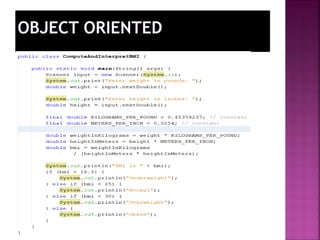
 Write a program that prompts the user to enter a
weight in pounds and height in inches and displays
the BMI.
1 pound = 0.45359237 kg
1 inch = 0.0254 m
 The procedural paradigm focuses on designing
methods and the object-oriented paradigm couples
data and methods together into objects. Software
design using the object-oriented paradigm focuses on
objects and operations on objects.
 The object oriented approach combines the power of
the procedural paradigm with an added dimension
that integrates data with operations into objects.
Automatically
Automatically
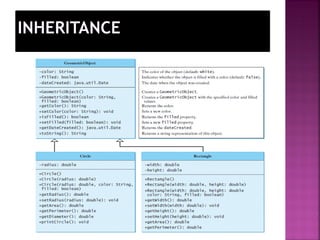
 Object-oriented programming allows you to
define new classes from existing classes. This
is called inheritance.
 Inheritance enables you to define a general
class (i.e., a superclass) and later extend it
to more specialized classes (i.e., subclasses).
Automatically
Automatically
 Contrary to the conventional interpretation,
a subclass is not a subset of its superclass.
 In fact, a subclass usually contains more
information and methods than its superclass.
 Private data fields in a superclass are not
accessible outside the class. Therefore, they
cannot be used directly in a subclass. They
can, however, be accessed/mutated through
public accessors/mutators if defined in the
superclass.
Automatically
Automatically
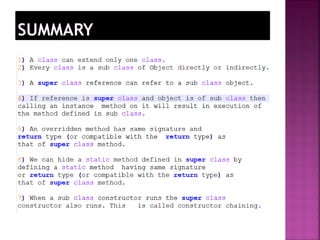
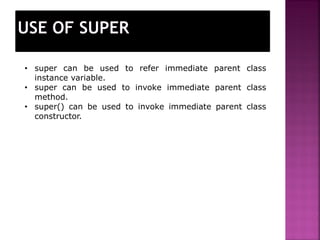
• super can be used to refer immediate parent class
instance variable.
• super can be used to invoke immediate parent class
method.
• super() can be used to invoke immediate parent class
constructor.
Automatically
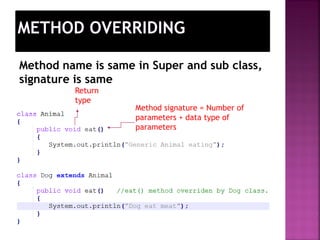
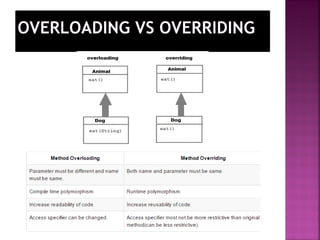
Method name is same in Super and sub class,
signature is same
Method signature = Number of
parameters + data type of
parameters
Return
type
Automatically
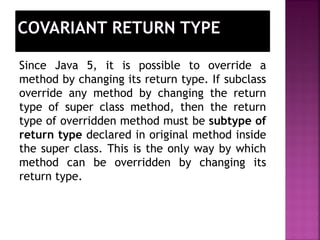
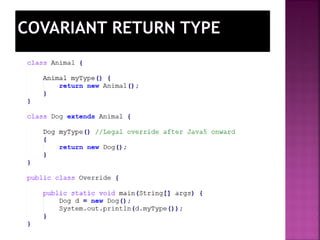
Since Java 5, it is possible to override a
method by changing its return type. If subclass
override any method by changing the return
type of super class method, then the return
type of overridden method must be subtype of
return type declared in original method inside
the super class. This is the only way by which
method can be overridden by changing its
return type.
Automatically
Automatically
atically
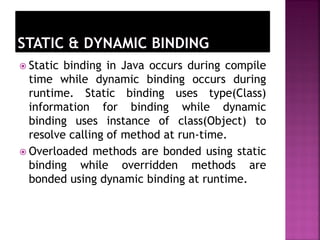
 Static binding in Java occurs during compile
time while dynamic binding occurs during
runtime. Static binding uses type(Class)
information for binding while dynamic
binding uses instance of class(Object) to
resolve calling of method at run-time.
 Overloaded methods are bonded using static
binding while overridden methods are
bonded using dynamic binding at runtime.
Automatically
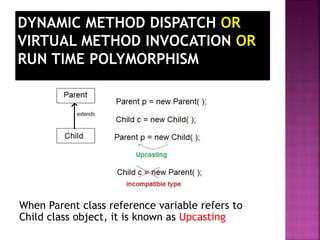
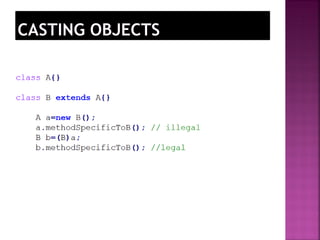
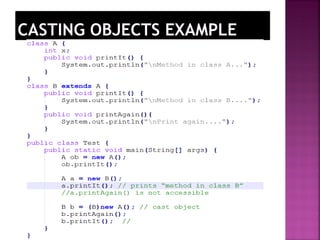
When Parent class reference variable refers to
Child class object, it is known as Upcasting
cally
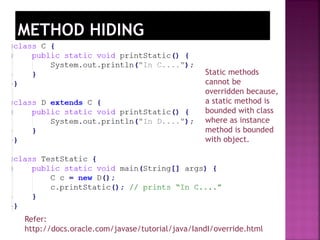
Refer:
http://docs.oracle.com/javase/tutorial/java/IandI/override.html
Static methods
cannot be
overridden because,
a static method is
bounded with class
where as instance
method is bounded
with object.
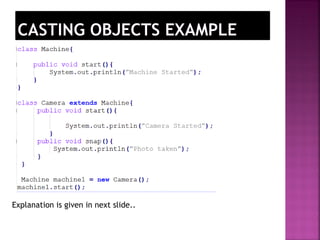
Explanation is given in next slide..
• It will create an instance of Camera class with a reference of Machine
class pointing to it.
• So, now the output will be "Camera Started" The variable is still a
reference of Machine class.
• If you attempt machine1.snap(); the code will not compile
• The takeaway here is all Cameras are Machines since Camera is a
subclass of Machine but all Machines are not Cameras. So you can
create an object of subclass and point it to a super class reference but
you cannot ask the super class reference to do all the functions of a
subclass object( In our example machine1.snap() wont compile).
• The superclass reference has access to only the functions known to the
superclass [In our example machine1.start()). You can not ask a
machine reference to take a snap. ]
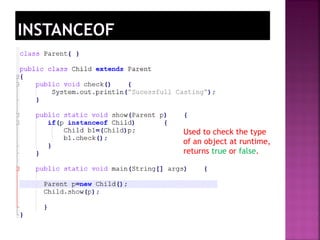
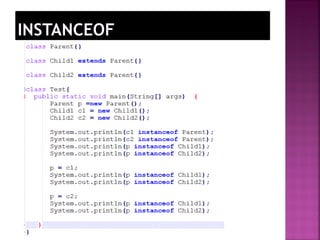
Used to check the type
of an object at runtime,
returns true or false.
 http://www.studytonight.com/java/dynamic
-method-dispatch
 http://javapapers.com/core-java/covariant-
return-type-in-java/
 http://www.vogella.com/tutorials/JavaIntro
duction/article.html
 http://www.studytonight.com/java/dynamic
-method-dispatch

Object oriented thinking

  • 1.
  • 2.
    Automatically  Write aprogram that prompts the user to enter a weight in pounds and height in inches and displays the BMI. 1 pound = 0.45359237 kg 1 inch = 0.0254 m  The procedural paradigm focuses on designing methods and the object-oriented paradigm couples data and methods together into objects. Software design using the object-oriented paradigm focuses on objects and operations on objects.  The object oriented approach combines the power of the procedural paradigm with an added dimension that integrates data with operations into objects.
  • 3.
  • 4.
    Automatically  Object-oriented programmingallows you to define new classes from existing classes. This is called inheritance.  Inheritance enables you to define a general class (i.e., a superclass) and later extend it to more specialized classes (i.e., subclasses).
  • 5.
  • 6.
    Automatically  Contrary tothe conventional interpretation, a subclass is not a subset of its superclass.  In fact, a subclass usually contains more information and methods than its superclass.  Private data fields in a superclass are not accessible outside the class. Therefore, they cannot be used directly in a subclass. They can, however, be accessed/mutated through public accessors/mutators if defined in the superclass.
  • 7.
  • 8.
    Automatically • super canbe used to refer immediate parent class instance variable. • super can be used to invoke immediate parent class method. • super() can be used to invoke immediate parent class constructor.
  • 9.
    Automatically Method name issame in Super and sub class, signature is same Method signature = Number of parameters + data type of parameters Return type
  • 10.
    Automatically Since Java 5,it is possible to override a method by changing its return type. If subclass override any method by changing the return type of super class method, then the return type of overridden method must be subtype of return type declared in original method inside the super class. This is the only way by which method can be overridden by changing its return type.
  • 11.
  • 12.
  • 13.
    atically  Static bindingin Java occurs during compile time while dynamic binding occurs during runtime. Static binding uses type(Class) information for binding while dynamic binding uses instance of class(Object) to resolve calling of method at run-time.  Overloaded methods are bonded using static binding while overridden methods are bonded using dynamic binding at runtime.
  • 14.
    Automatically When Parent classreference variable refers to Child class object, it is known as Upcasting
  • 15.
  • 16.
    Refer: http://docs.oracle.com/javase/tutorial/java/IandI/override.html Static methods cannot be overriddenbecause, a static method is bounded with class where as instance method is bounded with object.
  • 19.
    Explanation is givenin next slide..
  • 20.
    • It willcreate an instance of Camera class with a reference of Machine class pointing to it. • So, now the output will be "Camera Started" The variable is still a reference of Machine class. • If you attempt machine1.snap(); the code will not compile • The takeaway here is all Cameras are Machines since Camera is a subclass of Machine but all Machines are not Cameras. So you can create an object of subclass and point it to a super class reference but you cannot ask the super class reference to do all the functions of a subclass object( In our example machine1.snap() wont compile). • The superclass reference has access to only the functions known to the superclass [In our example machine1.start()). You can not ask a machine reference to take a snap. ]
  • 21.
    Used to checkthe type of an object at runtime, returns true or false.
  • 25.
     http://www.studytonight.com/java/dynamic -method-dispatch  http://javapapers.com/core-java/covariant- return-type-in-java/ http://www.vogella.com/tutorials/JavaIntro duction/article.html  http://www.studytonight.com/java/dynamic -method-dispatch