Download as PDF, PPTX







![ Threads can initiate an asynchronous task.
Asynchronous indicates that it can run
concurrently [at the same time instead of
sequentially]
The JVM gives each thread its own private JVM
stack.
This prevents threads from interfering with each
other.](https://image.slidesharecdn.com/multithreading1410-171014103607/85/Multi-t-hreading_14_10-13-320.jpg)



![Automatically
Suppose Thread A invokes deposit at about the
same time Thread B invokes withdraw. If the
initial value of balance is 500, their interleaved
actions might follow this sequence:
Thread A: Retrieve balance. [500]
Thread B: Retrieve balance. [500]
Thread A: Deposit 1000rs [1500].
Thread B: Withdraw 500rs [0 since Thread B has read
500].
Thread A: Store balance on server; balance is 1500
Thread B: Store balance on server; balance is
overwritten on server and now it is 0.](https://image.slidesharecdn.com/multithreading1410-171014103607/85/Multi-t-hreading_14_10-28-320.jpg)
![Automatically
To make a method synchronized, simply add the synchronized keyword to
its declaration [Refer program 6]](https://image.slidesharecdn.com/multithreading1410-171014103607/85/Multi-t-hreading_14_10-29-320.jpg)
![Automatically
While creating synchronized methods within classes that you create
is an easy and effective means of achieving synchronization, it will
not work in all cases. [Refer program 7]
Imagine that you want to synchronize access to objects of a class
that was not designed for multithreaded access. That is, the class
does not use synchronized methods. Further, this class was not
created by you, but by a third party, and you do not have access to
the source code. Thus, you can’t add synchronized to the appropriate
methods within the class. How can access to an object of this class
be synchronized? Fortunately, the solution to this problem is quite
easy: You simply put calls to the methods defined by this class inside
a synchronized block.
This is the general form of the synchronized statement:
synchronized(objRef) {
// statements to be synchronized
…….
…….
}
Here, objRef is a reference to the object
being synchronized. A synchronized block
ensures that a call to a synchronized method
that is a member of objRef’s class occurs only
after the current thread has successfully
entered objRef’s monitor](https://image.slidesharecdn.com/multithreading1410-171014103607/85/Multi-t-hreading_14_10-30-320.jpg)
![Automatically
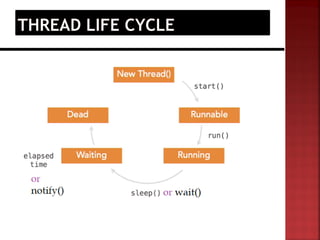
The Object class in Java has three final methods that
allow threads to communicate about the locked
status of a resource. [program – 8 producer, consumer]
These are :
wait( ) tells the calling thread to give up the
monitor and go to sleep until some other thread
enters the same monitor and calls notify( ) or
notifyAll( ).
notify( ) wakes up a thread that called wait( ) on
the same object.
notifyAll( ) wakes up all the threads that called
wait( ) on the same object. One of the threads
will be granted access](https://image.slidesharecdn.com/multithreading1410-171014103607/85/Multi-t-hreading_14_10-31-320.jpg)
![Automatically
A special type of error that you need to avoid that relates
specifically to multitasking is deadlock, which occurs when
two threads have a circular dependency on a pair of
synchronized objects. For example, suppose one thread
enters the monitor on object X and another thread enters
the monitor on object Y. If the thread in X tries to call any
synchronized method on Y, it will block as expected.
However, if the thread in Y, in turn, tries to call any
synchronized method on X, the thread waits forever,
because to access X, it would have to release its own lock
on Y so that the first thread could complete. Deadlock is a
difficult error to debug for two reasons:
In general, it occurs only rarely, when the two threads
time-slice in just the right way.
It may involve more than two threads and two
synchronized objects. (That is, deadlock can occur
through a more convoluted sequence of events than
just described.) [Refer Deadlock.java program 9]](https://image.slidesharecdn.com/multithreading1410-171014103607/85/Multi-t-hreading_14_10-32-320.jpg)
![utomatically
A special type of error that you need to avoid that relates
specifically to multitasking is deadlock, which occurs when
two threads have a circular dependency on a pair of
synchronized objects. For example, suppose one thread
enters the monitor on object X and another thread enters
the monitor on object Y. If the thread in X tries to call any
synchronized method on Y, it will block as expected.
However, if the thread in Y, in turn, tries to call any
synchronized method on X, the thread waits forever,
because to access X, it would have to release its own lock
on Y so that the first thread could complete. Deadlock is a
difficult error to debug for two reasons:
In general, it occurs only rarely, when the two threads
time-slice in just the right way.
It may involve more than two threads and two
synchronized objects. (That is, deadlock can occur
through a more convoluted sequence of events than
just described.) [Refer Deadlock.java]](https://image.slidesharecdn.com/multithreading1410-171014103607/85/Multi-t-hreading_14_10-33-320.jpg)


This document discusses multithreading in Java. It defines threads as lightweight processes that exist within a process and share its resources. The main thread is executed when a Java program begins. Additional threads can be created by implementing the Runnable interface or extending the Thread class. Synchronization is needed when threads access shared resources to prevent interference. Methods can be synchronized to allow only one thread to access them at a time. The wait(), notify(), and notifyAll() methods allow threads to communicate about locked resources. Deadlocks can occur when threads have a circular dependency on locks. The Java concurrency utilities provide additional tools for multithreaded programming.


![[Java concurrency]01.thread management](https://cdn.slidesharecdn.com/ss_thumbnails/javaconcurrency01-130927094151-phpapp02-thumbnail.jpg?width=640&height=640&fit=bounds)


