Object Oriented
Programming
Suresh Chandra Moharana,
Assistant Professor,
School of Computer Engineering,
KIIT University
EVOLUTION OF PROGRAMMING
PARADIGM
Software Crisis: development in software
technology continue to be dynamic.
Issues need to be addressed to face this crisis:
 How to represent real-life entities of problems in system
design?
 How to ensure reusability and extensibility of modules?
 How to develop modules that are tolerant to any changes
in future?
 How to improve software productivity and decrease
software cost?
 How to improve the quality of software?
 How to manage time schedules?
Dr. Sharmistha Roy,
Assistant Professor, SCE, KIIT
Object-oriented programming
Procedure-oriented
Assembly language
Machine language
 Software Evolution:
 Layers of Software evolution:
EVOLUTION OF PROGRAMMING
PARADIGM
1,0
Dr. Sharmistha Roy,
Assistant Professor, SCE, KIIT
STRUCTURED PROCEDURAL
PROGRAMMING(SPP)
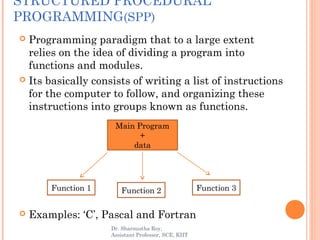
 Programming paradigm that to a large extent
relies on the idea of dividing a program into
functions and modules.
 Its basically consists of writing a list of instructions
for the computer to follow, and organizing these
instructions into groups known as functions.
 Examples: ‘C’, Pascal and Fortran
Main Program
+
data
Function 1 Function 2 Function 3
Dr. Sharmistha Roy,
Assistant Professor, SCE, KIIT
CHARACTERISTICS OF SPP..
 Emphasis is on doing things i.e. algorithms.
 Large programs are divided into smaller programs
known as functions.
 Most of the functions share global data.
 Data move openly around the system from function to
function.
 Functions transform data from one form to another.
 Employs top down approach in program design.
Dr. Sharmistha Roy,
Assistant Professor, SCE, KIIT
DISADVANTAGES OF SPP..
 SPP lacks code reusability, extensibility and
maintainability.
 Data and functions are stored separately and data is
globally accessed as the systems are modularized on the
basis of functions.
 Functions have unrestricted access to global data. Thus
changing the global data in a module causes program
side effects and that code becomes unreliable and error
prone in a complex system.
 Information hiding and data encapsulation are not
supported in SPP, therefore every function can access
every piece of data.
Dr. Sharmistha Roy,
Assistant Professor, SCE, KIIT
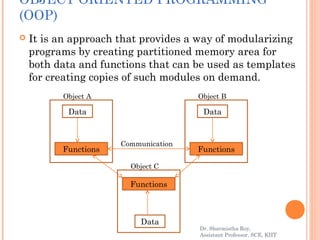
 It is an approach that provides a way of modularizing
programs by creating partitioned memory area for
both data and functions that can be used as templates
for creating copies of such modules on demand.
OBJECT ORIENTED PROGRAMMING
(OOP)
Data
Functions
Data
Functions
Data
Functions
Object A Object B
Object C
Communication
Dr. Sharmistha Roy,
Assistant Professor, SCE, KIIT
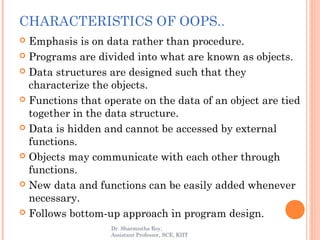
CHARACTERISTICS OF OOPS..
 Emphasis is on data rather than procedure.
 Programs are divided into what are known as objects.
 Data structures are designed such that they
characterize the objects.
 Functions that operate on the data of an object are tied
together in the data structure.
 Data is hidden and cannot be accessed by external
functions.
 Objects may communicate with each other through
functions.
 New data and functions can be easily added whenever
necessary.
 Follows bottom-up approach in program design.
Dr. Sharmistha Roy,
Assistant Professor, SCE, KIIT
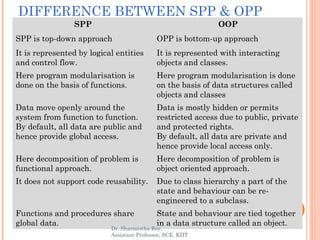
DIFFERENCE BETWEEN SPP & OPP
SPP OOP
SPP is top-down approach OPP is bottom-up approach
It is represented by logical entities
and control flow.
It is represented with interacting
objects and classes.
Here program modularisation is
done on the basis of functions.
Here program modularisation is done
on the basis of data structures called
objects and classes
Data move openly around the
system from function to function.
By default, all data are public and
hence provide global access.
Data is mostly hidden or permits
restricted access due to public, private
and protected rights.
By default, all data are private and
hence provide local access only.
Here decomposition of problem is
functional approach.
Here decomposition of problem is
object oriented approach.
It does not support code reusability. Due to class hierarchy a part of the
state and behaviour can be re-
engineered to a subclass.
Functions and procedures share
global data.
State and behaviour are tied together
in a data structure called an object.
Dr. Sharmistha Roy,
Assistant Professor, SCE, KIIT
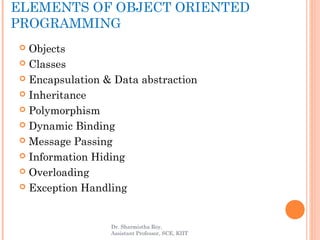
ELEMENTS OF OBJECT ORIENTED
PROGRAMMING
 Objects
 Classes
 Encapsulation & Data abstraction
 Inheritance
 Polymorphism
 Dynamic Binding
 Message Passing
 Information Hiding
 Overloading
 Exception Handling
Dr. Sharmistha Roy,
Assistant Professor, SCE, KIIT
OBJECTS
 Basic run-time entities in an object-oriented system i.e.
fundamental building blocks for designing a software.
 It is a collection of data members and the associated
member functions.
 An object represents a particular instance of a class.
There can be more than one instance of an object.
 An object has three characteristics:
 Name
 State
 Behaviour
 Objects take up space in the memory and have associated
address.
 When a program is executed the objects interact by
sending messages to one another.
 Example: Book, Bank, Customer etc.Dr. Sharmistha Roy,
Assistant Professor, SCE, KIIT
CLASS
 Template for constructing objects.
 The entire set of data and code of an object can be
made a user-defined data type with the help of a
class.
 Defining a class doesn't create any objects.
 Objects are variables of the type class. Once a
class has been defined we can create any number
of objects belonging to that class.
 A class is thus a collection of objects of similar
type.
 For e.g.: fruit mango;
Here ‘fruit’ has been defined as a class and
‘mango’ is the object belonging to the class fruit.
Dr. Sharmistha Roy,
Assistant Professor, SCE, KIIT
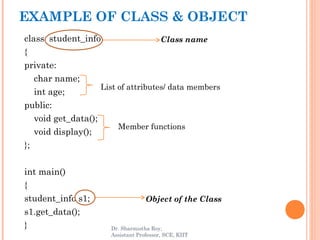
EXAMPLE OF CLASS & OBJECT
class student_info
{
private:
char name;
int age;
public:
void get_data();
void display();
};
int main()
{
student_info s1;
s1.get_data();
}
Class name
List of attributes/ data members
Member functions
Object of the Class
Dr. Sharmistha Roy,
Assistant Professor, SCE, KIIT
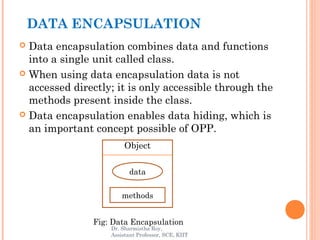
DATA ENCAPSULATION
 Data encapsulation combines data and functions
into a single unit called class.
 When using data encapsulation data is not
accessed directly; it is only accessible through the
methods present inside the class.
 Data encapsulation enables data hiding, which is
an important concept possible of OPP.
Object
data
methods
Fig: Data Encapsulation
Dr. Sharmistha Roy,
Assistant Professor, SCE, KIIT
DATA ABSTRACTION
 Abstraction refers to the act of representing essential
features without including the background details or
explanations.
 Data abstraction is an encapsulation of an object’s
state and behaviour.
 Data abstraction increases the power of programming
languages by creating user-defined data types.
 Classes use the concept of abstraction and are defined
as a list of abstract attributes and functions.
 Since classes use the concept of data abstraction, they
are known as Abstract Data Types (ADT).
Dr. Sharmistha Roy,
Assistant Professor, SCE, KIIT
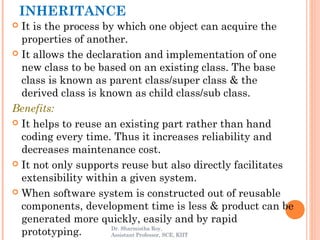
INHERITANCE
 It is the process by which one object can acquire the
properties of another.
 It allows the declaration and implementation of one
new class to be based on an existing class. The base
class is known as parent class/super class & the
derived class is known as child class/sub class.
Benefits:
 It helps to reuse an existing part rather than hand
coding every time. Thus it increases reliability and
decreases maintenance cost.
 It not only supports reuse but also directly facilitates
extensibility within a given system.
 When software system is constructed out of reusable
components, development time is less & product can be
generated more quickly, easily and by rapid
prototyping. Dr. Sharmistha Roy,
Assistant Professor, SCE, KIIT
 Example:
INHERITANCE..
Parent
features
Parent
features
Child’s
features
Parent
Base/ Super
class
Child Derived/ Sub
class
Derived part
Incremental
part
Fig: Single Inheritance
Single Inheritance: where child inherits properties from only one base
class
Dr. Sharmistha Roy,
Assistant Professor, SCE, KIIT
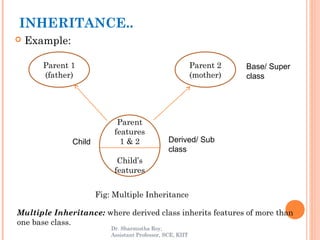
 Example:
INHERITANCE..
Parent 1
(father)
Parent
features
1 & 2
Child’s
features
Base/ Super
class
Child Derived/ Sub
class
Fig: Multiple Inheritance
Multiple Inheritance: where derived class inherits features of more than
one base class.
Parent 2
(mother)
Dr. Sharmistha Roy,
Assistant Professor, SCE, KIIT
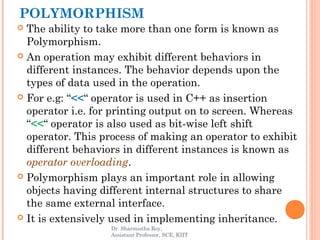
 The ability to take more than one form is known as
Polymorphism.
 An operation may exhibit different behaviors in
different instances. The behavior depends upon the
types of data used in the operation.
 For e.g: “<<“ operator is used in C++ as insertion
operator i.e. for printing output on to screen. Whereas
“<<“ operator is also used as bit-wise left shift
operator. This process of making an operator to exhibit
different behaviors in different instances is known as
operator overloading.
 Polymorphism plays an important role in allowing
objects having different internal structures to share
the same external interface.
 It is extensively used in implementing inheritance.
POLYMORPHISM
Dr. Sharmistha Roy,
Assistant Professor, SCE, KIIT
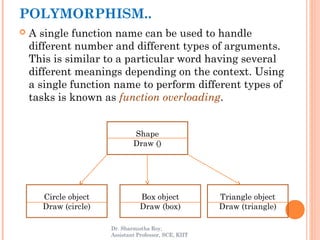
 A single function name can be used to handle
different number and different types of arguments.
This is similar to a particular word having several
different meanings depending on the context. Using
a single function name to perform different types of
tasks is known as function overloading.
POLYMORPHISM..
Shape
Draw ()
Circle object
Draw (circle)
Box object
Draw (box)
Triangle object
Draw (triangle)
Dr. Sharmistha Roy,
Assistant Professor, SCE, KIIT
 Binding refers to the linking of a procedure call
to the code to be executed in response to the call.
 Dynamic binding(late binding) means that the
code associated with a given procedure call is not
known until the time of the call at run-time.
 Consider the fig shown in polymorphism, every
object(circle/box/triangle) by inheritance have the
procedure “draw”. Its algorithm is unique to each
object and so the draw procedure is redefined in
each class that defines the object. At run-time
the code matching the object under current
reference will be called.
DYNAMIC BINDING
Dr. Sharmistha Roy,
Assistant Professor, SCE, KIIT
MESSAGE PASSING
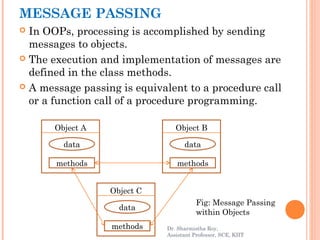
 In OOPs, processing is accomplished by sending
messages to objects.
 The execution and implementation of messages are
defined in the class methods.
 A message passing is equivalent to a procedure call
or a function call of a procedure programming.
Object A
methods
data
Object B
methods
data
Object C
methods
data
Fig: Message Passing
within Objects
Dr. Sharmistha Roy,
Assistant Professor, SCE, KIIT
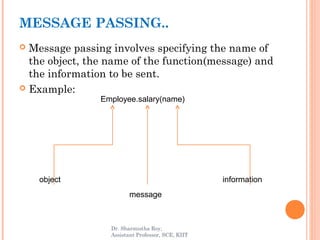
 Message passing involves specifying the name of
the object, the name of the function(message) and
the information to be sent.
 Example:
MESSAGE PASSING..
object information
message
Employee.salary(name)
Dr. Sharmistha Roy,
Assistant Professor, SCE, KIIT
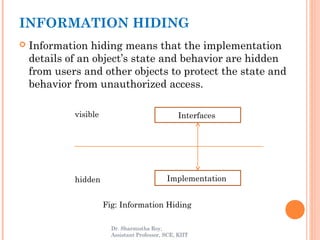
 Information hiding means that the implementation
details of an object’s state and behavior are hidden
from users and other objects to protect the state and
behavior from unauthorized access.
INFORMATION HIDING
Interfaces
Implementation
visible
hidden
Fig: Information Hiding
Dr. Sharmistha Roy,
Assistant Professor, SCE, KIIT
 Since it provides a better syntax structure, modelling
real world problem is easy and flexible.
 Complex software systems can be modularised on the
basis of class and objects.
 Data encapsulation and information hiding increases
software reliability and modifiability. It do not allows
unauthorized users to access the data.
 Polymorphism and dynamic binding increases
flexibility of code by allowing the creation of generic
software components.
 Inheritance allows software code to be extensible and
reusable.
ADVANTAGES OF OOPS
Dr. Sharmistha Roy,
Assistant Professor, SCE, KIIT
 Study yourself
APPLICATIONS OF OOPS
Dr. Sharmistha Roy,
Assistant Professor, SCE, KIIT

Object oriented programming

  • 1.
    Object Oriented Programming Suresh ChandraMoharana, Assistant Professor, School of Computer Engineering, KIIT University
  • 2.
    EVOLUTION OF PROGRAMMING PARADIGM SoftwareCrisis: development in software technology continue to be dynamic. Issues need to be addressed to face this crisis:  How to represent real-life entities of problems in system design?  How to ensure reusability and extensibility of modules?  How to develop modules that are tolerant to any changes in future?  How to improve software productivity and decrease software cost?  How to improve the quality of software?  How to manage time schedules? Dr. Sharmistha Roy, Assistant Professor, SCE, KIIT
  • 3.
    Object-oriented programming Procedure-oriented Assembly language Machinelanguage  Software Evolution:  Layers of Software evolution: EVOLUTION OF PROGRAMMING PARADIGM 1,0 Dr. Sharmistha Roy, Assistant Professor, SCE, KIIT
  • 4.
    STRUCTURED PROCEDURAL PROGRAMMING(SPP)  Programmingparadigm that to a large extent relies on the idea of dividing a program into functions and modules.  Its basically consists of writing a list of instructions for the computer to follow, and organizing these instructions into groups known as functions.  Examples: ‘C’, Pascal and Fortran Main Program + data Function 1 Function 2 Function 3 Dr. Sharmistha Roy, Assistant Professor, SCE, KIIT
  • 5.
    CHARACTERISTICS OF SPP.. Emphasis is on doing things i.e. algorithms.  Large programs are divided into smaller programs known as functions.  Most of the functions share global data.  Data move openly around the system from function to function.  Functions transform data from one form to another.  Employs top down approach in program design. Dr. Sharmistha Roy, Assistant Professor, SCE, KIIT
  • 6.
    DISADVANTAGES OF SPP.. SPP lacks code reusability, extensibility and maintainability.  Data and functions are stored separately and data is globally accessed as the systems are modularized on the basis of functions.  Functions have unrestricted access to global data. Thus changing the global data in a module causes program side effects and that code becomes unreliable and error prone in a complex system.  Information hiding and data encapsulation are not supported in SPP, therefore every function can access every piece of data. Dr. Sharmistha Roy, Assistant Professor, SCE, KIIT
  • 7.
     It isan approach that provides a way of modularizing programs by creating partitioned memory area for both data and functions that can be used as templates for creating copies of such modules on demand. OBJECT ORIENTED PROGRAMMING (OOP) Data Functions Data Functions Data Functions Object A Object B Object C Communication Dr. Sharmistha Roy, Assistant Professor, SCE, KIIT
  • 8.
    CHARACTERISTICS OF OOPS.. Emphasis is on data rather than procedure.  Programs are divided into what are known as objects.  Data structures are designed such that they characterize the objects.  Functions that operate on the data of an object are tied together in the data structure.  Data is hidden and cannot be accessed by external functions.  Objects may communicate with each other through functions.  New data and functions can be easily added whenever necessary.  Follows bottom-up approach in program design. Dr. Sharmistha Roy, Assistant Professor, SCE, KIIT
  • 9.
    DIFFERENCE BETWEEN SPP& OPP SPP OOP SPP is top-down approach OPP is bottom-up approach It is represented by logical entities and control flow. It is represented with interacting objects and classes. Here program modularisation is done on the basis of functions. Here program modularisation is done on the basis of data structures called objects and classes Data move openly around the system from function to function. By default, all data are public and hence provide global access. Data is mostly hidden or permits restricted access due to public, private and protected rights. By default, all data are private and hence provide local access only. Here decomposition of problem is functional approach. Here decomposition of problem is object oriented approach. It does not support code reusability. Due to class hierarchy a part of the state and behaviour can be re- engineered to a subclass. Functions and procedures share global data. State and behaviour are tied together in a data structure called an object. Dr. Sharmistha Roy, Assistant Professor, SCE, KIIT
  • 10.
    ELEMENTS OF OBJECTORIENTED PROGRAMMING  Objects  Classes  Encapsulation & Data abstraction  Inheritance  Polymorphism  Dynamic Binding  Message Passing  Information Hiding  Overloading  Exception Handling Dr. Sharmistha Roy, Assistant Professor, SCE, KIIT
  • 11.
    OBJECTS  Basic run-timeentities in an object-oriented system i.e. fundamental building blocks for designing a software.  It is a collection of data members and the associated member functions.  An object represents a particular instance of a class. There can be more than one instance of an object.  An object has three characteristics:  Name  State  Behaviour  Objects take up space in the memory and have associated address.  When a program is executed the objects interact by sending messages to one another.  Example: Book, Bank, Customer etc.Dr. Sharmistha Roy, Assistant Professor, SCE, KIIT
  • 12.
    CLASS  Template forconstructing objects.  The entire set of data and code of an object can be made a user-defined data type with the help of a class.  Defining a class doesn't create any objects.  Objects are variables of the type class. Once a class has been defined we can create any number of objects belonging to that class.  A class is thus a collection of objects of similar type.  For e.g.: fruit mango; Here ‘fruit’ has been defined as a class and ‘mango’ is the object belonging to the class fruit. Dr. Sharmistha Roy, Assistant Professor, SCE, KIIT
  • 13.
    EXAMPLE OF CLASS& OBJECT class student_info { private: char name; int age; public: void get_data(); void display(); }; int main() { student_info s1; s1.get_data(); } Class name List of attributes/ data members Member functions Object of the Class Dr. Sharmistha Roy, Assistant Professor, SCE, KIIT
  • 14.
    DATA ENCAPSULATION  Dataencapsulation combines data and functions into a single unit called class.  When using data encapsulation data is not accessed directly; it is only accessible through the methods present inside the class.  Data encapsulation enables data hiding, which is an important concept possible of OPP. Object data methods Fig: Data Encapsulation Dr. Sharmistha Roy, Assistant Professor, SCE, KIIT
  • 15.
    DATA ABSTRACTION  Abstractionrefers to the act of representing essential features without including the background details or explanations.  Data abstraction is an encapsulation of an object’s state and behaviour.  Data abstraction increases the power of programming languages by creating user-defined data types.  Classes use the concept of abstraction and are defined as a list of abstract attributes and functions.  Since classes use the concept of data abstraction, they are known as Abstract Data Types (ADT). Dr. Sharmistha Roy, Assistant Professor, SCE, KIIT
  • 16.
    INHERITANCE  It isthe process by which one object can acquire the properties of another.  It allows the declaration and implementation of one new class to be based on an existing class. The base class is known as parent class/super class & the derived class is known as child class/sub class. Benefits:  It helps to reuse an existing part rather than hand coding every time. Thus it increases reliability and decreases maintenance cost.  It not only supports reuse but also directly facilitates extensibility within a given system.  When software system is constructed out of reusable components, development time is less & product can be generated more quickly, easily and by rapid prototyping. Dr. Sharmistha Roy, Assistant Professor, SCE, KIIT
  • 17.
     Example: INHERITANCE.. Parent features Parent features Child’s features Parent Base/ Super class ChildDerived/ Sub class Derived part Incremental part Fig: Single Inheritance Single Inheritance: where child inherits properties from only one base class Dr. Sharmistha Roy, Assistant Professor, SCE, KIIT
  • 18.
     Example: INHERITANCE.. Parent 1 (father) Parent features 1& 2 Child’s features Base/ Super class Child Derived/ Sub class Fig: Multiple Inheritance Multiple Inheritance: where derived class inherits features of more than one base class. Parent 2 (mother) Dr. Sharmistha Roy, Assistant Professor, SCE, KIIT
  • 19.
     The abilityto take more than one form is known as Polymorphism.  An operation may exhibit different behaviors in different instances. The behavior depends upon the types of data used in the operation.  For e.g: “<<“ operator is used in C++ as insertion operator i.e. for printing output on to screen. Whereas “<<“ operator is also used as bit-wise left shift operator. This process of making an operator to exhibit different behaviors in different instances is known as operator overloading.  Polymorphism plays an important role in allowing objects having different internal structures to share the same external interface.  It is extensively used in implementing inheritance. POLYMORPHISM Dr. Sharmistha Roy, Assistant Professor, SCE, KIIT
  • 20.
     A singlefunction name can be used to handle different number and different types of arguments. This is similar to a particular word having several different meanings depending on the context. Using a single function name to perform different types of tasks is known as function overloading. POLYMORPHISM.. Shape Draw () Circle object Draw (circle) Box object Draw (box) Triangle object Draw (triangle) Dr. Sharmistha Roy, Assistant Professor, SCE, KIIT
  • 21.
     Binding refersto the linking of a procedure call to the code to be executed in response to the call.  Dynamic binding(late binding) means that the code associated with a given procedure call is not known until the time of the call at run-time.  Consider the fig shown in polymorphism, every object(circle/box/triangle) by inheritance have the procedure “draw”. Its algorithm is unique to each object and so the draw procedure is redefined in each class that defines the object. At run-time the code matching the object under current reference will be called. DYNAMIC BINDING Dr. Sharmistha Roy, Assistant Professor, SCE, KIIT
  • 22.
    MESSAGE PASSING  InOOPs, processing is accomplished by sending messages to objects.  The execution and implementation of messages are defined in the class methods.  A message passing is equivalent to a procedure call or a function call of a procedure programming. Object A methods data Object B methods data Object C methods data Fig: Message Passing within Objects Dr. Sharmistha Roy, Assistant Professor, SCE, KIIT
  • 23.
     Message passinginvolves specifying the name of the object, the name of the function(message) and the information to be sent.  Example: MESSAGE PASSING.. object information message Employee.salary(name) Dr. Sharmistha Roy, Assistant Professor, SCE, KIIT
  • 24.
     Information hidingmeans that the implementation details of an object’s state and behavior are hidden from users and other objects to protect the state and behavior from unauthorized access. INFORMATION HIDING Interfaces Implementation visible hidden Fig: Information Hiding Dr. Sharmistha Roy, Assistant Professor, SCE, KIIT
  • 25.
     Since itprovides a better syntax structure, modelling real world problem is easy and flexible.  Complex software systems can be modularised on the basis of class and objects.  Data encapsulation and information hiding increases software reliability and modifiability. It do not allows unauthorized users to access the data.  Polymorphism and dynamic binding increases flexibility of code by allowing the creation of generic software components.  Inheritance allows software code to be extensible and reusable. ADVANTAGES OF OOPS Dr. Sharmistha Roy, Assistant Professor, SCE, KIIT
  • 26.
     Study yourself APPLICATIONSOF OOPS Dr. Sharmistha Roy, Assistant Professor, SCE, KIIT