International Journal on Recent and Innovation Trends in Computing and Communication ISSN: 2321-8169
Volume: 5 Issue: 9 81 – 83
_______________________________________________________________________________________________
81
IJRITCC | September 2017, Available @ http://www.ijritcc.org
_______________________________________________________________________________________
NYMBLE: Servers Overcrowding Disobedient Users in Anonymizing Networks
1
R. Ravikumar, 2
J. Ramesh Kumar
1
Asst.professor, Dept.of.Computer Science, Tamil University, Thanjavur-613010
2
Research Scholar, Dept.of.Computer Science, Tamil University, Thanjavur-613010
Abstract: If a user wants to connect to a server has to provide his credentials where as some of the user (avoids to enter their original
credentials) connect through anonymizing network such tor browser. Internet services can be accessed privately through anonymizing networks
like Tor. A set of routers are used to achieve this in order to hide the identity of client from server. The advent of anonymizing networks
assured that users could access internet services with complete privacy avoiding any possible hindrance. IP was being shown everywhere, To
advertisers and other places, even from SPAM who compromised users identity. Anonymizing networks such as Tor allow users to access
Internet services privately by using a series of routers to hide the client’s IP address from the server. In order to allow users to access Internet
services privately, anonymizing networks like Tor uses a series of routers to hide the client’s IP address from the server. Anonymizing networks
such as Tor allow users to access Internet services privately by using a series of routers to hide the client’s IP address from the server.
Keywords: Nymble, anonymizing networks, symmetric cryptography, anonymizing networks, privacy, Nymble revocation.
__________________________________________________*****_________________________________________________
I. INTRODUCTION
The previous system or existing system provides
internet services to the users irrespective of their behavior.
Due to this it causes many threats to the system. Because of
this abusive purposes increases .It does not provide any kind
of security & has a chance of misbehaving with the server’s
confidential information. To address this problem of
misbehaving activities we introduce a Nymble system.
Nymble is the system which provides the security with the
chance of blocking the misbehaving users with the server. It
enhances the security to the data which is stored in the
server. It provides the feature such as backward
unlinkability, blacklisting, and fast access.
There are several answers for addressing this
problem, each offering some amount of accountability. In
case of pseudonymous credential systems users register into
websites by making use of pseudonyms that are added to a
blacklist if any user attempts to misbehave. The results of
this approach are pseudonymity for every user, and lessen
the strength of the anonymity that is offered by the
anonymizing network.
Anonymous authentication, backward unlink ability,
subjective blacklisting, fast authentication speeds, rate-
limited anonymous connections, revocation auditability
(where users can verify whether they have been blacklisted).
In this system we aim to generate nymbles, which are not
easy to connect, however a stream of these nymbles assures
we a simulation to anonymous access. Here we provide a
means where the website administrator can block user
without knowing his IP address (ie through pseudonym
generated: which is a random secret identity with the
pseudonym manager) without hindering the remaining
network. User also has his complete privacy without having
to compromise until he behaves.
II . PROPOSED SOLUTION
The problem of blacking misbehaving users has
properties such as addressing Sybil attack, revocation
auditability, rate-limited anonymous connections, fast
authentication speeds, subjective blacklisting, backward
unlinkability, and anonymous authentication. In the
proposed system security is provided when users connect to
web sites. Users get pseudonyms from Pseudonym Manager
in order to gain access to web sites. These pseudonyms help
in gaining anonymous access to web sites. The system
ensures that genuine users connect to web sites and their
anonymity is preserved.
1) Blacklist validation: The server sends the blacklist status
to the user along with its signing keys. The signing keys are
produced by the message authentication code. The verifying
algorithms are used to verify the blacklist status that was
updated by the NM.
2) Ticket examination: The NM before issuing the nymble
session id verifies the pseudo name if it was signed by the
PM. The keys which were shared during the system setup is
used to verify the pseudo name.
Although this work applies to anonymizing
networks in general, we consider Tor for purposes of
exhibition. Building and prototyping a system based on our
proposed solution is ongoing work. In this paper we present
International Journal on Recent and Innovation Trends in Computing and Communication ISSN: 2321-8169
Volume: 5 Issue: 9 81 – 83
_______________________________________________________________________________________________
82
IJRITCC | September 2017, Available @ http://www.ijritcc.org
_______________________________________________________________________________________
our proposed solution and protocol. Anonymizing networks
such as Tor allow users to access Internet services privately
by using a series of routers to hide the client’s IP address
from the server.
2.1. Advantages:
1. Intends to bind identity of an nameless user to a fictitious
name, generated from user’s IP address. This idea enables a
server to complainaboutmisbehavior of a user and blacklist
his future tickets.
2. Honest users remain anonymous, &blacklist future
connections of particular users and their requests remain
unlink able.
3. All connections of a blacklisted user before the complaint
will remain anonymous.
4. A user can check whether he is blacklisted or not at the
beginning of a connection.
5. Users are aware of their blacklist status before accessing a
service.
6. Servers can blacklist users for whatever reason, and the
privacy of blacklisted users is maintained.
There are several solutions to this problem, each
providing some degree of accountability. In pseudonymous
credential systems, users log into web sites using
pseudonyms, which can be added to a blacklist if a user
misbehaves. Unfortunately, this approach results in
pseudonymity for all users, and weakens the anonymity
provided by the anonym zing network.
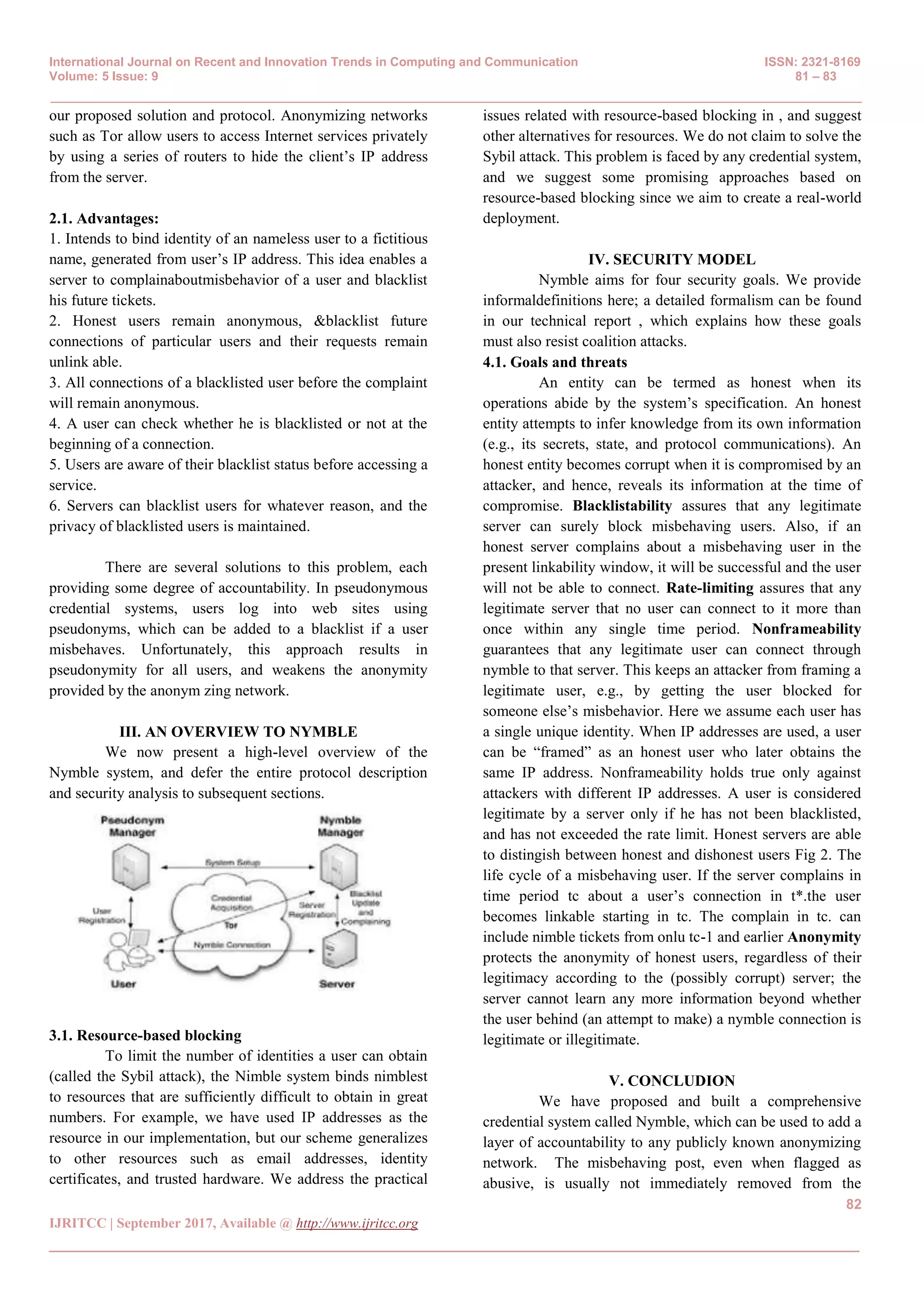
III. AN OVERVIEW TO NYMBLE
We now present a high-level overview of the
Nymble system, and defer the entire protocol description
and security analysis to subsequent sections.
3.1. Resource-based blocking
To limit the number of identities a user can obtain
(called the Sybil attack), the Nimble system binds nimblest
to resources that are sufficiently difficult to obtain in great
numbers. For example, we have used IP addresses as the
resource in our implementation, but our scheme generalizes
to other resources such as email addresses, identity
certificates, and trusted hardware. We address the practical
issues related with resource-based blocking in , and suggest
other alternatives for resources. We do not claim to solve the
Sybil attack. This problem is faced by any credential system,
and we suggest some promising approaches based on
resource-based blocking since we aim to create a real-world
deployment.
IV. SECURITY MODEL
Nymble aims for four security goals. We provide
informaldefinitions here; a detailed formalism can be found
in our technical report , which explains how these goals
must also resist coalition attacks.
4.1. Goals and threats
An entity can be termed as honest when its
operations abide by the system’s specification. An honest
entity attempts to infer knowledge from its own information
(e.g., its secrets, state, and protocol communications). An
honest entity becomes corrupt when it is compromised by an
attacker, and hence, reveals its information at the time of
compromise. Blacklistability assures that any legitimate
server can surely block misbehaving users. Also, if an
honest server complains about a misbehaving user in the
present linkability window, it will be successful and the user
will not be able to connect. Rate-limiting assures that any
legitimate server that no user can connect to it more than
once within any single time period. Nonframeability
guarantees that any legitimate user can connect through
nymble to that server. This keeps an attacker from framing a
legitimate user, e.g., by getting the user blocked for
someone else’s misbehavior. Here we assume each user has
a single unique identity. When IP addresses are used, a user
can be “framed” as an honest user who later obtains the
same IP address. Nonframeability holds true only against
attackers with different IP addresses. A user is considered
legitimate by a server only if he has not been blacklisted,
and has not exceeded the rate limit. Honest servers are able
to distingish between honest and dishonest users Fig 2. The
life cycle of a misbehaving user. If the server complains in
time period tc about a user’s connection in t*.the user
becomes linkable starting in tc. The complain in tc. can
include nimble tickets from onlu tc-1 and earlier Anonymity
protects the anonymity of honest users, regardless of their
legitimacy according to the (possibly corrupt) server; the
server cannot learn any more information beyond whether
the user behind (an attempt to make) a nymble connection is
legitimate or illegitimate.
V. CONCLUDION
We have proposed and built a comprehensive
credential system called Nymble, which can be used to add a
layer of accountability to any publicly known anonymizing
network. The misbehaving post, even when flagged as
abusive, is usually not immediately removed from the
International Journal on Recent and Innovation Trends in Computing and Communication ISSN: 2321-8169
Volume: 5 Issue: 9 81 – 83
_______________________________________________________________________________________________
83
IJRITCC | September 2017, Available @ http://www.ijritcc.org
_______________________________________________________________________________________
website. Anonymizing networks as Tor, thus far, has been
completely blocked by several web services because of users
who abuse their anonymity. Servers are able to blacklist
users who are misbehaving and maintain privacy of them,
and it is showed that it is possible to attain those properties
in a manner which is practical, effective, as well as sensitive
to requirements of both users as well as services.
REFERENCE
[1] C. Cornelius, A. Kapadia, P.P. Tsang, and S.W. Smith,
“Nymble: Blocking Misbehaving Users in Anonymizing
Networks,” Technical Report TR2008-637, Dartmouth
College, Computer Science, Dec. 2008.
[2] G. Ateniese, D.X. Song, and G. Tsudik, “Quasi-Efficient
Revocation in Group Signatures,” Proc. Conf. Financial
Cryptography, Springer, pp. 183-197, 2002.
[3] M. Bellare, H. Shi, and C. Zhang, “Foundations of
GroupSignatures: The Case of Dynamic Groups,” Proc.
Cryptographer’sTrack at RSA Conf. (CT-RSA),
Springer, pp. 136-153, 2005.
[4] D. Boneh and H. Shacham, “Group Signatures with
Verifier-Local Revocation,” Proc. ACM Conf. Computer
and Comm. Security,pp. 168-177, 2004.
[5] M. Bellare and P. Rogaway, “Random Oracles Are
Practical: A Paradigm for Designing Efficient Protocols,”
Proc. First ACM Conf. Computer and Comm. Security,
pp. 62-73, 1993.
[6] D. Boneh and H. Shacham. Group Signatures with
Verifier-Local Revocation. In ACM Conference on
Computer and Communications Security, pages 168–
177. ACM, 2004.
[7] S. Brands. Untraceable Off-line Cash in Wallets with
Observers (Extended Abstract). In CRYPTO, LNCS 773,
pages 302–318. Springer, 1993.
[8] E. Bresson and J. Stern. Efficient Revocation in Group
Signatures. In Public Key Cryptography, LNCS 1992,
pages 190–206. Springer, 2001.
[9] J. Camenisch and A. Lysyanskaya. An Efficient System
for Nontransferable Anonymous Credentials with
Optional Anonymity Revocation. In EUROCRYPT,
LNCS 2045, pages 93–118. Springer, 2001.

NYMBLE: Servers Overcrowding Disobedient Users in Anonymizing Networks

  • 1.
    International Journal onRecent and Innovation Trends in Computing and Communication ISSN: 2321-8169 Volume: 5 Issue: 9 81 – 83 _______________________________________________________________________________________________ 81 IJRITCC | September 2017, Available @ http://www.ijritcc.org _______________________________________________________________________________________ NYMBLE: Servers Overcrowding Disobedient Users in Anonymizing Networks 1 R. Ravikumar, 2 J. Ramesh Kumar 1 Asst.professor, Dept.of.Computer Science, Tamil University, Thanjavur-613010 2 Research Scholar, Dept.of.Computer Science, Tamil University, Thanjavur-613010 Abstract: If a user wants to connect to a server has to provide his credentials where as some of the user (avoids to enter their original credentials) connect through anonymizing network such tor browser. Internet services can be accessed privately through anonymizing networks like Tor. A set of routers are used to achieve this in order to hide the identity of client from server. The advent of anonymizing networks assured that users could access internet services with complete privacy avoiding any possible hindrance. IP was being shown everywhere, To advertisers and other places, even from SPAM who compromised users identity. Anonymizing networks such as Tor allow users to access Internet services privately by using a series of routers to hide the client’s IP address from the server. In order to allow users to access Internet services privately, anonymizing networks like Tor uses a series of routers to hide the client’s IP address from the server. Anonymizing networks such as Tor allow users to access Internet services privately by using a series of routers to hide the client’s IP address from the server. Keywords: Nymble, anonymizing networks, symmetric cryptography, anonymizing networks, privacy, Nymble revocation. __________________________________________________*****_________________________________________________ I. INTRODUCTION The previous system or existing system provides internet services to the users irrespective of their behavior. Due to this it causes many threats to the system. Because of this abusive purposes increases .It does not provide any kind of security & has a chance of misbehaving with the server’s confidential information. To address this problem of misbehaving activities we introduce a Nymble system. Nymble is the system which provides the security with the chance of blocking the misbehaving users with the server. It enhances the security to the data which is stored in the server. It provides the feature such as backward unlinkability, blacklisting, and fast access. There are several answers for addressing this problem, each offering some amount of accountability. In case of pseudonymous credential systems users register into websites by making use of pseudonyms that are added to a blacklist if any user attempts to misbehave. The results of this approach are pseudonymity for every user, and lessen the strength of the anonymity that is offered by the anonymizing network. Anonymous authentication, backward unlink ability, subjective blacklisting, fast authentication speeds, rate- limited anonymous connections, revocation auditability (where users can verify whether they have been blacklisted). In this system we aim to generate nymbles, which are not easy to connect, however a stream of these nymbles assures we a simulation to anonymous access. Here we provide a means where the website administrator can block user without knowing his IP address (ie through pseudonym generated: which is a random secret identity with the pseudonym manager) without hindering the remaining network. User also has his complete privacy without having to compromise until he behaves. II . PROPOSED SOLUTION The problem of blacking misbehaving users has properties such as addressing Sybil attack, revocation auditability, rate-limited anonymous connections, fast authentication speeds, subjective blacklisting, backward unlinkability, and anonymous authentication. In the proposed system security is provided when users connect to web sites. Users get pseudonyms from Pseudonym Manager in order to gain access to web sites. These pseudonyms help in gaining anonymous access to web sites. The system ensures that genuine users connect to web sites and their anonymity is preserved. 1) Blacklist validation: The server sends the blacklist status to the user along with its signing keys. The signing keys are produced by the message authentication code. The verifying algorithms are used to verify the blacklist status that was updated by the NM. 2) Ticket examination: The NM before issuing the nymble session id verifies the pseudo name if it was signed by the PM. The keys which were shared during the system setup is used to verify the pseudo name. Although this work applies to anonymizing networks in general, we consider Tor for purposes of exhibition. Building and prototyping a system based on our proposed solution is ongoing work. In this paper we present
  • 2.
    International Journal onRecent and Innovation Trends in Computing and Communication ISSN: 2321-8169 Volume: 5 Issue: 9 81 – 83 _______________________________________________________________________________________________ 82 IJRITCC | September 2017, Available @ http://www.ijritcc.org _______________________________________________________________________________________ our proposed solution and protocol. Anonymizing networks such as Tor allow users to access Internet services privately by using a series of routers to hide the client’s IP address from the server. 2.1. Advantages: 1. Intends to bind identity of an nameless user to a fictitious name, generated from user’s IP address. This idea enables a server to complainaboutmisbehavior of a user and blacklist his future tickets. 2. Honest users remain anonymous, &blacklist future connections of particular users and their requests remain unlink able. 3. All connections of a blacklisted user before the complaint will remain anonymous. 4. A user can check whether he is blacklisted or not at the beginning of a connection. 5. Users are aware of their blacklist status before accessing a service. 6. Servers can blacklist users for whatever reason, and the privacy of blacklisted users is maintained. There are several solutions to this problem, each providing some degree of accountability. In pseudonymous credential systems, users log into web sites using pseudonyms, which can be added to a blacklist if a user misbehaves. Unfortunately, this approach results in pseudonymity for all users, and weakens the anonymity provided by the anonym zing network. III. AN OVERVIEW TO NYMBLE We now present a high-level overview of the Nymble system, and defer the entire protocol description and security analysis to subsequent sections. 3.1. Resource-based blocking To limit the number of identities a user can obtain (called the Sybil attack), the Nimble system binds nimblest to resources that are sufficiently difficult to obtain in great numbers. For example, we have used IP addresses as the resource in our implementation, but our scheme generalizes to other resources such as email addresses, identity certificates, and trusted hardware. We address the practical issues related with resource-based blocking in , and suggest other alternatives for resources. We do not claim to solve the Sybil attack. This problem is faced by any credential system, and we suggest some promising approaches based on resource-based blocking since we aim to create a real-world deployment. IV. SECURITY MODEL Nymble aims for four security goals. We provide informaldefinitions here; a detailed formalism can be found in our technical report , which explains how these goals must also resist coalition attacks. 4.1. Goals and threats An entity can be termed as honest when its operations abide by the system’s specification. An honest entity attempts to infer knowledge from its own information (e.g., its secrets, state, and protocol communications). An honest entity becomes corrupt when it is compromised by an attacker, and hence, reveals its information at the time of compromise. Blacklistability assures that any legitimate server can surely block misbehaving users. Also, if an honest server complains about a misbehaving user in the present linkability window, it will be successful and the user will not be able to connect. Rate-limiting assures that any legitimate server that no user can connect to it more than once within any single time period. Nonframeability guarantees that any legitimate user can connect through nymble to that server. This keeps an attacker from framing a legitimate user, e.g., by getting the user blocked for someone else’s misbehavior. Here we assume each user has a single unique identity. When IP addresses are used, a user can be “framed” as an honest user who later obtains the same IP address. Nonframeability holds true only against attackers with different IP addresses. A user is considered legitimate by a server only if he has not been blacklisted, and has not exceeded the rate limit. Honest servers are able to distingish between honest and dishonest users Fig 2. The life cycle of a misbehaving user. If the server complains in time period tc about a user’s connection in t*.the user becomes linkable starting in tc. The complain in tc. can include nimble tickets from onlu tc-1 and earlier Anonymity protects the anonymity of honest users, regardless of their legitimacy according to the (possibly corrupt) server; the server cannot learn any more information beyond whether the user behind (an attempt to make) a nymble connection is legitimate or illegitimate. V. CONCLUDION We have proposed and built a comprehensive credential system called Nymble, which can be used to add a layer of accountability to any publicly known anonymizing network. The misbehaving post, even when flagged as abusive, is usually not immediately removed from the
  • 3.
    International Journal onRecent and Innovation Trends in Computing and Communication ISSN: 2321-8169 Volume: 5 Issue: 9 81 – 83 _______________________________________________________________________________________________ 83 IJRITCC | September 2017, Available @ http://www.ijritcc.org _______________________________________________________________________________________ website. Anonymizing networks as Tor, thus far, has been completely blocked by several web services because of users who abuse their anonymity. Servers are able to blacklist users who are misbehaving and maintain privacy of them, and it is showed that it is possible to attain those properties in a manner which is practical, effective, as well as sensitive to requirements of both users as well as services. REFERENCE [1] C. Cornelius, A. Kapadia, P.P. Tsang, and S.W. Smith, “Nymble: Blocking Misbehaving Users in Anonymizing Networks,” Technical Report TR2008-637, Dartmouth College, Computer Science, Dec. 2008. [2] G. Ateniese, D.X. Song, and G. Tsudik, “Quasi-Efficient Revocation in Group Signatures,” Proc. Conf. Financial Cryptography, Springer, pp. 183-197, 2002. [3] M. Bellare, H. Shi, and C. Zhang, “Foundations of GroupSignatures: The Case of Dynamic Groups,” Proc. Cryptographer’sTrack at RSA Conf. (CT-RSA), Springer, pp. 136-153, 2005. [4] D. Boneh and H. Shacham, “Group Signatures with Verifier-Local Revocation,” Proc. ACM Conf. Computer and Comm. Security,pp. 168-177, 2004. [5] M. Bellare and P. Rogaway, “Random Oracles Are Practical: A Paradigm for Designing Efficient Protocols,” Proc. First ACM Conf. Computer and Comm. Security, pp. 62-73, 1993. [6] D. Boneh and H. Shacham. Group Signatures with Verifier-Local Revocation. In ACM Conference on Computer and Communications Security, pages 168– 177. ACM, 2004. [7] S. Brands. Untraceable Off-line Cash in Wallets with Observers (Extended Abstract). In CRYPTO, LNCS 773, pages 302–318. Springer, 1993. [8] E. Bresson and J. Stern. Efficient Revocation in Group Signatures. In Public Key Cryptography, LNCS 1992, pages 190–206. Springer, 2001. [9] J. Camenisch and A. Lysyanskaya. An Efficient System for Nontransferable Anonymous Credentials with Optional Anonymity Revocation. In EUROCRYPT, LNCS 2045, pages 93–118. Springer, 2001.