NYLON
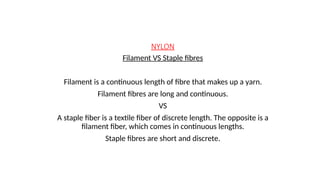
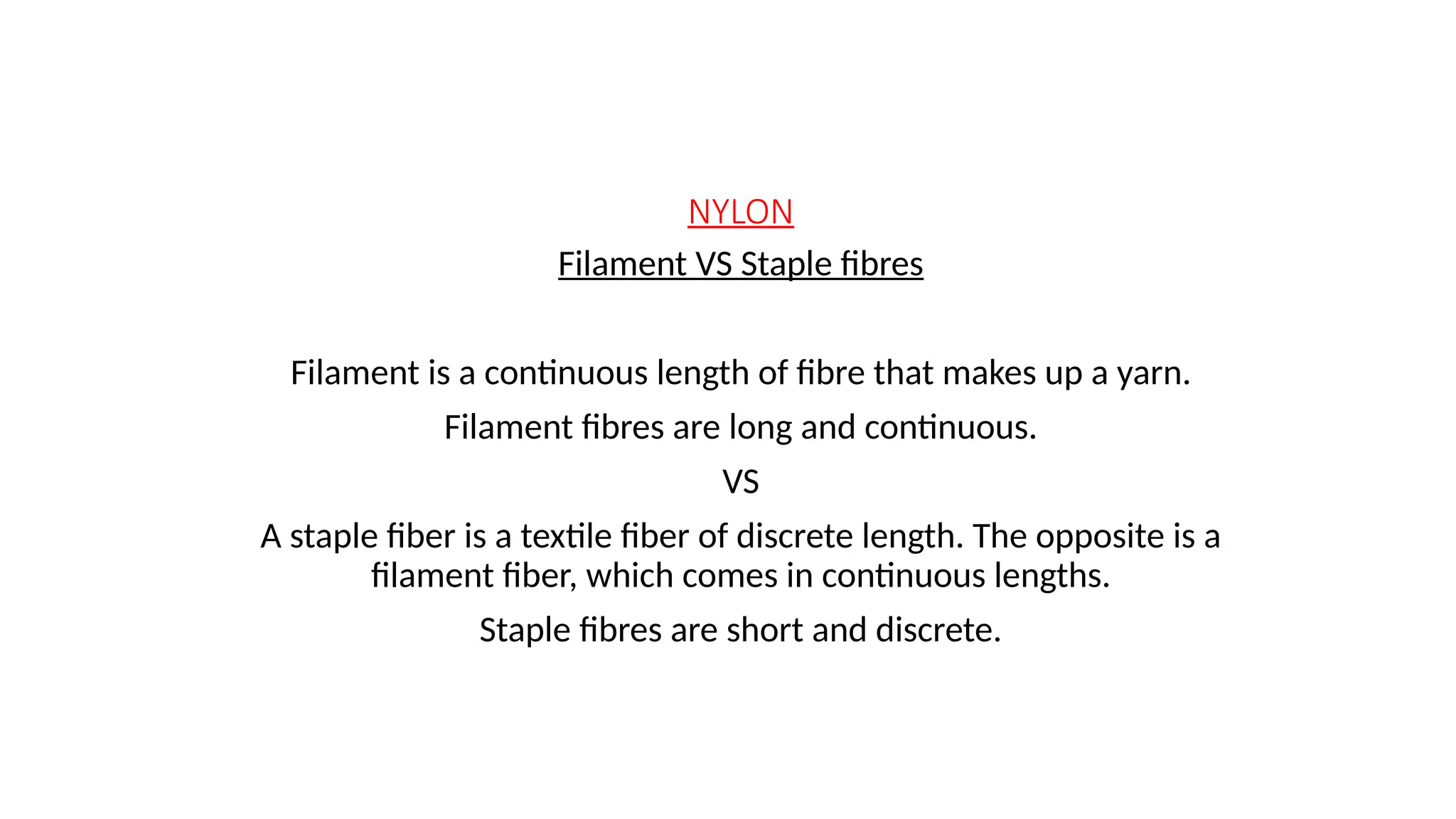
Filament VS Staple fibres
Filament is a continuous length of fibre that makes up a yarn.
Filament fibres are long and continuous.
VS
A staple fiber is a textile fiber of discrete length. The opposite is a
filament fiber, which comes in continuous lengths.
Staple fibres are short and discrete.
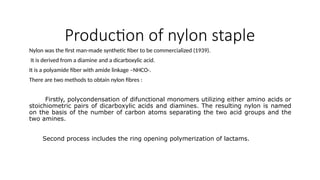
Production of nylon staple
Nylon was the first man-made synthetic fiber to be commercialized (1939).
It is derived from a diamine and a dicarboxylic acid.
It is a polyamide fiber with amide linkage –NHCO-.
There are two methods to obtain nylon fibres :
Firstly, polycondensation of difunctional monomers utilizing either amino acids or
stoichiometric pairs of dicarboxylic acids and diamines. The resulting nylon is named
on the basis of the number of carbon atoms separating the two acid groups and the
two amines.
Second process includes the ring opening polymerization of lactams.
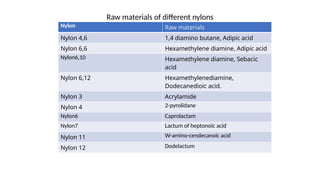
Raw materials of different nylons
Nylon Raw materials
Nylon 4,6 1,4 diamino butane, Adipic acid
Nylon 6,6 Hexamethylene diamine, Adipic acid
Nylon6,10 Hexamethylene diamine, Sebacic
acid
Nylon 6,12 Hexamethylenediamine,
Dodecanedioic acid.
Nylon 3 Acrylamide
Nylon 4 2-pyrolidane
Nylon6 Caprolactam
Nylon7 Lactum of heptonoic acid
Nylon 11 W-amino-cendecanoic acid
Nylon 12 Dodelactum
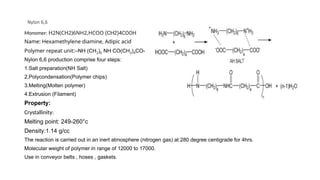
Nylon 6,6
Monomer: H2N(CH2)6NH2,HCOO (CH2)4COOH
Name: Hexamethylene diamine, Adipic acid
Polymer repeat unit:–NH (CH2)6 NH CO(CH2)4CO-
Nylon 6,6 production comprise four steps:
1.Salt preparation(NH Salt)
2.Polycondensation(Polymer chips)
3.Melting(Molten polymer)
4.Extrusion (Filament)
Property:
Crystallinity:
Melting point: 249-260°c
Density:1.14 g/cc
The reaction is carried out in an inert atmosphere (nitrogen gas) at 280 degree centigrade for 4hrs.
Molecular weight of polymer in range of 12000 to 17000.
Use in conveyor belts , hoses , gaskets.
Nylon 6
Monomer: OC-(CH2)5-NH
Name: Caprolactam
Type: AB
Polymer repeat unit: [OC-(CH2)5-NH]
Name: Nylon 6
Caprolactam can be synthesize by-Phenol , Benzene , Toluene , Cyclohexane
Caprolactam (CL), a colorless solid does not polymerize in a completely dry condition.
It requires a catalyst which converts a small amount of CL to aminocaproic acid (ACA).
The catalyst can be an acid, a base, or simply water.
The base- catalysed system has the advantage of high production rate, high molecular weight
and narrow molecular weight distribution.
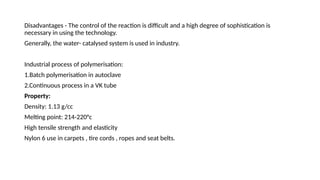
Disadvantages - The control of the reaction is difficult and a high degree of sophistication is
necessary in using the technology.
Generally, the water- catalysed system is used in industry.
Industrial process of polymerisation:
1.Batch polymerisation in autoclave
2.Continuous process in a VK tube
Property:
Density: 1.13 g/cc
Melting point: 214-220°c
High tensile strength and elasticity
Nylon 6 use in carpets , tire cords , ropes and seat belts.
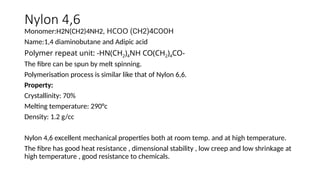
Nylon 4,6
Monomer:H2N(CH2)4NH2, HCOO (CH2)4COOH
Name:1,4 diaminobutane and Adipic acid
Polymer repeat unit: -HN(CH2)4NH CO(CH2)4CO-
The fibre can be spun by melt spinning.
Polymerisation process is similar like that of Nylon 6,6.
Property:
Crystallinity: 70%
Melting temperature: 290°c
Density: 1.2 g/cc
Nylon 4,6 excellent mechanical properties both at room temp. and at high temperature.
The fibre has good heat resistance , dimensional stability , low creep and low shrinkage at
high temperature , good resistance to chemicals.
Bio-based Nylon:
It’s a type of nylon fibre that is made from renewable resources such as castor oil, corn, or
sugarcane.
It is an eco-friendly alternative to traditional nylon fibres, and is commonly used in the production
of clothing, automotive parts, and other industrial applications.
NYLON ppt manufacturing process of nylon

NYLON ppt manufacturing process of nylon

  • 1.
    NYLON Filament VS Staplefibres Filament is a continuous length of fibre that makes up a yarn. Filament fibres are long and continuous. VS A staple fiber is a textile fiber of discrete length. The opposite is a filament fiber, which comes in continuous lengths. Staple fibres are short and discrete.
  • 2.
    Production of nylonstaple Nylon was the first man-made synthetic fiber to be commercialized (1939). It is derived from a diamine and a dicarboxylic acid. It is a polyamide fiber with amide linkage –NHCO-. There are two methods to obtain nylon fibres : Firstly, polycondensation of difunctional monomers utilizing either amino acids or stoichiometric pairs of dicarboxylic acids and diamines. The resulting nylon is named on the basis of the number of carbon atoms separating the two acid groups and the two amines. Second process includes the ring opening polymerization of lactams.
  • 3.
    Raw materials ofdifferent nylons Nylon Raw materials Nylon 4,6 1,4 diamino butane, Adipic acid Nylon 6,6 Hexamethylene diamine, Adipic acid Nylon6,10 Hexamethylene diamine, Sebacic acid Nylon 6,12 Hexamethylenediamine, Dodecanedioic acid. Nylon 3 Acrylamide Nylon 4 2-pyrolidane Nylon6 Caprolactam Nylon7 Lactum of heptonoic acid Nylon 11 W-amino-cendecanoic acid Nylon 12 Dodelactum
  • 4.
    Nylon 6,6 Monomer: H2N(CH2)6NH2,HCOO(CH2)4COOH Name: Hexamethylene diamine, Adipic acid Polymer repeat unit:–NH (CH2)6 NH CO(CH2)4CO- Nylon 6,6 production comprise four steps: 1.Salt preparation(NH Salt) 2.Polycondensation(Polymer chips) 3.Melting(Molten polymer) 4.Extrusion (Filament) Property: Crystallinity: Melting point: 249-260°c Density:1.14 g/cc The reaction is carried out in an inert atmosphere (nitrogen gas) at 280 degree centigrade for 4hrs. Molecular weight of polymer in range of 12000 to 17000. Use in conveyor belts , hoses , gaskets.
  • 5.
    Nylon 6 Monomer: OC-(CH2)5-NH Name:Caprolactam Type: AB Polymer repeat unit: [OC-(CH2)5-NH] Name: Nylon 6 Caprolactam can be synthesize by-Phenol , Benzene , Toluene , Cyclohexane Caprolactam (CL), a colorless solid does not polymerize in a completely dry condition. It requires a catalyst which converts a small amount of CL to aminocaproic acid (ACA). The catalyst can be an acid, a base, or simply water. The base- catalysed system has the advantage of high production rate, high molecular weight and narrow molecular weight distribution.
  • 6.
    Disadvantages - Thecontrol of the reaction is difficult and a high degree of sophistication is necessary in using the technology. Generally, the water- catalysed system is used in industry. Industrial process of polymerisation: 1.Batch polymerisation in autoclave 2.Continuous process in a VK tube Property: Density: 1.13 g/cc Melting point: 214-220°c High tensile strength and elasticity Nylon 6 use in carpets , tire cords , ropes and seat belts.
  • 7.
    Nylon 4,6 Monomer:H2N(CH2)4NH2, HCOO(CH2)4COOH Name:1,4 diaminobutane and Adipic acid Polymer repeat unit: -HN(CH2)4NH CO(CH2)4CO- The fibre can be spun by melt spinning. Polymerisation process is similar like that of Nylon 6,6. Property: Crystallinity: 70% Melting temperature: 290°c Density: 1.2 g/cc Nylon 4,6 excellent mechanical properties both at room temp. and at high temperature. The fibre has good heat resistance , dimensional stability , low creep and low shrinkage at high temperature , good resistance to chemicals.
  • 8.
    Bio-based Nylon: It’s atype of nylon fibre that is made from renewable resources such as castor oil, corn, or sugarcane. It is an eco-friendly alternative to traditional nylon fibres, and is commonly used in the production of clothing, automotive parts, and other industrial applications.