How to WIN the New Venture
       Challenge & SUCCEED in Business


George Deriso, Leeds School of Business   george.deriso@colorado.edu
Data Node
Lesson: Be the                of secret!
• Talk to your market (customers)

• Talk to your industry (know your competitors)

• Collect and analyze data (evidence)

• Iterate continuously
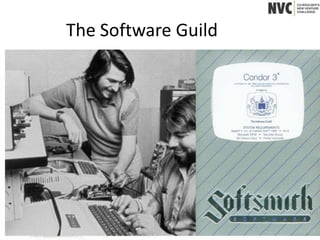
The Software Guild
Lesson: Craft the right

• Deliver the value your customer wants

• Deliver your product the way your customer
  wants

• Work with the right partners

• Keep it simple
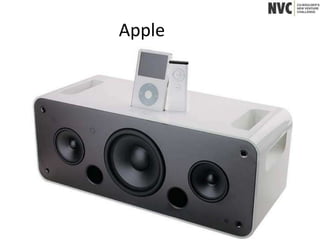
Apple
Lesson: Learn to embrace
• If you want to differentiate or
  innovate, expect to fail

• Make failure OK, and reward risk-takers

• Use failure as a learning tool

• Know when to “shoot it in the head”
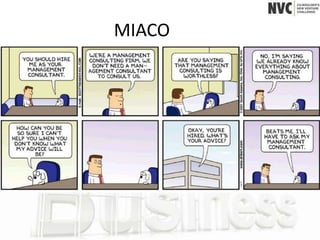
MIACO
Lesson: You must have the

• If you want to get s#*t done, hire well

• Be sure you and your partners agree, then put
  it in writing

• It’s not enough that the Captain can clearly
  see land, if everyone is rowing in different
  directions! (Communicate without constraint)
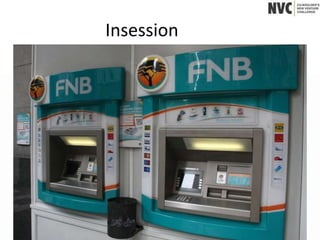
Insession
Requisite Technology
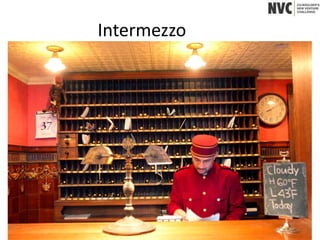
Intermezzo
Solista
Beyond Solista
• 2 years in an earn-out (indentured servitude)

• 2 more technology product & service startups

• 6 sell-side acquisitions (not all mine)

• 3 years on the investor side of the table

• 8 years working with CU and social enterprises


                       a lot more lessons…
Key Lessons
• Opposite of secret      • Product/market fit
• Business model          • Know who you are
• Embrace failure         • Banish ambiguity
• Right team              • Improve continuously
                          • Exploit your network
• Communicate
                          • Build win-win
• Innovate/differentiat     partnerships
  e                       • Cover your legal and
• Validate constantly       accounting bases
Let’s break it down
What the NVC judges want
•   A great Executive Summary
•   A flawless live presentation
•   A clear and understandable business concept
•   Validation and evidence
•   A plausible business model
•   A competent and experienced team
•   Evidence of strong support for the business
Let’s work on it
• Your Executive Summary and Presentation will
  be topics of future workshops

• Let’s focus right now on how you
  communicate and present your business
  concept
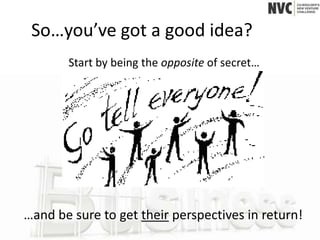
So…you’ve got a good idea?
       Start by being the opposite of secret…


…and be sure to get their perspectives in return!
Evidence of PAIN
• Demonstrate that you’ve talked to your target
  market
• Demonstrate that you’ve talked to members
  of your industry

• Prove:
  – The PAIN is known and well understood
  – Industry and market AGREE on what the PAIN is
Evidence of DEMAND
• Demonstrate that you’ve presented your solution
  to your target market
• Demonstrate that you’ve presented your solution
  to members of your industry

• Prove:
  – The DEMAND for your product is present and
    measurable
  – The market accepts your solution at your price
    delivered the way you expect to deliver it
Embody your evidence
• Create a brief PITCH
• Create a succinct ENCAPSULATION
• DISTILL your essence into one word

• Here’s how it looks…
The pitch: <=60 seconds
• What you should include:
  – Start with a “hook;” capture their attention.
  – What are you about? Mission? Objective?
  – What’s the BIG DEAL? Exactly what do you do?
  – So what? What makes you different? Why should
    they care?
  – Who’s your target? What problem do you solve?
  – Sell yourself – why will you succeed?
  – Strong close – leave them with a reason to want
    more. (This is a good place for a testimonial).
Encapsulate: <=7 words
• Think of this as a 7-word pitch that answers
  what you are about.
• If this is all you get to say, what will you leave
  them with? What should they think about
  you?
• Leave out company name, extraneous details.
• Here’s an example:

   “Mobile electronics, proven to simplify your life!”
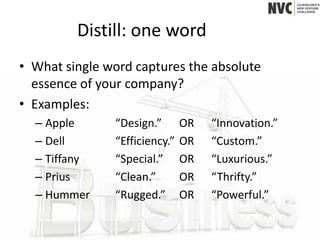
Distill: one word
• What single word captures the absolute
  essence of your company?
• Examples:
  – Apple      “Design.”       OR   “Innovation.”
  – Dell       “Efficiency.”   OR   “Custom.”
  – Tiffany    “Special.”      OR   “Luxurious.”
  – Prius      “Clean.”        OR   “Thrifty.”
  – Hummer     “Rugged.”       OR   “Powerful.”
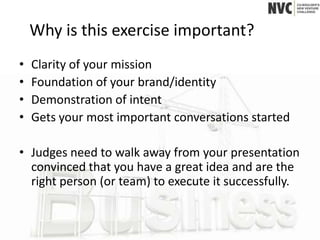
Why is this exercise important?
•   Clarity of your mission
•   Foundation of your brand/identity
•   Demonstration of intent
•   Gets your most important conversations started

• Judges need to walk away from your presentation
  convinced that you have a great idea and are the
  right person (or team) to execute it successfully.
You’ve got their attention…
• …Now convince them that you’ve got
  something.

• You need to PROVE beyond doubt that you
  have identified the PAIN suffered by your
  target market…

• …and that you have a solution that your
  market will DEMAND.
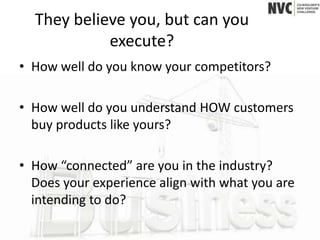
They believe you, but can you
            execute?
• How well do you know your competitors?

• How well do you understand HOW customers
  buy products like yours?

• How “connected” are you in the industry?
  Does your experience align with what you are
  intending to do?
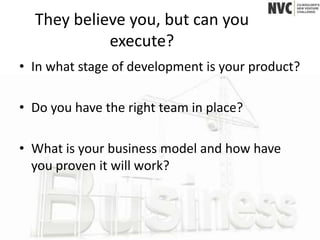
They believe you, but can you
            execute?
• In what stage of development is your product?

• Do you have the right team in place?

• What is your business model and how have
  you proven it will work?
How will you PROVE your
       business will work?
• Best way is to have sold
  something…repeatedly.
• Next best is to present evidence that your
  target market will buy at the price you want,
  once your product is available.

• In both cases, your business model must make
  sense.
Your business model
• Does your product solve a recognized
  problem?
• Will your customers buy it at the price you are
  asking?
• Will your competitors recognize that you have
  an advantage they don’t?
• Is your marketing crafted in the most effective
  way for driving demand from your target
  market?
Your business model
• Do you have partnerships in place that
  support or enhance your product offering?
• Have you proven your business will survive?
• Does your cost structure support immediate
  and persistent profits?
• Does your growth plan make sense?
• Will your operations support the business
  processes necessary to deliver your product?
One last thing…

               Jargon:
the dirty little secrets of Geoffrey Moore and
                     Eric Ries.
Applied jargon
• Geoffrey Moore (Technology Adoption Curve)
  – Crossing The Chasm (1991)
  – Popularized “Chasm,” “Bowling Alley,” “Tornado,”
    and “Main Street”

• Everett Rogers (Market Diffusion Theory)
  – Diffusion of Innovations (1962)
  – Originated “Innovators,” “Early Adopters,” “Early
    Majority,” “Late Majority,” and “Laggards”
Applied jargon
• Eric Ries (Lean Startup movement)
  – The Lean Startup (2011)
  – Popularized “Lean startup,” “MVP,” “Customer
    Development” and “Pivoting”

• Every successful entrepreneur
  – Most entrepreneurial texts
  – Popularized “manage cash flow,” “make something
    people will buy,” “market testing,” “build on your
    successes,” and “fail, fix and try a new approach”
Judges hate jargon…
…present your plan in simple terms using plain
English

BTW, don’t use texting abbreviations

And recognize that your customers want plain
simple language as well!
Time for questions…


   +          +

Nvc 2013 presentation

  • 1.
    How to WINthe New Venture Challenge & SUCCEED in Business George Deriso, Leeds School of Business george.deriso@colorado.edu
  • 2.
  • 3.
    Lesson: Be the of secret! • Talk to your market (customers) • Talk to your industry (know your competitors) • Collect and analyze data (evidence) • Iterate continuously
  • 4.
  • 5.
    Lesson: Craft theright • Deliver the value your customer wants • Deliver your product the way your customer wants • Work with the right partners • Keep it simple
  • 6.
  • 7.
    Lesson: Learn toembrace • If you want to differentiate or innovate, expect to fail • Make failure OK, and reward risk-takers • Use failure as a learning tool • Know when to “shoot it in the head”
  • 8.
  • 9.
    Lesson: You musthave the • If you want to get s#*t done, hire well • Be sure you and your partners agree, then put it in writing • It’s not enough that the Captain can clearly see land, if everyone is rowing in different directions! (Communicate without constraint)
  • 10.
  • 11.
  • 12.
  • 13.
  • 14.
    Beyond Solista • 2years in an earn-out (indentured servitude) • 2 more technology product & service startups • 6 sell-side acquisitions (not all mine) • 3 years on the investor side of the table • 8 years working with CU and social enterprises a lot more lessons…
  • 15.
    Key Lessons • Oppositeof secret • Product/market fit • Business model • Know who you are • Embrace failure • Banish ambiguity • Right team • Improve continuously • Exploit your network • Communicate • Build win-win • Innovate/differentiat partnerships e • Cover your legal and • Validate constantly accounting bases
  • 16.
  • 17.
    What the NVCjudges want • A great Executive Summary • A flawless live presentation • A clear and understandable business concept • Validation and evidence • A plausible business model • A competent and experienced team • Evidence of strong support for the business
  • 18.
    Let’s work onit • Your Executive Summary and Presentation will be topics of future workshops • Let’s focus right now on how you communicate and present your business concept
  • 19.
    So…you’ve got agood idea? Start by being the opposite of secret… …and be sure to get their perspectives in return!
  • 20.
    Evidence of PAIN •Demonstrate that you’ve talked to your target market • Demonstrate that you’ve talked to members of your industry • Prove: – The PAIN is known and well understood – Industry and market AGREE on what the PAIN is
  • 21.
    Evidence of DEMAND •Demonstrate that you’ve presented your solution to your target market • Demonstrate that you’ve presented your solution to members of your industry • Prove: – The DEMAND for your product is present and measurable – The market accepts your solution at your price delivered the way you expect to deliver it
  • 22.
    Embody your evidence •Create a brief PITCH • Create a succinct ENCAPSULATION • DISTILL your essence into one word • Here’s how it looks…
  • 23.
    The pitch: <=60seconds • What you should include: – Start with a “hook;” capture their attention. – What are you about? Mission? Objective? – What’s the BIG DEAL? Exactly what do you do? – So what? What makes you different? Why should they care? – Who’s your target? What problem do you solve? – Sell yourself – why will you succeed? – Strong close – leave them with a reason to want more. (This is a good place for a testimonial).
  • 24.
    Encapsulate: <=7 words •Think of this as a 7-word pitch that answers what you are about. • If this is all you get to say, what will you leave them with? What should they think about you? • Leave out company name, extraneous details. • Here’s an example: “Mobile electronics, proven to simplify your life!”
  • 25.
    Distill: one word •What single word captures the absolute essence of your company? • Examples: – Apple “Design.” OR “Innovation.” – Dell “Efficiency.” OR “Custom.” – Tiffany “Special.” OR “Luxurious.” – Prius “Clean.” OR “Thrifty.” – Hummer “Rugged.” OR “Powerful.”
  • 26.
    Why is thisexercise important? • Clarity of your mission • Foundation of your brand/identity • Demonstration of intent • Gets your most important conversations started • Judges need to walk away from your presentation convinced that you have a great idea and are the right person (or team) to execute it successfully.
  • 27.
    You’ve got theirattention… • …Now convince them that you’ve got something. • You need to PROVE beyond doubt that you have identified the PAIN suffered by your target market… • …and that you have a solution that your market will DEMAND.
  • 28.
    They believe you,but can you execute? • How well do you know your competitors? • How well do you understand HOW customers buy products like yours? • How “connected” are you in the industry? Does your experience align with what you are intending to do?
  • 29.
    They believe you,but can you execute? • In what stage of development is your product? • Do you have the right team in place? • What is your business model and how have you proven it will work?
  • 30.
    How will youPROVE your business will work? • Best way is to have sold something…repeatedly. • Next best is to present evidence that your target market will buy at the price you want, once your product is available. • In both cases, your business model must make sense.
  • 31.
    Your business model •Does your product solve a recognized problem? • Will your customers buy it at the price you are asking? • Will your competitors recognize that you have an advantage they don’t? • Is your marketing crafted in the most effective way for driving demand from your target market?
  • 32.
    Your business model •Do you have partnerships in place that support or enhance your product offering? • Have you proven your business will survive? • Does your cost structure support immediate and persistent profits? • Does your growth plan make sense? • Will your operations support the business processes necessary to deliver your product?
  • 33.
    One last thing… Jargon: the dirty little secrets of Geoffrey Moore and Eric Ries.
  • 34.
    Applied jargon • GeoffreyMoore (Technology Adoption Curve) – Crossing The Chasm (1991) – Popularized “Chasm,” “Bowling Alley,” “Tornado,” and “Main Street” • Everett Rogers (Market Diffusion Theory) – Diffusion of Innovations (1962) – Originated “Innovators,” “Early Adopters,” “Early Majority,” “Late Majority,” and “Laggards”
  • 35.
    Applied jargon • EricRies (Lean Startup movement) – The Lean Startup (2011) – Popularized “Lean startup,” “MVP,” “Customer Development” and “Pivoting” • Every successful entrepreneur – Most entrepreneurial texts – Popularized “manage cash flow,” “make something people will buy,” “market testing,” “build on your successes,” and “fail, fix and try a new approach”
  • 36.
    Judges hate jargon… …presentyour plan in simple terms using plain English BTW, don’t use texting abbreviations And recognize that your customers want plain simple language as well!
  • 37.