NUTRITIONAL SUPPORT FOR THE MOTHER
&
CONTRAINDICATIONS IN BREAST FEEDING
DR REJI MOHAN,MD,DNB,FELLOW in RM
ASSISTANT PROFESSOR
DEPT OF REPRODUCTIVE MEDICINE AND SURGERY
SREE AVITTOM THIRUNAAL HOSPITAL
GOVT MEDICAL COLLEGE
THIRUVANANTHAPURAM
6/20/2020 drrejimohan@gmail.com
My sincere gratitude
Topic outline
Introduction
Nutrition in lactation
Recommended dietery
allowances
Contraindications for
breastfeeding
Conclusion
Almighty
Teachers
Colleagues
Students
Well wishers
Family
My patients
Organizers
6/20/2020 drrejimohan@gmail.com
Nutrition in lactation
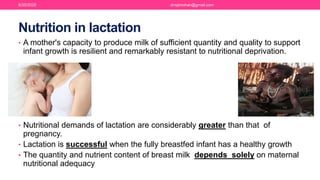
• A mother's capacity to produce milk of sufficient quantity and quality to support
infant growth is resilient and remarkably resistant to nutritional deprivation.
• Nutritional demands of lactation are considerably greater than that of
pregnancy.
• Lactation is successful when the fully breastfed infant has a healthy growth
• The quantity and nutrient content of breast milk depends solely on maternal
nutritional adequacy
6/20/2020 drrejimohan@gmail.com
Extra need
• Needs extra calories
• Needs extra macronutrients
• Needs extra micronutrients
• A varied diet
• An additional 300-450 kcal /day is recommended during pregnancy
• 600 kcal in 1st 6 months of lactation
• 520 kcal in next 6 months of lactation
6/20/2020 drrejimohan@gmail.com
• Maternal milk production is dependent upon
Mobilization of maternal stores
Dietary consumption
• During pregnancy extra 2-5kg (1900-4800kcal) stored in tissue as
fat
• Body stores used to maintain lactation if woman doesn’t consume
extra calories
• Infant demand is the major factor in determining milk volume.
• Macronutrient content of mature milk relatively constant & little
affected by diet except under conditions of severe malnutrition
6/20/2020 drrejimohan@gmail.com
• Milk output varies in the lactating mother
• Mean volume of breast milk/day -780ml (450-1200ml/day)
• Energy content of breast milk-6.7 kcal/100ml
• Maternal factors associated with decreased milk volume include maternal
stress, anxiety, fatigue, illness, maternal insulin resistance, hormonal oral
contraceptives, and smoking.
6/20/2020 drrejimohan@gmail.com
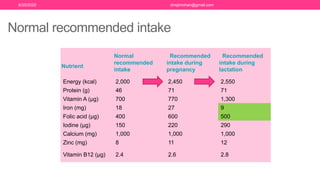
Normal recommended intake
Nutrient
Normal
recommended
intake
Recommended
intake during
pregnancy
Recommended
intake during
lactation
Energy (kcal) 2,000 2,450 2,550
Protein (g) 46 71 71
Vitamin A (μg) 700 770 1,300
Iron (mg) 18 27 9
Folic acid (μg) 400 600 500
Iodine (μg) 150 220 290
Calcium (mg) 1,000 1,000 1,000
Zinc (mg) 8 11 12
Vitamin B12 (μg) 2.4 2.6 2.8
6/20/2020 drrejimohan@gmail.com
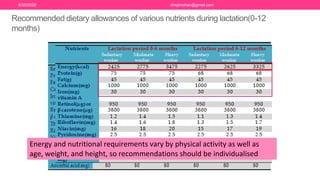
Recommended dietary allowances of various nutrients during lactation(0-12
months)
Energy and nutritional requirements vary by physical activity as well as
age, weight, and height, so recommendations should be individualised
6/20/2020 drrejimohan@gmail.com
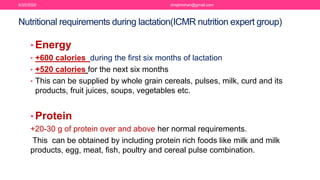
• Energy
• +600 calories during the first six months of lactation
• +520 calories for the next six months
• This can be supplied by whole grain cereals, pulses, milk, curd and its
products, fruit juices, soups, vegetables etc.
• Protein
+20-30 g of protein over and above her normal requirements.
This can be obtained by including protein rich foods like milk and milk
products, egg, meat, fish, poultry and cereal pulse combination.
Nutritional requirements during lactation(ICMR nutrition expert group)
6/20/2020 drrejimohan@gmail.com
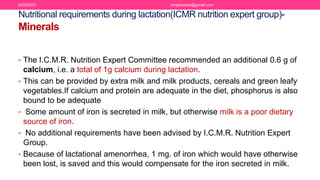
Nutritional requirements during lactation(ICMR nutrition expert group)-
Minerals
• The I.C.M.R. Nutrition Expert Committee recommended an additional 0.6 g of
calcium, i.e. a total of 1g calcium during lactation.
• This can be provided by extra milk and milk products, cereals and green leafy
vegetables.If calcium and protein are adequate in the diet, phosphorus is also
bound to be adequate
• Some amount of iron is secreted in milk, but otherwise milk is a poor dietary
source of iron.
• No additional requirements have been advised by I.C.M.R. Nutrition Expert
Group.
• Because of lactational amenorrhea, 1 mg. of iron which would have otherwise
been lost, is saved and this would compensate for the iron secreted in milk.
6/20/2020 drrejimohan@gmail.com
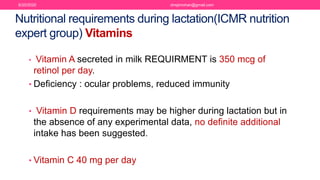
Nutritional requirements during lactation(ICMR nutrition
expert group) Vitamins
• Vitamin A secreted in milk REQUIRMENT is 350 mcg of
retinol per day.
• Deficiency : ocular problems, reduced immunity
• Vitamin D requirements may be higher during lactation but in
the absence of any experimental data, no definite additional
intake has been suggested.
• Vitamin C 40 mg per day
6/20/2020 drrejimohan@gmail.com
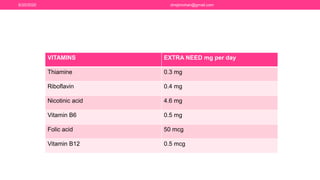
VITAMINS EXTRA NEED mg per day
Thiamine 0.3 mg
Riboflavin 0.4 mg
Nicotinic acid 4.6 mg
Vitamin B6 0.5 mg
Folic acid 50 mcg
Vitamin B12 0.5 mcg
6/20/2020 drrejimohan@gmail.com
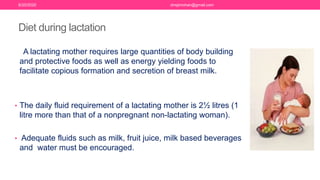
Diet during lactation
A lactating mother requires large quantities of body building
and protective foods as well as energy yielding foods to
facilitate copious formation and secretion of breast milk.
• The daily fluid requirement of a lactating mother is 2½ litres (1
litre more than that of a nonpregnant non-lactating woman).
• Adequate fluids such as milk, fruit juice, milk based beverages
and water must be encouraged.
6/20/2020 drrejimohan@gmail.com
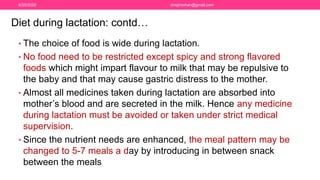
• The choice of food is wide during lactation.
• No food need to be restricted except spicy and strong flavored
foods which might impart flavour to milk that may be repulsive to
the baby and that may cause gastric distress to the mother.
• Almost all medicines taken during lactation are absorbed into
mother’s blood and are secreted in the milk. Hence any medicine
during lactation must be avoided or taken under strict medical
supervision.
• Since the nutrient needs are enhanced, the meal pattern may be
changed to 5-7 meals a day by introducing in between snack
between the meals
Diet during lactation: contd…
6/20/2020 drrejimohan@gmail.com
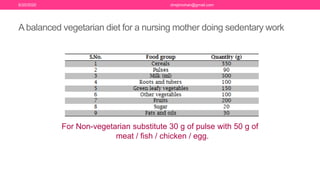
Abalanced vegetarian diet for a nursing mother doing sedentary work
For Non-vegetarian substitute 30 g of pulse with 50 g of
meat / fish / chicken / egg.
6/20/2020 drrejimohan@gmail.com
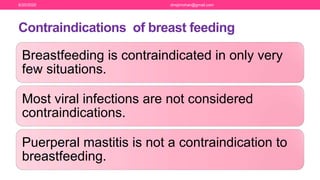
Contraindications of breast feeding
Breastfeeding is contraindicated in only very
few situations.
Most viral infections are not considered
contraindications.
Puerperal mastitis is not a contraindication to
breastfeeding.
6/20/2020 drrejimohan@gmail.com
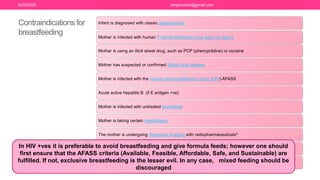
Contraindications for
breastfeeding
Infant is diagnosed with classic galactosemia
Mother is infected with human T-cell lymphotropic virus type I or type II
Mother is using an illicit street drug, such as PCP (phencyclidine) or cocaine
Mother has suspected or confirmed Ebola virus disease
Mother is infected with the human immunodeficiency virus (HIV)-AFASS
Acute active hepatitis B (if E antigen +ve)
Mother is infected with untreated brucellosis
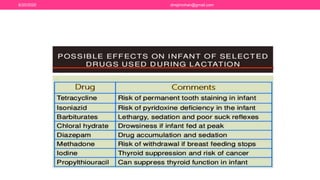
Mother is taking certain medications
The mother is undergoing diagnostic imaging with radiopharmaceuticals2
Mother has an active herpes simplex virus (HSV) infection with lesions present on the breast
(Note: Mothers can breastfeed directly from the unaffected breast if lesions on the affected breast are
covered completely to avoid transmission)
In HIV +ves it is preferable to avoid breastfeeding and give formula feeds; however one should
first ensure that the AFASS criteria (Available, Feasible, Affordable, Safe, and Sustainable) are
fulfilled. If not, exclusive breastfeeding is the lesser evil. In any case, mixed feeding should be
discouraged
6/20/2020 drrejimohan@gmail.com
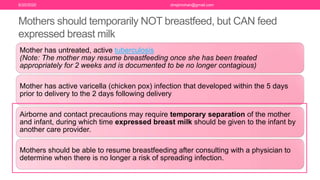
Mothers should temporarily NOT breastfeed, but CAN feed
expressed breast milk
Mother has untreated, active tuberculosis
(Note: The mother may resume breastfeeding once she has been treated
appropriately for 2 weeks and is documented to be no longer contagious)
Mother has active varicella (chicken pox) infection that developed within the 5 days
prior to delivery to the 2 days following delivery
Airborne and contact precautions may require temporary separation of the mother
and infant, during which time expressed breast milk should be given to the infant by
another care provider.
Mothers should be able to resume breastfeeding after consulting with a physician to
determine when there is no longer a risk of spreading infection.
6/20/2020 drrejimohan@gmail.com
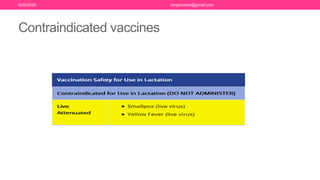
Contraindicated vaccines
6/20/2020 drrejimohan@gmail.com
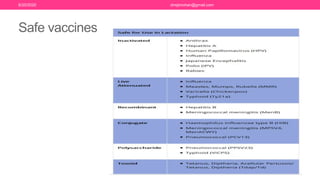
Safe vaccines
6/20/2020 drrejimohan@gmail.com
General considerations in drug therapy
-Avoid drug therapy when possible
Use topical when possible
Medicines that are safe for infants are generally considered safe
Medicines that are safe in pregnancy are not always safe in breast feeding
Always use reliable references before prescribing
Administer single daily dose jus before longest sleep interval for the infant usually after bedtime feeding
Breastfeed immediately medicine dose when multiple daily doses are needed
6/20/2020 drrejimohan@gmail.com
Maternal Drugs
• Chemotherapy agents – certain agents, discontinue breastfeeding for as
long as they remain in the milk
• Primaquine and Quinine – contraindicated if either infant or mother has
G6PD
• Metronidazole – discontinue breastfeeding until at least 12-24 hours after
medication
• Sulfa drugs – may be a problem in infants with jaundice or G6PD, stressed
or premature
• Radioactive isotope – discontinue breastfeeding for as long as the
radioactivity is in the milk
• Drugs of abuse – discontinue breastfeeding until drugs are out of maternal
system
6/20/2020 drrejimohan@gmail.com
To summarise
Nutrition in lactation is a key modifiable factor that affects infant
outcomes and has long-term effects on the health of offspring.
Patient nutrition risk and habits should be assessed early in
pregnancy and modified
Consultation with a trained specialist in maternal nutrition, such as
a registered dietitian, is recommended for women with high
nutrition risk.
Always use reliable references before prescribing drugs to a
lactating women
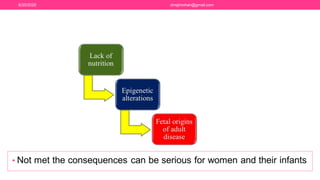
6/20/2020 drrejimohan@gmail.com
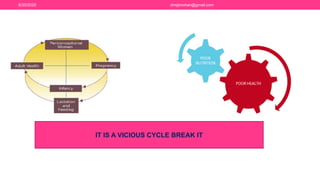
IT IS A VICIOUS CYCLE BREAK IT
6/20/2020 drrejimohan@gmail.com
References
1. Breast feeding in practice:module for trainers
2. ICMR nutrition expert group guidelines
3. CDC recommendations 2018-19-maternal nutrition during lactation
4. Uptodate recommendations 2019-maternal nutrition during lactation
6/20/2020 drrejimohan@gmail.com
GOD BLESS YOU
drrejimohan@gmail.com
6/20/2020 drrejimohan@gmail.com

NUTRITIONAL SUPPORT FOR THE MOTHER

  • 1.
    NUTRITIONAL SUPPORT FORTHE MOTHER & CONTRAINDICATIONS IN BREAST FEEDING DR REJI MOHAN,MD,DNB,FELLOW in RM ASSISTANT PROFESSOR DEPT OF REPRODUCTIVE MEDICINE AND SURGERY SREE AVITTOM THIRUNAAL HOSPITAL GOVT MEDICAL COLLEGE THIRUVANANTHAPURAM 6/20/2020 drrejimohan@gmail.com
  • 2.
    My sincere gratitude Topicoutline Introduction Nutrition in lactation Recommended dietery allowances Contraindications for breastfeeding Conclusion Almighty Teachers Colleagues Students Well wishers Family My patients Organizers 6/20/2020 drrejimohan@gmail.com
  • 3.
    Nutrition in lactation •A mother's capacity to produce milk of sufficient quantity and quality to support infant growth is resilient and remarkably resistant to nutritional deprivation. • Nutritional demands of lactation are considerably greater than that of pregnancy. • Lactation is successful when the fully breastfed infant has a healthy growth • The quantity and nutrient content of breast milk depends solely on maternal nutritional adequacy 6/20/2020 drrejimohan@gmail.com
  • 4.
  • 5.
    Extra need • Needsextra calories • Needs extra macronutrients • Needs extra micronutrients • A varied diet • An additional 300-450 kcal /day is recommended during pregnancy • 600 kcal in 1st 6 months of lactation • 520 kcal in next 6 months of lactation 6/20/2020 drrejimohan@gmail.com
  • 6.
    • Maternal milkproduction is dependent upon Mobilization of maternal stores Dietary consumption • During pregnancy extra 2-5kg (1900-4800kcal) stored in tissue as fat • Body stores used to maintain lactation if woman doesn’t consume extra calories • Infant demand is the major factor in determining milk volume. • Macronutrient content of mature milk relatively constant & little affected by diet except under conditions of severe malnutrition 6/20/2020 drrejimohan@gmail.com
  • 7.
    • Milk outputvaries in the lactating mother • Mean volume of breast milk/day -780ml (450-1200ml/day) • Energy content of breast milk-6.7 kcal/100ml • Maternal factors associated with decreased milk volume include maternal stress, anxiety, fatigue, illness, maternal insulin resistance, hormonal oral contraceptives, and smoking. 6/20/2020 drrejimohan@gmail.com
  • 8.
    Normal recommended intake Nutrient Normal recommended intake Recommended intakeduring pregnancy Recommended intake during lactation Energy (kcal) 2,000 2,450 2,550 Protein (g) 46 71 71 Vitamin A (μg) 700 770 1,300 Iron (mg) 18 27 9 Folic acid (μg) 400 600 500 Iodine (μg) 150 220 290 Calcium (mg) 1,000 1,000 1,000 Zinc (mg) 8 11 12 Vitamin B12 (μg) 2.4 2.6 2.8 6/20/2020 drrejimohan@gmail.com
  • 9.
    Recommended dietary allowancesof various nutrients during lactation(0-12 months) Energy and nutritional requirements vary by physical activity as well as age, weight, and height, so recommendations should be individualised 6/20/2020 drrejimohan@gmail.com
  • 10.
    • Energy • +600calories during the first six months of lactation • +520 calories for the next six months • This can be supplied by whole grain cereals, pulses, milk, curd and its products, fruit juices, soups, vegetables etc. • Protein +20-30 g of protein over and above her normal requirements. This can be obtained by including protein rich foods like milk and milk products, egg, meat, fish, poultry and cereal pulse combination. Nutritional requirements during lactation(ICMR nutrition expert group) 6/20/2020 drrejimohan@gmail.com
  • 11.
    Nutritional requirements duringlactation(ICMR nutrition expert group)- Minerals • The I.C.M.R. Nutrition Expert Committee recommended an additional 0.6 g of calcium, i.e. a total of 1g calcium during lactation. • This can be provided by extra milk and milk products, cereals and green leafy vegetables.If calcium and protein are adequate in the diet, phosphorus is also bound to be adequate • Some amount of iron is secreted in milk, but otherwise milk is a poor dietary source of iron. • No additional requirements have been advised by I.C.M.R. Nutrition Expert Group. • Because of lactational amenorrhea, 1 mg. of iron which would have otherwise been lost, is saved and this would compensate for the iron secreted in milk. 6/20/2020 drrejimohan@gmail.com
  • 12.
    Nutritional requirements duringlactation(ICMR nutrition expert group) Vitamins • Vitamin A secreted in milk REQUIRMENT is 350 mcg of retinol per day. • Deficiency : ocular problems, reduced immunity • Vitamin D requirements may be higher during lactation but in the absence of any experimental data, no definite additional intake has been suggested. • Vitamin C 40 mg per day 6/20/2020 drrejimohan@gmail.com
  • 13.
    VITAMINS EXTRA NEEDmg per day Thiamine 0.3 mg Riboflavin 0.4 mg Nicotinic acid 4.6 mg Vitamin B6 0.5 mg Folic acid 50 mcg Vitamin B12 0.5 mcg 6/20/2020 drrejimohan@gmail.com
  • 14.
    Diet during lactation Alactating mother requires large quantities of body building and protective foods as well as energy yielding foods to facilitate copious formation and secretion of breast milk. • The daily fluid requirement of a lactating mother is 2½ litres (1 litre more than that of a nonpregnant non-lactating woman). • Adequate fluids such as milk, fruit juice, milk based beverages and water must be encouraged. 6/20/2020 drrejimohan@gmail.com
  • 15.
    • The choiceof food is wide during lactation. • No food need to be restricted except spicy and strong flavored foods which might impart flavour to milk that may be repulsive to the baby and that may cause gastric distress to the mother. • Almost all medicines taken during lactation are absorbed into mother’s blood and are secreted in the milk. Hence any medicine during lactation must be avoided or taken under strict medical supervision. • Since the nutrient needs are enhanced, the meal pattern may be changed to 5-7 meals a day by introducing in between snack between the meals Diet during lactation: contd… 6/20/2020 drrejimohan@gmail.com
  • 16.
    Abalanced vegetarian dietfor a nursing mother doing sedentary work For Non-vegetarian substitute 30 g of pulse with 50 g of meat / fish / chicken / egg. 6/20/2020 drrejimohan@gmail.com
  • 17.
    Contraindications of breastfeeding Breastfeeding is contraindicated in only very few situations. Most viral infections are not considered contraindications. Puerperal mastitis is not a contraindication to breastfeeding. 6/20/2020 drrejimohan@gmail.com
  • 18.
    Contraindications for breastfeeding Infant isdiagnosed with classic galactosemia Mother is infected with human T-cell lymphotropic virus type I or type II Mother is using an illicit street drug, such as PCP (phencyclidine) or cocaine Mother has suspected or confirmed Ebola virus disease Mother is infected with the human immunodeficiency virus (HIV)-AFASS Acute active hepatitis B (if E antigen +ve) Mother is infected with untreated brucellosis Mother is taking certain medications The mother is undergoing diagnostic imaging with radiopharmaceuticals2 Mother has an active herpes simplex virus (HSV) infection with lesions present on the breast (Note: Mothers can breastfeed directly from the unaffected breast if lesions on the affected breast are covered completely to avoid transmission) In HIV +ves it is preferable to avoid breastfeeding and give formula feeds; however one should first ensure that the AFASS criteria (Available, Feasible, Affordable, Safe, and Sustainable) are fulfilled. If not, exclusive breastfeeding is the lesser evil. In any case, mixed feeding should be discouraged 6/20/2020 drrejimohan@gmail.com
  • 19.
    Mothers should temporarilyNOT breastfeed, but CAN feed expressed breast milk Mother has untreated, active tuberculosis (Note: The mother may resume breastfeeding once she has been treated appropriately for 2 weeks and is documented to be no longer contagious) Mother has active varicella (chicken pox) infection that developed within the 5 days prior to delivery to the 2 days following delivery Airborne and contact precautions may require temporary separation of the mother and infant, during which time expressed breast milk should be given to the infant by another care provider. Mothers should be able to resume breastfeeding after consulting with a physician to determine when there is no longer a risk of spreading infection. 6/20/2020 drrejimohan@gmail.com
  • 20.
  • 21.
  • 22.
    General considerations indrug therapy -Avoid drug therapy when possible Use topical when possible Medicines that are safe for infants are generally considered safe Medicines that are safe in pregnancy are not always safe in breast feeding Always use reliable references before prescribing Administer single daily dose jus before longest sleep interval for the infant usually after bedtime feeding Breastfeed immediately medicine dose when multiple daily doses are needed 6/20/2020 drrejimohan@gmail.com
  • 23.
    Maternal Drugs • Chemotherapyagents – certain agents, discontinue breastfeeding for as long as they remain in the milk • Primaquine and Quinine – contraindicated if either infant or mother has G6PD • Metronidazole – discontinue breastfeeding until at least 12-24 hours after medication • Sulfa drugs – may be a problem in infants with jaundice or G6PD, stressed or premature • Radioactive isotope – discontinue breastfeeding for as long as the radioactivity is in the milk • Drugs of abuse – discontinue breastfeeding until drugs are out of maternal system 6/20/2020 drrejimohan@gmail.com
  • 24.
  • 25.
    To summarise Nutrition inlactation is a key modifiable factor that affects infant outcomes and has long-term effects on the health of offspring. Patient nutrition risk and habits should be assessed early in pregnancy and modified Consultation with a trained specialist in maternal nutrition, such as a registered dietitian, is recommended for women with high nutrition risk. Always use reliable references before prescribing drugs to a lactating women 6/20/2020 drrejimohan@gmail.com
  • 26.
    IT IS AVICIOUS CYCLE BREAK IT 6/20/2020 drrejimohan@gmail.com
  • 27.
    References 1. Breast feedingin practice:module for trainers 2. ICMR nutrition expert group guidelines 3. CDC recommendations 2018-19-maternal nutrition during lactation 4. Uptodate recommendations 2019-maternal nutrition during lactation 6/20/2020 drrejimohan@gmail.com
  • 28.