Nursing Care Plan
Assessment Nursing Diagnosis Planning Nursing Interventions Rationale Evaluation
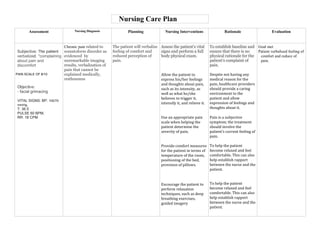
Subjective: The patient
verbalized, "complaining
about pain and
discomfort
PAIN SCALE OF 8/10
Objective:
- facial grimacing
VITAL SIGNS: BP: 100/70
mmHg,
T: 36.5
PULSE 60 BPM,
RR: 18 CPM
Chronic pain related to
somatoform disorder as
evidenced by
unremarkable imaging
results, verbalization of
pain that cannot be
explained medically,
restlessness
The patient will verbalize
feeling of comfort and
reduced perception of
pain.
Assess the patient’s vital
signs and perform a full
body physical exam.
Allow the patient to
express his/her feelings
and thoughts about pain,
such as its intensity, as
well as what he/she
believes to trigger it,
intensify it, and relieve it.
Use an appropriate pain
scale when helping the
patient determine the
severity of pain.
Provide comfort measures
for the patient in terms of
temperature of the room,
positioning of the bed,
provision of pillows.
Encourage the patient to
perform relaxation
techniques, such as deep
breathing exercises,
guided imagery
To establish baseline and
ensure that there is no
physical rationale for the
patient’s complaint of
pain.
Despite not having any
medical reason for the
pain, healthcare providers
should provide a caring
environment to the
patient and allow
expression of feelings and
thoughts about it.
Pain is a subjective
symptom; the treatment
should involve the
patient’s current feeling of
pain.
To help the patient
become relaxed and feel
comfortable. This can also
help establish rapport
between the nurse and the
patient.
To help the patient
become relaxed and feel
comfortable. This can also
help establish rapport
between the nurse and the
patient.
Goal met
Patient verbalized feeling of
comfort and reduce of
pain.
Nursing Care Plan
Assessment Nursing Diagnosis Planning Nursing Interventions Rationale Evaluation
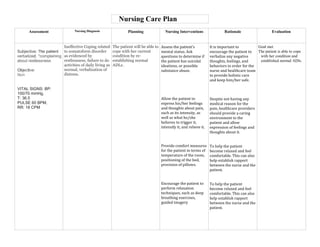
Subjective: The patient
verbalized, "complaining
about restlessness
Objective:
Non
VITAL SIGNS: BP:
100/70 mmHg,
T: 36.5
PULSE 60 BPM,
RR: 18 CPM
Ineffective Coping related
to somatoform disorder
as evidenced by
restlessness, failure to do
activities of daily living as
normal, verbalization of
distress.
The patient will be able to
cope with her current
condition by re-
establishing normal
ADLs.
Assess the patient’s
mental status. Ask
questions to determine if
the patient has suicidal
ideations, or possible
substance abuse.
Allow the patient to
express his/her feelings
and thoughts about pain,
such as its intensity, as
well as what he/she
believes to trigger it,
intensify it, and relieve it.
Provide comfort measures
for the patient in terms of
temperature of the room,
positioning of the bed,
provision of pillows.
Encourage the patient to
perform relaxation
techniques, such as deep
breathing exercises,
guided imagery
It is important to
encourage the patient to
verbalize any negative
thoughts, feelings, and
behaviors in order for the
nurse and healthcare team
to provide holistic care
and keep him/her safe.
Despite not having any
medical reason for the
pain, healthcare providers
should provide a caring
environment to the
patient and allow
expression of feelings and
thoughts about it.
To help the patient
become relaxed and feel
comfortable. This can also
help establish rapport
between the nurse and the
patient.
To help the patient
become relaxed and feel
comfortable. This can also
help establish rapport
between the nurse and the
patient.
Goal met
The patient is able to cope
with her condition and
established normal ADls.
Nursing Care Plan
Assessment Nursing Diagnosis Planning Nursing Interventions Rationale Evaluation
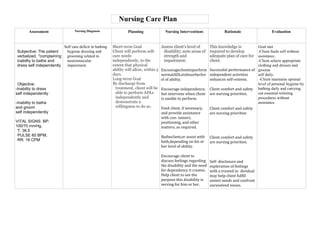
Subjective: The patient
verbalized, "complaining
negative feelings about
bodily changes
Objective:
- Refusal to talk about
physical changes
-Does not look at the
body part
VITAL SIGNS: BP:
100/70 mmHg,
T: 36.5
PULSE 60 BPM,
RR: 18 CPM
Disturbed Body Image
Weight loss
The patient will identify
irrational beliefs and use
new coping strategies to
enhance perception
about body image.
Encourage the patient to
express feelings about
body changes.
Praise the patient every
time he or she is
cooperative and willing to
participate in care.
Provide resources, such
as a list of support
groups.
Encourage the patient in
self-care with a step-by-
step approach.
Advise the patient to
focus on remaining
abilities.
Sharing their feelings
provides excellent insight
into the patient’s
insecurities and helps the
nurse in individualizing
care.
Positive reinforcement
promotes self-esteem
and motivates the patient
to continue care.
Patients may benefit from
exchanging experiences,
feelings, and thoughts
with people going through
the same hardships.
This approach allows the
patient to become used
to the altered body part or
function without
overwhelming the
patient.
Strengthening skills can
boost the patient’s
confidence and distract
from feelings of loss.
Goal met
The patient verbalized
acceptance of body
image
Nursing Care Plan
Assessment Nursing Diagnosis Planning Nursing Interventions Rationale Evaluation
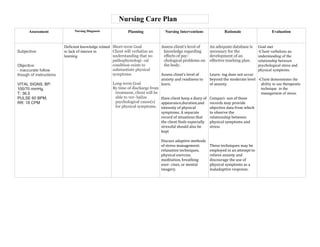
Subjective: The patient
verbalized, "complaining
inability to bathe and
dress self independently
Objective:
-Inability to dress
self independently
-Inability to bathe
and groom
self independently
VITAL SIGNS: BP:
100/70 mmHg,
T: 36.5
PULSE 60 BPM,
RR: 18 CPM
Self care deficit in bathing
hygiene dressing and
grooming related to
neuromuscular
impairment.
Short-term Goal
Client will perform self-
care needs
independently, to the
extent that physical
ability will allow, within 5
days.
Long-term Goal
By discharge from
treatment, client will be
able to perform ADLs
independently and
demonstrate a
willingness to do so.
Assess client’s level of
disability; note areas of
strength and
impairment.
Encourageclienttoperform
normalADLstohisorherlev
el of ability.
Encourage independence,
but intervene when client
is unable to perform.
Feed client, if necessary,
and provide assistance
with con- tainers,
positioning, and other
matters, as required.
Batheclient,or assist with
bath,depending on his or
her level of ability.
Encourage client to
discuss feelings regarding
the disability and the need
for dependency it creates.
Help client to see the
purpose this disability is
serving for him or her.
This knowledge is
required to develop
adequate plan of care for
client.
Successful performance of
independent activities
enhances self-esteem.
Client comfort and safety
are nursing priorities.
Client comfort and safety
are nursing priorities
Client comfort and safety
are nursing priorities.
Self- disclosure and
exploration of feelings
with a trusted in- dividual
may help client fulfill
unmet needs and confront
unresolved issues.
Goal met
-Client feeds self without
assistance.
-Client selects appropriate
clothing and dresses and
grooms
self daily.
-Client maintains optimal
level of personal hygiene by
bathing daily and carrying
out essential toileting
procedures without
assistance.
Nursing Care Plan
Assessment Nursing Diagnosis Planning Nursing Interventions Rationale Evaluation
Subjective:
Objective:
- inaccurate follow
though of instructions
VITAL SIGNS: BP:
100/70 mmHg,
T: 36.5
PULSE 60 BPM,
RR: 18 CPM
Deficient knowledge related
to lack of interest in
learning
Short-term Goal
Client will verbalize an
understanding that no
pathophysiologi- cal
condition exists to
substantiate physical
symptoms.
Long-term Goal
By time of discharge from
treatment, client will be
able to ver- balize
psychological cause(s)
for physical symptoms.
Assess client’s level of
knowledge regarding
effects of psy-
chological problems on
the body.
Assess client’s level of
anxiety and readiness to
learn.
Have client keep a diary of
appearance,duration,and
intensity of physical
symptoms. A separate
record of situations that
the client finds especially
stressful should also be
kept
Discuss adaptive methods
of stress management:
relaxation techniques,
physical exercise,
meditation, breathing
exer- cises, or mental
imagery.
An adequate database is
necessary for the
development of an
effective teaching plan.
Learn- ing does not occur
beyond the moderate level
of anxiety.
Compari- son of these
records may provide
objective data from which
to observe the
relationship between
physical symptoms and
stress
These techniques may be
employed in an attempt to
relieve anxiety and
discourage the use of
physical symptoms as a
maladaptive response.
Goal met
-Client verbalizes an
understanding of the
relationship between
psychological stress and
physical symptoms.
-Client demonstrates the
ability to use therapeutic
technique in the
management of stress.

Nursing Care Plan somatoform-disorders.docx

  • 1.
    Nursing Care Plan AssessmentNursing Diagnosis Planning Nursing Interventions Rationale Evaluation Subjective: The patient verbalized, "complaining about pain and discomfort PAIN SCALE OF 8/10 Objective: - facial grimacing VITAL SIGNS: BP: 100/70 mmHg, T: 36.5 PULSE 60 BPM, RR: 18 CPM Chronic pain related to somatoform disorder as evidenced by unremarkable imaging results, verbalization of pain that cannot be explained medically, restlessness The patient will verbalize feeling of comfort and reduced perception of pain. Assess the patient’s vital signs and perform a full body physical exam. Allow the patient to express his/her feelings and thoughts about pain, such as its intensity, as well as what he/she believes to trigger it, intensify it, and relieve it. Use an appropriate pain scale when helping the patient determine the severity of pain. Provide comfort measures for the patient in terms of temperature of the room, positioning of the bed, provision of pillows. Encourage the patient to perform relaxation techniques, such as deep breathing exercises, guided imagery To establish baseline and ensure that there is no physical rationale for the patient’s complaint of pain. Despite not having any medical reason for the pain, healthcare providers should provide a caring environment to the patient and allow expression of feelings and thoughts about it. Pain is a subjective symptom; the treatment should involve the patient’s current feeling of pain. To help the patient become relaxed and feel comfortable. This can also help establish rapport between the nurse and the patient. To help the patient become relaxed and feel comfortable. This can also help establish rapport between the nurse and the patient. Goal met Patient verbalized feeling of comfort and reduce of pain.
  • 2.
    Nursing Care Plan AssessmentNursing Diagnosis Planning Nursing Interventions Rationale Evaluation Subjective: The patient verbalized, "complaining about restlessness Objective: Non VITAL SIGNS: BP: 100/70 mmHg, T: 36.5 PULSE 60 BPM, RR: 18 CPM Ineffective Coping related to somatoform disorder as evidenced by restlessness, failure to do activities of daily living as normal, verbalization of distress. The patient will be able to cope with her current condition by re- establishing normal ADLs. Assess the patient’s mental status. Ask questions to determine if the patient has suicidal ideations, or possible substance abuse. Allow the patient to express his/her feelings and thoughts about pain, such as its intensity, as well as what he/she believes to trigger it, intensify it, and relieve it. Provide comfort measures for the patient in terms of temperature of the room, positioning of the bed, provision of pillows. Encourage the patient to perform relaxation techniques, such as deep breathing exercises, guided imagery It is important to encourage the patient to verbalize any negative thoughts, feelings, and behaviors in order for the nurse and healthcare team to provide holistic care and keep him/her safe. Despite not having any medical reason for the pain, healthcare providers should provide a caring environment to the patient and allow expression of feelings and thoughts about it. To help the patient become relaxed and feel comfortable. This can also help establish rapport between the nurse and the patient. To help the patient become relaxed and feel comfortable. This can also help establish rapport between the nurse and the patient. Goal met The patient is able to cope with her condition and established normal ADls.
  • 3.
    Nursing Care Plan AssessmentNursing Diagnosis Planning Nursing Interventions Rationale Evaluation Subjective: The patient verbalized, "complaining negative feelings about bodily changes Objective: - Refusal to talk about physical changes -Does not look at the body part VITAL SIGNS: BP: 100/70 mmHg, T: 36.5 PULSE 60 BPM, RR: 18 CPM Disturbed Body Image Weight loss The patient will identify irrational beliefs and use new coping strategies to enhance perception about body image. Encourage the patient to express feelings about body changes. Praise the patient every time he or she is cooperative and willing to participate in care. Provide resources, such as a list of support groups. Encourage the patient in self-care with a step-by- step approach. Advise the patient to focus on remaining abilities. Sharing their feelings provides excellent insight into the patient’s insecurities and helps the nurse in individualizing care. Positive reinforcement promotes self-esteem and motivates the patient to continue care. Patients may benefit from exchanging experiences, feelings, and thoughts with people going through the same hardships. This approach allows the patient to become used to the altered body part or function without overwhelming the patient. Strengthening skills can boost the patient’s confidence and distract from feelings of loss. Goal met The patient verbalized acceptance of body image
  • 4.
    Nursing Care Plan AssessmentNursing Diagnosis Planning Nursing Interventions Rationale Evaluation Subjective: The patient verbalized, "complaining inability to bathe and dress self independently Objective: -Inability to dress self independently -Inability to bathe and groom self independently VITAL SIGNS: BP: 100/70 mmHg, T: 36.5 PULSE 60 BPM, RR: 18 CPM Self care deficit in bathing hygiene dressing and grooming related to neuromuscular impairment. Short-term Goal Client will perform self- care needs independently, to the extent that physical ability will allow, within 5 days. Long-term Goal By discharge from treatment, client will be able to perform ADLs independently and demonstrate a willingness to do so. Assess client’s level of disability; note areas of strength and impairment. Encourageclienttoperform normalADLstohisorherlev el of ability. Encourage independence, but intervene when client is unable to perform. Feed client, if necessary, and provide assistance with con- tainers, positioning, and other matters, as required. Batheclient,or assist with bath,depending on his or her level of ability. Encourage client to discuss feelings regarding the disability and the need for dependency it creates. Help client to see the purpose this disability is serving for him or her. This knowledge is required to develop adequate plan of care for client. Successful performance of independent activities enhances self-esteem. Client comfort and safety are nursing priorities. Client comfort and safety are nursing priorities Client comfort and safety are nursing priorities. Self- disclosure and exploration of feelings with a trusted in- dividual may help client fulfill unmet needs and confront unresolved issues. Goal met -Client feeds self without assistance. -Client selects appropriate clothing and dresses and grooms self daily. -Client maintains optimal level of personal hygiene by bathing daily and carrying out essential toileting procedures without assistance.
  • 5.
    Nursing Care Plan AssessmentNursing Diagnosis Planning Nursing Interventions Rationale Evaluation Subjective: Objective: - inaccurate follow though of instructions VITAL SIGNS: BP: 100/70 mmHg, T: 36.5 PULSE 60 BPM, RR: 18 CPM Deficient knowledge related to lack of interest in learning Short-term Goal Client will verbalize an understanding that no pathophysiologi- cal condition exists to substantiate physical symptoms. Long-term Goal By time of discharge from treatment, client will be able to ver- balize psychological cause(s) for physical symptoms. Assess client’s level of knowledge regarding effects of psy- chological problems on the body. Assess client’s level of anxiety and readiness to learn. Have client keep a diary of appearance,duration,and intensity of physical symptoms. A separate record of situations that the client finds especially stressful should also be kept Discuss adaptive methods of stress management: relaxation techniques, physical exercise, meditation, breathing exer- cises, or mental imagery. An adequate database is necessary for the development of an effective teaching plan. Learn- ing does not occur beyond the moderate level of anxiety. Compari- son of these records may provide objective data from which to observe the relationship between physical symptoms and stress These techniques may be employed in an attempt to relieve anxiety and discourage the use of physical symptoms as a maladaptive response. Goal met -Client verbalizes an understanding of the relationship between psychological stress and physical symptoms. -Client demonstrates the ability to use therapeutic technique in the management of stress.