Designing a
Curriculum and
Instructional
Plan
Subject: Mathematics 6
PREPARED BY:
HELEN D. DIOMANGAY
I. Context Selection
San Miguel Elementary School develops curriculum enhancement plan for
Mathematics subject in grade 6 to enhance the numeracy skills of the learners.
Located in a remote area, the school serves as a pivotal institution within the
local community, catering to the educational needs of Grade 6 learners. The
context encompasses the school's infrastructure, resources, student
demographics, and the broader socio-economic and cultural characteristics of the
community it serves. Understanding the demographics of the student body is
essential for contextualizing the curriculum enhancement plan. Information about
the cultural backgrounds, socio-economic status, and varying learning needs of
Grade 6 learners inform the design and implementation of the curriculum. The
plan should be sensitive to the diversity within the student population, ensuring
inclusivity and cultural relevance.
The context includes an assessment of the resources available to the school. This
encompasses physical resources such as classrooms, laboratories, and technology
infrastructure, as well as human resources, including educators and support staff. The plan
acknowledges the existing resources and proposes enhancements or optimizations to
ensure effective implementation. The curriculum enhancement plan considers the level of
community engagement and collaboration. Involving parents, local community members,
and relevant stakeholders in the planning and implementation processes fosters a sense of
shared responsibility for students' education. This community engagement contributes to a
supportive learning environment that extends beyond the classroom.
Given the diverse cultural context of the community, the curriculum enhancement plan
prioritizes cultural sensitivity and local relevance. It acknowledges the unique cultural
backgrounds of students and integrates content that resonates with their experiences,
fostering a sense of identity and pride in one's cultural heritage. The context emphasizes the
commitment to continuous improvement. The plan incorporates feedback mechanisms,
ensuring that regular assessments, reviews, and evaluations are conducted. This iterative
approach allows for adaptability, responsiveness to changing needs, and ongoing
enhancement of the curriculum.
The context recognizes potential challenges, such as limited resources, technological
disparities, or socio-economic factors affecting students. Simultaneously, it identifies
opportunities for innovation, collaboration, and leveraging available resources effectively to
overcome challenges and enhance the overall educational experience.
II. Needs Assessment
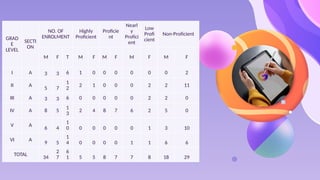
The Numeracy Result of Grade 6 learners for the first quarter
school year 2023-2024 at San Miguel School provide valuable insights
into the performance of Grade 1 pupils in Mathematics subject. A
scholarly discussion of these scores involves analyzing trends, identifying
strengths and weaknesses, and considering potential implications for
educational strategies and interventions.
The analysis provides a foundation for targeted interventions,
continuous improvement strategies, and informed decision-making to
enhance the overall educational experience for Grade 6 pupils.
GRAD
E
LEVEL
SECTI
ON
NO. OF
ENROLMENT
Highly
Proficient
Proficie
nt
Nearl
y
Profici
ent
Low
Profi
cient
Non-Proficient
M F T M F M F M F M F
I A 3 3 6 1 0 0 0 0 0 0 2
II A
5 7
1
2
2 1 0 0 0 2 2 11
III A 3 3 6 0 0 0 0 0 2 2 0
IV A 8 5
1
3
2 4 8 7 6 2 5 0
V A
6 4
1
0 0 0 0 0 0 1 3 10
VI A
9 5
1
4 0 0 0 0 1 1 6 6
TOTAL
34
2
7
6
1 5 5 8 7 7 8 18 29
III. Curriculum
Design
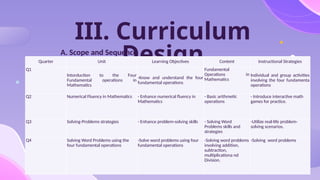
A. Scope and Sequence
Quarter Unit Learning Objectives Content Instructional Strategies
Q1
Intorduction to the Four
Fundamental operations in
Mathematics
-Know and understand the four
fundamental operations
Fundamental
Operations in
Mathematics
Individual and group activities
involving the four fundamenta
operations
Q2 Numerical Fluency in Mathematics - Enhance numerical fluency in
Mathematics
- Basic arithmetic
operations
- Introduce interactive math
games for practice.
Q3 Solving-Problems strategies - Enhance problem-solving skills - Solving Word
Problems skills and
strategies
-Utilize real-life problem-
solving scenarios.
Q4 Solving Word Problems using the
four fundamental operations
-Solve word problems using four
fundamental operations
-Solving word problems
involving addition,
subtraction,
multiplicationa nd
Division.
-Solving word problems
III. Curriculum
Design
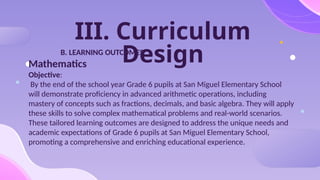
B. LEARNING OUTCOMES
Mathematics
Objective:
By the end of the school year Grade 6 pupils at San Miguel Elementary School
will demonstrate proficiency in advanced arithmetic operations, including
mastery of concepts such as fractions, decimals, and basic algebra. They will apply
these skills to solve complex mathematical problems and real-world scenarios.
These tailored learning outcomes are designed to address the unique needs and
academic expectations of Grade 6 pupils at San Miguel Elementary School,
promoting a comprehensive and enriching educational experience.
III. Curriculum
Design
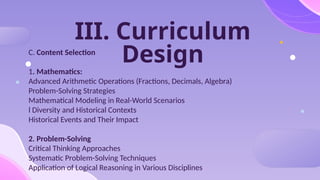
C. Content Selection
1. Mathematics:
Advanced Arithmetic Operations (Fractions, Decimals, Algebra)
Problem-Solving Strategies
Mathematical Modeling in Real-World Scenarios
l Diversity and Historical Contexts
Historical Events and Their Impact
2. Problem-Solving
Critical Thinking Approaches
Systematic Problem-Solving Techniques
Application of Logical Reasoning in Various Disciplines
III. Curriculum
Design
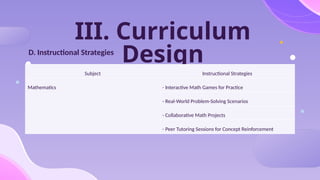
D. Instructional Strategies
Subject Instructional Strategies
Mathematics - Interactive Math Games for Practice
- Real-World Problem-Solving Scenarios
- Collaborative Math Projects
- Peer Tutoring Sessions for Concept Reinforcement
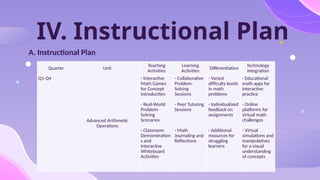
IV. Instructional Plan
A. Instructional Plan
Quarter Unit
Teaching
Activities
Learning
Activities
Differentiation
Technology
Integration
Q1-Q4
Advanced Arithmetic
Operations
- Interactive
Math Games
for Concept
Introduction
- Collaborative
Problem-
Solving
Sessions
- Varied
difficulty levels
in math
problems
- Educational
math apps for
interactive
practice
- Real-World
Problem-
Solving
Scenarios
- Peer Tutoring
Sessions
- Individualized
feedback on
assignments
- Online
platforms for
virtual math
challenges
- Classroom
Demonstration
s and
Interactive
Whiteboard
Activities
- Math
Journaling and
Reflections
- Additional
resources for
struggling
learners
- Virtual
simulations and
manipulatives
for a visual
understanding
of concepts
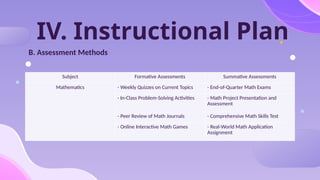
IV. Instructional Plan
B. Assessment Methods
Subject Formative Assessments Summative Assessments
Mathematics - Weekly Quizzes on Current Topics - End-of-Quarter Math Exams
- In-Class Problem-Solving Activities - Math Project Presentation and
Assessment
- Peer Review of Math Journals - Comprehensive Math Skills Test
- Online Interactive Math Games - Real-World Math Application
Assignment
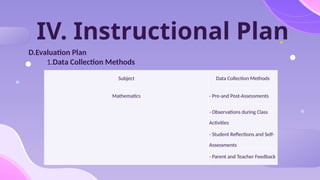
IV. Instructional Plan
D.Evaluation Plan
1.Data Collection Methods
Subject Data Collection Methods
Mathematics - Pre-and Post-Assessments
- Observations during Class
Activities
- Student Reflections and Self-
Assessments
- Parent and Teacher Feedback
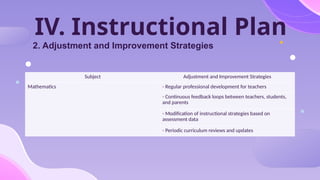
IV. Instructional Plan
2. Adjustment and Improvement Strategies
Subject Adjustment and Improvement Strategies
Mathematics - Regular professional development for teachers
- Continuous feedback loops between teachers, students,
and parents
- Modification of instructional strategies based on
assessment data
- Periodic curriculum reviews and updates
V. Implementation
Plan
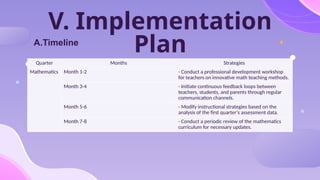
Quarter Months Strategies
Mathematics Month 1-2 - Conduct a professional development workshop
for teachers on innovative math teaching methods.
Month 3-4 - Initiate continuous feedback loops between
teachers, students, and parents through regular
communication channels.
Month 5-6 - Modify instructional strategies based on the
analysis of the first quarter's assessment data.
Month 7-8 - Conduct a periodic review of the mathematics
curriculum for necessary updates.
A.Timeline
V. Implementation
Plan
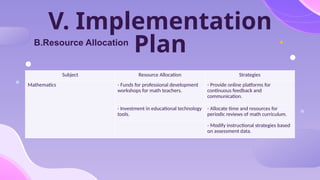
B.Resource Allocation
Subject Resource Allocation Strategies
Mathematics - Funds for professional development
workshops for math teachers.
- Provide online platforms for
continuous feedback and
communication.
- Investment in educational technology
tools.
- Allocate time and resources for
periodic reviews of math curriculum.
- Modify instructional strategies based
on assessment data.
V. Implementation
Plan
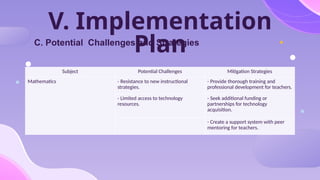
C. Potential Challenges and Strategies
Subject Potential Challenges Mitigation Strategies
Mathematics - Resistance to new instructional
strategies.
- Provide thorough training and
professional development for teachers.
- Limited access to technology
resources.
- Seek additional funding or
partnerships for technology
acquisition.
- Create a support system with peer
mentoring for teachers.
V. Implementation
Plan
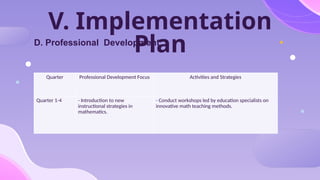
D. Professional Development
Quarter Professional Development Focus Activities and Strategies
Quarter 1-4 - Introduction to new
instructional strategies in
mathematics.
- Conduct workshops led by education specialists on
innovative math teaching methods.
VI. Presentation and Reflection
Curriculum designing is pivotal in developing the righ and appropriate skillls of the
clienetele. It is a must to know the needs of the recipient to develop an effective
curriculum design. The development of the Grade 6 curriculum enhancement in
Mathematics stems from a comprehensive analysis of the Numeracy Test Result,
identifying the need for targeted improvements. The plan addresses specific challenges
while aligning with the school's mission to provide a well-rounded education, fostering
critical thinking, creativity, and a love for learning.
The Scope and Sequence of the curriculum lay the foundation for a comprehensive
educational experience. Encompassing core the math subject, the curriculum is designed
to offer a holistic approach to learning. By including a broad range of subjects, students
are exposed to a diverse set of knowledge and skills, fostering a well-rounded education.
The scope ensures that essential elements of various disciplines are covered, preparing
students for a multifaceted understanding of the world.
VI. Presentation and Reflection
The Learning Outcomes are the heart of the curriculum, providing clear and measurable
objectives for student achievement. Each subject area delineates specific skills and
knowledge that students are expected to acquire by the end of Grade 6. The emphasis on
clarity ensures that educators, students, and parents have a shared understanding of what
success looks like. These outcomes serve as a roadmap, guiding the teaching and learning
process. They not only measure academic proficiency but also encompass broader skills
like critical thinking, problem-solving, and creativity, aligning with the overarching goals of
a well-rounded education.
VI. Presentation and Reflection
A noteworthy aspect is the integration and synergy between the strengths
and limitations identified. For instance, the emphasis on professional
development aligns with the need for adaptability. Well-trained educators
are better equipped to navigate unforeseen changes and make informed
adjustments to the curriculum. Similarly, the holistic approach contributes
to the adaptability by fostering a diverse skill set among students,
preparing them for a range of challenges.
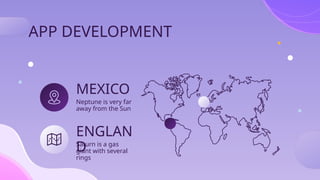
APP DEVELOPMENT
ENGLAN
D
Saturn is a gas
giant with several
rings
MEXICO
Neptune is very far
away from the Sun
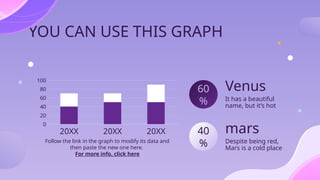
YOU CAN USE THIS GRAPH
Follow the link in the graph to modify its data and
then paste the new one here.
For more info, click here
Venus
It has a beautiful
name, but it’s hot
60
%
40
%
mars
Despite being red,
Mars is a cold place
20XX 20XX 20XX
0
20
40
60
80
100
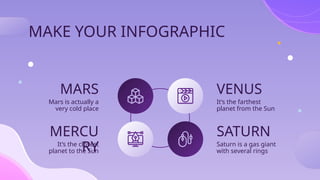
MAKE YOUR INFOGRAPHIC
SATURN
Saturn is a gas giant
with several rings
VENUS
It’s the farthest
planet from the Sun
MERCU
RY
It’s the closest
planet to the Sun
MARS
Mars is actually a
very cold place
DESIGN YOUR TIMELINE
00:00 01:00 02:00 03:00 04:00
Object 1
Object 2
Object 3
Object 4
Animation 1 Animation 2
CREDITS: This presentation template was created by Slidesgo,
including icons by Flaticon, infographics & images by Freepik
THANKS
!
Does anyone have any
questions?
addyouremail@freepik.com
+91 620 421 838
yourcompany.com
Please keep this slide for attribution
Here’s an assortment of alternative resources whose style fits the one of this template:
VECTOR:
• Realistic 3D shapes floating background
ALTERNATI
VE
RESOURCE
S
Did you like the resources in this template? Get them for free at our other websites:
VECTOR:
• Flat design geometric design pattern
Photos:
• Female logo designer working on a graphic tablet
• Young female logo designer working on a graphic tablet
RESOURCE
S OF THIS
TEMPLATE
Instructions for use
If you have a free account, in order to use this template, you must credit Slidesgo by keeping the Thanks slide. Please
refer to the next slide to read the instructions for premium users.
As a Free user, you are allowed to:
● Modify this template.
● Use it for both personal and commercial projects.
You are not allowed to:
● Sublicense, sell or rent any of Slidesgo Content (or a modified version of Slidesgo Content).
● Distribute Slidesgo Content unless it has been expressly authorized by Slidesgo.
● Include Slidesgo Content in an online or offline database or file.
● Offer Slidesgo templates (or modified versions of Slidesgo templates) for download.
● Acquire the copyright of Slidesgo Content.
For more information about editing slides, please read our FAQs or visit our blog:
https://slidesgo.com/faqs and https://slidesgo.com/slidesgo-school
As a Premium user, you can use this template without attributing Slidesgo or keeping the "Thanks" slide.
You are allowed to:
● Modify this template.
● Use it for both personal and commercial purposes.
● Hide or delete the “Thanks” slide and the mention to Slidesgo in the credits.
● Share this template in an editable format with people who are not part of your team.
You are not allowed to:
● Sublicense, sell or rent this Slidesgo Template (or a modified version of this Slidesgo Template).
● Distribute this Slidesgo Template (or a modified version of this Slidesgo Template) or include it in a database or in
any other product or service that offers downloadable images, icons or presentations that may be subject to
distribution or resale.
● Use any of the elements that are part of this Slidesgo Template in an isolated and separated way from this
Template.
● Register any of the elements that are part of this template as a trademark or logo, or register it as a work in an
intellectual property registry or similar.
For more information about editing slides, please read our FAQs or visit our blog:
https://slidesgo.com/faqs and https://slidesgo.com/slidesgo-school
Instructions for use (premium users)
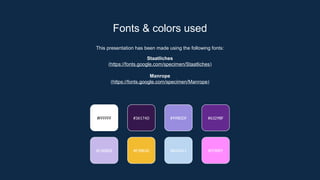
This presentation has been made using the following fonts:
Staatliches
(https://fonts.google.com/specimen/Staatliches)
Manrope
(https://fonts.google.com/specimen/Manrope)
Fonts & colors used
#FFFFFF #36174D #998DDF
#C6B8EB #F3BB30
#63298F
#BAD6F1 #FF8BFF
Create your Story with our illustrated concepts. Choose the style you like the most, edit its colors, pick the background
and layers you want to show and bring them to life with the animator panel! It will boost your presentation. Check out h
ow it works.
Storyset
Pana Amico Bro Rafiki Cuate
You can easily resize these resources without losing quality. To change the color, just ungroup the resource and click on
the object you want to change. Then, click on the paint bucket and select the color you want. Group the resource again
when you’re done. You can also look for more infographics on Slidesgo.
Use our editable graphic resources...
JANUARY FEBRUARY MARCH APRIL
PHASE 1
Task 1
Task 2
JANUARY FEBRUARY MARCH APRIL MAY JUNE
PHASE 1
PHASE 2
Task 1
Task 2
Task 1
Task 2
You can resize these icons without losing quality.
You can change the stroke and fill color; just select the icon and click on the paint bucket/pen.
In Google Slides, you can also use Flaticon’s extension, allowing you to customize and add even more icons.
...and our sets of editable icons
Educational Icons Medical Icons
Business Icons Teamwork Icons
Help & Support Icons Avatar Icons
Creative Process Icons Performing Arts Icons
Nature Icons
SEO & Marketing Icons
Add the title here
Text 1 Text 2 Text 3
Text 4 Text 5 Text 6
2016 2017 2018 2019 2020
“Despite being red,
Mars is actually a
very cold place”
“Mercury is the
smallest planet in
the Solar System”
“Neptune is the
farthest planet from
the Sun”
“Saturn is a gas
giant and has
several rings”
“Venus is the
second planet from
the Sun and is
terribly hot”
Premium infographics
“Despite being red,
Mars is actually a
very cold place”
“Jupiter is the
biggest planet in the
entire Solar System”
“Saturn is a gas
giant and has
several rings”
75%
Premium infographics
“Mercury is the
smallest planet in the
Solar System”
TITLE 1
75%
Digital Marketing
Premium Icons
Online Learning
Premium Icons
Laboratory
Premium Icons
Goals & Results
Premium Icons
Infographic Elements
Premium Icons
POWERPOINT PRESENTATION FOR CURRICULUM DESIGN AND INS.PLAN.pptx

POWERPOINT PRESENTATION FOR CURRICULUM DESIGN AND INS.PLAN.pptx

  • 1.
    Designing a Curriculum and Instructional Plan Subject:Mathematics 6 PREPARED BY: HELEN D. DIOMANGAY
  • 2.
    I. Context Selection SanMiguel Elementary School develops curriculum enhancement plan for Mathematics subject in grade 6 to enhance the numeracy skills of the learners. Located in a remote area, the school serves as a pivotal institution within the local community, catering to the educational needs of Grade 6 learners. The context encompasses the school's infrastructure, resources, student demographics, and the broader socio-economic and cultural characteristics of the community it serves. Understanding the demographics of the student body is essential for contextualizing the curriculum enhancement plan. Information about the cultural backgrounds, socio-economic status, and varying learning needs of Grade 6 learners inform the design and implementation of the curriculum. The plan should be sensitive to the diversity within the student population, ensuring inclusivity and cultural relevance.
  • 3.
    The context includesan assessment of the resources available to the school. This encompasses physical resources such as classrooms, laboratories, and technology infrastructure, as well as human resources, including educators and support staff. The plan acknowledges the existing resources and proposes enhancements or optimizations to ensure effective implementation. The curriculum enhancement plan considers the level of community engagement and collaboration. Involving parents, local community members, and relevant stakeholders in the planning and implementation processes fosters a sense of shared responsibility for students' education. This community engagement contributes to a supportive learning environment that extends beyond the classroom. Given the diverse cultural context of the community, the curriculum enhancement plan prioritizes cultural sensitivity and local relevance. It acknowledges the unique cultural backgrounds of students and integrates content that resonates with their experiences, fostering a sense of identity and pride in one's cultural heritage. The context emphasizes the commitment to continuous improvement. The plan incorporates feedback mechanisms, ensuring that regular assessments, reviews, and evaluations are conducted. This iterative approach allows for adaptability, responsiveness to changing needs, and ongoing enhancement of the curriculum. The context recognizes potential challenges, such as limited resources, technological disparities, or socio-economic factors affecting students. Simultaneously, it identifies opportunities for innovation, collaboration, and leveraging available resources effectively to overcome challenges and enhance the overall educational experience.
  • 4.
    II. Needs Assessment TheNumeracy Result of Grade 6 learners for the first quarter school year 2023-2024 at San Miguel School provide valuable insights into the performance of Grade 1 pupils in Mathematics subject. A scholarly discussion of these scores involves analyzing trends, identifying strengths and weaknesses, and considering potential implications for educational strategies and interventions. The analysis provides a foundation for targeted interventions, continuous improvement strategies, and informed decision-making to enhance the overall educational experience for Grade 6 pupils.
  • 5.
    GRAD E LEVEL SECTI ON NO. OF ENROLMENT Highly Proficient Proficie nt Nearl y Profici ent Low Profi cient Non-Proficient M FT M F M F M F M F I A 3 3 6 1 0 0 0 0 0 0 2 II A 5 7 1 2 2 1 0 0 0 2 2 11 III A 3 3 6 0 0 0 0 0 2 2 0 IV A 8 5 1 3 2 4 8 7 6 2 5 0 V A 6 4 1 0 0 0 0 0 0 1 3 10 VI A 9 5 1 4 0 0 0 0 1 1 6 6 TOTAL 34 2 7 6 1 5 5 8 7 7 8 18 29
  • 6.
    III. Curriculum Design A. Scopeand Sequence Quarter Unit Learning Objectives Content Instructional Strategies Q1 Intorduction to the Four Fundamental operations in Mathematics -Know and understand the four fundamental operations Fundamental Operations in Mathematics Individual and group activities involving the four fundamenta operations Q2 Numerical Fluency in Mathematics - Enhance numerical fluency in Mathematics - Basic arithmetic operations - Introduce interactive math games for practice. Q3 Solving-Problems strategies - Enhance problem-solving skills - Solving Word Problems skills and strategies -Utilize real-life problem- solving scenarios. Q4 Solving Word Problems using the four fundamental operations -Solve word problems using four fundamental operations -Solving word problems involving addition, subtraction, multiplicationa nd Division. -Solving word problems
  • 7.
    III. Curriculum Design B. LEARNINGOUTCOMES Mathematics Objective: By the end of the school year Grade 6 pupils at San Miguel Elementary School will demonstrate proficiency in advanced arithmetic operations, including mastery of concepts such as fractions, decimals, and basic algebra. They will apply these skills to solve complex mathematical problems and real-world scenarios. These tailored learning outcomes are designed to address the unique needs and academic expectations of Grade 6 pupils at San Miguel Elementary School, promoting a comprehensive and enriching educational experience.
  • 8.
    III. Curriculum Design C. ContentSelection 1. Mathematics: Advanced Arithmetic Operations (Fractions, Decimals, Algebra) Problem-Solving Strategies Mathematical Modeling in Real-World Scenarios l Diversity and Historical Contexts Historical Events and Their Impact 2. Problem-Solving Critical Thinking Approaches Systematic Problem-Solving Techniques Application of Logical Reasoning in Various Disciplines
  • 9.
    III. Curriculum Design D. InstructionalStrategies Subject Instructional Strategies Mathematics - Interactive Math Games for Practice - Real-World Problem-Solving Scenarios - Collaborative Math Projects - Peer Tutoring Sessions for Concept Reinforcement
  • 10.
    IV. Instructional Plan A.Instructional Plan Quarter Unit Teaching Activities Learning Activities Differentiation Technology Integration Q1-Q4 Advanced Arithmetic Operations - Interactive Math Games for Concept Introduction - Collaborative Problem- Solving Sessions - Varied difficulty levels in math problems - Educational math apps for interactive practice - Real-World Problem- Solving Scenarios - Peer Tutoring Sessions - Individualized feedback on assignments - Online platforms for virtual math challenges - Classroom Demonstration s and Interactive Whiteboard Activities - Math Journaling and Reflections - Additional resources for struggling learners - Virtual simulations and manipulatives for a visual understanding of concepts
  • 11.
    IV. Instructional Plan B.Assessment Methods Subject Formative Assessments Summative Assessments Mathematics - Weekly Quizzes on Current Topics - End-of-Quarter Math Exams - In-Class Problem-Solving Activities - Math Project Presentation and Assessment - Peer Review of Math Journals - Comprehensive Math Skills Test - Online Interactive Math Games - Real-World Math Application Assignment
  • 12.
    IV. Instructional Plan D.EvaluationPlan 1.Data Collection Methods Subject Data Collection Methods Mathematics - Pre-and Post-Assessments - Observations during Class Activities - Student Reflections and Self- Assessments - Parent and Teacher Feedback
  • 13.
    IV. Instructional Plan 2.Adjustment and Improvement Strategies Subject Adjustment and Improvement Strategies Mathematics - Regular professional development for teachers - Continuous feedback loops between teachers, students, and parents - Modification of instructional strategies based on assessment data - Periodic curriculum reviews and updates
  • 14.
    V. Implementation Plan Quarter MonthsStrategies Mathematics Month 1-2 - Conduct a professional development workshop for teachers on innovative math teaching methods. Month 3-4 - Initiate continuous feedback loops between teachers, students, and parents through regular communication channels. Month 5-6 - Modify instructional strategies based on the analysis of the first quarter's assessment data. Month 7-8 - Conduct a periodic review of the mathematics curriculum for necessary updates. A.Timeline
  • 15.
    V. Implementation Plan B.Resource Allocation SubjectResource Allocation Strategies Mathematics - Funds for professional development workshops for math teachers. - Provide online platforms for continuous feedback and communication. - Investment in educational technology tools. - Allocate time and resources for periodic reviews of math curriculum. - Modify instructional strategies based on assessment data.
  • 16.
    V. Implementation Plan C. PotentialChallenges and Strategies Subject Potential Challenges Mitigation Strategies Mathematics - Resistance to new instructional strategies. - Provide thorough training and professional development for teachers. - Limited access to technology resources. - Seek additional funding or partnerships for technology acquisition. - Create a support system with peer mentoring for teachers.
  • 17.
    V. Implementation Plan D. ProfessionalDevelopment Quarter Professional Development Focus Activities and Strategies Quarter 1-4 - Introduction to new instructional strategies in mathematics. - Conduct workshops led by education specialists on innovative math teaching methods.
  • 18.
    VI. Presentation andReflection Curriculum designing is pivotal in developing the righ and appropriate skillls of the clienetele. It is a must to know the needs of the recipient to develop an effective curriculum design. The development of the Grade 6 curriculum enhancement in Mathematics stems from a comprehensive analysis of the Numeracy Test Result, identifying the need for targeted improvements. The plan addresses specific challenges while aligning with the school's mission to provide a well-rounded education, fostering critical thinking, creativity, and a love for learning. The Scope and Sequence of the curriculum lay the foundation for a comprehensive educational experience. Encompassing core the math subject, the curriculum is designed to offer a holistic approach to learning. By including a broad range of subjects, students are exposed to a diverse set of knowledge and skills, fostering a well-rounded education. The scope ensures that essential elements of various disciplines are covered, preparing students for a multifaceted understanding of the world.
  • 19.
    VI. Presentation andReflection The Learning Outcomes are the heart of the curriculum, providing clear and measurable objectives for student achievement. Each subject area delineates specific skills and knowledge that students are expected to acquire by the end of Grade 6. The emphasis on clarity ensures that educators, students, and parents have a shared understanding of what success looks like. These outcomes serve as a roadmap, guiding the teaching and learning process. They not only measure academic proficiency but also encompass broader skills like critical thinking, problem-solving, and creativity, aligning with the overarching goals of a well-rounded education.
  • 20.
    VI. Presentation andReflection A noteworthy aspect is the integration and synergy between the strengths and limitations identified. For instance, the emphasis on professional development aligns with the need for adaptability. Well-trained educators are better equipped to navigate unforeseen changes and make informed adjustments to the curriculum. Similarly, the holistic approach contributes to the adaptability by fostering a diverse skill set among students, preparing them for a range of challenges.
  • 22.
    APP DEVELOPMENT ENGLAN D Saturn isa gas giant with several rings MEXICO Neptune is very far away from the Sun
  • 23.
    YOU CAN USETHIS GRAPH Follow the link in the graph to modify its data and then paste the new one here. For more info, click here Venus It has a beautiful name, but it’s hot 60 % 40 % mars Despite being red, Mars is a cold place 20XX 20XX 20XX 0 20 40 60 80 100
  • 24.
    MAKE YOUR INFOGRAPHIC SATURN Saturnis a gas giant with several rings VENUS It’s the farthest planet from the Sun MERCU RY It’s the closest planet to the Sun MARS Mars is actually a very cold place
  • 25.
    DESIGN YOUR TIMELINE 00:0001:00 02:00 03:00 04:00 Object 1 Object 2 Object 3 Object 4 Animation 1 Animation 2
  • 26.
    CREDITS: This presentationtemplate was created by Slidesgo, including icons by Flaticon, infographics & images by Freepik THANKS ! Does anyone have any questions? addyouremail@freepik.com +91 620 421 838 yourcompany.com Please keep this slide for attribution
  • 27.
    Here’s an assortmentof alternative resources whose style fits the one of this template: VECTOR: • Realistic 3D shapes floating background ALTERNATI VE RESOURCE S
  • 28.
    Did you likethe resources in this template? Get them for free at our other websites: VECTOR: • Flat design geometric design pattern Photos: • Female logo designer working on a graphic tablet • Young female logo designer working on a graphic tablet RESOURCE S OF THIS TEMPLATE
  • 29.
    Instructions for use Ifyou have a free account, in order to use this template, you must credit Slidesgo by keeping the Thanks slide. Please refer to the next slide to read the instructions for premium users. As a Free user, you are allowed to: ● Modify this template. ● Use it for both personal and commercial projects. You are not allowed to: ● Sublicense, sell or rent any of Slidesgo Content (or a modified version of Slidesgo Content). ● Distribute Slidesgo Content unless it has been expressly authorized by Slidesgo. ● Include Slidesgo Content in an online or offline database or file. ● Offer Slidesgo templates (or modified versions of Slidesgo templates) for download. ● Acquire the copyright of Slidesgo Content. For more information about editing slides, please read our FAQs or visit our blog: https://slidesgo.com/faqs and https://slidesgo.com/slidesgo-school
  • 30.
    As a Premiumuser, you can use this template without attributing Slidesgo or keeping the "Thanks" slide. You are allowed to: ● Modify this template. ● Use it for both personal and commercial purposes. ● Hide or delete the “Thanks” slide and the mention to Slidesgo in the credits. ● Share this template in an editable format with people who are not part of your team. You are not allowed to: ● Sublicense, sell or rent this Slidesgo Template (or a modified version of this Slidesgo Template). ● Distribute this Slidesgo Template (or a modified version of this Slidesgo Template) or include it in a database or in any other product or service that offers downloadable images, icons or presentations that may be subject to distribution or resale. ● Use any of the elements that are part of this Slidesgo Template in an isolated and separated way from this Template. ● Register any of the elements that are part of this template as a trademark or logo, or register it as a work in an intellectual property registry or similar. For more information about editing slides, please read our FAQs or visit our blog: https://slidesgo.com/faqs and https://slidesgo.com/slidesgo-school Instructions for use (premium users)
  • 31.
    This presentation hasbeen made using the following fonts: Staatliches (https://fonts.google.com/specimen/Staatliches) Manrope (https://fonts.google.com/specimen/Manrope) Fonts & colors used #FFFFFF #36174D #998DDF #C6B8EB #F3BB30 #63298F #BAD6F1 #FF8BFF
  • 32.
    Create your Storywith our illustrated concepts. Choose the style you like the most, edit its colors, pick the background and layers you want to show and bring them to life with the animator panel! It will boost your presentation. Check out h ow it works. Storyset Pana Amico Bro Rafiki Cuate
  • 33.
    You can easilyresize these resources without losing quality. To change the color, just ungroup the resource and click on the object you want to change. Then, click on the paint bucket and select the color you want. Group the resource again when you’re done. You can also look for more infographics on Slidesgo. Use our editable graphic resources...
  • 36.
    JANUARY FEBRUARY MARCHAPRIL PHASE 1 Task 1 Task 2 JANUARY FEBRUARY MARCH APRIL MAY JUNE PHASE 1 PHASE 2 Task 1 Task 2 Task 1 Task 2
  • 39.
    You can resizethese icons without losing quality. You can change the stroke and fill color; just select the icon and click on the paint bucket/pen. In Google Slides, you can also use Flaticon’s extension, allowing you to customize and add even more icons. ...and our sets of editable icons
  • 40.
  • 41.
  • 42.
    Help & SupportIcons Avatar Icons
  • 43.
    Creative Process IconsPerforming Arts Icons
  • 44.
  • 45.
  • 46.
    Add the titlehere Text 1 Text 2 Text 3 Text 4 Text 5 Text 6 2016 2017 2018 2019 2020 “Despite being red, Mars is actually a very cold place” “Mercury is the smallest planet in the Solar System” “Neptune is the farthest planet from the Sun” “Saturn is a gas giant and has several rings” “Venus is the second planet from the Sun and is terribly hot” Premium infographics
  • 47.
    “Despite being red, Marsis actually a very cold place” “Jupiter is the biggest planet in the entire Solar System” “Saturn is a gas giant and has several rings” 75% Premium infographics “Mercury is the smallest planet in the Solar System” TITLE 1 75%
  • 48.
  • 49.
  • 50.
  • 51.
  • 52.