NUMBER SYSTEM
AND CONVERSION
PRESENTED BY:
KRISH SHRESTHA
ADARSH BISTA
NABIN BAM
Acknowledgement
Computer Department
Mr Dhirendra Fauzdar
ECA Department
Mr Jay Gaudel
History
Introduction
Comparison
Types of Number System
Applications
Conclusion
Table Of Contents
History
 The concept of a number system has
evolved over time, and it doesn't
have a single inventor.
 Different cultures and civilizations
contributed to the development of
various number systems.
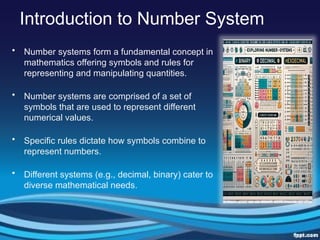
Introduction to Number System
• Number systems form a fundamental concept in
mathematics offering symbols and rules for
representing and manipulating quantities.
• Number systems are comprised of a set of
symbols that are used to represent different
numerical values.
• Specific rules dictate how symbols combine to
represent numbers.
• Different systems (e.g., decimal, binary) cater to
diverse mathematical needs.
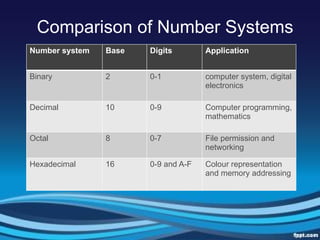
Comparison of Number Systems
Number system Base Digits Application
Binary 2 0-1 computer system, digital
electronics
Decimal 10 0-9 Computer programming,
mathematics
Octal 8 0-7 File permission and
networking
Hexadecimal 16 0-9 and A-F Colour representation
and memory addressing
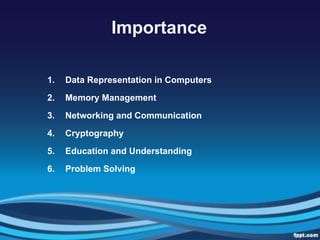
1. Data Representation in Computers
2. Memory Management
3. Networking and Communication
4. Cryptography
5. Education and Understanding
6. Problem Solving
Importance
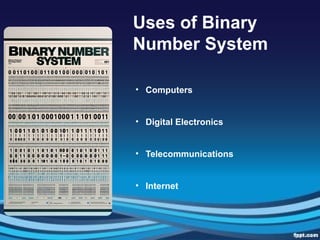
Binary Number
System
• The binary number system is a
base-2 number system that
uses only two digits: 0 and 1.
• Each 0 or 1 is a 'bit' (binary
digit).
Uses of Binary
Number System
• Computers
• Digital Electronics
• Telecommunications
• Internet
Decimal Number
System
• It uses ten digits (0-9) for representing
numbers.
• Separates whole numbers from fractions
in a decimal.
• Decimal numbers can be positive,
negative or zero.
• Also known as the base-10 system.
• Most commonly used in everyday life.
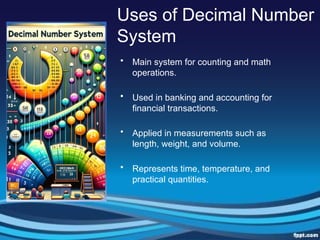
Uses of Decimal Number
System
• Main system for counting and math
operations.
• Used in banking and accounting for
financial transactions.
• Applied in measurements such as
length, weight, and volume.
• Represents time, temperature, and
practical quantities.
Octal Number
System
• Octal is a base-8 number system
using digits 0-7.
• Commonly used in computer
programming to represent and handle
binary data.
• Octal numbers denote file permissions
for owner, group, and others.
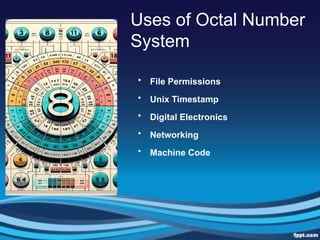
Uses of Octal Number
System
• File Permissions
• Unix Timestamp
• Digital Electronics
• Networking
• Machine Code
Hexadecimal Number
System
• Hexadecimal (hex) is a base-16 number
system.
• Uses 0-9 and A-F
• Widely used in computing and digital
systems.
• A-F represent 10-15
• Used for memory addresses machine
instructions
Uses of Hexadecimal
Number System
• Binary Data Handling
• Color Codes
• Memory Addresses
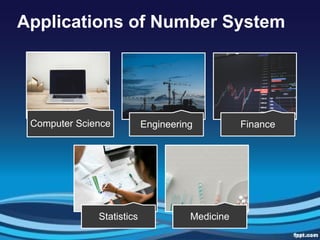
Applications of Number System
Computer Science Engineering Finance
Statistics Medicine
Conclusion
• Number systems are the building blocks of math.
• Used in daily life, science, technology, and engineering.
• Essential for logical thinking, problem-solving, and data
interpretation.
• Used in coding, finance, physics, and cryptography.
References
• https://www.splashlearn.com/math-vocabulary/number-sense/number-
system
• https://www.geeksforgeeks.org/what-is-a-number-system/
number system with diffrencent types of its

number system with diffrencent types of its

  • 1.
    NUMBER SYSTEM AND CONVERSION PRESENTEDBY: KRISH SHRESTHA ADARSH BISTA NABIN BAM
  • 2.
    Acknowledgement Computer Department Mr DhirendraFauzdar ECA Department Mr Jay Gaudel
  • 3.
    History Introduction Comparison Types of NumberSystem Applications Conclusion Table Of Contents
  • 4.
    History  The conceptof a number system has evolved over time, and it doesn't have a single inventor.  Different cultures and civilizations contributed to the development of various number systems.
  • 5.
    Introduction to NumberSystem • Number systems form a fundamental concept in mathematics offering symbols and rules for representing and manipulating quantities. • Number systems are comprised of a set of symbols that are used to represent different numerical values. • Specific rules dictate how symbols combine to represent numbers. • Different systems (e.g., decimal, binary) cater to diverse mathematical needs.
  • 6.
    Comparison of NumberSystems Number system Base Digits Application Binary 2 0-1 computer system, digital electronics Decimal 10 0-9 Computer programming, mathematics Octal 8 0-7 File permission and networking Hexadecimal 16 0-9 and A-F Colour representation and memory addressing
  • 7.
    1. Data Representationin Computers 2. Memory Management 3. Networking and Communication 4. Cryptography 5. Education and Understanding 6. Problem Solving Importance
  • 8.
    Binary Number System • Thebinary number system is a base-2 number system that uses only two digits: 0 and 1. • Each 0 or 1 is a 'bit' (binary digit).
  • 9.
    Uses of Binary NumberSystem • Computers • Digital Electronics • Telecommunications • Internet
  • 10.
    Decimal Number System • Ituses ten digits (0-9) for representing numbers. • Separates whole numbers from fractions in a decimal. • Decimal numbers can be positive, negative or zero. • Also known as the base-10 system. • Most commonly used in everyday life.
  • 11.
    Uses of DecimalNumber System • Main system for counting and math operations. • Used in banking and accounting for financial transactions. • Applied in measurements such as length, weight, and volume. • Represents time, temperature, and practical quantities.
  • 12.
    Octal Number System • Octalis a base-8 number system using digits 0-7. • Commonly used in computer programming to represent and handle binary data. • Octal numbers denote file permissions for owner, group, and others.
  • 13.
    Uses of OctalNumber System • File Permissions • Unix Timestamp • Digital Electronics • Networking • Machine Code
  • 14.
    Hexadecimal Number System • Hexadecimal(hex) is a base-16 number system. • Uses 0-9 and A-F • Widely used in computing and digital systems. • A-F represent 10-15 • Used for memory addresses machine instructions
  • 15.
    Uses of Hexadecimal NumberSystem • Binary Data Handling • Color Codes • Memory Addresses
  • 16.
    Applications of NumberSystem Computer Science Engineering Finance Statistics Medicine
  • 17.
    Conclusion • Number systemsare the building blocks of math. • Used in daily life, science, technology, and engineering. • Essential for logical thinking, problem-solving, and data interpretation. • Used in coding, finance, physics, and cryptography.
  • 18.