College: SST College Arts & Commerce
Subject: Digital Logic and applications
Subject Teacher: Divya Tiwari
2023-24
Avinash
• A Number System Defines A Set Of Values Used To Represent A Quantity.
• The Study Of The Number Is Not Just Limited To Computers.
• We Apply Numbers Every Day And Knowing How Numbers Work Will Give Us
An Insight Into How A Computer Manipulates And Store Numbers
• Number systems are like languages for representing and working with
numbers, and they're essential for understanding how computers process
information.
• In the digital world, a number is a fundamental representation of data or
information using discrete values, typically in binary format (0s and 1s),
crucial for all digital computations and operations.
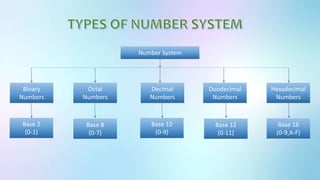
Binary
Numbers
Octal
Numbers
Decimal
Numbers
Hexadecimal
Numbers
Duodecimal
Numbers
Base 2
(0-1)
Base 8
(0-7)
Base 10
(0-9)
Base 12
(0-11)
Base 16
(0-9,A-F)
Number System
• A Number System With A Radix 2 Is Called As The Binary Number System.
• most of the modern computer systems are use the binary logic for their
operations. a computer cannot operate on the decimal number system.
• We Apply Numbers Every Day And Knowing How Numbers Work Will Give Us
An Insight Into How A Computer Manipulates And Store Numbers
• The binary number system operates similarly to the decimal number system,
with one key difference: it uses base 2 instead of base 10.
• In the binary number system, each digit can have a value of either 0 or 1,
making it a base-2 system.
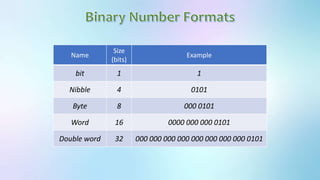
Name
Size
(bits)
Example
bit 1 1
Nibble 4 0101
Byte 8 000 0101
Word 16 0000 000 000 0101
Double word 32 000 000 000 000 000 000 000 000 0101
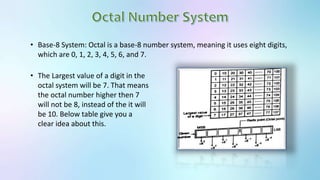
• Base-8 System: Octal is a base-8 number system, meaning it uses eight digits,
which are 0, 1, 2, 3, 4, 5, 6, and 7.
• The Largest value of a digit in the
octal system will be 7. That means
the octal number higher then 7
will not be 8, instead of the it will
be 10. Below table give you a
clear idea about this.
• Base-10 System: The decimal number system, also known as base-10, uses
ten digits: 0, 1, 2, 3, 4, 5, 6, 7, 8, and 9.
• Everyday Use: Decimal numbers are the most common numeric system used
in everyday life.
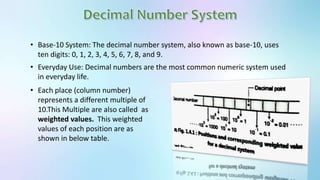
• Each place (column number)
represents a different multiple of
10.This Multiple are also called as
weighted values. This weighted
values of each position are as
shown in below table.
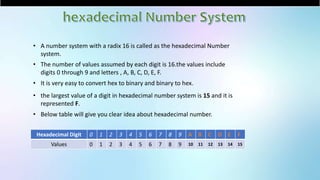
• A number system with a radix 16 is called as the hexadecimal Number
system.
• The number of values assumed by each digit is 16.the values include
digits 0 through 9 and letters , A, B, C, D, E, F.
• It is very easy to convert hex to binary and binary to hex.
• the largest value of a digit in hexadecimal number system is 15 and it is
represented F.
• Below table will give you clear idea about hexadecimal number.
Hexadecimal Digit
Values
0 1 2 3 4 5 6 7 8 9 A B C D E F
0 1 2 3 4 5 6 7 8 9 10 11 12 13 14 15
Number System.pptx

Number System.pptx

  • 1.
    College: SST CollegeArts & Commerce Subject: Digital Logic and applications Subject Teacher: Divya Tiwari 2023-24 Avinash
  • 2.
    • A NumberSystem Defines A Set Of Values Used To Represent A Quantity. • The Study Of The Number Is Not Just Limited To Computers. • We Apply Numbers Every Day And Knowing How Numbers Work Will Give Us An Insight Into How A Computer Manipulates And Store Numbers • Number systems are like languages for representing and working with numbers, and they're essential for understanding how computers process information. • In the digital world, a number is a fundamental representation of data or information using discrete values, typically in binary format (0s and 1s), crucial for all digital computations and operations.
  • 3.
  • 4.
    • A NumberSystem With A Radix 2 Is Called As The Binary Number System. • most of the modern computer systems are use the binary logic for their operations. a computer cannot operate on the decimal number system. • We Apply Numbers Every Day And Knowing How Numbers Work Will Give Us An Insight Into How A Computer Manipulates And Store Numbers • The binary number system operates similarly to the decimal number system, with one key difference: it uses base 2 instead of base 10. • In the binary number system, each digit can have a value of either 0 or 1, making it a base-2 system.
  • 5.
    Name Size (bits) Example bit 1 1 Nibble4 0101 Byte 8 000 0101 Word 16 0000 000 000 0101 Double word 32 000 000 000 000 000 000 000 000 0101
  • 6.
    • Base-8 System:Octal is a base-8 number system, meaning it uses eight digits, which are 0, 1, 2, 3, 4, 5, 6, and 7. • The Largest value of a digit in the octal system will be 7. That means the octal number higher then 7 will not be 8, instead of the it will be 10. Below table give you a clear idea about this.
  • 7.
    • Base-10 System:The decimal number system, also known as base-10, uses ten digits: 0, 1, 2, 3, 4, 5, 6, 7, 8, and 9. • Everyday Use: Decimal numbers are the most common numeric system used in everyday life. • Each place (column number) represents a different multiple of 10.This Multiple are also called as weighted values. This weighted values of each position are as shown in below table.
  • 8.
    • A numbersystem with a radix 16 is called as the hexadecimal Number system. • The number of values assumed by each digit is 16.the values include digits 0 through 9 and letters , A, B, C, D, E, F. • It is very easy to convert hex to binary and binary to hex. • the largest value of a digit in hexadecimal number system is 15 and it is represented F. • Below table will give you clear idea about hexadecimal number. Hexadecimal Digit Values 0 1 2 3 4 5 6 7 8 9 A B C D E F 0 1 2 3 4 5 6 7 8 9 10 11 12 13 14 15