Exploring Perceptions and Functioning of RKS in West Bengal  Emphasis on Maternal & Child Health   A Formative Research Study Initiative  Conducted by  CINI Regional Resource Center Supported by  Ministry of Health and Family Welfare, Government of India
About CINI RRC Child In Need Institute  (CINI), a NGO with national level recognition Prominent works in the domains of  health, nutrition, education and protection  for more than three decades now Guided by its mission –  Sustainable development in health, nutrition, education and protection of child, adolescent and woman in need In 2002 CINI  recognized as Regional Resource Center  for West Bengal, Jharkhand and A&N island by Ministry of Health and Family Welfare, Government of India under the RCH-II project of NRHM Key responsibilities :  Capacity building and nurturing of MNGOs  through trainings, documentation and dissemination of best practices, networking and advocacy –  Overall,   Strengthening RCH programme implementation and promoting GO-NGO partnership   CINI RRC
Background (1) Health intricately linked with development Developing countries still struggling with poor indicators, particularly with respect to MCH & Nutrition  MCH -  area of concern in India since independence  Need for improved health service delivery, community ownership and decentralized processes of planning and action  CINI RRC National Rural Health Mission (2005-2012)  aims at addressing these concerns so as to  accelerate achievement of MCH  targets
Background (2) Rogi Kalyan Samiti,  a key initiative of NRHM in strengthening health delivery systems Originated as a committee of people’s representatives at a hospital in Indore, Madhya Pradesh. Later incorporated in NRHM RKS committed for the optimal utilization of services, rendering transparency and accountability of the health service providers to community Rogi Kalyan Samiti in West Bengal  constituted at PHCs (from mid 2006), BPHCs, sub divisional hospitals, and district hospitals. Also in state medical colleges and state general hospitals CINI RRC
Background ( 3 ) Members drawn from health, administration, PRI, NGO and IMA. Leading PRI representative as chairman and health representative as convener and secretary Funding source –  Annual Maintenance Grant Untied fund Proportion of user charges at specific levels (Not applicable at BPHC & PHC level) Self generated fund CINI RRC
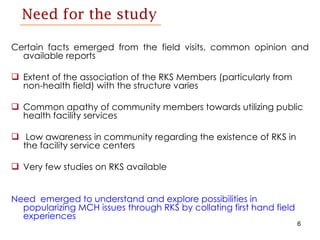
Need for the study Certain facts emerged from the field visits, common opinion and available reports Extent of the association of the RKS Members (particularly from non-health field) with the structure varies Common apathy of community members towards utilizing public health facility services  Low awareness in community regarding the existence of RKS in the facility service centers Very few studies on RKS available Need  emerged to understand and explore possibilities in popularizing MCH issues through RKS by collating first hand field experiences
Significance of the present study CINI RRC The study is nearly an unprecedented attempt in the region to instigate political will to act upon “ less focused ” component of NRHM Brings rural experiences for discussion Can lend strong voice to urge for improvement of health services and commensurate with the overwhelming endeavor of bringing community closer to the institutional services Substantiate evidences for making health system responsive to community demands Can enhance GO-NGO collaboration in health service delivery
Study Objectives   Understand perceptions of constituent members about RKS Analyse functioning of RKS with reference to maternal and child health activities Collate perceptions of users and local community members about institutional health service  Community opinions collected to understand health seeking practices, particularly MCH from facility centers 4.  Identify the limiting factors in RKS  CINI RRC
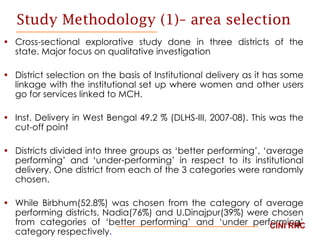
Study Methodology (1)– area selection Cross-sectional explorative study done in three districts of the state. Major focus on qualitative investigation District selection on the basis of Institutional delivery as it has some linkage with the institutional set up where women and other users go for services linked to MCH.  Inst. Delivery in West Bengal 49.2 % (DLHS-III, 2007-08). This was the cut-off point Districts divided into three groups as ‘better performing’, ‘average performing’ and ‘under-performing’ in respect to its institutional delivery. One district from each of the 3 categories were randomly chosen.  While Birbhum(52.8%) was chosen from the category of average performing districts, Nadia(76%) and U.Dinajpur(39%) were chosen from categories of ‘better performing’ and ‘under performing’ category respectively .   CINI RRC
Study Methodology (2) 3 blocks per district chosen through simple random method. CMOHs helped in block identification 1 PHC under each selected BPHCs were selected. Transportation feasibility was considered during PHC selection    Primary data gathered through: Semi-structured interview  with RKS members, as many as possible but emphasis on key members FGD  with community members  Checklist  for facility survey enquiring about IPD,OPD, Kitchen, toilets, medical equipments/medicines  and general logistics Analysis of the minutes  of the RKS meetings and the financial statement within a reference period of 6 months. Field work conducted from March-early June 2008
Study Points   Sample Emphasis on BPHC and PHC levels. Information from District  hospitals was collected for cross checking  CINI RRC District Block Primary Health Centre  ( 1 lac approx.) Primary Health Centre ( 30000-25000 popl.) Uttar Dinajpur Hemtabad Baharail Goalpokher Goagaon Islampur Sujali Birbhum Muraroi 1 Chatra Md Bazar Rampur Nanoor Kirnahar Nadia  Krishnanagar 2 Nowapara Tehatta Chotonolda Nakashipara Dharamada
Limitations  Availability of RKS members (various factors: PRI elections, busy schedule, not available during study period, outbreak of bird flu etc.) Sample too small to represent the district situation– this is more exploratory than a methodic investigation Unavailability of documents at some places Very short study period and remotely located study point CINI RRC
O bj 1:  To understand awareness of RKS among its members Perception of Members According to majority of  the respondents importance of RKS are: “ platform for public-private partnership” “ leading to greater transparency in financial dealings” “ promoting convergence between health and PRI”, opportunity for monitoring services  “ Perceptions are large and distant without emphasizing RKS’ immediate role in improving service delivery component Only district level health personnels could refer explicitly to guidelines.  Many members not sure about their roles and responsibilities. Comparatively, health personnel (MO,BMOH) and signatories (health and PRI representative) have a idea on their role as signatory. BAM has better idea of financial transactions  Overall, different representatives from the non-health sectors exhibited a wide range of understanding and involvement with RKS  CINI RRC
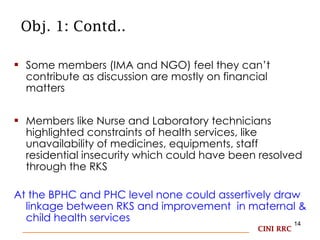
Obj. 1: Contd.. Some members (IMA and NGO) feel they can’t contribute as discussion are mostly on financial matters  Members like Nurse and Laboratory technicians highlighted constraints of health services, like unavailability of medicines, equipments, staff residential insecurity which could have been resolved through the RKS  At the BPHC and PHC level none could assertively draw  linkage between RKS and improvement  in maternal & child health services CINI RRC
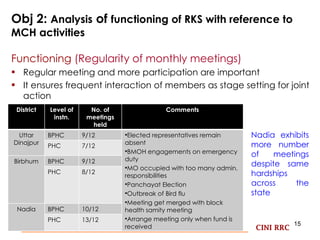
Obj 2:  Analysis  of  functioning of RKS with reference to MCH activities Functioning  (Regularity of monthly meetings) Regular meeting and more participation are important It ensures frequent interaction of members as stage setting for joint action CINI RRC Nadia exhibits more number of meetings despite same hardships across the state District Level of instn. No. of meetings held Comments Uttar Dinajpur BPHC 9/12 Elected representatives remain absent BMOH engagements on emergency duty MO occupied with too many admin. responsibilities Panchayat Election Outbreak of Bird flu  Meeting get merged with block health samity meeting Arrange meeting only when fund is received PHC 7/12 Birbhum BPHC 9/12 PHC 8/12 Nadia BPHC 10/12 PHC 13/12
Functioning ( Member Representation in meetings )   CINI RRC Attendance of BMOH as convener at all levels Less participation of members from non-health sectors due to their loose association with health domain Representation of PRI members more at PHC than BPHC Very low participation of civil society representatives at all levels 5/10 3/9 7/9 MLA 7/10 6/9 - Swasthya Karma dhakshya 6/10 7/9 6/9 Sabhapati 6/10 8/9 9/9 BDO/Jt. BDO Administration 5/10 6/9 6/9 2 nd  MO Dept. Representative member U Dinajpur Birbhum Nadia Health BMOH 9/9 9/9 10/10 MO-PHC 7/7 8/8 13/13 ZP member repr. 6/7 8/8 13/13 Pradhan 6/7 6/8 13/13 Civil Society IMA represen- tative - 0/9 1/10 NGO 11/16 3/17 14/23
Functioning  (MCH as priority issue) By and large, MCH issues and activities get less priority in  meetings and action (e.g fund expenditure) Overall,  MCH issues  discussed (  in order of frequency ):  -  JSY availability status -  Resolutions for Purchase of equipment and supplies  -  Updating cases of Referral transport  -  Sterilisation camps/services  - Repairing labour room and making renovations Decision to spend funds on infrastructure expansion & up gradation, making arrangements for electricity and water,  change of signatories and convey major decisions etc. are gross agendas in meeting Quality of services and care for the users are least prioritised/highlighted in discussions .   CINI RRC
Most of the BPHC study points are equipped with General instruments like,   B.P machine, Weight machine, thermometer, stethoscope, autoclave etc.  Few points have child specific instruments like, Baby resuscitation kit, sucker machine However, Though  X-Ray and Ultra Sonography are present at BPHCs but rarely used due to non-positioning of operators Even in Rural Hospitals,  beds number far below than sanctioned  (30 as against 50) Most places solely relies on referral of sick new borns due to  non availability of neonatal health support system  in contrast to the heavy demands from the community In some points there are sheer evidences of  lacunae in logistic arrangements  (Bed sheets and pillows were missing Absence of basic health facilities is a serious issue across the PHC study points In many places basic facilities like,  electricity  hampering cold chain  and beds  were missing or unclean Basic equipments like  thermometer and first-aid is dysfunctional for long Security of staff  and the equipments were basic problems Staff vacancy  is a major issue like pharmacist  Rarely OPDs open on time and usually close early Functioning  of RKS in monitoring & responding to MCH  CINI RRC
CINI RRC RKS members can assume greater responsibility in monitoring, identifying service gaps, reporting and taking action for sustaining health service development Quality of care and services is also needed Some common issues at both levels where serious attention is required: Cleanliness, a serious gaps No mechanism to get User Feedback Subsequently, grievance redressal systems not functional fully  Poor Female privacy during checkup and treatments  Poor Bed facility, thereby seriously affecting post partum care In most places even minor repair of essential equipments take long time for decisions to come from higher authority A regularized monitoring of health services by RKS is rarely practiced Facility staff seldom takes initiative to report paucity of any services/facilities  Functioning  (RKS in monitoring and responding to MCH services
Functioning (Financial management) CINI RRC During the study period (2007-08) all the study points received fund Nadia has evidences of generating fund through utilization of institution’s resources Also only study points in Nadia has evidences where PRI members channelised their fund into health institution development at both BPHC & PHCs.  Aggregately study points utilized fund in MCH services, like One time purchasing and repairing of labour room and related materials Purchasing equipment (e.g, nebuliser, mucus suckers, baby resuscitation kit and medicines etc.) Organising sterilisation camps Referral cases. Developing IECs for MCH The expenditure amount however varied in a wide range
Functioning (Financial Management) CINI RRC More expense for construction, expansion and upgradation of infrastructure In contrast low on quality of services like appointing a sweeper, waste disposal, cleaning undergrowths, repairing ambulance shed, water purifier, urinals, window panes of maternity wards etc. Unspent amount a major area of concern Financial guidelines not percolated beyond the district in many places Most head of expenditure were non-recurring (like, renovations, construction etc.) Low practice of regularly stock checking the existing equipments. So recurring costs are not frequently reflected Absence of signatories, particularly PRI representative Late arrival of fund Planning for fund expenditure done after fund arrival and not beforehand Importantly places where basic ammenities were absent like electricity and security Maintaining documents for Financial transactions need serious attention  Financial dealings for many PHCs are done at the Block level, thereby dampening the spirit of decentralisation Overall, funds spent scantily benefit mothers and newborns
Waste disposal point  in a RH Wall writing and sound system  in a BPHC Provision for drinking water  in a BPHC  Visitors waiting place   in a PHC Some General Positive Initiatives for Health improvement
Some General Positive Initiatives for Health improvement   Installation of Referral Map in a R.H Well maintenance of a public notice board at a PHC CINI-RRC Involvement of NGO in premise beautification of a BPHC Display of medical services available through tie-up with a private agency
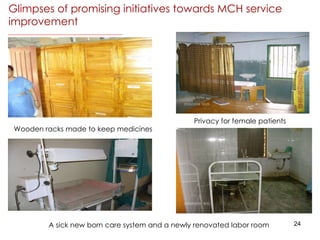
Wooden racks made to keep medicines Privacy for female patients Glimpses of promising initiatives towards MCH service improvement A sick new born care system and a newly renovated labor room
Obj 3.  Collate perceptions of users and others  about institutional health services  Perception based on personal experiences “ We prefer going to the PHC as it always opens on time”- A common man  “  Medicines for my daughter-in-law were free [at BPHC]” – A mother-in-law  “  I do not go to PHC. They have no medicine except for minor ailments”- In a general FGD  “ They [BPHC/PHCs] only refer us”- A woman  “ Woman do not wish to go to the BPHC if they are once turned out saying their labor pain is false. It becomes difficult to motivate others- A Community health worker  “  Toilets unclean. Dirty stains on bed linens. I did not want to stay there (BPHC)”- FGD with women  “  Food is tasteless and insufficient ”- A male acquaintance of an admitted pregnant woman “ Saw rodents in my bed. Could have bitten my child in the cot at my bedside”- An admitted women in the R.H CINI RRC
Obj 3. (Contd..)  Opinions formed through anecdotes “ Mothers and children alike die most in hospital due to infection ”- In a FGD  “ Medicines (given) there [PHC] for children are outdated”- FGD with Mothers  RKS need to take appropriate action for addressing users’ grievance and enhance practice for seeking health care from facility centers RKS can assume role of facilitator between community & service provider to disseminate “correct” information in the community Has a greater role in creating community awareness and knowledge CINI RRC
Obj 4. To identify the limiting factors in RKS Lack of adequate information about RKS functioning and members’ roles among all the members Often guidelines and related orders are not percolated beyond BPHC Lack of sufficient capacity to handle financial management and related aspects by MO-PHC Delay in fund transfer from higher level Lack of supportive supervision and monitoring from district levels  Co-ordination issues particularly with NGO representatives and also PRI & Health All decisions taken by Block with less empowerment for PHCs below CINI RRC “ We are given so many different activities to perform. Representing at RKS is one of them. If only we had an orientation in it our performance cvould have been better”- A Panchayat Pradhan in a GP of Birbhum
Dialogue for development- translating evidences to policies A systematic and mandatory orientation of RKS members about their roles and scope of activity Continuos capacity building support to health personnels on health management in realistic term (like basic security to IPD patients, female privacy) Simillarly, sensitising PRI representatives on MCH issues in the area Strengthening fund flows and related systems of monitoring Reviewing guidelines in light of evolving experiences Allowing NGOs and ASHAs to actively participate in RKS Linking RKS meetings at PHC with 4 th  Saturday & other village level meetings Putting in place grievance redressal and feedback mechanism - helping RKS to reach out to users and local communities  Strengthening Monitoring mechanism Regularised monitoring from dist./Block higher level Evaluate RKS performance in relation to the village micro plan (DHAP) CINI RRC
CINI RRC acknowledges the cooperation extended  by the  Ministry of Health & Family Welfare, Govt. of India &   Dept. of Health and Family Welfare, Govt. of West Bengal , district administration and PRI representatives, all the respondents and various other individuals who made this study possible Thank you! CINI RRC

Exploring perceptions and functioning of Rogi Kalyan Samiti in selected districts of West Bengal: Emphasizing on Maternal and Child health services-Nupur Basu

  • 1.
    Exploring Perceptions andFunctioning of RKS in West Bengal Emphasis on Maternal & Child Health A Formative Research Study Initiative Conducted by CINI Regional Resource Center Supported by Ministry of Health and Family Welfare, Government of India
  • 2.
    About CINI RRCChild In Need Institute (CINI), a NGO with national level recognition Prominent works in the domains of health, nutrition, education and protection for more than three decades now Guided by its mission – Sustainable development in health, nutrition, education and protection of child, adolescent and woman in need In 2002 CINI recognized as Regional Resource Center for West Bengal, Jharkhand and A&N island by Ministry of Health and Family Welfare, Government of India under the RCH-II project of NRHM Key responsibilities : Capacity building and nurturing of MNGOs through trainings, documentation and dissemination of best practices, networking and advocacy – Overall, Strengthening RCH programme implementation and promoting GO-NGO partnership CINI RRC
  • 3.
    Background (1) Healthintricately linked with development Developing countries still struggling with poor indicators, particularly with respect to MCH & Nutrition MCH - area of concern in India since independence Need for improved health service delivery, community ownership and decentralized processes of planning and action CINI RRC National Rural Health Mission (2005-2012) aims at addressing these concerns so as to accelerate achievement of MCH targets
  • 4.
    Background (2) RogiKalyan Samiti, a key initiative of NRHM in strengthening health delivery systems Originated as a committee of people’s representatives at a hospital in Indore, Madhya Pradesh. Later incorporated in NRHM RKS committed for the optimal utilization of services, rendering transparency and accountability of the health service providers to community Rogi Kalyan Samiti in West Bengal constituted at PHCs (from mid 2006), BPHCs, sub divisional hospitals, and district hospitals. Also in state medical colleges and state general hospitals CINI RRC
  • 5.
    Background ( 3) Members drawn from health, administration, PRI, NGO and IMA. Leading PRI representative as chairman and health representative as convener and secretary Funding source – Annual Maintenance Grant Untied fund Proportion of user charges at specific levels (Not applicable at BPHC & PHC level) Self generated fund CINI RRC
  • 6.
    Need for thestudy Certain facts emerged from the field visits, common opinion and available reports Extent of the association of the RKS Members (particularly from non-health field) with the structure varies Common apathy of community members towards utilizing public health facility services Low awareness in community regarding the existence of RKS in the facility service centers Very few studies on RKS available Need emerged to understand and explore possibilities in popularizing MCH issues through RKS by collating first hand field experiences
  • 7.
    Significance of thepresent study CINI RRC The study is nearly an unprecedented attempt in the region to instigate political will to act upon “ less focused ” component of NRHM Brings rural experiences for discussion Can lend strong voice to urge for improvement of health services and commensurate with the overwhelming endeavor of bringing community closer to the institutional services Substantiate evidences for making health system responsive to community demands Can enhance GO-NGO collaboration in health service delivery
  • 8.
    Study Objectives Understand perceptions of constituent members about RKS Analyse functioning of RKS with reference to maternal and child health activities Collate perceptions of users and local community members about institutional health service Community opinions collected to understand health seeking practices, particularly MCH from facility centers 4. Identify the limiting factors in RKS CINI RRC
  • 9.
    Study Methodology (1)–area selection Cross-sectional explorative study done in three districts of the state. Major focus on qualitative investigation District selection on the basis of Institutional delivery as it has some linkage with the institutional set up where women and other users go for services linked to MCH. Inst. Delivery in West Bengal 49.2 % (DLHS-III, 2007-08). This was the cut-off point Districts divided into three groups as ‘better performing’, ‘average performing’ and ‘under-performing’ in respect to its institutional delivery. One district from each of the 3 categories were randomly chosen. While Birbhum(52.8%) was chosen from the category of average performing districts, Nadia(76%) and U.Dinajpur(39%) were chosen from categories of ‘better performing’ and ‘under performing’ category respectively . CINI RRC
  • 10.
    Study Methodology (2)3 blocks per district chosen through simple random method. CMOHs helped in block identification 1 PHC under each selected BPHCs were selected. Transportation feasibility was considered during PHC selection   Primary data gathered through: Semi-structured interview with RKS members, as many as possible but emphasis on key members FGD with community members Checklist for facility survey enquiring about IPD,OPD, Kitchen, toilets, medical equipments/medicines and general logistics Analysis of the minutes of the RKS meetings and the financial statement within a reference period of 6 months. Field work conducted from March-early June 2008
  • 11.
    Study Points Sample Emphasis on BPHC and PHC levels. Information from District hospitals was collected for cross checking CINI RRC District Block Primary Health Centre ( 1 lac approx.) Primary Health Centre ( 30000-25000 popl.) Uttar Dinajpur Hemtabad Baharail Goalpokher Goagaon Islampur Sujali Birbhum Muraroi 1 Chatra Md Bazar Rampur Nanoor Kirnahar Nadia Krishnanagar 2 Nowapara Tehatta Chotonolda Nakashipara Dharamada
  • 12.
    Limitations Availabilityof RKS members (various factors: PRI elections, busy schedule, not available during study period, outbreak of bird flu etc.) Sample too small to represent the district situation– this is more exploratory than a methodic investigation Unavailability of documents at some places Very short study period and remotely located study point CINI RRC
  • 13.
    O bj 1: To understand awareness of RKS among its members Perception of Members According to majority of the respondents importance of RKS are: “ platform for public-private partnership” “ leading to greater transparency in financial dealings” “ promoting convergence between health and PRI”, opportunity for monitoring services “ Perceptions are large and distant without emphasizing RKS’ immediate role in improving service delivery component Only district level health personnels could refer explicitly to guidelines. Many members not sure about their roles and responsibilities. Comparatively, health personnel (MO,BMOH) and signatories (health and PRI representative) have a idea on their role as signatory. BAM has better idea of financial transactions Overall, different representatives from the non-health sectors exhibited a wide range of understanding and involvement with RKS CINI RRC
  • 14.
    Obj. 1: Contd..Some members (IMA and NGO) feel they can’t contribute as discussion are mostly on financial matters Members like Nurse and Laboratory technicians highlighted constraints of health services, like unavailability of medicines, equipments, staff residential insecurity which could have been resolved through the RKS At the BPHC and PHC level none could assertively draw linkage between RKS and improvement in maternal & child health services CINI RRC
  • 15.
    Obj 2: Analysis of functioning of RKS with reference to MCH activities Functioning (Regularity of monthly meetings) Regular meeting and more participation are important It ensures frequent interaction of members as stage setting for joint action CINI RRC Nadia exhibits more number of meetings despite same hardships across the state District Level of instn. No. of meetings held Comments Uttar Dinajpur BPHC 9/12 Elected representatives remain absent BMOH engagements on emergency duty MO occupied with too many admin. responsibilities Panchayat Election Outbreak of Bird flu Meeting get merged with block health samity meeting Arrange meeting only when fund is received PHC 7/12 Birbhum BPHC 9/12 PHC 8/12 Nadia BPHC 10/12 PHC 13/12
  • 16.
    Functioning ( MemberRepresentation in meetings ) CINI RRC Attendance of BMOH as convener at all levels Less participation of members from non-health sectors due to their loose association with health domain Representation of PRI members more at PHC than BPHC Very low participation of civil society representatives at all levels 5/10 3/9 7/9 MLA 7/10 6/9 - Swasthya Karma dhakshya 6/10 7/9 6/9 Sabhapati 6/10 8/9 9/9 BDO/Jt. BDO Administration 5/10 6/9 6/9 2 nd MO Dept. Representative member U Dinajpur Birbhum Nadia Health BMOH 9/9 9/9 10/10 MO-PHC 7/7 8/8 13/13 ZP member repr. 6/7 8/8 13/13 Pradhan 6/7 6/8 13/13 Civil Society IMA represen- tative - 0/9 1/10 NGO 11/16 3/17 14/23
  • 17.
    Functioning (MCHas priority issue) By and large, MCH issues and activities get less priority in meetings and action (e.g fund expenditure) Overall, MCH issues discussed ( in order of frequency ): - JSY availability status - Resolutions for Purchase of equipment and supplies - Updating cases of Referral transport - Sterilisation camps/services - Repairing labour room and making renovations Decision to spend funds on infrastructure expansion & up gradation, making arrangements for electricity and water, change of signatories and convey major decisions etc. are gross agendas in meeting Quality of services and care for the users are least prioritised/highlighted in discussions . CINI RRC
  • 18.
    Most of theBPHC study points are equipped with General instruments like, B.P machine, Weight machine, thermometer, stethoscope, autoclave etc. Few points have child specific instruments like, Baby resuscitation kit, sucker machine However, Though X-Ray and Ultra Sonography are present at BPHCs but rarely used due to non-positioning of operators Even in Rural Hospitals, beds number far below than sanctioned (30 as against 50) Most places solely relies on referral of sick new borns due to non availability of neonatal health support system in contrast to the heavy demands from the community In some points there are sheer evidences of lacunae in logistic arrangements (Bed sheets and pillows were missing Absence of basic health facilities is a serious issue across the PHC study points In many places basic facilities like, electricity hampering cold chain and beds were missing or unclean Basic equipments like thermometer and first-aid is dysfunctional for long Security of staff and the equipments were basic problems Staff vacancy is a major issue like pharmacist Rarely OPDs open on time and usually close early Functioning of RKS in monitoring & responding to MCH CINI RRC
  • 19.
    CINI RRC RKSmembers can assume greater responsibility in monitoring, identifying service gaps, reporting and taking action for sustaining health service development Quality of care and services is also needed Some common issues at both levels where serious attention is required: Cleanliness, a serious gaps No mechanism to get User Feedback Subsequently, grievance redressal systems not functional fully Poor Female privacy during checkup and treatments Poor Bed facility, thereby seriously affecting post partum care In most places even minor repair of essential equipments take long time for decisions to come from higher authority A regularized monitoring of health services by RKS is rarely practiced Facility staff seldom takes initiative to report paucity of any services/facilities Functioning (RKS in monitoring and responding to MCH services
  • 20.
    Functioning (Financial management)CINI RRC During the study period (2007-08) all the study points received fund Nadia has evidences of generating fund through utilization of institution’s resources Also only study points in Nadia has evidences where PRI members channelised their fund into health institution development at both BPHC & PHCs. Aggregately study points utilized fund in MCH services, like One time purchasing and repairing of labour room and related materials Purchasing equipment (e.g, nebuliser, mucus suckers, baby resuscitation kit and medicines etc.) Organising sterilisation camps Referral cases. Developing IECs for MCH The expenditure amount however varied in a wide range
  • 21.
    Functioning (Financial Management)CINI RRC More expense for construction, expansion and upgradation of infrastructure In contrast low on quality of services like appointing a sweeper, waste disposal, cleaning undergrowths, repairing ambulance shed, water purifier, urinals, window panes of maternity wards etc. Unspent amount a major area of concern Financial guidelines not percolated beyond the district in many places Most head of expenditure were non-recurring (like, renovations, construction etc.) Low practice of regularly stock checking the existing equipments. So recurring costs are not frequently reflected Absence of signatories, particularly PRI representative Late arrival of fund Planning for fund expenditure done after fund arrival and not beforehand Importantly places where basic ammenities were absent like electricity and security Maintaining documents for Financial transactions need serious attention Financial dealings for many PHCs are done at the Block level, thereby dampening the spirit of decentralisation Overall, funds spent scantily benefit mothers and newborns
  • 22.
    Waste disposal point in a RH Wall writing and sound system in a BPHC Provision for drinking water in a BPHC Visitors waiting place in a PHC Some General Positive Initiatives for Health improvement
  • 23.
    Some General PositiveInitiatives for Health improvement Installation of Referral Map in a R.H Well maintenance of a public notice board at a PHC CINI-RRC Involvement of NGO in premise beautification of a BPHC Display of medical services available through tie-up with a private agency
  • 24.
    Wooden racks madeto keep medicines Privacy for female patients Glimpses of promising initiatives towards MCH service improvement A sick new born care system and a newly renovated labor room
  • 25.
    Obj 3. Collate perceptions of users and others about institutional health services Perception based on personal experiences “ We prefer going to the PHC as it always opens on time”- A common man “ Medicines for my daughter-in-law were free [at BPHC]” – A mother-in-law “ I do not go to PHC. They have no medicine except for minor ailments”- In a general FGD “ They [BPHC/PHCs] only refer us”- A woman “ Woman do not wish to go to the BPHC if they are once turned out saying their labor pain is false. It becomes difficult to motivate others- A Community health worker “ Toilets unclean. Dirty stains on bed linens. I did not want to stay there (BPHC)”- FGD with women “ Food is tasteless and insufficient ”- A male acquaintance of an admitted pregnant woman “ Saw rodents in my bed. Could have bitten my child in the cot at my bedside”- An admitted women in the R.H CINI RRC
  • 26.
    Obj 3. (Contd..) Opinions formed through anecdotes “ Mothers and children alike die most in hospital due to infection ”- In a FGD “ Medicines (given) there [PHC] for children are outdated”- FGD with Mothers RKS need to take appropriate action for addressing users’ grievance and enhance practice for seeking health care from facility centers RKS can assume role of facilitator between community & service provider to disseminate “correct” information in the community Has a greater role in creating community awareness and knowledge CINI RRC
  • 27.
    Obj 4. Toidentify the limiting factors in RKS Lack of adequate information about RKS functioning and members’ roles among all the members Often guidelines and related orders are not percolated beyond BPHC Lack of sufficient capacity to handle financial management and related aspects by MO-PHC Delay in fund transfer from higher level Lack of supportive supervision and monitoring from district levels Co-ordination issues particularly with NGO representatives and also PRI & Health All decisions taken by Block with less empowerment for PHCs below CINI RRC “ We are given so many different activities to perform. Representing at RKS is one of them. If only we had an orientation in it our performance cvould have been better”- A Panchayat Pradhan in a GP of Birbhum
  • 28.
    Dialogue for development-translating evidences to policies A systematic and mandatory orientation of RKS members about their roles and scope of activity Continuos capacity building support to health personnels on health management in realistic term (like basic security to IPD patients, female privacy) Simillarly, sensitising PRI representatives on MCH issues in the area Strengthening fund flows and related systems of monitoring Reviewing guidelines in light of evolving experiences Allowing NGOs and ASHAs to actively participate in RKS Linking RKS meetings at PHC with 4 th Saturday & other village level meetings Putting in place grievance redressal and feedback mechanism - helping RKS to reach out to users and local communities Strengthening Monitoring mechanism Regularised monitoring from dist./Block higher level Evaluate RKS performance in relation to the village micro plan (DHAP) CINI RRC
  • 29.
    CINI RRC acknowledgesthe cooperation extended by the Ministry of Health & Family Welfare, Govt. of India & Dept. of Health and Family Welfare, Govt. of West Bengal , district administration and PRI representatives, all the respondents and various other individuals who made this study possible Thank you! CINI RRC