AP Biology
Topic: Nucleic acid chemistry
By
Dr. Zablon Kerima
Lecturer
Dept. Biochemistry
Kampala International
University -Tanzania
AP Biology
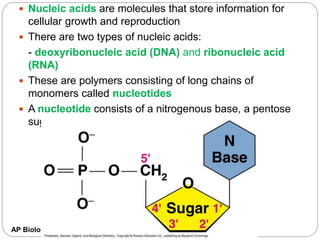
 Nucleic acids are molecules that store information for
cellular growth and reproduction
 There are two types of nucleic acids:
- deoxyribonucleic acid (DNA) and ribonucleic acid
(RNA)
 These are polymers consisting of long chains of
monomers called nucleotides
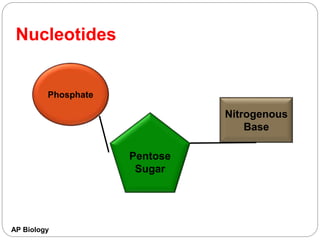
 A nucleotide consists of a nitrogenous base, a pentose
sugar and a phosphate group:
AP Biology
Nucleic Acids
 Function:
 store & transmit genetic information
 Types:
 RNA (ribonucleic acid) (rRNA, mRNA, tRNA)
 DNA (deoxyribonucleic acid)
 Structure:
 monomers = nucleotides…..?
 Polymers = polynucleotides (DNA, RNA)
AP Biology
Nucleotides
Phosphate
Pentose
Sugar
Nitrogenous
Base
AP Biology
AP Biology
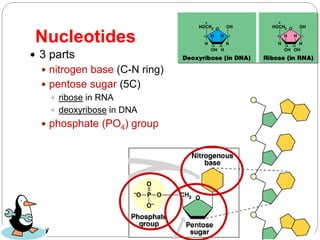
Nucleotides
 3 parts
 nitrogen base (C-N ring)
 pentose sugar (5C)
 ribose in RNA
 deoxyribose in DNA
 phosphate (PO4) group
AP Biology
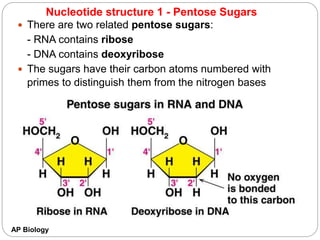
Nucleotide structure 1 - Pentose Sugars
 There are two related pentose sugars:
- RNA contains ribose
- DNA contains deoxyribose
 The sugars have their carbon atoms numbered with
primes to distinguish them from the nitrogen bases
AP Biology
Sugars
O
HOCH2
5’
1’
4’
3’ 2’
O
HOCH2
OH
OH
OH
O
HOCH2
OH
H
OH
Ribose
Deoxyribose
Generic Ribose
Structure
N.B. Carbons are given numberings as a
prime
AP Biology
Based on McMurry, Organic Chemistry, Chapter
28, 6th edition, (c) 2003
9
Nucleotide Structure - 2
Bases: Purine and Pyrimidine
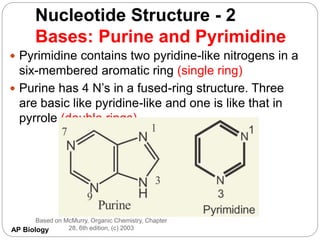
 Pyrimidine contains two pyridine-like nitrogens in a
six-membered aromatic ring (single ring)
 Purine has 4 N’s in a fused-ring structure. Three
are basic like pyridine-like and one is like that in
pyrrole (double rings)
AP Biology
Nitrogen Bases
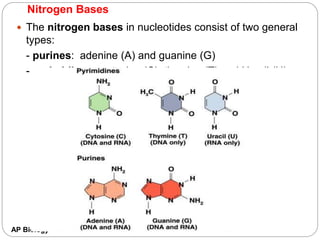
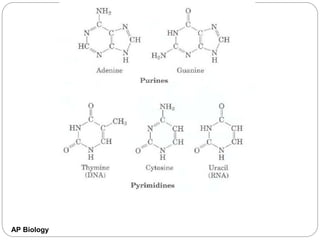
 The nitrogen bases in nucleotides consist of two general
types:
- purines: adenine (A) and guanine (G)
- pyrimidines: cytosine (C), thymine (T) and Uracil (U)
AP Biology
AP Biology
Bases - Pyrimidines
N
N
5
6
1
2
3
4
Uracil
NH
N
O
U
O
H
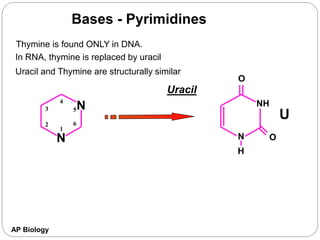
Thymine is found ONLY in DNA.
In RNA, thymine is replaced by uracil
Uracil and Thymine are structurally similar
AP Biology
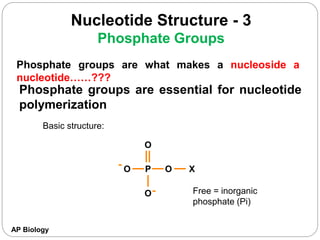
Nucleotide Structure - 3
Phosphate Groups
Phosphate groups are what makes a nucleoside a
nucleotide……???
Phosphate groups are essential for nucleotide
polymerization
P
O
O
O
O X
Basic structure:
Free = inorganic
phosphate (Pi)
AP Biology
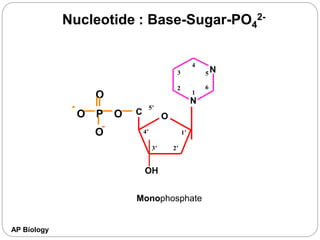
Nucleotide : Base-Sugar-PO4
2-
P
O
O
O
O
N
N
5
6
1
2
3
4
O
C
5’
1’
4’
3’ 2’
OH
Monophosphate
AP Biology
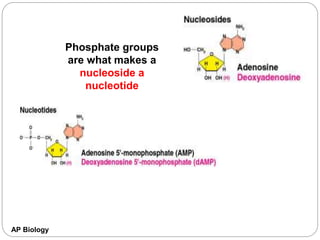
Phosphate groups
are what makes a
nucleoside a
nucleotide
AP Biology
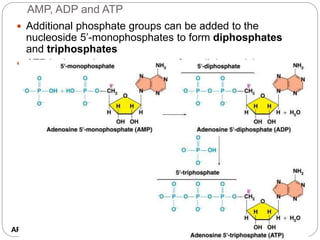
AMP, ADP and ATP
 Additional phosphate groups can be added to the
nucleoside 5’-monophosphates to form diphosphates
and triphosphates
 ATP is the major energy source for cellular activity
AP Biology
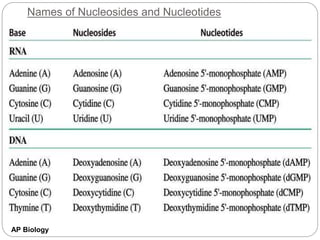
Nucleosides and Nucleotides
 A nucleoside consists of a nitrogen base linked by
a glycosidic bond to C1’ of a ribose or
deoxyribose
 Nucleosides are named by changing the nitrogen
base ending to -osine for purines and –idine for
pyrimidines
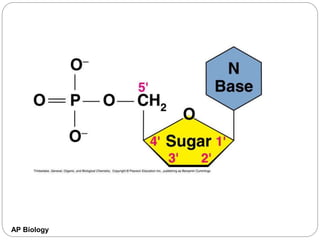
 A nucleotide is a nucleoside that forms a
phosphate ester with the C5’ OH group of ribose
or deoxyribose
 Nucleotides are named using the name of the
nucleoside followed by 5’-monophosphate
AP Biology
Names of Nucleosides and Nucleotides
AP Biology
AP Biology
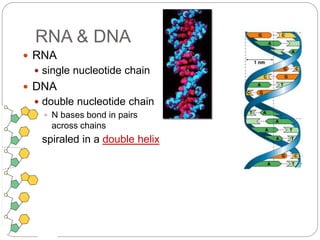
RNA & DNA
 RNA
 single nucleotide chain
 DNA
 double nucleotide chain
 N bases bond in pairs
across chains
 spiraled in a double helix
AP Biology
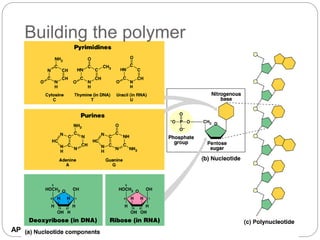
Building the polymer
AP Biology
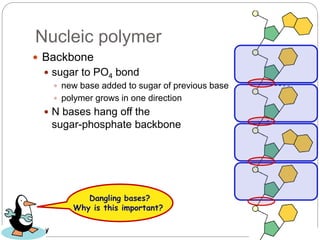
Nucleic polymer
 Backbone
 sugar to PO4 bond
 new base added to sugar of previous base
 polymer grows in one direction
 N bases hang off the
sugar-phosphate backbone
Dangling bases?
Why is this important?
AP Biology
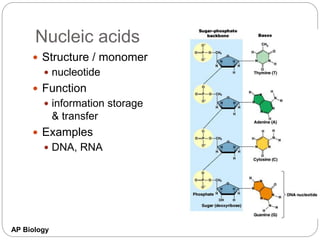
Nucleic acids
 Structure / monomer
 nucleotide
 Function
 information storage
& transfer
 Examples
 DNA, RNA
AP Biology
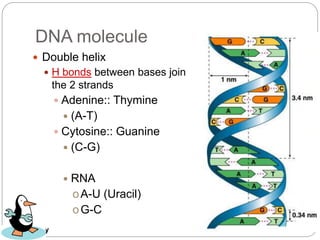
DNA molecule
 Double helix
 H bonds between bases join
the 2 strands
 Adenine:: Thymine
 (A-T)
 Cytosine:: Guanine
 (C-G)
 RNA
oA-U (Uracil)
oG-C
AP Biology
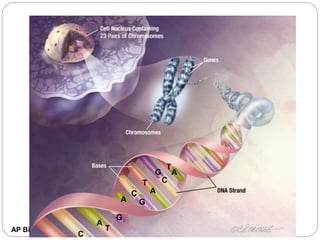
Information polymer
 Function
 series of bases encodes information
 like the letters of a book
 stored information is passed
from parent to offspring
 need to copy accurately
 stored information = genes
 genetic information
Passing on information?
Why is this important?
AP Biology
A
A
A
A
T
C
G
C
G
T
G
C
T
AP Biology
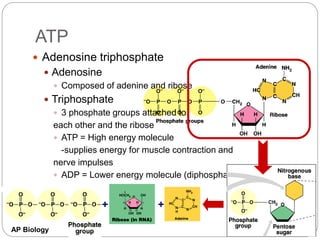
ATP
 Adenosine triphosphate
 Adenosine
 Composed of adenine and ribose
 Triphosphate
 3 phosphate groups attached to
each other and the ribose
 ATP = High energy molecule
-supplies energy for muscle contraction and
nerve impulses
 ADP = Lower energy molecule (diphosphate)
+
+
AP Biology
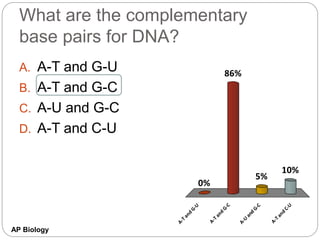
What are the complementary
base pairs for DNA?
A. A-T and G-U
B. A-T and G-C
C. A-U and G-C
D. A-T and C-U
A
-
T
a
n
d
G
-
U
A
-
T
a
n
d
G
-
C
A
-
U
a
n
d
G
-
C
A
-
T
a
n
d
C
-
U
0%
10%
5%
86%
AP Biology
What is one difference between
DNA and RNA?
A. DNA has uracil and
RNA does not
B. RNA is single
stranded and DNA
is double stranded
C. DNA has 4 bases
and RNA has 5
D. DNA has a ribose
sugar and RNA
does not
D
N
A
h
a
s
u
r
a
c
i
l
a
n
d
R
N
A
.
.
.
R
N
A
i
s
s
i
n
g
l
e
s
t
r
a
n
d
e
d
a
.
.
D
N
A
h
a
s
4
b
a
s
e
s
a
n
d
R
N
.
.
.
D
N
A
h
a
s
a
r
i
b
o
s
e
s
u
g
a
r
a
.
.
5% 5%
10%
81%
AP Biology
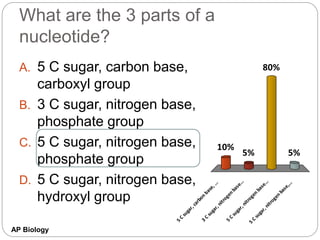
What are the 3 parts of a
nucleotide?
A. 5 C sugar, carbon base,
carboxyl group
B. 3 C sugar, nitrogen base,
phosphate group
C. 5 C sugar, nitrogen base,
phosphate group
D. 5 C sugar, nitrogen base,
hydroxyl group
5
C
s
u
g
a
r
,
c
a
r
b
o
n
b
a
s
e
,
.
.
.
3
C
s
u
g
a
r
,
n
i
t
r
o
g
e
n
b
a
s
e
.
.
.
5
C
s
u
g
a
r
,
n
i
t
r
o
g
e
n
b
a
s
e
.
.
.
5
C
s
u
g
a
r
,
n
i
t
r
o
g
e
n
b
a
s
e
,
.
.
.
10%
5%
80%
5%
AP Biology
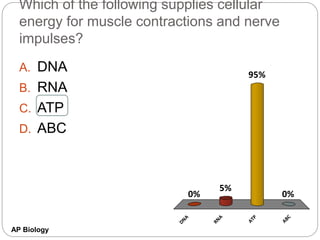
Which of the following supplies cellular
energy for muscle contractions and nerve
impulses?
A. DNA
B. RNA
C. ATP
D. ABC
D
N
A
R
N
A
A
T
P
A
B
C
0% 0%
95%
5%
AP Biology
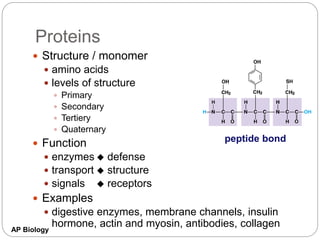
Proteins
 Structure / monomer
 amino acids
 levels of structure
 Primary
 Secondary
 Tertiery
 Quaternary
 Function
 enzymes u defense
 transport u structure
 signals u receptors
 Examples
 digestive enzymes, membrane channels, insulin
hormone, actin and myosin, antibodies, collagen
peptide bond

Nucleic Acid Chemistry session one.ppt

  • 1.
    AP Biology Topic: Nucleicacid chemistry By Dr. Zablon Kerima Lecturer Dept. Biochemistry Kampala International University -Tanzania
  • 2.
    AP Biology  Nucleicacids are molecules that store information for cellular growth and reproduction  There are two types of nucleic acids: - deoxyribonucleic acid (DNA) and ribonucleic acid (RNA)  These are polymers consisting of long chains of monomers called nucleotides  A nucleotide consists of a nitrogenous base, a pentose sugar and a phosphate group:
  • 3.
    AP Biology Nucleic Acids Function:  store & transmit genetic information  Types:  RNA (ribonucleic acid) (rRNA, mRNA, tRNA)  DNA (deoxyribonucleic acid)  Structure:  monomers = nucleotides…..?  Polymers = polynucleotides (DNA, RNA)
  • 4.
  • 5.
  • 6.
    AP Biology Nucleotides  3parts  nitrogen base (C-N ring)  pentose sugar (5C)  ribose in RNA  deoxyribose in DNA  phosphate (PO4) group
  • 7.
    AP Biology Nucleotide structure1 - Pentose Sugars  There are two related pentose sugars: - RNA contains ribose - DNA contains deoxyribose  The sugars have their carbon atoms numbered with primes to distinguish them from the nitrogen bases
  • 8.
  • 9.
    AP Biology Based onMcMurry, Organic Chemistry, Chapter 28, 6th edition, (c) 2003 9 Nucleotide Structure - 2 Bases: Purine and Pyrimidine  Pyrimidine contains two pyridine-like nitrogens in a six-membered aromatic ring (single ring)  Purine has 4 N’s in a fused-ring structure. Three are basic like pyridine-like and one is like that in pyrrole (double rings)
  • 10.
    AP Biology Nitrogen Bases The nitrogen bases in nucleotides consist of two general types: - purines: adenine (A) and guanine (G) - pyrimidines: cytosine (C), thymine (T) and Uracil (U)
  • 11.
  • 12.
    AP Biology Bases -Pyrimidines N N 5 6 1 2 3 4 Uracil NH N O U O H Thymine is found ONLY in DNA. In RNA, thymine is replaced by uracil Uracil and Thymine are structurally similar
  • 13.
    AP Biology Nucleotide Structure- 3 Phosphate Groups Phosphate groups are what makes a nucleoside a nucleotide……??? Phosphate groups are essential for nucleotide polymerization P O O O O X Basic structure: Free = inorganic phosphate (Pi)
  • 14.
    AP Biology Nucleotide :Base-Sugar-PO4 2- P O O O O N N 5 6 1 2 3 4 O C 5’ 1’ 4’ 3’ 2’ OH Monophosphate
  • 15.
    AP Biology Phosphate groups arewhat makes a nucleoside a nucleotide
  • 16.
    AP Biology AMP, ADPand ATP  Additional phosphate groups can be added to the nucleoside 5’-monophosphates to form diphosphates and triphosphates  ATP is the major energy source for cellular activity
  • 17.
    AP Biology Nucleosides andNucleotides  A nucleoside consists of a nitrogen base linked by a glycosidic bond to C1’ of a ribose or deoxyribose  Nucleosides are named by changing the nitrogen base ending to -osine for purines and –idine for pyrimidines  A nucleotide is a nucleoside that forms a phosphate ester with the C5’ OH group of ribose or deoxyribose  Nucleotides are named using the name of the nucleoside followed by 5’-monophosphate
  • 18.
    AP Biology Names ofNucleosides and Nucleotides
  • 19.
  • 20.
    AP Biology RNA &DNA  RNA  single nucleotide chain  DNA  double nucleotide chain  N bases bond in pairs across chains  spiraled in a double helix
  • 21.
  • 22.
    AP Biology Nucleic polymer Backbone  sugar to PO4 bond  new base added to sugar of previous base  polymer grows in one direction  N bases hang off the sugar-phosphate backbone Dangling bases? Why is this important?
  • 23.
    AP Biology Nucleic acids Structure / monomer  nucleotide  Function  information storage & transfer  Examples  DNA, RNA
  • 24.
    AP Biology DNA molecule Double helix  H bonds between bases join the 2 strands  Adenine:: Thymine  (A-T)  Cytosine:: Guanine  (C-G)  RNA oA-U (Uracil) oG-C
  • 25.
    AP Biology Information polymer Function  series of bases encodes information  like the letters of a book  stored information is passed from parent to offspring  need to copy accurately  stored information = genes  genetic information Passing on information? Why is this important?
  • 26.
  • 27.
    AP Biology ATP  Adenosinetriphosphate  Adenosine  Composed of adenine and ribose  Triphosphate  3 phosphate groups attached to each other and the ribose  ATP = High energy molecule -supplies energy for muscle contraction and nerve impulses  ADP = Lower energy molecule (diphosphate) + +
  • 28.
    AP Biology What arethe complementary base pairs for DNA? A. A-T and G-U B. A-T and G-C C. A-U and G-C D. A-T and C-U A - T a n d G - U A - T a n d G - C A - U a n d G - C A - T a n d C - U 0% 10% 5% 86%
  • 29.
    AP Biology What isone difference between DNA and RNA? A. DNA has uracil and RNA does not B. RNA is single stranded and DNA is double stranded C. DNA has 4 bases and RNA has 5 D. DNA has a ribose sugar and RNA does not D N A h a s u r a c i l a n d R N A . . . R N A i s s i n g l e s t r a n d e d a . . D N A h a s 4 b a s e s a n d R N . . . D N A h a s a r i b o s e s u g a r a . . 5% 5% 10% 81%
  • 30.
    AP Biology What arethe 3 parts of a nucleotide? A. 5 C sugar, carbon base, carboxyl group B. 3 C sugar, nitrogen base, phosphate group C. 5 C sugar, nitrogen base, phosphate group D. 5 C sugar, nitrogen base, hydroxyl group 5 C s u g a r , c a r b o n b a s e , . . . 3 C s u g a r , n i t r o g e n b a s e . . . 5 C s u g a r , n i t r o g e n b a s e . . . 5 C s u g a r , n i t r o g e n b a s e , . . . 10% 5% 80% 5%
  • 31.
    AP Biology Which ofthe following supplies cellular energy for muscle contractions and nerve impulses? A. DNA B. RNA C. ATP D. ABC D N A R N A A T P A B C 0% 0% 95% 5%
  • 32.
    AP Biology Proteins  Structure/ monomer  amino acids  levels of structure  Primary  Secondary  Tertiery  Quaternary  Function  enzymes u defense  transport u structure  signals u receptors  Examples  digestive enzymes, membrane channels, insulin hormone, actin and myosin, antibodies, collagen peptide bond