Nuclear Weapons and
Terrorism
Major killers in Wars
• Assault Rifles (64%)
• Handguns (10%)
• Landmines (10%)
• Hand grenades, Artillery, Mortars (16%)
• Since 1900: 34 million soldiers and 80
million civilians killed in wars world-wide
• 2 Nuclear bombs killed 200,000 total.
M16
Howitzer
Who has nuclear weapons?
US (1800)
Russia (2700)
UK (55.5)
France (91.5)
China(400)
Israel(32)
India(12?)
Pakistan(12?)
Thermonuclear
Fission
N. Korea 24?
Nuclear warheads and plutonium
production around the world
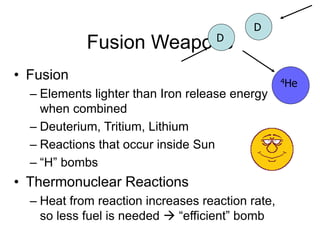
Fusion Weapons
• Fusion
– Elements lighter than Iron release energy
when combined
– Deuterium, Tritium, Lithium
– Reactions that occur inside Sun
– “H” bombs
• Thermonuclear Reactions
– Heat from reaction increases reaction rate,
so less fuel is needed  “efficient” bomb
D
D
4He
• Naturally occurring Uranium must be
enriched to >90% 235U in order to make
fission weapons (or to ~5% for nuclear
power plants)
• Enrichment methods
– Gas centrifuge (now being used in Iran and
found in Iraq after 1st Gulf War)
– Gaseous diffusion (used in USA)
– Electromagnetic isotope separation –
(unexpectedly found in Iraq after 1st Gulf War)
Enriching Uranium
Critical mass  chain
reactions
• When a large enough mass of either 235U or
239Pu is assembled, a self-sustaining chain
reaction results after the first fission is
produced.
• The minimum (“critical”) mass of fissile
material that can sustain a nuclear chain
reaction depends on the density, shape, and
type of fissile material, as well as the
effectiveness of any surrounding material
(called a reflector or tamper) at reflecting
neutrons back into the fissioning mass.
• Depleted U is often used in the tamper
The first “A” bombs
• Trinity – Gadget (7/16/45)
– Alamagordo test range in New Mexico
– 20 kTon yield
• Little Boy (8/6/45)
– Hiroshima
– 15 kTon yield
• Fat Man (8/9/45)
– Nagasaki
– 20 kTon yield
Museum display in NM
http://www.fas.org/nuke/hew/Usa/Med/Lbfm.html
How to make an “A” bomb
• Use >90% 235U
• Squeeze and confine evenly
• Reflect neutrons back into 235U
• Use initial explosive device to trigger
Little Boy (Hiroshima 8/6/45)
http://www.pcf.city.hiroshima.jp/peacesite/English/Stage1/1-3/1-3-3E.html
3 m
A-bomb dome
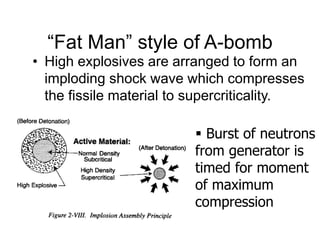
“Fat Man” style of A-bomb
• High explosives are arranged to form an
imploding shock wave which compresses
the fissile material to supercriticality.
 Burst of neutrons
from generator is
timed for moment
of maximum
compression
Low Yield Nuclear Weapons
 Designed to “threaten hard and deeply buried
targets."
• Despite claims to produce less fallout due to
underground explosion, a 5 kTon weapon would
produce considerable quantities of radioactive
dirt
“Dirty” bombs
• Does not involve nuclear explosion
• Spreads radiological materials over a
wide area
• Most deaths (<100) would be due to the
blast, not to the radioactivity
• “Weapon of mass disruption”
• “Difference between a dirty bomb and a
nuclear bomb is the difference between
a lightning bug and lightning” – Allison
• Much easier to make, however.
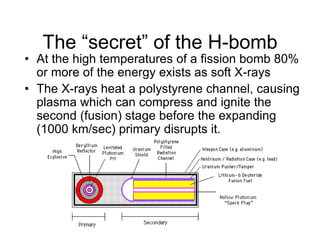
The “secret” of the H-bomb
• At the high temperatures of a fission bomb 80%
or more of the energy exists as soft X-rays
• The X-rays heat a polystyrene channel, causing
plasma which can compress and ignite the
second (fusion) stage before the expanding
(1000 km/sec) primary disrupts it.
Fusion weapons
Published due to Wen Ho Lee case
http://www.fas.org/sgp/eprint/morland.html
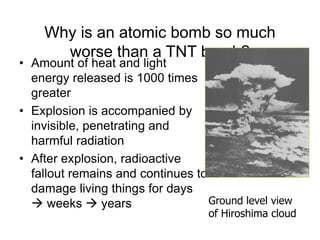
Why is an atomic bomb so much
worse than a TNT bomb?
• Amount of heat and light
energy released is 1000 times
greater
• Explosion is accompanied by
invisible, penetrating and
harmful radiation
• After explosion, radioactive
fallout remains and continues to
damage living things for days
 weeks  years Ground level view
of Hiroshima cloud
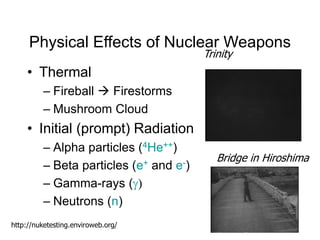
Physical Effects of Nuclear Weapons
• Thermal
– Fireball  Firestorms
– Mushroom Cloud
• Initial (prompt) Radiation
– Alpha particles (4He++)
– Beta particles (e+ and e-)
– Gamma-rays (g)
– Neutrons (n)
Trinity
http://nuketesting.enviroweb.org/
Bridge in Hiroshima
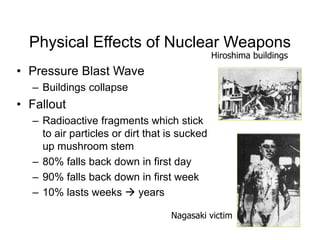
Physical Effects of Nuclear Weapons
• Pressure Blast Wave
– Buildings collapse
• Fallout
– Radioactive fragments which stick
to air particles or dirt that is sucked
up mushroom stem
– 80% falls back down in first day
– 90% falls back down in first week
– 10% lasts weeks  years
Nagasaki victim
Hiroshima buildings
Physical Effects of Nuclear Weapons
• Electromagnetic Pulse
– Strongest for very high bursts
 g-rays ionize air  electrons
– Electrons create large currents in air
– Currents are picked up by power lines
– Power surges shut down grid, destroy
attached electrical devices
• 1.4 Mton airburst in 1962 knocked out
lights in Hawaii over 1000 miles away
Electromagnetic Pulse Effects
http://www.heritage.org/library/backgrounder/bg1372.html
How big are the weapons?
• 1 kTon = 1000 tons = 2,000,000 pounds
of TNT equivalent
• ~2 pounds of 235U  20 kTons
• Today’s warhead is 100-200 kTons
• Largest underground burst: 4.5Mtons
• Largest airburst: 58 Mtons
• Over 1700 known tests since 1945
Nuclear Non-Proliferation Treaty
• Vertical – development of new weapons by the
“Big 5”
• Horizontal – spread of weapons to other
countries
• “Haves” agree not to spread weapons, materials
or technology to “have-nots” – also, to stop
vertical proliferation
• “Have-nots” agree not to try to acquire weapons
from the “haves,” and will accept inspection and
regulation of “peaceful” nuclear technology by
IAEA- this stops horizontal proliferation
There are currently eight states that we know have
successfully detonated nuclear weapons.
• Five are considered to be “nuclear weapons states”, an internationally
recognized status conferred by the Nuclear Non-Proliferation Treaty
(NPT). In order of acquisition of nuclear weapons these are:
– the United States of America
– Russia (formerly the Soviet Union)
– the United Kingdom
– France
– the People’s Republic of China
• Since the formulation of the NPT, three non-signatory states of the
NPT have conducted nuclear tests:
– India
– Pakistan
– North Korea
• In addition to these eight, Israel is believed to be an undeclared nuclear
power
Who still wants nuclear
weapons?
• Iran – Was enriching
• States?
• Terrorist?
The spread of nuclear weapons from Pakistan
LIBYA
CHECHNYA
For money?
• Small Crude
bombs by US
standards
How hard is it to
build an atomic
bomb if you have
the raw materials?
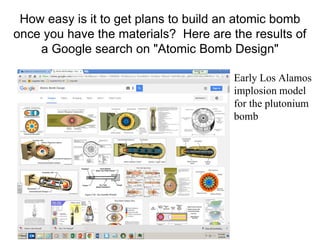
How easy is it to get plans to build an atomic bomb
once you have the materials? Here are the results of
a Google search on "Atomic Bomb Design"
• Early Los Alamos
implosion model
for the plutonium
bomb
Soviet nuclear suitcase bomb
Are 84 of some 132 special KGB 1 kton suitcase nuclear weapons
unaccounted for as first claimed by Yeltsin's assistant for national
security affairs, General Alexander Lebed, and then retracted?
A shipping container is
10 x 10 x 30 ft
20,000 shipping containers enter US Ports
in 1 day, but only 3 or 4% are inspected
Only two
or three
out of 65
shipping
containers
would be
inspected
How many atomic bombs can
fit into one shipping container?
The End

Nuclear Weapons (1).pdf

  • 1.
  • 2.
    Major killers inWars • Assault Rifles (64%) • Handguns (10%) • Landmines (10%) • Hand grenades, Artillery, Mortars (16%) • Since 1900: 34 million soldiers and 80 million civilians killed in wars world-wide • 2 Nuclear bombs killed 200,000 total. M16 Howitzer
  • 3.
    Who has nuclearweapons? US (1800) Russia (2700) UK (55.5) France (91.5) China(400) Israel(32) India(12?) Pakistan(12?) Thermonuclear Fission N. Korea 24?
  • 4.
    Nuclear warheads andplutonium production around the world
  • 5.
    Fusion Weapons • Fusion –Elements lighter than Iron release energy when combined – Deuterium, Tritium, Lithium – Reactions that occur inside Sun – “H” bombs • Thermonuclear Reactions – Heat from reaction increases reaction rate, so less fuel is needed  “efficient” bomb D D 4He
  • 6.
    • Naturally occurringUranium must be enriched to >90% 235U in order to make fission weapons (or to ~5% for nuclear power plants) • Enrichment methods – Gas centrifuge (now being used in Iran and found in Iraq after 1st Gulf War) – Gaseous diffusion (used in USA) – Electromagnetic isotope separation – (unexpectedly found in Iraq after 1st Gulf War) Enriching Uranium
  • 7.
    Critical mass chain reactions • When a large enough mass of either 235U or 239Pu is assembled, a self-sustaining chain reaction results after the first fission is produced. • The minimum (“critical”) mass of fissile material that can sustain a nuclear chain reaction depends on the density, shape, and type of fissile material, as well as the effectiveness of any surrounding material (called a reflector or tamper) at reflecting neutrons back into the fissioning mass. • Depleted U is often used in the tamper
  • 8.
    The first “A”bombs • Trinity – Gadget (7/16/45) – Alamagordo test range in New Mexico – 20 kTon yield • Little Boy (8/6/45) – Hiroshima – 15 kTon yield • Fat Man (8/9/45) – Nagasaki – 20 kTon yield Museum display in NM http://www.fas.org/nuke/hew/Usa/Med/Lbfm.html
  • 9.
    How to makean “A” bomb • Use >90% 235U • Squeeze and confine evenly • Reflect neutrons back into 235U • Use initial explosive device to trigger Little Boy (Hiroshima 8/6/45) http://www.pcf.city.hiroshima.jp/peacesite/English/Stage1/1-3/1-3-3E.html 3 m A-bomb dome
  • 10.
    “Fat Man” styleof A-bomb • High explosives are arranged to form an imploding shock wave which compresses the fissile material to supercriticality.  Burst of neutrons from generator is timed for moment of maximum compression
  • 11.
    Low Yield NuclearWeapons  Designed to “threaten hard and deeply buried targets." • Despite claims to produce less fallout due to underground explosion, a 5 kTon weapon would produce considerable quantities of radioactive dirt
  • 12.
    “Dirty” bombs • Doesnot involve nuclear explosion • Spreads radiological materials over a wide area • Most deaths (<100) would be due to the blast, not to the radioactivity • “Weapon of mass disruption” • “Difference between a dirty bomb and a nuclear bomb is the difference between a lightning bug and lightning” – Allison • Much easier to make, however.
  • 13.
    The “secret” ofthe H-bomb • At the high temperatures of a fission bomb 80% or more of the energy exists as soft X-rays • The X-rays heat a polystyrene channel, causing plasma which can compress and ignite the second (fusion) stage before the expanding (1000 km/sec) primary disrupts it.
  • 14.
    Fusion weapons Published dueto Wen Ho Lee case http://www.fas.org/sgp/eprint/morland.html
  • 15.
    Why is anatomic bomb so much worse than a TNT bomb? • Amount of heat and light energy released is 1000 times greater • Explosion is accompanied by invisible, penetrating and harmful radiation • After explosion, radioactive fallout remains and continues to damage living things for days  weeks  years Ground level view of Hiroshima cloud
  • 16.
    Physical Effects ofNuclear Weapons • Thermal – Fireball  Firestorms – Mushroom Cloud • Initial (prompt) Radiation – Alpha particles (4He++) – Beta particles (e+ and e-) – Gamma-rays (g) – Neutrons (n) Trinity http://nuketesting.enviroweb.org/ Bridge in Hiroshima
  • 17.
    Physical Effects ofNuclear Weapons • Pressure Blast Wave – Buildings collapse • Fallout – Radioactive fragments which stick to air particles or dirt that is sucked up mushroom stem – 80% falls back down in first day – 90% falls back down in first week – 10% lasts weeks  years Nagasaki victim Hiroshima buildings
  • 18.
    Physical Effects ofNuclear Weapons • Electromagnetic Pulse – Strongest for very high bursts  g-rays ionize air  electrons – Electrons create large currents in air – Currents are picked up by power lines – Power surges shut down grid, destroy attached electrical devices • 1.4 Mton airburst in 1962 knocked out lights in Hawaii over 1000 miles away
  • 19.
  • 20.
    How big arethe weapons? • 1 kTon = 1000 tons = 2,000,000 pounds of TNT equivalent • ~2 pounds of 235U  20 kTons • Today’s warhead is 100-200 kTons • Largest underground burst: 4.5Mtons • Largest airburst: 58 Mtons • Over 1700 known tests since 1945
  • 21.
    Nuclear Non-Proliferation Treaty •Vertical – development of new weapons by the “Big 5” • Horizontal – spread of weapons to other countries • “Haves” agree not to spread weapons, materials or technology to “have-nots” – also, to stop vertical proliferation • “Have-nots” agree not to try to acquire weapons from the “haves,” and will accept inspection and regulation of “peaceful” nuclear technology by IAEA- this stops horizontal proliferation
  • 22.
    There are currentlyeight states that we know have successfully detonated nuclear weapons. • Five are considered to be “nuclear weapons states”, an internationally recognized status conferred by the Nuclear Non-Proliferation Treaty (NPT). In order of acquisition of nuclear weapons these are: – the United States of America – Russia (formerly the Soviet Union) – the United Kingdom – France – the People’s Republic of China • Since the formulation of the NPT, three non-signatory states of the NPT have conducted nuclear tests: – India – Pakistan – North Korea • In addition to these eight, Israel is believed to be an undeclared nuclear power
  • 23.
    Who still wantsnuclear weapons? • Iran – Was enriching • States? • Terrorist?
  • 24.
    The spread ofnuclear weapons from Pakistan LIBYA CHECHNYA
  • 25.
    For money? • SmallCrude bombs by US standards
  • 26.
    How hard isit to build an atomic bomb if you have the raw materials?
  • 27.
    How easy isit to get plans to build an atomic bomb once you have the materials? Here are the results of a Google search on "Atomic Bomb Design" • Early Los Alamos implosion model for the plutonium bomb
  • 28.
    Soviet nuclear suitcasebomb Are 84 of some 132 special KGB 1 kton suitcase nuclear weapons unaccounted for as first claimed by Yeltsin's assistant for national security affairs, General Alexander Lebed, and then retracted?
  • 29.
    A shipping containeris 10 x 10 x 30 ft
  • 30.
    20,000 shipping containersenter US Ports in 1 day, but only 3 or 4% are inspected Only two or three out of 65 shipping containers would be inspected
  • 31.
    How many atomicbombs can fit into one shipping container?
  • 32.