Bulgarian National Green
Investment Scheme
Implemented through the NationalTrust EcoFund
CONTENT
• Legal basis of the NGIS
• NTEF – implementing agency
• The implementation of NGIS
• Implemented public projects
• The Private projects
• Results – environmental, financial, social
LEGAL BASIS OFTHE NGIS
• United Nations Framework Convention on Climate
Change
• Art. 17 of Kyoto Protocol
• Bulgarian NGIS Started in 2010 with the adoption of
amendments to the Environmental Protection Act
• Climate Change Act – 2014
• Regulations governing the structure and the activities of
the NationalTrust Eco Fund
NTEF
NTEF is a legal entity pursuant to:
• The “Debt-for-Environment“ Swap Agreement between the Governments of
Switzerland and Bulgaria of 23 October, 1995;
• Articles 66, 67 and 68 of the Environment Protection Act;
• The Regulation on Organization and Activities of the NationalTrust Ecofund.
• Management bodies - BoD, Consultative Council, EB (7 permanent and 7 on service
contracts)
• Priority Areas for funding - Reduction of air pollution and energy efficiency; Clean water
protection; Clean up of past pollution; Protection of biodiversity
• The Debt for Environment Program funded 100 projects at the amount of 26 Mill BGN
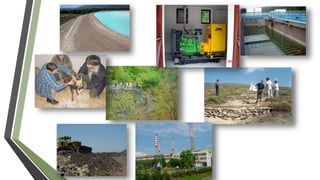
• Environmental Remediation Pilot Project – Pirdop – specific role of NTEF – financial
management and coordination of the stakeholders interest
• Protected Areas Fund – established as a revolving fund for the purposes of nature
conservation
• NGIS operator
IMPLEMENTATION OF NGIS
• Two Agreements for the Purchase of Assigned Amount Units under a
Green Investment Scheme between the Republic of Bulgaria and the
Republic of Austria – October 2011 and April 2012 - conditions for the sell
of Assigned Amount Units and the obligations and responsibilities of the
two parties
• Greening Frameworks – targeted greening activities, time frame, legal
framework, responsible institutions, GIS funds transfer scheme, eligible
funds and fund allocations, project selection process, monitoring of the
greening effect, reporting and auditing procedures,
• Operations Manual of the NGIS
PUBLIC PROJECTS FOR ENERGY EFFICIENCY
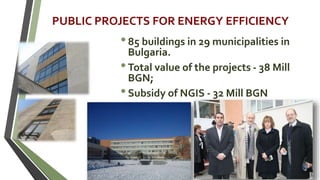
•85 buildings in 29 municipalities in
Bulgaria.
•Total value of the projects - 38 Mill
BGN;
•Subsidy of NGIS - 32 Mill BGN
PUBLIC PROJECTS FOR ENERGY EFFICIENCY
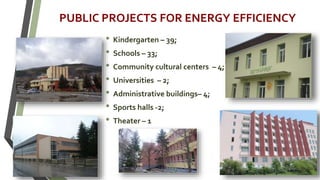
• Kindergarten – 39;
• Schools – 33;
• Community cultural centers – 4;
• Universities – 2;
• Administrative buildings– 4;
• Sports halls -2;
• Theater – 1
PUBLIC PROJECTS FOR ENERGY EFFICIENCY
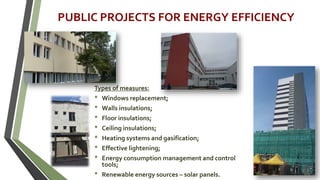
Types of measures:
• Windows replacement;
• Walls insulations;
• Floor insulations;
• Ceiling insulations;
• Heating systems and gasification;
• Effective lightening;
• Energy consumption management and control
tools;
• Renewable energy sources – solar panels.
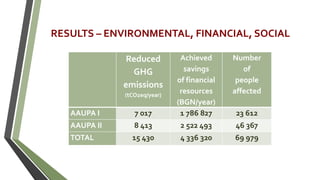
RESULTS – ENVIRONMENTAL, FINANCIAL, SOCIAL
Reduced
GHG
emissions
(tCO2eq/year)
Achieved
savings
of financial
resources
(BGN/year)
Number
of
people
affected
AAUPA I 7 017 1 786 827 23 612
AAUPA II 8 413 2 522 493 46 367
TOTAL 15 430 4 336 320 69 979
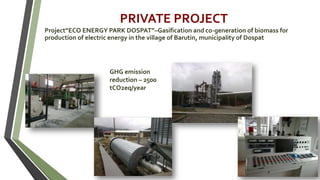
PRIVATE PROJECT
Project“ECO ENERGY PARK DOSPAT”–Gasification and co-generation of biomass for
production of electric energy in the village of Barutin, municipality of Dospat
GHG emission
reduction – 2500
tCO2eq/year
Thank you!
NationalTrust EcoFund
www.ecofund-bg.org
ecofund@ecofund-bg.org
+359 2 973 36 37

Bulgarian National Green Investment Scheme

  • 1.
    Bulgarian National Green InvestmentScheme Implemented through the NationalTrust EcoFund
  • 2.
    CONTENT • Legal basisof the NGIS • NTEF – implementing agency • The implementation of NGIS • Implemented public projects • The Private projects • Results – environmental, financial, social
  • 3.
    LEGAL BASIS OFTHENGIS • United Nations Framework Convention on Climate Change • Art. 17 of Kyoto Protocol • Bulgarian NGIS Started in 2010 with the adoption of amendments to the Environmental Protection Act • Climate Change Act – 2014 • Regulations governing the structure and the activities of the NationalTrust Eco Fund
  • 4.
    NTEF NTEF is alegal entity pursuant to: • The “Debt-for-Environment“ Swap Agreement between the Governments of Switzerland and Bulgaria of 23 October, 1995; • Articles 66, 67 and 68 of the Environment Protection Act; • The Regulation on Organization and Activities of the NationalTrust Ecofund. • Management bodies - BoD, Consultative Council, EB (7 permanent and 7 on service contracts) • Priority Areas for funding - Reduction of air pollution and energy efficiency; Clean water protection; Clean up of past pollution; Protection of biodiversity • The Debt for Environment Program funded 100 projects at the amount of 26 Mill BGN • Environmental Remediation Pilot Project – Pirdop – specific role of NTEF – financial management and coordination of the stakeholders interest • Protected Areas Fund – established as a revolving fund for the purposes of nature conservation • NGIS operator
  • 6.
    IMPLEMENTATION OF NGIS •Two Agreements for the Purchase of Assigned Amount Units under a Green Investment Scheme between the Republic of Bulgaria and the Republic of Austria – October 2011 and April 2012 - conditions for the sell of Assigned Amount Units and the obligations and responsibilities of the two parties • Greening Frameworks – targeted greening activities, time frame, legal framework, responsible institutions, GIS funds transfer scheme, eligible funds and fund allocations, project selection process, monitoring of the greening effect, reporting and auditing procedures, • Operations Manual of the NGIS
  • 7.
    PUBLIC PROJECTS FORENERGY EFFICIENCY •85 buildings in 29 municipalities in Bulgaria. •Total value of the projects - 38 Mill BGN; •Subsidy of NGIS - 32 Mill BGN
  • 8.
    PUBLIC PROJECTS FORENERGY EFFICIENCY • Kindergarten – 39; • Schools – 33; • Community cultural centers – 4; • Universities – 2; • Administrative buildings– 4; • Sports halls -2; • Theater – 1
  • 9.
    PUBLIC PROJECTS FORENERGY EFFICIENCY Types of measures: • Windows replacement; • Walls insulations; • Floor insulations; • Ceiling insulations; • Heating systems and gasification; • Effective lightening; • Energy consumption management and control tools; • Renewable energy sources – solar panels.
  • 10.
    RESULTS – ENVIRONMENTAL,FINANCIAL, SOCIAL Reduced GHG emissions (tCO2eq/year) Achieved savings of financial resources (BGN/year) Number of people affected AAUPA I 7 017 1 786 827 23 612 AAUPA II 8 413 2 522 493 46 367 TOTAL 15 430 4 336 320 69 979
  • 11.
    PRIVATE PROJECT Project“ECO ENERGYPARK DOSPAT”–Gasification and co-generation of biomass for production of electric energy in the village of Barutin, municipality of Dospat GHG emission reduction – 2500 tCO2eq/year
  • 12.

Editor's Notes

  • #4 Article 17 of the Kyoto Protocol provides that the parties included in Annex B to the Kyoto Protocol may participate in emissions trading for the purposes of fulfilling their commitments under Article 3 of the Kyoto Protocol; EPA The purpose of the National Green Investment Scheme is to promote, through financial and institutional means, investment and other projects which will result in decreasing greenhouse gas emissions on the territory of Bulgaria or will have any other positive environmental effects or impacts, including by reduction of the anthropogenic factors associated with climate change and global warming, in compliance with the requirements of European laws and the and the national legislation in the field of environmental protection. The National Green Investment Scheme organizes the calls, assessment, validation and funding of green investment projects through the NTEF, monitoring and supervision of the implementation of such projects for the purpose of implementation and achievement of results under green investment projects. The sale agreement are signed by the minister of finance, the minister of environment and waters and the minister of economy and energy and by the authorized representatives of the buyer respectively. The implementation and application of the NGIS is assigned to the NTEF which is responsible for the calls, approval and assignment of the implementation of green investment projects , funded with the proceeds from international AAU trading. The National Green Investment Scheme is managed in compliance with the EU regulations on state aid and the international principles of good practices, including: 1. transparency; 2. environmental and economic efficiency; 3. reliability; 4. traceability; 5. accountancy. AAU buyers participate in the supervision and monitoring systems by inclusion, if they wish so, of their representatives in the Advisory Committee of the NTEF.
  • #7 The agreed GIS Greening Activities subsidized through the Proceeds shall result in the decrease of CO2 emissions through an increase of energy efficiency in buildings by: insulation of external walls, roof and floor insulation and replacement of windows energy saving measures in heating installations including solar installations regulation and heat distribution and switch to biomass introduction of efficient lighting energy production from biomass and biogas RESPONSIBLE INSTITUTIONS The implementation of the Selected Projects as specified in the Greening Plan were managed by the following institutions: 1. In accordance with the EPA - the Ministry of the Environment and Water (MoEW) and the Ministry of Finance (MoF) and the Ministry of Economy and Energy are jointly liable to the Buyer for the fulfillment of the obligations under this Agreement, in particular for the implementation of the Greening Plan. All three ministries are represented at the Board of Directors of NTEF at the level of Deputy ministers, where also the Deputy minister of Environment and water is deputy chair of the BoD  2. In regard of the implementation of the Greening Framework NTEF and EMEPA (Enterprise for Management of the Environment Protection Activities ) have been assigned specific tasks: NTEF selection of the Identified Project conclusion of Subsidy Contracts with Final Beneficiaries on behalf of the Seller transfer of money accrued by EMEPA`s bridge-financing to the Final Beneficiaries of Public projects during Implementation transfer of Proceeds accrued by the Ministry of Finance to the Final Beneficiaries of Private Projects after Implementation Monitoring of Implementation of the Selected Projects Reporting and publicity EMEPA provides bridge financing for the public projects in the implementation period in the form of interest free loan to NTEF and supports the monitoring process accordingly. GIS funds transfer scheme After the full Implementation of one or more Selected Public Project(s) the Report including both qualitative and quantitative description of the scope of measures and the Incurred Costs of the Implementation are audited by an internationally recognized Auditor. Based on it the Ministry of Finance responds to a Request for Withdrawal of Proceeds and the loan to EMEPA is covered. The payment of the subsidy for the Private Projects is done in two equal installments (at the basis of de minimis rule of the State Aid reulations) at the stage of commissioning of the project and one year later based on verification report of a licensed verifier. Eligible funds – up to 85% of the investment cost for the public projects and up to 10% - for the private projects (but not to violate the de minimis rule) The objective of this Operational Manual is to set out the basic principles and procedures to be followed by the NTEF when evaluating and selecting projects under the National Green Investment Scheme, so that the proceeds from AAU sales are effectively used.  
  • #12 The plant, built under the project, is locatedin the village ofBarutin, Dospat Municipality,District of Smolyanon arehabilitatedwaste dumpof an olduraniummine. The installation includes equipment for pre-treatment and gasification of waste from the timber industry (including branches and waste from cutting down trees) and use of the resulting synthesis gas for cogeneration of electricity and heat. The capacity installed is 1.5 MW, generated by three motor-generators each of 0,5 MW. The electricity is used to cover the plant’s own needs of 0.35 MW, while the remaining capacity of 1.15 MW is supplied to the national grid. The heat produced during the operation of the plant is used for the preparation and drying of waste wood before supplying it to the gasifier. Fig.1: Installed motor-generators Fig.2: Drying drum for preparation of the raw material Fig.3: View of the gasification installation Fig.4: Process control panel