Did Rizal Retract?
CASE STUDY #3
Ticmon, Jonathan B.
CONTENTS OF THE PRESENTATION
A Did Rizal Retract?
B The Balaguer Testimony
C The Testimony of Cuerpo de Vigilancia
DID RIZAL
RETRACT?
A
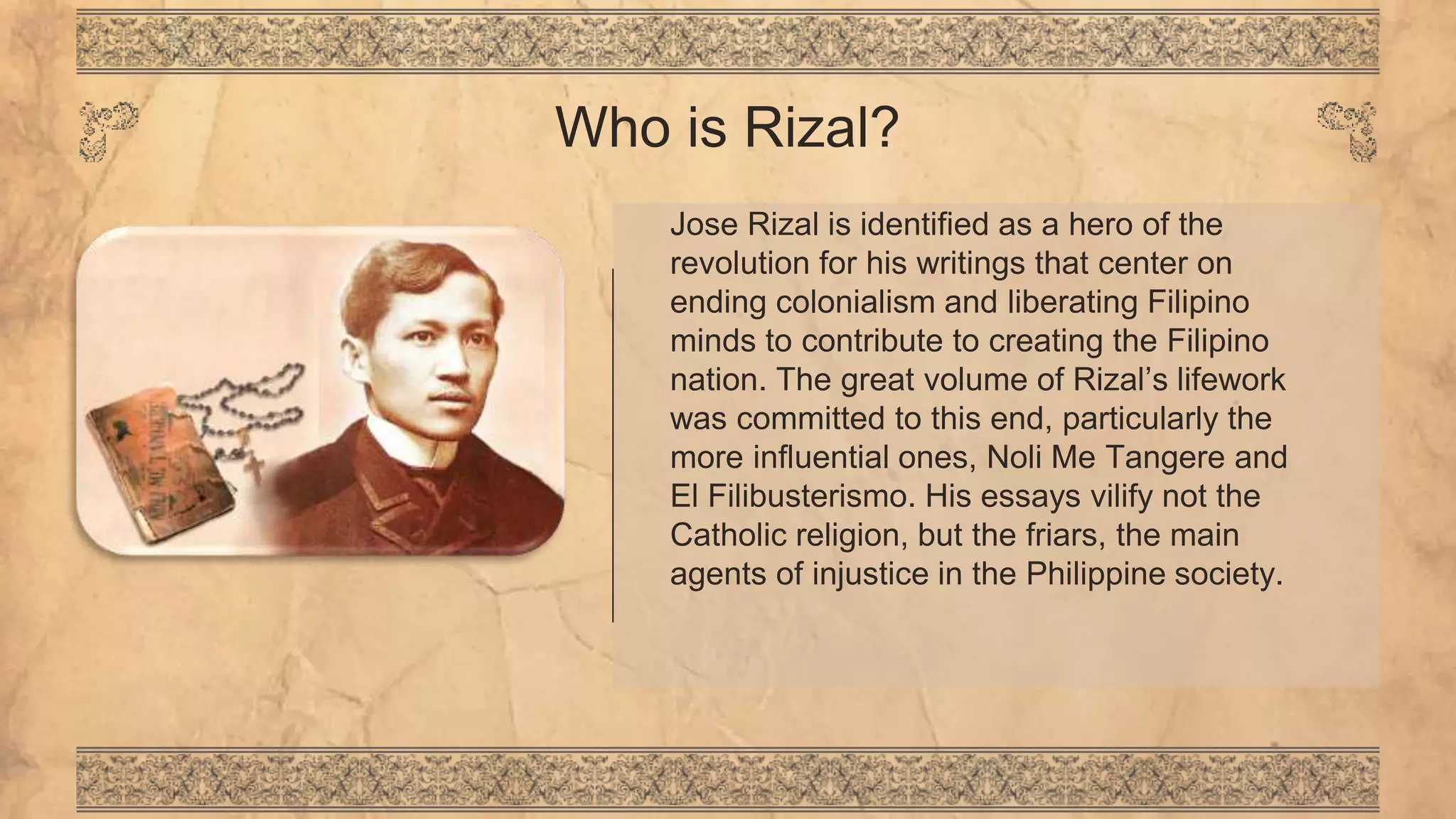
Who is Rizal?
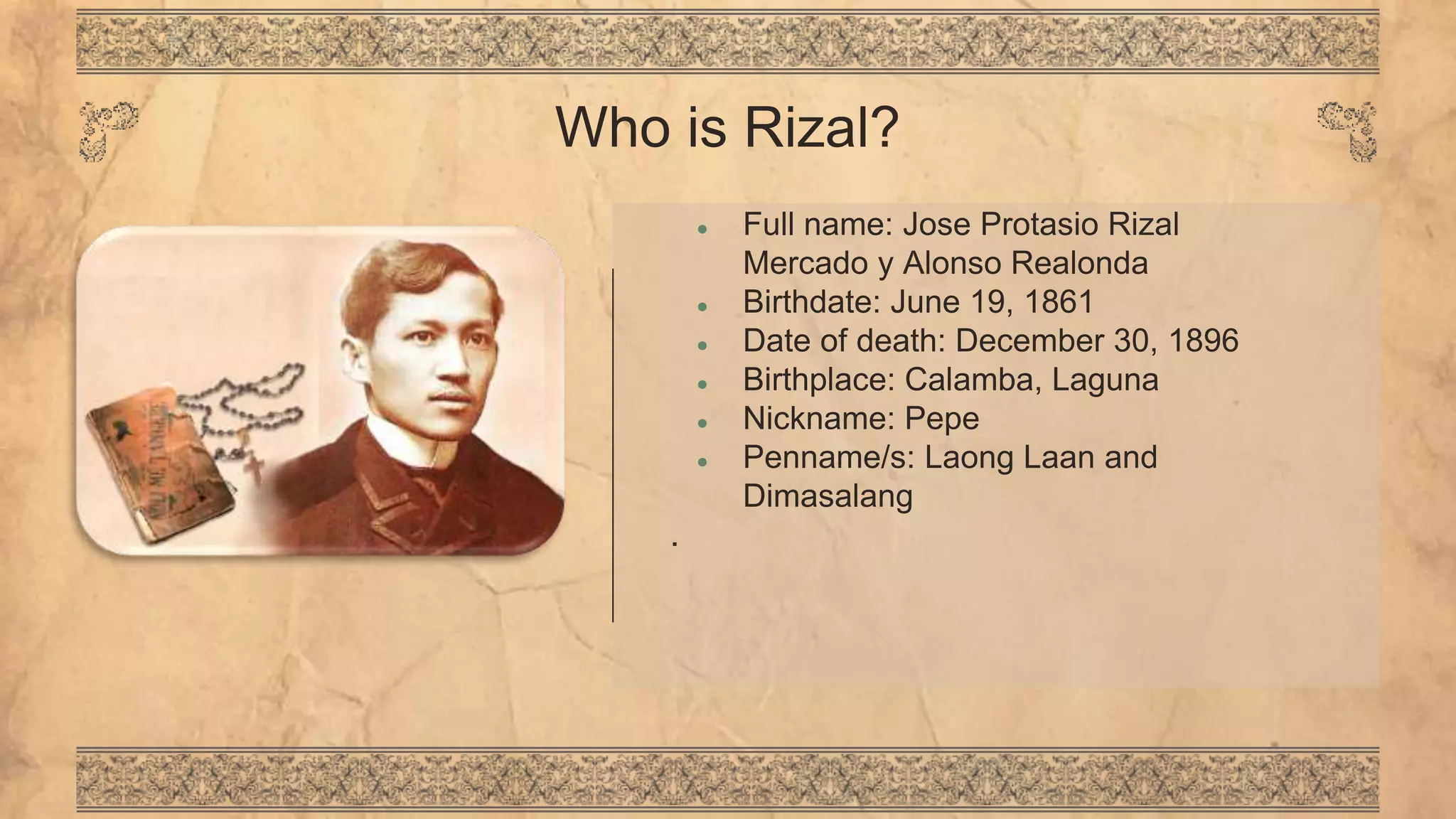
● Full name: Jose Protasio Rizal
Mercado y Alonso Realonda
● Birthdate: June 19, 1861
● Date of death: December 30, 1896
● Birthplace: Calamba, Laguna
● Nickname: Pepe
● Penname/s: Laong Laan and
Dimasalang
.
Who is Rizal?
Jose Rizal is identified as a hero of the
revolution for his writings that center on
ending colonialism and liberating Filipino
minds to contribute to creating the Filipino
nation. The great volume of Rizal’s lifework
was committed to this end, particularly the
more influential ones, Noli Me Tangere and
El Filibusterismo. His essays vilify not the
Catholic religion, but the friars, the main
agents of injustice in the Philippine society.
It is understandable, therefore, that any piece of writing from
Rizal that recants everything he wrote against the friars and
the Catholic Church in the Philippines could deal heavy
damage to his image as a prominent Filipino revolutionary.
Such document purportedly exists, allegedly signed by Rizal
a few hours before his execution. This documents, referred to
as “The Retraction”, declares Rizal’s belief in the Catholic
faith, and retracts everything he wrote against the Church.
Primary Source: Rizal’s Retraction
I declare myself a catholic and in this Religion in which I was born an
educated wish to live and die. I retract with all my heart whatever in
my words, writings, publications and conduct has been contrary to my
character as son of the Catholic Church. I believe and I confess
whatever she teaches and I submit to whatever she demands. I
abominate Masonry, as the enemy which is of the Church, and as a
Society prohibited by the Church. The Diocesan Prelate may, as the
Superior Ecclesiastical Authority, make public this spontaneous
manifestation of mine in order to repair the scandal which my acts may
have caused and so that God and people may pardon me.
Manila 29 of December of 1896
 There are four iterations of the texts of this retraction: the first was published in La
Voz Espaňola and Diario de Manila on the day of the execution, 30 December 1896.
The second text appeared in Barcelona, Spain, on the magazine La Juventud, a few
months after the execution, 14 February 1897, from an anonymous writer who was
later on revealed to be Fr. Vicente Balaguer.
 However, the "original" text was only found in the archdiocesan archives on May 18,
1935, after
almost four decades of disappearance.
 The fourth text appeared in El Imparcial on the day after Rizal’s execution; it is the
short formula of the retraction.
VOCABULARY
On the day of his execution,
the newspaper La Voz
Española reported what
happened in Luneta, and it
also printed the text of the
retraction letter that Rizal
allegedly signed (NAP
Manuscript A-1, Doc. 27).
La Voz Española
01
Diario de Manila was a
Spanish language newspaper
published in the Philippines,
founded on October 11, 1848,
and closed down by official
decree on February 19, 1898,
after the colonial authorities
discovered that its
installations were being used
to print revolutionary material
Diario de Manila
02
VOCABULARY
A la juventud filipina is a
poem written in Spanish by
Filipino writer and patriot
José Rizal, first presented
in 1879 in Manila, while he
was studying at the
University of Santo Tomas.
La Juventud
03
El Imparcial, founded in 1918,
was a newspaper in Puerto
Rico. It circulated daily, except
Sundays./ About El Imparcial.
(San Juan, P.R.) 1918-197?.]
United States Library of
Congress. Retrieved 26 July
2012.</ref> Its complete name
was El Imparcial: El diario
ilustrado de Puerto Rico.
El Imparcial
04
B
Balaguer
Testimony
Doubts on the retraction document abound, especially because only one
eyewitness account of the writing of the document exist—that of the Jesuit
friar Fr. Vicente Balaguer. According to his testimony, Rizal woke up several
times, confessed four times, attended a mass, received communion, and
prayed the rosary, all of which seem out of character. But since it is the only
testimony of allegedly a "primary" account that Rizal ever wrote a retraction
document, it has been used to argue the authenticity of the document.
C
The Testimony of
Cuerpo de
Vigilanci
Primary Source: Eyewitness Account
of the Last Hours of Rizal
Most Illustrious Sir, the agent of the Cuerpo de Vigilancia stationed in Fort
Santiago to report on the events during the (illegible) day in prison of the
accused José Rizal, informs me on this date of the following: At 7:50
yesterday morning, Jose Rizal entered death row accompanied by his
counsel, Seňor Taviel de Andrade, and the Jesuit priest Vilaclara. At the
urgings of the former and moments after entering, he was served a light
breakfast. At approximately 9, the Assistant of the Plaza, Seňor Maure, asked
Rizal if he wanted anything. He replied that at the moment he only wanted a
prayer book, which was brought to him shortly by Father March. Seňor
Andrade left death row at 10 and Rizal spoke for a long while with the Jesuit
fathers, March and Vilaclara. regarding religious matters, it seems. It appears
that these two presented him with a prepared retraction on his life and deeds
that he refused to sign.
This account corroborates the existence of the
retraction giving it credence. However, nowhere in
the account was Fr. Balaguer mentioned, which
makes the friar a mere secondary source to the
writing of the document.
The retraction of Rizal remains to this day, a
controversy; many scholars, however, agree that
the document does not tarnish the heroism of
Rizal. His relevance remained solidified to
Filipinos and pushed them to continue the
Revolution, which eventually resulted to
independence in 1898.
If Rizal retracted, he would not have been
executed. But he was executed;
therefore Rizal did not retract. He would
have been an example for the cause of
the friars; he would have been given a
decent Christian burial, not buried like a
dead dog outside Paco Cemetery.
Why do they
want Rizal to
retract?
They wanted Rizal to retract because the
writings of Jose Rizal made a greater impact
wherein, he exposed the conditions of the
Philippines, particularly the actions of the friars
and the colonial officials, so the friars wanted to
hide that fact.
Thank you
for
listening!

case study of Rizal's Retraction

  • 1.
    Did Rizal Retract? CASESTUDY #3 Ticmon, Jonathan B.
  • 2.
    CONTENTS OF THEPRESENTATION A Did Rizal Retract? B The Balaguer Testimony C The Testimony of Cuerpo de Vigilancia
  • 3.
  • 4.
    Who is Rizal? ●Full name: Jose Protasio Rizal Mercado y Alonso Realonda ● Birthdate: June 19, 1861 ● Date of death: December 30, 1896 ● Birthplace: Calamba, Laguna ● Nickname: Pepe ● Penname/s: Laong Laan and Dimasalang .
  • 5.
    Who is Rizal? JoseRizal is identified as a hero of the revolution for his writings that center on ending colonialism and liberating Filipino minds to contribute to creating the Filipino nation. The great volume of Rizal’s lifework was committed to this end, particularly the more influential ones, Noli Me Tangere and El Filibusterismo. His essays vilify not the Catholic religion, but the friars, the main agents of injustice in the Philippine society.
  • 6.
    It is understandable,therefore, that any piece of writing from Rizal that recants everything he wrote against the friars and the Catholic Church in the Philippines could deal heavy damage to his image as a prominent Filipino revolutionary. Such document purportedly exists, allegedly signed by Rizal a few hours before his execution. This documents, referred to as “The Retraction”, declares Rizal’s belief in the Catholic faith, and retracts everything he wrote against the Church.
  • 7.
    Primary Source: Rizal’sRetraction I declare myself a catholic and in this Religion in which I was born an educated wish to live and die. I retract with all my heart whatever in my words, writings, publications and conduct has been contrary to my character as son of the Catholic Church. I believe and I confess whatever she teaches and I submit to whatever she demands. I abominate Masonry, as the enemy which is of the Church, and as a Society prohibited by the Church. The Diocesan Prelate may, as the Superior Ecclesiastical Authority, make public this spontaneous manifestation of mine in order to repair the scandal which my acts may have caused and so that God and people may pardon me. Manila 29 of December of 1896
  • 8.
     There arefour iterations of the texts of this retraction: the first was published in La Voz Espaňola and Diario de Manila on the day of the execution, 30 December 1896. The second text appeared in Barcelona, Spain, on the magazine La Juventud, a few months after the execution, 14 February 1897, from an anonymous writer who was later on revealed to be Fr. Vicente Balaguer.  However, the "original" text was only found in the archdiocesan archives on May 18, 1935, after almost four decades of disappearance.  The fourth text appeared in El Imparcial on the day after Rizal’s execution; it is the short formula of the retraction.
  • 9.
    VOCABULARY On the dayof his execution, the newspaper La Voz Española reported what happened in Luneta, and it also printed the text of the retraction letter that Rizal allegedly signed (NAP Manuscript A-1, Doc. 27). La Voz Española 01 Diario de Manila was a Spanish language newspaper published in the Philippines, founded on October 11, 1848, and closed down by official decree on February 19, 1898, after the colonial authorities discovered that its installations were being used to print revolutionary material Diario de Manila 02
  • 10.
    VOCABULARY A la juventudfilipina is a poem written in Spanish by Filipino writer and patriot José Rizal, first presented in 1879 in Manila, while he was studying at the University of Santo Tomas. La Juventud 03 El Imparcial, founded in 1918, was a newspaper in Puerto Rico. It circulated daily, except Sundays./ About El Imparcial. (San Juan, P.R.) 1918-197?.] United States Library of Congress. Retrieved 26 July 2012.</ref> Its complete name was El Imparcial: El diario ilustrado de Puerto Rico. El Imparcial 04
  • 11.
  • 12.
    Doubts on theretraction document abound, especially because only one eyewitness account of the writing of the document exist—that of the Jesuit friar Fr. Vicente Balaguer. According to his testimony, Rizal woke up several times, confessed four times, attended a mass, received communion, and prayed the rosary, all of which seem out of character. But since it is the only testimony of allegedly a "primary" account that Rizal ever wrote a retraction document, it has been used to argue the authenticity of the document.
  • 13.
  • 14.
    Primary Source: EyewitnessAccount of the Last Hours of Rizal Most Illustrious Sir, the agent of the Cuerpo de Vigilancia stationed in Fort Santiago to report on the events during the (illegible) day in prison of the accused José Rizal, informs me on this date of the following: At 7:50 yesterday morning, Jose Rizal entered death row accompanied by his counsel, Seňor Taviel de Andrade, and the Jesuit priest Vilaclara. At the urgings of the former and moments after entering, he was served a light breakfast. At approximately 9, the Assistant of the Plaza, Seňor Maure, asked Rizal if he wanted anything. He replied that at the moment he only wanted a prayer book, which was brought to him shortly by Father March. Seňor Andrade left death row at 10 and Rizal spoke for a long while with the Jesuit fathers, March and Vilaclara. regarding religious matters, it seems. It appears that these two presented him with a prepared retraction on his life and deeds that he refused to sign.
  • 15.
    This account corroboratesthe existence of the retraction giving it credence. However, nowhere in the account was Fr. Balaguer mentioned, which makes the friar a mere secondary source to the writing of the document. The retraction of Rizal remains to this day, a controversy; many scholars, however, agree that the document does not tarnish the heroism of Rizal. His relevance remained solidified to Filipinos and pushed them to continue the Revolution, which eventually resulted to independence in 1898.
  • 16.
    If Rizal retracted,he would not have been executed. But he was executed; therefore Rizal did not retract. He would have been an example for the cause of the friars; he would have been given a decent Christian burial, not buried like a dead dog outside Paco Cemetery.
  • 17.
    Why do they wantRizal to retract?
  • 18.
    They wanted Rizalto retract because the writings of Jose Rizal made a greater impact wherein, he exposed the conditions of the Philippines, particularly the actions of the friars and the colonial officials, so the friars wanted to hide that fact.
  • 19.