NSAIDS
A S S I G N M E N T O N :
NSAIDS:
• Nonsteroidal anti-inflammatory drugs (NSAIDs) are members of a drug class that
reduces pain, decreases fever, prevents blood clots, and in higher doses, decreases
inflammation. e. g Aspirin
• Class of NSAIDs: There are four classes of drugs
1. Analgesic
2. Antipyretics
3. Anti-inflammatory
4. Antiplatelet.
A) Analgesic: An analgesic or painkiller is any member of the group of drugs used to achieve
analgesia, relief from pain. ... Analgesics include paracetamol (known in North America as
acetaminophen or simply APAP), the nonsteroidal anti-inflammatory drugs (NSAIDs) such as
the salicylates, and opioid drugs such as morphine and oxycodone.
B) Antipyretics: Drugs/Agents that reduces fever by lowering the body temperature (8th edition
2010, Oxford University Press)
Mechanism of Fever/Pyrexia:
1. Release of endogenous pyrogens (Interleukin-1 enzyme) from leucocytes
2. Generation of Prostaglandin
3. Stimulation of thermoregulatory centers in hypothalamus
4. Reduce sweating and increases body temperature by vasoconstriction.
C) Anti-inflammatory: Inflammation is defined as complex series of events that occurs
in vascularized living tissues in response to local injury and tissue damage. Where
Nonsteroidal anti-inflammatory drugs (NSAIDs) are drugs that help
reduce inflammation.
Causes of inflammation:
 Physical agents: heat, cold, radiation, mechanical trauma.
 Chemical agents: organic and inorganic poisons.
 Infective agents: bacteria and virous.
 Immunological agents: cell mediated antigen-antibody reactions.
D) Antiplatelets: Are a group of medicines that stop blood cells (called platelets) from sticking
together and forming a blood clot. Whenever there is an injury in your body, platelets are sent to
the site of the injury, where they clump together to form a blood clot. This stops the bleeding in
your body.
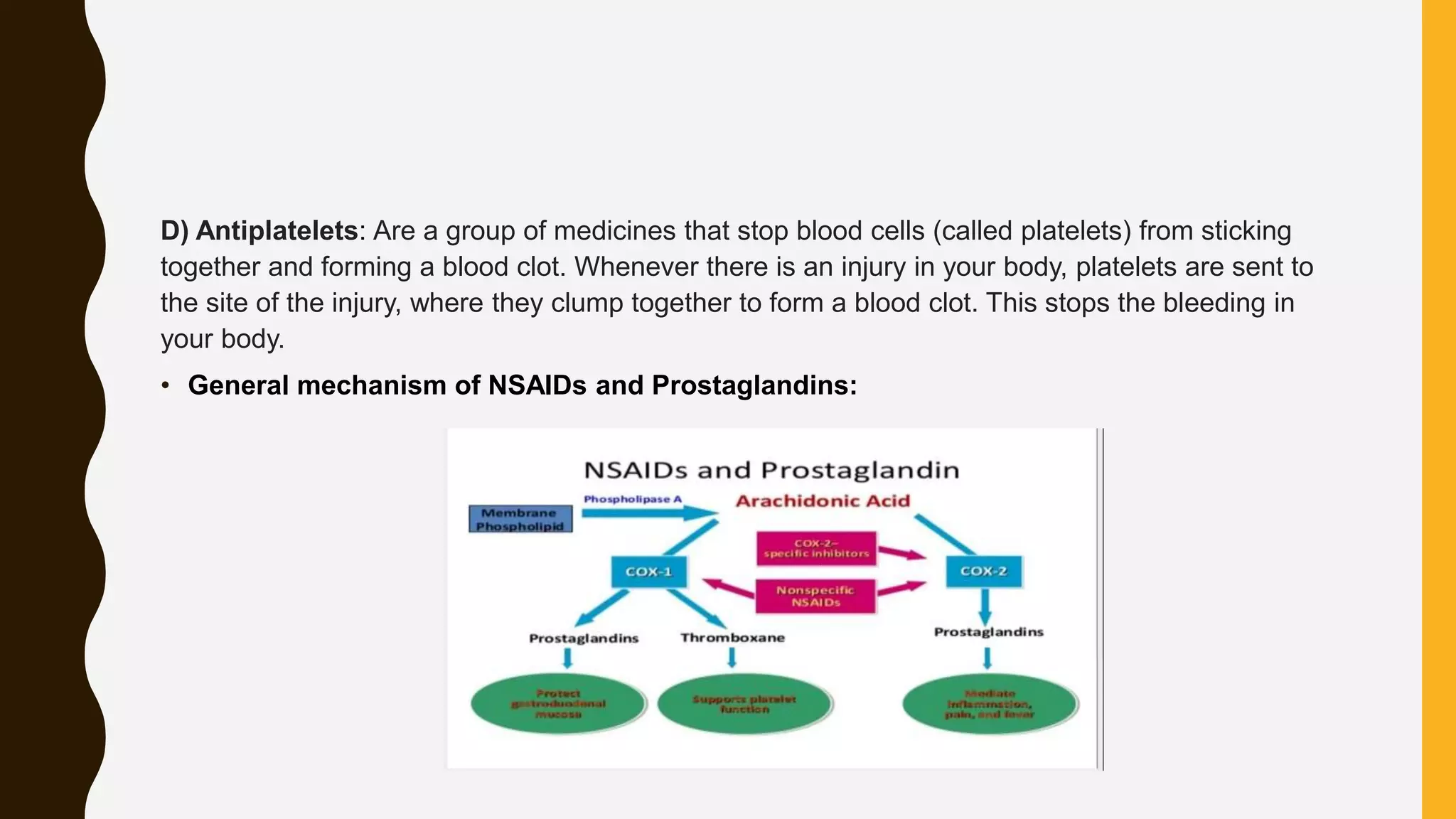
• General mechanism of NSAIDs and Prostaglandins:
• Note: From above mechanism it is seen that:
 COX-1 Prostaglandins are beneficial because they help in: -
1. Cytoprotecting gastroduodenal mucosa (housekeeping)
2. Regulation of renal blood flow.
3. Platelet aggregation.
• Whereas
 COX-2 Prostaglandins are harmful because they mediate-
1. Fever
2. Pain
3. Inflammation
4. Inflammatory stimuli
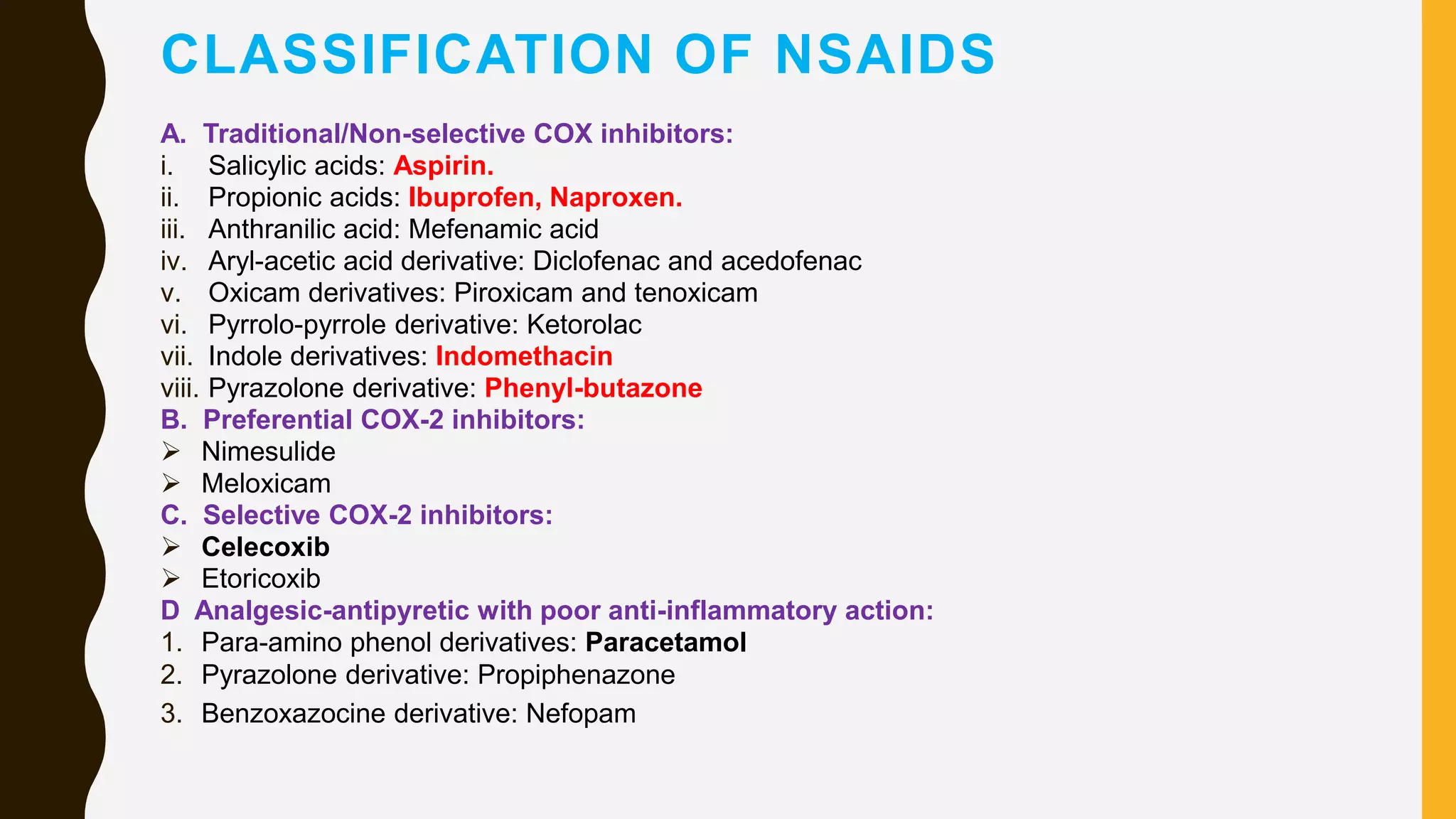
CLASSIFICATION OF NSAIDS
A. Traditional/Non-selective COX inhibitors:
i. Salicylic acids: Aspirin.
ii. Propionic acids: Ibuprofen, Naproxen.
iii. Anthranilic acid: Mefenamic acid
iv. Aryl-acetic acid derivative: Diclofenac and acedofenac
v. Oxicam derivatives: Piroxicam and tenoxicam
vi. Pyrrolo-pyrrole derivative: Ketorolac
vii. Indole derivatives: Indomethacin
viii. Pyrazolone derivative: Phenyl-butazone
B. Preferential COX-2 inhibitors:
 Nimesulide
 Meloxicam
C. Selective COX-2 inhibitors:
 Celecoxib
 Etoricoxib
D Analgesic-antipyretic with poor anti-inflammatory action:
1. Para-amino phenol derivatives: Paracetamol
2. Pyrazolone derivative: Propiphenazone
3. Benzoxazocine derivative: Nefopam
EXAMPLES OF FEW NSAIDS:
Aspirin
• Aspirin is the oldest analgesic. Aspirin is acetyl-salicylic acid (the prototype which
converted in the body to salicylic acid). It is weaker than morphine. Aspirin
irreversibly inhibits COX-1 & COX-2 activity.
Structure Activity Relationship (SAR):
1. For the optimal activity of aspirin acetyl group is necessary at position no.2.
2. Increase in carbon chain with acetyl group will decrease the activity.
3. If carboxylic group is replaced by ester group its activity will decrease.
4. Attachment of any substituent at position no.4 the pharmacological of aspirin will
lost.
5. Halogen substituent to benzene ring result in increase activity but toxicity
increase.
6. Removal of -OH group from salicylic results in benzoic acid, that is less active.
• Synthesis of Aspirin:
• The synthesis of aspirin is classified as an esterification reaction.
• Uses:
1. Antipyretic 4. Acute rheumatic fever
2. Analgesic 5. Rheumatoid Arthritis
3. Anti-inflammatory 6. Osteo-arthritis.
• Dosage: 300-900 mg hours
• Max: 4g daily (children not recommended)
IBUPROFEN
• Ibuprofen was the 1st member of propionic acid class of NSAIDs to come into general
use. They may often significant advantage over aspirin and indomethacin since they
are usually better tolerated.
STRUCTURE ACTIVITY RELATIONSHIP (SAR):
1. The substitution of methyl group on the alkanoic acid portion of acetic
acid derivative enhance anti-inflammatory action and reduce many
side effect But smaller or larger substituent (H,C2H5,C3H7) show
diminish activity.
2. Isobutyl substituent gives maximum activity. Small substituent (-CH3,
-C2H5) reduced activity, Longer substituent {-(CH2)2CH3, -
(CH2)5CH3} sharply reduced activity.
3. The S-isomer of ibuprofen is more active than R-isomer.
• Mechanism of action (MOA):
i. Ibuprofen
ii. Irreversible bind with COX-1 and COX-2 enzyme
iii. Reduce PG and thromboxane synthesis
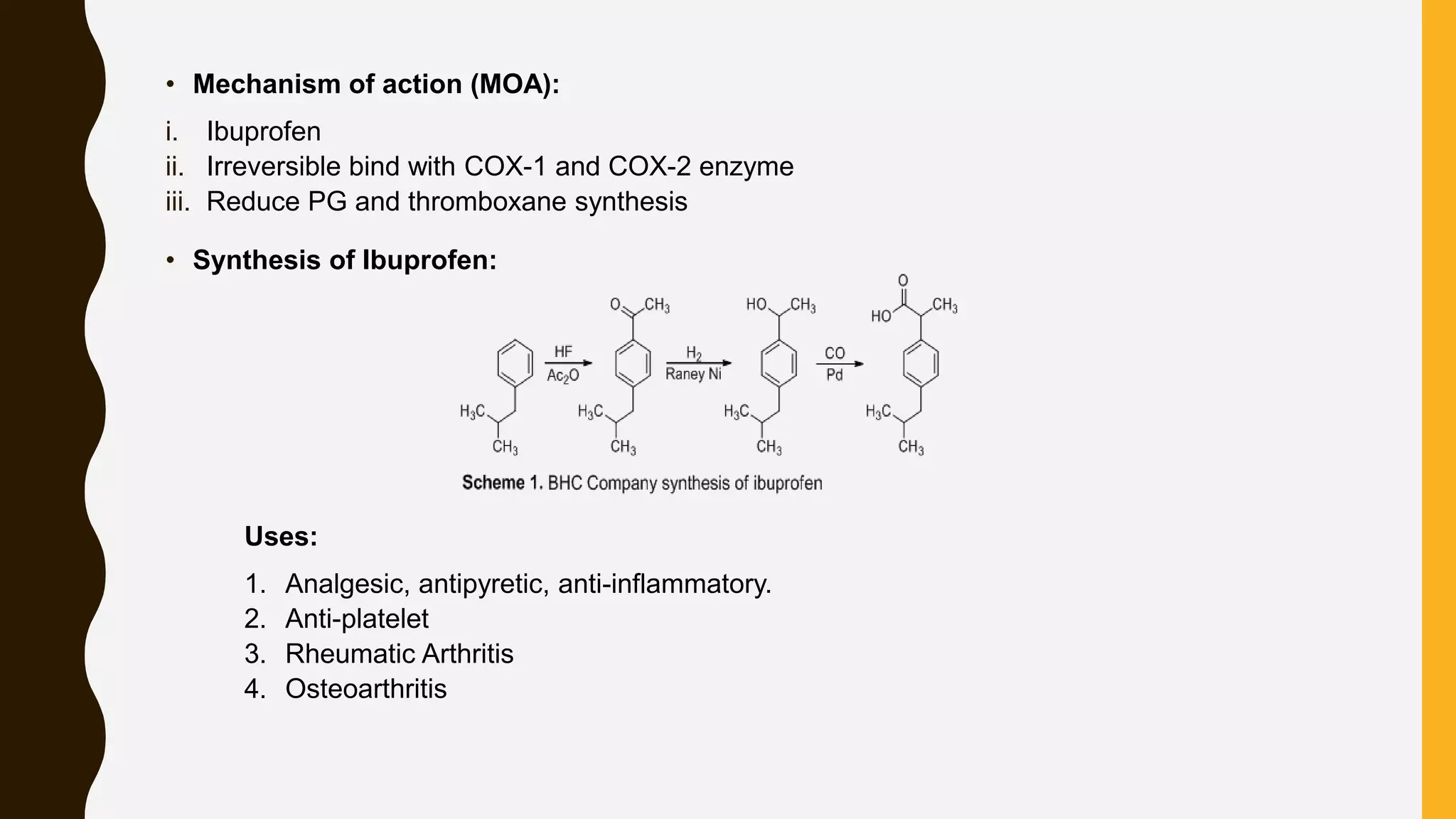
• Synthesis of Ibuprofen:
Uses:
1. Analgesic, antipyretic, anti-inflammatory.
2. Anti-platelet
3. Rheumatic Arthritis
4. Osteoarthritis
NAPROXEN
• Naproxen is used to relieve pain from various conditions such as headache, muscle aches,
tendonitis, dental pain, and menstrual cramps. It also reduces pain, swelling, and joint stiffness
caused by arthritis, bursitis, and gout attacks. This medication is known as a nonsteroidal anti-
inflammatory drug (NSAID).
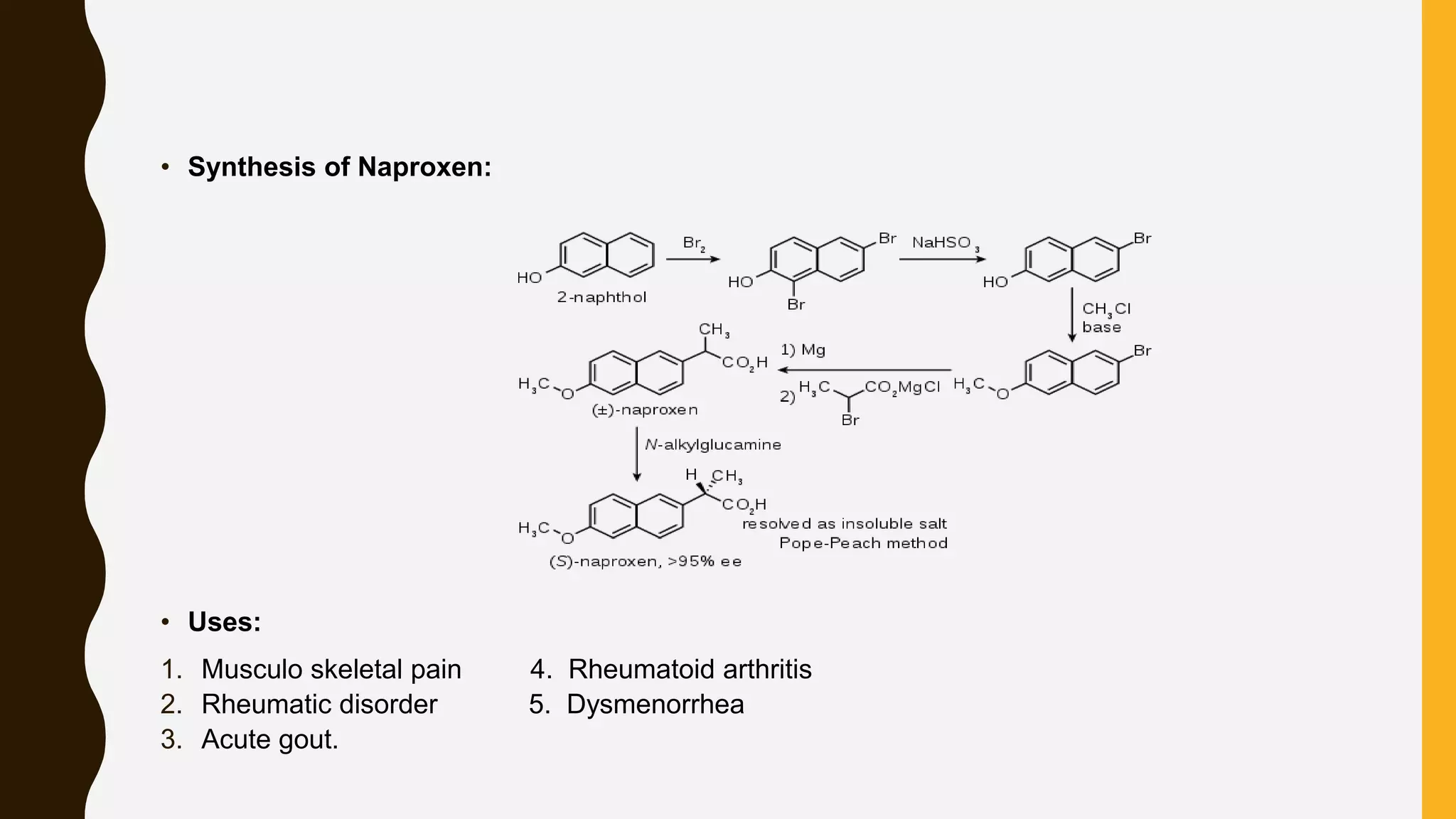
• Synthesis of Naproxen:
• Uses:
1. Musculo skeletal pain 4. Rheumatoid arthritis
2. Rheumatic disorder 5. Dysmenorrhea
3. Acute gout.
INDOMETHACIN
• Indomethacin is one of the commonly used and most effective NSAIDs to reduced
fever, pain, stiffness and swelling.
• Structure Activity Relationship (SAR):
1. The N-benzyl derivative substitute in the para-position with F,Cl,CF3 and S-CH3 groups are the
most active.
2. Presence of Indole ring nitrogen is not essential for activity. As C version indene analog
(sulindac) is also active.
3. -CH3 group at 2nd position are more active than phenyl.
4. Replacement of -COOH group at 3rd position with other acidic functions decrease the activity.
Amide analogs are inactive.
5. -CH2 branching has no effect on activity.
6. At the 5th position, the substituent activities are ranked as:
• OCH3 > F > N(CH3)2 > CH3 > COCH3 > H.
• Dosage: Gout: Orally 100mg, initially followed by 50 mg 3times a day.
• Antipyretic: 25-50 mg, 2-3 times daily.
THANK YOU……….

NSAIDs (Non-steroidal anti-inflammatory drugs)

  • 1.
    NSAIDS A S SI G N M E N T O N :
  • 2.
    NSAIDS: • Nonsteroidal anti-inflammatorydrugs (NSAIDs) are members of a drug class that reduces pain, decreases fever, prevents blood clots, and in higher doses, decreases inflammation. e. g Aspirin • Class of NSAIDs: There are four classes of drugs 1. Analgesic 2. Antipyretics 3. Anti-inflammatory 4. Antiplatelet. A) Analgesic: An analgesic or painkiller is any member of the group of drugs used to achieve analgesia, relief from pain. ... Analgesics include paracetamol (known in North America as acetaminophen or simply APAP), the nonsteroidal anti-inflammatory drugs (NSAIDs) such as the salicylates, and opioid drugs such as morphine and oxycodone. B) Antipyretics: Drugs/Agents that reduces fever by lowering the body temperature (8th edition 2010, Oxford University Press)
  • 3.
    Mechanism of Fever/Pyrexia: 1.Release of endogenous pyrogens (Interleukin-1 enzyme) from leucocytes 2. Generation of Prostaglandin 3. Stimulation of thermoregulatory centers in hypothalamus 4. Reduce sweating and increases body temperature by vasoconstriction. C) Anti-inflammatory: Inflammation is defined as complex series of events that occurs in vascularized living tissues in response to local injury and tissue damage. Where Nonsteroidal anti-inflammatory drugs (NSAIDs) are drugs that help reduce inflammation. Causes of inflammation:  Physical agents: heat, cold, radiation, mechanical trauma.  Chemical agents: organic and inorganic poisons.  Infective agents: bacteria and virous.  Immunological agents: cell mediated antigen-antibody reactions.
  • 4.
    D) Antiplatelets: Area group of medicines that stop blood cells (called platelets) from sticking together and forming a blood clot. Whenever there is an injury in your body, platelets are sent to the site of the injury, where they clump together to form a blood clot. This stops the bleeding in your body. • General mechanism of NSAIDs and Prostaglandins:
  • 5.
    • Note: Fromabove mechanism it is seen that:  COX-1 Prostaglandins are beneficial because they help in: - 1. Cytoprotecting gastroduodenal mucosa (housekeeping) 2. Regulation of renal blood flow. 3. Platelet aggregation. • Whereas  COX-2 Prostaglandins are harmful because they mediate- 1. Fever 2. Pain 3. Inflammation 4. Inflammatory stimuli
  • 6.
    CLASSIFICATION OF NSAIDS A.Traditional/Non-selective COX inhibitors: i. Salicylic acids: Aspirin. ii. Propionic acids: Ibuprofen, Naproxen. iii. Anthranilic acid: Mefenamic acid iv. Aryl-acetic acid derivative: Diclofenac and acedofenac v. Oxicam derivatives: Piroxicam and tenoxicam vi. Pyrrolo-pyrrole derivative: Ketorolac vii. Indole derivatives: Indomethacin viii. Pyrazolone derivative: Phenyl-butazone B. Preferential COX-2 inhibitors:  Nimesulide  Meloxicam C. Selective COX-2 inhibitors:  Celecoxib  Etoricoxib D Analgesic-antipyretic with poor anti-inflammatory action: 1. Para-amino phenol derivatives: Paracetamol 2. Pyrazolone derivative: Propiphenazone 3. Benzoxazocine derivative: Nefopam
  • 7.
    EXAMPLES OF FEWNSAIDS: Aspirin • Aspirin is the oldest analgesic. Aspirin is acetyl-salicylic acid (the prototype which converted in the body to salicylic acid). It is weaker than morphine. Aspirin irreversibly inhibits COX-1 & COX-2 activity. Structure Activity Relationship (SAR): 1. For the optimal activity of aspirin acetyl group is necessary at position no.2. 2. Increase in carbon chain with acetyl group will decrease the activity. 3. If carboxylic group is replaced by ester group its activity will decrease. 4. Attachment of any substituent at position no.4 the pharmacological of aspirin will lost. 5. Halogen substituent to benzene ring result in increase activity but toxicity increase. 6. Removal of -OH group from salicylic results in benzoic acid, that is less active.
  • 8.
    • Synthesis ofAspirin: • The synthesis of aspirin is classified as an esterification reaction. • Uses: 1. Antipyretic 4. Acute rheumatic fever 2. Analgesic 5. Rheumatoid Arthritis 3. Anti-inflammatory 6. Osteo-arthritis. • Dosage: 300-900 mg hours • Max: 4g daily (children not recommended)
  • 9.
    IBUPROFEN • Ibuprofen wasthe 1st member of propionic acid class of NSAIDs to come into general use. They may often significant advantage over aspirin and indomethacin since they are usually better tolerated.
  • 10.
    STRUCTURE ACTIVITY RELATIONSHIP(SAR): 1. The substitution of methyl group on the alkanoic acid portion of acetic acid derivative enhance anti-inflammatory action and reduce many side effect But smaller or larger substituent (H,C2H5,C3H7) show diminish activity. 2. Isobutyl substituent gives maximum activity. Small substituent (-CH3, -C2H5) reduced activity, Longer substituent {-(CH2)2CH3, - (CH2)5CH3} sharply reduced activity. 3. The S-isomer of ibuprofen is more active than R-isomer.
  • 11.
    • Mechanism ofaction (MOA): i. Ibuprofen ii. Irreversible bind with COX-1 and COX-2 enzyme iii. Reduce PG and thromboxane synthesis • Synthesis of Ibuprofen: Uses: 1. Analgesic, antipyretic, anti-inflammatory. 2. Anti-platelet 3. Rheumatic Arthritis 4. Osteoarthritis
  • 12.
    NAPROXEN • Naproxen isused to relieve pain from various conditions such as headache, muscle aches, tendonitis, dental pain, and menstrual cramps. It also reduces pain, swelling, and joint stiffness caused by arthritis, bursitis, and gout attacks. This medication is known as a nonsteroidal anti- inflammatory drug (NSAID).
  • 13.
    • Synthesis ofNaproxen: • Uses: 1. Musculo skeletal pain 4. Rheumatoid arthritis 2. Rheumatic disorder 5. Dysmenorrhea 3. Acute gout.
  • 14.
    INDOMETHACIN • Indomethacin isone of the commonly used and most effective NSAIDs to reduced fever, pain, stiffness and swelling.
  • 15.
    • Structure ActivityRelationship (SAR): 1. The N-benzyl derivative substitute in the para-position with F,Cl,CF3 and S-CH3 groups are the most active. 2. Presence of Indole ring nitrogen is not essential for activity. As C version indene analog (sulindac) is also active. 3. -CH3 group at 2nd position are more active than phenyl. 4. Replacement of -COOH group at 3rd position with other acidic functions decrease the activity. Amide analogs are inactive. 5. -CH2 branching has no effect on activity. 6. At the 5th position, the substituent activities are ranked as: • OCH3 > F > N(CH3)2 > CH3 > COCH3 > H. • Dosage: Gout: Orally 100mg, initially followed by 50 mg 3times a day. • Antipyretic: 25-50 mg, 2-3 times daily.
  • 16.