The Sperm Responsible For Driving
Selective Speciation
Biology with Psychology C1C8
Jananan Nandakumar
090137918
Jananan Nandakumar (090137918)
Biology with Psychology C1C8
New Scientist Article 1
Dr Rhonda R Snook Wednesday 18th
January 12pm
The Sperm Responsible For Driving Selective
Speciation
The idea on how species diverged through
a process initially termed ‘transmutation of
species’ was presented by Jean Baptiste
Lamarck in 1809 and later re-debated,
visualised and comprehensively proven by
Charles Darwin in 1895, in which he
argued in favour of natural selection as the
predominant factor of speciation.
Darwin believed species formed when
animals became isolated in their
environment, so specific traits become
formed within a group or subgroup of
species. This was partly as a result of
survival of the fittest occurring, in which
the stronger species adapted and bred,
leading to their ultimate survival in the
changed environment over others. His idea
that this process of natural selection occurs
over time in which organisms were able to
evolve separately, from a common
ancestors, develop various unique traits
that would help to promote their unique
traits over others , living in the specific
habitats or environments, was published in
a book title “On the Origin of Species”
received an overwhelming attention.
This being said we can say that all species
are inter-related by an evolutionary tree
where a single ancestor promoted the
evolution into different forms of life over
time. The result is speciation, and is
defined as the process in which an original
species diversifies and splits into new
species. For this to occur we need two
species that are heading in different
directions and have no common genetic
mutation or sequence that allows them to
stem and evolve into a specific direction.
For this form of selection and speciation to
occur, all species will be required to
reproduce via the process of fertilization
and formation of a zygote; that is sperm
fertilising an egg. Sperms have many
desirable traits making them a prime
evolutionary vehicle to promote sexual
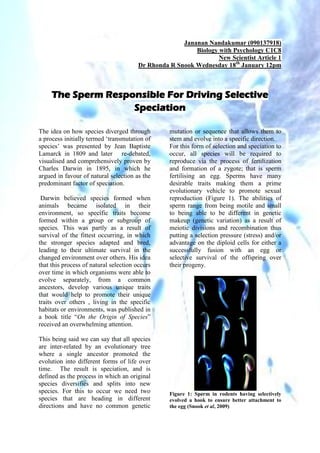
reproduction (Figure 1). The abilities of
sperm range from being motile and small
to being able to be different in genetic
makeup (genetic variation) as a result of
meiotic divisions and recombination thus
putting a selection pressure (stress) and/or
advantage on the diploid cells for either a
successfully fusion with an egg or
selective survival of the offspring over
their progeny.
Figure 1: Sperm in rodents having selectively
evolved a hook to ensure better attachment to
the egg (Snook et al, 2009)
However, not all organisms possess such
gametes and do not require such means
(e.g. with algae). Added to this, some
organisms have more than two mating
types, such as the organism found on algae
called stylonchia. So why is there an
overwhelming preference to gamete
dimorphism in which the sperm is a
predominant reproductive factor? Surely, it
was selection that resulted in the sperm
evolving from an isogamy state (first
ancestral state). However, different models
present interesting theories as to which
may be the fundamental cause for the
selection of the sperm.
The isogamy model predicts that the
morphology of gametes was the same at
one point in time. The pseudoanisogamy
model on the other hand predicted that
gamete size varied resulting only in similar
sized gametes fusing with other similar
size gametes. This conjured up the
understanding of evolutionary model
called the anisogamy theory in which
gametes of different sizes and classes were
able to mate. Finally evolution has
processed a system in which gamete
dimorphism being so large, lead to the
production of small and motile gametes
becoming the perfect reproductive tool.
Interestingly though, as evolution has
occurred, the size and mass of the egg has
become greater than that of the sperm by
some 1000 fold in certain examples of
species. This can only occur if certain
selective pressures are placed on
individuals, leading to a prominent
direction in evolution taking place. For this
evolution of sperm and egg to occur the
frequency must also greatly intensify. In
order for this mono-directional selection to
have occurred the gametes must i) present
strong motility (so the time taken to find
their fusion partner is quicker), and ii) the
amount of gamete productivity must
increase (to give a greater chance of
fusion).
This was often scrutinised by a previous
misunderstood theory which interpreted
gamete size as a function of fitness, which
is, obviously, not the case seen. These we
can see are the common traits present in
sperm; which must have evolved over time
in a mono-directional means to produce
effective reproduction. The knowledge on
how sexual patterns are selected is still
questionable, evolutionary scientists such
as Dr Snook and her colleagues have come
up with means to test this particular type
of selection.
To test these hypotheses, Dr Snook used
drosophilia pseudoobscura, a type of fruit
fly species with several desirable
characteristics, to perform their
experiments. One important feature of this
fruit fly is that it is a heteromorphic
species, where both sterile and unsterile
sperm are produced. Results from Dr
Snook work on these heterotrophic fruit
fly proved that sexual conflicts along with
male mating behaviour and ejaculating
traits were prime alterations for
determining mating influence. Added to
this it was noted that sexual selection was
not dependant on size or the number of
sperm (testis mass).
Interestingly though, those mosquitos that
presented large accessory glands presented
greater mating opportunities. Other studies
have shown that population size is varied
and not dependent on genetic diversity.
Primarily these investigations have
highlighted the use of population size as
means of tracing evolutionary traits that
can be specific for sexual selection.
However, with these studies on the sexual
selection, the results can only be relevant if
genetic drift does not cause such an
evolutionary process, and if results were
only due to this sexual selection. To avoid
this it has been suggested to carry out
microsatellite surveys where additional
information of selection pressures can be
carried out to promote the reasoning
behind a selection choice.
These findings, help us understand a
greater motive behind the selection and
specification of species, and could argue in
favour of Darwin’s idea of the fittest
surviving. The idea of the sperm being
selectively driven down an evolutionary
path parallel to that of trait selection
pressures could also be a fundamental
point to drive not only selection but
evolution within species. This being said,
it is still important to closely analyse fully
the traits that have driven species to
selectively characterise and choose a mate,
therefore developing the promotion,
evolution and speciation and survival.
Words; 1,030

NSA1

  • 1.
    The Sperm ResponsibleFor Driving Selective Speciation Biology with Psychology C1C8 Jananan Nandakumar 090137918
  • 2.
    Jananan Nandakumar (090137918) Biologywith Psychology C1C8 New Scientist Article 1 Dr Rhonda R Snook Wednesday 18th January 12pm The Sperm Responsible For Driving Selective Speciation The idea on how species diverged through a process initially termed ‘transmutation of species’ was presented by Jean Baptiste Lamarck in 1809 and later re-debated, visualised and comprehensively proven by Charles Darwin in 1895, in which he argued in favour of natural selection as the predominant factor of speciation. Darwin believed species formed when animals became isolated in their environment, so specific traits become formed within a group or subgroup of species. This was partly as a result of survival of the fittest occurring, in which the stronger species adapted and bred, leading to their ultimate survival in the changed environment over others. His idea that this process of natural selection occurs over time in which organisms were able to evolve separately, from a common ancestors, develop various unique traits that would help to promote their unique traits over others , living in the specific habitats or environments, was published in a book title “On the Origin of Species” received an overwhelming attention. This being said we can say that all species are inter-related by an evolutionary tree where a single ancestor promoted the evolution into different forms of life over time. The result is speciation, and is defined as the process in which an original species diversifies and splits into new species. For this to occur we need two species that are heading in different directions and have no common genetic mutation or sequence that allows them to stem and evolve into a specific direction. For this form of selection and speciation to occur, all species will be required to reproduce via the process of fertilization and formation of a zygote; that is sperm fertilising an egg. Sperms have many desirable traits making them a prime evolutionary vehicle to promote sexual reproduction (Figure 1). The abilities of sperm range from being motile and small to being able to be different in genetic makeup (genetic variation) as a result of meiotic divisions and recombination thus putting a selection pressure (stress) and/or advantage on the diploid cells for either a successfully fusion with an egg or selective survival of the offspring over their progeny. Figure 1: Sperm in rodents having selectively evolved a hook to ensure better attachment to the egg (Snook et al, 2009)
  • 3.
    However, not allorganisms possess such gametes and do not require such means (e.g. with algae). Added to this, some organisms have more than two mating types, such as the organism found on algae called stylonchia. So why is there an overwhelming preference to gamete dimorphism in which the sperm is a predominant reproductive factor? Surely, it was selection that resulted in the sperm evolving from an isogamy state (first ancestral state). However, different models present interesting theories as to which may be the fundamental cause for the selection of the sperm. The isogamy model predicts that the morphology of gametes was the same at one point in time. The pseudoanisogamy model on the other hand predicted that gamete size varied resulting only in similar sized gametes fusing with other similar size gametes. This conjured up the understanding of evolutionary model called the anisogamy theory in which gametes of different sizes and classes were able to mate. Finally evolution has processed a system in which gamete dimorphism being so large, lead to the production of small and motile gametes becoming the perfect reproductive tool. Interestingly though, as evolution has occurred, the size and mass of the egg has become greater than that of the sperm by some 1000 fold in certain examples of species. This can only occur if certain selective pressures are placed on individuals, leading to a prominent direction in evolution taking place. For this evolution of sperm and egg to occur the frequency must also greatly intensify. In order for this mono-directional selection to have occurred the gametes must i) present strong motility (so the time taken to find their fusion partner is quicker), and ii) the amount of gamete productivity must increase (to give a greater chance of fusion). This was often scrutinised by a previous misunderstood theory which interpreted gamete size as a function of fitness, which is, obviously, not the case seen. These we can see are the common traits present in sperm; which must have evolved over time in a mono-directional means to produce effective reproduction. The knowledge on how sexual patterns are selected is still questionable, evolutionary scientists such as Dr Snook and her colleagues have come up with means to test this particular type of selection. To test these hypotheses, Dr Snook used drosophilia pseudoobscura, a type of fruit fly species with several desirable characteristics, to perform their experiments. One important feature of this fruit fly is that it is a heteromorphic species, where both sterile and unsterile sperm are produced. Results from Dr Snook work on these heterotrophic fruit fly proved that sexual conflicts along with male mating behaviour and ejaculating traits were prime alterations for determining mating influence. Added to this it was noted that sexual selection was not dependant on size or the number of sperm (testis mass). Interestingly though, those mosquitos that presented large accessory glands presented greater mating opportunities. Other studies have shown that population size is varied and not dependent on genetic diversity. Primarily these investigations have highlighted the use of population size as means of tracing evolutionary traits that can be specific for sexual selection. However, with these studies on the sexual selection, the results can only be relevant if genetic drift does not cause such an evolutionary process, and if results were only due to this sexual selection. To avoid this it has been suggested to carry out microsatellite surveys where additional information of selection pressures can be
  • 4.
    carried out topromote the reasoning behind a selection choice. These findings, help us understand a greater motive behind the selection and specification of species, and could argue in favour of Darwin’s idea of the fittest surviving. The idea of the sperm being selectively driven down an evolutionary path parallel to that of trait selection pressures could also be a fundamental point to drive not only selection but evolution within species. This being said, it is still important to closely analyse fully the traits that have driven species to selectively characterise and choose a mate, therefore developing the promotion, evolution and speciation and survival. Words; 1,030