Mahmoud Ismail
MD, Fellowship of Egyptian board
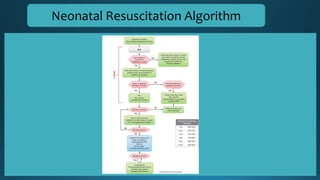
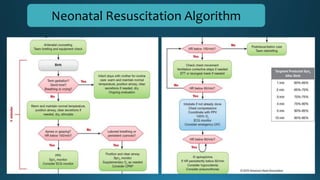
Neonatal Resuscitation Algorithm
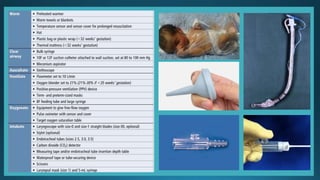
Resuscitation team:
The number of personnel depends on anticipated risks:
 If no risk factors:
o Qualified individual skilled in initial steps of
neonatal At least 1 care and PPV.
 If there is (are) risk factor (s):
o At least 2 least 1 qualified individuals.
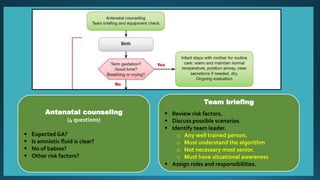
Antenatal counseling
(4 questions)
 Expected GA?
 Is amniotic fluid is clear?
 No of babies?
 Other risk factors?
Team briefing
 Review risk factors.
 Discuss possible scenarios.
 Identify team leader.
o Any well trained person.
o Must understand the algorithm
o Not necessary most senior.
o Must have situational awareness
 Assign roles and responsibilities.
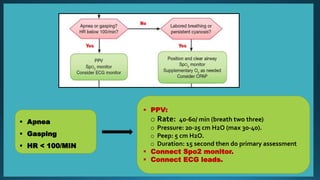
 Apnea
 Gasping
 HR < 100/MIN
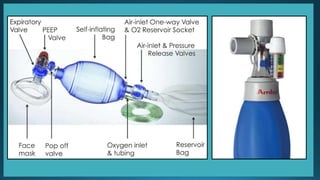
 PPV:
o Rate: 40-60/ min (breath two three)
o Pressure: 20-25 cm H2O (max 30-40).
o Peep: 5 cm H2O.
o Duration: 15 second then do primary assessment
 Connect Spo2 monitor.
 Connect ECG leads.
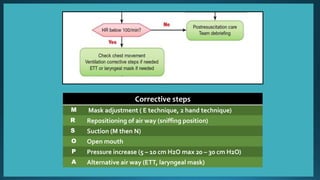
Corrective steps
Mask adjustment ( E technique, 2 hand technique)
M
Repositioning of air way (sniffing position)
R
Suction (M then N)
S
Open mouth
O
Pressure increase (5 – 10 cm H2O max 20 – 30 cm H2O)
P
Alternative air way (ETT, laryngeal mask)
A
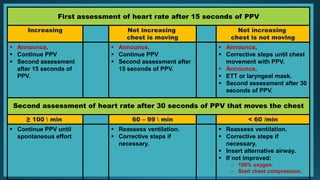
First assessment of heart rate after 15 seconds of PPV
Not increasing
chest is not moving
Not increasing
chest is moving
Increasing
 Announce.
 Corrective steps until chest
movement with PPV.
 Announce.
 ETT or laryngeal mask.
 Second assessment after 30
seconds of PPV.
 Announce.
 Continue PPV
 Second assessment after
15 seconds of PPV.
 Announce.
 Continue PPV
 Second assessment
after 15 seconds of
PPV.
Second assessment of heart rate after 30 seconds of PPV that moves the chest
< 60 /min
60 – 99  min
≥ 100  min
 Reassess ventilation.
 Corrective steps if
necessary.
 Insert alternative airway.
 If not improved:
o 100% oxygen.
o Start chest compression.
 Reassess ventilation.
 Corrective steps if
necessary.
 Continue PPV until
spontaneous effort
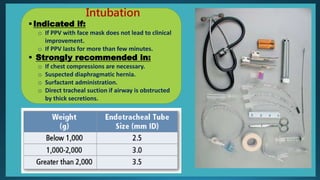
Intubation
Indicated if:
o If PPV with face mask does not lead to clinical
improvement.
o If PPV lasts for more than few minutes.
 Strongly recommended in:
o If chest compressions are necessary.
o Suspected diaphragmatic hernia.
o Surfactant administration.
o Direct tracheal suction if airway is obstructed
by thick secretions.
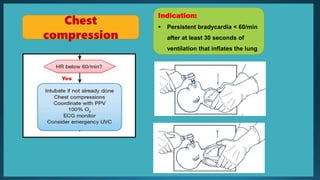
Indication:
 Persistent bradycardia < 60/min
after at least 30 seconds of
ventilation that inflates the lung
Chest
compression
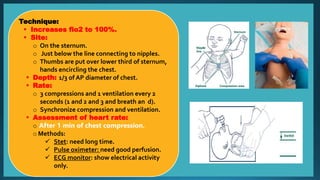
Technique:
 Increases fio2 to 100%.
 Site:
o On the sternum.
o Just below the line connecting to nipples.
o Thumbs are put over lower third of sternum,
hands encircling the chest.
 Depth: 1/3 of AP diameter of chest.
 Rate:
o 3 compressions and 1 ventilation every 2
seconds (1 and 2 and 3 and breath an d).
o Synchronize compression and ventilation.
 Assessment of heart rate:
o After 1 min of chest compression.
o Methods:
 Stet: need long time.
 Pulse oximeter: need good perfusion.
 ECG monitor: show electrical activity
only.
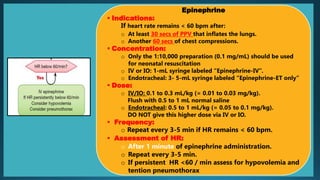
Epinephrine
 Indications:
If heart rate remains < 60 bpm after:
o At least 30 secs of PPV that inflates the lungs.
o Another 60 secs of chest compressions.
 Concentration:
o Only the 1:10,000 preparation (0.1 mg/mL) should be used
for neonatal resuscitation
o IV or IO: 1-mL syringe labeled “Epinephrine-IV”.
o Endotracheal: 3- 5-mL syringe labeled “Epinephrine-ET only”
 Dose:
o IV/IO: 0.1 to 0.3 mL/kg (= 0.01 to 0.03 mg/kg).
Flush with 0.5 to 1 mL normal saline
o Endotracheal: 0.5 to 1 mL/kg (= 0.05 to 0.1 mg/kg).
DO NOT give this higher dose via IV or IO.
 Frequency:
o Repeat every 3-5 min if HR remains < 60 bpm.
 Assessment of HR:
o After 1 minute of epinephrine administration.
o Repeat every 3-5 min.
o If persistent HR <60 / min assess for hypovolemia and
tention pneumothorax
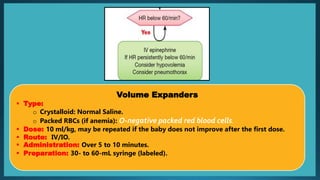
Volume Expanders
 Type:
o Crystalloid: Normal Saline.
o Packed RBCs (if anemia): O-negative packed red blood cells.
 Dose: 10 ml/kg, may be repeated if the baby does not improve after the first dose.
 Route: IV/IO.
 Administration: Over 5 to 10 minutes.
 Preparation: 30- to 60-mL syringe (labeled).
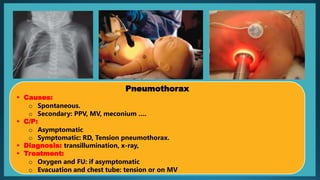
Pneumothorax
 Causes:
o Spontaneous.
o Secondary: PPV, MV, meconium ….
 C/P:
o Asymptomatic
o Symptomatic: RD, Tension pneumothorax.
 Diagnosis: transillumination, x-ray,
 Treatment:
o Oxygen and FU: if asymptomatic
o Evacuation and chest tube: tension or on MV

NRP.pptx

  • 1.
    Mahmoud Ismail MD, Fellowshipof Egyptian board Neonatal Resuscitation Algorithm
  • 2.
  • 3.
  • 4.
    Neonatal Resuscitation Algorithm Resuscitationteam: The number of personnel depends on anticipated risks:  If no risk factors: o Qualified individual skilled in initial steps of neonatal At least 1 care and PPV.  If there is (are) risk factor (s): o At least 2 least 1 qualified individuals.
  • 5.
    Antenatal counseling (4 questions) Expected GA?  Is amniotic fluid is clear?  No of babies?  Other risk factors? Team briefing  Review risk factors.  Discuss possible scenarios.  Identify team leader. o Any well trained person. o Must understand the algorithm o Not necessary most senior. o Must have situational awareness  Assign roles and responsibilities.
  • 8.
     Apnea  Gasping HR < 100/MIN  PPV: o Rate: 40-60/ min (breath two three) o Pressure: 20-25 cm H2O (max 30-40). o Peep: 5 cm H2O. o Duration: 15 second then do primary assessment  Connect Spo2 monitor.  Connect ECG leads.
  • 10.
    Corrective steps Mask adjustment( E technique, 2 hand technique) M Repositioning of air way (sniffing position) R Suction (M then N) S Open mouth O Pressure increase (5 – 10 cm H2O max 20 – 30 cm H2O) P Alternative air way (ETT, laryngeal mask) A
  • 11.
    First assessment ofheart rate after 15 seconds of PPV Not increasing chest is not moving Not increasing chest is moving Increasing  Announce.  Corrective steps until chest movement with PPV.  Announce.  ETT or laryngeal mask.  Second assessment after 30 seconds of PPV.  Announce.  Continue PPV  Second assessment after 15 seconds of PPV.  Announce.  Continue PPV  Second assessment after 15 seconds of PPV. Second assessment of heart rate after 30 seconds of PPV that moves the chest < 60 /min 60 – 99 min ≥ 100 min  Reassess ventilation.  Corrective steps if necessary.  Insert alternative airway.  If not improved: o 100% oxygen. o Start chest compression.  Reassess ventilation.  Corrective steps if necessary.  Continue PPV until spontaneous effort
  • 12.
    Intubation Indicated if: o IfPPV with face mask does not lead to clinical improvement. o If PPV lasts for more than few minutes.  Strongly recommended in: o If chest compressions are necessary. o Suspected diaphragmatic hernia. o Surfactant administration. o Direct tracheal suction if airway is obstructed by thick secretions.
  • 13.
    Indication:  Persistent bradycardia< 60/min after at least 30 seconds of ventilation that inflates the lung Chest compression
  • 14.
    Technique:  Increases fio2to 100%.  Site: o On the sternum. o Just below the line connecting to nipples. o Thumbs are put over lower third of sternum, hands encircling the chest.  Depth: 1/3 of AP diameter of chest.  Rate: o 3 compressions and 1 ventilation every 2 seconds (1 and 2 and 3 and breath an d). o Synchronize compression and ventilation.  Assessment of heart rate: o After 1 min of chest compression. o Methods:  Stet: need long time.  Pulse oximeter: need good perfusion.  ECG monitor: show electrical activity only.
  • 15.
    Epinephrine  Indications: If heartrate remains < 60 bpm after: o At least 30 secs of PPV that inflates the lungs. o Another 60 secs of chest compressions.  Concentration: o Only the 1:10,000 preparation (0.1 mg/mL) should be used for neonatal resuscitation o IV or IO: 1-mL syringe labeled “Epinephrine-IV”. o Endotracheal: 3- 5-mL syringe labeled “Epinephrine-ET only”  Dose: o IV/IO: 0.1 to 0.3 mL/kg (= 0.01 to 0.03 mg/kg). Flush with 0.5 to 1 mL normal saline o Endotracheal: 0.5 to 1 mL/kg (= 0.05 to 0.1 mg/kg). DO NOT give this higher dose via IV or IO.  Frequency: o Repeat every 3-5 min if HR remains < 60 bpm.  Assessment of HR: o After 1 minute of epinephrine administration. o Repeat every 3-5 min. o If persistent HR <60 / min assess for hypovolemia and tention pneumothorax
  • 16.
    Volume Expanders  Type: oCrystalloid: Normal Saline. o Packed RBCs (if anemia): O-negative packed red blood cells.  Dose: 10 ml/kg, may be repeated if the baby does not improve after the first dose.  Route: IV/IO.  Administration: Over 5 to 10 minutes.  Preparation: 30- to 60-mL syringe (labeled).
  • 17.
    Pneumothorax  Causes: o Spontaneous. oSecondary: PPV, MV, meconium ….  C/P: o Asymptomatic o Symptomatic: RD, Tension pneumothorax.  Diagnosis: transillumination, x-ray,  Treatment: o Oxygen and FU: if asymptomatic o Evacuation and chest tube: tension or on MV