NPPF 2012
“Development that is sustainable should go
ahead, without delay”
• Planning law requires that applications for planning permission must be
determined in accordance with the development plan, unless material
considerations indicate otherwise. The National Planning Policy Framework
must be taken into account in the preparation of local and neighbourhood
plans, and is a material consideration in planning decisions. Planning
policies and decisions must reflect and where appropriate promote relevant
EU obligations and statutory requirements.
• This National Planning Policy Framework does not change the statutory
status of the development plan as the starting point for decision making.
Proposed development that accords with an up-to-date Local Plan should
be approved, and proposed development that conflicts should be refused
unless other material considerations indicate otherwise. It is highly
desirable that local planning authorities should have an up-to-date plan in
place.
Defining Sustainability
• The UK Sustainable Development Strategy Securing
the Future set out five ‘guiding principles’ of
sustainable development: living within the planet’s
environmental limits; ensuring a strong, healthy and
just society; achieving a sustainable economy;
promoting good governance; and using sound
science responsibly.
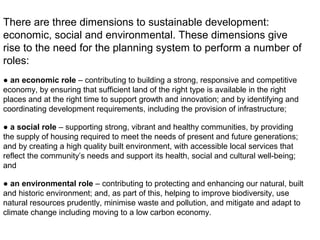
There are three dimensions to sustainable development:
economic, social and environmental. These dimensions give
rise to the need for the planning system to perform a number of
roles:
● an economic role – contributing to building a strong, responsive and competitive
economy, by ensuring that sufficient land of the right type is available in the right
places and at the right time to support growth and innovation; and by identifying and
coordinating development requirements, including the provision of infrastructure;
● a social role – supporting strong, vibrant and healthy communities, by providing
the supply of housing required to meet the needs of present and future generations;
and by creating a high quality built environment, with accessible local services that
reflect the community’s needs and support its health, social and cultural well-being;
and
● an environmental role – contributing to protecting and enhancing our natural, built
and historic environment; and, as part of this, helping to improve biodiversity, use
natural resources prudently, minimise waste and pollution, and mitigate and adapt to
climate change including moving to a low carbon economy.
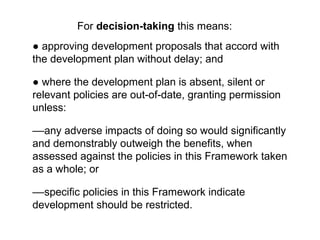
● approving development proposals that accord with
the development plan without delay; and
● where the development plan is absent, silent or
relevant policies are out of date, granting permission‑ ‑
unless:
––any adverse impacts of doing so would significantly
and demonstrably outweigh the benefits, when
assessed against the policies in this Framework taken
as a whole; or
––specific policies in this Framework indicate
development should be restricted.
For decision-taking this means:
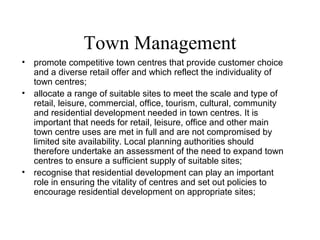
Town Management
• promote competitive town centres that provide customer choice
and a diverse retail offer and which reflect the individuality of
town centres;
• allocate a range of suitable sites to meet the scale and type of
retail, leisure, commercial, office, tourism, cultural, community
and residential development needed in town centres. It is
important that needs for retail, leisure, office and other main
town centre uses are met in full and are not compromised by
limited site availability. Local planning authorities should
therefore undertake an assessment of the need to expand town
centres to ensure a sufficient supply of suitable sites;
• recognise that residential development can play an important
role in ensuring the vitality of centres and set out policies to
encourage residential development on appropriate sites;
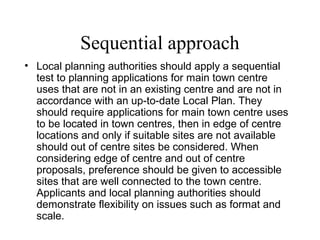
Sequential approach
• Local planning authorities should apply a sequential
test to planning applications for main town centre
uses that are not in an existing centre and are not in
accordance with an up-to-date Local Plan. They
should require applications for main town centre uses
to be located in town centres, then in edge of centre
locations and only if suitable sites are not available
should out of centre sites be considered. When
considering edge of centre and out of centre
proposals, preference should be given to accessible
sites that are well connected to the town centre.
Applicants and local planning authorities should
demonstrate flexibility on issues such as format and
scale.
Rural issues
Planning policies should support economic growth in rural areas in order to
create jobs and prosperity by taking a positive approach to sustainable
new development. To promote a strong rural economy, local and
neighbourhood plans should
●support the sustainable growth and expansion of all types of business
and enterprise in rural areas, both through conversion of existing
buildings and well designed new buildings;
●promote the development and diversification of agricultural and other
land-based rural businesses
●support sustainable rural tourism and leisure developments that benefit
businesses in rural areas, communities and visitors, and which respect
the character of the countryside. This should include supporting the
provision and expansion of tourist and visitor facilities in appropriate
locations where identified needs are not met by existing facilities in rural
service centres; and
●promote the retention and development of local services and community
facilities in villages, such as local shops, meeting places, sports

Nppf and sustainability

  • 1.
  • 2.
    “Development that issustainable should go ahead, without delay” • Planning law requires that applications for planning permission must be determined in accordance with the development plan, unless material considerations indicate otherwise. The National Planning Policy Framework must be taken into account in the preparation of local and neighbourhood plans, and is a material consideration in planning decisions. Planning policies and decisions must reflect and where appropriate promote relevant EU obligations and statutory requirements. • This National Planning Policy Framework does not change the statutory status of the development plan as the starting point for decision making. Proposed development that accords with an up-to-date Local Plan should be approved, and proposed development that conflicts should be refused unless other material considerations indicate otherwise. It is highly desirable that local planning authorities should have an up-to-date plan in place.
  • 3.
    Defining Sustainability • TheUK Sustainable Development Strategy Securing the Future set out five ‘guiding principles’ of sustainable development: living within the planet’s environmental limits; ensuring a strong, healthy and just society; achieving a sustainable economy; promoting good governance; and using sound science responsibly.
  • 4.
    There are threedimensions to sustainable development: economic, social and environmental. These dimensions give rise to the need for the planning system to perform a number of roles: ● an economic role – contributing to building a strong, responsive and competitive economy, by ensuring that sufficient land of the right type is available in the right places and at the right time to support growth and innovation; and by identifying and coordinating development requirements, including the provision of infrastructure; ● a social role – supporting strong, vibrant and healthy communities, by providing the supply of housing required to meet the needs of present and future generations; and by creating a high quality built environment, with accessible local services that reflect the community’s needs and support its health, social and cultural well-being; and ● an environmental role – contributing to protecting and enhancing our natural, built and historic environment; and, as part of this, helping to improve biodiversity, use natural resources prudently, minimise waste and pollution, and mitigate and adapt to climate change including moving to a low carbon economy.
  • 5.
    ● approving developmentproposals that accord with the development plan without delay; and ● where the development plan is absent, silent or relevant policies are out of date, granting permission‑ ‑ unless: ––any adverse impacts of doing so would significantly and demonstrably outweigh the benefits, when assessed against the policies in this Framework taken as a whole; or ––specific policies in this Framework indicate development should be restricted. For decision-taking this means:
  • 6.
    Town Management • promotecompetitive town centres that provide customer choice and a diverse retail offer and which reflect the individuality of town centres; • allocate a range of suitable sites to meet the scale and type of retail, leisure, commercial, office, tourism, cultural, community and residential development needed in town centres. It is important that needs for retail, leisure, office and other main town centre uses are met in full and are not compromised by limited site availability. Local planning authorities should therefore undertake an assessment of the need to expand town centres to ensure a sufficient supply of suitable sites; • recognise that residential development can play an important role in ensuring the vitality of centres and set out policies to encourage residential development on appropriate sites;
  • 7.
    Sequential approach • Localplanning authorities should apply a sequential test to planning applications for main town centre uses that are not in an existing centre and are not in accordance with an up-to-date Local Plan. They should require applications for main town centre uses to be located in town centres, then in edge of centre locations and only if suitable sites are not available should out of centre sites be considered. When considering edge of centre and out of centre proposals, preference should be given to accessible sites that are well connected to the town centre. Applicants and local planning authorities should demonstrate flexibility on issues such as format and scale.
  • 8.
    Rural issues Planning policiesshould support economic growth in rural areas in order to create jobs and prosperity by taking a positive approach to sustainable new development. To promote a strong rural economy, local and neighbourhood plans should ●support the sustainable growth and expansion of all types of business and enterprise in rural areas, both through conversion of existing buildings and well designed new buildings; ●promote the development and diversification of agricultural and other land-based rural businesses ●support sustainable rural tourism and leisure developments that benefit businesses in rural areas, communities and visitors, and which respect the character of the countryside. This should include supporting the provision and expansion of tourist and visitor facilities in appropriate locations where identified needs are not met by existing facilities in rural service centres; and ●promote the retention and development of local services and community facilities in villages, such as local shops, meeting places, sports