Wednesday, November 7, 2012


                              Today:

                Final Exam Make-Up
                     Seating Chart
             Multiplication/Division Tests
                  Final Exam Results
                 First Quarter Grades
                       Warm-Up
             Fractions/Decimals/Percents
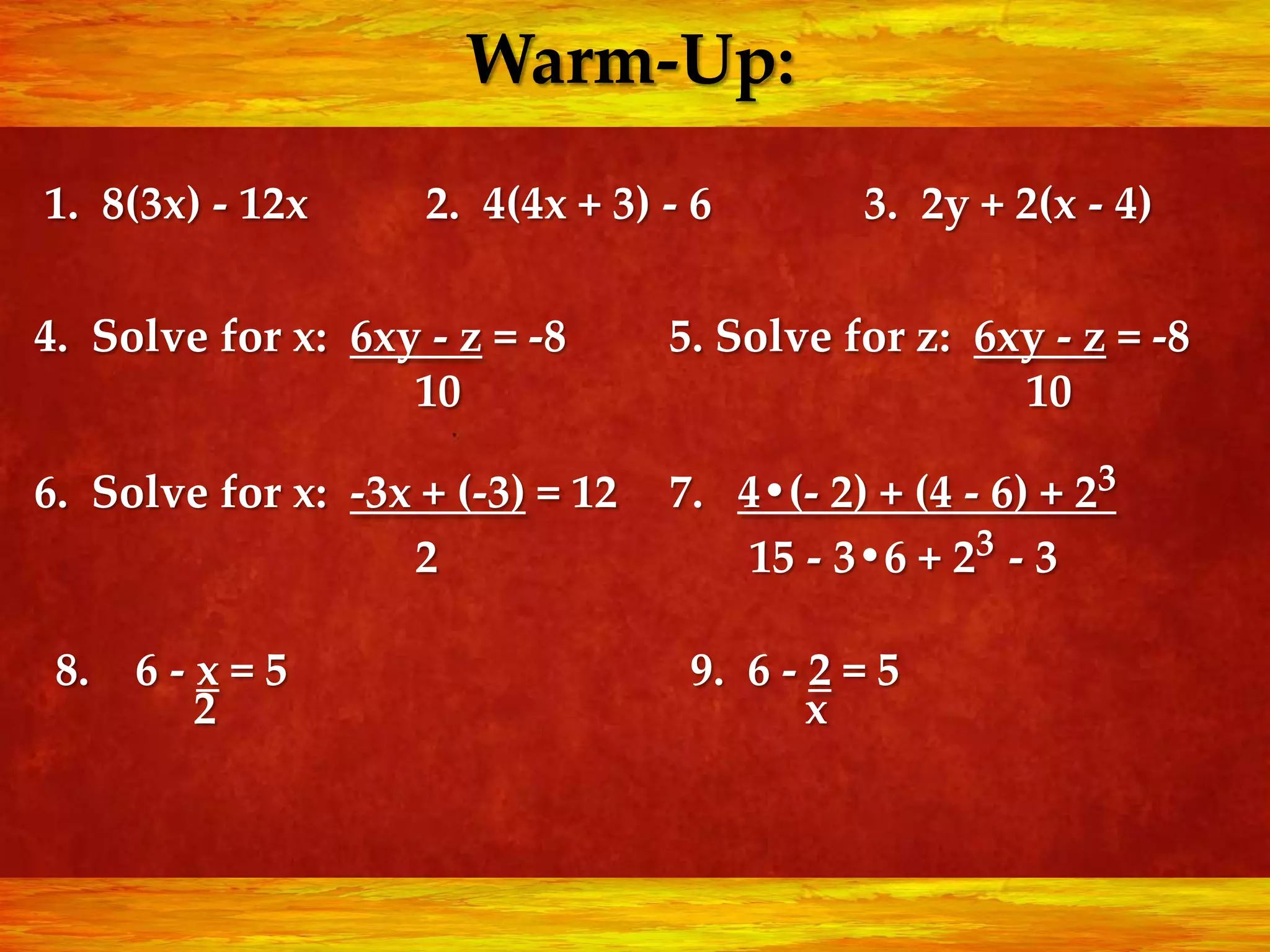
Warm-Up:
1. 8(3x) - 12x      2. 4(4x + 3) - 6        3. 2y + 2(x - 4)

4. Solve for x: 6xy - z = -8      5. Solve for z: 6xy - z = -8
                   10                               10

6. Solve for x: -3x + (-3) = 12   7. 4•(- 2) + (4 - 6) + 23
                   2                 15 - 3•6 + 23 - 3

 8. 6 - x = 5                      9. 6 - 2 = 5
        2                                 x
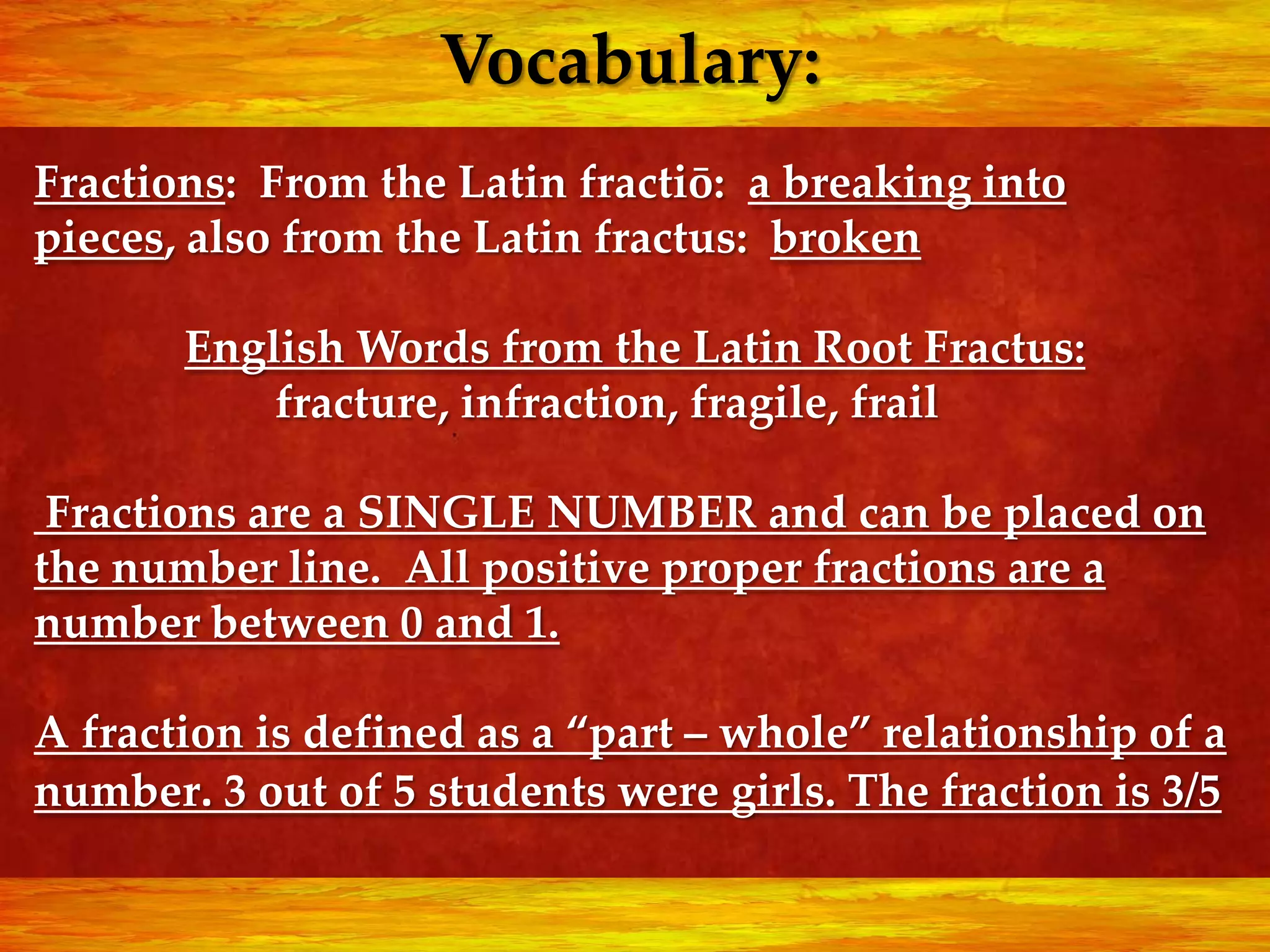
Vocabulary:
Fractions: From the Latin fractiō: a breaking into
pieces, also from the Latin fractus: broken

       English Words from the Latin Root Fractus:
           fracture, infraction, fragile, frail

 Fractions are a SINGLE NUMBER and can be placed on
the number line. All positive proper fractions are a
number between 0 and 1.

A fraction is defined as a “part – whole” relationship of a
number. 3 out of 5 students were girls. The fraction is 3/5
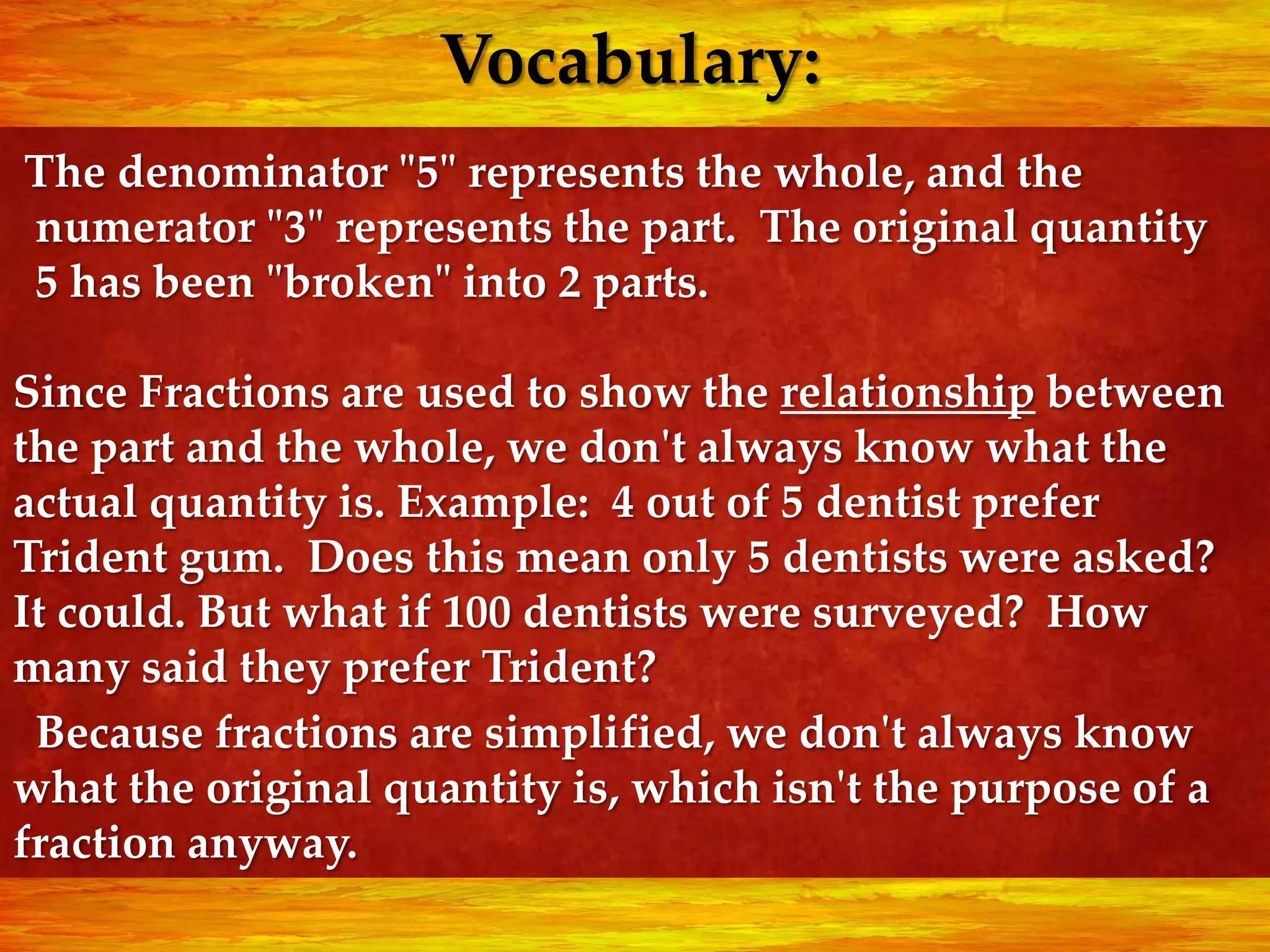
Vocabulary:
The denominator "5" represents the whole, and the
numerator "3" represents the part. The original quantity
5 has been "broken" into 2 parts.

Since Fractions are used to show the relationship between
the part and the whole, we don't always know what the
actual quantity is. Example: 4 out of 5 dentist prefer
Trident gum. Does this mean only 5 dentists were asked?
It could. But what if 100 dentists were surveyed? How
many said they prefer Trident?
 Because fractions are simplified, we don't always know
what the original quantity is, which isn't the purpose of a
fraction anyway.
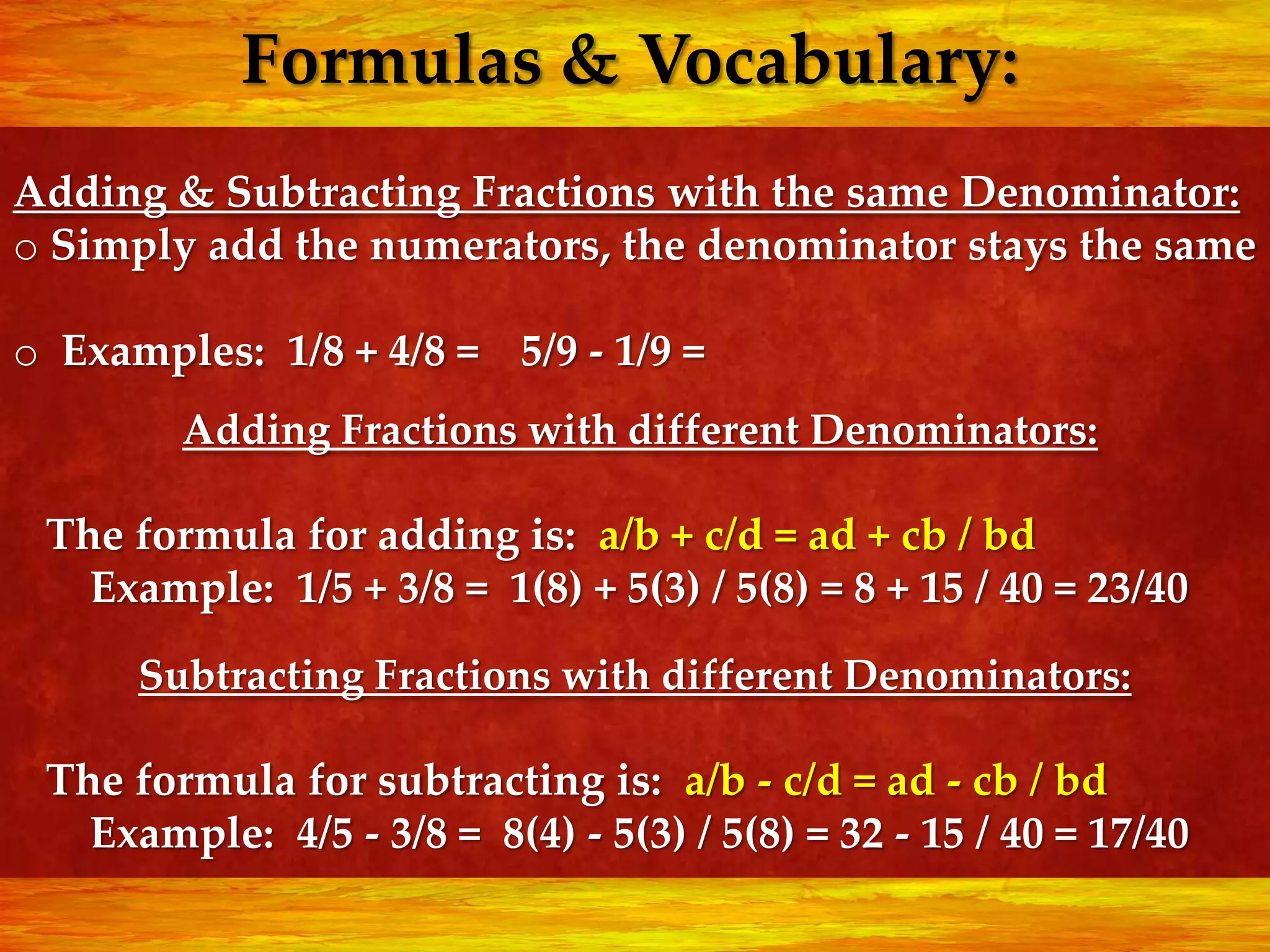
Formulas & Vocabulary:
Adding & Subtracting Fractions with the same Denominator:
o Simply add the numerators, the denominator stays the same

o Examples: 1/8 + 4/8 = 5/9 - 1/9 =
        Adding Fractions with different Denominators:

 The formula for adding is: a/b + c/d = ad + cb / bd
   Example: 1/5 + 3/8 = 1(8) + 5(3) / 5(8) = 8 + 15 / 40 = 23/40
      Subtracting Fractions with different Denominators:

 The formula for subtracting is: a/b - c/d = ad - cb / bd
   Example: 4/5 - 3/8 = 8(4) - 5(3) / 5(8) = 32 - 15 / 40 = 17/40
Class Work: Ruler

  A. Label each line of the top ruler with the proper fraction:

B. Answer (simplify) and place the mark on the bottom ruler :

  1. 4/32         2. 7/4 - 7/8          3. 4/64       4. 3/4 - 2/16

  5. 3/2 - 3/4    6. 3/16 + 2/8         7. 14/32 + 16/32

  8. 2/16 ÷ 1/4          9. 6/8 • 1/4      10. 3/4 ÷ 4
Class Work: Fraction Worksheets
November 7

November 7

  • 1.
    Wednesday, November 7,2012 Today: Final Exam Make-Up Seating Chart Multiplication/Division Tests Final Exam Results First Quarter Grades Warm-Up Fractions/Decimals/Percents
  • 2.
    Warm-Up: 1. 8(3x) -12x 2. 4(4x + 3) - 6 3. 2y + 2(x - 4) 4. Solve for x: 6xy - z = -8 5. Solve for z: 6xy - z = -8 10 10 6. Solve for x: -3x + (-3) = 12 7. 4•(- 2) + (4 - 6) + 23 2 15 - 3•6 + 23 - 3 8. 6 - x = 5 9. 6 - 2 = 5 2 x
  • 3.
    Vocabulary: Fractions: From theLatin fractiō: a breaking into pieces, also from the Latin fractus: broken English Words from the Latin Root Fractus: fracture, infraction, fragile, frail Fractions are a SINGLE NUMBER and can be placed on the number line. All positive proper fractions are a number between 0 and 1. A fraction is defined as a “part – whole” relationship of a number. 3 out of 5 students were girls. The fraction is 3/5
  • 4.
    Vocabulary: The denominator "5"represents the whole, and the numerator "3" represents the part. The original quantity 5 has been "broken" into 2 parts. Since Fractions are used to show the relationship between the part and the whole, we don't always know what the actual quantity is. Example: 4 out of 5 dentist prefer Trident gum. Does this mean only 5 dentists were asked? It could. But what if 100 dentists were surveyed? How many said they prefer Trident? Because fractions are simplified, we don't always know what the original quantity is, which isn't the purpose of a fraction anyway.
  • 5.
    Formulas & Vocabulary: Adding& Subtracting Fractions with the same Denominator: o Simply add the numerators, the denominator stays the same o Examples: 1/8 + 4/8 = 5/9 - 1/9 = Adding Fractions with different Denominators: The formula for adding is: a/b + c/d = ad + cb / bd Example: 1/5 + 3/8 = 1(8) + 5(3) / 5(8) = 8 + 15 / 40 = 23/40 Subtracting Fractions with different Denominators: The formula for subtracting is: a/b - c/d = ad - cb / bd Example: 4/5 - 3/8 = 8(4) - 5(3) / 5(8) = 32 - 15 / 40 = 17/40
  • 6.
    Class Work: Ruler A. Label each line of the top ruler with the proper fraction: B. Answer (simplify) and place the mark on the bottom ruler : 1. 4/32 2. 7/4 - 7/8 3. 4/64 4. 3/4 - 2/16 5. 3/2 - 3/4 6. 3/16 + 2/8 7. 14/32 + 16/32 8. 2/16 ÷ 1/4 9. 6/8 • 1/4 10. 3/4 ÷ 4
  • 7.