Functions and Types
A noun is a name of a person, place, time, 
object, events, animals, and ideas. 
Some of the jobs of a noun in a sentence 
are subject, direct object, indirect object, 
object of the preposition, predicate nouns 
and object complements.
Subject- nouns tell us whom the sentence 
is all about. 
Example: Luis took the coin. 
Direct Object-noun that receives actions of 
certain kinds of verbs. 
Example: Luis took the coin. 
Indirect Object- noun that receives direct 
object 
Example: Luis took Charlie the coin.
Object of Prepositions-noun that comes 
after the preposition. 
Example: Luis took the coin to Charlie. 
Predicate Nouns- nouns that renames the 
subject; comes after a linking verb. 
Example: Marlon is a cheater. 
Object Complements- nouns that 
completes the direct objects. 
Example: They talked to teacher Mavis.
Common Nouns- these nouns are general, 
nonspecific people, names, or ideas. They 
start in lowercase letter unless hey begin a 
sentence. 
EXAMPLES: 
park tree dog
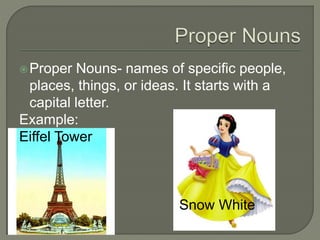
Proper Nouns- names of specific people, 
places, things, or ideas. It starts with a 
capital letter. 
Example: 
Eiffel Tower 
Snow White
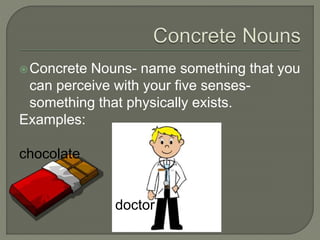
Concrete Nouns- name something that you 
can perceive with your five senses-something 
that physically exists. 
Examples: 
chocolate 
doctor
Abstract Nouns- these are the opposite of 
concrete. They name something that you 
cannot perceive with your five senses. 
Examples: 
love 
freedom
Compound Nouns- made up of two or 
more smaller words. 
Examples: 
rainbow playground
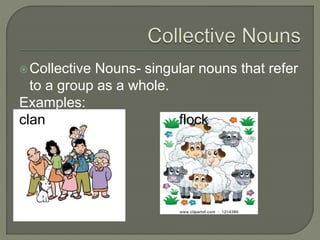
Collective Nouns- singular nouns that refer 
to a group as a whole. 
Examples: 
clan flock
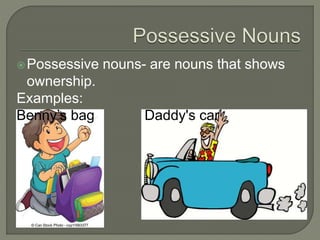
Possessive nouns- are nouns that shows 
ownership. 
Examples: 
Benny’s bag Daddy's car
Nouns

Nouns

  • 1.
  • 2.
    A noun isa name of a person, place, time, object, events, animals, and ideas. Some of the jobs of a noun in a sentence are subject, direct object, indirect object, object of the preposition, predicate nouns and object complements.
  • 3.
    Subject- nouns tellus whom the sentence is all about. Example: Luis took the coin. Direct Object-noun that receives actions of certain kinds of verbs. Example: Luis took the coin. Indirect Object- noun that receives direct object Example: Luis took Charlie the coin.
  • 4.
    Object of Prepositions-nounthat comes after the preposition. Example: Luis took the coin to Charlie. Predicate Nouns- nouns that renames the subject; comes after a linking verb. Example: Marlon is a cheater. Object Complements- nouns that completes the direct objects. Example: They talked to teacher Mavis.
  • 6.
    Common Nouns- thesenouns are general, nonspecific people, names, or ideas. They start in lowercase letter unless hey begin a sentence. EXAMPLES: park tree dog
  • 7.
    Proper Nouns- namesof specific people, places, things, or ideas. It starts with a capital letter. Example: Eiffel Tower Snow White
  • 8.
    Concrete Nouns- namesomething that you can perceive with your five senses-something that physically exists. Examples: chocolate doctor
  • 9.
    Abstract Nouns- theseare the opposite of concrete. They name something that you cannot perceive with your five senses. Examples: love freedom
  • 10.
    Compound Nouns- madeup of two or more smaller words. Examples: rainbow playground
  • 11.
    Collective Nouns- singularnouns that refer to a group as a whole. Examples: clan flock
  • 12.
    Possessive nouns- arenouns that shows ownership. Examples: Benny’s bag Daddy's car