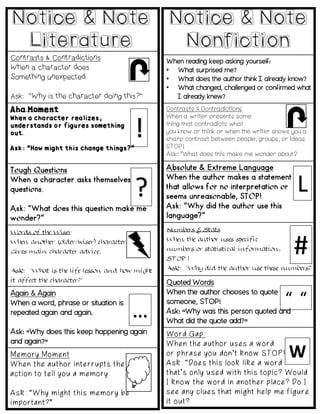
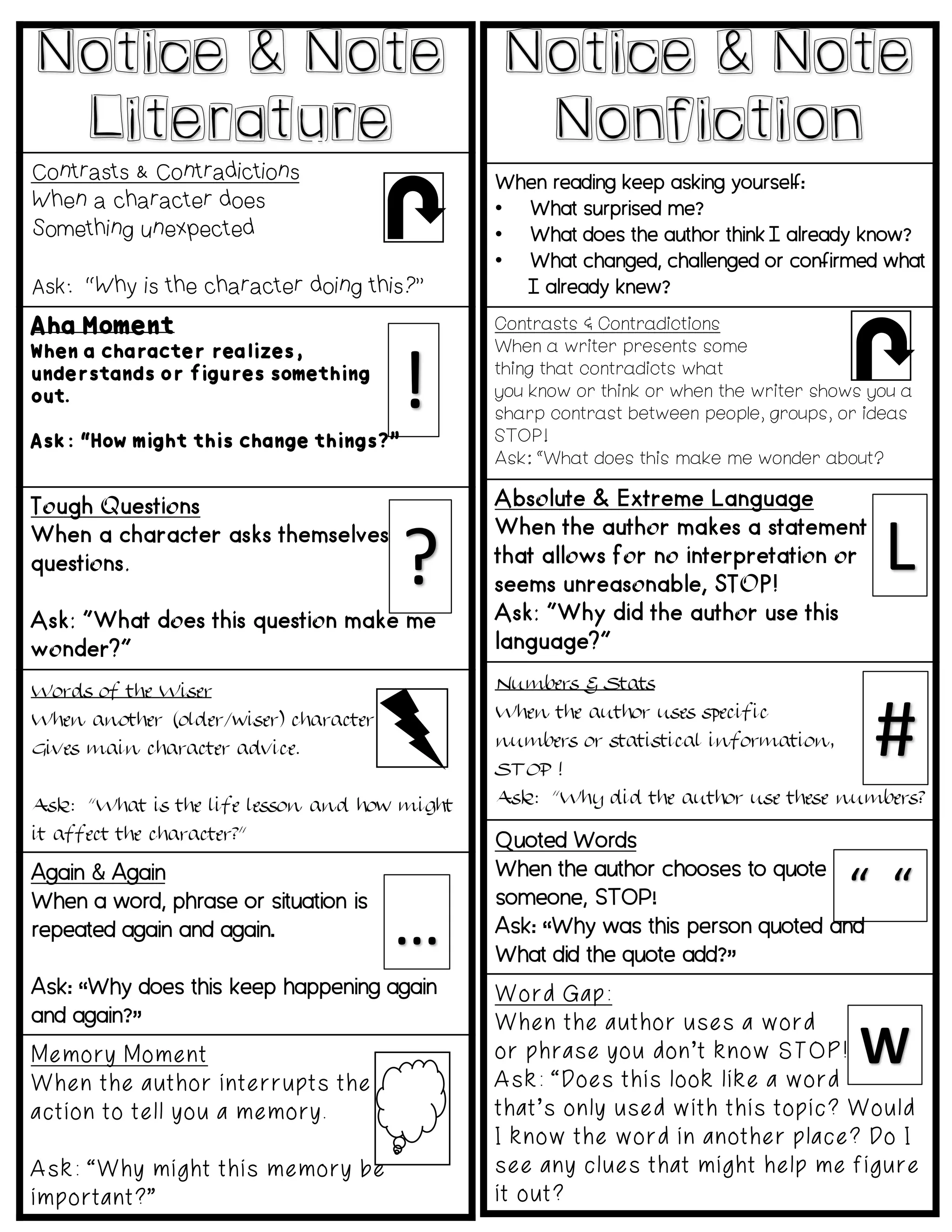
Contrasts & Contradictions
When a character does
Something unexpected
Ask: “Why is the character doing this?”
Aha Moment
When a character realizes,
understands or figures something
out.
Ask: “How might this change things?”
Tough Questions
When a character asks themselves
questions.
Ask: “What does this question make me
wonder?”
Words of the Wiser
When another (older/wiser) character
Gives main character advice.
Ask: “What is the life lesson and how might
it affect the character?”
Again & Again
When a word, phrase or situation is
repeated again and again.
Ask: “Why does this keep happening again
and again?”
Memory Moment
When the author interrupts the
action to tell you a memory.
Ask: “Why might this memory be
important?”
Notice & Note
Literature
?
…
When reading keep asking yourself:
• What surprised me?
• What does the author think I already know?
• What changed, challenged or confirmed what
I already knew?
Contrasts & Contradictions
When a writer presents some
thing that contradicts what
you know or think or when the writer shows you a
sharp contrast between people, groups, or ideas
STOP!
Ask: “What does this make me wonder about?
Absolute & Extreme Language
When the author makes a statement
that allows for no interpretation or
seems unreasonable, STOP!
Ask: “Why did the author use this
language?”
Numbers & Stats
When the author uses specific
numbers or statistical information,
STOP !
Ask: “Why did the author use these numbers?
Quoted Words
When the author chooses to quote
someone, STOP!
Ask: “Why was this person quoted and
What did the quote add?”
Word Gap:
When the author uses a word
or phrase you don’t know STOP!
Ask: “Does this look like a word
that’s only used with this topic? Would
I know the word in another place? Do I
see any clues that might help me figure
it out?
Notice & Note
Nonfiction
L
“ “
#
W
Contrasts & Contradictions
When a character does
Something unexpected
Ask: “Why is the character doing this?”
Aha Moment
When a character realizes,
understands or figures something
out.
Ask: “How might this change things?”
Tough Questions
When a character asks themselves
questions.
Ask: “What does this question make me
wonder?”
Words of the Wiser
When another (older/wiser) character
Gives main character advice.
Ask: “What is the life lesson and how might
it affect the character?”
Again & Again
When a word, phrase or situation is
repeated again and again.
Ask: “Why does this keep happening again
and again?”
Memory Moment
When the author interrupts the
action to tell you a memory.
Ask: “Why might this memory be
important?”
Notice & Note
Literature
…
When reading keep asking yourself:
• What surprised me?
• What does the author think I already know?
• What changed, challenged or confirmed what
I already knew?
Contrasts & Contradictions
When a writer presents some
thing that contradicts what
you know or think or when the writer shows you a
sharp contrast between people, groups, or ideas
STOP!
Ask: “What does this make me wonder about?
Absolute & Extreme Language
When the author makes a statement
that allows for no interpretation or
seems unreasonable, STOP!
Ask: “Why did the author use this
language?”
Numbers & Stats
When the author uses specific
numbers or statistical information,
STOP !
Ask: “Why did the author use these numbers?
Quoted Words
When the author chooses to quote
someone, STOP!
Ask: “Why was this person quoted and
What did the quote add?”
Word Gap:
When the author uses a word
or phrase you don’t know STOP!
Ask: “Does this look like a word
that’s only used with this topic? Would
I know the word in another place? Do I
see any clues that might help me figure
it out?
Notice & Note
Nonfiction
Thank You!!
Thank you for purchasing this product! This product was designed
and adapted from Kylene Beers & Bob Probst’s fabulous
professional book, Notice & Note: Strategies for Close Reading and
their 2015 Reading Nonfiction: Notice & Note: Stances, Sign Posts
and Strategies.
These bookmarks come in both color and black/white and can be
printed on cardstock, folded, laminated and distributed to your kids.
Once you have taught the signposts, your kids will have a handy
resource to keep by their side. Once folded, your students will be
able to refer to literature signposts on one side and nonfiction
signposts on the other.
In the age of college and career readiness, kids need to read more
closely and deeply to make true meaning of the text.
The questions will help guide your students to thinking about the text
more deeply and the symbols will allow your kids to code the text.
They can use post-its and write the symbol or write the symbol on
the text for quick annotation. Whichever way you choose, your kids
will no doubt be on the right track to thinking, discussing and writing
more intelligently about the texts they read.
Credits!
Graphics and fonts by:
Power Point shapes

Notice and note book

  • 1.
    Contrasts & Contradictions Whena character does Something unexpected Ask: “Why is the character doing this?” Aha Moment When a character realizes, understands or figures something out. Ask: “How might this change things?” Tough Questions When a character asks themselves questions. Ask: “What does this question make me wonder?” Words of the Wiser When another (older/wiser) character Gives main character advice. Ask: “What is the life lesson and how might it affect the character?” Again & Again When a word, phrase or situation is repeated again and again. Ask: “Why does this keep happening again and again?” Memory Moment When the author interrupts the action to tell you a memory. Ask: “Why might this memory be important?” Notice & Note Literature ? … When reading keep asking yourself: • What surprised me? • What does the author think I already know? • What changed, challenged or confirmed what I already knew? Contrasts & Contradictions When a writer presents some thing that contradicts what you know or think or when the writer shows you a sharp contrast between people, groups, or ideas STOP! Ask: “What does this make me wonder about? Absolute & Extreme Language When the author makes a statement that allows for no interpretation or seems unreasonable, STOP! Ask: “Why did the author use this language?” Numbers & Stats When the author uses specific numbers or statistical information, STOP ! Ask: “Why did the author use these numbers? Quoted Words When the author chooses to quote someone, STOP! Ask: “Why was this person quoted and What did the quote add?” Word Gap: When the author uses a word or phrase you don’t know STOP! Ask: “Does this look like a word that’s only used with this topic? Would I know the word in another place? Do I see any clues that might help me figure it out? Notice & Note Nonfiction L “ “ # W
  • 2.
    Contrasts & Contradictions Whena character does Something unexpected Ask: “Why is the character doing this?” Aha Moment When a character realizes, understands or figures something out. Ask: “How might this change things?” Tough Questions When a character asks themselves questions. Ask: “What does this question make me wonder?” Words of the Wiser When another (older/wiser) character Gives main character advice. Ask: “What is the life lesson and how might it affect the character?” Again & Again When a word, phrase or situation is repeated again and again. Ask: “Why does this keep happening again and again?” Memory Moment When the author interrupts the action to tell you a memory. Ask: “Why might this memory be important?” Notice & Note Literature … When reading keep asking yourself: • What surprised me? • What does the author think I already know? • What changed, challenged or confirmed what I already knew? Contrasts & Contradictions When a writer presents some thing that contradicts what you know or think or when the writer shows you a sharp contrast between people, groups, or ideas STOP! Ask: “What does this make me wonder about? Absolute & Extreme Language When the author makes a statement that allows for no interpretation or seems unreasonable, STOP! Ask: “Why did the author use this language?” Numbers & Stats When the author uses specific numbers or statistical information, STOP ! Ask: “Why did the author use these numbers? Quoted Words When the author chooses to quote someone, STOP! Ask: “Why was this person quoted and What did the quote add?” Word Gap: When the author uses a word or phrase you don’t know STOP! Ask: “Does this look like a word that’s only used with this topic? Would I know the word in another place? Do I see any clues that might help me figure it out? Notice & Note Nonfiction
  • 3.
    Thank You!! Thank youfor purchasing this product! This product was designed and adapted from Kylene Beers & Bob Probst’s fabulous professional book, Notice & Note: Strategies for Close Reading and their 2015 Reading Nonfiction: Notice & Note: Stances, Sign Posts and Strategies. These bookmarks come in both color and black/white and can be printed on cardstock, folded, laminated and distributed to your kids. Once you have taught the signposts, your kids will have a handy resource to keep by their side. Once folded, your students will be able to refer to literature signposts on one side and nonfiction signposts on the other. In the age of college and career readiness, kids need to read more closely and deeply to make true meaning of the text. The questions will help guide your students to thinking about the text more deeply and the symbols will allow your kids to code the text. They can use post-its and write the symbol or write the symbol on the text for quick annotation. Whichever way you choose, your kids will no doubt be on the right track to thinking, discussing and writing more intelligently about the texts they read. Credits! Graphics and fonts by: Power Point shapes