Genetic Technology
DNA Technology
Genetic Engineering
ALL THE SAME
Genetic Engineering: DNA
Technology
 process of making changes in the
DNA code of living organisms
 uses DNA technology to cure
diseases, treat genetic disorders,
 improve food crops, etc.
How do we make changes
to DNA of an organism???
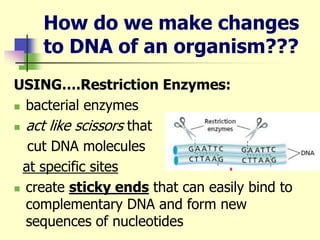
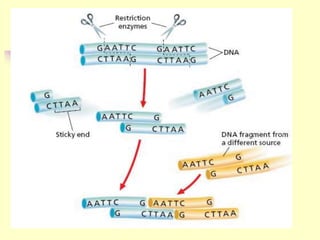
USING….Restriction Enzymes:
 bacterial enzymes
 act like scissors that
cut DNA molecules
at specific sites
 create sticky ends that can easily bind to
complementary DNA and form new
sequences of nucleotides
Plasmids are:
 ring of DNA found in a bacterium (bacteria)
in addition to its main chromosome
 these plasmids can be cut with restriction
enzymes, allowing other genes (donor
genes) to be spliced into the plasmid
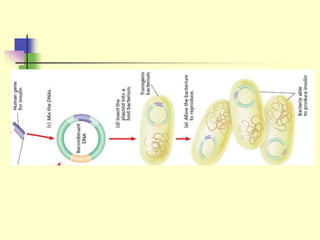
 once gene has been spliced into plasmid,
the plasmid is returned to the bacteria
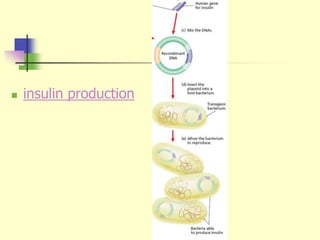
 insulin production
Plasmids are:
 the bacteria then divides, giving copies
of the new gene
 recombinant DNA- combination of DNA
from two or more sources
 Ex.: inserting human gene for insulin
into bacteria in order to produce large
amounts of insulin for people whose
bodies do not produce enough
MORE DNA Technology
Techniques:
1. DNA Fingerprinting: pattern of bands
made up of specific fragments from an
organism's DNA
•Uses:
-determining relationships between
individuals
-determining how closely species are
related
-helping solve crimes
DNA Fingerprinting
How it works:
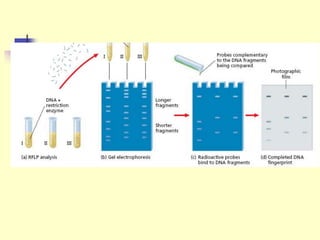
use RFLP analysis to (omit) extract DNA
and cut it using restriction enzymes
 gel electrophoresis: DNA placed into
wells made on a gel; fragments or
segments of DNA are then separated
based on size and charge
 Gel-Electrophoresis-Animation-
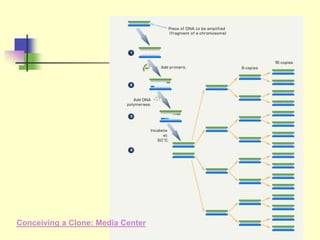
Polymerase Chain
Reaction (PCR)
 used to quickly make many
 copies of selected segments of
DNA, only requires tiny
amounts of DNA
Conceiving a Clone: Media Center
Human Genome Project
(began in 1990)
Purposes:
 to determine the nucleotide sequence of the
entire human genome (approx. 3 billion
nucleotide pairs)
 to map the location of every gene on each
chromosome
 improve diagnoses, treatments, and cures for
genetic diseases
Human Genome Proj.
 J. Craig Venter: Designing Life - 60
Minutes - CBS News
Cloning:
 A group of genetically
Identical cells
 May be produces
asexually… (Mitosis)
 Growing Body Parts
Gene Therapy
 treating a genetic disorder by
introducing a gene into a cell or by
correcting a gene defect in a cell's
genome
 involves ethical decisions - Ex.
insurance companies
To Rw. Practical Uses of DNA
Technology:
 produce pharmaceutical products
inexpensively
 Ex. insulin
Practical Uses of DNA
Technology:
 produce effective vaccines
 interesting research--scientists
are creating a banana vaccine to
vaccinate children against viral
diseases like Hepatitis B
Practical Uses of DNA
Technology:
Increase agricultural yields by:
 protecting plants by transferring
genes that are harmful to pests into
the plants
 producing plants that are resistant to
weed-controlling chemicals
(herbicides)
 developing plants that do not require
fertilizers to grow
 NOVA | scienceNOW | Personal DNA
Testing | PBS
 NOVA Online | Cracking the Code of Life
| Watch the Program Here
Safety and Environmental
Issues
 genetically engineered foods
may contain toxins, making
people allergic to the foods
 genetically engineered crops
may take over the native plant
species
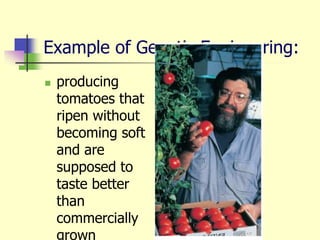
Example of Genetic Engineering:
 producing
tomatoes that
ripen without
becoming soft
and are
supposed to
taste better
than
commercially
grown
Notes_Genetic_Technology in biology a/as level

Notes_Genetic_Technology in biology a/as level

  • 1.
  • 2.
    Genetic Engineering: DNA Technology process of making changes in the DNA code of living organisms  uses DNA technology to cure diseases, treat genetic disorders,  improve food crops, etc.
  • 3.
    How do wemake changes to DNA of an organism??? USING….Restriction Enzymes:  bacterial enzymes  act like scissors that cut DNA molecules at specific sites  create sticky ends that can easily bind to complementary DNA and form new sequences of nucleotides
  • 5.
    Plasmids are:  ringof DNA found in a bacterium (bacteria) in addition to its main chromosome  these plasmids can be cut with restriction enzymes, allowing other genes (donor genes) to be spliced into the plasmid  once gene has been spliced into plasmid, the plasmid is returned to the bacteria
  • 6.
  • 7.
    Plasmids are:  thebacteria then divides, giving copies of the new gene  recombinant DNA- combination of DNA from two or more sources  Ex.: inserting human gene for insulin into bacteria in order to produce large amounts of insulin for people whose bodies do not produce enough
  • 9.
    MORE DNA Technology Techniques: 1.DNA Fingerprinting: pattern of bands made up of specific fragments from an organism's DNA •Uses: -determining relationships between individuals -determining how closely species are related -helping solve crimes
  • 10.
    DNA Fingerprinting How itworks: use RFLP analysis to (omit) extract DNA and cut it using restriction enzymes  gel electrophoresis: DNA placed into wells made on a gel; fragments or segments of DNA are then separated based on size and charge
  • 12.
  • 13.
    Polymerase Chain Reaction (PCR) used to quickly make many  copies of selected segments of DNA, only requires tiny amounts of DNA
  • 14.
    Conceiving a Clone:Media Center
  • 15.
    Human Genome Project (beganin 1990) Purposes:  to determine the nucleotide sequence of the entire human genome (approx. 3 billion nucleotide pairs)  to map the location of every gene on each chromosome  improve diagnoses, treatments, and cures for genetic diseases
  • 16.
    Human Genome Proj. J. Craig Venter: Designing Life - 60 Minutes - CBS News
  • 17.
    Cloning:  A groupof genetically Identical cells  May be produces asexually… (Mitosis)  Growing Body Parts
  • 18.
    Gene Therapy  treatinga genetic disorder by introducing a gene into a cell or by correcting a gene defect in a cell's genome  involves ethical decisions - Ex. insurance companies
  • 19.
    To Rw. PracticalUses of DNA Technology:  produce pharmaceutical products inexpensively  Ex. insulin
  • 20.
    Practical Uses ofDNA Technology:  produce effective vaccines  interesting research--scientists are creating a banana vaccine to vaccinate children against viral diseases like Hepatitis B
  • 21.
    Practical Uses ofDNA Technology: Increase agricultural yields by:  protecting plants by transferring genes that are harmful to pests into the plants  producing plants that are resistant to weed-controlling chemicals (herbicides)  developing plants that do not require fertilizers to grow
  • 22.
     NOVA |scienceNOW | Personal DNA Testing | PBS  NOVA Online | Cracking the Code of Life | Watch the Program Here
  • 23.
    Safety and Environmental Issues genetically engineered foods may contain toxins, making people allergic to the foods  genetically engineered crops may take over the native plant species
  • 24.
    Example of GeneticEngineering:  producing tomatoes that ripen without becoming soft and are supposed to taste better than commercially grown