Chapter 5
Probability: What Are the Chances?
Section 5.2
Probability Rules
Starnes/Tabor, The Practice of Statistics
By the end of this section, you should be able to:
LEARNING TARGETS
Probability Rules
GIVE a probability model for a chance process with equally
likely outcomes and USE it to find the probability of an
event.
USE basic probability rules, including the complement rule
and the addition rule for mutually exclusive events.
USE a two-way table or Venn diagram to model a chance
process and calculate probabilities involving two events.
APPLY the general addition rule to calculate probabilities.
Starnes/Tabor, The Practice of Statistics
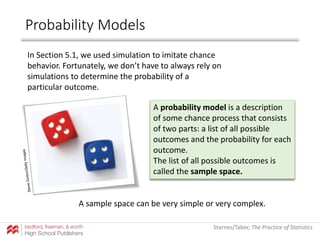
Probability Models
In Section 5.1, we used simulation to imitate chance
behavior. Fortunately, we don’t have to always rely on
simulations to determine the probability of a
particular outcome.
A probability model is a description
of some chance process that consists
of two parts: a list of all possible
outcomes and the probability for each
outcome.
The list of all possible outcomes is
called the sample space.
A sample space can be very simple or very complex.
Starnes/Tabor, The Practice of Statistics
Probability Models
Sample Space
36 Outcomes
Since the dice are fair,
each outcome is equally likely.
Each outcome has probability 1/36.
Starnes/Tabor, The Practice of Statistics
Probability Models
An event is any collection of outcomes from some chance process.
Let A = getting a sum of 5 when two fair
dice are rolled
Since each outcome has
probability
1
36
, P(A) =
4
36
.
There are 4 outcomes that result
in a sum of 5.
Starnes/Tabor, The Practice of Statistics
Probability Models
Finding Probabilities: Equally Likely Outcomes
If all outcomes in the sample space are equally likely, the probability that
event A occurs can be found using the formula
𝑃 𝐴 =
𝑛𝑢𝑚𝑏𝑒𝑟 𝑜𝑓 𝑜𝑢𝑡𝑐𝑜𝑚𝑒𝑠 𝑖𝑛 𝑒𝑣𝑒𝑛𝑡 𝐴
𝑡𝑜𝑡𝑎𝑙 𝑛𝑢𝑚𝑏𝑒𝑟 𝑜𝑓 𝑜𝑢𝑡𝑐𝑜𝑚𝑒𝑠 𝑖𝑛 𝑠𝑎𝑚𝑝𝑙𝑒 𝑠𝑝𝑎𝑐𝑒
Starnes/Tabor, The Practice of Statistics
Basic Probability Rules
Rules that a valid probability model must obey:
1. If all outcomes in the sample space are equally likely, the probability
that event A occurs is 𝑃 𝐴 =
𝑛𝑢𝑚𝑏𝑒𝑟 𝑜𝑓 𝑜𝑢𝑡𝑐𝑜𝑚𝑒𝑠 𝑖𝑛 𝑒𝑣𝑒𝑛𝑡 𝐴
𝑡𝑜𝑡𝑎𝑙 𝑛𝑢𝑚𝑏𝑒𝑟 𝑜𝑓 𝑜𝑢𝑡𝑐𝑜𝑚𝑒𝑠 𝑖𝑛 𝑠𝑎𝑚𝑝𝑙𝑒 𝑠𝑝𝑎𝑐𝑒
2. The probability of any event is a number between 0 and 1.
3. All possible outcomes together must have probabilities that
add up to 1.
4. The probability that an event does not occur is 1 minus the probability
that the event does occur.
The complement rule says that P (AC) = 1 – P(A), where AC is the
complement of event A; that is, the event that A does not occur.
Starnes/Tabor, The Practice of Statistics
Basic Probability Rules
Rules that a valid probability model must obey:
1. If all outcomes in the sample space are equally likely, the probability
that event A occurs is 𝑃 𝐴 =
𝑛𝑢𝑚𝑏𝑒𝑟 𝑜𝑓 𝑜𝑢𝑡𝑐𝑜𝑚𝑒𝑠 𝑖𝑛 𝑒𝑣𝑒𝑛𝑡 𝐴
𝑡𝑜𝑡𝑎𝑙 𝑛𝑢𝑚𝑏𝑒𝑟 𝑜𝑓 𝑜𝑢𝑡𝑐𝑜𝑚𝑒𝑠 𝑖𝑛 𝑠𝑎𝑚𝑝𝑙𝑒 𝑠𝑝𝑎𝑐𝑒
2. The probability of any event is a number between 0 and 1.
3. All possible outcomes together must have probabilities that
add up to 1.
4. The probability that an event does not occur is 1 minus the probability
that the event does occur.
The complement rule says that P (AC) = 1 – P(A), where AC is the
complement of event A; that is, the event that A does not occur.
Starnes/Tabor, The Practice of Statistics
Basic Probability Rules
If we roll two fair dice, what is the probability that the sum is 6?
Two events A and B are mutually exclusive if they have no
outcomes in common and so can never occur together—that is, if
P(A and B) = 0.
The addition rule for mutually exclusive events A and B says that
P(A or B) 5= P(A) + P(B)
P(sum is 6) =
5
36
P(sum is 5 or sum is 6) = P(sum is 5) + P(sum is 6)=
4
36
+
5
36
=
9
36
= 0.25
If we roll two fair dice, what is the probability that the sum is 5 or 6?
Starnes/Tabor, The Practice of Statistics
Basic Probability Rules
If we roll two fair dice, what is the probability that the sum is 6?
Two events A and B are mutually exclusive if they have no
outcomes in common and so can never occur together—that is, if
P(A and B) = 0.
The addition rule for mutually exclusive events A and B says that
P(A or B) 5= P(A) + P(B)
P(sum is 6) =
5
36
P(sum is 5 or sum is 6) = P(sum is 5) + P(sum is 6)=
4
36
+
5
36
=
9
36
= 0.25
If we roll two fair dice, what is the probability that the sum is 5 or 6?
Starnes/Tabor, The Practice of Statistics
Basic Probability Rules
• For any event A, 0 ≤ 𝑃(𝐴) ≤ 1.
• If S is the sample space in a probability model, 𝑃 𝑆 = 1
• In the case of equally likely outcomes,
𝑃 𝐴 =
𝑛𝑢𝑚𝑏𝑒𝑟 𝑜𝑓 𝑜𝑢𝑡𝑐𝑜𝑚𝑒𝑠 𝑖𝑛 𝑒𝑣𝑒𝑛𝑡 𝐴
𝑡𝑜𝑡𝑎𝑙 𝑛𝑢𝑚𝑏𝑒𝑟 𝑜𝑓 𝑜𝑢𝑡𝑐𝑜𝑚𝑒𝑠 𝑖𝑛 𝑠𝑎𝑚𝑝𝑙𝑒 𝑠𝑝𝑎𝑐𝑒
• Complement rule: 𝑃 𝐴𝐶 = 1 − 𝑃(𝐴)
• Addition rule for mutually exclusive events: If A and B are mutually
exclusive, 𝑃 𝐴 𝑜𝑟 𝐵 = 𝑃 𝐴 + 𝑃(𝐵)
We can summarize the basic probability rules in symbolic form.
Starnes/Tabor, The Practice of Statistics
Basic Probability Rules
Problem: Suppose you tear open the corner of a bag of M&M’S® Milk Chocolate
Candies, pour one candy into your hand, and observe the color. According to Mars,
Inc., the maker of M&M’S, the probability model for a bag from its Cleveland
factory is:
(a) Explain why this is a valid probability model.
Niels
Poulsen
std/Alamy
(a) The probability of each outcome is a number between 0 and 1.
The sum of the probabilities is
0.207 + 0.205 + 0.198 + 0.135 + 0.131 + 0.124 = 1.
Starnes/Tabor, The Practice of Statistics
Basic Probability Rules
Problem: Suppose you tear open the corner of a bag of M&M’S® Milk Chocolate
Candies, pour one candy into your hand, and observe the color. According to Mars,
Inc., the maker of M&M’S, the probability model for a bag from its Cleveland
factory is:
(a) Explain why this is a valid probability model.
(b) Find the probability that you don’t get a blue
M&M.
Niels
Poulsen
std/Alamy
(b) P (not blue) = 1 – P(blue) = 1 – 0.207 = 0.793
Starnes/Tabor, The Practice of Statistics
Basic Probability Rules
Problem: Suppose you tear open the corner of a bag of M&M’S® Milk Chocolate
Candies, pour one candy into your hand, and observe the color. According to Mars,
Inc., the maker of M&M’S, the probability model for a bag from its Cleveland
factory is:
(a) Explain why this is a valid probability model.
(b) Find the probability that you don’t get a blue
M&M.
(c) What’s the probability that you get an orange
or a brown M&M?
Niels
Poulsen
std/Alamy
(c) P (orange or brown) = P (orange) + P (brown)
= 0.205 + 0.124
= 0.329
Starnes/Tabor, The Practice of Statistics
Two-Way Tables, Probability, and the
General Addition Rule
There are two different uses of the word or in everyday life.
When you are asked if you
want “soup or salad,” the
waiter wants you to choose
one or the other, but not both.
However, when you order coffee
and are asked if you want
“cream or sugar,” it’s OK to ask
for one or the other or both.
In mathematics and probability, “A or B” means one or the other or both.
When you’re trying to find probabilities involving two events, like
P(A or B), a two-way table can display the sample space in a way
that makes probability calculations easier.
Starnes/Tabor, The Practice of Statistics
Two-Way Tables, Probability, and the
General Addition Rule
Problem: Students in a college statistics class wanted to find out how common it is
for young adults to have their ears pierced. They recorded data on two variables—
gender and whether or not the student had a pierced ear—for all 178 people in
the class. The two-way table summarizes
the data. Suppose we choose a student
from the class at random. Define
event A as getting a male student
and event B as getting a student
with a pierced ear.
(a) Find P(B).
(a) P (B) = P (pierced ear)
=
103
178
= 0.579
Starnes/Tabor, The Practice of Statistics
Two-Way Tables, Probability, and the
General Addition Rule
Problem: Students in a college statistics class wanted to find out how common it is
for young adults to have their ears pierced. They recorded data on two variables—
gender and whether or not the student had a pierced ear—for all 178 people in
the class. The two-way table summarizes
the data. Suppose we choose a student
from the class at random. Define
event A as getting a male student
and event B as getting a student
with a pierced ear.
(a) Find P(B).
(b) Find P(A and B). Interpret this value in context.
(b) P (A and B) = P (male and pierced ear)
=
19
178
= 0.107
Starnes/Tabor, The Practice of Statistics
Two-Way Tables, Probability, and the
General Addition Rule
Problem: Students in a college statistics class wanted to find out how common it is
for young adults to have their ears pierced. They recorded data on two variables—
gender and whether or not the student had a pierced ear—for all 178 people in
the class. The two-way table summarizes
the data. Suppose we choose a student
from the class at random. Define
event A as getting a male student
and event B as getting a student
with a pierced ear.
(a) Find P(B).
(b) Find P(A and B). Interpret this value in context.
(b) There’s about an 11% chance that a
randomly selected student from this
class is male and has a pierced ear.
Starnes/Tabor, The Practice of Statistics
Two-Way Tables, Probability, and the
General Addition Rule
Problem: Students in a college statistics class wanted to find out how common it is
for young adults to have their ears pierced. They recorded data on two variables—
gender and whether or not the student had a pierced ear—for all 178 people in
the class. The two-way table summarizes
the data. Suppose we choose a student
from the class at random. Define
event A as getting a male student
and event B as getting a student
with a pierced ear.
(a) Find P(B).
(b) Find P(A and B). Interpret this value in context.
(c) Find P(A or B).
(c) P (A or B) = P (male or pierced ear)
=
71+19+84
178
= 0.978
Starnes/Tabor, The Practice of Statistics
Two-Way Tables, Probability, and the
General Addition Rule
Part (c) of the example
reveals an important fact
about finding the
probability P(A or B): we
can’t use the addition
rule for mutually exclusive
events unless events A and
B have no outcomes in
common.
Starnes/Tabor, The Practice of Statistics
Two-Way Tables, Probability, and the
General Addition Rule
We can fix the double-
counting problem
illustrated in the two-
way table by subtracting
the probability
P(male and pierced ear)
from the sum of
P(A) and P(B).
𝑃 𝑚𝑎𝑙𝑒 𝑜𝑟 𝑝𝑖𝑒𝑟𝑐𝑒𝑑 𝑒𝑎𝑟 = 𝑃 𝑚𝑎𝑙𝑒 + 𝑃 𝑝𝑖𝑒𝑟𝑐𝑒𝑑 𝑒𝑎𝑟 − 𝑃(𝑚𝑎𝑙𝑒 𝑎𝑛𝑑 𝑝𝑖𝑒𝑟𝑐𝑒𝑑 𝑒𝑎𝑟)
=
90
178
+
103
178
−
19
178
=
174
178
If A and B are any two events resulting from some chance process, the
general addition rule says that 𝑃 𝐴 𝑜𝑟 𝐵 = 𝑃 𝐴 + 𝑃 𝐵 − 𝑃(𝐴 𝑎𝑛𝑑 𝐵)
Starnes/Tabor, The Practice of Statistics
Two-Way Tables, Probability, and the
General Addition Rule
Problem: A survey of all residents in a large apartment complex reveals
that 68% use Facebook, 28% use Instagram, and 25% do both. Suppose
we select a resident at random. What’s the probability that the person
uses Facebook or uses Instagram?
Let event F = uses Facebook and
I = uses Instagram.
P(F or I) = P(F) + P(I) – P(F and I)
= 0.68 + 0.28 – 0.25
= 0.71
Ann
Heath
Starnes/Tabor, The Practice of Statistics
Venn Diagrams and Probability
A Venn diagram consists of one or more circles surrounded by a rectangle.
Each circle represents an event. The region inside the rectangle represents
the sample space of the chance process.
Starnes/Tabor, The Practice of Statistics
Venn Diagrams and Probability
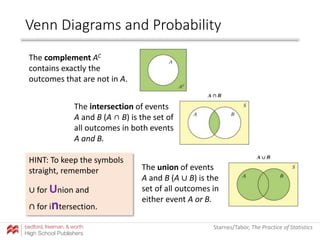
The complement AC
contains exactly the
outcomes that are not in A.
The intersection of events
A and B (A ∩ B) is the set of
all outcomes in both events
A and B.
The union of events
A and B (A ∪ B) is the
set of all outcomes in
either event A or B.
HINT: To keep the symbols
straight, remember
∪ for Union and
∩ for intersection.
Starnes/Tabor, The Practice of Statistics
Venn Diagrams and Probability
Problem: A survey of all residents in a large apartment complex reveals
that 68% use Facebook, 28% use Instagram, and 25% do both. Suppose
we select a resident at random.
(a) Make a Venn diagram to display the sample space of this chance
process using the events F: uses Facebook and I: uses Instagram.
(a)
Starnes/Tabor, The Practice of Statistics
Venn Diagrams and Probability
Problem: A survey of all residents in a large apartment complex reveals
that 68% use Facebook, 28% use Instagram, and 25% do both. Suppose
we select a resident at random.
(a) Make a Venn diagram to display the sample space of this chance
process using the events F: uses Facebook and I: uses Instagram.
(b) Find the probability that the person uses neither Facebook nor
Instagram.
(b) P(no Facebook and no Instagram) = 0.29

Notes_5.2.pptx

  • 1.
    Chapter 5 Probability: WhatAre the Chances? Section 5.2 Probability Rules
  • 2.
    Starnes/Tabor, The Practiceof Statistics By the end of this section, you should be able to: LEARNING TARGETS Probability Rules GIVE a probability model for a chance process with equally likely outcomes and USE it to find the probability of an event. USE basic probability rules, including the complement rule and the addition rule for mutually exclusive events. USE a two-way table or Venn diagram to model a chance process and calculate probabilities involving two events. APPLY the general addition rule to calculate probabilities.
  • 3.
    Starnes/Tabor, The Practiceof Statistics Probability Models In Section 5.1, we used simulation to imitate chance behavior. Fortunately, we don’t have to always rely on simulations to determine the probability of a particular outcome. A probability model is a description of some chance process that consists of two parts: a list of all possible outcomes and the probability for each outcome. The list of all possible outcomes is called the sample space. A sample space can be very simple or very complex.
  • 4.
    Starnes/Tabor, The Practiceof Statistics Probability Models Sample Space 36 Outcomes Since the dice are fair, each outcome is equally likely. Each outcome has probability 1/36.
  • 5.
    Starnes/Tabor, The Practiceof Statistics Probability Models An event is any collection of outcomes from some chance process. Let A = getting a sum of 5 when two fair dice are rolled Since each outcome has probability 1 36 , P(A) = 4 36 . There are 4 outcomes that result in a sum of 5.
  • 6.
    Starnes/Tabor, The Practiceof Statistics Probability Models Finding Probabilities: Equally Likely Outcomes If all outcomes in the sample space are equally likely, the probability that event A occurs can be found using the formula 𝑃 𝐴 = 𝑛𝑢𝑚𝑏𝑒𝑟 𝑜𝑓 𝑜𝑢𝑡𝑐𝑜𝑚𝑒𝑠 𝑖𝑛 𝑒𝑣𝑒𝑛𝑡 𝐴 𝑡𝑜𝑡𝑎𝑙 𝑛𝑢𝑚𝑏𝑒𝑟 𝑜𝑓 𝑜𝑢𝑡𝑐𝑜𝑚𝑒𝑠 𝑖𝑛 𝑠𝑎𝑚𝑝𝑙𝑒 𝑠𝑝𝑎𝑐𝑒
  • 7.
    Starnes/Tabor, The Practiceof Statistics Basic Probability Rules Rules that a valid probability model must obey: 1. If all outcomes in the sample space are equally likely, the probability that event A occurs is 𝑃 𝐴 = 𝑛𝑢𝑚𝑏𝑒𝑟 𝑜𝑓 𝑜𝑢𝑡𝑐𝑜𝑚𝑒𝑠 𝑖𝑛 𝑒𝑣𝑒𝑛𝑡 𝐴 𝑡𝑜𝑡𝑎𝑙 𝑛𝑢𝑚𝑏𝑒𝑟 𝑜𝑓 𝑜𝑢𝑡𝑐𝑜𝑚𝑒𝑠 𝑖𝑛 𝑠𝑎𝑚𝑝𝑙𝑒 𝑠𝑝𝑎𝑐𝑒 2. The probability of any event is a number between 0 and 1. 3. All possible outcomes together must have probabilities that add up to 1. 4. The probability that an event does not occur is 1 minus the probability that the event does occur. The complement rule says that P (AC) = 1 – P(A), where AC is the complement of event A; that is, the event that A does not occur.
  • 8.
    Starnes/Tabor, The Practiceof Statistics Basic Probability Rules Rules that a valid probability model must obey: 1. If all outcomes in the sample space are equally likely, the probability that event A occurs is 𝑃 𝐴 = 𝑛𝑢𝑚𝑏𝑒𝑟 𝑜𝑓 𝑜𝑢𝑡𝑐𝑜𝑚𝑒𝑠 𝑖𝑛 𝑒𝑣𝑒𝑛𝑡 𝐴 𝑡𝑜𝑡𝑎𝑙 𝑛𝑢𝑚𝑏𝑒𝑟 𝑜𝑓 𝑜𝑢𝑡𝑐𝑜𝑚𝑒𝑠 𝑖𝑛 𝑠𝑎𝑚𝑝𝑙𝑒 𝑠𝑝𝑎𝑐𝑒 2. The probability of any event is a number between 0 and 1. 3. All possible outcomes together must have probabilities that add up to 1. 4. The probability that an event does not occur is 1 minus the probability that the event does occur. The complement rule says that P (AC) = 1 – P(A), where AC is the complement of event A; that is, the event that A does not occur.
  • 9.
    Starnes/Tabor, The Practiceof Statistics Basic Probability Rules If we roll two fair dice, what is the probability that the sum is 6? Two events A and B are mutually exclusive if they have no outcomes in common and so can never occur together—that is, if P(A and B) = 0. The addition rule for mutually exclusive events A and B says that P(A or B) 5= P(A) + P(B) P(sum is 6) = 5 36 P(sum is 5 or sum is 6) = P(sum is 5) + P(sum is 6)= 4 36 + 5 36 = 9 36 = 0.25 If we roll two fair dice, what is the probability that the sum is 5 or 6?
  • 10.
    Starnes/Tabor, The Practiceof Statistics Basic Probability Rules If we roll two fair dice, what is the probability that the sum is 6? Two events A and B are mutually exclusive if they have no outcomes in common and so can never occur together—that is, if P(A and B) = 0. The addition rule for mutually exclusive events A and B says that P(A or B) 5= P(A) + P(B) P(sum is 6) = 5 36 P(sum is 5 or sum is 6) = P(sum is 5) + P(sum is 6)= 4 36 + 5 36 = 9 36 = 0.25 If we roll two fair dice, what is the probability that the sum is 5 or 6?
  • 11.
    Starnes/Tabor, The Practiceof Statistics Basic Probability Rules Basic Probability Rules • For any event A, 0 ≤ 𝑃(𝐴) ≤ 1. • If S is the sample space in a probability model, 𝑃 𝑆 = 1 • In the case of equally likely outcomes, 𝑃 𝐴 = 𝑛𝑢𝑚𝑏𝑒𝑟 𝑜𝑓 𝑜𝑢𝑡𝑐𝑜𝑚𝑒𝑠 𝑖𝑛 𝑒𝑣𝑒𝑛𝑡 𝐴 𝑡𝑜𝑡𝑎𝑙 𝑛𝑢𝑚𝑏𝑒𝑟 𝑜𝑓 𝑜𝑢𝑡𝑐𝑜𝑚𝑒𝑠 𝑖𝑛 𝑠𝑎𝑚𝑝𝑙𝑒 𝑠𝑝𝑎𝑐𝑒 • Complement rule: 𝑃 𝐴𝐶 = 1 − 𝑃(𝐴) • Addition rule for mutually exclusive events: If A and B are mutually exclusive, 𝑃 𝐴 𝑜𝑟 𝐵 = 𝑃 𝐴 + 𝑃(𝐵) We can summarize the basic probability rules in symbolic form.
  • 12.
    Starnes/Tabor, The Practiceof Statistics Basic Probability Rules Problem: Suppose you tear open the corner of a bag of M&M’S® Milk Chocolate Candies, pour one candy into your hand, and observe the color. According to Mars, Inc., the maker of M&M’S, the probability model for a bag from its Cleveland factory is: (a) Explain why this is a valid probability model. Niels Poulsen std/Alamy (a) The probability of each outcome is a number between 0 and 1. The sum of the probabilities is 0.207 + 0.205 + 0.198 + 0.135 + 0.131 + 0.124 = 1.
  • 13.
    Starnes/Tabor, The Practiceof Statistics Basic Probability Rules Problem: Suppose you tear open the corner of a bag of M&M’S® Milk Chocolate Candies, pour one candy into your hand, and observe the color. According to Mars, Inc., the maker of M&M’S, the probability model for a bag from its Cleveland factory is: (a) Explain why this is a valid probability model. (b) Find the probability that you don’t get a blue M&M. Niels Poulsen std/Alamy (b) P (not blue) = 1 – P(blue) = 1 – 0.207 = 0.793
  • 14.
    Starnes/Tabor, The Practiceof Statistics Basic Probability Rules Problem: Suppose you tear open the corner of a bag of M&M’S® Milk Chocolate Candies, pour one candy into your hand, and observe the color. According to Mars, Inc., the maker of M&M’S, the probability model for a bag from its Cleveland factory is: (a) Explain why this is a valid probability model. (b) Find the probability that you don’t get a blue M&M. (c) What’s the probability that you get an orange or a brown M&M? Niels Poulsen std/Alamy (c) P (orange or brown) = P (orange) + P (brown) = 0.205 + 0.124 = 0.329
  • 15.
    Starnes/Tabor, The Practiceof Statistics Two-Way Tables, Probability, and the General Addition Rule There are two different uses of the word or in everyday life. When you are asked if you want “soup or salad,” the waiter wants you to choose one or the other, but not both. However, when you order coffee and are asked if you want “cream or sugar,” it’s OK to ask for one or the other or both. In mathematics and probability, “A or B” means one or the other or both. When you’re trying to find probabilities involving two events, like P(A or B), a two-way table can display the sample space in a way that makes probability calculations easier.
  • 16.
    Starnes/Tabor, The Practiceof Statistics Two-Way Tables, Probability, and the General Addition Rule Problem: Students in a college statistics class wanted to find out how common it is for young adults to have their ears pierced. They recorded data on two variables— gender and whether or not the student had a pierced ear—for all 178 people in the class. The two-way table summarizes the data. Suppose we choose a student from the class at random. Define event A as getting a male student and event B as getting a student with a pierced ear. (a) Find P(B). (a) P (B) = P (pierced ear) = 103 178 = 0.579
  • 17.
    Starnes/Tabor, The Practiceof Statistics Two-Way Tables, Probability, and the General Addition Rule Problem: Students in a college statistics class wanted to find out how common it is for young adults to have their ears pierced. They recorded data on two variables— gender and whether or not the student had a pierced ear—for all 178 people in the class. The two-way table summarizes the data. Suppose we choose a student from the class at random. Define event A as getting a male student and event B as getting a student with a pierced ear. (a) Find P(B). (b) Find P(A and B). Interpret this value in context. (b) P (A and B) = P (male and pierced ear) = 19 178 = 0.107
  • 18.
    Starnes/Tabor, The Practiceof Statistics Two-Way Tables, Probability, and the General Addition Rule Problem: Students in a college statistics class wanted to find out how common it is for young adults to have their ears pierced. They recorded data on two variables— gender and whether or not the student had a pierced ear—for all 178 people in the class. The two-way table summarizes the data. Suppose we choose a student from the class at random. Define event A as getting a male student and event B as getting a student with a pierced ear. (a) Find P(B). (b) Find P(A and B). Interpret this value in context. (b) There’s about an 11% chance that a randomly selected student from this class is male and has a pierced ear.
  • 19.
    Starnes/Tabor, The Practiceof Statistics Two-Way Tables, Probability, and the General Addition Rule Problem: Students in a college statistics class wanted to find out how common it is for young adults to have their ears pierced. They recorded data on two variables— gender and whether or not the student had a pierced ear—for all 178 people in the class. The two-way table summarizes the data. Suppose we choose a student from the class at random. Define event A as getting a male student and event B as getting a student with a pierced ear. (a) Find P(B). (b) Find P(A and B). Interpret this value in context. (c) Find P(A or B). (c) P (A or B) = P (male or pierced ear) = 71+19+84 178 = 0.978
  • 20.
    Starnes/Tabor, The Practiceof Statistics Two-Way Tables, Probability, and the General Addition Rule Part (c) of the example reveals an important fact about finding the probability P(A or B): we can’t use the addition rule for mutually exclusive events unless events A and B have no outcomes in common.
  • 21.
    Starnes/Tabor, The Practiceof Statistics Two-Way Tables, Probability, and the General Addition Rule We can fix the double- counting problem illustrated in the two- way table by subtracting the probability P(male and pierced ear) from the sum of P(A) and P(B). 𝑃 𝑚𝑎𝑙𝑒 𝑜𝑟 𝑝𝑖𝑒𝑟𝑐𝑒𝑑 𝑒𝑎𝑟 = 𝑃 𝑚𝑎𝑙𝑒 + 𝑃 𝑝𝑖𝑒𝑟𝑐𝑒𝑑 𝑒𝑎𝑟 − 𝑃(𝑚𝑎𝑙𝑒 𝑎𝑛𝑑 𝑝𝑖𝑒𝑟𝑐𝑒𝑑 𝑒𝑎𝑟) = 90 178 + 103 178 − 19 178 = 174 178 If A and B are any two events resulting from some chance process, the general addition rule says that 𝑃 𝐴 𝑜𝑟 𝐵 = 𝑃 𝐴 + 𝑃 𝐵 − 𝑃(𝐴 𝑎𝑛𝑑 𝐵)
  • 22.
    Starnes/Tabor, The Practiceof Statistics Two-Way Tables, Probability, and the General Addition Rule Problem: A survey of all residents in a large apartment complex reveals that 68% use Facebook, 28% use Instagram, and 25% do both. Suppose we select a resident at random. What’s the probability that the person uses Facebook or uses Instagram? Let event F = uses Facebook and I = uses Instagram. P(F or I) = P(F) + P(I) – P(F and I) = 0.68 + 0.28 – 0.25 = 0.71 Ann Heath
  • 23.
    Starnes/Tabor, The Practiceof Statistics Venn Diagrams and Probability A Venn diagram consists of one or more circles surrounded by a rectangle. Each circle represents an event. The region inside the rectangle represents the sample space of the chance process.
  • 24.
    Starnes/Tabor, The Practiceof Statistics Venn Diagrams and Probability The complement AC contains exactly the outcomes that are not in A. The intersection of events A and B (A ∩ B) is the set of all outcomes in both events A and B. The union of events A and B (A ∪ B) is the set of all outcomes in either event A or B. HINT: To keep the symbols straight, remember ∪ for Union and ∩ for intersection.
  • 25.
    Starnes/Tabor, The Practiceof Statistics Venn Diagrams and Probability Problem: A survey of all residents in a large apartment complex reveals that 68% use Facebook, 28% use Instagram, and 25% do both. Suppose we select a resident at random. (a) Make a Venn diagram to display the sample space of this chance process using the events F: uses Facebook and I: uses Instagram. (a)
  • 26.
    Starnes/Tabor, The Practiceof Statistics Venn Diagrams and Probability Problem: A survey of all residents in a large apartment complex reveals that 68% use Facebook, 28% use Instagram, and 25% do both. Suppose we select a resident at random. (a) Make a Venn diagram to display the sample space of this chance process using the events F: uses Facebook and I: uses Instagram. (b) Find the probability that the person uses neither Facebook nor Instagram. (b) P(no Facebook and no Instagram) = 0.29