INTRODUCTION TO STATISTICS
20/01/2024 1
NATURE OF STATISTICS
 STATISTICS – scientific procedures and methods for collecting,
organising, summarising, presenting and analysing data, as
well as obtaining useful information, drawing valid conclusions
and making effective decisions based on the analysis.
 Example :
 Public health : an administrator might be concerned with the
number of resident contract a new flu virus during a certain year
 Education : a researcher might want to know if methods of
teaching are better than olds one
20/01/2024 2
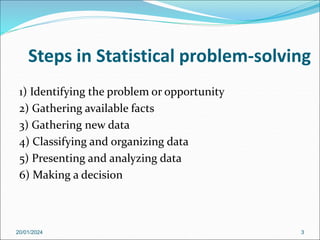
Steps in Statistical problem-solving
1) Identifying the problem or opportunity
2) Gathering available facts
3) Gathering new data
4) Classifying and organizing data
5) Presenting and analyzing data
6) Making a decision
20/01/2024 3
20/01/2024
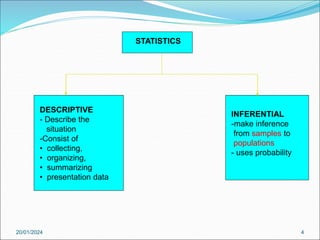
STATISTICS
DESCRIPTIVE
- Describe the
situation
-Consist of
• collecting,
• organizing,
• summarizing
• presentation data
INFERENTIAL
-make inference
from samples to
populations
- uses probability
4
TERM IN STATISTICS
 Population : consists of all subjects (human or otherwise)
that are being studied
 Sample : group of subjects selected from population
 Statistic – summary measure computed from sample data
 Parameter – summary measure for the entire population
 Census – if the study is carried out using the whole
population
 Sample survey – involved a subgroup (or sample) of a
population being chosen
 Pilot study – is a study done before the actual fieldwork is
carried out.
20/01/2024 5
Data
 Primary data
 Data collected from primary source or from sample
 Example : interviews the respondents, distribute
questionnaire
 Advantages –
1) more accurate and consistent
2)Able to explain how the data are collected
 Disadvantages -
1) Requires more time, manpower, high cost
20/01/2024 6
 Secondary Data
 Data collected from other parties
 Example : Bank Negara, Statistics Department
 Advantage
1) easily accessible from the internet, journals,
annual report etc.
2) inexpensive, less time to collect
 Disadvantage
1) lack accuracy because method of data collection
are not explained
2) biased – original purpose of data collection is not
known
3) not meet the specific needs and objectives
20/01/2024 7
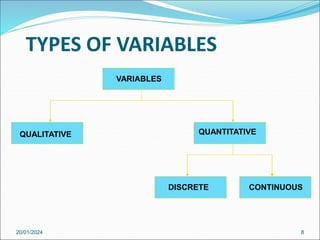
TYPES OF VARIABLES
20/01/2024
VARIABLES
QUALITATIVE QUANTITATIVE
DISCRETE CONTINUOUS
8
 Qualitative : variable that can categorize according to
some characteristic or attribute.
Example : gender (male or female), religious preference
(Muslim, Buddha, Christian)
 Quantitative : numerical and can be order or rank.
Example : Age, height, body temperature
20/01/2024 9
 Discrete : assume value that can be counted. 0, 1, 2, 3, …
Example : number of children in a family, number of
student in a classroom.
 Continuous : assume an infinite number of values
between any two specific values. Usually obtained by
measuring. Include fractions and decimals
Example : weight, height, time, mass, etc.
20/01/2024 10
Scale of measurement
 Nominal scale – categorical data
o The number in the data cannot be added or subtracted
from another number.
o Example: gender (male, female), religion (muslim,
christian, hinduism)
 Ordinal scale – can be arranged in ranking order and
inequality signs can be used when comparing the value of
the variable.
o Example: size of building (small, medium, large),
education level (Phd, Master, Degree, Diploma)
20/01/2024 11
Cont..
 Interval scale – the differences between data value are
meaningful but cannot be manipulated with multiplication
and division.
o Example: IQ score, temperature
 Ratio scale – is the interval measurement with an inherent
zero setting.
o Example: height, weight, time taken to complete a given
task, monthly income.
20/01/2024 12
SAMPLING AND DATA COLLECTION METHODS
20/01/2024 13
Non-Probability Sampling Techniques
 Convenience sampling
pre-testing of questionnaires
 Judgemental Sampling
selected based on the judgement
 Snowball Sampling
select respondent at random. After interviewed, asked
respondent to identify others who are in the target
population of interest
 Quota Sampling
observes the specific characteristics of potential
respondent.
20/01/2024 14
 Simple random sampling
each item have the same chance of being selected as a
sample
 Systematic sampling
Samples are selected by using every kth number after the
first subject is randomly selected from 1 through k
20/01/2024 15
Probability Sampling Techniques
 Stratified sampling
divide the population into groups (strata) and samples selected
randomly within groups
 Example:
A factory manager wants to find out what his workers think about the
factory canteen facilities. He decides to give a questionnaire to a sample
of 80 workers. It is though that different age groups will have different
opinions.
There are 75 workers between 18 and 32, 140 workers between 33 and 47
and 85 workers between 48 and 62.
20/01/2024 16
Probability Sampling Techniques
 Cluster
divide population into subpopulations or clusters.
 Multi-stage sampling
This method is designed to reduce time and cost when
working with samples from very large populations.
20/01/2024 17
Probability Sampling Techniques
Data Collection Methods
 Face-to-face interview
 Telephone interview
 Direct questionnaire
 Mail (or postal) questionnaire
 Direct observation
20/01/2024 18
Designing a questionnaire
In designing a questionnaire, the following points
should be taken into consideration.
 The questionnaire should be short and simple
 Begin with simple and less controversial questions first
 Should not be biased towards certain groups
 Avoid sensitive questions
 A questionnaire checklist can be constructed to ensure
all required data are included.
20/01/2024 19
iam/ppssp/fskm/2013
DATA PRESENTATION
20/01/2024 20
Organizing and graphing qualitative data
Example 1
Twenty-five army inductees were given a blood test to
determine their blood type. The data set is
A B B AB O
O O B AB B
B B O A O
A O O O AB
AB A O B A
Construct a frequency distribution for the data
20/01/2024 21
1)Frequency distribution
Blood type Frequency
A
B
O
AB
20/01/2024 22
2) Pie Chart
 A pie graph is a circle that is divided into sections or
wedges according to the percentage of frequencies in
each category of the distribution.
 Procedure for constructing a pie chart : Refer to
Example 1
Step 1: Number of categories = 4
20/01/2024 23
 Step 2 : Percentage
 Step 3 : Convert to degrees (total 360)
%
16
100
25
4
:
%
36
100
25
9
:
%
28
100
25
7
:
%
20
100
25
5
:








AB
O
B
A
20/01/2024 24
100


n
f
o
o
o
o
o
o
o
o
AB
O
B
A
6
.
57
360
%
16
:
6
.
129
360
%
36
:
8
.
100
360
%
28
:
72
360
%
20
:








20/01/2024 25
3) Bar Chart
 A graph of bars whose heights represent the
frequencies of respective categories
 Categories on the vertical axis
 Frequencies on the horizontal axis.
20/01/2024 26
Vertical bar chart
20/01/2024 27
3a) Cluster/multiple bar chart
No College Four-year degree Advanced Degree
Urban 15 12 8
Suburban 8 15 9
Rural 6 8 7
0
2
4
6
8
10
12
14
16
20/01/2024 28
3b) Stacked/component bar chart
Example 2
 A random sample of car owners was selected and the
following results were obtained.
20/01/2024 29
Car ownership City Town Rural
Owns a foreign car 90 60 25
Do not own a foreign car 110 90 125
Total 200 150 150
Solution
% of car ownership City Town Rural
Owns a foreign car 45 40 16.7
Do not own a foreign car 55 60 83.3
Total 100 100 100
20/01/2024 30
0%
20%
40%
60%
80%
100%
City Town Rural
Percentage of car ownership
Do not own a
foreign car
Owns a foreign
car
4) Contingency table
 Also known as cross tabulation.
 To examine the categorical responses in term of two
qualitative variables simultaneously.
20/01/2024 31
Red Green White Black Total
Men 30 10 26 34 100
Women 8 10 45 37 100
Total 75 18 63 44 200
2-32
1) Stem-and-Leaf Plots
 This plot separates data entries into leading digits and
trailing digits.
 Steps
a) Split each value into two sets of digits.
b) List all the possible stem digits from the lowest to the
highest.
c) For each score in the mass of data, write down the leaf
numbers on the line labelled by the appropriate stem
number.
20/01/2024
Organizing and graphing quantitative data
Example 3
 Display the following data with a stem-and-leaf plot.
3.4 4.5 2.3 2.7 3.8 5.9 3.4 4.7 2.4 4.1 3.6 5.1
20/01/2024 33
Example 4
 Construct a stem and leaf plot by using classes 0-4, 5-9,
10-14, 15-19, and 20-24
20/01/2024 34
3 9 14 22 11 4 12 0
15 20 8 7 5 1 7 13
9 8 14 11 19 17 3 6
2) Histogram
 Histogram – graph that
displays the data by using
contiguous vertical bars
(unless the frequency of a
class is 0) of various
heights to represent the
frequencies of the classes.
0
2
4
6
8
0 10.5 20.5 30.5 40.5 50.5 60.5 70.5 80.5
Class Boundaries
Frequency
20/01/2024 35
Example 5
 The table below shows the weight of 100 honeydews
produced from Farm X. Draw a histogram representing
the weight distribution of the honeydews.
20/01/2024 36
Weight (‘00 g) Frequency
4 – 6 4
6 – 8 9
8 – 10 34
10 – 12 25
12 - 14 28
3) Frequency polygon
 If a histogram is available, the frequency polygon is
obtained by connecting the mid-point of the tops of
the rectangles in the histogram.
20/01/2024 37
4) Cumulative frequency distribution
and ogives
 Cumulative frequency distribution
There are 2 types of cumulative frequency distributions. They
are ‘less than’ and ‘more than’ cumulative distribution. The
‘less than’ cumulative frequency is more frequently used.
 Ogives (Cumulative frequency curve)
Ogive is a graph or line chart of a cumulative frequency
distribution. There are 2 types of ogives. They are ‘less than’
ogive and ‘more than’ ogive.
20/01/2024 38
 Example 6
 The table below shows the number of service years of 120
employees at a firm called SITI. Draw a ‘less than’ ogive.
20/01/2024 39
Service years No of employees
1 – 4 16
5 – 8 20
9 – 12 28
13 – 16 24
17 – 20 16
21 – 24 11
25 – 28 5
 Solution
20/01/2024 40
Service years Cumulative frequency
Less than 0.5 0
Less than 4.5 16
Less than 8.5 36
Less than 12.5 64
Less than 16.5 88
Less than 20.5 104
Less than 24.5 115
Less than 28.5 120
20/01/2024 41

NOTES1.ppt

  • 1.
  • 2.
    NATURE OF STATISTICS STATISTICS – scientific procedures and methods for collecting, organising, summarising, presenting and analysing data, as well as obtaining useful information, drawing valid conclusions and making effective decisions based on the analysis.  Example :  Public health : an administrator might be concerned with the number of resident contract a new flu virus during a certain year  Education : a researcher might want to know if methods of teaching are better than olds one 20/01/2024 2
  • 3.
    Steps in Statisticalproblem-solving 1) Identifying the problem or opportunity 2) Gathering available facts 3) Gathering new data 4) Classifying and organizing data 5) Presenting and analyzing data 6) Making a decision 20/01/2024 3
  • 4.
    20/01/2024 STATISTICS DESCRIPTIVE - Describe the situation -Consistof • collecting, • organizing, • summarizing • presentation data INFERENTIAL -make inference from samples to populations - uses probability 4
  • 5.
    TERM IN STATISTICS Population : consists of all subjects (human or otherwise) that are being studied  Sample : group of subjects selected from population  Statistic – summary measure computed from sample data  Parameter – summary measure for the entire population  Census – if the study is carried out using the whole population  Sample survey – involved a subgroup (or sample) of a population being chosen  Pilot study – is a study done before the actual fieldwork is carried out. 20/01/2024 5
  • 6.
    Data  Primary data Data collected from primary source or from sample  Example : interviews the respondents, distribute questionnaire  Advantages – 1) more accurate and consistent 2)Able to explain how the data are collected  Disadvantages - 1) Requires more time, manpower, high cost 20/01/2024 6
  • 7.
     Secondary Data Data collected from other parties  Example : Bank Negara, Statistics Department  Advantage 1) easily accessible from the internet, journals, annual report etc. 2) inexpensive, less time to collect  Disadvantage 1) lack accuracy because method of data collection are not explained 2) biased – original purpose of data collection is not known 3) not meet the specific needs and objectives 20/01/2024 7
  • 8.
    TYPES OF VARIABLES 20/01/2024 VARIABLES QUALITATIVEQUANTITATIVE DISCRETE CONTINUOUS 8
  • 9.
     Qualitative :variable that can categorize according to some characteristic or attribute. Example : gender (male or female), religious preference (Muslim, Buddha, Christian)  Quantitative : numerical and can be order or rank. Example : Age, height, body temperature 20/01/2024 9
  • 10.
     Discrete :assume value that can be counted. 0, 1, 2, 3, … Example : number of children in a family, number of student in a classroom.  Continuous : assume an infinite number of values between any two specific values. Usually obtained by measuring. Include fractions and decimals Example : weight, height, time, mass, etc. 20/01/2024 10
  • 11.
    Scale of measurement Nominal scale – categorical data o The number in the data cannot be added or subtracted from another number. o Example: gender (male, female), religion (muslim, christian, hinduism)  Ordinal scale – can be arranged in ranking order and inequality signs can be used when comparing the value of the variable. o Example: size of building (small, medium, large), education level (Phd, Master, Degree, Diploma) 20/01/2024 11
  • 12.
    Cont..  Interval scale– the differences between data value are meaningful but cannot be manipulated with multiplication and division. o Example: IQ score, temperature  Ratio scale – is the interval measurement with an inherent zero setting. o Example: height, weight, time taken to complete a given task, monthly income. 20/01/2024 12
  • 13.
    SAMPLING AND DATACOLLECTION METHODS 20/01/2024 13
  • 14.
    Non-Probability Sampling Techniques Convenience sampling pre-testing of questionnaires  Judgemental Sampling selected based on the judgement  Snowball Sampling select respondent at random. After interviewed, asked respondent to identify others who are in the target population of interest  Quota Sampling observes the specific characteristics of potential respondent. 20/01/2024 14
  • 15.
     Simple randomsampling each item have the same chance of being selected as a sample  Systematic sampling Samples are selected by using every kth number after the first subject is randomly selected from 1 through k 20/01/2024 15 Probability Sampling Techniques
  • 16.
     Stratified sampling dividethe population into groups (strata) and samples selected randomly within groups  Example: A factory manager wants to find out what his workers think about the factory canteen facilities. He decides to give a questionnaire to a sample of 80 workers. It is though that different age groups will have different opinions. There are 75 workers between 18 and 32, 140 workers between 33 and 47 and 85 workers between 48 and 62. 20/01/2024 16 Probability Sampling Techniques
  • 17.
     Cluster divide populationinto subpopulations or clusters.  Multi-stage sampling This method is designed to reduce time and cost when working with samples from very large populations. 20/01/2024 17 Probability Sampling Techniques
  • 18.
    Data Collection Methods Face-to-face interview  Telephone interview  Direct questionnaire  Mail (or postal) questionnaire  Direct observation 20/01/2024 18
  • 19.
    Designing a questionnaire Indesigning a questionnaire, the following points should be taken into consideration.  The questionnaire should be short and simple  Begin with simple and less controversial questions first  Should not be biased towards certain groups  Avoid sensitive questions  A questionnaire checklist can be constructed to ensure all required data are included. 20/01/2024 19 iam/ppssp/fskm/2013
  • 20.
  • 21.
    Organizing and graphingqualitative data Example 1 Twenty-five army inductees were given a blood test to determine their blood type. The data set is A B B AB O O O B AB B B B O A O A O O O AB AB A O B A Construct a frequency distribution for the data 20/01/2024 21 1)Frequency distribution
  • 22.
  • 23.
    2) Pie Chart A pie graph is a circle that is divided into sections or wedges according to the percentage of frequencies in each category of the distribution.  Procedure for constructing a pie chart : Refer to Example 1 Step 1: Number of categories = 4 20/01/2024 23
  • 24.
     Step 2: Percentage  Step 3 : Convert to degrees (total 360) % 16 100 25 4 : % 36 100 25 9 : % 28 100 25 7 : % 20 100 25 5 :         AB O B A 20/01/2024 24 100   n f o o o o o o o o AB O B A 6 . 57 360 % 16 : 6 . 129 360 % 36 : 8 . 100 360 % 28 : 72 360 % 20 :        
  • 25.
  • 26.
    3) Bar Chart A graph of bars whose heights represent the frequencies of respective categories  Categories on the vertical axis  Frequencies on the horizontal axis. 20/01/2024 26
  • 27.
  • 28.
    3a) Cluster/multiple barchart No College Four-year degree Advanced Degree Urban 15 12 8 Suburban 8 15 9 Rural 6 8 7 0 2 4 6 8 10 12 14 16 20/01/2024 28
  • 29.
    3b) Stacked/component barchart Example 2  A random sample of car owners was selected and the following results were obtained. 20/01/2024 29 Car ownership City Town Rural Owns a foreign car 90 60 25 Do not own a foreign car 110 90 125 Total 200 150 150
  • 30.
    Solution % of carownership City Town Rural Owns a foreign car 45 40 16.7 Do not own a foreign car 55 60 83.3 Total 100 100 100 20/01/2024 30 0% 20% 40% 60% 80% 100% City Town Rural Percentage of car ownership Do not own a foreign car Owns a foreign car
  • 31.
    4) Contingency table Also known as cross tabulation.  To examine the categorical responses in term of two qualitative variables simultaneously. 20/01/2024 31 Red Green White Black Total Men 30 10 26 34 100 Women 8 10 45 37 100 Total 75 18 63 44 200
  • 32.
    2-32 1) Stem-and-Leaf Plots This plot separates data entries into leading digits and trailing digits.  Steps a) Split each value into two sets of digits. b) List all the possible stem digits from the lowest to the highest. c) For each score in the mass of data, write down the leaf numbers on the line labelled by the appropriate stem number. 20/01/2024 Organizing and graphing quantitative data
  • 33.
    Example 3  Displaythe following data with a stem-and-leaf plot. 3.4 4.5 2.3 2.7 3.8 5.9 3.4 4.7 2.4 4.1 3.6 5.1 20/01/2024 33
  • 34.
    Example 4  Constructa stem and leaf plot by using classes 0-4, 5-9, 10-14, 15-19, and 20-24 20/01/2024 34 3 9 14 22 11 4 12 0 15 20 8 7 5 1 7 13 9 8 14 11 19 17 3 6
  • 35.
    2) Histogram  Histogram– graph that displays the data by using contiguous vertical bars (unless the frequency of a class is 0) of various heights to represent the frequencies of the classes. 0 2 4 6 8 0 10.5 20.5 30.5 40.5 50.5 60.5 70.5 80.5 Class Boundaries Frequency 20/01/2024 35
  • 36.
    Example 5  Thetable below shows the weight of 100 honeydews produced from Farm X. Draw a histogram representing the weight distribution of the honeydews. 20/01/2024 36 Weight (‘00 g) Frequency 4 – 6 4 6 – 8 9 8 – 10 34 10 – 12 25 12 - 14 28
  • 37.
    3) Frequency polygon If a histogram is available, the frequency polygon is obtained by connecting the mid-point of the tops of the rectangles in the histogram. 20/01/2024 37
  • 38.
    4) Cumulative frequencydistribution and ogives  Cumulative frequency distribution There are 2 types of cumulative frequency distributions. They are ‘less than’ and ‘more than’ cumulative distribution. The ‘less than’ cumulative frequency is more frequently used.  Ogives (Cumulative frequency curve) Ogive is a graph or line chart of a cumulative frequency distribution. There are 2 types of ogives. They are ‘less than’ ogive and ‘more than’ ogive. 20/01/2024 38
  • 39.
     Example 6 The table below shows the number of service years of 120 employees at a firm called SITI. Draw a ‘less than’ ogive. 20/01/2024 39 Service years No of employees 1 – 4 16 5 – 8 20 9 – 12 28 13 – 16 24 17 – 20 16 21 – 24 11 25 – 28 5
  • 40.
     Solution 20/01/2024 40 Serviceyears Cumulative frequency Less than 0.5 0 Less than 4.5 16 Less than 8.5 36 Less than 12.5 64 Less than 16.5 88 Less than 20.5 104 Less than 24.5 115 Less than 28.5 120
  • 41.