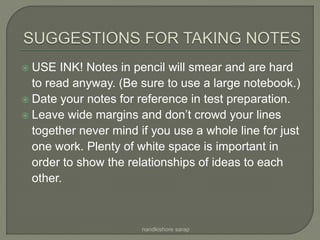
 USE INK! Notes in pencil will smear and are hard
to read anyway. (Be sure to use a large notebook.)
 Date your notes for reference in test preparation.
 Leave wide margins and don’t crowd your lines
together never mind if you use a whole line for just
one work. Plenty of white space is important in
order to show the relationships of ideas to each
other.
nandkishore sarap
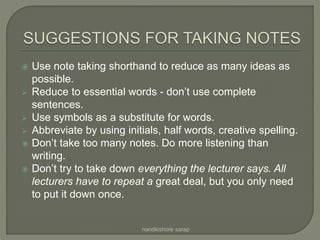
 Use note taking shorthand to reduce as many ideas as
possible.
 Reduce to essential words - don’t use complete
sentences.
 Use symbols as a substitute for words.
 Abbreviate by using initials, half words, creative spelling.
 Don’t take too many notes. Do more listening than
writing.
 Don’t try to take down everything the lecturer says. All
lecturers have to repeat a great deal, but you only need
to put it down once.
nandkishore sarap
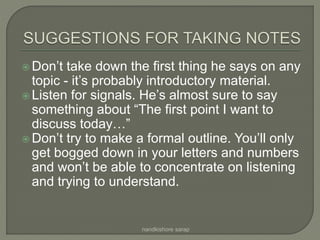
 Don’t take down the first thing he says on any
topic - it’s probably introductory material.
 Listen for signals. He’s almost sure to say
something about “The first point I want to
discuss today…”
 Don’t try to make a formal outline. You’ll only
get bogged down in your letters and numbers
and won’t be able to concentrate on listening
and trying to understand.
nandkishore sarap
 Underline the first main topic. Then write down,
in list form but without numbers, the most
important things he talks about.
(Don’t try to make sub- topics and sub-sub-
topics.)
 Keep on doing this until you find that he is
talking about something else. Then you will
know it’s time for another main topic.
nandkishore sarap
 Don’t bother to number sub-topics unless the
lecturer says: “There are three reasons…,” or
mentions a specific number of facts. Then number
them so you will be sure to learn that many facts
when you study for your examination. (In other
words, don’t number just for the sake of
numbering, but make the numbers mean
something.)
 Read your notes over as soon after class as
possible to fix handwriting, spelling and clarity.
nandkishore sarap
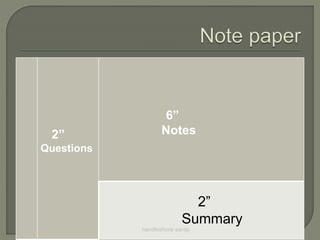
2”
Questions
6”
Notes
2”
Summary
nandkishore sarap

Note making and note taking pract (2)

  • 2.
     USE INK!Notes in pencil will smear and are hard to read anyway. (Be sure to use a large notebook.)  Date your notes for reference in test preparation.  Leave wide margins and don’t crowd your lines together never mind if you use a whole line for just one work. Plenty of white space is important in order to show the relationships of ideas to each other. nandkishore sarap
  • 3.
     Use notetaking shorthand to reduce as many ideas as possible.  Reduce to essential words - don’t use complete sentences.  Use symbols as a substitute for words.  Abbreviate by using initials, half words, creative spelling.  Don’t take too many notes. Do more listening than writing.  Don’t try to take down everything the lecturer says. All lecturers have to repeat a great deal, but you only need to put it down once. nandkishore sarap
  • 4.
     Don’t takedown the first thing he says on any topic - it’s probably introductory material.  Listen for signals. He’s almost sure to say something about “The first point I want to discuss today…”  Don’t try to make a formal outline. You’ll only get bogged down in your letters and numbers and won’t be able to concentrate on listening and trying to understand. nandkishore sarap
  • 5.
     Underline thefirst main topic. Then write down, in list form but without numbers, the most important things he talks about. (Don’t try to make sub- topics and sub-sub- topics.)  Keep on doing this until you find that he is talking about something else. Then you will know it’s time for another main topic. nandkishore sarap
  • 6.
     Don’t botherto number sub-topics unless the lecturer says: “There are three reasons…,” or mentions a specific number of facts. Then number them so you will be sure to learn that many facts when you study for your examination. (In other words, don’t number just for the sake of numbering, but make the numbers mean something.)  Read your notes over as soon after class as possible to fix handwriting, spelling and clarity. nandkishore sarap
  • 7.