UNIT III
Assignment and Transportaion Problem
by:
Dr. Pravin Kumar Agrawal
Assistant Professor
CSJMU
Unit II (10 L)
• Linear Programming Problem & Transportation
Problem Linear programming: Mathematical
formulations of LP Models for product-mix problems;
graphical and simplex method of solving LP problems;
duality.
• Transportation problem: Various methods of finding
Initial basic feasible solution-North West Corner
Method, Least Cost Method & VAM Method and
optimal solution-Stepping Stone & MODI Method,
Maximization Transportation Problem
Transportation Problem
• The transportation problem is a special type of linear
programming problem where the objective is to minimise the
cost of distributing a product from a number
of sources or origins to a number of destinations.
• Because of its special structure the usual simplex method is
not suitable for solving transportation problems. These
problems require a special method of solution.
• The origin of a transportation problem is the location from
which shipments are despatched. The destination of a
transportation problem is the location to which shipments are
transported.
• The unit transportation cost is the cost of transporting one
unit of the consignment from an origin to a destination.
Transportation problem
• Cells in the transportation table that have
positive allocations are called as occupied cells
otherwise they are known as non-occupied
cells.
The Decision Variables
• The variables in the Linear Programming (LP) model
of the TP will hold the values for the number of units
shipped from one source to a destination.
• The decision variables are: Xij = the size of shipment
from warehouse i to outlet j ,
• Where I = 1,2,3...m and j = 1,2,3,...n .
• This is a set of m X n variables
UNBALANCED TRANSPORTATION PROBLEM
Feasible Solution (F.S.)
• A set of non-negative allocations xij > 0
which satisfies the row and column
restrictions is known as feasible solution
Basic Feasible Solution (B.F.S.)
• A feasible solution to a m-origin and n-
destination problem is said to be basic feasible
solution if the number of positive Allocations
are (m+n–1).
• If the number of allocations in a basic feasible
solutions are less than (m+n–1), it is called
degenerate basic feasible solution (DBFS)
(Otherwise non-degenerate).
Optimal Solution
• A feasible solution (not necessarily basic) is
said to be optimal if it minimizes the total
transportation cost.
Allocation
• The number of units of items transported from a
source to a destination which is recorded in a cell in
the transportation tableau.
Types of Transportation Problems
Balanced Transportation Problems
• Cases where the total supply is equal to the
total demand.
Unbalanced Transportation Problems
Cases where the total supply is not equal to the
total demand. When the supply is higher than the
demand, a dummy destination is introduced in
the equation to make it equal to the supply (with
shipping costs of rs. 0); the excess supply is
assumed to go to inventory. On the other hand,
when the demand is higher than the supply,
a dummy source is introduced in the equation to
make it equal to the demand (in these cases
there is usually a penalty cost associated for not
fulfilling the demand).
Unbalanced Transportation Problems
• When the number of positive allocations
(values of decision variable) at any stage of
the feasible solution is less than the required
number (rows+columns-1) i.e number of
independent constraints equations, the
solution is said to be degenerate, otherwise
non-degenerate.
General Mathematical Model of
Transportation Problem
• Let there be m sources of supply s1, s2,
.…..............sm having ai ( i = 1,2,......m) units of supplies
respectively to be transported among n destinations
d1, d2………dn with bj ( j = 1,2…..n) units of requirements
respectively.
• Let cij be the cost for shipping one unit of the
commodity from source i, to destination j for each
route. If xij represents the units shipped per route from
source i, to destination j, then the problem is to
determine the transportation schedule which
minimizes the total transportation cost of satisfying
supply and demand conditions.
Existence of a feasible solution
• A necessary and sufficient condition for the
existence of a feasible solution to a
transpiration problem is
That is the total supply must be equal to the total demand.
General Transportation Table
Existence of a feasible solution
• In this problem there are m + n constraints,
one for each source of supply and distinction
and m X n variables. Any feasible solution for a
transportation problem must have exactly
(m+n-1) non negative basic variables
(allocations) xij Satisfying the rim conditions.
Methods to Solve
• To find the initial basic feasible solution there
are three methods:
– North West Corner Cell Method.
– Least Call Cell Method.
– Vogel’s Approximation Method (VAM).
Methods to Solve
• In the above table D1, D2, D3 and D4 are the
destinations where the products/goods are to
be delivered from different
sources S1, S2, S3 and S4. Si is the supply from
the source Oi. dj is the demand of the
destination Dj. Cij is the cost when the product
is delivered from source Si to destination Dj.
Steps for North-West Corner Method
• Allocate the maximum amount allowable by the supply and
demand constraints to the variable X11 (i.e. the cell in the top
left corner of the transportation tableau).
• If a column (or row) is satisfied, cross it out. The remaining
decision variables in that column (or row) are non-basic and
are set equal to zero. If a row and column are satisfied
simultaneously, cross only one out (it does not matter
which).
• Adjust supply and demand for the non-crossed out rows and
columns.
• Allocate the maximum feasible amount to the first available
non-crossed out element in the next column (or row).
• When exactly one row or column is left, all the remaining
variables are basic and are assigned the only feasible
Steps for North-West Corner Method
• Start with the cell at the upper left (north -
west) corner of the transportation matrix and
allocate commodity equal to the minimum of
the rim values for the first row and first
coloumn i.e min (a1, b1)
Steps for North-West Corner Method…
• If allocation made in step 1 is equal to the supply available at
first source (a1, in first row) then move vertically down to the
cell (2,1) in the second row and first column. Apply step I
again, for next allocation.
• If allocation made in step I is equal to the demand of the first
destination (b1 in first column), then move horizontally to the
cell (1,2) in the first row and second coloumn. Applly step I
again for next allocation.
• If a1= b1 allocate X11 = a1 or b1 and move diagonally to the cell
(2,2)
Steps for North-West Corner Method…
• Continue the process step by step till an
allocation is made in the south east corner cell
of the transportation table.
Numerical 1
• A company has three production facilities S1, S2 and S3 and
the production capacity of 7, 9 and 18 units (in 100s) per
week of a product, respectively. These units are to be shipped
to four warehouses D1, D2, D3 and D4 with requirement of
5,6,7 and 14 units (in 100s) per week respectively. The
transportation cost per unit in rupees between factories to
warehouses are given in the table below:
Numerical
D1 D2 D3 D4 Capacity/
Supply
S1 =
warehou
e
19 30 50 10
7
S2 70 30 40 60
9
S3 40 8 70 20
18
Demand 5 8 7 14 34
Formulate this problem as an LP Model to minimize the total transportation cost.
Numerical
D1 D2 D3 D4 Capacity/
Supply
S1 =
warehou
e
19 30 50 10
2
S2 70 30 40 60
9
S3 40 8 70 20
18
Demand 5 8 7 14 34
Formulate this problem as an LP Model to minimize the total transportation cost.
5
Numerical
D1 D2 D3 D4 Capacity/
Supply
S1 =
warehou
e
19 30 50 10
2
S2 70 30 40 60
9
S3 40 8 70 20
18
Demand 5 6 7 14 34
Formulate this problem as an LP Model to minimize the total transportation cost.
5 2
Numerical
D1 D2 D3 D4 Capacity/
Supply
S1 =
warehou
e
19 30 50 10
2
S2 70 30 40 60
3
S3 40 8 70 20
18
Demand 5 6 4 14 34
Formulate this problem as an LP Model to minimize the total transportation cost.
5 2
6 3
Numerical
D1 D2 D3 D4 Capacity/
Supply
S1 =
warehou
e
19 30 50 10
2
S2 70 30 40 60
3
S3 40 8 70 20
18
Demand 5 6 4 14 34
Total Transportation Cost = 19X5 + 30 X2 + 30X6 + 40X3 + 70X4 +14X20 =
5 2
6 3
4 14
Numerical
D1 D2 D3 D4 Capacity
S1 19 30 50 10 2
S2 70 30 40 60 9
S3 40 8 70 20 18
Demand 3 8 7 14 34
Formulate this problem as an LP Model to minimize the total transportation cost.
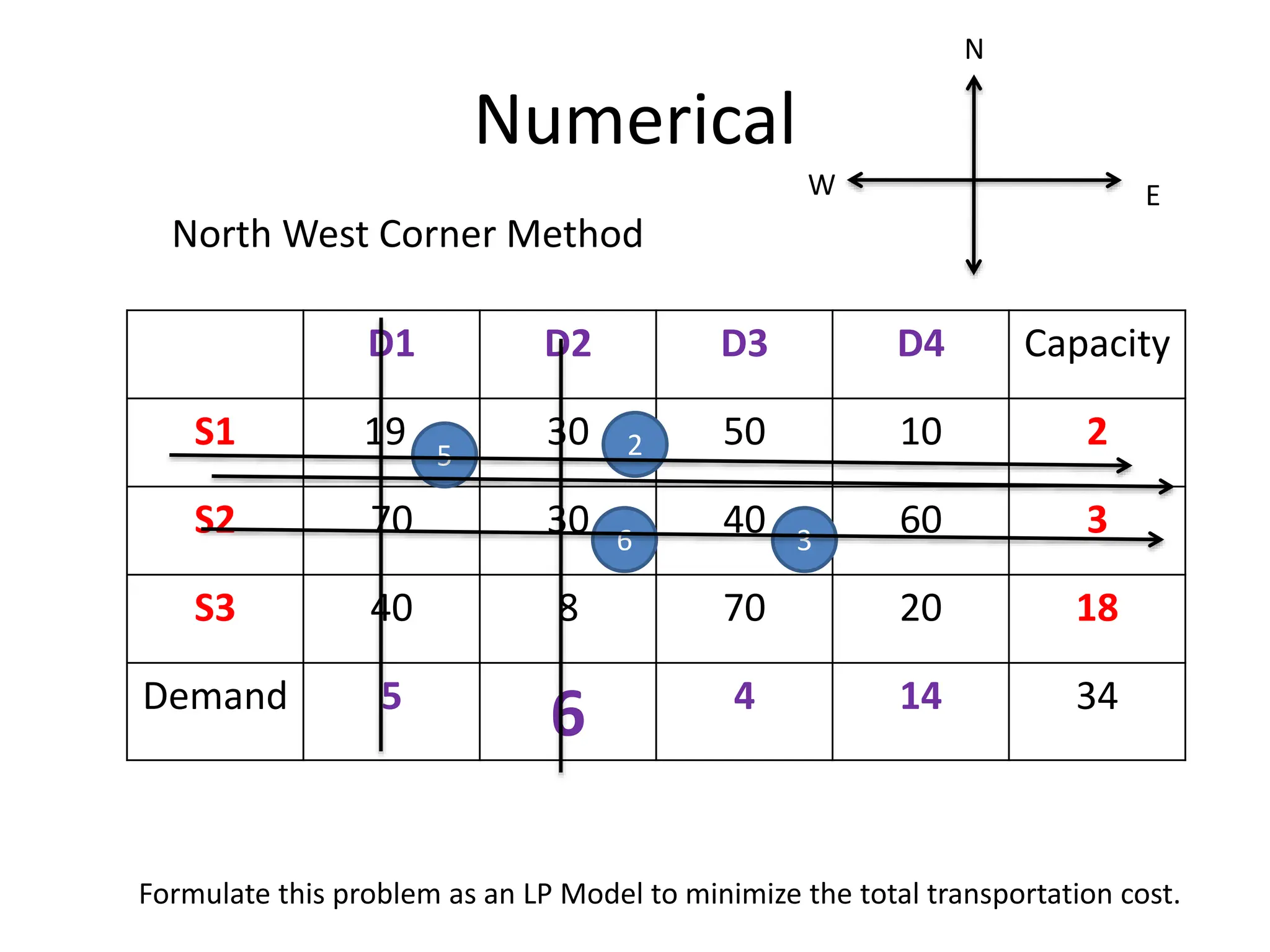
North West Corner Method
E
W
N
2
Numerical
D1 D2 D3 D4 Capacity
S1 19 30 50 10 2
S2 70 30 40 60 9
S3 40 8 70 20 18
Demand 5
6 7 14 34
Formulate this problem as an LP Model to minimize the total transportation cost.
5
North West Corner Method
E
W
N
2
Numerical
D1 D2 D3 D4 Capacity
S1 19 30 50 10 2
S2 70 30 40 60 3
S3 40 8 70 20 18
Demand 5
6 7 14 34
Formulate this problem as an LP Model to minimize the total transportation cost.
5
North West Corner Method
E
W
N
2
6
Numerical
D1 D2 D3 D4 Capacity
S1 19 30 50 10 2
S2 70 30 40 60 3
S3 40 8 70 20 18
Demand 5
6 4 14 34
Formulate this problem as an LP Model to minimize the total transportation cost.
5
North West Corner Method
E
W
N
2
6 3
Numerical
D1 D2 D3 D4 Capacity
S1 19 30 50 10 2
S2 70 30 40 60 3
S3 40 8 70 20 18
Demand 5
6 4 14 34
Formulate this problem as an LP Model to minimize the total transportation cost.
5
North West Corner Method
E
W
N
2
6 3
4 14
==19X5 + 30X2 +30X6 + 40X3 + 70X4 + 14X20 = 95+60+180+120+280+280 = Rs. 1015
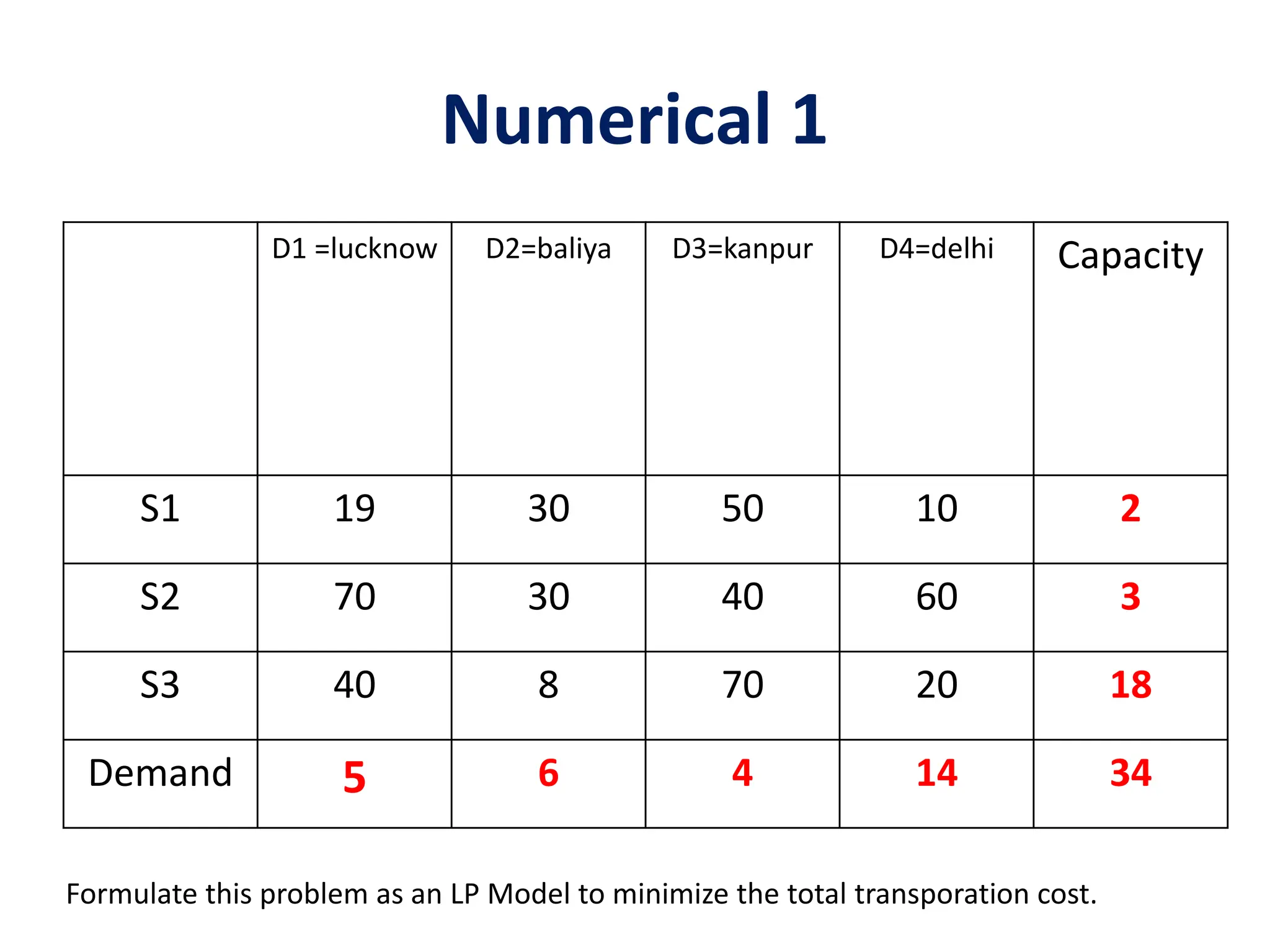
Numerical 1
D1 =lucknow D2=baliya D3=kanpur D4=delhi Capacity
S1 19 30 50 10 2
S2 70 30 40 60 3
S3 40 8 70 20 18
Demand 5 6 4 14 34
Formulate this problem as an LP Model to minimize the total transporation cost.
Solution
D1 D2 D3 D4 Capacity
S1 19 30 50 10 7
S2 70 30 40 60 9
S3 40 8 70 20 18
Demand 5 8 7 14 34
Formulate this problem as an LP Model to minimize the total transporation cost.
5
Solution
D1 D2 D3 D4 Capacity
S1 19 30 50 10 7
S2 70 30 40 60 9
S3 40 8 70 20 18
Demand 5 8 7 14 34
Formulate this problem as an LP Model to minimize the total transporation cost.
5
Solution
• The cell (S1, D1) is the north west corner cell in the
given transpiration table. The rim values for row S1
and column D1 are compared. The smaller of the
two, i.e. 5 is assigned as the first allocation.
• This means that 5 units of a commodity are to be
transported from source S1 to destination D1.
However this allocation leaves a supply of 7-5 = 2
units of commodity at S1.
Solution
D1 D2 D3 D4 Capacity
S1 19 30 50 10 7
S2 70 30 40 60 9
S3 40 8 70 20 18
Demand 5 8 7 14 34
Formulate this problem as an LP Model to minimize the total transporation cost.
5 2
6
Solution
D1 D2 D3 D4 Capacity
S1 19 30 50 10 7
S2 70 30 40 60 9
S3 40 8 70 20 18
Demand 5 8 7 14 34
Formulate this problem as an LP Model to minimize the total transporation cost.
5 2
6 3
Solution
D1 D2 D3 D4 Capacity
S1 19 30 50 10 7
S2 70 30 40 60 9
S3 40 8 70 20 18
Demand 5 8 7 14 34
5 2
6 3
14
4
Solution
• The cell (S1, D1) is the north west corner cell in the
given transpiration table. The rim values for row S1
and column D1 are compared. The smaller of the
two, i.e. 5 is assigned as the first allocation.
• This means that 5 units of a commodity are to be
transported from source S1 to destination D1.
However this allocation leaves a supply of 7-5 = 2
units of commodity at S1.
Solution
• Move horizontally and allocate as much as possible
to cell (S1, d2). The rim values for S1 is 2 and
coloumn D2 is 8. The smaller of the two i.e 2 is
placed in the cell.
– Proceeding to row S2 since the demand of D1 has been
met nothing further can be allocated to D1. The unfulfilled
demand of D2 is now 8-2 = 6 units. This can be fulfilled by
S2 with capacity of 9 units. So 6 units are allocated to cell
(S2, D2). The demand of D2 is now satisfied and a balance
of 9 – 6 =3 units remains with S2.
Solution
• Move horizontally and vertically in the same
manner. This should be done because
successive demand and supply are met.
• Ensure that solution is feasible , the number
of positive allocation is equal to m+n-1 = 3+4-
1 = 6.
• Total cost =
=5X19+ 2X30 + 6X30 + 3X40 + 4X70 + 14X 20 =
Rs. 1015
Assignment 1
D1
=lucknow
D2=baliya D3=kanpur D4=delhi Supply
S1 2 3 11 7 6
S2 1 0 6 1 1
S3 5 8 15 9 10
Require
ments
7 5 3 2 17
Formulate this problem as an LP Model to minimize the total transportation cost by North
West Corner Method.
Assignment 1
D1
=lucknow
D2=baliya D3=kanpur D4=delhi Supply
S1 2 3 11 7 6
S2 1 0 6 1 1
S3 5 8 15 9 10
Require
ments
7 5 3 2 17
Formulate this problem as an LP Model to minimize the total transportation cost by North
West Corner Method.
6
3 2
1
5
Least Cost Method
• We must try to transport as much as possible
through those routes where the unit transportation
cost is minimum.
• This method takes into account the minimum unit
cost of transportation for obtaining the initial
solution and can be summarized as follows
Steps
• Select the cell with the lowest unit cost in the entire
transportation table and allocate as much as
possible to this cell. Then eliminate that row or
column in which either the supply or demand is
exhausted. If a row and a column are both satisfied
simultaneously, then only one may be crossed out.
– In case the smallest unit cost cell is not unique then
select the cell where the maximum allocation can be
made.
Steps
• After adjusting the supply and demand for all
uncrossed out rows and column repeat the
procedure with the next lowest unit cost among the
remaining rows and columns of the transportation
table and allocate as much as possible to this cell.
Then eliminate (line out) that row and column in
which either supply or demand is exhausted.
Steps
• Repeat the procedure until the entire available
supply at various sources and demand at
various destinations is satisfied.
Solution
D1 D2 D3 D4 Capacity
S1 19 30 50 10 7
S2 70 30 40 60 9
S3 40 8 70 20 18
Demand 5 8 7 14 34
Use Least Cost Method to find initial feasible solution to the transportation problem
Solution
D1 D2 D3 D4 Capacity
S1 19 30 50 10 7
S2 70 30 40 60 9
S3 40 8 70 20 10
Demand 5 8 7 14 34
Use Least Cost Method to find initial feasible solution to the transportation problem
8
Solution
D1 D2 D3 D4 Capacity
S1 19 30 50 10 7
S2 70 30 40 60 9
S3 40 8 70 20 10
Demand 5 8 7 14 34
Use Least Cost Method to find initial feasible solution to the transportation problem
8
Solution
D1 D2 D3 D4 Capacity
S1 19 30 50 10 7
S2 70 30 40 60 9
S3 40 8 70 20 10
Demand 5 8 7 7 34
Use Least Cost Method to find initial feasible solution to the transportation problem
8
7
Solution
D1 D2 D3 D4 Capacity
S1 19 30 50 10 7
S2 70 30 40 60 9
S3 40 8 70 20 3
Demand 5 8 7 7 34
Use Least Cost Method to find initial feasible solution to the transportation problem
8
7
7
Solution
D1 D2 D3 D4 Capacity
S1 19 30 50 10 7
S2 70 30 40 60 2
S3 40 8 70 20 3
Demand 5 8 7 7 34
Use Least Cost Method to find initial feasible solution to the transportation problem
8
7
7
7
3
2
Solution…
• The cell with lowest unit cost is (Rs. 8) i.e (S3,
D2). The maximum units which we can
allocate to this cell is 8. The meets the
complete demand of D2 and leave 10 units
with S3 as shown in Table.
– In the reduced table without column D2, the next
smallest unit transportation cost is 10 in cell (S1,
D4). The maximum which can be allocated to this
cell is 7. This exhausts the capacity of S1 and
leaves 7 units with D4 as unsatisfied demand.
Numerical
D1 D2 D3 D4 Capacity
S1 19 30 50 10 7
S2 70 30 40 60 9
S3 40 8 70 20 18
Demand 5 8 7 14 34
Use Least Cost Method to find initial feasible solution to the transportation problem
Numerical
D1 D2 D3 D4 Capacity
S1 19 30 50 10 7
S2 70 30 40 60 9
S3 40 8 70 20 18
Demand 5 8 7 14 34
Use Least Cost Method to find initial feasible solution to the transportation problem
8
Numerical
D1 D2 D3 D4 Capacity
S1 19 30 50 10 7
S2 70 30 40 60 9
S3 40 8 70 20 10
Demand 5 8 7 7 34
Use Least Cost Method to find initial feasible solution to the transportation problem
8
7
7
Numerical
D1 D2 D3 D4 Capacity
S1 19 30 50 10 7
S2 70 30 40 60 2
S3 40 8 70 20 3
Demand 5 8 7 7 34
Use Least Cost Method to find initial feasible solution to the transportation problem
8
7
7
7
Numerical
D1 D2 D3 D4 Capacity
S1 19 30 50 10 7
S2 70 30 40 60 2
S3 40 8 70 20 3
Demand 5 8 7 7 34
Use Least Cost Method to find initial feasible solution to the transportation problem
8
7
7
7
Numerical
D1 D2 D3 D4 Capacity
S1 19 30 50 10 7
S2 70 30 40 60 2
S3 40 8 70 20 3
Demand 5 8 7 7 34
Use Least Cost Method to find initial feasible solution to the transportation problem
8
7
7
7
2
3
Numerical
D1 D2 D3 D4 Capacity
S1 19 30 50 10 7
S2 70 30 40 60 2
S3 40 8 70 20 3
Demand 5 8 7 7 34
Use Least Cost Method to find initial feasible solution to the transportation problem
8
7
7
7
Solution
D1 D2 D3 D4 Capacity
S1 19 30 50 10 7
S2 70 30 40 60 9
S3 40 8 70 20 18
Demand 5 8 7 14 34
Use Least Cost Method to find initial feasible solution to the transportation problem
7
8 7
7
• The next smallest cost is 20 in cell (S3, D4).
The maximum that can be allocated to this cell
is 7 units. This satisfies the entire demand of
D4 and leaves 3 units with S3.
Solution
D1 D2 D3 D4 Capacity
S1 19 30 50 10 7
S2 70 30 40 60 9
S3 40 8 70 20 18
Demand 5 8 7 14 34
Use Least Cost Method to find initial feasible solution to the transportation problem
7
8
3
2 7
7
• The next smallest unit cost cell is not unique. That is
there ae two cells (S2, D3) and(S3, D1 ) that have the
same unit transporattion cost of Rs. 40. Allocate 7
units in cell (S2, d3) first because it can
accommodate more units as compared to cell (S3,
D1). Then allocate 3 units (only supply left with S3)
to cell (S3, D1). The remaining demand of 2 units of
D1 is fulfilled from S2. Since supply and demand of
each origin and destination is exhausted, the initial
solution is arrived at and shown in above table.
• The total transportation cost is Rs. 814.
Assignment 2
D1 =lucknow D2=baliya D3=kanpur D4=delhi Supply
S1 2 3 11 7 6
S2 1 0 6 1 1
S3 5 8 15 9 10
Requirem
ents
7 5 3 2 17
Formulate this problem as an LP Model to minimize the total transportation cost by North
West Corner Method.
1
Assignment 2
D1 =lucknow D2=baliya D3=kanpur D4=delhi Supply
S1 2 3 11 7 6
S2 1 0 6 1 1
S3 5 8 15 9 10
Requirem
ents
7 5 3 2 17
Formulate this problem as an LP Model to minimize the total transportation cost by North
West Corner Method.
1
6
Assignment 2
D1 =lucknow D2=baliya D3=kanpur D4=delhi Supply
S1 2 3 11 7 6
S2 1 0 6 1 1
S3 5 8 15 9 10
Requirem
ents
7 5 3 2 17
Formulate this problem as an LP Model to minimize the total transportation cost by North
West Corner Method.
1
6
Assignment 2
D1 =lucknow D2=baliya D3=kanpur D4=delhi Supply
S1 2 3 11 7 6
S2 1 0 6 1 1
S3 5 8 15 9 9
Requirem
ents
7 5 3 2 17
Formulate this problem as an LP Model to minimize the total transportation cost by North
West Corner Method.
1
6
1
Assignment 2
D1 =lucknow D2=baliya D3=kanpur D4=delhi Supply
S1 2 3 11 7 6
S2 1 0 6 1 1
S3 5 8 15 9 5
Requirem
ents
7 5 3 2 17
Formulate this problem as an LP Model to minimize the total transportation cost by North
West Corner Method.
1
6
1 4
Assignment 2
D1 =lucknow D2=baliya D3=kanpur D4=delhi Supply
S1 2 3 11 7 6
S2 1 0 6 1 1
S3 5 8 15 9 10
Requirem
ents
7 5 3 2 17
Formulate this problem as an LP Model to minimize the total transportation cost by North
West Corner Method.
1
6
1 4
Assignment 2
D1 =lucknow D2=baliya D3=kanpur D4=delhi Supply
S1 2 3 11 7 6
S2 1 0 6 1 1
S3 5 8 15 9 10
Requirem
ents
7 5 3 2 17
Formulate this problem as an LP Model to minimize the total transportation cost by North
West Corner Method.
1
6
1 4 3 2
Total Transportation Cost = 2X6 + 1X0 + 5X1 +8X4 +15X3 +9X2 = Rs. 112
Vogel’s Approximation Method
• This method is preferred over the NWCM and
Least Cost Method, because the initial basic
feasible solution obtained by this method is
either optimal solution or very nearer to the
optimal solution.
Steps
1: Find the cells having smallest and next to smallest cost in each
row and write the difference (called penalty) along the side of
the table in row penalty.
2: Find the cells having smallest and next to smallest cost in each
column and write the difference (called penalty) along the
side of the table in each column penalty.
3: Select the row or column with the maximum penalty and find
cell that has least cost in selected row or column. Allocate as
much as possible in this cell.
If there is a tie in the values of penalties then select the cell
where maximum allocation can be possible
4: Adjust the supply & demand and cross out (strike out) the
satisfied row or column.
5: Repeat this steps until all supply and demand values are 0.
Numerical 2
D1 D2 D3 D4 Supply Row
Differences
S1 19 30 50 10 7
S2 70 30 40 60 9
S3 40 8 70 20 18
Demand 5 8 7 14 34
Column
Differen
ces
Use VAM Method to find initial feasible solution to the transportation problem
Numerical 2
D1 D2 D3 D4 Supply Row
Differences
S1 19 30 50 10 7 9
S2 70 30 40 60 9 10
S3 40 8 70 20 10 12
Demand 5 8 7 14 34
Coloumn
Differenc
es
21
22
10 10
Use VAM Method to find initial feasible solution to the transportation problem
8
Solution
• The differences penalty cost for each row and
column have been calculated as shown in Table. In
the first round the maximum penalty . 22 occurs in
column D2. Thus the cell (S3, D2) having the least
transportation cost 8 is chosen for allocation. The
maximum possible allocation in this cell is 8 and it
satisfies the demand in column D2. Adjust the supply
of S3 from 18 to 10. (18 - 8 = 10)
Numerical 2
D1 D2 D3 D4 Supply Row
Differences
S1 19 30 50 10 7 9 9
S2 70 30 40 60 9 10 20
S3 40 8 70 20 18 12 20
Demand 5 8 7 14 34
Coloumn
Differences
21 22 10 10
21 - 10 10
Use VAM Method to find initial feasible solution to the transportation problem
8
5
Solution
• The new row and column penalties are
calculated except column D2 because D2
demand has been satisfied.
– The second round allocation is made in column D1
with target penalty 21 in the same way as first
round as shown in cell (S1, D1) of Table.
Numerical 2
D1 D2 D3 D4 Supply Row
Differences
S1 19 30 50 10 7 9 9
S2 70 30 40 60 9 10 20
S3 40 8 70 20 18 12 20
Demand 5 8 7 14 34
Coloumn
Differences
21 22 10 10
21 - 10 10
Use VAM Method to find initial feasible solution to the transportation problem
8
5
7
10
2
2
Solution
• In the third round the maximum penalty 50
occurs at S3. The maximum possible allocation
of 10 units is made in cell (S3, D4) that has the
least transportation cost of Rs. 20.
– The process is continued with new allocations till a
complete solution is obtained. The initial solution
using VAM is shown. The total transportation cost
is obtained as
– Total cost = 5X19 + 2X10+ 7X40 + 2X60 + 8 X8 +
10X20 = Rs. 779.
Assignment 2…
D1
=lucknow
D2=baliya D3=kanpu
r
D4=delhi Supply Row
Penalty
S1 2 3 11 7 6 1
S2 1 0 6 1 1 1
S3 5 8 15 9 10 3
Require
ments
7 5 3 2 17
Column
Penalty
1 3 5 6
Assignment 2…
D1
=lucknow
D2=baliya D3=kanpu
r
D4=delhi Supply Row
Penalty
S1 2 3 11 7 6 1
S2 1 0 6 1 1 1
S3 5 8 15 9 10 3
Require
ments
7 5 3 2 17
Column
Penalty
1 3 5 6
1
Assignment 2…
D1
=lucknow
D2=baliya D3=kanpu
r
D4=delhi Supply Row
Penalty
S1 2 3 11 7 6 1
S2 1 0 6 1 1 1
S3 5 8 15 9 10 3
Require
ments
7 5 3 1 16
Column
Penalty
3 5 4 2
1
Assignment 2…
D1
=lucknow
D2=baliya D3=kanpu
r
D4=delhi Supply Row
Penalty
S1 2 3 11 7 6 1
S2 1 0 6 1 1 1
S3 5 8 15 9 10 3
Require
ments
7 5 3 1 16
Column
Penalty
3 5 4 2
1
Assignment 2…
D1
=lucknow
D2=baliya D3=kanpu
r
D4=delhi Supply Row
Penalty
S1 2 3 11 7 6 1
S2 1 0 6 1 1 1
S3 5 8 15 9 10 3
Require
ments
7 5 3 1 16
Column
Penalty
3 5 4 2
1
5
Assignment 2…
D1
=lucknow
D2=baliya D3=kanpu
r
D4=delhi Supply Row
Penalty
S1 2 3 11 7 1 5
S2 1 0 6 1 1 1
S3 5 8 15 9 10 4
Require
ments
7 5 3 1 11
Column
Penalty
3 5 4 2
1
5
Assignment 2…
D1
=lucknow
D2=baliya D3=kanpu
r
D4=delhi Supply Row
Penalty
S1 2 3 11 7 1 5
S2 1 0 6 1 1 1
S3 5 8 15 9 10 4
Require
ments
6 5 3 1 11
Column
Penalty
3 5 4 2
1
5
1
Assignment 2…
D1
=lucknow
D2=baliya D3=kanpu
r
D4=delhi Supply Row
Penalty
S1 2 3 11 7 1 5
S2 1 0 6 1 1 1
S3 5 8 15 9 10 4
Require
ments
6 5 3 1 11
Column
Penalty
3 5 4 2
1
5
1
Assignment 2…
D1
=lucknow
D2=baliya D3=kanpu
r
D4=delhi Supply Row
Penalty
S1 2 3 11 7 1 5
S2 1 0 6 1 1 1
S3 5 8 15 9 10 4
Require
ments
6 5 3 1 10
Column
Penalty
3 5 4 2
1
5
1
6
6
6
6
3
1
Optimality Test of Transportation
Problem
Optimal Solution
• To obtain an optimal solution by making
successive improvements to initial basic
feasible solution until no further decrease in
the transportation cost is possible. An optimal
solution is one where there is no other set of
transportation routes that will further reduce
the total transportation cost.
Optimal Solution…
• Thus, we have to evaluate each unoccupied cell in the
transportation table in terms of an opportunity of reducing
total transportation cost.
• An unoccupied cell with the largest negative opportunity cost
is selected to include in the new set of transportation routes
(allocations).
• This value indicates the per unit cost reduction that can be
achieved by raising the shipment allocation in the unoccupied
cell from its present level of zero. This is also known as an
incoming cell (or variable).
Optimal Solution…
• The outgoing cell (or variable) in the current
solution is the occupied cell (basic variable) in
the unique closed path (loop) whose
allocation will become zero first as more units
are allocated to the unoccupied cell with
largest negative opportunity cost. That is, the
current solution cannot be improved further.
This is the optimal solution.
Numerical 3
D1 =lucknow D2=baliya D3=kanpur D4=delhi Supply
S1 21 16 25 13 11
S2 17 18 14 23 13
S3 32 27 18 41 19
Requirem
ents
6 10 12 15 43
Solve the above transportation problem with VAM Techniques and
check for optimality.
Answer
D1 =lucknow D2=baliya D3=kanpur D4=delhi Supply
S1 21 16 25 13 11
S2 17 18 14 23 13
S3 32 27 18 41 19
Requirem
ents
6 10 12 15 43
Since total supply = total demand, the given transportation problem is
Balanced. Hence there exist a basic feasible solution to the problem.
By VAM Technique the initial basic feasible solution, with all allocations are
made is given as
Answer
D1 =lucknow D2=baliya D3=kanpur D4=delhi Supply
S1 21 (d11) 16 (d12) 25 (d13) 13 11
S2 17 18 14(d23) 23 13
S3 32 (d31) 27 18 41 (d34) 19
Requirem
ents
6 10 12 15 43
Total transportation Cost is Rs. 796.
11
3
6
7 12
4
V1 v2 v3 v4
U1
U2
u3
Calculate dij = cij – (ui+vj) for non occupied
cell
d11 = c11 – (u1+v1) = 21 – (-10+17) = 14
d12 = c12 – (u1+v2) = 16 – (-10 + 18) = 8
d13 = c13 – (u1+v3) = 25 – (-10 + 9) = 26
d23 = c23 – (u2+v3) = 14 – ( 0 + 9) = 5
d31 = c31 – (u3+v1) = 6
d34 = c34 – (u3+v4) = 9
Since all dij > 0, the solution under the text is optimal and unique.
MODI Method
• The following table shows all the necessary
information on the available supply to each
warehouse, the requirement of each market
and the unit transportation cost from each
warehouse to each market.
Numerical/MODI METHOD…
I II III IV SUPPLY
A 5 2 4 3 22
B 4 8 1 6 15
C 4
6 7 5 8
Demand 7 12 17 9 45
MARKET
WARE
HOUSE
Numerical..
• The shipping clerk has worked out the following schedule
from experience:
12 units from A to II
1 units from A to III
9 units from A to IV
15 units from B to III
7 units from C to I
1 units from C to III
• Check whether the clerk has optimal schedule and find the
optimal schedule and cost
MODI METHOD…
I II III IV SUPPLY
A 5 2 4 3 22
B 4 8 1 6 15
C 4
6 7 5 8
Demand 7 12 17 9 45
MARKET
WARE
HOUSE
12 9
1
15
1
7
U1
U2
U3
V1 V2 V3 V4
• Calculate ui and vj using ui + vj = cij for
occupied cells.
u1 + v2 = 2
u1 + v3 = 4
u1 + v4 = 3
u2 + v3 = 1
u3 + v1 = 4
u3 + v3 = 7
u1 + v2 = 2, v2 = 2
u1 + v3 = 4 v3 = 4
u1 + v4 = 3 v4 = 3
u2 + v3 = 1 u2 = -3
u3 + v1 = 4, v1= 1
u3 + v3 = 7 u3 = 3
Take u1 = 0 as there is 3 no. of allocations hence
Calculate dij = cij – (ui+vj) for non occupied cell
d11 = c11 – (u1+v1) = 5 – (0+1) = 4
d21 = c21 – (u2+v1) = 4 – (-3 + 1) = 6
d22 = c22 – (u2+v2) = 8– (-3 + 2) = 9
d24 = c24 – (u2+v4) = 6 – ( -3 + 3) = 6
d32 = c32 – (u3+v2) = 6 – (3+2) = 1
d34 = c34 – (u3+v4) = 5 – (3+3) = -1
Since one dij < 0, the solution under the text is not optimal and unique
• Trace the path and assign +ϴ , -ϴ alternatively to
each occupied cell at the corners of the path. Here ϴ
= min (9,1) = 1, Following table gives the result of
second iteration
I II III IV SUPPLY
A 5 2 (+ϴ)
4
3 (-ϴ) 22
B 4 8 1 6 15
C 4
6 7
(-ϴ)
5
(+ϴ)
8
Demand 7 12 17 9 45
WARE
HOUSE
1
2 9
1
1
5
1
7
U1
U2
U3
V1 V2 V3 V4
MODI METHOD…
I II III IV SUPPLY
A 5 2 4 3 22
B 4 8 1 6 15
C 4
6 7 5 8
Demand 7 12 17 9 45
MARKET
WARE
HOUSE
12 8
2
15
1
7
U1
U2
U3
V1 V2 V3 V4
• Since all dij >0 hence the current solution is
optimal
• Minimum Total Shipping Cost is Rs. 104.
• (12x2 + 2x4 + 8x3 + 15X1 + 7x4 + 1x5 =
Rs. 104 )
UNIT III
Assignment Model
by:
Dr. Pravin Kumar Agrawal
Ph.D. (Finance)
ASSIGNMENT PROBLEM
• This is a special case of the transportation
problem in which the objective is to assign a
number of origins to the equal number of
destinations at a minimum cost or a maximum
profit.
ASSIGNMENT PROBLEM….
• Let there are n jobs in a factory and the
factory has n machines to process the jobs. Let
cij be the cost of assignment when the job i (i
= 1,2...n) is processed by the machine j (j =
1,2...n). The assignment is to be made in such
a way that each job can associate with one
and only one machined.
• Let xij be the variable defined by
ASSIGNMENT PROBLEM
Hungarian Method
• The Hungarian Method is based on the
principle that if a constant is added to every
element of a row and/or a column of cost
matrix, the optimum solution of the resulting
assignment problem is the same as the
original problem and vice versa.
Hungarian Method
Consider an example where four jobs (J1, J2,
J3, and J4) need to be executed by four
workers (W1, W2, W3, and W4), one job per
worker. The matrix below shows the cost of
assigning a certain worker to a certain job. The
objective is to minimize the total cost of the
assignment.
Hungarian method for Assignment Problem
STEP I
1. If number of rows is not equal to number of
columns, then add dummy rows or columns
with cost 0, to make it a square matrix.
….Hungarian method for Assignment Problem
STEP II
2. a. Identify the minimum element in each row
and subtract it from each element of that row.
b. Identify the minimum element in each
column and subtract it from every element of
that column.
….Hungarian method for Assignment Problem
STEP III
• Make assignment in the opportunity cost table
• Identify rows successively from top to bottom until a row
with exactly one zero element is found. Make an
assignment to single zero by making a square [0] around
it. Then cross of all other zeros in the corresponding
column.
• Identify columns from left to right until a column with
exactly one unmarked zero element is found. Make an
assignment to this single zero by making a square [0]
around it. Then cross of all other zeros in the
corresponding row.
….Hungarian method for Assignment Problem
STEP IV
(a) If the number of assigned cells = the number of
rows, then an optimal assignment is found and In
case If a row and/or column has two or more
unmarked 0 and one cannot be chosen by
inspection, then choose the cell arbitrarily.
Continue this process until all 0 in
rows/columns are either assigned or cross off.
(b) If optimal solution is not optimal, then goto
Step-5.
STEP V
Draw a set of horizontal and vertical lines to cover all the 0
a. Tick(✓) mark all the rows in which no assigned 0.
b. Examine Tick(✓) marked rows, If any 0 cell occurs in that row, then
tick(✓) mark that column.
c. Examine Tick(✓) marked columns, If any assigned 0 exists in that
columns, then tick(✓) mark that row.
d. Repeat this process until no more rows or columns can be marked.
e. Draw a straight line for each unmarked rows and marked columns.
f. If the number of lines is equal to the number of rows then the current
solution is the optimal, otherwise goto step-6
STEP VI
• Develop the new revised opportunity cost table
a. Select the minimum element, say k, from the
cells not covered by any line,
b. Subtract k from each element not covered by a
line.
c. Add k to each intersection element of two
lines.
STEP VII
• Repeat steps 3 to 6 until an optimal solution is
arrived.
Q. Assignment cost of siding anyone operator to
anyone machine is given in the following table:
Find the optimal assignment.
Operators
Machine
I II III IV
A 10 5 13 15
B 3 9 18 3
C 10 7 3 2
D 5 11 9 7
Solution:
Step 1: Subtracting the smallest element of each row from every element of the
corresponding row, we get the reduce matrix as:
5 0 8 10
0 6 15 0
8 5 1 0
0 6 4 2
Step 2: Subtracting the smallest element of each column of the reduced matrix from
every element of the corresponding column, we get the following reduced matrix:
5 0 7 10
0 6 14 0
8 5 0 0
0 6 3 2
Solution:
Step 1: Subtracting the smallest element of each row from every element of the
corresponding row, we get the reduce matrix as:
5 0 8 10
0 6 15 0
8 5 1 0
0 6 4 2
Step 2: Subtracting the smallest element of each column of the reduced matrix from
every element of the corresponding column, we get the following reduced matrix:
5 0 7 10
0 6 14 0
8 5 0 0
0 6 3 2
• Step 3: Starting with Row 1, we box a single zero (i.e.
make assignment), and cross (x) all other zeros in its
column. Thus we get
5 0 7 10
0 6 14 0
8 5 0 0
0 6 3 2
Since each row and each column contains exactly one
assignment, the current assignment is optimal. The optimal
schedule is
A II, B IV, C III, D I
And the optimum assignment cost is
Rs [5+3+3+5]=Rs 16.

Unit-III-Assignment-and-Transportation-Problem.pptx

  • 1.
    UNIT III Assignment andTransportaion Problem by: Dr. Pravin Kumar Agrawal Assistant Professor CSJMU
  • 2.
    Unit II (10L) • Linear Programming Problem & Transportation Problem Linear programming: Mathematical formulations of LP Models for product-mix problems; graphical and simplex method of solving LP problems; duality. • Transportation problem: Various methods of finding Initial basic feasible solution-North West Corner Method, Least Cost Method & VAM Method and optimal solution-Stepping Stone & MODI Method, Maximization Transportation Problem
  • 3.
    Transportation Problem • Thetransportation problem is a special type of linear programming problem where the objective is to minimise the cost of distributing a product from a number of sources or origins to a number of destinations. • Because of its special structure the usual simplex method is not suitable for solving transportation problems. These problems require a special method of solution. • The origin of a transportation problem is the location from which shipments are despatched. The destination of a transportation problem is the location to which shipments are transported. • The unit transportation cost is the cost of transporting one unit of the consignment from an origin to a destination.
  • 4.
    Transportation problem • Cellsin the transportation table that have positive allocations are called as occupied cells otherwise they are known as non-occupied cells.
  • 5.
    The Decision Variables •The variables in the Linear Programming (LP) model of the TP will hold the values for the number of units shipped from one source to a destination. • The decision variables are: Xij = the size of shipment from warehouse i to outlet j , • Where I = 1,2,3...m and j = 1,2,3,...n . • This is a set of m X n variables
  • 6.
  • 7.
    Feasible Solution (F.S.) •A set of non-negative allocations xij > 0 which satisfies the row and column restrictions is known as feasible solution
  • 8.
    Basic Feasible Solution(B.F.S.) • A feasible solution to a m-origin and n- destination problem is said to be basic feasible solution if the number of positive Allocations are (m+n–1). • If the number of allocations in a basic feasible solutions are less than (m+n–1), it is called degenerate basic feasible solution (DBFS) (Otherwise non-degenerate).
  • 9.
    Optimal Solution • Afeasible solution (not necessarily basic) is said to be optimal if it minimizes the total transportation cost.
  • 10.
    Allocation • The numberof units of items transported from a source to a destination which is recorded in a cell in the transportation tableau.
  • 11.
  • 12.
    Balanced Transportation Problems •Cases where the total supply is equal to the total demand.
  • 13.
    Unbalanced Transportation Problems Caseswhere the total supply is not equal to the total demand. When the supply is higher than the demand, a dummy destination is introduced in the equation to make it equal to the supply (with shipping costs of rs. 0); the excess supply is assumed to go to inventory. On the other hand, when the demand is higher than the supply, a dummy source is introduced in the equation to make it equal to the demand (in these cases there is usually a penalty cost associated for not fulfilling the demand).
  • 14.
    Unbalanced Transportation Problems •When the number of positive allocations (values of decision variable) at any stage of the feasible solution is less than the required number (rows+columns-1) i.e number of independent constraints equations, the solution is said to be degenerate, otherwise non-degenerate.
  • 15.
    General Mathematical Modelof Transportation Problem
  • 16.
    • Let therebe m sources of supply s1, s2, .…..............sm having ai ( i = 1,2,......m) units of supplies respectively to be transported among n destinations d1, d2………dn with bj ( j = 1,2…..n) units of requirements respectively. • Let cij be the cost for shipping one unit of the commodity from source i, to destination j for each route. If xij represents the units shipped per route from source i, to destination j, then the problem is to determine the transportation schedule which minimizes the total transportation cost of satisfying supply and demand conditions.
  • 18.
    Existence of afeasible solution • A necessary and sufficient condition for the existence of a feasible solution to a transpiration problem is That is the total supply must be equal to the total demand.
  • 19.
  • 20.
    Existence of afeasible solution • In this problem there are m + n constraints, one for each source of supply and distinction and m X n variables. Any feasible solution for a transportation problem must have exactly (m+n-1) non negative basic variables (allocations) xij Satisfying the rim conditions.
  • 21.
    Methods to Solve •To find the initial basic feasible solution there are three methods: – North West Corner Cell Method. – Least Call Cell Method. – Vogel’s Approximation Method (VAM).
  • 23.
    Methods to Solve •In the above table D1, D2, D3 and D4 are the destinations where the products/goods are to be delivered from different sources S1, S2, S3 and S4. Si is the supply from the source Oi. dj is the demand of the destination Dj. Cij is the cost when the product is delivered from source Si to destination Dj.
  • 24.
    Steps for North-WestCorner Method • Allocate the maximum amount allowable by the supply and demand constraints to the variable X11 (i.e. the cell in the top left corner of the transportation tableau). • If a column (or row) is satisfied, cross it out. The remaining decision variables in that column (or row) are non-basic and are set equal to zero. If a row and column are satisfied simultaneously, cross only one out (it does not matter which). • Adjust supply and demand for the non-crossed out rows and columns. • Allocate the maximum feasible amount to the first available non-crossed out element in the next column (or row). • When exactly one row or column is left, all the remaining variables are basic and are assigned the only feasible
  • 25.
    Steps for North-WestCorner Method • Start with the cell at the upper left (north - west) corner of the transportation matrix and allocate commodity equal to the minimum of the rim values for the first row and first coloumn i.e min (a1, b1)
  • 26.
    Steps for North-WestCorner Method… • If allocation made in step 1 is equal to the supply available at first source (a1, in first row) then move vertically down to the cell (2,1) in the second row and first column. Apply step I again, for next allocation. • If allocation made in step I is equal to the demand of the first destination (b1 in first column), then move horizontally to the cell (1,2) in the first row and second coloumn. Applly step I again for next allocation. • If a1= b1 allocate X11 = a1 or b1 and move diagonally to the cell (2,2)
  • 27.
    Steps for North-WestCorner Method… • Continue the process step by step till an allocation is made in the south east corner cell of the transportation table.
  • 28.
    Numerical 1 • Acompany has three production facilities S1, S2 and S3 and the production capacity of 7, 9 and 18 units (in 100s) per week of a product, respectively. These units are to be shipped to four warehouses D1, D2, D3 and D4 with requirement of 5,6,7 and 14 units (in 100s) per week respectively. The transportation cost per unit in rupees between factories to warehouses are given in the table below:
  • 29.
    Numerical D1 D2 D3D4 Capacity/ Supply S1 = warehou e 19 30 50 10 7 S2 70 30 40 60 9 S3 40 8 70 20 18 Demand 5 8 7 14 34 Formulate this problem as an LP Model to minimize the total transportation cost.
  • 30.
    Numerical D1 D2 D3D4 Capacity/ Supply S1 = warehou e 19 30 50 10 2 S2 70 30 40 60 9 S3 40 8 70 20 18 Demand 5 8 7 14 34 Formulate this problem as an LP Model to minimize the total transportation cost. 5
  • 31.
    Numerical D1 D2 D3D4 Capacity/ Supply S1 = warehou e 19 30 50 10 2 S2 70 30 40 60 9 S3 40 8 70 20 18 Demand 5 6 7 14 34 Formulate this problem as an LP Model to minimize the total transportation cost. 5 2
  • 32.
    Numerical D1 D2 D3D4 Capacity/ Supply S1 = warehou e 19 30 50 10 2 S2 70 30 40 60 3 S3 40 8 70 20 18 Demand 5 6 4 14 34 Formulate this problem as an LP Model to minimize the total transportation cost. 5 2 6 3
  • 33.
    Numerical D1 D2 D3D4 Capacity/ Supply S1 = warehou e 19 30 50 10 2 S2 70 30 40 60 3 S3 40 8 70 20 18 Demand 5 6 4 14 34 Total Transportation Cost = 19X5 + 30 X2 + 30X6 + 40X3 + 70X4 +14X20 = 5 2 6 3 4 14
  • 34.
    Numerical D1 D2 D3D4 Capacity S1 19 30 50 10 2 S2 70 30 40 60 9 S3 40 8 70 20 18 Demand 3 8 7 14 34 Formulate this problem as an LP Model to minimize the total transportation cost. North West Corner Method E W N 2
  • 35.
    Numerical D1 D2 D3D4 Capacity S1 19 30 50 10 2 S2 70 30 40 60 9 S3 40 8 70 20 18 Demand 5 6 7 14 34 Formulate this problem as an LP Model to minimize the total transportation cost. 5 North West Corner Method E W N 2
  • 36.
    Numerical D1 D2 D3D4 Capacity S1 19 30 50 10 2 S2 70 30 40 60 3 S3 40 8 70 20 18 Demand 5 6 7 14 34 Formulate this problem as an LP Model to minimize the total transportation cost. 5 North West Corner Method E W N 2 6
  • 37.
    Numerical D1 D2 D3D4 Capacity S1 19 30 50 10 2 S2 70 30 40 60 3 S3 40 8 70 20 18 Demand 5 6 4 14 34 Formulate this problem as an LP Model to minimize the total transportation cost. 5 North West Corner Method E W N 2 6 3
  • 38.
    Numerical D1 D2 D3D4 Capacity S1 19 30 50 10 2 S2 70 30 40 60 3 S3 40 8 70 20 18 Demand 5 6 4 14 34 Formulate this problem as an LP Model to minimize the total transportation cost. 5 North West Corner Method E W N 2 6 3 4 14 ==19X5 + 30X2 +30X6 + 40X3 + 70X4 + 14X20 = 95+60+180+120+280+280 = Rs. 1015
  • 39.
    Numerical 1 D1 =lucknowD2=baliya D3=kanpur D4=delhi Capacity S1 19 30 50 10 2 S2 70 30 40 60 3 S3 40 8 70 20 18 Demand 5 6 4 14 34 Formulate this problem as an LP Model to minimize the total transporation cost.
  • 40.
    Solution D1 D2 D3D4 Capacity S1 19 30 50 10 7 S2 70 30 40 60 9 S3 40 8 70 20 18 Demand 5 8 7 14 34 Formulate this problem as an LP Model to minimize the total transporation cost. 5
  • 41.
    Solution D1 D2 D3D4 Capacity S1 19 30 50 10 7 S2 70 30 40 60 9 S3 40 8 70 20 18 Demand 5 8 7 14 34 Formulate this problem as an LP Model to minimize the total transporation cost. 5
  • 42.
    Solution • The cell(S1, D1) is the north west corner cell in the given transpiration table. The rim values for row S1 and column D1 are compared. The smaller of the two, i.e. 5 is assigned as the first allocation. • This means that 5 units of a commodity are to be transported from source S1 to destination D1. However this allocation leaves a supply of 7-5 = 2 units of commodity at S1.
  • 43.
    Solution D1 D2 D3D4 Capacity S1 19 30 50 10 7 S2 70 30 40 60 9 S3 40 8 70 20 18 Demand 5 8 7 14 34 Formulate this problem as an LP Model to minimize the total transporation cost. 5 2 6
  • 44.
    Solution D1 D2 D3D4 Capacity S1 19 30 50 10 7 S2 70 30 40 60 9 S3 40 8 70 20 18 Demand 5 8 7 14 34 Formulate this problem as an LP Model to minimize the total transporation cost. 5 2 6 3
  • 45.
    Solution D1 D2 D3D4 Capacity S1 19 30 50 10 7 S2 70 30 40 60 9 S3 40 8 70 20 18 Demand 5 8 7 14 34 5 2 6 3 14 4
  • 46.
    Solution • The cell(S1, D1) is the north west corner cell in the given transpiration table. The rim values for row S1 and column D1 are compared. The smaller of the two, i.e. 5 is assigned as the first allocation. • This means that 5 units of a commodity are to be transported from source S1 to destination D1. However this allocation leaves a supply of 7-5 = 2 units of commodity at S1.
  • 47.
    Solution • Move horizontallyand allocate as much as possible to cell (S1, d2). The rim values for S1 is 2 and coloumn D2 is 8. The smaller of the two i.e 2 is placed in the cell. – Proceeding to row S2 since the demand of D1 has been met nothing further can be allocated to D1. The unfulfilled demand of D2 is now 8-2 = 6 units. This can be fulfilled by S2 with capacity of 9 units. So 6 units are allocated to cell (S2, D2). The demand of D2 is now satisfied and a balance of 9 – 6 =3 units remains with S2.
  • 48.
    Solution • Move horizontallyand vertically in the same manner. This should be done because successive demand and supply are met. • Ensure that solution is feasible , the number of positive allocation is equal to m+n-1 = 3+4- 1 = 6. • Total cost = =5X19+ 2X30 + 6X30 + 3X40 + 4X70 + 14X 20 = Rs. 1015
  • 49.
    Assignment 1 D1 =lucknow D2=baliya D3=kanpurD4=delhi Supply S1 2 3 11 7 6 S2 1 0 6 1 1 S3 5 8 15 9 10 Require ments 7 5 3 2 17 Formulate this problem as an LP Model to minimize the total transportation cost by North West Corner Method.
  • 50.
    Assignment 1 D1 =lucknow D2=baliya D3=kanpurD4=delhi Supply S1 2 3 11 7 6 S2 1 0 6 1 1 S3 5 8 15 9 10 Require ments 7 5 3 2 17 Formulate this problem as an LP Model to minimize the total transportation cost by North West Corner Method. 6 3 2 1 5
  • 51.
    Least Cost Method •We must try to transport as much as possible through those routes where the unit transportation cost is minimum. • This method takes into account the minimum unit cost of transportation for obtaining the initial solution and can be summarized as follows
  • 52.
    Steps • Select thecell with the lowest unit cost in the entire transportation table and allocate as much as possible to this cell. Then eliminate that row or column in which either the supply or demand is exhausted. If a row and a column are both satisfied simultaneously, then only one may be crossed out. – In case the smallest unit cost cell is not unique then select the cell where the maximum allocation can be made.
  • 53.
    Steps • After adjustingthe supply and demand for all uncrossed out rows and column repeat the procedure with the next lowest unit cost among the remaining rows and columns of the transportation table and allocate as much as possible to this cell. Then eliminate (line out) that row and column in which either supply or demand is exhausted.
  • 54.
    Steps • Repeat theprocedure until the entire available supply at various sources and demand at various destinations is satisfied.
  • 55.
    Solution D1 D2 D3D4 Capacity S1 19 30 50 10 7 S2 70 30 40 60 9 S3 40 8 70 20 18 Demand 5 8 7 14 34 Use Least Cost Method to find initial feasible solution to the transportation problem
  • 56.
    Solution D1 D2 D3D4 Capacity S1 19 30 50 10 7 S2 70 30 40 60 9 S3 40 8 70 20 10 Demand 5 8 7 14 34 Use Least Cost Method to find initial feasible solution to the transportation problem 8
  • 57.
    Solution D1 D2 D3D4 Capacity S1 19 30 50 10 7 S2 70 30 40 60 9 S3 40 8 70 20 10 Demand 5 8 7 14 34 Use Least Cost Method to find initial feasible solution to the transportation problem 8
  • 58.
    Solution D1 D2 D3D4 Capacity S1 19 30 50 10 7 S2 70 30 40 60 9 S3 40 8 70 20 10 Demand 5 8 7 7 34 Use Least Cost Method to find initial feasible solution to the transportation problem 8 7
  • 59.
    Solution D1 D2 D3D4 Capacity S1 19 30 50 10 7 S2 70 30 40 60 9 S3 40 8 70 20 3 Demand 5 8 7 7 34 Use Least Cost Method to find initial feasible solution to the transportation problem 8 7 7
  • 60.
    Solution D1 D2 D3D4 Capacity S1 19 30 50 10 7 S2 70 30 40 60 2 S3 40 8 70 20 3 Demand 5 8 7 7 34 Use Least Cost Method to find initial feasible solution to the transportation problem 8 7 7 7 3 2
  • 61.
    Solution… • The cellwith lowest unit cost is (Rs. 8) i.e (S3, D2). The maximum units which we can allocate to this cell is 8. The meets the complete demand of D2 and leave 10 units with S3 as shown in Table. – In the reduced table without column D2, the next smallest unit transportation cost is 10 in cell (S1, D4). The maximum which can be allocated to this cell is 7. This exhausts the capacity of S1 and leaves 7 units with D4 as unsatisfied demand.
  • 62.
    Numerical D1 D2 D3D4 Capacity S1 19 30 50 10 7 S2 70 30 40 60 9 S3 40 8 70 20 18 Demand 5 8 7 14 34 Use Least Cost Method to find initial feasible solution to the transportation problem
  • 63.
    Numerical D1 D2 D3D4 Capacity S1 19 30 50 10 7 S2 70 30 40 60 9 S3 40 8 70 20 18 Demand 5 8 7 14 34 Use Least Cost Method to find initial feasible solution to the transportation problem 8
  • 64.
    Numerical D1 D2 D3D4 Capacity S1 19 30 50 10 7 S2 70 30 40 60 9 S3 40 8 70 20 10 Demand 5 8 7 7 34 Use Least Cost Method to find initial feasible solution to the transportation problem 8 7 7
  • 65.
    Numerical D1 D2 D3D4 Capacity S1 19 30 50 10 7 S2 70 30 40 60 2 S3 40 8 70 20 3 Demand 5 8 7 7 34 Use Least Cost Method to find initial feasible solution to the transportation problem 8 7 7 7
  • 66.
    Numerical D1 D2 D3D4 Capacity S1 19 30 50 10 7 S2 70 30 40 60 2 S3 40 8 70 20 3 Demand 5 8 7 7 34 Use Least Cost Method to find initial feasible solution to the transportation problem 8 7 7 7
  • 67.
    Numerical D1 D2 D3D4 Capacity S1 19 30 50 10 7 S2 70 30 40 60 2 S3 40 8 70 20 3 Demand 5 8 7 7 34 Use Least Cost Method to find initial feasible solution to the transportation problem 8 7 7 7 2 3
  • 68.
    Numerical D1 D2 D3D4 Capacity S1 19 30 50 10 7 S2 70 30 40 60 2 S3 40 8 70 20 3 Demand 5 8 7 7 34 Use Least Cost Method to find initial feasible solution to the transportation problem 8 7 7 7
  • 69.
    Solution D1 D2 D3D4 Capacity S1 19 30 50 10 7 S2 70 30 40 60 9 S3 40 8 70 20 18 Demand 5 8 7 14 34 Use Least Cost Method to find initial feasible solution to the transportation problem 7 8 7 7
  • 70.
    • The nextsmallest cost is 20 in cell (S3, D4). The maximum that can be allocated to this cell is 7 units. This satisfies the entire demand of D4 and leaves 3 units with S3.
  • 71.
    Solution D1 D2 D3D4 Capacity S1 19 30 50 10 7 S2 70 30 40 60 9 S3 40 8 70 20 18 Demand 5 8 7 14 34 Use Least Cost Method to find initial feasible solution to the transportation problem 7 8 3 2 7 7
  • 72.
    • The nextsmallest unit cost cell is not unique. That is there ae two cells (S2, D3) and(S3, D1 ) that have the same unit transporattion cost of Rs. 40. Allocate 7 units in cell (S2, d3) first because it can accommodate more units as compared to cell (S3, D1). Then allocate 3 units (only supply left with S3) to cell (S3, D1). The remaining demand of 2 units of D1 is fulfilled from S2. Since supply and demand of each origin and destination is exhausted, the initial solution is arrived at and shown in above table.
  • 73.
    • The totaltransportation cost is Rs. 814.
  • 74.
    Assignment 2 D1 =lucknowD2=baliya D3=kanpur D4=delhi Supply S1 2 3 11 7 6 S2 1 0 6 1 1 S3 5 8 15 9 10 Requirem ents 7 5 3 2 17 Formulate this problem as an LP Model to minimize the total transportation cost by North West Corner Method. 1
  • 75.
    Assignment 2 D1 =lucknowD2=baliya D3=kanpur D4=delhi Supply S1 2 3 11 7 6 S2 1 0 6 1 1 S3 5 8 15 9 10 Requirem ents 7 5 3 2 17 Formulate this problem as an LP Model to minimize the total transportation cost by North West Corner Method. 1 6
  • 76.
    Assignment 2 D1 =lucknowD2=baliya D3=kanpur D4=delhi Supply S1 2 3 11 7 6 S2 1 0 6 1 1 S3 5 8 15 9 10 Requirem ents 7 5 3 2 17 Formulate this problem as an LP Model to minimize the total transportation cost by North West Corner Method. 1 6
  • 77.
    Assignment 2 D1 =lucknowD2=baliya D3=kanpur D4=delhi Supply S1 2 3 11 7 6 S2 1 0 6 1 1 S3 5 8 15 9 9 Requirem ents 7 5 3 2 17 Formulate this problem as an LP Model to minimize the total transportation cost by North West Corner Method. 1 6 1
  • 78.
    Assignment 2 D1 =lucknowD2=baliya D3=kanpur D4=delhi Supply S1 2 3 11 7 6 S2 1 0 6 1 1 S3 5 8 15 9 5 Requirem ents 7 5 3 2 17 Formulate this problem as an LP Model to minimize the total transportation cost by North West Corner Method. 1 6 1 4
  • 79.
    Assignment 2 D1 =lucknowD2=baliya D3=kanpur D4=delhi Supply S1 2 3 11 7 6 S2 1 0 6 1 1 S3 5 8 15 9 10 Requirem ents 7 5 3 2 17 Formulate this problem as an LP Model to minimize the total transportation cost by North West Corner Method. 1 6 1 4
  • 80.
    Assignment 2 D1 =lucknowD2=baliya D3=kanpur D4=delhi Supply S1 2 3 11 7 6 S2 1 0 6 1 1 S3 5 8 15 9 10 Requirem ents 7 5 3 2 17 Formulate this problem as an LP Model to minimize the total transportation cost by North West Corner Method. 1 6 1 4 3 2 Total Transportation Cost = 2X6 + 1X0 + 5X1 +8X4 +15X3 +9X2 = Rs. 112
  • 81.
    Vogel’s Approximation Method •This method is preferred over the NWCM and Least Cost Method, because the initial basic feasible solution obtained by this method is either optimal solution or very nearer to the optimal solution.
  • 82.
    Steps 1: Find thecells having smallest and next to smallest cost in each row and write the difference (called penalty) along the side of the table in row penalty. 2: Find the cells having smallest and next to smallest cost in each column and write the difference (called penalty) along the side of the table in each column penalty. 3: Select the row or column with the maximum penalty and find cell that has least cost in selected row or column. Allocate as much as possible in this cell. If there is a tie in the values of penalties then select the cell where maximum allocation can be possible 4: Adjust the supply & demand and cross out (strike out) the satisfied row or column. 5: Repeat this steps until all supply and demand values are 0.
  • 83.
    Numerical 2 D1 D2D3 D4 Supply Row Differences S1 19 30 50 10 7 S2 70 30 40 60 9 S3 40 8 70 20 18 Demand 5 8 7 14 34 Column Differen ces Use VAM Method to find initial feasible solution to the transportation problem
  • 84.
    Numerical 2 D1 D2D3 D4 Supply Row Differences S1 19 30 50 10 7 9 S2 70 30 40 60 9 10 S3 40 8 70 20 10 12 Demand 5 8 7 14 34 Coloumn Differenc es 21 22 10 10 Use VAM Method to find initial feasible solution to the transportation problem 8
  • 85.
    Solution • The differencespenalty cost for each row and column have been calculated as shown in Table. In the first round the maximum penalty . 22 occurs in column D2. Thus the cell (S3, D2) having the least transportation cost 8 is chosen for allocation. The maximum possible allocation in this cell is 8 and it satisfies the demand in column D2. Adjust the supply of S3 from 18 to 10. (18 - 8 = 10)
  • 86.
    Numerical 2 D1 D2D3 D4 Supply Row Differences S1 19 30 50 10 7 9 9 S2 70 30 40 60 9 10 20 S3 40 8 70 20 18 12 20 Demand 5 8 7 14 34 Coloumn Differences 21 22 10 10 21 - 10 10 Use VAM Method to find initial feasible solution to the transportation problem 8 5
  • 87.
    Solution • The newrow and column penalties are calculated except column D2 because D2 demand has been satisfied. – The second round allocation is made in column D1 with target penalty 21 in the same way as first round as shown in cell (S1, D1) of Table.
  • 88.
    Numerical 2 D1 D2D3 D4 Supply Row Differences S1 19 30 50 10 7 9 9 S2 70 30 40 60 9 10 20 S3 40 8 70 20 18 12 20 Demand 5 8 7 14 34 Coloumn Differences 21 22 10 10 21 - 10 10 Use VAM Method to find initial feasible solution to the transportation problem 8 5 7 10 2 2
  • 89.
    Solution • In thethird round the maximum penalty 50 occurs at S3. The maximum possible allocation of 10 units is made in cell (S3, D4) that has the least transportation cost of Rs. 20. – The process is continued with new allocations till a complete solution is obtained. The initial solution using VAM is shown. The total transportation cost is obtained as – Total cost = 5X19 + 2X10+ 7X40 + 2X60 + 8 X8 + 10X20 = Rs. 779.
  • 90.
    Assignment 2… D1 =lucknow D2=baliya D3=kanpu r D4=delhiSupply Row Penalty S1 2 3 11 7 6 1 S2 1 0 6 1 1 1 S3 5 8 15 9 10 3 Require ments 7 5 3 2 17 Column Penalty 1 3 5 6
  • 91.
    Assignment 2… D1 =lucknow D2=baliya D3=kanpu r D4=delhiSupply Row Penalty S1 2 3 11 7 6 1 S2 1 0 6 1 1 1 S3 5 8 15 9 10 3 Require ments 7 5 3 2 17 Column Penalty 1 3 5 6 1
  • 92.
    Assignment 2… D1 =lucknow D2=baliya D3=kanpu r D4=delhiSupply Row Penalty S1 2 3 11 7 6 1 S2 1 0 6 1 1 1 S3 5 8 15 9 10 3 Require ments 7 5 3 1 16 Column Penalty 3 5 4 2 1
  • 93.
    Assignment 2… D1 =lucknow D2=baliya D3=kanpu r D4=delhiSupply Row Penalty S1 2 3 11 7 6 1 S2 1 0 6 1 1 1 S3 5 8 15 9 10 3 Require ments 7 5 3 1 16 Column Penalty 3 5 4 2 1
  • 94.
    Assignment 2… D1 =lucknow D2=baliya D3=kanpu r D4=delhiSupply Row Penalty S1 2 3 11 7 6 1 S2 1 0 6 1 1 1 S3 5 8 15 9 10 3 Require ments 7 5 3 1 16 Column Penalty 3 5 4 2 1 5
  • 95.
    Assignment 2… D1 =lucknow D2=baliya D3=kanpu r D4=delhiSupply Row Penalty S1 2 3 11 7 1 5 S2 1 0 6 1 1 1 S3 5 8 15 9 10 4 Require ments 7 5 3 1 11 Column Penalty 3 5 4 2 1 5
  • 96.
    Assignment 2… D1 =lucknow D2=baliya D3=kanpu r D4=delhiSupply Row Penalty S1 2 3 11 7 1 5 S2 1 0 6 1 1 1 S3 5 8 15 9 10 4 Require ments 6 5 3 1 11 Column Penalty 3 5 4 2 1 5 1
  • 97.
    Assignment 2… D1 =lucknow D2=baliya D3=kanpu r D4=delhiSupply Row Penalty S1 2 3 11 7 1 5 S2 1 0 6 1 1 1 S3 5 8 15 9 10 4 Require ments 6 5 3 1 11 Column Penalty 3 5 4 2 1 5 1
  • 98.
    Assignment 2… D1 =lucknow D2=baliya D3=kanpu r D4=delhiSupply Row Penalty S1 2 3 11 7 1 5 S2 1 0 6 1 1 1 S3 5 8 15 9 10 4 Require ments 6 5 3 1 10 Column Penalty 3 5 4 2 1 5 1 6 6 6 6 3 1
  • 99.
    Optimality Test ofTransportation Problem
  • 100.
    Optimal Solution • Toobtain an optimal solution by making successive improvements to initial basic feasible solution until no further decrease in the transportation cost is possible. An optimal solution is one where there is no other set of transportation routes that will further reduce the total transportation cost.
  • 101.
    Optimal Solution… • Thus,we have to evaluate each unoccupied cell in the transportation table in terms of an opportunity of reducing total transportation cost. • An unoccupied cell with the largest negative opportunity cost is selected to include in the new set of transportation routes (allocations). • This value indicates the per unit cost reduction that can be achieved by raising the shipment allocation in the unoccupied cell from its present level of zero. This is also known as an incoming cell (or variable).
  • 102.
    Optimal Solution… • Theoutgoing cell (or variable) in the current solution is the occupied cell (basic variable) in the unique closed path (loop) whose allocation will become zero first as more units are allocated to the unoccupied cell with largest negative opportunity cost. That is, the current solution cannot be improved further. This is the optimal solution.
  • 103.
    Numerical 3 D1 =lucknowD2=baliya D3=kanpur D4=delhi Supply S1 21 16 25 13 11 S2 17 18 14 23 13 S3 32 27 18 41 19 Requirem ents 6 10 12 15 43 Solve the above transportation problem with VAM Techniques and check for optimality.
  • 104.
    Answer D1 =lucknow D2=baliyaD3=kanpur D4=delhi Supply S1 21 16 25 13 11 S2 17 18 14 23 13 S3 32 27 18 41 19 Requirem ents 6 10 12 15 43 Since total supply = total demand, the given transportation problem is Balanced. Hence there exist a basic feasible solution to the problem. By VAM Technique the initial basic feasible solution, with all allocations are made is given as
  • 105.
    Answer D1 =lucknow D2=baliyaD3=kanpur D4=delhi Supply S1 21 (d11) 16 (d12) 25 (d13) 13 11 S2 17 18 14(d23) 23 13 S3 32 (d31) 27 18 41 (d34) 19 Requirem ents 6 10 12 15 43 Total transportation Cost is Rs. 796. 11 3 6 7 12 4 V1 v2 v3 v4 U1 U2 u3
  • 106.
    Calculate dij =cij – (ui+vj) for non occupied cell d11 = c11 – (u1+v1) = 21 – (-10+17) = 14 d12 = c12 – (u1+v2) = 16 – (-10 + 18) = 8 d13 = c13 – (u1+v3) = 25 – (-10 + 9) = 26 d23 = c23 – (u2+v3) = 14 – ( 0 + 9) = 5 d31 = c31 – (u3+v1) = 6 d34 = c34 – (u3+v4) = 9 Since all dij > 0, the solution under the text is optimal and unique.
  • 107.
    MODI Method • Thefollowing table shows all the necessary information on the available supply to each warehouse, the requirement of each market and the unit transportation cost from each warehouse to each market.
  • 108.
    Numerical/MODI METHOD… I IIIII IV SUPPLY A 5 2 4 3 22 B 4 8 1 6 15 C 4 6 7 5 8 Demand 7 12 17 9 45 MARKET WARE HOUSE
  • 109.
    Numerical.. • The shippingclerk has worked out the following schedule from experience: 12 units from A to II 1 units from A to III 9 units from A to IV 15 units from B to III 7 units from C to I 1 units from C to III • Check whether the clerk has optimal schedule and find the optimal schedule and cost
  • 110.
    MODI METHOD… I IIIII IV SUPPLY A 5 2 4 3 22 B 4 8 1 6 15 C 4 6 7 5 8 Demand 7 12 17 9 45 MARKET WARE HOUSE 12 9 1 15 1 7 U1 U2 U3 V1 V2 V3 V4
  • 111.
    • Calculate uiand vj using ui + vj = cij for occupied cells. u1 + v2 = 2 u1 + v3 = 4 u1 + v4 = 3 u2 + v3 = 1 u3 + v1 = 4 u3 + v3 = 7
  • 112.
    u1 + v2= 2, v2 = 2 u1 + v3 = 4 v3 = 4 u1 + v4 = 3 v4 = 3 u2 + v3 = 1 u2 = -3 u3 + v1 = 4, v1= 1 u3 + v3 = 7 u3 = 3 Take u1 = 0 as there is 3 no. of allocations hence
  • 113.
    Calculate dij =cij – (ui+vj) for non occupied cell d11 = c11 – (u1+v1) = 5 – (0+1) = 4 d21 = c21 – (u2+v1) = 4 – (-3 + 1) = 6 d22 = c22 – (u2+v2) = 8– (-3 + 2) = 9 d24 = c24 – (u2+v4) = 6 – ( -3 + 3) = 6 d32 = c32 – (u3+v2) = 6 – (3+2) = 1 d34 = c34 – (u3+v4) = 5 – (3+3) = -1 Since one dij < 0, the solution under the text is not optimal and unique
  • 114.
    • Trace thepath and assign +ϴ , -ϴ alternatively to each occupied cell at the corners of the path. Here ϴ = min (9,1) = 1, Following table gives the result of second iteration
  • 115.
    I II IIIIV SUPPLY A 5 2 (+ϴ) 4 3 (-ϴ) 22 B 4 8 1 6 15 C 4 6 7 (-ϴ) 5 (+ϴ) 8 Demand 7 12 17 9 45 WARE HOUSE 1 2 9 1 1 5 1 7 U1 U2 U3 V1 V2 V3 V4
  • 116.
    MODI METHOD… I IIIII IV SUPPLY A 5 2 4 3 22 B 4 8 1 6 15 C 4 6 7 5 8 Demand 7 12 17 9 45 MARKET WARE HOUSE 12 8 2 15 1 7 U1 U2 U3 V1 V2 V3 V4
  • 117.
    • Since alldij >0 hence the current solution is optimal • Minimum Total Shipping Cost is Rs. 104. • (12x2 + 2x4 + 8x3 + 15X1 + 7x4 + 1x5 = Rs. 104 )
  • 118.
    UNIT III Assignment Model by: Dr.Pravin Kumar Agrawal Ph.D. (Finance)
  • 119.
    ASSIGNMENT PROBLEM • Thisis a special case of the transportation problem in which the objective is to assign a number of origins to the equal number of destinations at a minimum cost or a maximum profit.
  • 120.
    ASSIGNMENT PROBLEM…. • Letthere are n jobs in a factory and the factory has n machines to process the jobs. Let cij be the cost of assignment when the job i (i = 1,2...n) is processed by the machine j (j = 1,2...n). The assignment is to be made in such a way that each job can associate with one and only one machined. • Let xij be the variable defined by
  • 121.
  • 125.
    Hungarian Method • TheHungarian Method is based on the principle that if a constant is added to every element of a row and/or a column of cost matrix, the optimum solution of the resulting assignment problem is the same as the original problem and vice versa.
  • 126.
    Hungarian Method Consider anexample where four jobs (J1, J2, J3, and J4) need to be executed by four workers (W1, W2, W3, and W4), one job per worker. The matrix below shows the cost of assigning a certain worker to a certain job. The objective is to minimize the total cost of the assignment.
  • 127.
    Hungarian method forAssignment Problem STEP I 1. If number of rows is not equal to number of columns, then add dummy rows or columns with cost 0, to make it a square matrix.
  • 128.
    ….Hungarian method forAssignment Problem STEP II 2. a. Identify the minimum element in each row and subtract it from each element of that row. b. Identify the minimum element in each column and subtract it from every element of that column.
  • 129.
    ….Hungarian method forAssignment Problem STEP III • Make assignment in the opportunity cost table • Identify rows successively from top to bottom until a row with exactly one zero element is found. Make an assignment to single zero by making a square [0] around it. Then cross of all other zeros in the corresponding column. • Identify columns from left to right until a column with exactly one unmarked zero element is found. Make an assignment to this single zero by making a square [0] around it. Then cross of all other zeros in the corresponding row.
  • 130.
    ….Hungarian method forAssignment Problem STEP IV (a) If the number of assigned cells = the number of rows, then an optimal assignment is found and In case If a row and/or column has two or more unmarked 0 and one cannot be chosen by inspection, then choose the cell arbitrarily. Continue this process until all 0 in rows/columns are either assigned or cross off. (b) If optimal solution is not optimal, then goto Step-5.
  • 131.
    STEP V Draw aset of horizontal and vertical lines to cover all the 0 a. Tick(✓) mark all the rows in which no assigned 0. b. Examine Tick(✓) marked rows, If any 0 cell occurs in that row, then tick(✓) mark that column. c. Examine Tick(✓) marked columns, If any assigned 0 exists in that columns, then tick(✓) mark that row. d. Repeat this process until no more rows or columns can be marked. e. Draw a straight line for each unmarked rows and marked columns. f. If the number of lines is equal to the number of rows then the current solution is the optimal, otherwise goto step-6
  • 132.
    STEP VI • Developthe new revised opportunity cost table a. Select the minimum element, say k, from the cells not covered by any line, b. Subtract k from each element not covered by a line. c. Add k to each intersection element of two lines.
  • 133.
    STEP VII • Repeatsteps 3 to 6 until an optimal solution is arrived.
  • 134.
    Q. Assignment costof siding anyone operator to anyone machine is given in the following table: Find the optimal assignment. Operators Machine I II III IV A 10 5 13 15 B 3 9 18 3 C 10 7 3 2 D 5 11 9 7
  • 135.
    Solution: Step 1: Subtractingthe smallest element of each row from every element of the corresponding row, we get the reduce matrix as: 5 0 8 10 0 6 15 0 8 5 1 0 0 6 4 2 Step 2: Subtracting the smallest element of each column of the reduced matrix from every element of the corresponding column, we get the following reduced matrix: 5 0 7 10 0 6 14 0 8 5 0 0 0 6 3 2
  • 136.
    Solution: Step 1: Subtractingthe smallest element of each row from every element of the corresponding row, we get the reduce matrix as: 5 0 8 10 0 6 15 0 8 5 1 0 0 6 4 2 Step 2: Subtracting the smallest element of each column of the reduced matrix from every element of the corresponding column, we get the following reduced matrix: 5 0 7 10 0 6 14 0 8 5 0 0 0 6 3 2
  • 137.
    • Step 3:Starting with Row 1, we box a single zero (i.e. make assignment), and cross (x) all other zeros in its column. Thus we get 5 0 7 10 0 6 14 0 8 5 0 0 0 6 3 2 Since each row and each column contains exactly one assignment, the current assignment is optimal. The optimal schedule is A II, B IV, C III, D I And the optimum assignment cost is Rs [5+3+3+5]=Rs 16.

Editor's Notes

  • #24 https://www.geeksforgeeks.org/transportation-problem-set-1-introduction/
  • #128 http://www.hungarianalgorithm.com/examplehungarianalgorithm.php