D-DAY

-Jose Antonio López Cabezas
 -Javier Alcalá de la Moneda
  -Pablo Bujalance Moreno
INDEX
•   Introduction
•   Army who participated in World War 2
•   operation Overlord
•   Causes of the landing
•   Responsible for landing
•   Number of participants and casualties
•   Calais
•   offensive strategy
•   defensive strategy
•   D Day and that meant
•   Results of the Second World War
INTRODUCTION
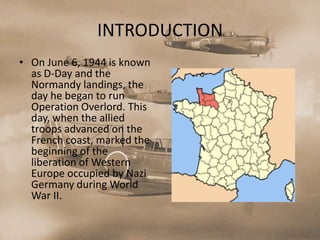
• On June 6, 1944 is known
  as D-Day and the
  Normandy landings, the
  day he began to run
  Operation Overlord. This
  day, when the allied
  troops advanced on the
  French coast, marked the
  beginning of the
  liberation of Western
  Europe occupied by Nazi
  Germany during World
  War II.
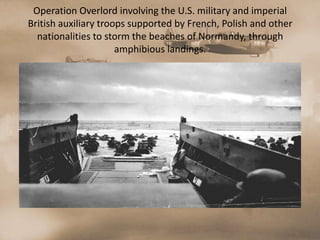
Operation Overlord involving the U.S. military and imperial
British auxiliary troops supported by French, Polish and other
  nationalities to storm the beaches of Normandy, through
                      amphibious landings.
ARMYS INVOLVED IN II WORLD WAR
ARMY ALLIED        •   AXIS
• U.S.             •   Germany
• France           •   Japan
• United Kingdom   •   Bulgaria
• Canada           •   Croatia
• Poland           •   Romania
• Belgium          •   Italy
• Holland
• Greece
• Australia
• Norway
OVERLORD OPERATION
• In 1942, in the development of the Second
  World War, the Allies were preparing a
  massive military onslaught, which would
  ground the imperial dreams of Nazi Germany.
  Britain was the scene where Operation
  Overlord was prepared, which aimed to
  eradicate the Nazis on French territory and
  move on Germany, meeting with Russian
  troops.
CAUSES OF LANDING
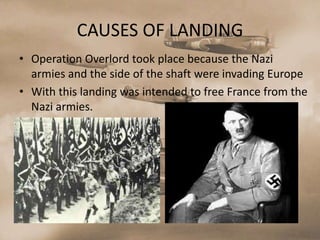
• Operation Overlord took place because the Nazi
  armies and the side of the shaft were invading Europe
• With this landing was intended to free France from the
  Nazi armies.
Responsible for the Normandy
                 landings
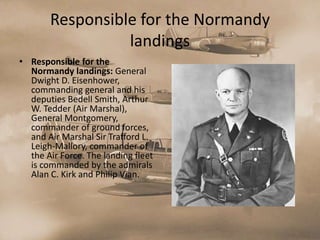
• Responsible for the
  Normandy landings: General
  Dwight D. Eisenhower,
  commanding general and his
  deputies Bedell Smith, Arthur
  W. Tedder (Air Marshal),
  General Montgomery,
  commander of ground forces,
  and Air Marshal Sir Trafford L.
  Leigh-Mallory, commander of
  the Air Force. The landing fleet
  is commanded by the admirals
  Alan C. Kirk and Philip Vian.
WEAPONS FOR LANDING
•   6 battleships
•   93 destroyers
•   22 cruises
•   1600 landing craft
•   6 infantry divisions
•   11 armored divisions
•   22 motorized divisions
•   5112 bombers
•   5747 fighters
•   4907 gliders and transport aircraft
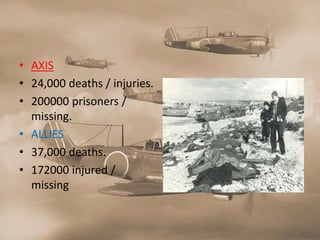
• AXIS
• 24,000 deaths / injuries.
• 200000 prisoners /
  missing.
• ALLIES
• 37,000 deaths.
• 172000 injured /
  missing
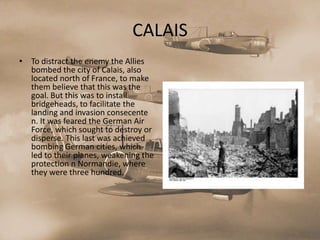
CALAIS
• To distract the enemy the Allies
  bombed the city of Calais, also
  located north of France, to make
  them believe that this was the
  goal. But this was to install
  bridgeheads, to facilitate the
  landing and invasion consecente
  n. It was feared the German Air
  Force, which sought to destroy or
  disperse. This last was achieved
  bombing German cities, which
  led to their planes, weakening the
  protection n Normandie, where
  they were three hundred.
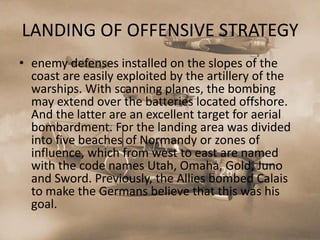
LANDING OF OFFENSIVE STRATEGY
• enemy defenses installed on the slopes of the
  coast are easily exploited by the artillery of the
  warships. With scanning planes, the bombing
  may extend over the batteries located offshore.
  And the latter are an excellent target for aerial
  bombardment. For the landing area was divided
  into five beaches of Normandy or zones of
  influence, which from west to east are named
  with the code names Utah, Omaha, Gold, Juno
  and Sword. Previously, the Allies bombed Calais
  to make the Germans believe that this was his
  goal.
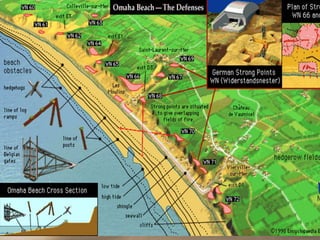
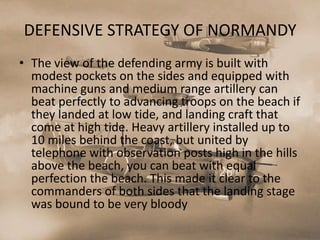
DEFENSIVE STRATEGY OF NORMANDY
• The view of the defending army is built with
  modest pockets on the sides and equipped with
  machine guns and medium range artillery can
  beat perfectly to advancing troops on the beach if
  they landed at low tide, and landing craft that
  come at high tide. Heavy artillery installed up to
  10 miles behind the coast, but united by
  telephone with observation posts high in the hills
  above the beach, you can beat with equal
  perfection the beach. This made ​it clear to the
  commanders of both sides that the landing stage
  was bound to be very bloody
JUNE 6: D DAY
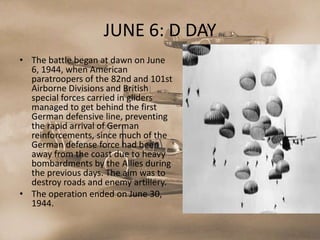
• The battle began at dawn on June
  6, 1944, when American
  paratroopers of the 82nd and 101st
  Airborne Divisions and British
  special forces carried in gliders
  managed to get behind the first
  German defensive line, preventing
  the rapid arrival of German
  reinforcements, since much of the
  German defense force had been
  away from the coast due to heavy
  bombardments by the Allies during
  the previous days. The aim was to
  destroy roads and enemy artillery.
• The operation ended on June 30,
  1944.
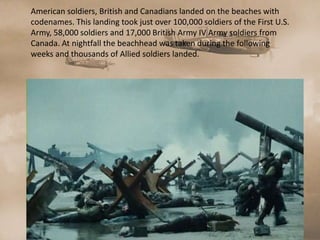
American soldiers, British and Canadians landed on the beaches with
codenames. This landing took just over 100,000 soldiers of the First U.S.
Army, 58,000 soldiers and 17,000 British Army IV Army soldiers from
Canada. At nightfall the beachhead was taken during the following
weeks and thousands of Allied soldiers landed.
CONSEQUENCES OF D-DAY
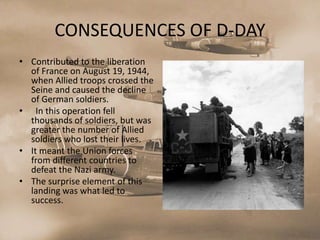
• Contributed to the liberation
  of France on August 19, 1944,
  when Allied troops crossed the
  Seine and caused the decline
  of German soldiers.
• In this operation fell
  thousands of soldiers, but was
  greater the number of Allied
  soldiers who lost their lives.
• It meant the Union forces
  from different countries to
  defeat the Nazi army.
• The surprise element of this
  landing was what led to
  success.
RESULT OF WORLD WAR 2
• The Second World War saw the most far-
  reaching transformation of world politics to
  date. The destructive technologies introduced
  during the war – foremost, the atomic bomb –
  made it very unlikely that a land-based conflict
  of similar scale and duration among the major
  nations could ever happen again, because of
  the potential for total destruction of all
  combatants.
No advanced industrial nation has
been invaded since 1945, and all wars
  since that time have either been
 guerrilla conflicts in less-developed
  countries, conflicts involving less-
   developed countries with more
advanced ones, or some combination
       of these two scenarios.
HIROSHIMA AND NAGASAKI
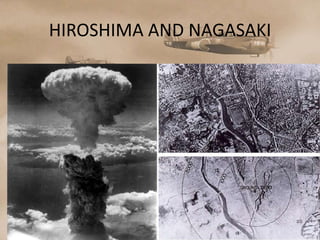
• During the final stages of World War II in 1945,
  the Allies of World War II conducted two atomic
  bombings against the cities of Hiroshima and
  Nagasaki in Japan. These two events are the only
  use of nuclear weapons in war to date. Within
  the first two to four months of the bombings, the
  acute effects killed 90,000–166,000 people in
  Hiroshima and 60,000–80,000 in Nagasaki, with
  roughly half of the deaths in each city occurring
  on the first day. The Hiroshima prefecture health
  department estimated that, of the people who
  died on the day of the explosion, 60% died from
  flash or flame burns, 30% from falling debris and
  10% from other causes.
• During the following months, large numbers
  died from the effect of burns, radiation
  sickness, and other injuries, compounded by
  illness. In a U.S. estimate of the total
  immediate and short term cause of death, 15–
  20% died from radiation sickness, 20–30%
  from burns, and 50–60% from other injuries,
  compounded by illness. In both cities, most of
  the dead were civilians, although Hiroshima
  had a sizeable garrison.
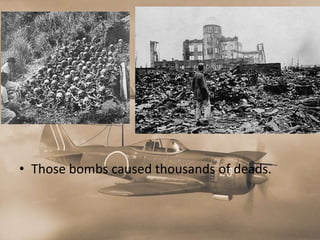
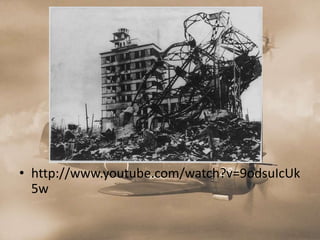
• Those bombs caused thousands of deads.
• http://www.youtube.com/watch?v=9odsuIcUk
  5w

D day

  • 1.
    D-DAY -Jose Antonio LópezCabezas -Javier Alcalá de la Moneda -Pablo Bujalance Moreno
  • 2.
    INDEX • Introduction • Army who participated in World War 2 • operation Overlord • Causes of the landing • Responsible for landing • Number of participants and casualties • Calais • offensive strategy • defensive strategy • D Day and that meant • Results of the Second World War
  • 3.
    INTRODUCTION • On June6, 1944 is known as D-Day and the Normandy landings, the day he began to run Operation Overlord. This day, when the allied troops advanced on the French coast, marked the beginning of the liberation of Western Europe occupied by Nazi Germany during World War II.
  • 4.
    Operation Overlord involvingthe U.S. military and imperial British auxiliary troops supported by French, Polish and other nationalities to storm the beaches of Normandy, through amphibious landings.
  • 5.
    ARMYS INVOLVED INII WORLD WAR ARMY ALLIED • AXIS • U.S. • Germany • France • Japan • United Kingdom • Bulgaria • Canada • Croatia • Poland • Romania • Belgium • Italy • Holland • Greece • Australia • Norway
  • 6.
    OVERLORD OPERATION • In1942, in the development of the Second World War, the Allies were preparing a massive military onslaught, which would ground the imperial dreams of Nazi Germany. Britain was the scene where Operation Overlord was prepared, which aimed to eradicate the Nazis on French territory and move on Germany, meeting with Russian troops.
  • 7.
    CAUSES OF LANDING •Operation Overlord took place because the Nazi armies and the side of the shaft were invading Europe • With this landing was intended to free France from the Nazi armies.
  • 8.
    Responsible for theNormandy landings • Responsible for the Normandy landings: General Dwight D. Eisenhower, commanding general and his deputies Bedell Smith, Arthur W. Tedder (Air Marshal), General Montgomery, commander of ground forces, and Air Marshal Sir Trafford L. Leigh-Mallory, commander of the Air Force. The landing fleet is commanded by the admirals Alan C. Kirk and Philip Vian.
  • 9.
    WEAPONS FOR LANDING • 6 battleships • 93 destroyers • 22 cruises • 1600 landing craft • 6 infantry divisions • 11 armored divisions • 22 motorized divisions • 5112 bombers • 5747 fighters • 4907 gliders and transport aircraft
  • 10.
    • AXIS • 24,000deaths / injuries. • 200000 prisoners / missing. • ALLIES • 37,000 deaths. • 172000 injured / missing
  • 12.
    CALAIS • To distractthe enemy the Allies bombed the city of Calais, also located north of France, to make them believe that this was the goal. But this was to install bridgeheads, to facilitate the landing and invasion consecente n. It was feared the German Air Force, which sought to destroy or disperse. This last was achieved bombing German cities, which led to their planes, weakening the protection n Normandie, where they were three hundred.
  • 13.
    LANDING OF OFFENSIVESTRATEGY • enemy defenses installed on the slopes of the coast are easily exploited by the artillery of the warships. With scanning planes, the bombing may extend over the batteries located offshore. And the latter are an excellent target for aerial bombardment. For the landing area was divided into five beaches of Normandy or zones of influence, which from west to east are named with the code names Utah, Omaha, Gold, Juno and Sword. Previously, the Allies bombed Calais to make the Germans believe that this was his goal.
  • 15.
    DEFENSIVE STRATEGY OFNORMANDY • The view of the defending army is built with modest pockets on the sides and equipped with machine guns and medium range artillery can beat perfectly to advancing troops on the beach if they landed at low tide, and landing craft that come at high tide. Heavy artillery installed up to 10 miles behind the coast, but united by telephone with observation posts high in the hills above the beach, you can beat with equal perfection the beach. This made ​it clear to the commanders of both sides that the landing stage was bound to be very bloody
  • 16.
    JUNE 6: DDAY • The battle began at dawn on June 6, 1944, when American paratroopers of the 82nd and 101st Airborne Divisions and British special forces carried in gliders managed to get behind the first German defensive line, preventing the rapid arrival of German reinforcements, since much of the German defense force had been away from the coast due to heavy bombardments by the Allies during the previous days. The aim was to destroy roads and enemy artillery. • The operation ended on June 30, 1944.
  • 17.
    American soldiers, Britishand Canadians landed on the beaches with codenames. This landing took just over 100,000 soldiers of the First U.S. Army, 58,000 soldiers and 17,000 British Army IV Army soldiers from Canada. At nightfall the beachhead was taken during the following weeks and thousands of Allied soldiers landed.
  • 18.
    CONSEQUENCES OF D-DAY •Contributed to the liberation of France on August 19, 1944, when Allied troops crossed the Seine and caused the decline of German soldiers. • In this operation fell thousands of soldiers, but was greater the number of Allied soldiers who lost their lives. • It meant the Union forces from different countries to defeat the Nazi army. • The surprise element of this landing was what led to success.
  • 19.
  • 20.
    • The SecondWorld War saw the most far- reaching transformation of world politics to date. The destructive technologies introduced during the war – foremost, the atomic bomb – made it very unlikely that a land-based conflict of similar scale and duration among the major nations could ever happen again, because of the potential for total destruction of all combatants.
  • 21.
    No advanced industrialnation has been invaded since 1945, and all wars since that time have either been guerrilla conflicts in less-developed countries, conflicts involving less- developed countries with more advanced ones, or some combination of these two scenarios.
  • 23.
  • 24.
    • During thefinal stages of World War II in 1945, the Allies of World War II conducted two atomic bombings against the cities of Hiroshima and Nagasaki in Japan. These two events are the only use of nuclear weapons in war to date. Within the first two to four months of the bombings, the acute effects killed 90,000–166,000 people in Hiroshima and 60,000–80,000 in Nagasaki, with roughly half of the deaths in each city occurring on the first day. The Hiroshima prefecture health department estimated that, of the people who died on the day of the explosion, 60% died from flash or flame burns, 30% from falling debris and 10% from other causes.
  • 25.
    • During thefollowing months, large numbers died from the effect of burns, radiation sickness, and other injuries, compounded by illness. In a U.S. estimate of the total immediate and short term cause of death, 15– 20% died from radiation sickness, 20–30% from burns, and 50–60% from other injuries, compounded by illness. In both cities, most of the dead were civilians, although Hiroshima had a sizeable garrison.
  • 26.
    • Those bombscaused thousands of deads.
  • 27.