Great Britain International Tribune, Volume 96, Number 1, 2011


   Teaching English to Polish Post-Secondary Vocational
                   Institution Learners
Authors:    Norman L. Butler, PhD
           Lecturer in English
           Department of Foreign Languages
           AGH University of Science and Technology
           Cracow, Poland

            Renata Pirog, MA
            Senior Teacher of Polish
            SZKOLA POLICEALNA ‘VADEMECUM’
            Cracow

            William Allan Kritsonis, PhD
            Professor
            PhD Program in Educational Leadership
            Whitlowe R. Green College of Education
            Prairie View A&M University
            The Texas A&M University System
            Prairie View, Texas, USA


Publication date: January 2011

___________________________________________________________________________
                                ABSTRACT

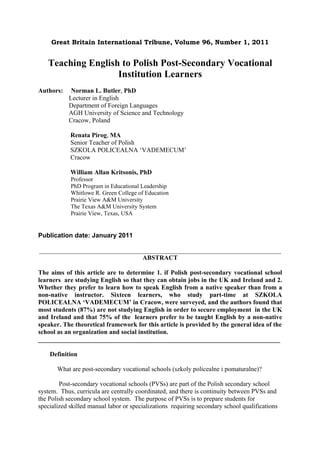
The aims of this article are to determine 1. if Polish post-secondary vocational school
learners are studying English so that they can obtain jobs in the UK and Ireland and 2.
Whether they prefer to learn how to speak English from a native speaker than from a
non-native instructor. Sixteen learners, who study part-time at SZKOLA
POLICEALNA ‘VADEMECUM’ in Cracow, were surveyed, and the authors found that
most students (87%) are not studying English in order to secure employment in the UK
and Ireland and that 75% of the learners prefer to be taught English by a non-native
speaker. The theoretical framework for this article is provided by the general idea of the
school as an organization and social institution.
___________________________________________________________________________

    Definition

       What are post-secondary vocational schools (szkoly policealne i pomaturalne)?

        Post-secondary vocational schools (PVSs) are part of the Polish secondary school
system. Thus, curricula are centrally coordinated, and there is continuity between PVSs and
the Polish secondary school system. The purpose of PVSs is to prepare students for
specialized skilled manual labor or specializations requiring secondary school qualifications
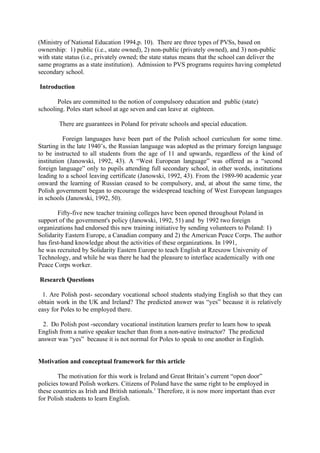
(Ministry of National Education 1994,p. 10). There are three types of PVSs, based on
ownership: 1) public (i.e., state owned), 2) non-public (privately owned), and 3) non-public
with state status (i.e., privately owned; the state status means that the school can deliver the
same programs as a state institution). Admission to PVS programs requires having completed
secondary school.

Introduction

       Poles are committed to the notion of compulsory education and public (state)
schooling. Poles start school at age seven and can leave at eighteen.

        There are guarantees in Poland for private schools and special education.

          Foreign languages have been part of the Polish school curriculum for some time.
Starting in the late 1940’s, the Russian language was adopted as the primary foreign language
to be instructed to all students from the age of 11 and upwards, regardless of the kind of
institution (Janowski, 1992, 43). A “West European language” was offered as a “second
foreign language” only to pupils attending full secondary school, in other words, institutions
leading to a school leaving certificate (Janowski, 1992, 43). From the 1989-90 academic year
onward the learning of Russian ceased to be compulsory, and, at about the same time, the
Polish government began to encourage the widespread teaching of West European languages
in schools (Janowski, 1992, 50).

        Fifty-five new teacher training colleges have been opened throughout Poland in
support of the government's policy (Janowski, 1992, 51) and by 1992 two foreign
organizations had endorsed this new training initiative by sending volunteers to Poland: 1)
Solidarity Eastern Europe, a Canadian company and 2) the American Peace Corps. The author
has first-hand knowledge about the activities of these organizations. In 1991,
he was recruited by Solidarity Eastern Europe to teach English at Rzeszow University of
Technology, and while he was there he had the pleasure to interface academically with one
Peace Corps worker.

Research Questions

 1. Are Polish post- secondary vocational school students studying English so that they can
obtain work in the UK and Ireland? The predicted answer was “yes” because it is relatively
easy for Poles to be employed there.

  2. Do Polish post -secondary vocational institution learners prefer to learn how to speak
English from a native speaker teacher than from a non-native instructor? The predicted
answer was “yes” because it is not normal for Poles to speak to one another in English.


Motivation and conceptual framework for this article

        The motivation for this work is Ireland and Great Britain’s current “open door”
policies toward Polish workers. Citizens of Poland have the same right to be employed in
these countries as Irish and British nationals.1 Therefore, it is now more important than ever
for Polish students to learn English.
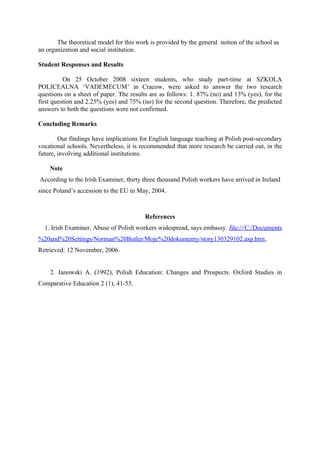
The theoretical model for this work is provided by the general notion of the school as
an organization and social institution.

Student Responses and Results

          On 25 October 2008 sixteen students, who study part-time at SZKOLA
POLICEALNA ‘VADEMECUM’ in Cracow, were asked to answer the two research
questions on a sheet of paper. The results are as follows: 1. 87% (no) and 13% (yes), for the
first question and 2.25% (yes) and 75% (no) for the second question. Therefore, the predicted
answers to both the questions were not confirmed.

Concluding Remarks

        Our findings have implications for English language teaching at Polish post-secondary
vocational schools. Nevertheless, it is recommended that more research be carried out, in the
future, involving additional institutions.

    Note
According to the Irish Examiner, thirty three thousand Polish workers have arrived in Ireland
since Poland’s accession to the EU in May, 2004.


                                         References
  1. Irish Examiner, Abuse of Polish workers widespread, says embassy. file:///C:/Documents
%20and%20Settings/Norman%20Butler/Moje%20dokumenty/story130329102.asp.htm,
Retrieved: 12 November, 2006.


    2. Janowski A. (1992), Polish Education: Changes and Prospects. Oxford Studies in
Comparative Education 2 (1), 41-55.

Norman L. Butler, Renata Pirog, and William Allan Kritsonis

  • 1.
    Great Britain InternationalTribune, Volume 96, Number 1, 2011 Teaching English to Polish Post-Secondary Vocational Institution Learners Authors: Norman L. Butler, PhD Lecturer in English Department of Foreign Languages AGH University of Science and Technology Cracow, Poland Renata Pirog, MA Senior Teacher of Polish SZKOLA POLICEALNA ‘VADEMECUM’ Cracow William Allan Kritsonis, PhD Professor PhD Program in Educational Leadership Whitlowe R. Green College of Education Prairie View A&M University The Texas A&M University System Prairie View, Texas, USA Publication date: January 2011 ___________________________________________________________________________ ABSTRACT The aims of this article are to determine 1. if Polish post-secondary vocational school learners are studying English so that they can obtain jobs in the UK and Ireland and 2. Whether they prefer to learn how to speak English from a native speaker than from a non-native instructor. Sixteen learners, who study part-time at SZKOLA POLICEALNA ‘VADEMECUM’ in Cracow, were surveyed, and the authors found that most students (87%) are not studying English in order to secure employment in the UK and Ireland and that 75% of the learners prefer to be taught English by a non-native speaker. The theoretical framework for this article is provided by the general idea of the school as an organization and social institution. ___________________________________________________________________________ Definition What are post-secondary vocational schools (szkoly policealne i pomaturalne)? Post-secondary vocational schools (PVSs) are part of the Polish secondary school system. Thus, curricula are centrally coordinated, and there is continuity between PVSs and the Polish secondary school system. The purpose of PVSs is to prepare students for specialized skilled manual labor or specializations requiring secondary school qualifications
  • 2.
    (Ministry of NationalEducation 1994,p. 10). There are three types of PVSs, based on ownership: 1) public (i.e., state owned), 2) non-public (privately owned), and 3) non-public with state status (i.e., privately owned; the state status means that the school can deliver the same programs as a state institution). Admission to PVS programs requires having completed secondary school. Introduction Poles are committed to the notion of compulsory education and public (state) schooling. Poles start school at age seven and can leave at eighteen. There are guarantees in Poland for private schools and special education. Foreign languages have been part of the Polish school curriculum for some time. Starting in the late 1940’s, the Russian language was adopted as the primary foreign language to be instructed to all students from the age of 11 and upwards, regardless of the kind of institution (Janowski, 1992, 43). A “West European language” was offered as a “second foreign language” only to pupils attending full secondary school, in other words, institutions leading to a school leaving certificate (Janowski, 1992, 43). From the 1989-90 academic year onward the learning of Russian ceased to be compulsory, and, at about the same time, the Polish government began to encourage the widespread teaching of West European languages in schools (Janowski, 1992, 50). Fifty-five new teacher training colleges have been opened throughout Poland in support of the government's policy (Janowski, 1992, 51) and by 1992 two foreign organizations had endorsed this new training initiative by sending volunteers to Poland: 1) Solidarity Eastern Europe, a Canadian company and 2) the American Peace Corps. The author has first-hand knowledge about the activities of these organizations. In 1991, he was recruited by Solidarity Eastern Europe to teach English at Rzeszow University of Technology, and while he was there he had the pleasure to interface academically with one Peace Corps worker. Research Questions 1. Are Polish post- secondary vocational school students studying English so that they can obtain work in the UK and Ireland? The predicted answer was “yes” because it is relatively easy for Poles to be employed there. 2. Do Polish post -secondary vocational institution learners prefer to learn how to speak English from a native speaker teacher than from a non-native instructor? The predicted answer was “yes” because it is not normal for Poles to speak to one another in English. Motivation and conceptual framework for this article The motivation for this work is Ireland and Great Britain’s current “open door” policies toward Polish workers. Citizens of Poland have the same right to be employed in these countries as Irish and British nationals.1 Therefore, it is now more important than ever for Polish students to learn English.
  • 3.
    The theoretical modelfor this work is provided by the general notion of the school as an organization and social institution. Student Responses and Results On 25 October 2008 sixteen students, who study part-time at SZKOLA POLICEALNA ‘VADEMECUM’ in Cracow, were asked to answer the two research questions on a sheet of paper. The results are as follows: 1. 87% (no) and 13% (yes), for the first question and 2.25% (yes) and 75% (no) for the second question. Therefore, the predicted answers to both the questions were not confirmed. Concluding Remarks Our findings have implications for English language teaching at Polish post-secondary vocational schools. Nevertheless, it is recommended that more research be carried out, in the future, involving additional institutions. Note According to the Irish Examiner, thirty three thousand Polish workers have arrived in Ireland since Poland’s accession to the EU in May, 2004. References 1. Irish Examiner, Abuse of Polish workers widespread, says embassy. file:///C:/Documents %20and%20Settings/Norman%20Butler/Moje%20dokumenty/story130329102.asp.htm, Retrieved: 12 November, 2006. 2. Janowski A. (1992), Polish Education: Changes and Prospects. Oxford Studies in Comparative Education 2 (1), 41-55.