Integration and simplification
eGovernment conference - Copenhagen

Håkon Olderbakk 2011.12.07
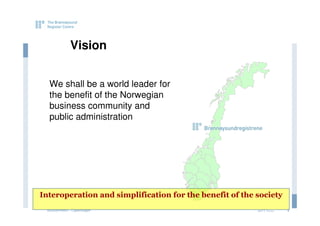
Vision


  We shall be a world leader for
  the benefit of the Norwegian
  business community and
  public administration


Interoperation and simplification for the benefit of the society
 eGovernment - Copenhagen                                2011.12.07   2
Steps towards interoperation and
simplification
      Cooperation
      Sharing key information
      Sharing other information
      Sharing a solution for exchange of information
      Sharing tools and components to design services


eGovernment - Copenhagen                               2011.12.07   3
Interoperation requires cooperation

• Preferably voluntary
       – Sharing visions and ideas
       – Focusing on the same aspects of things


• Force may be required
       – Law
       – Government instructions
       – Standards
       – -money talks-


eGovernment - Copenhagen                          2011.12.07   4
et


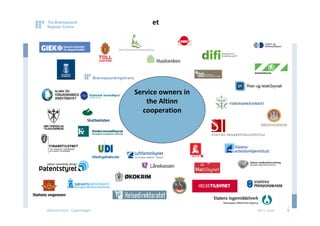
                           Service owners in
                               the Altinn
                             cooperation


                                                            5
eGovernment - Copenhagen                       2011.12.07   5
Opportunities and Challenges

• Cooperation enables joint forces and creation of
  advanced solutions


• Cooperation requires stakeholder involvement
  (private and public), management structures and
  maintenance of cooperation ”Capital”


eGovernment - Copenhagen                             2011.12.07   6
Steps towards interoperation and
simplification
• Sharing key information by common use of a unique
  identification number
• Sharing information other than key information
• Sharing a solution for exchange of information
• Sharing tools and components to design services


                           A continuous process that is still ongoing


eGovernment - Copenhagen                                                2011.12.07   7
Sharing key information by use of a
unique identification number

• The Central Coordinating Register for Legal Entities
  established in 1995
• Governed by a separate Law

• Purpose: provide for the sharing of key information by
  common use of a unique identification number


                 A separate law and registry to identify legal entities


eGovernment - Copenhagen                                                  2011.12.07   8
Sharing other additional information

• 1997: The Register of Reporting Obligations of Enterprises
• Governed by a separate Law

• overview of the reporting obligations of enterprises

• coordination and simplification of reporting obligations

• Has contributed to an awareness in public sector on
  adminstrative burdens

 A pathfinder for the re-use of business data within public administration


eGovernment - Copenhagen                                             2011.12.07   9
The Register of Reporting Obligations of Enterprises


Four important functions:
• Coordinating function
   – for existing and new reporting obligations

• Information-centre function
   – for business sector and public administration

• Hearing function
   – for legislators

• Definition function
   – for all the information requested by public administration

                                                     eGovernment - Copenhagen
                                                                    2011.12.07   10
Interoperation and simplification depends
on the legal framework
• Electronic data must be legally valid

• The legal weight of electronic data must be known
  and recognized

• Synchronization of the legal framework may be
  required


eGovernment - Copenhagen                          2011.12.07   11
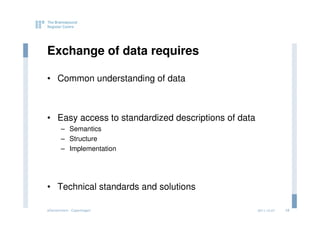
Exchange of data requires

• Common understanding of data


• Easy access to standardized descriptions of data
       – Semantics
       – Structure
       – Implementation


• Technical standards and solutions

eGovernment - Copenhagen                             2011.12.07   12
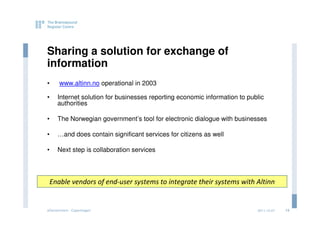
Sharing a solution for exchange of
information
•     www.altinn.no operational in 2003

•    Internet solution for businesses reporting economic information to public
     authorities

•    The Norwegian government’s tool for electronic dialogue with businesses

•    …and does contain significant services for citizens as well

•    Next step is collaboration services


 Enable vendors of end-user systems to integrate their systems with Altinn


eGovernment - Copenhagen                                                   2011.12.07   13
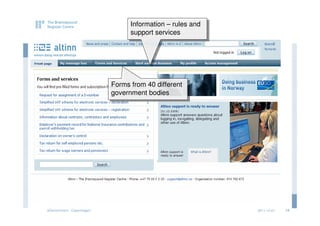
Information – rules and
                                 support services


                           Forms from 40 different
                           government bodies


eGovernment - Copenhagen                                   2011.12.07   14
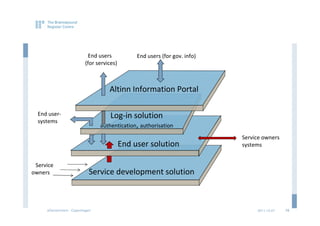
End users            End users (for gov. info)
                         (for services)


                                   Altinn Information Portal

  End user-                         Log-in solution
  systems
                                authentication, authorisation
                                                                           Service owners
                                          End user solution                systems


 Service
owners                     Service development solution


     eGovernment - Copenhagen                                                   2011.12.07   15
Altinn II Collaboration Services

• Presents the process to the user
       – Guiding the user through the various activities
       – Removes the need for the user to know how the Government works
       – Allows the user to focus on what he wants to do…
         (”I want to build a house”)
         …and not how to do so
         (”I think I need to fill out forms X, Y and Z.”)
• Collects all case materials in one location
       – Easy to keep track of the dialogue


eGovernment - Copenhagen                                          2011.12.07   16
Opportunities and Challenges


• Collaboration enables better services for clients


• Collaboration may require change in procedures and
  organization


eGovernment - Copenhagen                              2011.12.07   17
Sharing tools and components to design
services
• Metadata repository for the exchanged information
       –    Derived from the data definition catalogue in the Register of Reporting Obligations of
            Enterprises


• User’s access rights to Altinn linked to key
  information from The Central Coordinating Register for Legal
  Entities

• Forms pre-populated with key information from The Central
  Coordinating Register for Legal Entities and the Population
  Register

                               Lesser-known side of Altinn

eGovernment - Copenhagen                                                                     2011.12.07   18
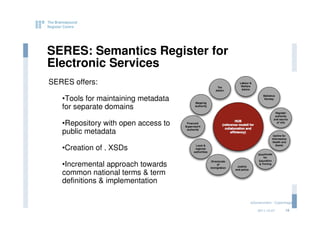
SERES: Semantics Register for
Electronic Services
SERES offers:

   •Tools for maintaining metadata
   for separate domains

   •Repository with open access to
   public metadata

   •Creation of . XSDs

   •Incremental approach towards
   common national terms & term
   definitions & implementation

                                     eGovernment - Copenhagen

                                        2011.12.07      19
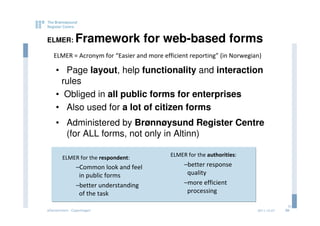
ELMER:         Framework for web-based forms
   ELMER = Acronym for “Easier and more efficient reporting” (in Norwegian)

    • Page layout, help functionality and interaction
     rules
    • Obliged in all public forms for enterprises
    • Also used for a lot of citizen forms
    • Administered by Brønnøysund Register Centre
      (for ALL forms, not only in Altinn)

        ELMER for the respondent:          ELMER for the authorities:

               –Common look and feel            –better response
                in public forms                  quality
               –better understanding            –more efficient
                of the task                      processing

                                                                                       20
eGovernment - Copenhagen                                                 2011.12.07   20
Common obstacles and challenges

• Information sharing:
  General skepticism regarding the relevance and the
  quality of information registered by other public
  authorities

• Sharing components:
  Common components have to serve many interests


eGovernment - Copenhagen                         2011.12.07   21
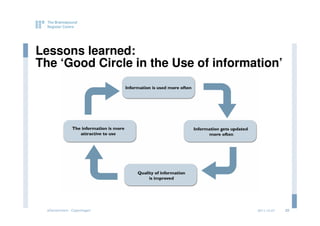
Lessons learned:
The ‘Good Circle in the Use of information’


  eGovernment - Copenhagen            2011.12.07   22
Lessons learned:
Working across structures
• Understanding the potential of technology is vital for
  legal experts and technologists must be familiar with
  the legal framework .

• Innovative solutions may affect different ministries
  with different budgetary constraints.
• Working across structures means also dealing with
  issues across the divide between the public and
  private sectors.

eGovernment - Copenhagen                             2011.12.07   23
Lessons learned:
Focus on business processes

• May have positive impacts both on the business
  sector and on the public authorities involved

• Important to include the tasks to be performed by
  businesses


eGovernment - Copenhagen                              2011.12.07   24
Steps towards integration and
simplification
      Cooperation is the basis for everything
              Create conditions for cooperation

      Sharing information requires structures
              Legal framework
              Unique ID
              Metadata

      Technical standards and solutions (tools)
              Creation of services
              Maintaining security


eGovernment - Copenhagen                          2011.12.07   25
Major challenges right now

• Cross border eID

• Legal terms across borders

• How to avoid using private eID for business purposes

• Financing initiatives and operation


eGovernment - Copenhagen                          2011.12.07   26
Thank you for your attention


27                    eGovernment - Copenhagen
                                     2011.12.07
Xtras


eGovernment - Copenhagen   2011.12.07   28
Conclusions

        1. Administrative burdens for businesses are reduced
        2. User satisfaction is very high
        3. Efficiency gains in public sector
        4. The number of government agencies joining the
           collaboration is ever increasing
        5. Very high penetration rate for major forms
           The most complex forms are already available via Altinn
           (tax etc.)
        6. The number of forms reported through Altinn is rapidly
           increasing (till now 65 mill)
        7. Very many users (450 000 businesses, 2,5 mill. Citizens)
                                                                             29
eGovernment - Copenhagen                                       2011.12.07   29
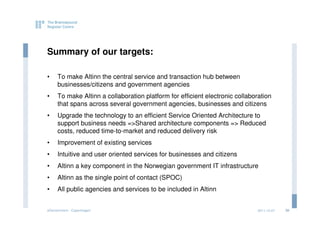
Summary of our targets:

•    To make Altinn the central service and transaction hub between
     businesses/citizens and government agencies
•    To make Altinn a collaboration platform for efficient electronic collaboration
     that spans across several government agencies, businesses and citizens
•    Upgrade the technology to an efficient Service Oriented Architecture to
     support business needs =>Shared architecture components => Reduced
     costs, reduced time-to-market and reduced delivery risk
•    Improvement of existing services
•    Intuitive and user oriented services for businesses and citizens
•    Altinn a key component in the Norwegian government IT infrastructure
•    Altinn as the single point of contact (SPOC)
•    All public agencies and services to be included in Altinn


eGovernment - Copenhagen                                                     2011.12.07   30
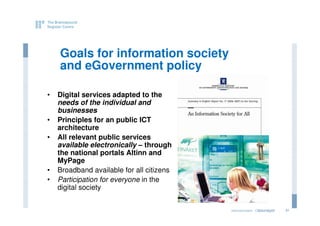
Goals for information society
    and eGovernment policy

•   Digital services adapted to the
    needs of the individual and
    businesses
•   Principles for an public ICT
    architecture
•   All relevant public services
    available electronically – through
    the national portals Altinn and
    MyPage
•   Broadband available for all citizens
•   Participation for everyone in the
    digital society


                                           eGovernment - Copenhagen
                                                          2011.12.07   31
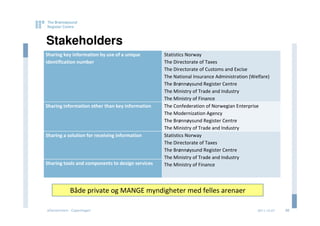
Stakeholders
Sharing key information by use of a unique        Statistics Norway
identification number                             The Directorate of Taxes
                                                  The Directorate of Customs and Excise
                                                  The National Insurance Administration (Welfare)
                                                  The Brønnøysund Register Centre
                                                  The Ministry of Trade and Industry
                                                  The Ministry of Finance
Sharing information other than key information    The Confederation of Norwegian Enterprise
                                                  The Modernization Agency
                                                  The Brønnøysund Register Centre
                                                  The Ministry of Trade and Industry
Sharing a solution for receiving information      Statistics Norway
                                                  The Directorate of Taxes
                                                  The Brønnøysund Register Centre
                                                  The Ministry of Trade and Industry
Sharing tools and components to design services   The Ministry of Finance


            Både private og MANGE myndigheter med felles arenaer

eGovernment - Copenhagen                                                                   2011.12.07   32
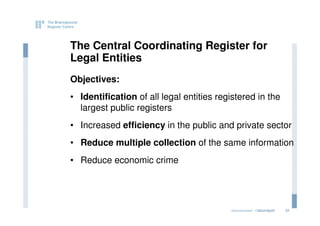
The Central Coordinating Register for
Legal Entities
Objectives:
• Identification of all legal entities registered in the
  largest public registers
• Increased efficiency in the public and private sector
• Reduce multiple collection of the same information
• Reduce economic crime


                                          eGovernment - Copenhagen
                                                         2011.12.07   33
The Register of Reporting Obligations of Enterprises


Four important functions:
• Coordinating function
   – for existing and new reporting obligations

• Information-centre function
   – for business sector and public administration

• Hearing function
   – for legislators

• Definition function
   – for all the information requested by public administration

                                                     eGovernment - Copenhagen
                                                                    2011.12.07   34
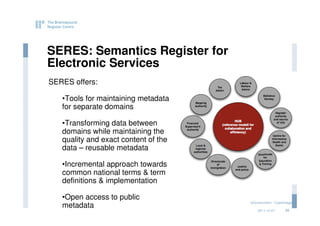
SERES: Semantics Register for
Electronic Services
SERES offers:

   •Tools for maintaining metadata
   for separate domains

   •Transforming data between
   domains while maintaining the
   quality and exact content of the
   data – reusable metadata

   •Incremental approach towards
   common national terms & term
   definitions & implementation

   •Open access to public
                                      eGovernment - Copenhagen
   metadata
                                         2011.12.07      35
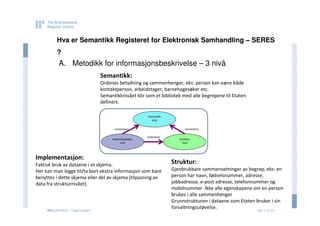
Hva er Semantikk Registeret for Elektronisk Samhandling – SERES
          ?
           A. Metodikk for informasjonsbeskrivelse – 3 nivå
                                Semantikk:
                                Ordenes betydning og sammenhenger, eks: person kan være både
                                kontaktperson, arbeidstager, barnehagesøker etc.
                                Semantikknivået blir som et bibliotek med alle begrepene til Etaten
                                definert.

                                                      Semantisk
                                                        nivå

                                      annotation                           annotation

                                                      realization
                                     Implementasjon                    Struktur
                                          nivå                           nivå


Implementasjon:
Faktisk bruk av dataene i et skjema.                                Struktur:
Her kan man legge til/ta bort ekstra informasjon som bare           Gjenbrukbare sammensetninger av begrep, eks: en
benyttes i dette skjema eller del av skjema (tilpasning av          person har navn, fødselsnummer, adresse,
data fra strukturnivået).                                           jobbadresse, e-post adresse, telefonnummer og
                                                                    mobilnummer. Ikke alle egenskapene om en person
                                                                    brukes i alle sammenhenger
                                                                    Grunnstrukturen i dataene som Etaten bruker i sin
                                                                    forvaltningsutøvelse.
     eGovernment - Copenhagen
     36                                                                                                  2011.12.07
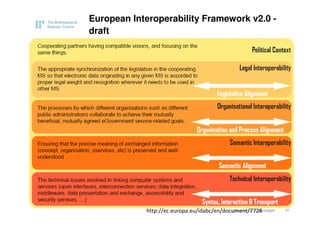
European Interoperability Framework v2.0 -
   draft


…………….


               http://ec.europa.eu/idabc/en/document/7728
                                               eGovernment - Copenhagen
                                                              2011.12.07   37
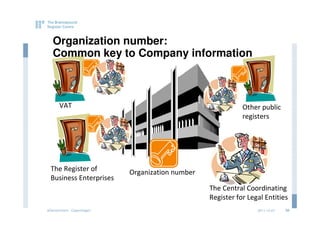
Organization number:
   Common key to Company information


      VAT                                                   Other public
                                                            registers


 The Register of           Organization number
 Business Enterprises
                                                 The Central Coordinating
                                                 Register for Legal Entities
eGovernment - Copenhagen                                         2011.12.07   38

Nordic eGovernment Conference 2011 - Håkon Olderbakk

  • 1.
    Integration and simplification eGovernmentconference - Copenhagen Håkon Olderbakk 2011.12.07
  • 2.
    Vision Weshall be a world leader for the benefit of the Norwegian business community and public administration Interoperation and simplification for the benefit of the society eGovernment - Copenhagen 2011.12.07 2
  • 3.
    Steps towards interoperationand simplification Cooperation Sharing key information Sharing other information Sharing a solution for exchange of information Sharing tools and components to design services eGovernment - Copenhagen 2011.12.07 3
  • 4.
    Interoperation requires cooperation •Preferably voluntary – Sharing visions and ideas – Focusing on the same aspects of things • Force may be required – Law – Government instructions – Standards – -money talks- eGovernment - Copenhagen 2011.12.07 4
  • 5.
    et Service owners in the Altinn cooperation 5 eGovernment - Copenhagen 2011.12.07 5
  • 6.
    Opportunities and Challenges •Cooperation enables joint forces and creation of advanced solutions • Cooperation requires stakeholder involvement (private and public), management structures and maintenance of cooperation ”Capital” eGovernment - Copenhagen 2011.12.07 6
  • 7.
    Steps towards interoperationand simplification • Sharing key information by common use of a unique identification number • Sharing information other than key information • Sharing a solution for exchange of information • Sharing tools and components to design services A continuous process that is still ongoing eGovernment - Copenhagen 2011.12.07 7
  • 8.
    Sharing key informationby use of a unique identification number • The Central Coordinating Register for Legal Entities established in 1995 • Governed by a separate Law • Purpose: provide for the sharing of key information by common use of a unique identification number A separate law and registry to identify legal entities eGovernment - Copenhagen 2011.12.07 8
  • 9.
    Sharing other additionalinformation • 1997: The Register of Reporting Obligations of Enterprises • Governed by a separate Law • overview of the reporting obligations of enterprises • coordination and simplification of reporting obligations • Has contributed to an awareness in public sector on adminstrative burdens A pathfinder for the re-use of business data within public administration eGovernment - Copenhagen 2011.12.07 9
  • 10.
    The Register ofReporting Obligations of Enterprises Four important functions: • Coordinating function – for existing and new reporting obligations • Information-centre function – for business sector and public administration • Hearing function – for legislators • Definition function – for all the information requested by public administration eGovernment - Copenhagen 2011.12.07 10
  • 11.
    Interoperation and simplificationdepends on the legal framework • Electronic data must be legally valid • The legal weight of electronic data must be known and recognized • Synchronization of the legal framework may be required eGovernment - Copenhagen 2011.12.07 11
  • 12.
    Exchange of datarequires • Common understanding of data • Easy access to standardized descriptions of data – Semantics – Structure – Implementation • Technical standards and solutions eGovernment - Copenhagen 2011.12.07 12
  • 13.
    Sharing a solutionfor exchange of information • www.altinn.no operational in 2003 • Internet solution for businesses reporting economic information to public authorities • The Norwegian government’s tool for electronic dialogue with businesses • …and does contain significant services for citizens as well • Next step is collaboration services Enable vendors of end-user systems to integrate their systems with Altinn eGovernment - Copenhagen 2011.12.07 13
  • 14.
    Information – rulesand support services Forms from 40 different government bodies eGovernment - Copenhagen 2011.12.07 14
  • 15.
    End users End users (for gov. info) (for services) Altinn Information Portal End user- Log-in solution systems authentication, authorisation Service owners End user solution systems Service owners Service development solution eGovernment - Copenhagen 2011.12.07 15
  • 16.
    Altinn II CollaborationServices • Presents the process to the user – Guiding the user through the various activities – Removes the need for the user to know how the Government works – Allows the user to focus on what he wants to do… (”I want to build a house”) …and not how to do so (”I think I need to fill out forms X, Y and Z.”) • Collects all case materials in one location – Easy to keep track of the dialogue eGovernment - Copenhagen 2011.12.07 16
  • 17.
    Opportunities and Challenges •Collaboration enables better services for clients • Collaboration may require change in procedures and organization eGovernment - Copenhagen 2011.12.07 17
  • 18.
    Sharing tools andcomponents to design services • Metadata repository for the exchanged information – Derived from the data definition catalogue in the Register of Reporting Obligations of Enterprises • User’s access rights to Altinn linked to key information from The Central Coordinating Register for Legal Entities • Forms pre-populated with key information from The Central Coordinating Register for Legal Entities and the Population Register Lesser-known side of Altinn eGovernment - Copenhagen 2011.12.07 18
  • 19.
    SERES: Semantics Registerfor Electronic Services SERES offers: •Tools for maintaining metadata for separate domains •Repository with open access to public metadata •Creation of . XSDs •Incremental approach towards common national terms & term definitions & implementation eGovernment - Copenhagen 2011.12.07 19
  • 20.
    ELMER: Framework for web-based forms ELMER = Acronym for “Easier and more efficient reporting” (in Norwegian) • Page layout, help functionality and interaction rules • Obliged in all public forms for enterprises • Also used for a lot of citizen forms • Administered by Brønnøysund Register Centre (for ALL forms, not only in Altinn) ELMER for the respondent: ELMER for the authorities: –Common look and feel –better response in public forms quality –better understanding –more efficient of the task processing 20 eGovernment - Copenhagen 2011.12.07 20
  • 21.
    Common obstacles andchallenges • Information sharing: General skepticism regarding the relevance and the quality of information registered by other public authorities • Sharing components: Common components have to serve many interests eGovernment - Copenhagen 2011.12.07 21
  • 22.
    Lessons learned: The ‘GoodCircle in the Use of information’ eGovernment - Copenhagen 2011.12.07 22
  • 23.
    Lessons learned: Working acrossstructures • Understanding the potential of technology is vital for legal experts and technologists must be familiar with the legal framework . • Innovative solutions may affect different ministries with different budgetary constraints. • Working across structures means also dealing with issues across the divide between the public and private sectors. eGovernment - Copenhagen 2011.12.07 23
  • 24.
    Lessons learned: Focus onbusiness processes • May have positive impacts both on the business sector and on the public authorities involved • Important to include the tasks to be performed by businesses eGovernment - Copenhagen 2011.12.07 24
  • 25.
    Steps towards integrationand simplification Cooperation is the basis for everything Create conditions for cooperation Sharing information requires structures Legal framework Unique ID Metadata Technical standards and solutions (tools) Creation of services Maintaining security eGovernment - Copenhagen 2011.12.07 25
  • 26.
    Major challenges rightnow • Cross border eID • Legal terms across borders • How to avoid using private eID for business purposes • Financing initiatives and operation eGovernment - Copenhagen 2011.12.07 26
  • 27.
    Thank you foryour attention 27 eGovernment - Copenhagen 2011.12.07
  • 28.
  • 29.
    Conclusions 1. Administrative burdens for businesses are reduced 2. User satisfaction is very high 3. Efficiency gains in public sector 4. The number of government agencies joining the collaboration is ever increasing 5. Very high penetration rate for major forms The most complex forms are already available via Altinn (tax etc.) 6. The number of forms reported through Altinn is rapidly increasing (till now 65 mill) 7. Very many users (450 000 businesses, 2,5 mill. Citizens) 29 eGovernment - Copenhagen 2011.12.07 29
  • 30.
    Summary of ourtargets: • To make Altinn the central service and transaction hub between businesses/citizens and government agencies • To make Altinn a collaboration platform for efficient electronic collaboration that spans across several government agencies, businesses and citizens • Upgrade the technology to an efficient Service Oriented Architecture to support business needs =>Shared architecture components => Reduced costs, reduced time-to-market and reduced delivery risk • Improvement of existing services • Intuitive and user oriented services for businesses and citizens • Altinn a key component in the Norwegian government IT infrastructure • Altinn as the single point of contact (SPOC) • All public agencies and services to be included in Altinn eGovernment - Copenhagen 2011.12.07 30
  • 31.
    Goals for informationsociety and eGovernment policy • Digital services adapted to the needs of the individual and businesses • Principles for an public ICT architecture • All relevant public services available electronically – through the national portals Altinn and MyPage • Broadband available for all citizens • Participation for everyone in the digital society eGovernment - Copenhagen 2011.12.07 31
  • 32.
    Stakeholders Sharing key informationby use of a unique Statistics Norway identification number The Directorate of Taxes The Directorate of Customs and Excise The National Insurance Administration (Welfare) The Brønnøysund Register Centre The Ministry of Trade and Industry The Ministry of Finance Sharing information other than key information The Confederation of Norwegian Enterprise The Modernization Agency The Brønnøysund Register Centre The Ministry of Trade and Industry Sharing a solution for receiving information Statistics Norway The Directorate of Taxes The Brønnøysund Register Centre The Ministry of Trade and Industry Sharing tools and components to design services The Ministry of Finance Både private og MANGE myndigheter med felles arenaer eGovernment - Copenhagen 2011.12.07 32
  • 33.
    The Central CoordinatingRegister for Legal Entities Objectives: • Identification of all legal entities registered in the largest public registers • Increased efficiency in the public and private sector • Reduce multiple collection of the same information • Reduce economic crime eGovernment - Copenhagen 2011.12.07 33
  • 34.
    The Register ofReporting Obligations of Enterprises Four important functions: • Coordinating function – for existing and new reporting obligations • Information-centre function – for business sector and public administration • Hearing function – for legislators • Definition function – for all the information requested by public administration eGovernment - Copenhagen 2011.12.07 34
  • 35.
    SERES: Semantics Registerfor Electronic Services SERES offers: •Tools for maintaining metadata for separate domains •Transforming data between domains while maintaining the quality and exact content of the data – reusable metadata •Incremental approach towards common national terms & term definitions & implementation •Open access to public eGovernment - Copenhagen metadata 2011.12.07 35
  • 36.
    Hva er SemantikkRegisteret for Elektronisk Samhandling – SERES ? A. Metodikk for informasjonsbeskrivelse – 3 nivå Semantikk: Ordenes betydning og sammenhenger, eks: person kan være både kontaktperson, arbeidstager, barnehagesøker etc. Semantikknivået blir som et bibliotek med alle begrepene til Etaten definert. Semantisk nivå annotation annotation realization Implementasjon Struktur nivå nivå Implementasjon: Faktisk bruk av dataene i et skjema. Struktur: Her kan man legge til/ta bort ekstra informasjon som bare Gjenbrukbare sammensetninger av begrep, eks: en benyttes i dette skjema eller del av skjema (tilpasning av person har navn, fødselsnummer, adresse, data fra strukturnivået). jobbadresse, e-post adresse, telefonnummer og mobilnummer. Ikke alle egenskapene om en person brukes i alle sammenhenger Grunnstrukturen i dataene som Etaten bruker i sin forvaltningsutøvelse. eGovernment - Copenhagen 36 2011.12.07
  • 37.
    European Interoperability Frameworkv2.0 - draft ……………. http://ec.europa.eu/idabc/en/document/7728 eGovernment - Copenhagen 2011.12.07 37
  • 38.
    Organization number: Common key to Company information VAT Other public registers The Register of Organization number Business Enterprises The Central Coordinating Register for Legal Entities eGovernment - Copenhagen 2011.12.07 38