April 2009


  Nonprofit
Social Network
Survey Report


www.nten.org   www.commonknow.com           www.theport.com


   www.nonprofitsocialnetworksurvey.com

               www.nonprofitsocialnetworksurvey.com                         
                                       © Common Knowledge • NTEN • ThePort 2009
Executive Summary

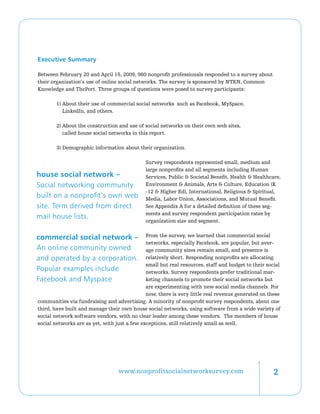
Between February 20 and April 15, 2009, 980 nonprofit professionals responded to a survey about
their organization’s use of online social networks. The survey is sponsored by NTEN, Common
Knowledge and ThePort. Three groups of questions were posed to survey participants:

        1) About their use of commercial social networks such as Facebook, MySpace,
           LinkedIn, and others.

        2) About the construction and use of social networks on their own web sites,
           called house social networks in this report.

        3) Demographic information about their organization.

                                              Survey respondents represented small, medium and
                                              large nonprofits and all segments including Human
house social network –                        Services, Public  Societal Benefit, Health  Healthcare,
Social networking community                   Environment  Animals, Arts  Culture, Education (K
                                              -12  Higher Ed), International, Religious  Spiritual,
built on a nonprofit’s own web                Media, Labor Union, Associations, and Mutual Benefit.
site. Term derived from direct                See Appendix A for a detailed definition of these seg-
                                              ments and survey respondent participation rates by
mail house lists.
                                              organization size and segment.


commercial social network –                   From the survey, we learned that commercial social
                                              networks, especially Facebook, are popular, but aver-
An online community owned                     age community sizes remain small, and presence is
and operated by a corporation.                relatively short. Responding nonprofits are allocating
                                              small but real resources, staff and budget to their social
Popular examples include                      networks. Survey respondents prefer traditional mar-
Facebook and Myspace                          keting channels to promote their social networks but
                                              are experimenting with new social media channels. For
                                              now, there is very little real revenue generated on these
communities via fundraising and advertising. A minority of nonprofit survey respondents, about one
third, have built and manage their own house social networks, using software from a wide variety of
social network software vendors, with no clear leader among these vendors. The members of house
social networks are as yet, with just a few exceptions, still relatively small as well.


                                  www.nonprofitsocialnetworksurvey.com
Following are more highlights from the survey:

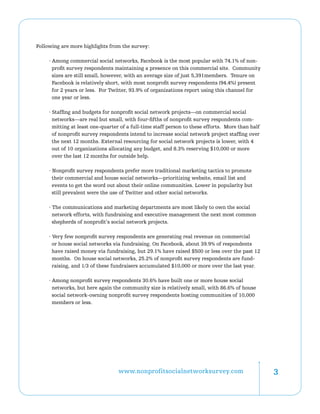
     · Among commercial social networks, Facebook is the most popular with 74.1% of non-
       profit survey respondents maintaining a presence on this commercial site. Community
       sizes are still small, however, with an average size of just 5,391members. Tenure on
       Facebook is relatively short, with most nonprofit survey respondents (94.4%) present
       for 2 years or less. For Twitter, 93.9% of organizations report using this channel for
       one year or less.

     · Staffing and budgets for nonprofit social network projects—on commercial social
       networks—are real but small, with four-fifths of nonprofit survey respondents com-
       mitting at least one-quarter of a full-time staff person to these efforts. More than half
       of nonprofit survey respondents intend to increase social network project staffing over
       the next 12 months. External resourcing for social network projects is lower, with 4
       out of 10 organizations allocating any budget, and 8.3% reserving $10,000 or more
       over the last 12 months for outside help.

     · Nonprofit survey respondents prefer more traditional marketing tactics to promote
       their commercial and house social networks—prioritizing website, email list and
       events to get the word out about their online communities. Lower in popularity but
       still prevalent were the use of Twitter and other social networks.

     · The communications and marketing departments are most likely to own the social
       network efforts, with fundraising and executive management the next most common
       shepherds of nonprofit’s social network projects.

     · Very few nonprofit survey respondents are generating real revenue on commercial
       or house social networks via fundraising. On Facebook, about 39.9% of respondents
       have raised money via fundraising, but 29.1% have raised $500 or less over the past 12
       months. On house social networks, 25.2% of nonprofit survey respondents are fund-
       raising, and 1/3 of these fundraisers accumulated $10,000 or more over the last year.

     · Among nonprofit survey respondents 30.6% have built one or more house social
       networks, but here again the community size is relatively small, with 86.6% of house
       social network-owning nonprofit survey respondents hosting communities of 10,000
       members or less.


                                  www.nonprofitsocialnetworksurvey.com
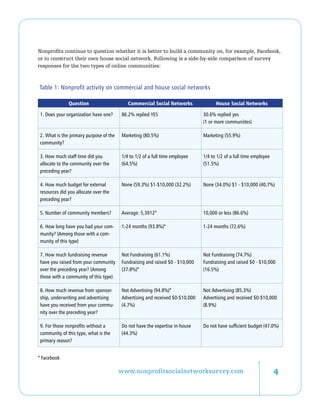
Nonprofits continue to question whether it is better to build a community on, for example, Facebook,
or to construct their own house social network. Following is a side-by-side comparison of survey
responses for the two types of online communities:


Table 1: Nonprofit activity on commercial and house social networks

               Question                     Commercial Social Networks               House Social Networks

 1. Does your organization have one?     86.2% replied YES                     30.6% replied yes
                                                                               (1 or more communiites)

 2. What is the primary purpose of the   Marketing (80.5%)                     Marketing (55.9%)
 community?

 3. How much staff time did you          1/4 to 1/2 of a full time employee    1/4 to 1/2 of a full time employee
 allocate to the community over the      (64.5%)                               (51.5%)
 preceding year?

 4. How much budget for external         None (59.3%) $1-$10,000 (32.2%)       None (34.0%) $1 - $10,000 (40.7%)
 resources did you allocate over the
 preceding year?

 5. Number of community members?         Average: 5,3912*                      10,000 or less (86.6%)

 6. How long have you had your com-      1-24 months (93.8%)*                  1-24 months (72.6%)
 munity? (Among those with a com-
 munity of this type)

 7. How much fundraising revenue         Not Fundraising (61.1%)               Not Fundraising (74.7%)
 have you raised from your community     Fundraising and raised $0 - $10,000   Fundraising and raised $0 - $10,000
 over the preceding year? (Among         (37.8%)*                              (16.5%)
 those with a community of this type)

 8. How much revenue from sponsor-       Not Advertising (94.8%)*              Not Advertising (85.3%)
 ship, underwriting and advertising      Advertising and received $0-$10,000   Advertising and received $0-$10,000
 have you received from your commu-      (4.7%)                                (8.9%)
 nity over the preceding year?

 9. For those nonprofits without a       Do not have the expertise in-house    Do not have sufficient budget (47.0%)
 community of this type, what is the     (44.3%)
 primary reason?


* Facebook 	

                                         www.nonprofitsocialnetworksurvey.com
The primary difference between the two types of communities, then, is “Does your organization have
a community of this type?” Among respondents 86.2% of nonprofits have a presence on at least one
commercial social network, and just 30.6% have a house social network. Presumably, nonprofits
find it easier to get started on Facebook with a Group, Page or Cause then to build their first house
network, so more of them do. To get real value from their networks, however, nonprofits will need
to scale and manage a large community. The ease and efficiency of building and managing a large
community is not discernible from this survey, but will be an important theme in the long term. The
potential for building and integrating both platforms simultaneously looms as a valuable strategy.

       · The social network software market—vendors offering software to build house social
         networks—is highly fragmented. Ning leads with 18.5% of nonprofit survey respon-
         dents specifying this vendor as their platform, and 15+ other vendors with 5% or
         less each.

       · The universal ID protocols— Open Social (Google, Yahoo, MySpace) and Facebook
         Connect— are used by 29.7% of organizations with house social networks, where
         Open Social is the more popular with 17.4% of nonprofit survey respondents using
         this standard, compared to Facebook’s standard used by 12.3% of respondents.


                                 www.nonprofitsocialnetworksurvey.com
Detailed Reporting of Survey Results
Commercial Social Networks

Popularity of Commercial Social Networks
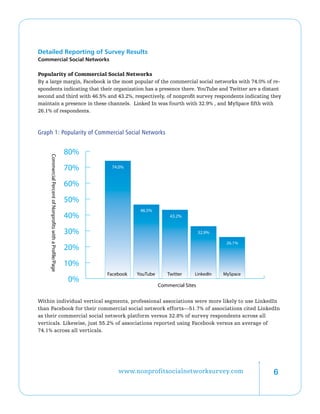
By a large margin, Facebook is the most popular of the commercial social networks with 74.0% of re-
spondents indicating that their organization has a presence there. YouTube and Twitter are a distant
second and third with 46.5% and 43.2%, respectively, of nonprofit survey respondents indicating they
maintain a presence in these channels. Linked In was fourth with 32.9% , and MySpace fifth with
26.1% of respondents.


Graph 1: Popularity of Commercial Social Networks


                                                            80%
     Commercial Percent of Nonprofits with a Profile/Page


                                                            70%    74.0%


                                                            60%
                                                            50%
                                                                              46.5%
                                                            40%                             43.2%


                                                            30%                                           32.9%

                                                                                                                   26.1%
                                                            20%
                                                            10%
                                                                  Facebook   YouTube       Twitter    LinkedIn    MySpace
                                                            0%
                                                                                       Commercial Sites

Within individual vertical segments, professional associations were more likely to use LinkedIn
than Facebook for their commercial social network efforts—51.7% of associations cited LinkedIn
as their commercial social network platform versus 32.8% of survey respondents across all
verticals. Likewise, just 55.2% of associations reported using Facebook versus an average of
74.1% across all verticals.


                                                                      www.nonprofitsocialnetworksurvey.com
Role of Commercial Social Networks
Looking at how survey respondents use their commercial social networks, we find the most popular
role is for traditional marketing—to promote the nonprofit’s brand, programs, events or services,
with 80.5% of survey respondents indicating this role as the purpose of their presence on commercial
social networks. The second most popular role is for word-of-mouth marketing, at 72.7% of respon-
dents. Market research and delivering programs or services via the social network are significantly
less typical with 43.1% and 35.5% respectively.

Staff Time and External Resources Dedicated to Commercial Social Networks
Fully four-fifths (80.8%) of survey respondents committed at least one-quarter of a full-time staff
member to maintaining—marketing, managing and cultivating—their commercial social network
presence over the last 12 months. Roughly two thirds (64.5%) of survey respondents dedicated one-
quarter to one-half of a full-time resource, and 16.3% committed three-quarters or more staff to their
commercial social networks.

Looking ahead, over half (55.0%) of survey respondents indicate they will increase staffing over the
next 12 months, 39.5%) say staffing will stay the same, and just 1 in 20 (5.6%) will decrease staffing.

Four out of ten (40.6%) survey respondents had some budget over the last 12 months for external
resources dedicated to helping with their commercial social network work, but just 8.3% set aside
$10,000 or more, with only 1.4% allotting more than $100,000 to external resources to help with
commercial social network efforts.

About one-quarter (24.1%) of survey respondents indicate they will increase funding for external re-
sources dedicated to helping with commercial social network efforts in the coming 12 months, while
the majority (68.0%) say they will keep external resourcing budgets the same. 7.9% of survey respon-
dents will decrease their social network external resource budgets for the coming year.

Community Size: Commercial Social Networks
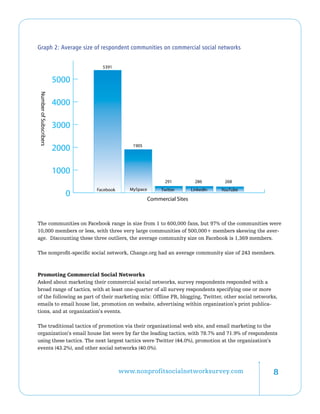
When asked about the size of their commercial social network communities, survey respondents
indicated an average of 5,391 members on their Facebook presence, 1,905 on MySpace, and 291, 286,
and 268 respectively on LinkedIn, Twitter and YouTube.


                                  www.nonprofitsocialnetworksurvey.com
Graph 2: Average size of respondent communities on commercial social networks
                        6000
                                 5391


                        5000
Number of Subscribers


                        4000

                        3000

                        2000                  1905


                        1000
                                                             291           286        268
                               Facebook      MySpace        Twitter       LinkedIn   YouTube
                          0
                                                       Commercial Sites


The communities on Facebook range in size from 1 to 600,000 fans, but 97% of the communities were
10,000 members or less, with three very large communities of 500,000+ members skewing the aver-
age. Discounting these three outliers, the average community size on Facebook is 1,369 members.

The nonprofit-specific social network, Change.org had an average community size of 243 members.


Promoting Commercial Social Networks
Asked about marketing their commercial social networks, survey respondents responded with a
broad range of tactics, with at least one-quarter of all survey respondents specifying one or more
of the following as part of their marketing mix: Offline PR, blogging, Twitter, other social networks,
emails to email house list, promotion on website, advertising within organization’s print publica-
tions, and at organization’s events.

The traditional tactics of promotion via their organizational web site, and email marketing to the
organization’s email house list were by far the leading tactics, with 78.7% and 71.9% of respondents
using these tactics. The next largest tactics were Twitter (44.0%), promotion at the organization’s
events (43.2%), and other social networks (40.0%).


                                          www.nonprofitsocialnetworksurvey.com
Departmental Responsibility for Commercial Social Networks
The communications (25.7% of respondents) and marketing (22.2%) departments are the most likely
teams to take responsibility for the organization’s commercial social networks. Trailing these two
leaders, the fundraising team (9.8%), executive management (9.3%), IT (5.6%) and volunteering (5.7%)
were the next most likely groups to house the commercial social network efforts.

Presence on Commercial Social Networks
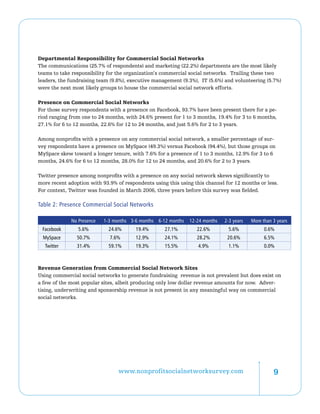
For those survey respondents with a presence on Facebook, 93.7% have been present there for a pe-
riod ranging from one to 24 months, with 24.6% present for 1 to 3 months, 19.4% for 3 to 6 months,
27.1% for 6 to 12 months, 22.6% for 12 to 24 months, and just 5.6% for 2 to 3 years.

Among nonprofits with a presence on any commercial social network, a smaller percentage of sur-
vey respondents have a presence on MySpace (49.3%) versus Facebook (94.4%), but those groups on
MySpace skew toward a longer tenure, with 7.6% for a presence of 1 to 3 months, 12.9% for 3 to 6
months, 24.6% for 6 to 12 months, 28.0% for 12 to 24 months, and 20.6% for 2 to 3 years.

Twitter presence among nonprofits with a presence on any social network skews significantly to
more recent adoption with 93.9% of respondents using this using this channel for 12 months or less.
For context, Twitter was founded in March 2006, three years before this survey was fielded.

Table 2: Presence Commercial Social Networks

             No Presence   1-3 months 3-6 months 6-12 months   12-24 months   2-3 years   More than 3 years
 Facebook       5.6%         24.6%      19.4%       27.1%         22.6%        5.6%             0.6%
  MySpace       50.7%        7.6%       12.9%       24.1%         28.2%        20.6%            6.5%
  Twitter       31.4%        59.1%      19.3%       15.5%         4.9%         1.1%             0.0%


Revenue Generation from Commercial Social Network Sites
Using commercial social networks to generate fundraising revenue is not prevalent but does exist on
a few of the most popular sites, albeit producing only low dollar revenue amounts for now. Adver-
tising, underwriting and sponsorship revenue is not present in any meaningful way on commercial
social networks.


                                 www.nonprofitsocialnetworksurvey.com
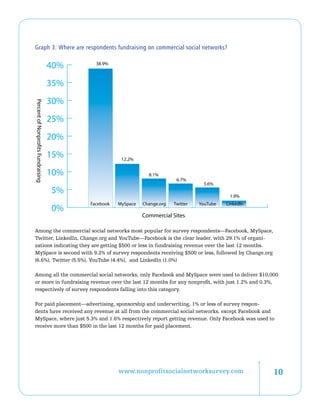
Graph 3: Where are respondents fundraising on commercial social networks?


                                    40%     38.9%


                                    35%
                                    30%
Percent of Nonprofits Fundraising


                                    25%
                                    20%
                                    15%               12.2%


                                    10%                          8.1%
                                                                             6.7%
                                                                                       5.6%
                                    5%                                                           1.9%
                                          Facebook   MySpace   Change.org   Twitter   YouTube   LinkedIn
                                    0%
                                                               Commercial Sites

Among the commercial social networks most popular for survey respondents—Facebook, MySpace,
Twitter, LinkedIn, Change.org and YouTube—Facebook is the clear leader, with 29.1% of organi-
zations indicating they are getting $500 or less in fundraising revenue over the last 12 months.
MySpace is second with 9.2% of survey respondents receiving $500 or less, followed by Change.org
(6.6%), Twitter (5.5%), YouTube (4.4%), and LinkedIn (1.0%)

Among all the commercial social networks, only Facebook and MySpace were used to deliver $10,000
or more in fundraising revenue over the last 12 months for any nonprofit, with just 1.2% and 0.3%,
respectively of survey respondents falling into this category.

For paid placement—advertising, sponsorship and underwriting, 1% or less of survey respon-
dents have received any revenue at all from the commercial social networks, except Facebook and
MySpace, where just 5.3% and 1.6% respectively report getting revenue. Only Facebook was used to
receive more than $500 in the last 12 months for paid placement.


                                                     www.nonprofitsocialnetworksurvey.com                  10
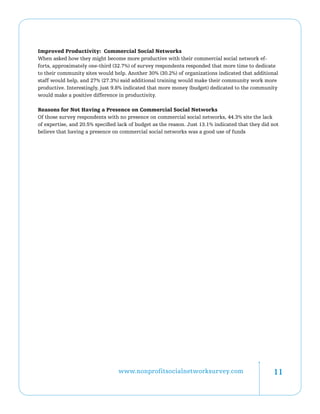
Improved Productivity: Commercial Social Networks
When asked how they might become more productive with their commercial social network ef-
forts, approximately one-third (32.7%) of survey respondents responded that more time to dedicate
to their community sites would help. Another 30% (30.2%) of organizations indicated that additional
staff would help, and 27% (27.3%) said additional training would make their community work more
productive. Interestingly, just 9.8% indicated that more money (budget) dedicated to the community
would make a positive difference in productivity.

Reasons for Not Having a Presence on Commercial Social Networks
Of those survey respondents with no presence on commercial social networks, 44.3% site the lack
of expertise, and 20.5% specified lack of budget as the reason. Just 13.1% indicated that they did not
believe that having a presence on commercial social networks was a good use of funds


                                  www.nonprofitsocialnetworksurvey.com                             11
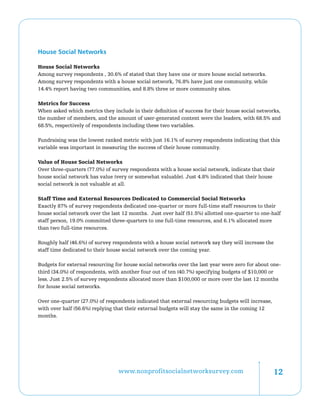
House Social Networks

House Social Networks
Among survey respondents , 30.6% of stated that they have one or more house social networks.
Among survey respondents with a house social network, 76.8% have just one community, while
14.4% report having two communities, and 8.8% three or more community sites.

Metrics for Success
When asked which metrics they include in their definition of success for their house social networks,
the number of members, and the amount of user-generated content were the leaders, with 68.5% and
68.5%, respectively of respondents including these two variables.

Fundraising was the lowest ranked metric with just 16.1% of survey respondents indicating that this
variable was important in measuring the success of their house community.

Value of House Social Networks
Over three-quarters (77.0%) of survey respondents with a house social network, indicate that their
house social network has value (very or somewhat valuable). Just 4.8% indicated that their house
social network is not valuable at all.

Staff Time and External Resources Dedicated to Commercial Social Networks
Exactly 87% of survey respondents dedicated one-quarter or more full-time staff resources to their
house social network over the last 12 months. Just over half (51.5%) allotted one-quarter to one-half
staff person, 19.0% committed three-quarters to one full-time resources, and 6.1% allocated more
than two full-time resources.

Roughly half (46.6%) of survey respondents with a house social network say they will increase the
staff time dedicated to their house social network over the coming year.

Budgets for external resourcing for house social networks over the last year were zero for about one-
third (34.0%) of respondents, with another four out of ten (40.7%) specifying budgets of $10,000 or
less. Just 2.5% of survey respondents allocated more than $100,000 or more over the last 12 months
for house social networks.

Over one-quarter (27.0%) of respondents indicated that external resourcing budgets will increase,
with over half (56.6%) replying that their external budgets will stay the same in the coming 12
months.


                                 www.nonprofitsocialnetworksurvey.com                               12
House Community Size
When queried about the size of their house communities, three-quarters (74.4%) of survey respon-
dents specify 2,500 or less registered members, 12.2% have 2,501 to 10,000 members, and another
13.5% have more than 10,000.

Marketing House Communities
Nonprofit survey respondents are using more traditional channels most often to promote their house
social networks to prospective community members—nearly three-quarters (74.7%) of respondents
say they market their house community via their web site. Seventy-two percent (72.1%) of survey
respondents use email marketing to the organization’s email house list to promote their house social
network, and 61.7% use promotion at organizational events.

Social media channels are used less often by survey respondents to promote their house social net-
works with other social networks (40.9%) , blogging (38.3%), and Twitter (35.7%) [JM4] among the
most commonly used in this emerging promotional category.

Departmental Ownership
Communications, marketing and executive management are the top three owning departments of an
organization’s house social networks with 22.2%, 14.6% and 13.3%, respectively of survey respon-
dents citing these as the department with primary responsibility for the management and mainte-
nance of these sites.

Community Duration
The duration—how long since you launched your house social network—skews to more recent
launches but includes more than one-quarter of survey respondents that launched their communities
two or more years ago.

Of the survey respondents with house social networks roughly four in ten survey respondents (41.4%)
launched their house networks one to 6 months ago, 31.2%) launched their sites 6 months to 2 years
ago, and 27.4% have had house social networks in place for more than two years.

Revenue Generation from House Social Networks
Very few nonprofit survey respondents are generating substantive revenue from their house social
networks. Among survey respondents ,74.7% are not fundraising at all on their house social net-
works. Of the remaining quarter of survey respondents fundraising on their community sites, one-
third (35.0%) raised $10,000 or more over the last 12 months.

Paid placement—advertising, underwriting and sponsorship—on house social networks is used by
14.8%) of respondents, with 5.8% indicating they brought in $1,000 or less over the last 12 months.
The other 9% spanned the range of $1,000 to $100,000+ in paid placement over the preceding year.


                                 www.nonprofitsocialnetworksurvey.com                             13
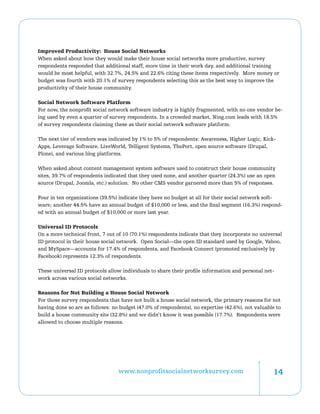
Improved Productivity: House Social Networks
When asked about how they would make their house social networks more productive, survey
respondents responded that additional staff, more time in their work day, and additional training
would be most helpful, with 32.7%, 24.5% and 22.6% citing these items respectively. More money or
budget was fourth with 20.1% of survey respondents selecting this as the best way to improve the
productivity of their house community.

Social Network Software Platform
For now, the nonprofit social network software industry is highly fragmented, with no one vendor be-
ing used by even a quarter of survey respondents. In a crowded market, Ning.com leads with 18.5%
of survey respondents claiming these as their social network software platform.

The next tier of vendors was indicated by 1% to 5% of respondents: Awareness, Higher Logic, Kick-
Apps, Leverage Software, LiveWorld, Telligent Systems, ThePort, open source software (Drupal,
Plone), and various blog platforms.

When asked about content management system software used to construct their house community
sites, 39.7% of respondents indicated that they used none, and another quarter (24.3%) use an open
source (Drupal, Joomla, etc.) solution. No other CMS vendor garnered more than 5% of responses.

Four in ten organizations (39.5%) indicate they have no budget at all for their social network soft-
ware; another 44.5% have an annual budget of $10,000 or less, and the final segment (16.3%) respond-
ed with an annual budget of $10,000 or more last year.

Universal ID Protocols
On a more technical front, 7 out of 10 (70.1%) respondents indicate that they incorporate no universal
ID protocol in their house social network. Open Social—the open ID standard used by Google, Yahoo,
and MySpace—accounts for 17.4% of respondents, and Facebook Connect (promoted exclusively by
Facebook) represents 12.3% of respondents.

These universal ID protocols allow individuals to share their profile information and personal net-
work across various social networks.

Reasons for Not Building a House Social Network
For those survey respondents that have not built a house social network, the primary reasons for not
having done so are as follows: no budget (47.0% of respondents), no expertise (42.6%), not valuable to
build a house community site (32.8%) and we didn’t know it was possible (17.7%). Respondents were
allowed to choose multiple reasons.


                                 www.nonprofitsocialnetworksurvey.com                             14
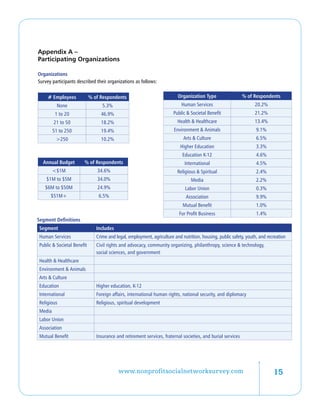
Appendix A –
Participating Organizations

Organizations
Survey participants described their organizations as follows:


     # Employees            % of Respondents                              Organization Type                  % of Respondents
          None                    5.3%                                      Human Services                         20.2%
         1 to 20                 46.9%                                  Public  Societal Benefit                  21.2%
        21 to 50                 18.2%                                    Health  Healthcare                      13.4%
        51 to 250                19.4%                                  Environment  Animals                       9.1%
         250                    10.2%                                       Arts  Culture                         6.5%
                                                                           Higher Education                         3.3%
                                                                            Education K-12                          4.6%
  Annual Budget        % of Respondents                                       International                         4.5%
        $1M                   34.6%                                      Religious  Spiritual                     2.4%
    $1M to $5M                 34.0%                                             Media                              2.2%
   $6M to $50M                 24.9%                                          Labor Union                           0.3%
      $51M+                     6.5%                                          Association                           9.9%
                                                                             Mutual Benefit                         1.0%
                                                                           For Profit Business                      1.4%
Segment Definitions
Segment                        Includes
Human Services                 Crime and legal, employment, agriculture and nutrition, housing, public safety, youth, and recreation
Public  Societal Benefit      Civil rights and advocacy, community organizing, philanthropy, science  technology,
                               social sciences, and government
Health  Healthcare
Environment  Animals
Arts  Culture
Education                      Higher education, K-12
International                  Foreign affairs, international human rights, national security, and diplomacy
Religious                      Religious, spiritual development
Media
Labor Union
Association
Mutual Benefit                 Insurance and retirement services, fraternal societies, and burial services


                                          www.nonprofitsocialnetworksurvey.com                                               15
Appendix B – Survey Methodology

A 50-question online survey was fielded from February 20, 2009 to April 15, 2009, drawing a sample
size of 980 respondents and producing a margin of error of +/- 3.13% with 95% confidence.


                                  www.nonprofitsocialnetworksurvey.com                           16
About
                                   NTEN aspires to a world where all nonprofit organizations skillfully and confidently use
                                   technology to meet community needs and fulfill their missions.

We are the membership organization of nonprofit technology professionals. Our members share the common goal of helping
nonprofits use all aspects of technology more effectively.

We believe that technology allows nonprofits to work with greater social impact. We enable our members to strategically use
technology to make the world a better, just, and equitable place.

NTEN facilitates the exchange of knowledge and information within our community. We connect our members to each other,
provide professional development opportunities, educate our constituency on issues of technology use in nonprofits, and spear-
head groundbreaking research, advocacy, and education on technology issues affecting our entire community.


                                  Common Knowledge, an online agency founded in 2002 and based in San Francisco
                                  provides comprehensive services for online fundraising, advocacy, marketing,
communications, and social networking to nonprofit organizations that need to leverage the Internet more effectively
to further their mission.

Broadly, Common Knowledge offers assistance to our clients in four service areas:
• Online Strategy (including interactive media),
• Web Site Design and Development,
• Social Networking and Online Community Development,
• Online Campaigns (including email fundraising and acquisition).

Our current base of 30+ nonprofit clients includes Arthritis Foundation, Sierra Club, Operation Smile, International Fund for
Animal Welfare, Partnership for a Drug Free America, Seva Foundation, Community Gatepath, Disabled Americans Veterans,
Equality California and others.


                                                ThePort™ Network, Inc. is dedicated to delivering compelling and complete soft-
                                                ware as a service (SaaS) solutions that enable customers to create, operate and
monetize socially enabled online communities. Through its integrated suite of proven social media solutions, ThePort enables its
customers to enhance their existing web presence with branded online communities, creating engagement between the brand
and their constituents, stimulating interaction between community members, and driving new revenue opportunities. With a
focus on the nonprofit, trade association and media industries, ThePort customers include such world-renowned organizations
as BizJournals, CARE, Arthritis Foundation, Sierra Club, Reserve Officers Association, Restaurant and Facility Management As-
sociation, and Lee Enterprises. For more information, visit www.theport.com.


                                         www.nonprofitsocialnetworksurvey.com                                                   17

Nonprofit socialnetworksurveyreport

  • 1.
    April 2009 Nonprofit Social Network Survey Report www.nten.org www.commonknow.com www.theport.com www.nonprofitsocialnetworksurvey.com www.nonprofitsocialnetworksurvey.com © Common Knowledge • NTEN • ThePort 2009
  • 2.
    Executive Summary Between February20 and April 15, 2009, 980 nonprofit professionals responded to a survey about their organization’s use of online social networks. The survey is sponsored by NTEN, Common Knowledge and ThePort. Three groups of questions were posed to survey participants: 1) About their use of commercial social networks such as Facebook, MySpace, LinkedIn, and others. 2) About the construction and use of social networks on their own web sites, called house social networks in this report. 3) Demographic information about their organization. Survey respondents represented small, medium and large nonprofits and all segments including Human house social network – Services, Public Societal Benefit, Health Healthcare, Social networking community Environment Animals, Arts Culture, Education (K -12 Higher Ed), International, Religious Spiritual, built on a nonprofit’s own web Media, Labor Union, Associations, and Mutual Benefit. site. Term derived from direct See Appendix A for a detailed definition of these seg- ments and survey respondent participation rates by mail house lists. organization size and segment. commercial social network – From the survey, we learned that commercial social networks, especially Facebook, are popular, but aver- An online community owned age community sizes remain small, and presence is and operated by a corporation. relatively short. Responding nonprofits are allocating small but real resources, staff and budget to their social Popular examples include networks. Survey respondents prefer traditional mar- Facebook and Myspace keting channels to promote their social networks but are experimenting with new social media channels. For now, there is very little real revenue generated on these communities via fundraising and advertising. A minority of nonprofit survey respondents, about one third, have built and manage their own house social networks, using software from a wide variety of social network software vendors, with no clear leader among these vendors. The members of house social networks are as yet, with just a few exceptions, still relatively small as well. www.nonprofitsocialnetworksurvey.com
  • 3.
    Following are morehighlights from the survey: · Among commercial social networks, Facebook is the most popular with 74.1% of non- profit survey respondents maintaining a presence on this commercial site. Community sizes are still small, however, with an average size of just 5,391members. Tenure on Facebook is relatively short, with most nonprofit survey respondents (94.4%) present for 2 years or less. For Twitter, 93.9% of organizations report using this channel for one year or less. · Staffing and budgets for nonprofit social network projects—on commercial social networks—are real but small, with four-fifths of nonprofit survey respondents com- mitting at least one-quarter of a full-time staff person to these efforts. More than half of nonprofit survey respondents intend to increase social network project staffing over the next 12 months. External resourcing for social network projects is lower, with 4 out of 10 organizations allocating any budget, and 8.3% reserving $10,000 or more over the last 12 months for outside help. · Nonprofit survey respondents prefer more traditional marketing tactics to promote their commercial and house social networks—prioritizing website, email list and events to get the word out about their online communities. Lower in popularity but still prevalent were the use of Twitter and other social networks. · The communications and marketing departments are most likely to own the social network efforts, with fundraising and executive management the next most common shepherds of nonprofit’s social network projects. · Very few nonprofit survey respondents are generating real revenue on commercial or house social networks via fundraising. On Facebook, about 39.9% of respondents have raised money via fundraising, but 29.1% have raised $500 or less over the past 12 months. On house social networks, 25.2% of nonprofit survey respondents are fund- raising, and 1/3 of these fundraisers accumulated $10,000 or more over the last year. · Among nonprofit survey respondents 30.6% have built one or more house social networks, but here again the community size is relatively small, with 86.6% of house social network-owning nonprofit survey respondents hosting communities of 10,000 members or less. www.nonprofitsocialnetworksurvey.com
  • 4.
    Nonprofits continue toquestion whether it is better to build a community on, for example, Facebook, or to construct their own house social network. Following is a side-by-side comparison of survey responses for the two types of online communities: Table 1: Nonprofit activity on commercial and house social networks Question Commercial Social Networks House Social Networks 1. Does your organization have one? 86.2% replied YES 30.6% replied yes (1 or more communiites) 2. What is the primary purpose of the Marketing (80.5%) Marketing (55.9%) community? 3. How much staff time did you 1/4 to 1/2 of a full time employee 1/4 to 1/2 of a full time employee allocate to the community over the (64.5%) (51.5%) preceding year? 4. How much budget for external None (59.3%) $1-$10,000 (32.2%) None (34.0%) $1 - $10,000 (40.7%) resources did you allocate over the preceding year? 5. Number of community members? Average: 5,3912* 10,000 or less (86.6%) 6. How long have you had your com- 1-24 months (93.8%)* 1-24 months (72.6%) munity? (Among those with a com- munity of this type) 7. How much fundraising revenue Not Fundraising (61.1%) Not Fundraising (74.7%) have you raised from your community Fundraising and raised $0 - $10,000 Fundraising and raised $0 - $10,000 over the preceding year? (Among (37.8%)* (16.5%) those with a community of this type) 8. How much revenue from sponsor- Not Advertising (94.8%)* Not Advertising (85.3%) ship, underwriting and advertising Advertising and received $0-$10,000 Advertising and received $0-$10,000 have you received from your commu- (4.7%) (8.9%) nity over the preceding year? 9. For those nonprofits without a Do not have the expertise in-house Do not have sufficient budget (47.0%) community of this type, what is the (44.3%) primary reason? * Facebook www.nonprofitsocialnetworksurvey.com
  • 5.
    The primary differencebetween the two types of communities, then, is “Does your organization have a community of this type?” Among respondents 86.2% of nonprofits have a presence on at least one commercial social network, and just 30.6% have a house social network. Presumably, nonprofits find it easier to get started on Facebook with a Group, Page or Cause then to build their first house network, so more of them do. To get real value from their networks, however, nonprofits will need to scale and manage a large community. The ease and efficiency of building and managing a large community is not discernible from this survey, but will be an important theme in the long term. The potential for building and integrating both platforms simultaneously looms as a valuable strategy. · The social network software market—vendors offering software to build house social networks—is highly fragmented. Ning leads with 18.5% of nonprofit survey respon- dents specifying this vendor as their platform, and 15+ other vendors with 5% or less each. · The universal ID protocols— Open Social (Google, Yahoo, MySpace) and Facebook Connect— are used by 29.7% of organizations with house social networks, where Open Social is the more popular with 17.4% of nonprofit survey respondents using this standard, compared to Facebook’s standard used by 12.3% of respondents. www.nonprofitsocialnetworksurvey.com
  • 6.
    Detailed Reporting ofSurvey Results Commercial Social Networks Popularity of Commercial Social Networks By a large margin, Facebook is the most popular of the commercial social networks with 74.0% of re- spondents indicating that their organization has a presence there. YouTube and Twitter are a distant second and third with 46.5% and 43.2%, respectively, of nonprofit survey respondents indicating they maintain a presence in these channels. Linked In was fourth with 32.9% , and MySpace fifth with 26.1% of respondents. Graph 1: Popularity of Commercial Social Networks 80% Commercial Percent of Nonprofits with a Profile/Page 70% 74.0% 60% 50% 46.5% 40% 43.2% 30% 32.9% 26.1% 20% 10% Facebook YouTube Twitter LinkedIn MySpace 0% Commercial Sites Within individual vertical segments, professional associations were more likely to use LinkedIn than Facebook for their commercial social network efforts—51.7% of associations cited LinkedIn as their commercial social network platform versus 32.8% of survey respondents across all verticals. Likewise, just 55.2% of associations reported using Facebook versus an average of 74.1% across all verticals. www.nonprofitsocialnetworksurvey.com
  • 7.
    Role of CommercialSocial Networks Looking at how survey respondents use their commercial social networks, we find the most popular role is for traditional marketing—to promote the nonprofit’s brand, programs, events or services, with 80.5% of survey respondents indicating this role as the purpose of their presence on commercial social networks. The second most popular role is for word-of-mouth marketing, at 72.7% of respon- dents. Market research and delivering programs or services via the social network are significantly less typical with 43.1% and 35.5% respectively. Staff Time and External Resources Dedicated to Commercial Social Networks Fully four-fifths (80.8%) of survey respondents committed at least one-quarter of a full-time staff member to maintaining—marketing, managing and cultivating—their commercial social network presence over the last 12 months. Roughly two thirds (64.5%) of survey respondents dedicated one- quarter to one-half of a full-time resource, and 16.3% committed three-quarters or more staff to their commercial social networks. Looking ahead, over half (55.0%) of survey respondents indicate they will increase staffing over the next 12 months, 39.5%) say staffing will stay the same, and just 1 in 20 (5.6%) will decrease staffing. Four out of ten (40.6%) survey respondents had some budget over the last 12 months for external resources dedicated to helping with their commercial social network work, but just 8.3% set aside $10,000 or more, with only 1.4% allotting more than $100,000 to external resources to help with commercial social network efforts. About one-quarter (24.1%) of survey respondents indicate they will increase funding for external re- sources dedicated to helping with commercial social network efforts in the coming 12 months, while the majority (68.0%) say they will keep external resourcing budgets the same. 7.9% of survey respon- dents will decrease their social network external resource budgets for the coming year. Community Size: Commercial Social Networks When asked about the size of their commercial social network communities, survey respondents indicated an average of 5,391 members on their Facebook presence, 1,905 on MySpace, and 291, 286, and 268 respectively on LinkedIn, Twitter and YouTube. www.nonprofitsocialnetworksurvey.com
  • 8.
    Graph 2: Averagesize of respondent communities on commercial social networks 6000 5391 5000 Number of Subscribers 4000 3000 2000 1905 1000 291 286 268 Facebook MySpace Twitter LinkedIn YouTube 0 Commercial Sites The communities on Facebook range in size from 1 to 600,000 fans, but 97% of the communities were 10,000 members or less, with three very large communities of 500,000+ members skewing the aver- age. Discounting these three outliers, the average community size on Facebook is 1,369 members. The nonprofit-specific social network, Change.org had an average community size of 243 members. Promoting Commercial Social Networks Asked about marketing their commercial social networks, survey respondents responded with a broad range of tactics, with at least one-quarter of all survey respondents specifying one or more of the following as part of their marketing mix: Offline PR, blogging, Twitter, other social networks, emails to email house list, promotion on website, advertising within organization’s print publica- tions, and at organization’s events. The traditional tactics of promotion via their organizational web site, and email marketing to the organization’s email house list were by far the leading tactics, with 78.7% and 71.9% of respondents using these tactics. The next largest tactics were Twitter (44.0%), promotion at the organization’s events (43.2%), and other social networks (40.0%). www.nonprofitsocialnetworksurvey.com
  • 9.
    Departmental Responsibility forCommercial Social Networks The communications (25.7% of respondents) and marketing (22.2%) departments are the most likely teams to take responsibility for the organization’s commercial social networks. Trailing these two leaders, the fundraising team (9.8%), executive management (9.3%), IT (5.6%) and volunteering (5.7%) were the next most likely groups to house the commercial social network efforts. Presence on Commercial Social Networks For those survey respondents with a presence on Facebook, 93.7% have been present there for a pe- riod ranging from one to 24 months, with 24.6% present for 1 to 3 months, 19.4% for 3 to 6 months, 27.1% for 6 to 12 months, 22.6% for 12 to 24 months, and just 5.6% for 2 to 3 years. Among nonprofits with a presence on any commercial social network, a smaller percentage of sur- vey respondents have a presence on MySpace (49.3%) versus Facebook (94.4%), but those groups on MySpace skew toward a longer tenure, with 7.6% for a presence of 1 to 3 months, 12.9% for 3 to 6 months, 24.6% for 6 to 12 months, 28.0% for 12 to 24 months, and 20.6% for 2 to 3 years. Twitter presence among nonprofits with a presence on any social network skews significantly to more recent adoption with 93.9% of respondents using this using this channel for 12 months or less. For context, Twitter was founded in March 2006, three years before this survey was fielded. Table 2: Presence Commercial Social Networks No Presence 1-3 months 3-6 months 6-12 months 12-24 months 2-3 years More than 3 years Facebook 5.6% 24.6% 19.4% 27.1% 22.6% 5.6% 0.6% MySpace 50.7% 7.6% 12.9% 24.1% 28.2% 20.6% 6.5% Twitter 31.4% 59.1% 19.3% 15.5% 4.9% 1.1% 0.0% Revenue Generation from Commercial Social Network Sites Using commercial social networks to generate fundraising revenue is not prevalent but does exist on a few of the most popular sites, albeit producing only low dollar revenue amounts for now. Adver- tising, underwriting and sponsorship revenue is not present in any meaningful way on commercial social networks. www.nonprofitsocialnetworksurvey.com
  • 10.
    Graph 3: Whereare respondents fundraising on commercial social networks? 40% 38.9% 35% 30% Percent of Nonprofits Fundraising 25% 20% 15% 12.2% 10% 8.1% 6.7% 5.6% 5% 1.9% Facebook MySpace Change.org Twitter YouTube LinkedIn 0% Commercial Sites Among the commercial social networks most popular for survey respondents—Facebook, MySpace, Twitter, LinkedIn, Change.org and YouTube—Facebook is the clear leader, with 29.1% of organi- zations indicating they are getting $500 or less in fundraising revenue over the last 12 months. MySpace is second with 9.2% of survey respondents receiving $500 or less, followed by Change.org (6.6%), Twitter (5.5%), YouTube (4.4%), and LinkedIn (1.0%) Among all the commercial social networks, only Facebook and MySpace were used to deliver $10,000 or more in fundraising revenue over the last 12 months for any nonprofit, with just 1.2% and 0.3%, respectively of survey respondents falling into this category. For paid placement—advertising, sponsorship and underwriting, 1% or less of survey respon- dents have received any revenue at all from the commercial social networks, except Facebook and MySpace, where just 5.3% and 1.6% respectively report getting revenue. Only Facebook was used to receive more than $500 in the last 12 months for paid placement. www.nonprofitsocialnetworksurvey.com 10
  • 11.
    Improved Productivity: CommercialSocial Networks When asked how they might become more productive with their commercial social network ef- forts, approximately one-third (32.7%) of survey respondents responded that more time to dedicate to their community sites would help. Another 30% (30.2%) of organizations indicated that additional staff would help, and 27% (27.3%) said additional training would make their community work more productive. Interestingly, just 9.8% indicated that more money (budget) dedicated to the community would make a positive difference in productivity. Reasons for Not Having a Presence on Commercial Social Networks Of those survey respondents with no presence on commercial social networks, 44.3% site the lack of expertise, and 20.5% specified lack of budget as the reason. Just 13.1% indicated that they did not believe that having a presence on commercial social networks was a good use of funds www.nonprofitsocialnetworksurvey.com 11
  • 12.
    House Social Networks HouseSocial Networks Among survey respondents , 30.6% of stated that they have one or more house social networks. Among survey respondents with a house social network, 76.8% have just one community, while 14.4% report having two communities, and 8.8% three or more community sites. Metrics for Success When asked which metrics they include in their definition of success for their house social networks, the number of members, and the amount of user-generated content were the leaders, with 68.5% and 68.5%, respectively of respondents including these two variables. Fundraising was the lowest ranked metric with just 16.1% of survey respondents indicating that this variable was important in measuring the success of their house community. Value of House Social Networks Over three-quarters (77.0%) of survey respondents with a house social network, indicate that their house social network has value (very or somewhat valuable). Just 4.8% indicated that their house social network is not valuable at all. Staff Time and External Resources Dedicated to Commercial Social Networks Exactly 87% of survey respondents dedicated one-quarter or more full-time staff resources to their house social network over the last 12 months. Just over half (51.5%) allotted one-quarter to one-half staff person, 19.0% committed three-quarters to one full-time resources, and 6.1% allocated more than two full-time resources. Roughly half (46.6%) of survey respondents with a house social network say they will increase the staff time dedicated to their house social network over the coming year. Budgets for external resourcing for house social networks over the last year were zero for about one- third (34.0%) of respondents, with another four out of ten (40.7%) specifying budgets of $10,000 or less. Just 2.5% of survey respondents allocated more than $100,000 or more over the last 12 months for house social networks. Over one-quarter (27.0%) of respondents indicated that external resourcing budgets will increase, with over half (56.6%) replying that their external budgets will stay the same in the coming 12 months. www.nonprofitsocialnetworksurvey.com 12
  • 13.
    House Community Size Whenqueried about the size of their house communities, three-quarters (74.4%) of survey respon- dents specify 2,500 or less registered members, 12.2% have 2,501 to 10,000 members, and another 13.5% have more than 10,000. Marketing House Communities Nonprofit survey respondents are using more traditional channels most often to promote their house social networks to prospective community members—nearly three-quarters (74.7%) of respondents say they market their house community via their web site. Seventy-two percent (72.1%) of survey respondents use email marketing to the organization’s email house list to promote their house social network, and 61.7% use promotion at organizational events. Social media channels are used less often by survey respondents to promote their house social net- works with other social networks (40.9%) , blogging (38.3%), and Twitter (35.7%) [JM4] among the most commonly used in this emerging promotional category. Departmental Ownership Communications, marketing and executive management are the top three owning departments of an organization’s house social networks with 22.2%, 14.6% and 13.3%, respectively of survey respon- dents citing these as the department with primary responsibility for the management and mainte- nance of these sites. Community Duration The duration—how long since you launched your house social network—skews to more recent launches but includes more than one-quarter of survey respondents that launched their communities two or more years ago. Of the survey respondents with house social networks roughly four in ten survey respondents (41.4%) launched their house networks one to 6 months ago, 31.2%) launched their sites 6 months to 2 years ago, and 27.4% have had house social networks in place for more than two years. Revenue Generation from House Social Networks Very few nonprofit survey respondents are generating substantive revenue from their house social networks. Among survey respondents ,74.7% are not fundraising at all on their house social net- works. Of the remaining quarter of survey respondents fundraising on their community sites, one- third (35.0%) raised $10,000 or more over the last 12 months. Paid placement—advertising, underwriting and sponsorship—on house social networks is used by 14.8%) of respondents, with 5.8% indicating they brought in $1,000 or less over the last 12 months. The other 9% spanned the range of $1,000 to $100,000+ in paid placement over the preceding year. www.nonprofitsocialnetworksurvey.com 13
  • 14.
    Improved Productivity: HouseSocial Networks When asked about how they would make their house social networks more productive, survey respondents responded that additional staff, more time in their work day, and additional training would be most helpful, with 32.7%, 24.5% and 22.6% citing these items respectively. More money or budget was fourth with 20.1% of survey respondents selecting this as the best way to improve the productivity of their house community. Social Network Software Platform For now, the nonprofit social network software industry is highly fragmented, with no one vendor be- ing used by even a quarter of survey respondents. In a crowded market, Ning.com leads with 18.5% of survey respondents claiming these as their social network software platform. The next tier of vendors was indicated by 1% to 5% of respondents: Awareness, Higher Logic, Kick- Apps, Leverage Software, LiveWorld, Telligent Systems, ThePort, open source software (Drupal, Plone), and various blog platforms. When asked about content management system software used to construct their house community sites, 39.7% of respondents indicated that they used none, and another quarter (24.3%) use an open source (Drupal, Joomla, etc.) solution. No other CMS vendor garnered more than 5% of responses. Four in ten organizations (39.5%) indicate they have no budget at all for their social network soft- ware; another 44.5% have an annual budget of $10,000 or less, and the final segment (16.3%) respond- ed with an annual budget of $10,000 or more last year. Universal ID Protocols On a more technical front, 7 out of 10 (70.1%) respondents indicate that they incorporate no universal ID protocol in their house social network. Open Social—the open ID standard used by Google, Yahoo, and MySpace—accounts for 17.4% of respondents, and Facebook Connect (promoted exclusively by Facebook) represents 12.3% of respondents. These universal ID protocols allow individuals to share their profile information and personal net- work across various social networks. Reasons for Not Building a House Social Network For those survey respondents that have not built a house social network, the primary reasons for not having done so are as follows: no budget (47.0% of respondents), no expertise (42.6%), not valuable to build a house community site (32.8%) and we didn’t know it was possible (17.7%). Respondents were allowed to choose multiple reasons. www.nonprofitsocialnetworksurvey.com 14
  • 15.
    Appendix A – ParticipatingOrganizations Organizations Survey participants described their organizations as follows: # Employees % of Respondents Organization Type % of Respondents None 5.3% Human Services 20.2% 1 to 20 46.9% Public Societal Benefit 21.2% 21 to 50 18.2% Health Healthcare 13.4% 51 to 250 19.4% Environment Animals 9.1% 250 10.2% Arts Culture 6.5% Higher Education 3.3% Education K-12 4.6% Annual Budget % of Respondents International 4.5% $1M 34.6% Religious Spiritual 2.4% $1M to $5M 34.0% Media 2.2% $6M to $50M 24.9% Labor Union 0.3% $51M+ 6.5% Association 9.9% Mutual Benefit 1.0% For Profit Business 1.4% Segment Definitions Segment Includes Human Services Crime and legal, employment, agriculture and nutrition, housing, public safety, youth, and recreation Public Societal Benefit Civil rights and advocacy, community organizing, philanthropy, science technology, social sciences, and government Health Healthcare Environment Animals Arts Culture Education Higher education, K-12 International Foreign affairs, international human rights, national security, and diplomacy Religious Religious, spiritual development Media Labor Union Association Mutual Benefit Insurance and retirement services, fraternal societies, and burial services www.nonprofitsocialnetworksurvey.com 15
  • 16.
    Appendix B –Survey Methodology A 50-question online survey was fielded from February 20, 2009 to April 15, 2009, drawing a sample size of 980 respondents and producing a margin of error of +/- 3.13% with 95% confidence. www.nonprofitsocialnetworksurvey.com 16
  • 17.
    About NTEN aspires to a world where all nonprofit organizations skillfully and confidently use technology to meet community needs and fulfill their missions. We are the membership organization of nonprofit technology professionals. Our members share the common goal of helping nonprofits use all aspects of technology more effectively. We believe that technology allows nonprofits to work with greater social impact. We enable our members to strategically use technology to make the world a better, just, and equitable place. NTEN facilitates the exchange of knowledge and information within our community. We connect our members to each other, provide professional development opportunities, educate our constituency on issues of technology use in nonprofits, and spear- head groundbreaking research, advocacy, and education on technology issues affecting our entire community. Common Knowledge, an online agency founded in 2002 and based in San Francisco provides comprehensive services for online fundraising, advocacy, marketing, communications, and social networking to nonprofit organizations that need to leverage the Internet more effectively to further their mission. Broadly, Common Knowledge offers assistance to our clients in four service areas: • Online Strategy (including interactive media), • Web Site Design and Development, • Social Networking and Online Community Development, • Online Campaigns (including email fundraising and acquisition). Our current base of 30+ nonprofit clients includes Arthritis Foundation, Sierra Club, Operation Smile, International Fund for Animal Welfare, Partnership for a Drug Free America, Seva Foundation, Community Gatepath, Disabled Americans Veterans, Equality California and others. ThePort™ Network, Inc. is dedicated to delivering compelling and complete soft- ware as a service (SaaS) solutions that enable customers to create, operate and monetize socially enabled online communities. Through its integrated suite of proven social media solutions, ThePort enables its customers to enhance their existing web presence with branded online communities, creating engagement between the brand and their constituents, stimulating interaction between community members, and driving new revenue opportunities. With a focus on the nonprofit, trade association and media industries, ThePort customers include such world-renowned organizations as BizJournals, CARE, Arthritis Foundation, Sierra Club, Reserve Officers Association, Restaurant and Facility Management As- sociation, and Lee Enterprises. For more information, visit www.theport.com.   www.nonprofitsocialnetworksurvey.com 17