1 
A 
DISSERTATION REPORT 
ON 
“Are Social Networking more persuasive than 
Traditional Word of Mouth” 
Submitted by 
KUMAR GAURAV 
In partial fulfillment of the requirement for the degree of 
Master of Business Administration 
Submitted to 
Dr. Anurag Singh 
Assistant Professor 
FMS-BHU 
Faculty of Management Studies 
Banaras Hindu University 
Roll no Enrolment no Batch 
12380MA025 351041 2012-2014
2 
DECLARATION 
I hereby declare that this project work entitled “Are social networking more 
persuasive than traditional word of mouth ” is my original work, carried out under 
the guidance of my faculty guide Dr. Anurag Singh has not been submitted to any 
other institute/ university or any organization apart from Faculty of Management 
Studies Banaras Hindu University. 
Kumar Gaurav 
(Signature)
3 
ACKNOWLEDGEMENT 
To acknowledge all the persons who had helped for the fulfillment of the project 
is not possible for any researcher but in spite of all that, it becomes a foremost 
responsibility of the researcher and also the part of research ethics to 
acknowledge those who had played a great role for the completion of the 
project. 
So in the same sequence at very first, I would like to acknowledge my parents 
because of whom I got the existence in the world for the inception and the 
conception of this project. Later on I would like to confer the flower of 
acknowledgement to Dr. Anurag Singh Sir and other faculty members who 
taught me that how to do project through appropriate tools and techniques. And 
would also like to thanks my friends who constantly supported me while working 
on the project. 
Rest all those people who helped me are not only matter of acknowledgement 
but also authorized for sharing my success. 
Kumar Gaurav 
MBA(Marketing) 4th Sem 
Roll No. 25
CERTIFICATE 
, 670 1414 
Are social networking more 
This is to certify that the research report entitled “ 
persuasive than traditional word of mouth 
supervision by Mr. Kumar Gaurav 
2012-2014) of this faculty as a part of his Course Curriculum. This report is his 
original work and up to the standard expected of an MBA student of this Faculty. 
I recommend the Report be forwarded for evaluation. 
mouth” has been prepared under my 
a student of MBA (Marketing) IV Sem. (Batch 
(Dr. Anurag Singh 
Supervisor 
Singh) 
4
5 
CONTENT 
 Introduction 5 
Word of Mouth 
Social Networking 
 Literature Review 9 
 Objective 18 
 Hypothesis 18 
 Research Methodology 19 
 Data Analysis and Interpretation 20 
 Conclusion and Findings 31 
 Suggestion 33 
 Learning 34 
 Limitation 35 
 References 36 
 Questionnaire 37
6 
Introduction 
The word of mouth (WOM) industry is experiencing massive growth—since 2004 
the Word of Mouth Marketing Association (WOMMA) has grown from3 to 350 
corporate members (WOMMA, 2007). This growth is particularly evident in online 
and social networking media. Research estimates that while 90% of WOM 
conversations take place offline (Keller Berry, 2006), just 15% of consumers 
account for one third of WOM conversations in America, and those “Conversation 
Catalysts” rely heavily on the Internet as a resource for the information they pass 
along to their family and friends (Keller Fay, 2006) Word-of-mouth (WOM) 
marketing has recently attracted a great deal of attention among practitioners. 
For example, several books tout word-of-mouth as a viable alternative to 
traditional marketing communication tools. One calls it “the world’s most 
effective, yet least understood marketing strategy” (Misner 1999). Marketers are 
particularly interested in better understanding word-of-mouth as traditional forms 
of communication appear to be losing effectiveness (Forrester 2005). For 
example, one survey showed consumer attitudes toward advertising plummeting 
between September 2002 and June 2004. Forrester (2005) reported that 40% 
fewer agree that ads are a good way to learn about new products, 59% fewer say 
they buy products because of their ads, and49% fewer find ads entertaining. 
WOM communication strategies are appealing because they combine the 
prospect of overcoming consumer resistance with significantly lower costs and 
fast delivery – especially through technology such as the Internet. Unfortunately, 
empirical evidence is currently scant regarding the relative effectiveness of WOM 
marketing in increasing firm performance over time. This raises the need to study 
how firms can measure the effects of word-of-mouth communications and how 
WOM compares to other forms of marketing communication. WOM marketing is 
a particularly prominent feature on the Internet. The Internet provides numerous 
venues for consumers to share their views, preferences, or experiences with 
others as well as opportunities for firms to take advantage of WOM marketing. As 
one commentator stated, “Instead of tossing away millions of dollars on Super 
bowl ads, fledging dot-com companies are trying to catch attention through much 
cheaper marketing strategies such as blogging and word-of-mouth campaigns”
(Whitman2006). As many of these companies have “grown up” and also begin to 
spend significantly on traditional marketing (e.g., the Superbowl 3 
One of the fastest growing arenas of the World Wide Web is the space o fso-called 
7 
social networking sites (e.g., Facebook, MySpace, Friendster, Xanga). 
These sites rely up on user-generated content to attract and retain visitors, 
obtaining revenue primarily from the sale of online display advertising. They also 
accumulate user information that may be valuable for targeted marketing 
purposes. 
The social network setting offers an appealing context to study word-of-mouth. 
The sites provide easy-to-use tools for current users to invite others to join the 
network. The electronic recording of these outbound referrals opens a new 
window into the effects of WOM, giving researchers an unobtrusive trace of this 
often hard-to-study activity. When combined with data that also tracks new 
member signups, it becomes possible to model the dynamic relationship between 
this form of word-of-mouth and the addition of new members to the social 
networking site. These members are, in a real sense, also the “customers” of the 
social networking site, as their exposure to advertising while using the site 
produces revenue for the firm. 
Internet companies commonly employ several types of WOM marketing 
activities. The major categories include the following: 
1) Viral Marketing – creating entertaining or informative messages designed to 
be passed on by each message receiver, analogous to the spread of an 
epidemic, often electronically or by email. 
2) Referral Programs– creating tools that enable satisfied customers to refer 
their family and friends; and 4 Effects of Word-of-Mouth versus Traditional 
Marketing 
3) Community Marketing – forming or supporting niche communities that are 
likely to share interests about a product or brand (such as user groups, fan clubs, 
and discussion forums) and providing tools, content, and information to support 
those communities.
In this project we tried to compare measure the effectiveness of recommendation 
made through social networking and traditional WOM. Here social networking 
involves the online forum, groups, blogs that contain positive or negative review 
of the goods and services. And traditional WOM involves recommendation made 
offline. Though traditional WOM is used widely by the consumer while marketing 
through social networking is confined to the internet user . But recent research 
shows that marketing through social networking is growing very fast. 
8
Word of Mouth Communication 
WOM is a consumer-dominated channel of marketing communication where the 
sender is independent of the market. It is therefore perceived to be more reliable, 
credible, and trustworthy by consumers compared to firm-initiated 
communications. 
(Schiffman & Kanuk,1995; Arndt, 1967). 
Traditional communications theory considers WOM as having a powerful 
influence on behavior, especially on consumers’ information search, evaluation, 
and subsequent decision making. 
(Cox,1963; Brown & Reingen, 1987; Money, Gilly, &Graham, 1998; G. 
Silverman, 2001). 
Social Networking 
A social network is a group of individuals linked together by different social ties, 
ranging from casual acquaintance to work relationships and family ties. 
The social network is therefore meant to be a service whose primary 
function is to allow or facilitate the organization and management of a map 
of a social community. 
Social networks are a means but not a medium in the sense of 
"intermediary" (as in the mass media) but in the sense of a social tool, social 
media. 
9
Literature Review 
In recent years, social networking sites and social media have increased in 
popularity, at a global level. For instance, Facebook is said to have more than a 
billion active users (as of 2012) since its beginning in 2004 
(www.facebook.com). Social networking sites can be described as networks of 
friends for social or professional interactions (Trusov, Bucklin, & Pauwels, 2009). 
Indeed, online social networks have profoundly changed the propagation of 
information by making it incredibly easy to share and digest information on the 
internet (Akrimi & Khemakhem, 2012). 
The unique aspects of social media and its immense popularity have 
revolutionized marketing practices such as advertising and promotion (Hanna, 
Rohm, & Crittenden, 2011). Social media has also influenced consumer 
behavior from information acquisition to post-purchase behavior such as 
dissatisfaction statements or behaviors (Mangold & Faulds, 2009) and patterns 
of Internet usage (Ross et al., 2009; Laroche et al., 2012). 
Social media is ‘‘a group of internet based applications that builds on the 
ideological and technological foundations of Web 2.0, and it allows the creation 
and exchange of user-generated content’’ (Kaplan & Haenlein, 2010, p.61). 
Social media has many advantages as it helps connect businesses to 
consumers, develop relationships and foster those relationships in a timely 
manner and at a low cost as Kaplan and Haenlein discovered (2010). 
Broadly speaking, word-of-mouth affects consumer behavior through two key 
routes (Vanden Bulte and Wuyts 2009). The first is awareness. Word-of-mouth 
can inform people that a product or behavior exists (and makeitmore accessible 
or top-of-mind). This function is particularly important for new, unknown, or low-risk 
products and ideas (Godes and Mayzlin 2009). 
Research on the effects of word-of-mouth can be broadly divided into two 
categories: quantitative research using field data and more behaviorally based 
experimental laboratory research. 
10
11 
Quantitative Research on Word-of-Mouth Effects 
Across a variety of domains, quantitative research finds that word-of-mouth 
has a causal impact on individual behavior (e.g., purchase or new 
product adoption) and the firm more broadly (e.g., aggregate sales or financial 
performance).1Word of mouth has been shown to boost sales of books 
(Chevalier and Mayzlin 2006), bath and beauty products (Moe and Trusov 
2011), and restaurants (Godes and Mayzlin 2009) and speed the adoption and 
diffusion of new pharmaceutical drugs (Iyengar et al 2010).Other work suggests 
that word-of-mouth may boost sales of music (Dhar and Chang 2009), movies 
(Chintagunta, Gopinath, and Venkataraman 2010; Dellarocas, Zhang, and Awad 
2007; Duan, Gu, and Whinston 2008; Liu 2006) and video games(Zhu and 
Zhang 2010) and increase microfinance loans (Stephen and Galak 2012), 
television show viewership (Godes and Mayzlin 2004), and sign-ups to a social 
network website (Trusov, Bucklin, and Pauwels 2009). Some data even 
suggests that negative word-of-mouth may hurt stock prices (Luo 2009) and 
stock returns (Luo 2007). Most studies that have collected word-of-mouth 
content have focused on online word-of-mouth, in part because it is easier to 
acquire. Online word-of-mouth includes consumer reviews and blog posts, and 
can be decomposed into volume, valence, and variance (Dellarocas and 
Narayan 2006; Moe and Trusov 2011). Volume is the number of reviews or 
posts that a given item receives, where more postings are usually associated 
with increased sales. Valence is the average rating a product receives (e.g., 3.7 
out of 5 stars, Dellarocas et al 2007),or the number of reviews of different types 
(e.g., 37 1-star reviews, Chevalier and Mayzlin 2006), and more positive reviews 
are generally associated with increased sales (though see Berger, Sorensen, 
and Rasmussen 2010). Finally, variance is either the statistical variance 
(Clemons, Gao, and Hitt 2006) or entropy (Godes and Mayzlin 2004) of the 
reviews. 
One interestingquestion for future research is when and why different 
online word-of-mouth metrics have a stronger impact on (or are more predictive 
of) behavior, sales, or other relevant outcomes. Different papers have found 
different metrics to be more or less important. Some papers have found 
significant effects on both the volume and valence of reviews (Chevalier and
Mayzlin 2006; Dellarocas, et al. 2007). Other papers have found either only 
effects of review volume (Duan, et al. 2008; Liu 2006) or review valence 
(Chintagunta et al. 2010), but not the other. While some of the difference may 
be due to the specific modeling framework used, or dependent variable 
examined, the distinction between awareness and persuasion may also be 
important. Word-of-mouth may be valued or used differently depending the 
novelty and risk involved with the thing being adopted (Godes and Mayzlin 2009; 
Van den Bulte and Wuyts 2009). For products that are relatively high-risk, or 
already quite well-known, the persuasive function of word-of-mouth should be 
particularly important. Thus valence should matter: Positive word-of-mouth 
should increase choice, while negative word-of-mouth may decrease it. For low-risk 
12 
or novel products, however, word-of-mouth should also impact behavior 
through increasing awareness. Here, volume should matter more than valence, 
and even negative word-of-mouth may boost trial (Berger et al. 2010). 
Another rich area for behavioral research is the social dynamics of online 
reviews. Online review systems are organized in such a way that consumers are 
likely to see others’ reviews before they write their own. How does the volume 
and valence of existing reviews impact whether (1) consumers write a review 
and (2) the nature of the review they write? Consumers might be more (or less) 
likely to post their opinion if there are few reviews about a product already, or if 
their opinion differs from the prevailing view. Similarly, existing reviews might 
generate either assimilation or contrast effects.Indeed, social dynamics may be 
part of the reasons that the average product rating tends to decrease as more 
ratings arrive (Godes and Silva 2012; Li and Hitt 2008). Consequently, 
researchers have pointed out the importance of considering (and explicitly 
modeling) how existing reviews impact the arrival of new reviews (Moe and 
Trusov 2011; Moe and Schweidel 2012). 
Defining the field- 
Word of mouth (WOM) is informal advice passed between consumers. It is 
usually interactive, swift, and lacking in commercial bias. WOM is a powerful in 
Defining the field Word of mouth (WOM) is informal advice passed between 
consumers. It is usually interactive, swift, and lacking in commercial bias. WOM 
is a powerful influence on consumer behavior. Keaveney(1995)noted that 50%
of service provider replacements were found in this way. WOM may be positive 
(PWOM), encouraging brand choice, or negative (NWOM), discouraging brand 
choice. 
Brand purchase probability will be affected by the relative incidence of PWOM 
and NWOM about the brand and also by the relative impact of instances of 
PWOM and NWOM. Here, we are concerned with the impact of PWOM 
compared with NWOM. There is little evidence on this matter, which may relate 
to the difficulty of making accurate measurements in this field. Below, we review 
this measurement problem. 
WOM can affect the adoption of new categories and the choice of brands in 
mature categories. In product adoption research, interest falls on the few initial 
users of products whose advice to non-users may decide the success or failure 
of a new product. In mature categories, which are our research focus, changes 
occur mainly as switching between brands and interest falls on users of the 
category, who may be a majority of the population when categories such as cell 
phones and restaurants are studied. Among users of mature categories, WOM 
acts within a framework of acquired consumer beliefs, preferences, habits, and 
commercial influences that may constrain or assist response to the advice. 
Research on the role of WOM in brand switching is required for three reasons. 
First, WOM is often the major reason for brand choice, but we do not yet 
understand how PWOM and NWOM contribute to this influence. Second, some 
groups are more responsive to WOM than others, and we show how segments 
with different probabilities of purchase will respond differently to PWOM and 
NWOM. Third, Reichheld's (2003)Net Promoter Score has performed poorly as 
predictor of brand/company performance. Our work provides some explanation 
for this failure, and our methods may be used to develop a better WOM metric. 
Difficultly in studying word of mouth 
13
Although consumers often attribute their brand choice to WOM, it is difficult to 
observe cases where advice affects brand choice since WOM about a specific 
category is relatively uncommon and any effect is often delayed. When evidence 
is scarce, too much weight may be given to the limited research that is available. 
One solitary field study by Arndt (1967)is often cited. Arndt found that NWOM 
had twice as much impact on purchase as PWOM. However, he studied only 
one brand, and systematic research should be based on all the brands in a 
category and should include a range of categories. In addition,although the 
category was familiar, Arndt used a new brand aboutwhich there could be few 
established beliefs. Without direct evidenceof WOM effect, inferences have 
been made from experimental workon the impact of positive and negative 
information. It is well established that negative information usually has more 
impact on judgment than positive information (Skowronski &Carlston,1989) but 
this finding may not extend to the relative impact of PWOM and WOM on brand 
choice in familiar categories .Although there is little evidence, it appears that 
marketers believe that NWOM has more impact than PWOM. For example, 
Assael (2004)states, “Negative word of mouth is more influential than positive 
word of mouth” (though this claim may conflate relative incidence and relative 
impact). Conventions in media publicity also support the idea that negative 
information is more potent. According to the Krol off(1988)principle, negative 
copy is four times as persuasive as positive copy. 
When direct observation is not feasible, we have to gather evidence on the 
relative impact of PWOM and NWOM using indirect methods. One method is to 
measure Internet postings about brandsand their subsequent sales performance 
(e.g., Godes & Mayzlin,2004). A problem with this method is that there may be 
little correspondence between the content of consumer-generated media and 
face-to-face advice. One is not necessarily typical of the other,and the large 
amount of face-to-face advice is likely to be the dominant influence on 
consumption. Keller and Fay (2006)found that 8% of advice was Web mediated, 
70% was face-to-face, and 19%was by telephone. For this reason, we did not 
14
specifically explore the effect of Internet advice, though growth of Internet use is 
likely to make this an increasingly important form of WOM. A second method is 
to use laboratory experiments to investigate the response to information on 
familiar brands. Other techniques that may be used include role-play 
experiments and surveys. These methods also present problems. Role-play may 
not typify naturally occurring behavior, and the measures of PWOM and NWOM 
in surveys may be subject to different degrees of bias that will distort the 
estimation of their relative impact. Since no single method can provide 
conclusive evidence, we adopt a three-pronged approach designed to build a 
persuasive argument about the relative impact of PWOM and NWOM. First, 
using both role-play experiments and surveys, we find that PWOM usually has 
some what more effect than NWOM. This finding is similar to experimental 
evidence that positive and negative information have much the same impact on 
attitudes when the brands are familiar (Ahluwalia, Burnkrant, & Unnava, 2000; 
Ahluwalia, 2002). Second, we describe how the pre-WOM probability of 
purchase (here after referred to as PPP) and other variables contribute to the 
impact of WOM. We show that this evidence suggests that PWOM and NWOM 
are closely similar behaviors, making it less likely that measures of the two are 
subject to strongly differential bias. Third, we explain why PWOM could have 
more effect than NWOM if the pre-WOM probability of purchase (PPP) is less 
than 0.5, and we find that this is so. 
15
16 
Behavioral Research on Word-of-MouthEffects 
Behavioral research on word-of-mouth has focused on when word-of-mouth 
may have a larger impact on behavior and why.2 
Most of this work has looked at whenand how word-of-mouth affects the 
word-of-mouth recipient.3One important factor is characteristics of the word-of-mouth 
source. People tend to listen to more to credible sources, or those that 
are more trustworthy or have more expertise (Hovland and Weiss 1951; Petty 
and Wegner 1998; Pornpitakpan 2004). Other important factors are the strength 
of the tie (i.e., friends vs. acquaintances, or strong vs. weak ties) and their 
similarity to the word-of-mouth recipient. Per dose or instance of word-of-mouth, 
strong ties may be more impactful because people tend to trust them more and 
think they know more about their tastes and interests (Bakshy, et al. 2012; 
Brown and Reingen 1987). That said, people have more weak ties, or 
acquaintances, so the overall impact of these types of individuals may be larger 
(Bakshy, et al. 2012; see Brown and Reingen 1987; Granovetter 1973; 
Goldenberg, Libai, and Muller 2001 for related discussions).4Similarly, word-of-mouth 
from similar others may have a more positive effect (Brown and Reingen 
1987; Forman, Ghose, and Wiesenfeld 2008; also see Naylor, Lamberton, and 
Norton 2011) because people think their tastes are similar (Brock 1965). That 
said, word-of-mouth from dissimilar others may have benefits because these 
individuals have access to different information (Granovetter 1973) and may be 
more familiar with alternative ways of thinking (Burt 2004).Consequently, 
whether word-of-mouth from strong or weak ties and similar or dissimilar others 
is more impactful may depend on the particular situation. Finally, heavy users 
seems to have a larger impact on social contagion (Iyengar et al. 2011), but it is 
unclear whether this is because they talk more frequently or because they have 
higher status and are thus more likely to be listened to (Godes 2011). 
Another important factor is the nature of the word-of-mouth itself. Word-of-mouth 
varies in its valence: People can recommend a restaurant, say they hated 
it, or merely mention that they went there. Recommendations likely have the
most positive impact on behavior, but even mentions should have a positive 
effect if they increase product awareness or accessibility (see Lynch and Srull 
1982; also see Berger, et al. 2010; Nedungadi 1990; Stigler 1961). In terms of 
absolute impact, negative word-of-mouth may have a stronger impact than 
positive word-of-mouth, in some cases(Basuroy, Chatterjee, and Ravid 2003; 
Chevalier and Mayzlin 2006; see Chen and Lurie 2012 for a potential behavioral 
explanation) and may be more impactful when the word-of-mouth event 
happened further in the past (Smith and Schwarz 2012). Word-of-mouth also 
varies in its intensity or depth: People can talk briefly about an experience or 
they can go on at length.Longer or more in-depth word-of-mouth discussions 
should have a stronger impact on behavior [though this may be mitigated for 
online word-of-mouth, see Godes and Mayzlin (2004), as people may not end up 
reading an entire post or review]. Along these lines, face-to-face word-of-mouth 
may have a stronger impact than online or written word-of-mouth because it 
tends to be more engaging and vivid (Herr, Kardes, and Kim 1991).5 Whether 
the word-of-mouth is solicited also matters. Solicited advice seems to have a 
more positive impact than unsolicited advice (East et al. 2005) and unsolicited 
recommendations which go against an individual’s opinion may even lead to 
reactance and strengthen the initial opinion (Fitzsimons and Lehmann 2004). 
Finally, the level of certainty expressed along with an opinion can also have an 
effect, with uncertainty actually being beneficial in some cases (Karmarkar and 
Tormala 2010). 
The susceptibility of the word-of-mouth recipient is also important (Watts 
and Dodds 2007). Just like some people may be more susceptible to catching a 
cold or a disease (e.g., because they have a weaker immune system), some 
people may be more susceptible to, or prone to be affected by, social influence 
(Aral and Walker 2012; Bearden, Netemeyer, and Tell 1989; Godes 2011). 
More susceptible individuals, for example, should be more likely to adopt new 
products or ideas if they hear about or see others using them. Though relatively 
little research has examined this issue, some data suggests that young people 
are more susceptible(Park and Lessig 1977; Pasupathi 1999) and people who 
perceive themselves as opinion leaders are less susceptible (Iyengar et al. 
2011).Beyond individual differences, situational factors should also shape 
17
susceptibility. The closer people already are to taking some action, the more 
likely it is that a dose of word-of-mouth will push them over the edge. People 
who are searching online reviews, for example, are often close to being ready to 
make a purchase, and thus may be particularly susceptible to influence. 
18
Objective 
The objective of the project is “To investigate and compare the 
reliability of recommendation made through social 
networking and word of mouth. 
Hypothesis 
H1- WOM and social networking influence the customer purchase decision. 
H2- Social networking recommendation are more reliable than traditional WOM. 
19
20 
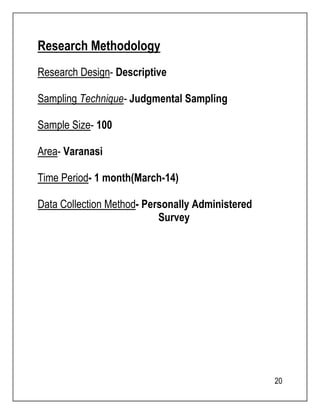
Research Methodology 
Research Design- Descriptive 
Sampling Technique- Judgmental Sampling 
Sample Size- 100 
Area- Varanasi 
Time Period- 1 month(March-14) 
Data Collection Method- Personally Administered 
Survey
Data Analysis and Interpretation 
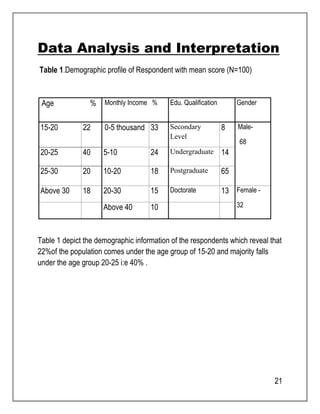
Table 1.Demographic profile of Respondent with mean score (N=100) 
21 
Age % Monthly Income % Edu. Qualification Gender 
15-20 22 0-5 thousand 33 Secondary 
Level 
8 Male- 
68 
20-25 40 5-10 24 Undergraduate 14 
25-30 20 10-20 18 Postgraduate 65 
Above 30 18 20-30 15 Doctorate 13 Female - 
Above 40 10 32 
Table 1 depict the demographic information of the respondents which reveal that 
22%of the population comes under the age group of 15-20 and majority falls 
under the age group 20-25 i:e 40% .
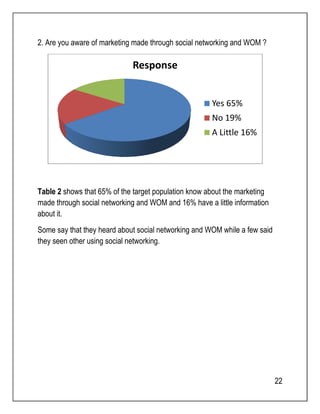
2. Are you aware of marketing made through social networki 
networking and WOM 
Response 
Table 2 shows that 65% of the target population know about the 
made through social networking and WOM 
about it. 
Some say that they heard about 
they seen other using social networking 
marketing 
and 16% have a little information 
social networking and WOM while a few said 
networking. 
Yes 65% 
No 19% 
A Little 16% 
22 
ng ? 
%
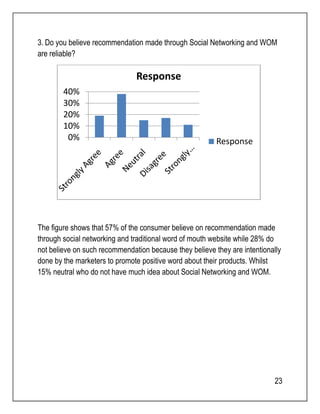
3. Do you believe recommendation made through Social Networking and WOM 
are reliable? 
40% 
30% 
20% 
10% 
The figure shows that 57% of the consumer believe on recommendation made 
through social networking and traditional word of mouth website while 28% do 
not believe on such recommendation because they believe they are intentionally 
done by the marketers to promote positive word about their products. Whilst 
15% neutral who do not have much idea about Social Networking and WOM. 
23 
0% 
Response 
Response
24 
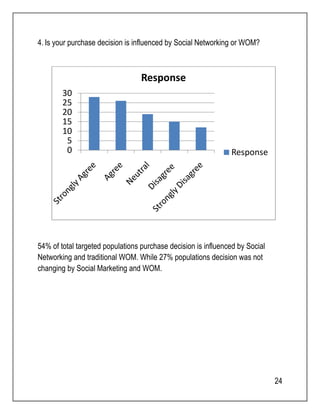
4. Is your purchase decision is influenced by Social Networking or WOM? 
30 
25 
20 
15 
10 
0 5 
Response 
Response 
54% of total targeted populations purchase decision is influenced by Social 
Networking and traditional WOM. While 27% populations decision was not 
changing by Social Marketing and WOM.
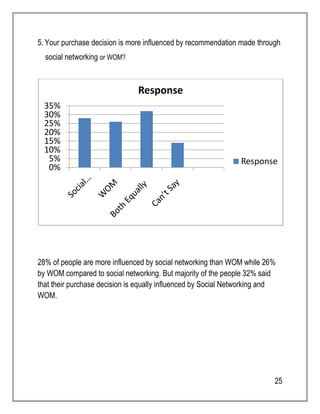
5. Your purchase decision is more influenced by recommendation made through 
social networking or WOM? 
35% 
30% 
25% 
20% 
15% 
10% 
5% 
28% of people are more influenced by social networking than WOM while 26% 
by WOM compared to social networking. But majority of the people 32% said 
that their purchase decision is equally influenced by Social Networking and 
WOM. 
25 
0% 
Response 
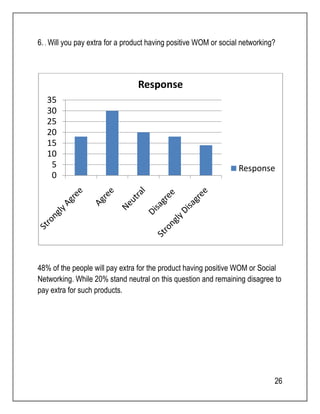
Response
6. . Will you pay extra for a product having positive WOM or social networking? 
35 
30 
25 
20 
15 
10 
48% of the people will pay extra for the product having positive WOM or Social 
Networking. While 20% stand neutral on this question and remaining disagree to 
pay extra for such products. 
26 
0 5 
Response 
Response
Response 
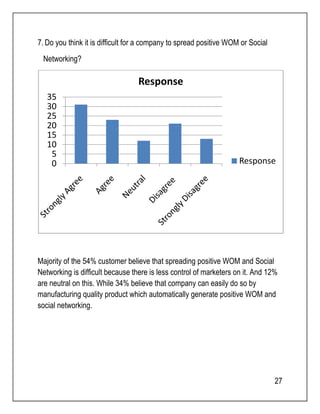
27 
7. Do you think it is difficult for a company to spread positive WOM or Social 
Networking? 
35 
30 
25 
20 
15 
10 
0 5 
Response 
Majority of the 54% customer believe that spreading positive WOM and Social 
Networking is difficult because there is less control of marketers on it. And 12% 
are neutral on this. While 34% believe that company can easily do so by 
manufacturing quality product which automatically generate positive WOM and 
social networking.
Response 
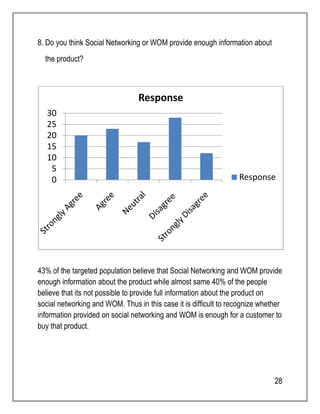
28 
8. Do you think Social Networking or WOM provide enough information about 
the product? 
30 
25 
20 
15 
10 
0 5 
Response 
43% of the targeted population believe that Social Networking and WOM provide 
enough information about the product while almost same 40% of the people 
believe that its not possible to provide full information about the product on 
social networking and WOM. Thus in this case it is difficult to recognize whether 
information provided on social networking and WOM is enough for a customer to 
buy that product.
Response 
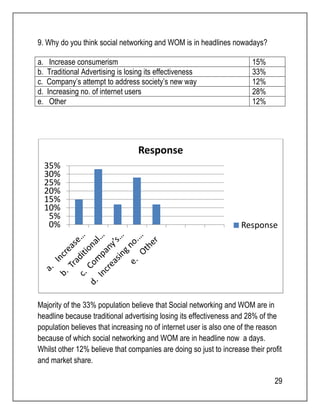
29 
9. Why do you think social networking and WOM is in headlines nowadays? 
a. Increase consumerism 15% 
b. Traditional Advertising is losing its effectiveness 33% 
c. Company’s attempt to address society’s new way 12% 
d. Increasing no. of internet users 28% 
e. Other 12% 
35% 
30% 
25% 
20% 
15% 
10% 
5% 
0% 
Response 
Majority of the 33% population believe that Social networking and WOM are in 
headline because traditional advertising losing its effectiveness and 28% of the 
population believes that increasing no of internet user is also one of the reason 
because of which social networking and WOM are in headline now a days. 
Whilst other 12% believe that companies are doing so just to increase their profit 
and market share.
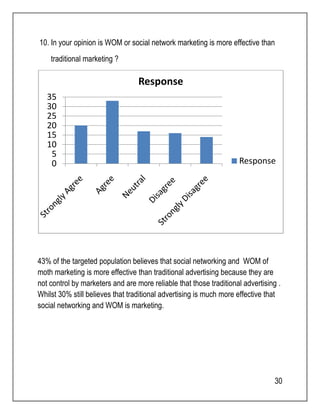
10. In your opinion is WOM or social network marketing is more effective than 
traditional marketing ? 
35 
30 
25 
20 
15 
10 
43% of the targeted population believes that social networking and WOM of 
moth marketing is more effective than traditional advertising because they are 
not control by marketers and are more reliable that those traditional advertising . 
Whilst 30% still believes that traditional advertising is much more effective that 
social networking and WOM is marketing. 
30 
0 5 
Response 
Response
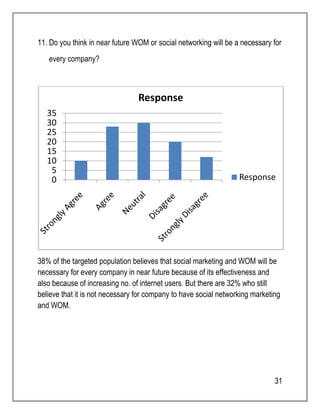
11. Do you think in near future WOM or social networking will be a necessary for 
every company? 
35 
30 
25 
20 
15 
10 
38% of the targeted population believes that social marketing and WOM will be 
necessary for every company in near future because of its effectiveness and 
also because of increasing no. of internet users. But there are 32% who still 
believe that it is not necessary for company to have social networking marketing 
and WOM. 
31 
0 5 
Response 
Response
32 
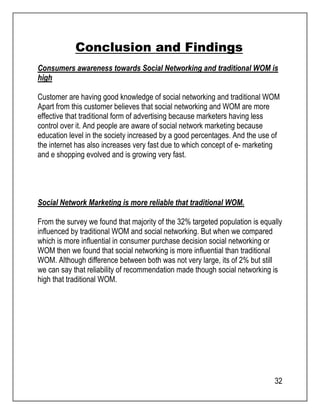
Conclusion and Findings 
Consumers awareness towards Social Networking and traditional WOM is 
high 
Customer are having good knowledge of social networking and traditional WOM 
Apart from this customer believes that social networking and WOM are more 
effective that traditional form of advertising because marketers having less 
control over it. And people are aware of social network marketing because 
education level in the society increased by a good percentages. And the use of 
the internet has also increases very fast due to which concept of e- marketing 
and e shopping evolved and is growing very fast. 
Social Network Marketing is more reliable that traditional WOM. 
From the survey we found that majority of the 32% targeted population is equally 
influenced by traditional WOM and social networking. But when we compared 
which is more influential in consumer purchase decision social networking or 
WOM then we found that social networking is more influential than traditional 
WOM. Although difference between both was not very large, its of 2% but still 
we can say that reliability of recommendation made though social networking is 
high that traditional WOM.
Consumer purchase decision is influenced by social networking and WOM 
As far as purchase decision is concerned customer purchase decision are 
influenced by traditional WOM and social networking. 57% of the targeted 
population accepted that their purchase decision is influenced by social 
networking and WOM marketing. And majority of them are ready to pay extra for 
a product having positive WOM or social networking. And they believe that this 
mean provide enough information to buy the product and company should opt 
this medium to target customer though it is difficult to have positive social 
networking and WOM. 
33
34 
Suggestion 
 Companies should try to promote positive word about their products 
through social networking and WOM because traditional advertising id 
losing its effectiveness and due to increased consumerism. 
 Companies should to use social networking efficiently to increase their 
market share because it is not only cost effective but reliable too. 
 Quality should be maintained because consumer believe that spreading 
positive WOM and social networking is difficult because they are not 
controlled by the marketers and its possible only when product quality is 
good.
35 
Learning 
 The project helped me think pro actively on a topic of interest. 
 Talking to people and understanding their perception was an enriching 
experience. 
 The purchasing behaviors of Indian consumer align with their global counterparts 
thus I have been able to map this phenomenon in global context.
36 
Limitations 
 A convenience sample was used for the data collection which makes the result no readily 
generalizable. Although great effort was put in to get a sample which include people from 
different demographics. 
 This study is only conducted in Varanasi region. So it is very difficult to determine whether it 
can be extended to a larger population outside this region. 
 This study is not product specific. This study is conducted only to understand the perception 
of consumers about green product as a whole. 
 Personal bias of the respondent while answering the question may have skewed the result 
slightly. Although an effort has been made to verify the result through all sorts of possible 
analysis applicable to this research.
37 
References 
 Social-Media-Word-of-Mouth-White-Paper-Microsoft-Advertising-August- 
2011 Driving Word-of-mouth with the MSN Audience. 
 2013 social media marketing industry report. 
 Dee T ALLSOP , BRYCE R. BASSETT 1993. " 2013 social media 
marketing industry report. 
 Derek Foster Shaun Lawson and Mark Doughty “Social networking sites 
as platforms to persuade behavior change in domestic energy 
consumption” 
 Effects of Word-of-Mouth Versus Traditional Marketing: Findings from an 
Internet Social Networking Site. Working Paper No. RHS-06-065 
 Intern. J. of Research in Marketing 25 (2008) 215–224 “Measuring the 
impact of positive and negative word of mouth on brand purchase 
probability”
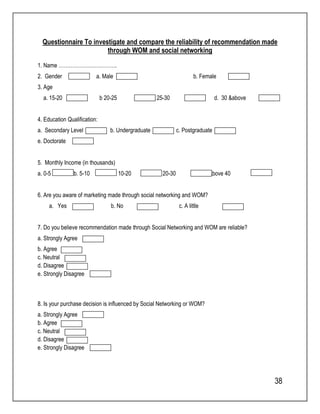
Questionnaire To investigate and compare the reliability of recommendation made 
38 
through WOM and social networking 
1. Name ……………………………. 
2. Gender a. Male b. Female 
3. Age 
a. 15-20 b 20-25 c. 25-30 d. 30 &above 
4. Education Qualification: 
a. Secondary Level b. Undergraduate c. Postgraduate 
e. Doctorate 
5. Monthly Income (in thousands) 
a. 0-5 b. 5-10 c. 10-20 d. 20-30 e. Above 40 
6. Are you aware of marketing made through social networking and WOM? 
a. Yes b. No c. A little 
7. Do you believe recommendation made through Social Networking and WOM are reliable? 
a. Strongly Agree 
b. Agree 
c. Neutral 
d. Disagree 
e. Strongly Disagree 
8. Is your purchase decision is influenced by Social Networking or WOM? 
a. Strongly Agree 
b. Agree 
c. Neutral 
d. Disagree 
e. Strongly Disagree
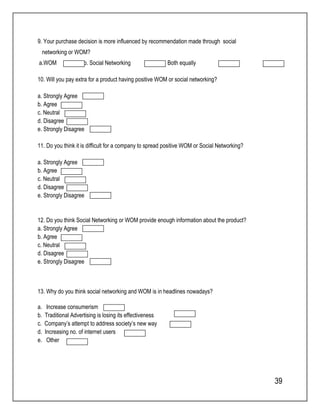
39 
9. Your purchase decision is more influenced by recommendation made through social 
networking or WOM? 
a.WOM b. Social Networking c. Both equally d. None 
10. Will you pay extra for a product having positive WOM or social networking? 
a. Strongly Agree 
b. Agree 
c. Neutral 
d. Disagree 
e. Strongly Disagree 
11. Do you think it is difficult for a company to spread positive WOM or Social Networking? 
a. Strongly Agree 
b. Agree 
c. Neutral 
d. Disagree 
e. Strongly Disagree 
12. Do you think Social Networking or WOM provide enough information about the product? 
a. Strongly Agree 
b. Agree 
c. Neutral 
d. Disagree 
e. Strongly Disagree 
13. Why do you think social networking and WOM is in headlines nowadays? 
a. Increase consumerism 
b. Traditional Advertising is losing its effectiveness 
c. Company’s attempt to address society’s new way 
d. Increasing no. of internet users 
e. Other
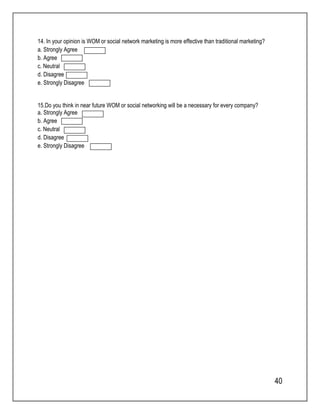
40 
14. In your opinion is WOM or social network marketing is more effective than traditional marketing? 
a. Strongly Agree 
b. Agree 
c. Neutral 
d. Disagree 
e. Strongly Disagree 
15.Do you think in near future WOM or social networking will be a necessary for every company? 
a. Strongly Agree 
b. Agree 
c. Neutral 
d. Disagree 
e. Strongly Disagree

Are Social Networking more persuasive than Traditional Word of Mouth

  • 1.
    1 A DISSERTATIONREPORT ON “Are Social Networking more persuasive than Traditional Word of Mouth” Submitted by KUMAR GAURAV In partial fulfillment of the requirement for the degree of Master of Business Administration Submitted to Dr. Anurag Singh Assistant Professor FMS-BHU Faculty of Management Studies Banaras Hindu University Roll no Enrolment no Batch 12380MA025 351041 2012-2014
  • 2.
    2 DECLARATION Ihereby declare that this project work entitled “Are social networking more persuasive than traditional word of mouth ” is my original work, carried out under the guidance of my faculty guide Dr. Anurag Singh has not been submitted to any other institute/ university or any organization apart from Faculty of Management Studies Banaras Hindu University. Kumar Gaurav (Signature)
  • 3.
    3 ACKNOWLEDGEMENT Toacknowledge all the persons who had helped for the fulfillment of the project is not possible for any researcher but in spite of all that, it becomes a foremost responsibility of the researcher and also the part of research ethics to acknowledge those who had played a great role for the completion of the project. So in the same sequence at very first, I would like to acknowledge my parents because of whom I got the existence in the world for the inception and the conception of this project. Later on I would like to confer the flower of acknowledgement to Dr. Anurag Singh Sir and other faculty members who taught me that how to do project through appropriate tools and techniques. And would also like to thanks my friends who constantly supported me while working on the project. Rest all those people who helped me are not only matter of acknowledgement but also authorized for sharing my success. Kumar Gaurav MBA(Marketing) 4th Sem Roll No. 25
  • 4.
    CERTIFICATE , 6701414 Are social networking more This is to certify that the research report entitled “ persuasive than traditional word of mouth supervision by Mr. Kumar Gaurav 2012-2014) of this faculty as a part of his Course Curriculum. This report is his original work and up to the standard expected of an MBA student of this Faculty. I recommend the Report be forwarded for evaluation. mouth” has been prepared under my a student of MBA (Marketing) IV Sem. (Batch (Dr. Anurag Singh Supervisor Singh) 4
  • 5.
    5 CONTENT Introduction 5 Word of Mouth Social Networking  Literature Review 9  Objective 18  Hypothesis 18  Research Methodology 19  Data Analysis and Interpretation 20  Conclusion and Findings 31  Suggestion 33  Learning 34  Limitation 35  References 36  Questionnaire 37
  • 6.
    6 Introduction Theword of mouth (WOM) industry is experiencing massive growth—since 2004 the Word of Mouth Marketing Association (WOMMA) has grown from3 to 350 corporate members (WOMMA, 2007). This growth is particularly evident in online and social networking media. Research estimates that while 90% of WOM conversations take place offline (Keller Berry, 2006), just 15% of consumers account for one third of WOM conversations in America, and those “Conversation Catalysts” rely heavily on the Internet as a resource for the information they pass along to their family and friends (Keller Fay, 2006) Word-of-mouth (WOM) marketing has recently attracted a great deal of attention among practitioners. For example, several books tout word-of-mouth as a viable alternative to traditional marketing communication tools. One calls it “the world’s most effective, yet least understood marketing strategy” (Misner 1999). Marketers are particularly interested in better understanding word-of-mouth as traditional forms of communication appear to be losing effectiveness (Forrester 2005). For example, one survey showed consumer attitudes toward advertising plummeting between September 2002 and June 2004. Forrester (2005) reported that 40% fewer agree that ads are a good way to learn about new products, 59% fewer say they buy products because of their ads, and49% fewer find ads entertaining. WOM communication strategies are appealing because they combine the prospect of overcoming consumer resistance with significantly lower costs and fast delivery – especially through technology such as the Internet. Unfortunately, empirical evidence is currently scant regarding the relative effectiveness of WOM marketing in increasing firm performance over time. This raises the need to study how firms can measure the effects of word-of-mouth communications and how WOM compares to other forms of marketing communication. WOM marketing is a particularly prominent feature on the Internet. The Internet provides numerous venues for consumers to share their views, preferences, or experiences with others as well as opportunities for firms to take advantage of WOM marketing. As one commentator stated, “Instead of tossing away millions of dollars on Super bowl ads, fledging dot-com companies are trying to catch attention through much cheaper marketing strategies such as blogging and word-of-mouth campaigns”
  • 7.
    (Whitman2006). As manyof these companies have “grown up” and also begin to spend significantly on traditional marketing (e.g., the Superbowl 3 One of the fastest growing arenas of the World Wide Web is the space o fso-called 7 social networking sites (e.g., Facebook, MySpace, Friendster, Xanga). These sites rely up on user-generated content to attract and retain visitors, obtaining revenue primarily from the sale of online display advertising. They also accumulate user information that may be valuable for targeted marketing purposes. The social network setting offers an appealing context to study word-of-mouth. The sites provide easy-to-use tools for current users to invite others to join the network. The electronic recording of these outbound referrals opens a new window into the effects of WOM, giving researchers an unobtrusive trace of this often hard-to-study activity. When combined with data that also tracks new member signups, it becomes possible to model the dynamic relationship between this form of word-of-mouth and the addition of new members to the social networking site. These members are, in a real sense, also the “customers” of the social networking site, as their exposure to advertising while using the site produces revenue for the firm. Internet companies commonly employ several types of WOM marketing activities. The major categories include the following: 1) Viral Marketing – creating entertaining or informative messages designed to be passed on by each message receiver, analogous to the spread of an epidemic, often electronically or by email. 2) Referral Programs– creating tools that enable satisfied customers to refer their family and friends; and 4 Effects of Word-of-Mouth versus Traditional Marketing 3) Community Marketing – forming or supporting niche communities that are likely to share interests about a product or brand (such as user groups, fan clubs, and discussion forums) and providing tools, content, and information to support those communities.
  • 8.
    In this projectwe tried to compare measure the effectiveness of recommendation made through social networking and traditional WOM. Here social networking involves the online forum, groups, blogs that contain positive or negative review of the goods and services. And traditional WOM involves recommendation made offline. Though traditional WOM is used widely by the consumer while marketing through social networking is confined to the internet user . But recent research shows that marketing through social networking is growing very fast. 8
  • 9.
    Word of MouthCommunication WOM is a consumer-dominated channel of marketing communication where the sender is independent of the market. It is therefore perceived to be more reliable, credible, and trustworthy by consumers compared to firm-initiated communications. (Schiffman & Kanuk,1995; Arndt, 1967). Traditional communications theory considers WOM as having a powerful influence on behavior, especially on consumers’ information search, evaluation, and subsequent decision making. (Cox,1963; Brown & Reingen, 1987; Money, Gilly, &Graham, 1998; G. Silverman, 2001). Social Networking A social network is a group of individuals linked together by different social ties, ranging from casual acquaintance to work relationships and family ties. The social network is therefore meant to be a service whose primary function is to allow or facilitate the organization and management of a map of a social community. Social networks are a means but not a medium in the sense of "intermediary" (as in the mass media) but in the sense of a social tool, social media. 9
  • 10.
    Literature Review Inrecent years, social networking sites and social media have increased in popularity, at a global level. For instance, Facebook is said to have more than a billion active users (as of 2012) since its beginning in 2004 (www.facebook.com). Social networking sites can be described as networks of friends for social or professional interactions (Trusov, Bucklin, & Pauwels, 2009). Indeed, online social networks have profoundly changed the propagation of information by making it incredibly easy to share and digest information on the internet (Akrimi & Khemakhem, 2012). The unique aspects of social media and its immense popularity have revolutionized marketing practices such as advertising and promotion (Hanna, Rohm, & Crittenden, 2011). Social media has also influenced consumer behavior from information acquisition to post-purchase behavior such as dissatisfaction statements or behaviors (Mangold & Faulds, 2009) and patterns of Internet usage (Ross et al., 2009; Laroche et al., 2012). Social media is ‘‘a group of internet based applications that builds on the ideological and technological foundations of Web 2.0, and it allows the creation and exchange of user-generated content’’ (Kaplan & Haenlein, 2010, p.61). Social media has many advantages as it helps connect businesses to consumers, develop relationships and foster those relationships in a timely manner and at a low cost as Kaplan and Haenlein discovered (2010). Broadly speaking, word-of-mouth affects consumer behavior through two key routes (Vanden Bulte and Wuyts 2009). The first is awareness. Word-of-mouth can inform people that a product or behavior exists (and makeitmore accessible or top-of-mind). This function is particularly important for new, unknown, or low-risk products and ideas (Godes and Mayzlin 2009). Research on the effects of word-of-mouth can be broadly divided into two categories: quantitative research using field data and more behaviorally based experimental laboratory research. 10
  • 11.
    11 Quantitative Researchon Word-of-Mouth Effects Across a variety of domains, quantitative research finds that word-of-mouth has a causal impact on individual behavior (e.g., purchase or new product adoption) and the firm more broadly (e.g., aggregate sales or financial performance).1Word of mouth has been shown to boost sales of books (Chevalier and Mayzlin 2006), bath and beauty products (Moe and Trusov 2011), and restaurants (Godes and Mayzlin 2009) and speed the adoption and diffusion of new pharmaceutical drugs (Iyengar et al 2010).Other work suggests that word-of-mouth may boost sales of music (Dhar and Chang 2009), movies (Chintagunta, Gopinath, and Venkataraman 2010; Dellarocas, Zhang, and Awad 2007; Duan, Gu, and Whinston 2008; Liu 2006) and video games(Zhu and Zhang 2010) and increase microfinance loans (Stephen and Galak 2012), television show viewership (Godes and Mayzlin 2004), and sign-ups to a social network website (Trusov, Bucklin, and Pauwels 2009). Some data even suggests that negative word-of-mouth may hurt stock prices (Luo 2009) and stock returns (Luo 2007). Most studies that have collected word-of-mouth content have focused on online word-of-mouth, in part because it is easier to acquire. Online word-of-mouth includes consumer reviews and blog posts, and can be decomposed into volume, valence, and variance (Dellarocas and Narayan 2006; Moe and Trusov 2011). Volume is the number of reviews or posts that a given item receives, where more postings are usually associated with increased sales. Valence is the average rating a product receives (e.g., 3.7 out of 5 stars, Dellarocas et al 2007),or the number of reviews of different types (e.g., 37 1-star reviews, Chevalier and Mayzlin 2006), and more positive reviews are generally associated with increased sales (though see Berger, Sorensen, and Rasmussen 2010). Finally, variance is either the statistical variance (Clemons, Gao, and Hitt 2006) or entropy (Godes and Mayzlin 2004) of the reviews. One interestingquestion for future research is when and why different online word-of-mouth metrics have a stronger impact on (or are more predictive of) behavior, sales, or other relevant outcomes. Different papers have found different metrics to be more or less important. Some papers have found significant effects on both the volume and valence of reviews (Chevalier and
  • 12.
    Mayzlin 2006; Dellarocas,et al. 2007). Other papers have found either only effects of review volume (Duan, et al. 2008; Liu 2006) or review valence (Chintagunta et al. 2010), but not the other. While some of the difference may be due to the specific modeling framework used, or dependent variable examined, the distinction between awareness and persuasion may also be important. Word-of-mouth may be valued or used differently depending the novelty and risk involved with the thing being adopted (Godes and Mayzlin 2009; Van den Bulte and Wuyts 2009). For products that are relatively high-risk, or already quite well-known, the persuasive function of word-of-mouth should be particularly important. Thus valence should matter: Positive word-of-mouth should increase choice, while negative word-of-mouth may decrease it. For low-risk 12 or novel products, however, word-of-mouth should also impact behavior through increasing awareness. Here, volume should matter more than valence, and even negative word-of-mouth may boost trial (Berger et al. 2010). Another rich area for behavioral research is the social dynamics of online reviews. Online review systems are organized in such a way that consumers are likely to see others’ reviews before they write their own. How does the volume and valence of existing reviews impact whether (1) consumers write a review and (2) the nature of the review they write? Consumers might be more (or less) likely to post their opinion if there are few reviews about a product already, or if their opinion differs from the prevailing view. Similarly, existing reviews might generate either assimilation or contrast effects.Indeed, social dynamics may be part of the reasons that the average product rating tends to decrease as more ratings arrive (Godes and Silva 2012; Li and Hitt 2008). Consequently, researchers have pointed out the importance of considering (and explicitly modeling) how existing reviews impact the arrival of new reviews (Moe and Trusov 2011; Moe and Schweidel 2012). Defining the field- Word of mouth (WOM) is informal advice passed between consumers. It is usually interactive, swift, and lacking in commercial bias. WOM is a powerful in Defining the field Word of mouth (WOM) is informal advice passed between consumers. It is usually interactive, swift, and lacking in commercial bias. WOM is a powerful influence on consumer behavior. Keaveney(1995)noted that 50%
  • 13.
    of service providerreplacements were found in this way. WOM may be positive (PWOM), encouraging brand choice, or negative (NWOM), discouraging brand choice. Brand purchase probability will be affected by the relative incidence of PWOM and NWOM about the brand and also by the relative impact of instances of PWOM and NWOM. Here, we are concerned with the impact of PWOM compared with NWOM. There is little evidence on this matter, which may relate to the difficulty of making accurate measurements in this field. Below, we review this measurement problem. WOM can affect the adoption of new categories and the choice of brands in mature categories. In product adoption research, interest falls on the few initial users of products whose advice to non-users may decide the success or failure of a new product. In mature categories, which are our research focus, changes occur mainly as switching between brands and interest falls on users of the category, who may be a majority of the population when categories such as cell phones and restaurants are studied. Among users of mature categories, WOM acts within a framework of acquired consumer beliefs, preferences, habits, and commercial influences that may constrain or assist response to the advice. Research on the role of WOM in brand switching is required for three reasons. First, WOM is often the major reason for brand choice, but we do not yet understand how PWOM and NWOM contribute to this influence. Second, some groups are more responsive to WOM than others, and we show how segments with different probabilities of purchase will respond differently to PWOM and NWOM. Third, Reichheld's (2003)Net Promoter Score has performed poorly as predictor of brand/company performance. Our work provides some explanation for this failure, and our methods may be used to develop a better WOM metric. Difficultly in studying word of mouth 13
  • 14.
    Although consumers oftenattribute their brand choice to WOM, it is difficult to observe cases where advice affects brand choice since WOM about a specific category is relatively uncommon and any effect is often delayed. When evidence is scarce, too much weight may be given to the limited research that is available. One solitary field study by Arndt (1967)is often cited. Arndt found that NWOM had twice as much impact on purchase as PWOM. However, he studied only one brand, and systematic research should be based on all the brands in a category and should include a range of categories. In addition,although the category was familiar, Arndt used a new brand aboutwhich there could be few established beliefs. Without direct evidenceof WOM effect, inferences have been made from experimental workon the impact of positive and negative information. It is well established that negative information usually has more impact on judgment than positive information (Skowronski &Carlston,1989) but this finding may not extend to the relative impact of PWOM and WOM on brand choice in familiar categories .Although there is little evidence, it appears that marketers believe that NWOM has more impact than PWOM. For example, Assael (2004)states, “Negative word of mouth is more influential than positive word of mouth” (though this claim may conflate relative incidence and relative impact). Conventions in media publicity also support the idea that negative information is more potent. According to the Krol off(1988)principle, negative copy is four times as persuasive as positive copy. When direct observation is not feasible, we have to gather evidence on the relative impact of PWOM and NWOM using indirect methods. One method is to measure Internet postings about brandsand their subsequent sales performance (e.g., Godes & Mayzlin,2004). A problem with this method is that there may be little correspondence between the content of consumer-generated media and face-to-face advice. One is not necessarily typical of the other,and the large amount of face-to-face advice is likely to be the dominant influence on consumption. Keller and Fay (2006)found that 8% of advice was Web mediated, 70% was face-to-face, and 19%was by telephone. For this reason, we did not 14
  • 15.
    specifically explore theeffect of Internet advice, though growth of Internet use is likely to make this an increasingly important form of WOM. A second method is to use laboratory experiments to investigate the response to information on familiar brands. Other techniques that may be used include role-play experiments and surveys. These methods also present problems. Role-play may not typify naturally occurring behavior, and the measures of PWOM and NWOM in surveys may be subject to different degrees of bias that will distort the estimation of their relative impact. Since no single method can provide conclusive evidence, we adopt a three-pronged approach designed to build a persuasive argument about the relative impact of PWOM and NWOM. First, using both role-play experiments and surveys, we find that PWOM usually has some what more effect than NWOM. This finding is similar to experimental evidence that positive and negative information have much the same impact on attitudes when the brands are familiar (Ahluwalia, Burnkrant, & Unnava, 2000; Ahluwalia, 2002). Second, we describe how the pre-WOM probability of purchase (here after referred to as PPP) and other variables contribute to the impact of WOM. We show that this evidence suggests that PWOM and NWOM are closely similar behaviors, making it less likely that measures of the two are subject to strongly differential bias. Third, we explain why PWOM could have more effect than NWOM if the pre-WOM probability of purchase (PPP) is less than 0.5, and we find that this is so. 15
  • 16.
    16 Behavioral Researchon Word-of-MouthEffects Behavioral research on word-of-mouth has focused on when word-of-mouth may have a larger impact on behavior and why.2 Most of this work has looked at whenand how word-of-mouth affects the word-of-mouth recipient.3One important factor is characteristics of the word-of-mouth source. People tend to listen to more to credible sources, or those that are more trustworthy or have more expertise (Hovland and Weiss 1951; Petty and Wegner 1998; Pornpitakpan 2004). Other important factors are the strength of the tie (i.e., friends vs. acquaintances, or strong vs. weak ties) and their similarity to the word-of-mouth recipient. Per dose or instance of word-of-mouth, strong ties may be more impactful because people tend to trust them more and think they know more about their tastes and interests (Bakshy, et al. 2012; Brown and Reingen 1987). That said, people have more weak ties, or acquaintances, so the overall impact of these types of individuals may be larger (Bakshy, et al. 2012; see Brown and Reingen 1987; Granovetter 1973; Goldenberg, Libai, and Muller 2001 for related discussions).4Similarly, word-of-mouth from similar others may have a more positive effect (Brown and Reingen 1987; Forman, Ghose, and Wiesenfeld 2008; also see Naylor, Lamberton, and Norton 2011) because people think their tastes are similar (Brock 1965). That said, word-of-mouth from dissimilar others may have benefits because these individuals have access to different information (Granovetter 1973) and may be more familiar with alternative ways of thinking (Burt 2004).Consequently, whether word-of-mouth from strong or weak ties and similar or dissimilar others is more impactful may depend on the particular situation. Finally, heavy users seems to have a larger impact on social contagion (Iyengar et al. 2011), but it is unclear whether this is because they talk more frequently or because they have higher status and are thus more likely to be listened to (Godes 2011). Another important factor is the nature of the word-of-mouth itself. Word-of-mouth varies in its valence: People can recommend a restaurant, say they hated it, or merely mention that they went there. Recommendations likely have the
  • 17.
    most positive impacton behavior, but even mentions should have a positive effect if they increase product awareness or accessibility (see Lynch and Srull 1982; also see Berger, et al. 2010; Nedungadi 1990; Stigler 1961). In terms of absolute impact, negative word-of-mouth may have a stronger impact than positive word-of-mouth, in some cases(Basuroy, Chatterjee, and Ravid 2003; Chevalier and Mayzlin 2006; see Chen and Lurie 2012 for a potential behavioral explanation) and may be more impactful when the word-of-mouth event happened further in the past (Smith and Schwarz 2012). Word-of-mouth also varies in its intensity or depth: People can talk briefly about an experience or they can go on at length.Longer or more in-depth word-of-mouth discussions should have a stronger impact on behavior [though this may be mitigated for online word-of-mouth, see Godes and Mayzlin (2004), as people may not end up reading an entire post or review]. Along these lines, face-to-face word-of-mouth may have a stronger impact than online or written word-of-mouth because it tends to be more engaging and vivid (Herr, Kardes, and Kim 1991).5 Whether the word-of-mouth is solicited also matters. Solicited advice seems to have a more positive impact than unsolicited advice (East et al. 2005) and unsolicited recommendations which go against an individual’s opinion may even lead to reactance and strengthen the initial opinion (Fitzsimons and Lehmann 2004). Finally, the level of certainty expressed along with an opinion can also have an effect, with uncertainty actually being beneficial in some cases (Karmarkar and Tormala 2010). The susceptibility of the word-of-mouth recipient is also important (Watts and Dodds 2007). Just like some people may be more susceptible to catching a cold or a disease (e.g., because they have a weaker immune system), some people may be more susceptible to, or prone to be affected by, social influence (Aral and Walker 2012; Bearden, Netemeyer, and Tell 1989; Godes 2011). More susceptible individuals, for example, should be more likely to adopt new products or ideas if they hear about or see others using them. Though relatively little research has examined this issue, some data suggests that young people are more susceptible(Park and Lessig 1977; Pasupathi 1999) and people who perceive themselves as opinion leaders are less susceptible (Iyengar et al. 2011).Beyond individual differences, situational factors should also shape 17
  • 18.
    susceptibility. The closerpeople already are to taking some action, the more likely it is that a dose of word-of-mouth will push them over the edge. People who are searching online reviews, for example, are often close to being ready to make a purchase, and thus may be particularly susceptible to influence. 18
  • 19.
    Objective The objectiveof the project is “To investigate and compare the reliability of recommendation made through social networking and word of mouth. Hypothesis H1- WOM and social networking influence the customer purchase decision. H2- Social networking recommendation are more reliable than traditional WOM. 19
  • 20.
    20 Research Methodology Research Design- Descriptive Sampling Technique- Judgmental Sampling Sample Size- 100 Area- Varanasi Time Period- 1 month(March-14) Data Collection Method- Personally Administered Survey
  • 21.
    Data Analysis andInterpretation Table 1.Demographic profile of Respondent with mean score (N=100) 21 Age % Monthly Income % Edu. Qualification Gender 15-20 22 0-5 thousand 33 Secondary Level 8 Male- 68 20-25 40 5-10 24 Undergraduate 14 25-30 20 10-20 18 Postgraduate 65 Above 30 18 20-30 15 Doctorate 13 Female - Above 40 10 32 Table 1 depict the demographic information of the respondents which reveal that 22%of the population comes under the age group of 15-20 and majority falls under the age group 20-25 i:e 40% .
  • 22.
    2. Are youaware of marketing made through social networki networking and WOM Response Table 2 shows that 65% of the target population know about the made through social networking and WOM about it. Some say that they heard about they seen other using social networking marketing and 16% have a little information social networking and WOM while a few said networking. Yes 65% No 19% A Little 16% 22 ng ? %
  • 23.
    3. Do youbelieve recommendation made through Social Networking and WOM are reliable? 40% 30% 20% 10% The figure shows that 57% of the consumer believe on recommendation made through social networking and traditional word of mouth website while 28% do not believe on such recommendation because they believe they are intentionally done by the marketers to promote positive word about their products. Whilst 15% neutral who do not have much idea about Social Networking and WOM. 23 0% Response Response
  • 24.
    24 4. Isyour purchase decision is influenced by Social Networking or WOM? 30 25 20 15 10 0 5 Response Response 54% of total targeted populations purchase decision is influenced by Social Networking and traditional WOM. While 27% populations decision was not changing by Social Marketing and WOM.
  • 25.
    5. Your purchasedecision is more influenced by recommendation made through social networking or WOM? 35% 30% 25% 20% 15% 10% 5% 28% of people are more influenced by social networking than WOM while 26% by WOM compared to social networking. But majority of the people 32% said that their purchase decision is equally influenced by Social Networking and WOM. 25 0% Response Response
  • 26.
    6. . Willyou pay extra for a product having positive WOM or social networking? 35 30 25 20 15 10 48% of the people will pay extra for the product having positive WOM or Social Networking. While 20% stand neutral on this question and remaining disagree to pay extra for such products. 26 0 5 Response Response
  • 27.
    Response 27 7.Do you think it is difficult for a company to spread positive WOM or Social Networking? 35 30 25 20 15 10 0 5 Response Majority of the 54% customer believe that spreading positive WOM and Social Networking is difficult because there is less control of marketers on it. And 12% are neutral on this. While 34% believe that company can easily do so by manufacturing quality product which automatically generate positive WOM and social networking.
  • 28.
    Response 28 8.Do you think Social Networking or WOM provide enough information about the product? 30 25 20 15 10 0 5 Response 43% of the targeted population believe that Social Networking and WOM provide enough information about the product while almost same 40% of the people believe that its not possible to provide full information about the product on social networking and WOM. Thus in this case it is difficult to recognize whether information provided on social networking and WOM is enough for a customer to buy that product.
  • 29.
    Response 29 9.Why do you think social networking and WOM is in headlines nowadays? a. Increase consumerism 15% b. Traditional Advertising is losing its effectiveness 33% c. Company’s attempt to address society’s new way 12% d. Increasing no. of internet users 28% e. Other 12% 35% 30% 25% 20% 15% 10% 5% 0% Response Majority of the 33% population believe that Social networking and WOM are in headline because traditional advertising losing its effectiveness and 28% of the population believes that increasing no of internet user is also one of the reason because of which social networking and WOM are in headline now a days. Whilst other 12% believe that companies are doing so just to increase their profit and market share.
  • 30.
    10. In youropinion is WOM or social network marketing is more effective than traditional marketing ? 35 30 25 20 15 10 43% of the targeted population believes that social networking and WOM of moth marketing is more effective than traditional advertising because they are not control by marketers and are more reliable that those traditional advertising . Whilst 30% still believes that traditional advertising is much more effective that social networking and WOM is marketing. 30 0 5 Response Response
  • 31.
    11. Do youthink in near future WOM or social networking will be a necessary for every company? 35 30 25 20 15 10 38% of the targeted population believes that social marketing and WOM will be necessary for every company in near future because of its effectiveness and also because of increasing no. of internet users. But there are 32% who still believe that it is not necessary for company to have social networking marketing and WOM. 31 0 5 Response Response
  • 32.
    32 Conclusion andFindings Consumers awareness towards Social Networking and traditional WOM is high Customer are having good knowledge of social networking and traditional WOM Apart from this customer believes that social networking and WOM are more effective that traditional form of advertising because marketers having less control over it. And people are aware of social network marketing because education level in the society increased by a good percentages. And the use of the internet has also increases very fast due to which concept of e- marketing and e shopping evolved and is growing very fast. Social Network Marketing is more reliable that traditional WOM. From the survey we found that majority of the 32% targeted population is equally influenced by traditional WOM and social networking. But when we compared which is more influential in consumer purchase decision social networking or WOM then we found that social networking is more influential than traditional WOM. Although difference between both was not very large, its of 2% but still we can say that reliability of recommendation made though social networking is high that traditional WOM.
  • 33.
    Consumer purchase decisionis influenced by social networking and WOM As far as purchase decision is concerned customer purchase decision are influenced by traditional WOM and social networking. 57% of the targeted population accepted that their purchase decision is influenced by social networking and WOM marketing. And majority of them are ready to pay extra for a product having positive WOM or social networking. And they believe that this mean provide enough information to buy the product and company should opt this medium to target customer though it is difficult to have positive social networking and WOM. 33
  • 34.
    34 Suggestion Companies should try to promote positive word about their products through social networking and WOM because traditional advertising id losing its effectiveness and due to increased consumerism.  Companies should to use social networking efficiently to increase their market share because it is not only cost effective but reliable too.  Quality should be maintained because consumer believe that spreading positive WOM and social networking is difficult because they are not controlled by the marketers and its possible only when product quality is good.
  • 35.
    35 Learning The project helped me think pro actively on a topic of interest.  Talking to people and understanding their perception was an enriching experience.  The purchasing behaviors of Indian consumer align with their global counterparts thus I have been able to map this phenomenon in global context.
  • 36.
    36 Limitations A convenience sample was used for the data collection which makes the result no readily generalizable. Although great effort was put in to get a sample which include people from different demographics.  This study is only conducted in Varanasi region. So it is very difficult to determine whether it can be extended to a larger population outside this region.  This study is not product specific. This study is conducted only to understand the perception of consumers about green product as a whole.  Personal bias of the respondent while answering the question may have skewed the result slightly. Although an effort has been made to verify the result through all sorts of possible analysis applicable to this research.
  • 37.
    37 References Social-Media-Word-of-Mouth-White-Paper-Microsoft-Advertising-August- 2011 Driving Word-of-mouth with the MSN Audience.  2013 social media marketing industry report.  Dee T ALLSOP , BRYCE R. BASSETT 1993. " 2013 social media marketing industry report.  Derek Foster Shaun Lawson and Mark Doughty “Social networking sites as platforms to persuade behavior change in domestic energy consumption”  Effects of Word-of-Mouth Versus Traditional Marketing: Findings from an Internet Social Networking Site. Working Paper No. RHS-06-065  Intern. J. of Research in Marketing 25 (2008) 215–224 “Measuring the impact of positive and negative word of mouth on brand purchase probability”
  • 38.
    Questionnaire To investigateand compare the reliability of recommendation made 38 through WOM and social networking 1. Name ……………………………. 2. Gender a. Male b. Female 3. Age a. 15-20 b 20-25 c. 25-30 d. 30 &above 4. Education Qualification: a. Secondary Level b. Undergraduate c. Postgraduate e. Doctorate 5. Monthly Income (in thousands) a. 0-5 b. 5-10 c. 10-20 d. 20-30 e. Above 40 6. Are you aware of marketing made through social networking and WOM? a. Yes b. No c. A little 7. Do you believe recommendation made through Social Networking and WOM are reliable? a. Strongly Agree b. Agree c. Neutral d. Disagree e. Strongly Disagree 8. Is your purchase decision is influenced by Social Networking or WOM? a. Strongly Agree b. Agree c. Neutral d. Disagree e. Strongly Disagree
  • 39.
    39 9. Yourpurchase decision is more influenced by recommendation made through social networking or WOM? a.WOM b. Social Networking c. Both equally d. None 10. Will you pay extra for a product having positive WOM or social networking? a. Strongly Agree b. Agree c. Neutral d. Disagree e. Strongly Disagree 11. Do you think it is difficult for a company to spread positive WOM or Social Networking? a. Strongly Agree b. Agree c. Neutral d. Disagree e. Strongly Disagree 12. Do you think Social Networking or WOM provide enough information about the product? a. Strongly Agree b. Agree c. Neutral d. Disagree e. Strongly Disagree 13. Why do you think social networking and WOM is in headlines nowadays? a. Increase consumerism b. Traditional Advertising is losing its effectiveness c. Company’s attempt to address society’s new way d. Increasing no. of internet users e. Other
  • 40.
    40 14. Inyour opinion is WOM or social network marketing is more effective than traditional marketing? a. Strongly Agree b. Agree c. Neutral d. Disagree e. Strongly Disagree 15.Do you think in near future WOM or social networking will be a necessary for every company? a. Strongly Agree b. Agree c. Neutral d. Disagree e. Strongly Disagree