Visual Analysis of Nonlinear
Dynamical Systems:
Chaos, Fractals, Self-Similarity
and the Limits of Prediction
Geoff Boeing
Department of City and Regional Planning,
University of California, Berkeley, USA;
Published: 13 November 2016
Presented by:
Arslan Ahmed Amin
2016-PHD-Elect-09
Abstract
 Nearly all real-world systems are nonlinear dynamical
systems.
 Chaos describes certain nonlinear dynamical systems that
have a very sensitive dependence on initial conditions.
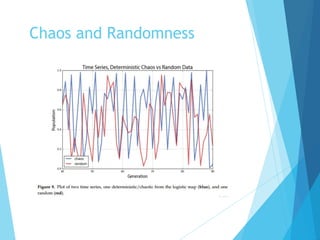
Chaotic systems are always deterministic and may be very
simple, yet they produce completely unpredictable and
divergent behavior.
 Systems of nonlinear equations are difficult to solve
analytically, and scientists have relied heavily on visual
and qualitative approaches to discover and analyze the
dynamics of nonlinearity: from strange attractors, to
bifurcation diagrams, to cobweb plots and phase diagrams.
Abstract
This paper has three aims.
 First, it argues for several visualization methods to
critically analyze and understand the behavior of nonlinear
dynamical systems.
 Second, it uses these visualizations to introduce the
foundations of nonlinear dynamics: chaos, fractals, self-
similarity and the limits of prediction.
 Finally, it presents Pynamical, an open-source Python
package to easily visualize and explore nonlinear
dynamical systems’ behavior.
Chaos
 Chaos theory is a branch of mathematics that deals with nonlinear
dynamical systems.
 A system is simply a set of interacting components that form a larger
whole.
 Nonlinear means that due to feedback or multiplicative effects between
the components, the whole becomes something greater than the mere
sum of its individual parts.
 Dynamical means the system changes over time based on its current
state.
 Nearly every real-world system is a nonlinear dynamical system.
 Chaotic systems are a type of nonlinear dynamical system that may
contain very few interacting parts and may follow simple rules, but all
have a very sensitive dependence on their initial conditions.
 One might expect that any simple deterministic system would produce
easily-predictable behavior. Yet, despite their deterministic simplicity,
over time, these systems can produce wildly unpredictable, divergent
and fractal (i.e., infinitely detailed and self-similar without ever actually
repeating) behavior due to that sensitivity.
Logistic Map
 The logistic function uses a differential equation that
treats time as continuous. The logistic map instead uses a
difference equation to look at discrete time steps. It is
called the logistic map because it maps the population
value at any time step to its value at the next time step:
xt +1 = r·xt ·(1 − xt ).
 If the growth rate is set too low, the population will die out
and go extinct. Higher growth rates might settle toward a
stable value or fluctuate across a series of population
booms and busts.
 The logistic map is a simple, one-dimensional, discrete
equation that produces chaos at certain growth rates.
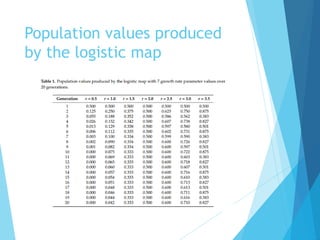
 The model always starts with a population level of 0.5 and
represents population as a ratio between zero (extinction)
and one (the maximum carrying capacity of our system).
Population values produced
by the logistic map
Attractors and Limit Cycles
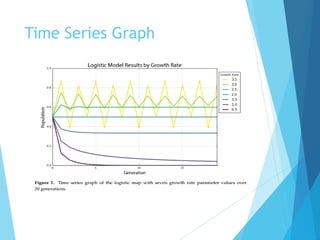
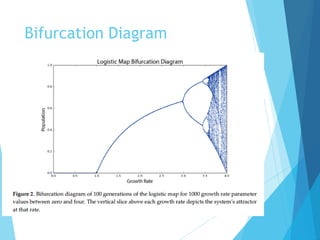
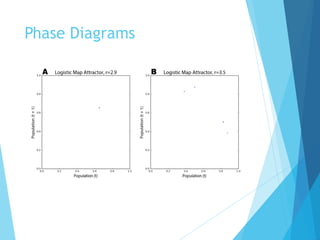
 An attractor is the value, or set of values, that a system
settles toward over time. When the growth rate parameter
is set to 0.5, the system has a fixed-point attractor at a
population level of zero, as depicted by the violet line.
 When the growth rate parameter is set to 3.5, the system
oscillates between four values as depicted by the yellow
line. This oscillating attractor is called a limit cycle.
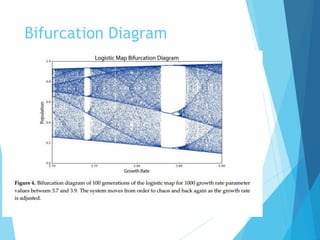
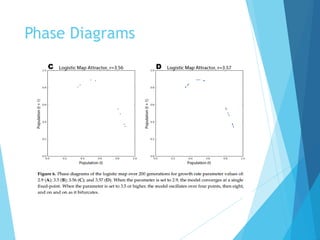
 However, when we adjust the growth rate parameter
beyond 3.57, we witness the onset of chaos. A chaotic
system has a strange attractor, around which the system
oscillates forever without ever repeating itself or settling
into a steady state of behavior. It never produces the same
value twice, and its structure is fractal, meaning the same
patterns exist at every scale no matter how much we zoom
into it.
Time Series Graph
Bifurcation Diagram
Bifurcation Diagram
Phase Diagrams
Phase Diagrams
Phase Diagrams
Phase Diagrams
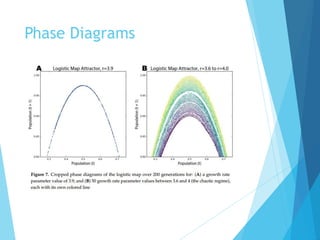
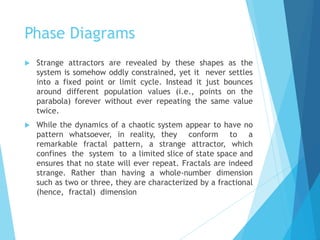
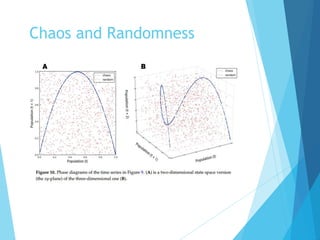
 Strange attractors are revealed by these shapes as the
system is somehow oddly constrained, yet it never settles
into a fixed point or limit cycle. Instead it just bounces
around different population values (i.e., points on the
parabola) forever without ever repeating the same value
twice.
 While the dynamics of a chaotic system appear to have no
pattern whatsoever, in reality, they conform to a
remarkable fractal pattern, a strange attractor, which
confines the system to a limited slice of state space and
ensures that no state will ever repeat. Fractals are indeed
strange. Rather than having a whole-number dimension
such as two or three, they are characterized by a fractional
(hence, fractal) dimension
Cobweb Plot
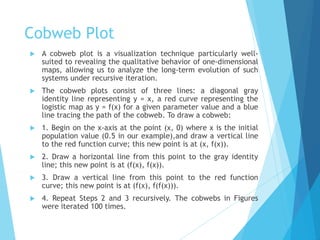
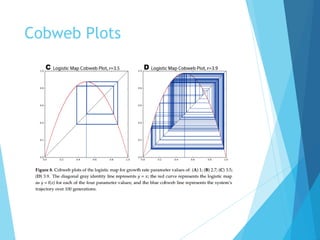
 A cobweb plot is a visualization technique particularly well-
suited to revealing the qualitative behavior of one-dimensional
maps, allowing us to analyze the long-term evolution of such
systems under recursive iteration.
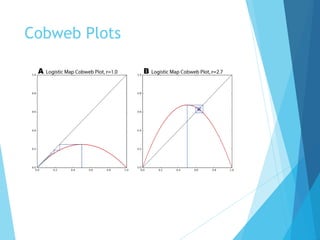
 The cobweb plots consist of three lines: a diagonal gray
identity line representing y = x, a red curve representing the
logistic map as y = f(x) for a given parameter value and a blue
line tracing the path of the cobweb. To draw a cobweb:
 1. Begin on the x-axis at the point (x, 0) where x is the initial
population value (0.5 in our example),and draw a vertical line
to the red function curve; this new point is at (x, f(x)).
 2. Draw a horizontal line from this point to the gray identity
line; this new point is at (f(x), f(x)).
 3. Draw a vertical line from this point to the red function
curve; this new point is at (f(x), f(f(x))).
 4. Repeat Steps 2 and 3 recursively. The cobwebs in Figures
were iterated 100 times.
Cobweb Plots
Cobweb Plots
Chaos and Randomness
Lyapunov Exponent
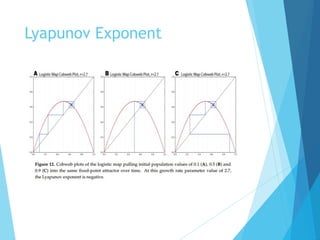
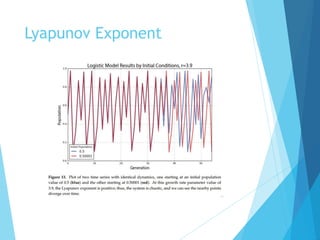
 Chaotic systems are characterized by their sensitive dependence on initial
conditions. Their strange attractors are globally stable, yet locally unstable: they
have basins of attraction, yet within a strange attractor, infinitesimally close
points diverge over time without ever leaving the attractor's confines. This
divergence can be measured by Lyapunov exponents.
 If the Lyapunov exponent’s value is positive, then the two points move apart over
time at an exponential rate.
 If the Lyapunov exponent is negative, then these points converge exponentially
quickly, such as toward a fixed point or limit cycle.
 Finally, the Lyapunov exponent is zero when there is a bifurcation. For example,
with our logistic model, the Lyapunovexponent is zero when the growth rate is
set to one or three because they are bifurcation points; it isnegative for most
growth rates, such as 0 ≤ r < 1 and 1 < r < 3, because they have fixed-point or
limitcycle attractors; and it is positive for the chaotic regime (exclusive of those
occasional windows whenthe system resumes brief periodicity, such as when the
growth rate is 3.83).
 A positive Lyapunov exponent indicates that the system has a highly sensitive
dependence on initial conditions and is a common signature of chaos.
Lyapunov Exponent
Lyapunov Exponent
Summary
 Nearly all real-world systems are nonlinear dynamical
systems.
 Chaos describes certain nonlinear dynamical systems that
have a very sensitive dependence on initial conditions.
Chaotic systems are always deterministic and may be very
simple, yet they produce completely unpredictable and
divergent behavior.
 Systems of nonlinear equations are difficult to solve
analytically, and scientists have relied heavily on visual
and qualitative approaches to discover and analyze the
dynamics of nonlinearity: from strange attractors, to
bifurcation diagrams, to cobweb plots and phase diagrams.
Summary
This paper had three aims.
 First, it argued for several visualization methods to
critically analyze and understand the behavior of nonlinear
dynamical systems.
 Second, it used these visualizations to introduce the
foundations of nonlinear dynamics, chaos, fractals, self-
similarity and the limits of prediction.
 Finally, it presented Pynamical, an open-source Python
package to easily visualize and explore nonlinear
dynamical systems’ behavior.
THANK YOU!

Non linear Dynamical Control Systems

  • 1.
    Visual Analysis ofNonlinear Dynamical Systems: Chaos, Fractals, Self-Similarity and the Limits of Prediction Geoff Boeing Department of City and Regional Planning, University of California, Berkeley, USA; Published: 13 November 2016 Presented by: Arslan Ahmed Amin 2016-PHD-Elect-09
  • 2.
    Abstract  Nearly allreal-world systems are nonlinear dynamical systems.  Chaos describes certain nonlinear dynamical systems that have a very sensitive dependence on initial conditions. Chaotic systems are always deterministic and may be very simple, yet they produce completely unpredictable and divergent behavior.  Systems of nonlinear equations are difficult to solve analytically, and scientists have relied heavily on visual and qualitative approaches to discover and analyze the dynamics of nonlinearity: from strange attractors, to bifurcation diagrams, to cobweb plots and phase diagrams.
  • 3.
    Abstract This paper hasthree aims.  First, it argues for several visualization methods to critically analyze and understand the behavior of nonlinear dynamical systems.  Second, it uses these visualizations to introduce the foundations of nonlinear dynamics: chaos, fractals, self- similarity and the limits of prediction.  Finally, it presents Pynamical, an open-source Python package to easily visualize and explore nonlinear dynamical systems’ behavior.
  • 4.
    Chaos  Chaos theoryis a branch of mathematics that deals with nonlinear dynamical systems.  A system is simply a set of interacting components that form a larger whole.  Nonlinear means that due to feedback or multiplicative effects between the components, the whole becomes something greater than the mere sum of its individual parts.  Dynamical means the system changes over time based on its current state.  Nearly every real-world system is a nonlinear dynamical system.  Chaotic systems are a type of nonlinear dynamical system that may contain very few interacting parts and may follow simple rules, but all have a very sensitive dependence on their initial conditions.  One might expect that any simple deterministic system would produce easily-predictable behavior. Yet, despite their deterministic simplicity, over time, these systems can produce wildly unpredictable, divergent and fractal (i.e., infinitely detailed and self-similar without ever actually repeating) behavior due to that sensitivity.
  • 5.
    Logistic Map  Thelogistic function uses a differential equation that treats time as continuous. The logistic map instead uses a difference equation to look at discrete time steps. It is called the logistic map because it maps the population value at any time step to its value at the next time step: xt +1 = r·xt ·(1 − xt ).  If the growth rate is set too low, the population will die out and go extinct. Higher growth rates might settle toward a stable value or fluctuate across a series of population booms and busts.  The logistic map is a simple, one-dimensional, discrete equation that produces chaos at certain growth rates.  The model always starts with a population level of 0.5 and represents population as a ratio between zero (extinction) and one (the maximum carrying capacity of our system).
  • 6.
  • 7.
    Attractors and LimitCycles  An attractor is the value, or set of values, that a system settles toward over time. When the growth rate parameter is set to 0.5, the system has a fixed-point attractor at a population level of zero, as depicted by the violet line.  When the growth rate parameter is set to 3.5, the system oscillates between four values as depicted by the yellow line. This oscillating attractor is called a limit cycle.  However, when we adjust the growth rate parameter beyond 3.57, we witness the onset of chaos. A chaotic system has a strange attractor, around which the system oscillates forever without ever repeating itself or settling into a steady state of behavior. It never produces the same value twice, and its structure is fractal, meaning the same patterns exist at every scale no matter how much we zoom into it.
  • 8.
  • 9.
  • 10.
  • 11.
  • 12.
  • 13.
  • 14.
    Phase Diagrams  Strangeattractors are revealed by these shapes as the system is somehow oddly constrained, yet it never settles into a fixed point or limit cycle. Instead it just bounces around different population values (i.e., points on the parabola) forever without ever repeating the same value twice.  While the dynamics of a chaotic system appear to have no pattern whatsoever, in reality, they conform to a remarkable fractal pattern, a strange attractor, which confines the system to a limited slice of state space and ensures that no state will ever repeat. Fractals are indeed strange. Rather than having a whole-number dimension such as two or three, they are characterized by a fractional (hence, fractal) dimension
  • 15.
    Cobweb Plot  Acobweb plot is a visualization technique particularly well- suited to revealing the qualitative behavior of one-dimensional maps, allowing us to analyze the long-term evolution of such systems under recursive iteration.  The cobweb plots consist of three lines: a diagonal gray identity line representing y = x, a red curve representing the logistic map as y = f(x) for a given parameter value and a blue line tracing the path of the cobweb. To draw a cobweb:  1. Begin on the x-axis at the point (x, 0) where x is the initial population value (0.5 in our example),and draw a vertical line to the red function curve; this new point is at (x, f(x)).  2. Draw a horizontal line from this point to the gray identity line; this new point is at (f(x), f(x)).  3. Draw a vertical line from this point to the red function curve; this new point is at (f(x), f(f(x))).  4. Repeat Steps 2 and 3 recursively. The cobwebs in Figures were iterated 100 times.
  • 16.
  • 17.
  • 18.
  • 19.
  • 20.
    Lyapunov Exponent  Chaoticsystems are characterized by their sensitive dependence on initial conditions. Their strange attractors are globally stable, yet locally unstable: they have basins of attraction, yet within a strange attractor, infinitesimally close points diverge over time without ever leaving the attractor's confines. This divergence can be measured by Lyapunov exponents.  If the Lyapunov exponent’s value is positive, then the two points move apart over time at an exponential rate.  If the Lyapunov exponent is negative, then these points converge exponentially quickly, such as toward a fixed point or limit cycle.  Finally, the Lyapunov exponent is zero when there is a bifurcation. For example, with our logistic model, the Lyapunovexponent is zero when the growth rate is set to one or three because they are bifurcation points; it isnegative for most growth rates, such as 0 ≤ r < 1 and 1 < r < 3, because they have fixed-point or limitcycle attractors; and it is positive for the chaotic regime (exclusive of those occasional windows whenthe system resumes brief periodicity, such as when the growth rate is 3.83).  A positive Lyapunov exponent indicates that the system has a highly sensitive dependence on initial conditions and is a common signature of chaos.
  • 21.
  • 22.
  • 23.
    Summary  Nearly allreal-world systems are nonlinear dynamical systems.  Chaos describes certain nonlinear dynamical systems that have a very sensitive dependence on initial conditions. Chaotic systems are always deterministic and may be very simple, yet they produce completely unpredictable and divergent behavior.  Systems of nonlinear equations are difficult to solve analytically, and scientists have relied heavily on visual and qualitative approaches to discover and analyze the dynamics of nonlinearity: from strange attractors, to bifurcation diagrams, to cobweb plots and phase diagrams.
  • 24.
    Summary This paper hadthree aims.  First, it argued for several visualization methods to critically analyze and understand the behavior of nonlinear dynamical systems.  Second, it used these visualizations to introduce the foundations of nonlinear dynamics, chaos, fractals, self- similarity and the limits of prediction.  Finally, it presented Pynamical, an open-source Python package to easily visualize and explore nonlinear dynamical systems’ behavior.
  • 25.