Table 2—Glucose-lowering medications and therapies available in the U.S. or Europe and specific characteristics that may guide individualized treatment choices in
nonpregnant adults with type 2 diabetes
Class
Medications/therapies
in class Primary physiological action(s) Advantages Disadvantages/adverse effects Efficacy
Lifestyle
Diet quality c Mediterranean type
c DASH
c Low carbohydrate
c Vegetarian
c Others
c Depends on diet c Inexpensive
c No side effects
c Requires instruction
c Requires motivation
c Requires lifelong behavioral change
c Social barriers may exist
Intermediate
Physical activity c Running, walking
c Bicycling (including
stationary)
c Swimming
c Resistance training
c Yoga
c Tai chi
c Many others
c Energy expenditure
c Weight management
c ↑ Insulin sensitivity
c Inexpensive
c ↓ Fall risk by increasing balance/strength
c ? Improves mental health
c ↑ Bone density
c ↓ Blood pressure
c ↓ Weight
c Improves ASCVD risk factors
c Risk of musculoskeletal injury
c Requires motivation
c Risk of foot trauma in patients with
neuropathy
c Requires lifelong behavioral change
Intermediate
Energy restriction c Individual energy
restriction with or
without energy tracking
c Programs with
counseling
c Food substitution
programs
c Energy restriction
c Weight management
c ↓ Hepatic and pancreatic
fat
c ↑ Insulin sensitivity
c Lowers glycemia
c Reduces need for diabetes and
other medications
c No serious side effects
c Improves ASCVD risk factors
c Requires motivation
c Requires lifelong behavioral change
Variable, with potential for
very high efficacy; often
intermediate
Oral medications
Biguanides c Metformin c ↓ Hepatic glucose production
c Multiple other non-insulin-
mediated mechanisms
c Extensive experience
c No hypoglycemia
c Inexpensive
c GI symptoms
c Vitamin B12 deficiency
c Use with caution or dose adjustment
forCKDstage3B(eGFR30–44mLmin21
[1.73 m]22
)
c Lactic acidosis (rare)
High
SGLT2 inhibitors c Canagliflozin
c Dapagliflozin
c Empagliflozin
c Ertugliflozin
c Blocks glucose reabsorption
by the kidney, increasing
glucosuria
c ? Other tubulo-glomerular
effects
c No hypoglycemia
c ↓ Weight
c ↓ Blood pressure
c Effective at all stages of T2DM
with preserved glomerular function
c ↓ MACE, HF, CKD with some
agents (see text)
c Genital infections
c UTI
c Polyuria
c Volume depletion/hypotension/
dizziness
c ↑ LDL-C
c ↑ Creatinine (transient)
c Dose adjustment/avoidance for renal
disease
c ↑ Risk for amputation (canagliflozin)
c ↑ Risk for fracture (canagliflozin)
Intermediate–high
(dependent on GFR)
Continued on p. 2682
care.diabetesjournals.orgDaviesandAssociates2681
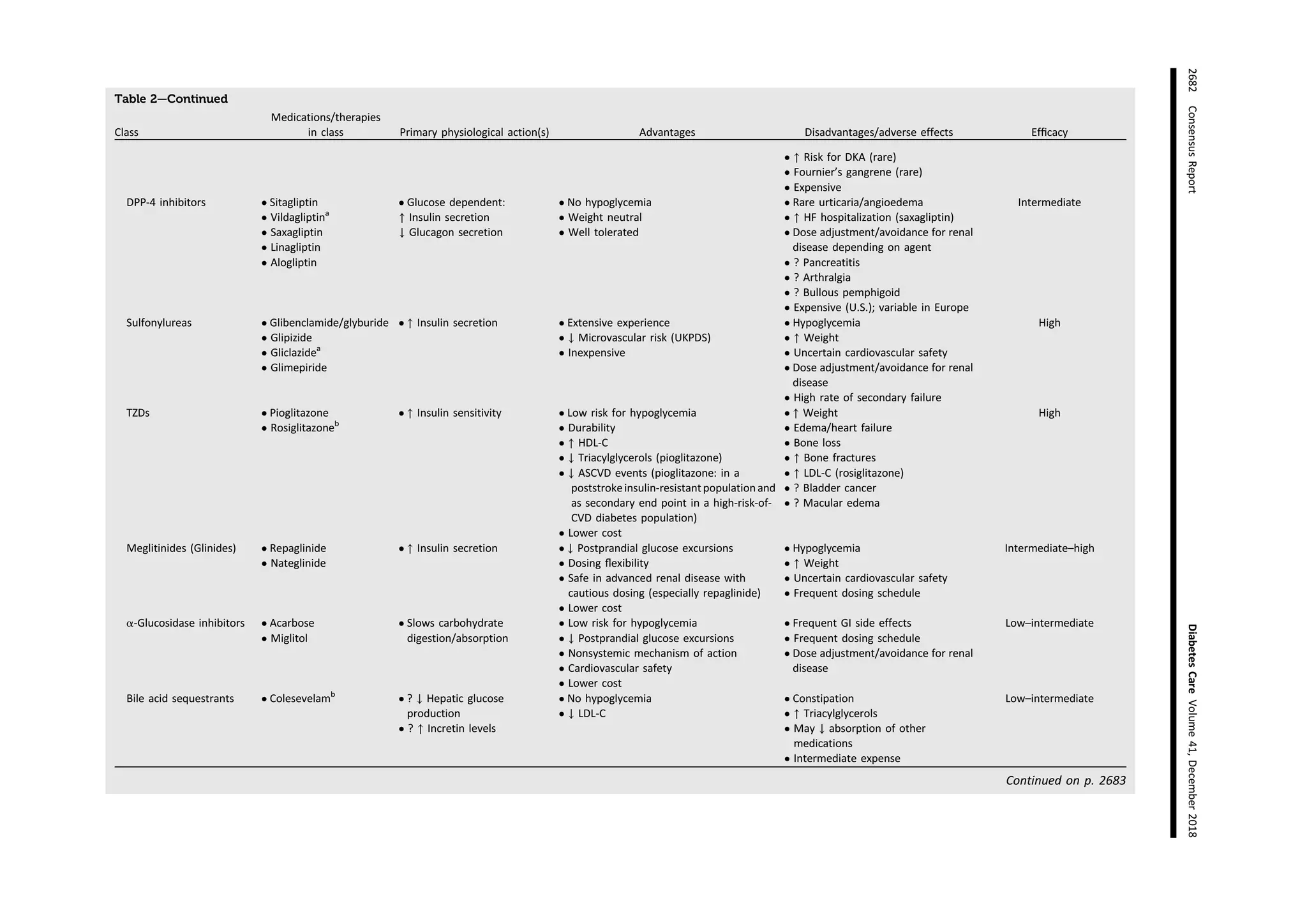
Table 2—Continued
Class
Medications/therapies
in class Primary physiological action(s) Advantages Disadvantages/adverse effects Efficacy
c ↑ Risk for DKA (rare)
c Fournier’s gangrene (rare)
c Expensive
DPP-4 inhibitors c Sitagliptin
c Vildagliptina
c Saxagliptin
c Linagliptin
c Alogliptin
c Glucose dependent:
↑ Insulin secretion
↓ Glucagon secretion
c No hypoglycemia
c Weight neutral
c Well tolerated
c Rare urticaria/angioedema
c ↑ HF hospitalization (saxagliptin)
c Dose adjustment/avoidance for renal
disease depending on agent
c ? Pancreatitis
c ? Arthralgia
c ? Bullous pemphigoid
c Expensive (U.S.); variable in Europe
Intermediate
Sulfonylureas c Glibenclamide/glyburide
c Glipizide
c Gliclazidea
c Glimepiride
c ↑ Insulin secretion c Extensive experience
c ↓ Microvascular risk (UKPDS)
c Inexpensive
c Hypoglycemia
c ↑ Weight
c Uncertain cardiovascular safety
c Dose adjustment/avoidance for renal
disease
c High rate of secondary failure
High
TZDs c Pioglitazone
c Rosiglitazoneb
c ↑ Insulin sensitivity c Low risk for hypoglycemia
c Durability
c ↑ HDL-C
c ↓ Triacylglycerols (pioglitazone)
c ↓ ASCVD events (pioglitazone: in a
poststrokeinsulin-resistantpopulationand
as secondary end point in a high-risk-of-
CVD diabetes population)
c Lower cost
c ↑ Weight
c Edema/heart failure
c Bone loss
c ↑ Bone fractures
c ↑ LDL-C (rosiglitazone)
c ? Bladder cancer
c ? Macular edema
High
Meglitinides (Glinides) c Repaglinide
c Nateglinide
c ↑ Insulin secretion c ↓ Postprandial glucose excursions
c Dosing flexibility
c Safe in advanced renal disease with
cautious dosing (especially repaglinide)
c Lower cost
c Hypoglycemia
c ↑ Weight
c Uncertain cardiovascular safety
c Frequent dosing schedule
Intermediate–high
a-Glucosidase inhibitors c Acarbose
c Miglitol
c Slows carbohydrate
digestion/absorption
c Low risk for hypoglycemia
c ↓ Postprandial glucose excursions
c Nonsystemic mechanism of action
c Cardiovascular safety
c Lower cost
c Frequent GI side effects
c Frequent dosing schedule
c Dose adjustment/avoidance for renal
disease
Low–intermediate
Bile acid sequestrants c Colesevelamb
c ? ↓ Hepatic glucose
production
c ? ↑ Incretin levels
c No hypoglycemia
c ↓ LDL-C
c Constipation
c ↑ Triacylglycerols
c May ↓ absorption of other
medications
c Intermediate expense
Low–intermediate
Continued on p. 2683
2682ConsensusReportDiabetesCareVolume41,December2018
Table 2—Continued
Class
Medications/therapies
in class Primary physiological action(s) Advantages Disadvantages/adverse effects Efficacy
Dopamine-2 agonists c Quick-release
bromocriptineb
c Modulates hypothalamic
regulation of metabolism
c ↑ Insulin sensitivity
c No hypoglycemia
c ? ↓ ASCVD events
c Headache/dizziness/syncope
c Nausea
c Fatigue
c Rhinitis
c High cost
Low–intermediate
Injectable medications
Insulins
Long acting (basal) c Degludec (U100, U200)
c Detemir
c Glargine (U100, U300)
c Activates insulin receptor
c ↑ Glucose disposal
c ↓ Glucose production
c Nearly universal response
c Theoretically unlimited efficacy
c Once-daily injection
c Hypoglycemia
c Weight gain
c Training requirements
c Frequentdoseadjustmentforoptimal
efficacy
c High cost
Very high
Intermediate acting
(basal)
c Human NPH c Activates insulin receptor
c ↑ Glucose disposal
c ↓ Glucose production
c Nearly universal response
c Theoretically unlimited efficacy
c Less expensive than analogs
c Hypoglycemia
c Weight gain
c Training requirements
c Often given twice daily
c Frequent dose adjustment for optimal
efficacy
Very high
Rapid acting c Aspart (conventional and
fast acting)
c Lispro (U100, U200)
c Glulisine
c Activates insulin receptor
c ↑ Glucose disposal
c ↓ Glucose production
c Nearly universal response
c Theoretically unlimited efficacy
c ↓ Postprandial glucose
c Hypoglycemia
c Weight gain
c Training requirements
c May require multiple daily injections
c Frequent dose adjustment for optimal
efficacy
c High cost
Very high
Inhaled rapid acting c Human insulin inhalation
powderb
c Activates insulin receptor
c ↑ Glucose disposal
c ↓ Glucose production
c Nearly universal response
c ↓ Postprandial glucose
c More rapid onset and shorter duration
than rapid-acting analogs
c Spirometry (FEV1) required before
initiating, after 6 months, and
annually
c Contraindicated in chronic lung
disease
c Not recommended in smokers
c Hypoglycemia
c Weight gain
c Training requirements
c May require multiple inhalations daily
High
Continued on p. 2684
care.diabetesjournals.orgDaviesandAssociates2683
Table 2—Continued
Class
Medications/therapies
in class Primary physiological action(s) Advantages Disadvantages/adverse effects Efficacy
c Frequent dose adjustment for optimal
efficacy; limited options in dosing
interval
c High cost
c Respiratory side effects (e.g.,
bronchospasm, cough, decline in
FEV1)
Short acting c Human regular (U100,
U500)
c Activates insulin receptor
c ↑ Glucose disposal
c ↓ Glucose production
c Nearly universal response
c Theoretically unlimited efficacy
c ↓ Postprandial glucose
c Less expensive than analogs
c Hypoglycemia
c Weight gain
c Training requirements
c Frequent dose adjustment for optimal
efficacy
c May require multiple daily injections
Very high
Premixed c Many c Activates insulin receptor
c ↑ Glucose disposal
c ↓ Glucose production
c Nearly universal response
c Theoretically unlimited efficacy
c Fewer injections than basal/bolus
before every meal
c Recombinant human analogs
are less expensive
c Hypoglycemia
c Weight gain
c Training requirements
c Frequent dose adjustment for optimal
efficacy
c High cost (except human insulin
premix)
c Can lead to obligate eating
Very high
GLP-1 RA
Shorter acting c Exenatide
c Lixisenatide
c Glucose dependent:
↑ Insulin secretion
↓ Glucagon secretion
c Slows gastric emptying
c ↑ Satiety
c No hypoglycemia as monotherapy
c ↓ Weight
c Excellent postprandial glucose
efficacy for meals after injections
c Improves cardiovascular risk
factors
c Frequent GI side effects that may be
transient
c Modestly ↑ heart rate
c Training requirements
c Dose adjustment/avoidance in renal
disease
c Acute pancreatitis (rare/uncertain)
c Very high cost
Intermediate–high
Longer acting c Dulaglutide
c Exenatide extended-
release
c Liraglutide
c Semaglutide
c Glucose dependent:
↑ Insulin secretion
↓ Glucagon secretion
c ↑ Satiety
c No hypoglycemia as monotherapy
c ↓ Weight
c ↓ Postprandial glucose excursions
c Improves cardiovascular risk factors
c ↓ MACE with some agents (see text)
c ↓ Albuminuria with some agents
(see text)
c GI side effects, including gallbladder
disease
c Greater ↑ heart rate
c Training requirements
c Dose adjustment/avoidance for some
agents in renal disease
c Acute pancreatitis (rare/uncertain)
High–very high
Continued on p. 2685
2684ConsensusReportDiabetesCareVolume41,December2018
Table 2—Continued
Class
Medications/therapies
in class Primary physiological action(s) Advantages Disadvantages/adverse effects Efficacy
c Greater lowering of fasting
glucose vs. short-acting preparations
c Once-weekly dosing (except
liraglutide, which is daily)
c C-cell hyperplasia/medullary thyroid
tumors (rare/uncertain; observed in
animals only)
c Very high cost
Other injectables
Amylin mimetics c Pramlintideb
c ↓ Glucagon secretion
c Slows gastric emptying
c ↑ Satiety
c ↓ Postprandial glucose excursions
c ↓ Weight
c Hypoglycemia
c Frequent dosing schedule
c Training requirements
c Frequent GI side effects
c Very high cost
Intermediate
Fixed-dose
combinationofGLP-1
RA and basal insulin
analogs
c Liraglutide/degludec
c Lixisenatide/glargine
c Combined activities of
components
c Enhanced glycemic efficacy vs. components
c Reduced adverse effects (e.g., GI,
hypoglycemia)
vs. components
c Less weight loss than GLP-1 receptor
agonist alone
c Very high cost
Very high
Weight loss medications c Lorcaserinb
c Naltrexone/bupropion
c Orlistat
c Phentermine/
topiramateb
c Liraglutide 3 mg
c Reduced appetite
c Fat malabsorption (orlistat)
c Mean 3–9 kg weight loss vs. placebo c High discontinuation rates from side
effects
c ,50% achieve $5% weight loss
c Drug-specific side effects
c Limited durability
c High cost
Intermediate
Metabolic surgery c VSG
c RYGB
c Adjustable gastric band
c BPD
c Restriction of food intake (all)
c Malabsorption (RYGB, BPD)
c Changes in hormonal and
possibly neuronal signaling
(VSG, RYGB, BPD)
c Sustained weight reduction
c ↑ Rate of remission of diabetes
c ↓ Number of diabetes drugs
c ↓ Blood pressure
c Improved lipid metabolism
c High initial cost
c ↑ Risk for early and late surgical
complications
c ↑ Risk for reoperation
c ↑ Risk for dumping syndrome
c ↑ Nutrient and vitamin malabsorption
c ↑ Risk for new-onset depression
c ↑ Risk for new-onset opioid use
c ↑ Risk for gastroduodenal ulcer
c ↑ Risk for hypoglycemia
c ↑ Risk for alcohol use disorder
Very high
More details available in ADA’s Standards of Medical Care in Diabetesd2018 (3). Glucose-lowering efficacy of drugs by change in HbA1c: .22 mmol/mol (2%) very high, 11–22 mmol/mol (1–2%)
high, 6–11 mmol/mol (0.5–1.5%) intermediate, ,6 mmol/mol (0.5%) low. a
Not licensed in the U.S. for type 2 diabetes. b
Not licensed in Europe for type 2 diabetes. BPD, biliopancreatic diversion;
DKA, diabetic ketoacidosis; FEV1, forced expiratory volume in 1 s on pulmonary function testing; GI, gastrointestinal; GLP-1 RA, glucagon-like peptide 1 receptor agonist; HDL-C, HDL-cholesterol; LDL-C,
LDL-cholesterol; RYGB, Roux-en-Y gastric bypass; VSG, vertical sleeve gastroplasty; T2DM, type 2 diabetes mellitus; UTI, urinary tract infection.
care.diabetesjournals.orgDaviesandAssociates2685

Glucose-lowering medications

  • 1.
    Table 2—Glucose-lowering medicationsand therapies available in the U.S. or Europe and specific characteristics that may guide individualized treatment choices in nonpregnant adults with type 2 diabetes Class Medications/therapies in class Primary physiological action(s) Advantages Disadvantages/adverse effects Efficacy Lifestyle Diet quality c Mediterranean type c DASH c Low carbohydrate c Vegetarian c Others c Depends on diet c Inexpensive c No side effects c Requires instruction c Requires motivation c Requires lifelong behavioral change c Social barriers may exist Intermediate Physical activity c Running, walking c Bicycling (including stationary) c Swimming c Resistance training c Yoga c Tai chi c Many others c Energy expenditure c Weight management c ↑ Insulin sensitivity c Inexpensive c ↓ Fall risk by increasing balance/strength c ? Improves mental health c ↑ Bone density c ↓ Blood pressure c ↓ Weight c Improves ASCVD risk factors c Risk of musculoskeletal injury c Requires motivation c Risk of foot trauma in patients with neuropathy c Requires lifelong behavioral change Intermediate Energy restriction c Individual energy restriction with or without energy tracking c Programs with counseling c Food substitution programs c Energy restriction c Weight management c ↓ Hepatic and pancreatic fat c ↑ Insulin sensitivity c Lowers glycemia c Reduces need for diabetes and other medications c No serious side effects c Improves ASCVD risk factors c Requires motivation c Requires lifelong behavioral change Variable, with potential for very high efficacy; often intermediate Oral medications Biguanides c Metformin c ↓ Hepatic glucose production c Multiple other non-insulin- mediated mechanisms c Extensive experience c No hypoglycemia c Inexpensive c GI symptoms c Vitamin B12 deficiency c Use with caution or dose adjustment forCKDstage3B(eGFR30–44mLmin21 [1.73 m]22 ) c Lactic acidosis (rare) High SGLT2 inhibitors c Canagliflozin c Dapagliflozin c Empagliflozin c Ertugliflozin c Blocks glucose reabsorption by the kidney, increasing glucosuria c ? Other tubulo-glomerular effects c No hypoglycemia c ↓ Weight c ↓ Blood pressure c Effective at all stages of T2DM with preserved glomerular function c ↓ MACE, HF, CKD with some agents (see text) c Genital infections c UTI c Polyuria c Volume depletion/hypotension/ dizziness c ↑ LDL-C c ↑ Creatinine (transient) c Dose adjustment/avoidance for renal disease c ↑ Risk for amputation (canagliflozin) c ↑ Risk for fracture (canagliflozin) Intermediate–high (dependent on GFR) Continued on p. 2682 care.diabetesjournals.orgDaviesandAssociates2681
  • 2.
    Table 2—Continued Class Medications/therapies in classPrimary physiological action(s) Advantages Disadvantages/adverse effects Efficacy c ↑ Risk for DKA (rare) c Fournier’s gangrene (rare) c Expensive DPP-4 inhibitors c Sitagliptin c Vildagliptina c Saxagliptin c Linagliptin c Alogliptin c Glucose dependent: ↑ Insulin secretion ↓ Glucagon secretion c No hypoglycemia c Weight neutral c Well tolerated c Rare urticaria/angioedema c ↑ HF hospitalization (saxagliptin) c Dose adjustment/avoidance for renal disease depending on agent c ? Pancreatitis c ? Arthralgia c ? Bullous pemphigoid c Expensive (U.S.); variable in Europe Intermediate Sulfonylureas c Glibenclamide/glyburide c Glipizide c Gliclazidea c Glimepiride c ↑ Insulin secretion c Extensive experience c ↓ Microvascular risk (UKPDS) c Inexpensive c Hypoglycemia c ↑ Weight c Uncertain cardiovascular safety c Dose adjustment/avoidance for renal disease c High rate of secondary failure High TZDs c Pioglitazone c Rosiglitazoneb c ↑ Insulin sensitivity c Low risk for hypoglycemia c Durability c ↑ HDL-C c ↓ Triacylglycerols (pioglitazone) c ↓ ASCVD events (pioglitazone: in a poststrokeinsulin-resistantpopulationand as secondary end point in a high-risk-of- CVD diabetes population) c Lower cost c ↑ Weight c Edema/heart failure c Bone loss c ↑ Bone fractures c ↑ LDL-C (rosiglitazone) c ? Bladder cancer c ? Macular edema High Meglitinides (Glinides) c Repaglinide c Nateglinide c ↑ Insulin secretion c ↓ Postprandial glucose excursions c Dosing flexibility c Safe in advanced renal disease with cautious dosing (especially repaglinide) c Lower cost c Hypoglycemia c ↑ Weight c Uncertain cardiovascular safety c Frequent dosing schedule Intermediate–high a-Glucosidase inhibitors c Acarbose c Miglitol c Slows carbohydrate digestion/absorption c Low risk for hypoglycemia c ↓ Postprandial glucose excursions c Nonsystemic mechanism of action c Cardiovascular safety c Lower cost c Frequent GI side effects c Frequent dosing schedule c Dose adjustment/avoidance for renal disease Low–intermediate Bile acid sequestrants c Colesevelamb c ? ↓ Hepatic glucose production c ? ↑ Incretin levels c No hypoglycemia c ↓ LDL-C c Constipation c ↑ Triacylglycerols c May ↓ absorption of other medications c Intermediate expense Low–intermediate Continued on p. 2683 2682ConsensusReportDiabetesCareVolume41,December2018
  • 3.
    Table 2—Continued Class Medications/therapies in classPrimary physiological action(s) Advantages Disadvantages/adverse effects Efficacy Dopamine-2 agonists c Quick-release bromocriptineb c Modulates hypothalamic regulation of metabolism c ↑ Insulin sensitivity c No hypoglycemia c ? ↓ ASCVD events c Headache/dizziness/syncope c Nausea c Fatigue c Rhinitis c High cost Low–intermediate Injectable medications Insulins Long acting (basal) c Degludec (U100, U200) c Detemir c Glargine (U100, U300) c Activates insulin receptor c ↑ Glucose disposal c ↓ Glucose production c Nearly universal response c Theoretically unlimited efficacy c Once-daily injection c Hypoglycemia c Weight gain c Training requirements c Frequentdoseadjustmentforoptimal efficacy c High cost Very high Intermediate acting (basal) c Human NPH c Activates insulin receptor c ↑ Glucose disposal c ↓ Glucose production c Nearly universal response c Theoretically unlimited efficacy c Less expensive than analogs c Hypoglycemia c Weight gain c Training requirements c Often given twice daily c Frequent dose adjustment for optimal efficacy Very high Rapid acting c Aspart (conventional and fast acting) c Lispro (U100, U200) c Glulisine c Activates insulin receptor c ↑ Glucose disposal c ↓ Glucose production c Nearly universal response c Theoretically unlimited efficacy c ↓ Postprandial glucose c Hypoglycemia c Weight gain c Training requirements c May require multiple daily injections c Frequent dose adjustment for optimal efficacy c High cost Very high Inhaled rapid acting c Human insulin inhalation powderb c Activates insulin receptor c ↑ Glucose disposal c ↓ Glucose production c Nearly universal response c ↓ Postprandial glucose c More rapid onset and shorter duration than rapid-acting analogs c Spirometry (FEV1) required before initiating, after 6 months, and annually c Contraindicated in chronic lung disease c Not recommended in smokers c Hypoglycemia c Weight gain c Training requirements c May require multiple inhalations daily High Continued on p. 2684 care.diabetesjournals.orgDaviesandAssociates2683
  • 4.
    Table 2—Continued Class Medications/therapies in classPrimary physiological action(s) Advantages Disadvantages/adverse effects Efficacy c Frequent dose adjustment for optimal efficacy; limited options in dosing interval c High cost c Respiratory side effects (e.g., bronchospasm, cough, decline in FEV1) Short acting c Human regular (U100, U500) c Activates insulin receptor c ↑ Glucose disposal c ↓ Glucose production c Nearly universal response c Theoretically unlimited efficacy c ↓ Postprandial glucose c Less expensive than analogs c Hypoglycemia c Weight gain c Training requirements c Frequent dose adjustment for optimal efficacy c May require multiple daily injections Very high Premixed c Many c Activates insulin receptor c ↑ Glucose disposal c ↓ Glucose production c Nearly universal response c Theoretically unlimited efficacy c Fewer injections than basal/bolus before every meal c Recombinant human analogs are less expensive c Hypoglycemia c Weight gain c Training requirements c Frequent dose adjustment for optimal efficacy c High cost (except human insulin premix) c Can lead to obligate eating Very high GLP-1 RA Shorter acting c Exenatide c Lixisenatide c Glucose dependent: ↑ Insulin secretion ↓ Glucagon secretion c Slows gastric emptying c ↑ Satiety c No hypoglycemia as monotherapy c ↓ Weight c Excellent postprandial glucose efficacy for meals after injections c Improves cardiovascular risk factors c Frequent GI side effects that may be transient c Modestly ↑ heart rate c Training requirements c Dose adjustment/avoidance in renal disease c Acute pancreatitis (rare/uncertain) c Very high cost Intermediate–high Longer acting c Dulaglutide c Exenatide extended- release c Liraglutide c Semaglutide c Glucose dependent: ↑ Insulin secretion ↓ Glucagon secretion c ↑ Satiety c No hypoglycemia as monotherapy c ↓ Weight c ↓ Postprandial glucose excursions c Improves cardiovascular risk factors c ↓ MACE with some agents (see text) c ↓ Albuminuria with some agents (see text) c GI side effects, including gallbladder disease c Greater ↑ heart rate c Training requirements c Dose adjustment/avoidance for some agents in renal disease c Acute pancreatitis (rare/uncertain) High–very high Continued on p. 2685 2684ConsensusReportDiabetesCareVolume41,December2018
  • 5.
    Table 2—Continued Class Medications/therapies in classPrimary physiological action(s) Advantages Disadvantages/adverse effects Efficacy c Greater lowering of fasting glucose vs. short-acting preparations c Once-weekly dosing (except liraglutide, which is daily) c C-cell hyperplasia/medullary thyroid tumors (rare/uncertain; observed in animals only) c Very high cost Other injectables Amylin mimetics c Pramlintideb c ↓ Glucagon secretion c Slows gastric emptying c ↑ Satiety c ↓ Postprandial glucose excursions c ↓ Weight c Hypoglycemia c Frequent dosing schedule c Training requirements c Frequent GI side effects c Very high cost Intermediate Fixed-dose combinationofGLP-1 RA and basal insulin analogs c Liraglutide/degludec c Lixisenatide/glargine c Combined activities of components c Enhanced glycemic efficacy vs. components c Reduced adverse effects (e.g., GI, hypoglycemia) vs. components c Less weight loss than GLP-1 receptor agonist alone c Very high cost Very high Weight loss medications c Lorcaserinb c Naltrexone/bupropion c Orlistat c Phentermine/ topiramateb c Liraglutide 3 mg c Reduced appetite c Fat malabsorption (orlistat) c Mean 3–9 kg weight loss vs. placebo c High discontinuation rates from side effects c ,50% achieve $5% weight loss c Drug-specific side effects c Limited durability c High cost Intermediate Metabolic surgery c VSG c RYGB c Adjustable gastric band c BPD c Restriction of food intake (all) c Malabsorption (RYGB, BPD) c Changes in hormonal and possibly neuronal signaling (VSG, RYGB, BPD) c Sustained weight reduction c ↑ Rate of remission of diabetes c ↓ Number of diabetes drugs c ↓ Blood pressure c Improved lipid metabolism c High initial cost c ↑ Risk for early and late surgical complications c ↑ Risk for reoperation c ↑ Risk for dumping syndrome c ↑ Nutrient and vitamin malabsorption c ↑ Risk for new-onset depression c ↑ Risk for new-onset opioid use c ↑ Risk for gastroduodenal ulcer c ↑ Risk for hypoglycemia c ↑ Risk for alcohol use disorder Very high More details available in ADA’s Standards of Medical Care in Diabetesd2018 (3). Glucose-lowering efficacy of drugs by change in HbA1c: .22 mmol/mol (2%) very high, 11–22 mmol/mol (1–2%) high, 6–11 mmol/mol (0.5–1.5%) intermediate, ,6 mmol/mol (0.5%) low. a Not licensed in the U.S. for type 2 diabetes. b Not licensed in Europe for type 2 diabetes. BPD, biliopancreatic diversion; DKA, diabetic ketoacidosis; FEV1, forced expiratory volume in 1 s on pulmonary function testing; GI, gastrointestinal; GLP-1 RA, glucagon-like peptide 1 receptor agonist; HDL-C, HDL-cholesterol; LDL-C, LDL-cholesterol; RYGB, Roux-en-Y gastric bypass; VSG, vertical sleeve gastroplasty; T2DM, type 2 diabetes mellitus; UTI, urinary tract infection. care.diabetesjournals.orgDaviesandAssociates2685