Article on Nomination and Remuneration Committee 
For the sake of this Article: 
“Act” here means Companies Act, 2013. 
“Circular” here means SEBI Circular dated September 15, 2014 on Corporate 
Governance in listed entities – Amendments to Clause 49 of the Equity Listing 
Agreement. 
“Rules” here means The Companies (Meetings of Board and its Powers) Rules, 2014. 
“Prescribed Authority” here means Registrar of Companies (ROC) or Regional 
Director (RD) or Securities & Exchange Board of India (SEBI). 
“FAQ’s”: 
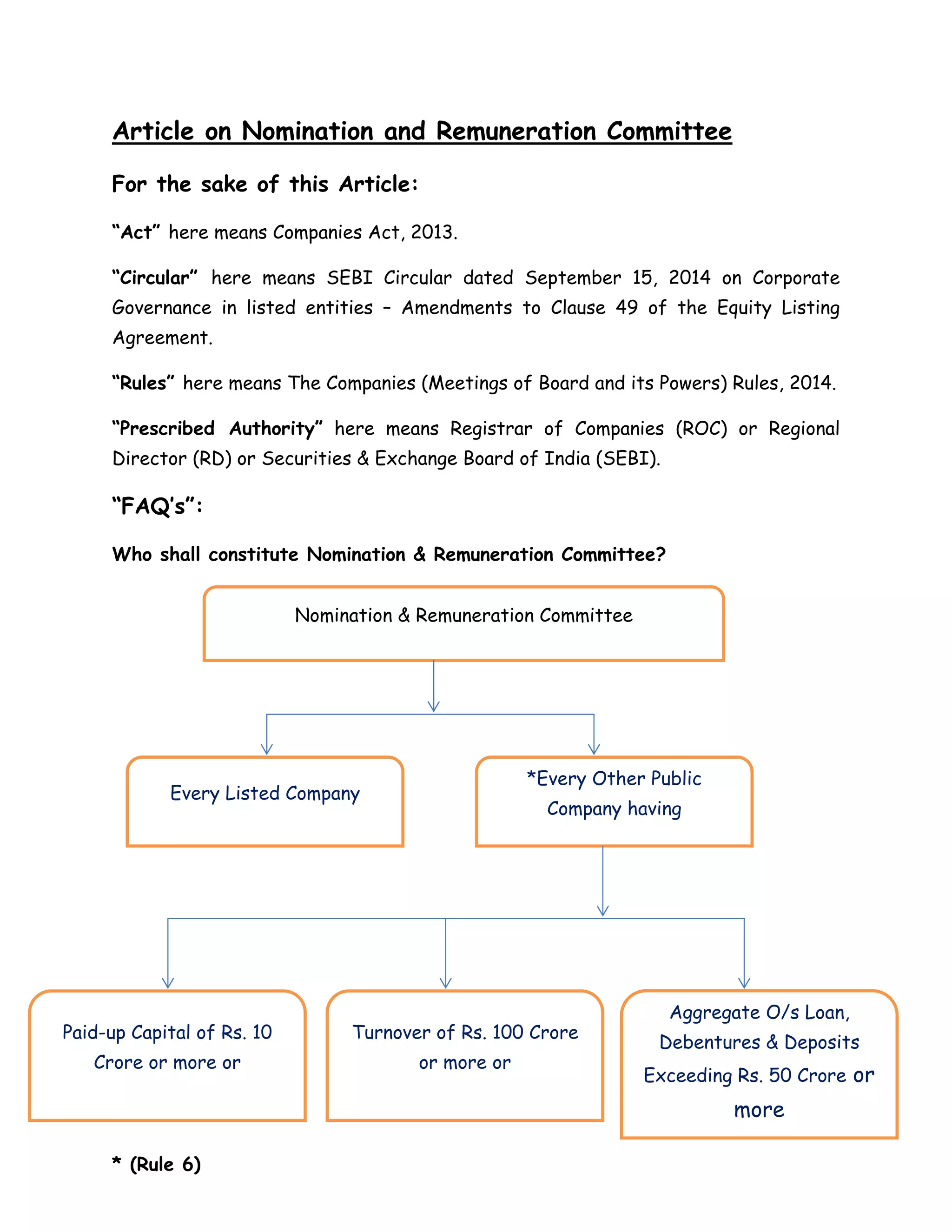
Who shall constitute Nomination & Remuneration Committee? 
* (Rule 6) 
Nomination & Remuneration Committee 
Every Listed Company 
*Every Other Public 
Company having 
Paid-up Capital of Rs. 10 
Crore or more or 
Turnover of Rs. 100 Crore 
or more or 
Aggregate O/s Loan, 
Debentures & Deposits 
Exceeding Rs. 50 Crore or 
more
Note:Paid-up Share Capital, Turnover or O/s Loans or borrowings or 
debentures or deposits, as the case may be, as existing on the date of last 
Audited Financial Statements shall be taken into account for the purpose. 
As per sub-section (64) of Section 2 of the Act “Paid-up Share Capital” or 
“Share Capital Paid-up” means such aggregate amount of money credited as paid-up 
as is equivalent to the amount received as paid-up in respect of shares issued 
and also includes any amount credited as paid-up in respect of shares of the 
company, but does not include any other amount received in respect of such shares, 
by whatever name called 
As per sub-section (91) of Section 2 of the Act “Turnover” means the 
aggregate value of the realization of amount made from the sale, supply or 
distribution of goods or on account services rendered, or both, by the company 
during a financial year. 
As per sub-section (30) of Section 2 of the Act “Debenture” includes 
debenture stock, bonds or any other instrument of a company evidencing a debt, 
whether constituting a charge on the assets of the company or not. 
As per sub-section (31) of Section 2 of the Act “Deposit” includes any receipt 
of money by way of deposit or loan or in any other form by a company, but does not 
include such categories of amount as may be prescribed in consultation with the 
Reserve Bank of India.
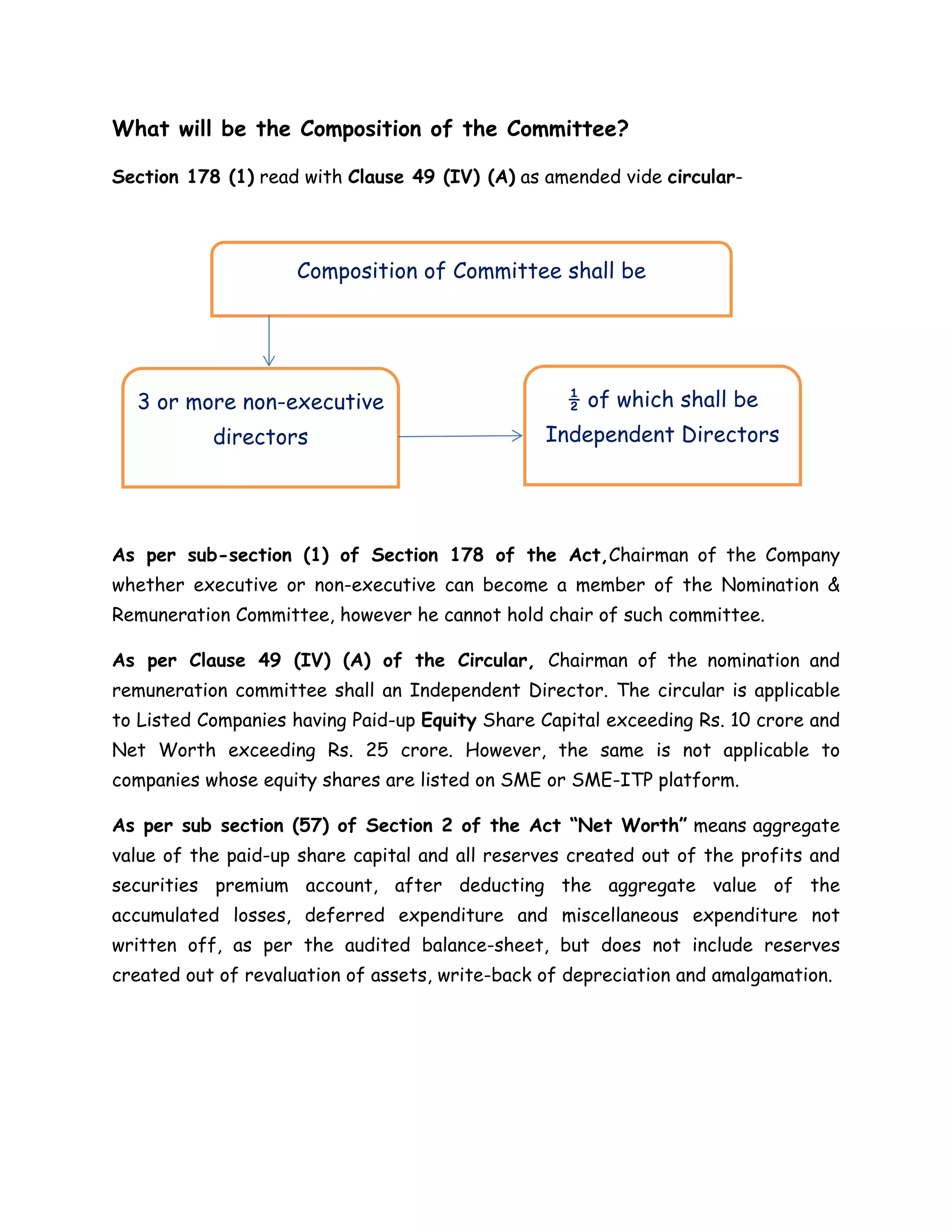
What will be the Composition of the Committee? 
Section 178 (1) read with Clause 49 (IV) (A) as amended vide circular- 
Composition of Committee shall be 
3 or more non-executive 
directors 
½ of which shall be 
Independent Directors 
As per sub-section (1) of Section 178 of the Act,Chairman of the Company 
whether executive or non-executive can become a member of the Nomination & 
Remuneration Committee, however he cannot hold chair of such committee. 
As per Clause 49 (IV) (A) of the Circular, Chairman of the nomination and 
remuneration committee shall an Independent Director. The circular is applicable 
to Listed Companies having Paid-up Equity Share Capital exceeding Rs. 10 crore and 
Net Worth exceeding Rs. 25 crore. However, the same is not applicable to 
companies whose equity shares are listed on SME or SME-ITP platform. 
As per sub section (57) of Section 2 of the Act “Net Worth” means aggregate 
value of the paid-up share capital and all reserves created out of the profits and 
securities premium account, after deducting the aggregate value of the 
accumulated losses, deferred expenditure and miscellaneous expenditure not 
written off, as per the audited balance-sheet, but does not include reserves 
created out of revaluation of assets, write-back of depreciation and amalgamation.
What are the contradictions between Act and Clause 49 on Listing Agreements 
on Nomination and Remuneration Committee? 
Act here specifically speaks about the applicability of appointment of Nomination 
and Remuneration Committee to Every Listed Company, however Clause 49 of the 
Listing Agreement exempts companies having Paid-up Equity Share Capital not 
exceeding Rs. 10 crore and Net Worth not exceeding Rs. 25 crore. It also exempts 
companies whose equity share capital is listed exclusively on the Small and Medium 
Enterprises (SME) platform. 
According to Sub-section (52) of Section 2 of the Act, “Listed Company” 
means a company which has any of its securities listed on any recognized stock 
exchange. 
According to Clause (h) of Section 2 of Securities Contracts (Regulation) Act, 
1956 “Securities” include – 
i) shares, scrips, stocks, bonds, debentures, debenture stock or other 
marketable securities of a like nature in or of any incorporated company or 
other body corporate 
ia) derivative (w.e.f. 22.02.2000) 
ib) units or any other instrument issued by any collective investment scheme to 
the investors in such schemes 
ic) security receipt as defined in clause (zg) of section 2 of the Securitization 
and Reconstruction of Financial Assets and Enforcement of Security Interest 
Act, 2002 (w.e.f. 21.06.2002) 
id) units or any other such instrument issued to the investors under any mutual 
fund scheme (w.e.f. 12.10.2004); 
ii) Government Securities (w.e.f. 30.01.1992) 
iia) such other instruments as may be declared by the Central Government to be 
securities; and 
iii) rights or interest in securities.
So question here arises whether the Act overrides the provisions of Clause 49 
of the Equity Listing Agreement on Nomination and Remuneration Committee? 
Prima Facie on plain reading of the definitions as given in the Act and other 
legislations we can conclude that Act over rides the provisions of clause 49 of the 
Equity Listing Agreement. However, a clarification on the matter may be sought 
from the prescribed authority. 
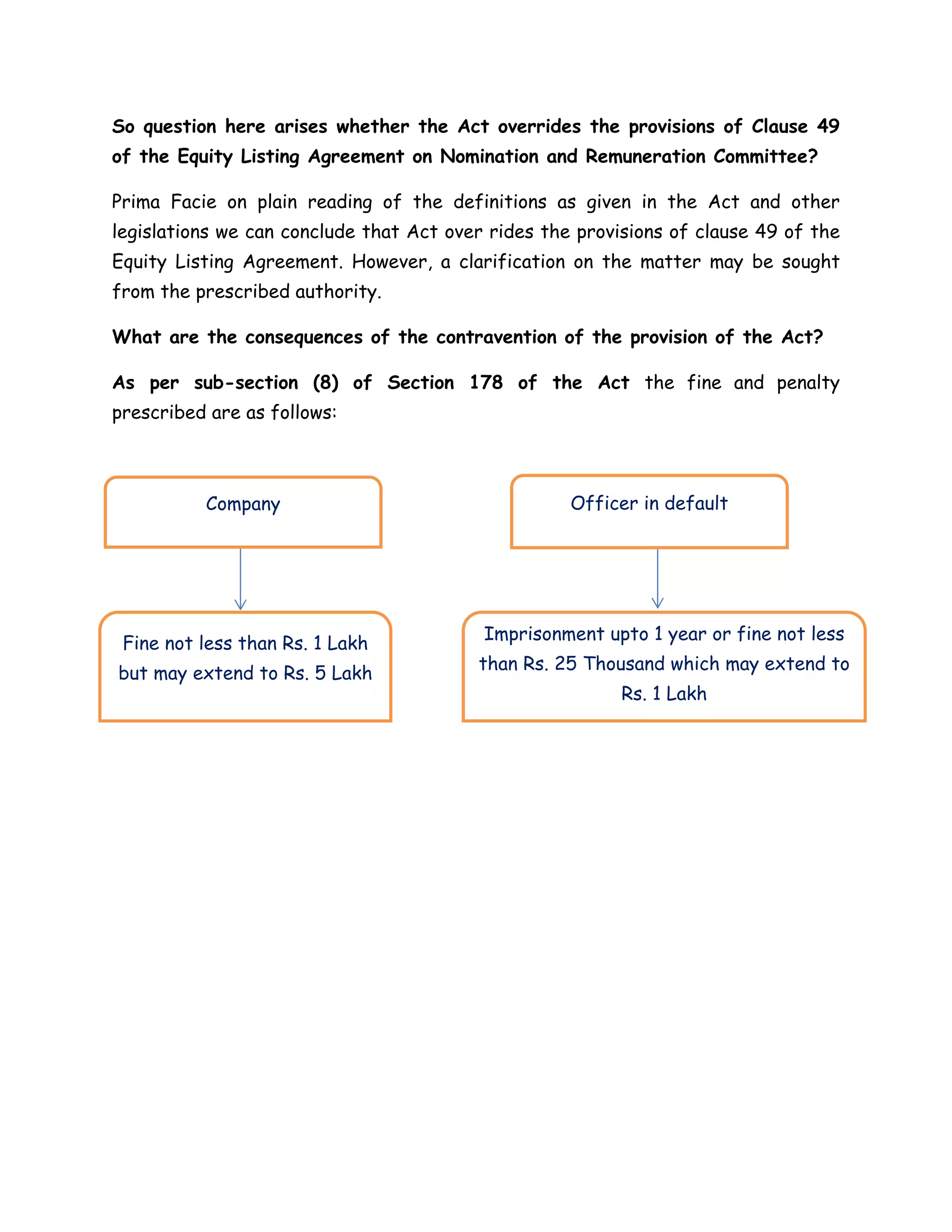
What are the consequences of the contravention of the provision of the Act? 
As per sub-section (8) of Section 178 of the Act the fine and penalty 
prescribed are as follows: 
Company Officer in default 
Fine not less than Rs. 1 Lakh 
but may extend to Rs. 5 Lakh 
Imprisonment upto 1 year or fine not less 
than Rs. 25 Thousand which may extend to 
Rs. 1 Lakh

Section 178 nomination & remuneration committee

  • 1.
    Article on Nominationand Remuneration Committee For the sake of this Article: “Act” here means Companies Act, 2013. “Circular” here means SEBI Circular dated September 15, 2014 on Corporate Governance in listed entities – Amendments to Clause 49 of the Equity Listing Agreement. “Rules” here means The Companies (Meetings of Board and its Powers) Rules, 2014. “Prescribed Authority” here means Registrar of Companies (ROC) or Regional Director (RD) or Securities & Exchange Board of India (SEBI). “FAQ’s”: Who shall constitute Nomination & Remuneration Committee? * (Rule 6) Nomination & Remuneration Committee Every Listed Company *Every Other Public Company having Paid-up Capital of Rs. 10 Crore or more or Turnover of Rs. 100 Crore or more or Aggregate O/s Loan, Debentures & Deposits Exceeding Rs. 50 Crore or more
  • 2.
    Note:Paid-up Share Capital,Turnover or O/s Loans or borrowings or debentures or deposits, as the case may be, as existing on the date of last Audited Financial Statements shall be taken into account for the purpose. As per sub-section (64) of Section 2 of the Act “Paid-up Share Capital” or “Share Capital Paid-up” means such aggregate amount of money credited as paid-up as is equivalent to the amount received as paid-up in respect of shares issued and also includes any amount credited as paid-up in respect of shares of the company, but does not include any other amount received in respect of such shares, by whatever name called As per sub-section (91) of Section 2 of the Act “Turnover” means the aggregate value of the realization of amount made from the sale, supply or distribution of goods or on account services rendered, or both, by the company during a financial year. As per sub-section (30) of Section 2 of the Act “Debenture” includes debenture stock, bonds or any other instrument of a company evidencing a debt, whether constituting a charge on the assets of the company or not. As per sub-section (31) of Section 2 of the Act “Deposit” includes any receipt of money by way of deposit or loan or in any other form by a company, but does not include such categories of amount as may be prescribed in consultation with the Reserve Bank of India.
  • 3.
    What will bethe Composition of the Committee? Section 178 (1) read with Clause 49 (IV) (A) as amended vide circular- Composition of Committee shall be 3 or more non-executive directors ½ of which shall be Independent Directors As per sub-section (1) of Section 178 of the Act,Chairman of the Company whether executive or non-executive can become a member of the Nomination & Remuneration Committee, however he cannot hold chair of such committee. As per Clause 49 (IV) (A) of the Circular, Chairman of the nomination and remuneration committee shall an Independent Director. The circular is applicable to Listed Companies having Paid-up Equity Share Capital exceeding Rs. 10 crore and Net Worth exceeding Rs. 25 crore. However, the same is not applicable to companies whose equity shares are listed on SME or SME-ITP platform. As per sub section (57) of Section 2 of the Act “Net Worth” means aggregate value of the paid-up share capital and all reserves created out of the profits and securities premium account, after deducting the aggregate value of the accumulated losses, deferred expenditure and miscellaneous expenditure not written off, as per the audited balance-sheet, but does not include reserves created out of revaluation of assets, write-back of depreciation and amalgamation.
  • 4.
    What are thecontradictions between Act and Clause 49 on Listing Agreements on Nomination and Remuneration Committee? Act here specifically speaks about the applicability of appointment of Nomination and Remuneration Committee to Every Listed Company, however Clause 49 of the Listing Agreement exempts companies having Paid-up Equity Share Capital not exceeding Rs. 10 crore and Net Worth not exceeding Rs. 25 crore. It also exempts companies whose equity share capital is listed exclusively on the Small and Medium Enterprises (SME) platform. According to Sub-section (52) of Section 2 of the Act, “Listed Company” means a company which has any of its securities listed on any recognized stock exchange. According to Clause (h) of Section 2 of Securities Contracts (Regulation) Act, 1956 “Securities” include – i) shares, scrips, stocks, bonds, debentures, debenture stock or other marketable securities of a like nature in or of any incorporated company or other body corporate ia) derivative (w.e.f. 22.02.2000) ib) units or any other instrument issued by any collective investment scheme to the investors in such schemes ic) security receipt as defined in clause (zg) of section 2 of the Securitization and Reconstruction of Financial Assets and Enforcement of Security Interest Act, 2002 (w.e.f. 21.06.2002) id) units or any other such instrument issued to the investors under any mutual fund scheme (w.e.f. 12.10.2004); ii) Government Securities (w.e.f. 30.01.1992) iia) such other instruments as may be declared by the Central Government to be securities; and iii) rights or interest in securities.
  • 5.
    So question herearises whether the Act overrides the provisions of Clause 49 of the Equity Listing Agreement on Nomination and Remuneration Committee? Prima Facie on plain reading of the definitions as given in the Act and other legislations we can conclude that Act over rides the provisions of clause 49 of the Equity Listing Agreement. However, a clarification on the matter may be sought from the prescribed authority. What are the consequences of the contravention of the provision of the Act? As per sub-section (8) of Section 178 of the Act the fine and penalty prescribed are as follows: Company Officer in default Fine not less than Rs. 1 Lakh but may extend to Rs. 5 Lakh Imprisonment upto 1 year or fine not less than Rs. 25 Thousand which may extend to Rs. 1 Lakh