QUÍMICA ORGANICA     ¿Qué es la química orgánica?   ¿Por qué la han estudiado tantas personas?   ¿Por qué debes estudiarla?       -organismos vivos...  sustancias orgánicas   -proteínas...  pelo, piel, músculos   -DNA...  herencia genética   -alimentos   -prendas   -medicinas      Cualquiera que muestre cierta curiosidad por la vida y las cosas vivientes, debe tener un conocimiento básico de la química orgánica.


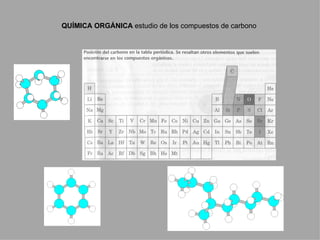
QUÍMICA ORGÁNICA  estudio de los compuestos de carbono
Nomenclatura IUPAC de  Alcanos   NO   Ramificados
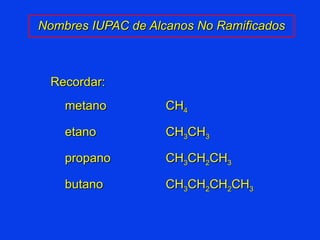
Recordar: metano CH 4 etano CH 3 CH 3 propano CH 3 CH 2 CH 3 butano CH 3 CH 2 CH 2 CH 3 Nombres IUPAC de Alcanos No Ramificados
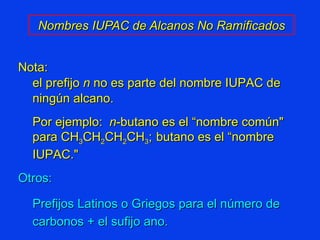
Nombres IUPAC de Alcanos No Ramificados Nota: el prefijo  n  no es parte del nombre IUPAC de ningún alcano. Por ejemplo:  n -butano es el “nombre común"  para CH 3 CH 2 CH 2 CH 3 ;   butano es el “nombre  IUPAC." Otros: Prefijos Latinos o Griegos para el número de  carbonos + el sufijo ano.
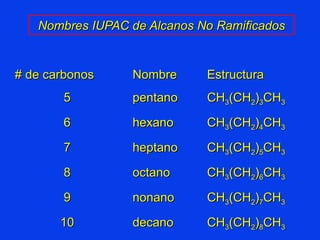
# de carbonos  Nombre Estructura 5 pentano CH 3 (CH 2 ) 3 CH 3 6 hexano CH 3 (CH 2 ) 4 CH 3 7 heptano CH 3 (CH 2 ) 5 CH 3 8 octano CH 3 (CH 2 ) 6 CH 3 9 nonano CH 3 (CH 2 ) 7 CH 3 10 decano CH 3 (CH 2 ) 8 CH 3 Nombres IUPAC de Alcanos No Ramificados
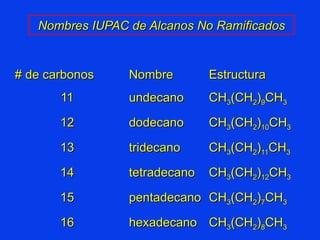
# de carbonos  Nombre Estructura 11 undecano CH 3 (CH 2 ) 9 CH 3 12 dodecano CH 3 (CH 2 ) 10 CH 3 13 tridecano CH 3 (CH 2 ) 11 CH 3 14 tetradecano CH 3 (CH 2 ) 12 CH 3 15 pentadecano CH 3 (CH 2 ) 7 CH 3 16 hexadecano CH 3 (CH 2 ) 8 CH 3 Nombres IUPAC de Alcanos No Ramificados
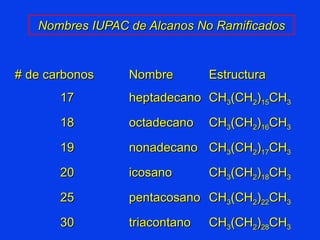
# de carbonos  Nombre Estructura 17 heptadecano CH 3 (CH 2 ) 15 CH 3 18 octadecano CH 3 (CH 2 ) 16 CH 3 19 nonadecano CH 3 (CH 2 ) 17 CH 3 20 icosano CH 3 (CH 2 ) 18 CH 3 25 pentacosano CH 3 (CH 2 ) 22 CH 3 30 triacontano CH 3 (CH 2 ) 28 CH 3 Nombres IUPAC de Alcanos No Ramificados
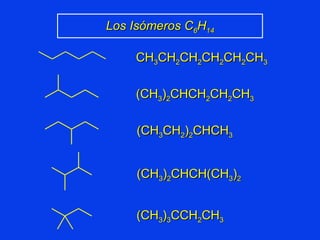
Aplicación de las Reglas  de la IUPAC: Los Nombres de los Isómeros C 6 H 14
Los Isómeros C 6 H 14 CH 3 CH 2 CH 2 CH 2 CH 2 CH 3 (CH 3 ) 2 CHCH 2 CH 2 CH 3 (CH 3 CH 2 ) 2 CHCH 3 (CH 3 ) 2 CHCH(CH 3 ) 2 (CH 3 ) 3 CCH 2 CH 3
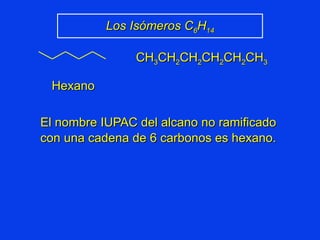
El nombre IUPAC del alcano no ramificado con una cadena de 6 carbonos es hexano. Los Isómeros C 6 H 14 CH 3 CH 2 CH 2 CH 2 CH 2 CH 3 Hexano
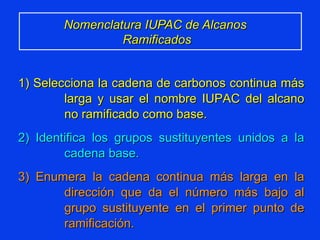
Nomenclatura IUPAC de Alcanos  Ramificados  1) Selecciona la cadena de carbonos continua más larga y usar el nombre IUPAC del alcano no ramificado como base. 2) Identifica los grupos sustituyentes unidos a la cadena base. 3) Enumera la cadena continua más larga en la dirección que da el número más bajo al grupo sustituyente en el primer punto de ramificación.
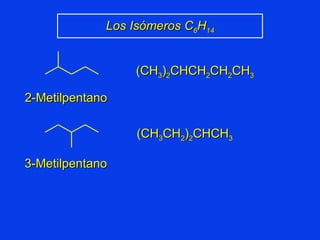
Los Isómeros C 6 H 14 (CH 3 ) 2 CHCH 2 CH 2 CH 3 (CH 3 CH 2 ) 2 CHCH 3 2-Metilpentano 3-Metilpentano
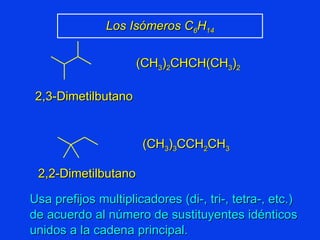
Usa prefijos multiplicadores (di-, tri-, tetra-, etc.)  de acuerdo al número de sustituyentes idénticos unidos a la cadena principal. Los Isómeros C 6 H 14 (CH 3 ) 2 CHCH(CH 3 ) 2 (CH 3 ) 3 CCH 2 CH 3 2,3-Dimetilbutano 2,2-Dimetilbutano
Grupos Alquilo
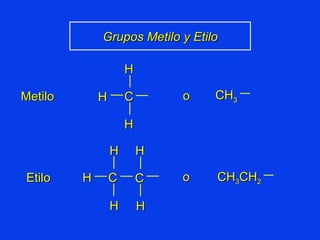
Grupos Metilo y Etilo Metilo Etilo o o C C H H H H H CH 3 CH 2 C H H H CH 3
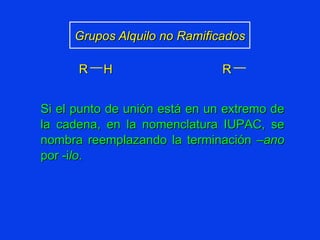
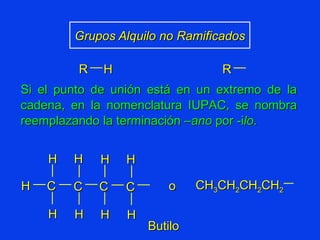
Grupos Alquilo no Ramificados Si el punto de unión está en un extremo de la cadena, en la nomenclatura IUPAC, se nombra reemplazando la terminación – ano  por -i lo . R H R
Grupos Alquilo no Ramificados Butilo o Si el punto de unión está en un extremo de la cadena, en la nomenclatura IUPAC, se nombra reemplazando la terminación – ano  por -i lo . R H R CH 3 CH 2 CH 2 CH 2 C C H H H H H C C H H H H
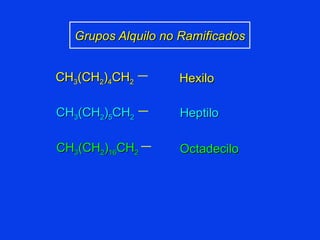
Grupos Alquilo no Ramificados Hexilo Heptilo Octadecilo CH 3 (CH 2 ) 4 CH 2 CH 3 (CH 2 ) 5 CH 2 CH 3 (CH 2 ) 16 CH 2
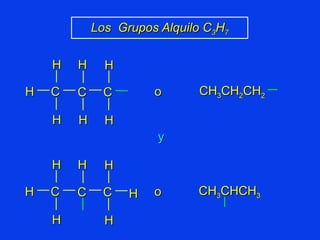
Los  Grupos Alquilo C 3 H 7 CH 3 CH 2 CH 2 C C H H H H H C H H o y CH 3 CHCH 3 C C H H H H H C H H o
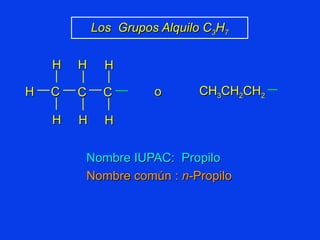
Nombre IUPAC:  Propilo Nombre común :  n -Propilo Los  Grupos Alquilo C 3 H 7 CH 3 CH 2 CH 2 C C H H H H H C H H o
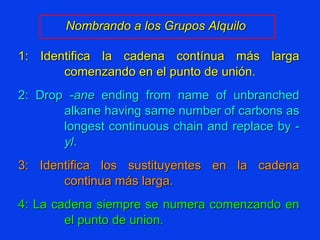
Nombrando a los Grupos Alquilo  1: Identifica la cadena contínua más larga comenzando en el punto de unión. 2: Drop - ane  ending from name of unbranched alkane having same number of carbons as longest continuous chain and replace by - yl . 3: Identifica los sustituyentes en la cadena continua más larga. 4: La cadena siempre se numera comenzando en el punto de union.
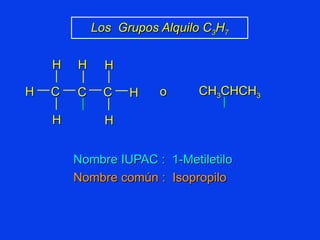
Nombre IUPAC :  1-Metiletilo Nombre común :  Isopropilo Los  Grupos Alquilo C 3 H 7 CH 3 CHCH 3 C C H H H H C H H o H
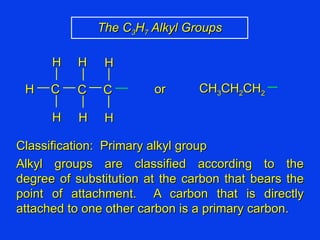
Classification:  Primary alkyl group Alkyl groups are classified according to the degree of substitution at the carbon that bears the point of attachment.  A carbon that is directly attached to one other carbon is a primary carbon. The C 3 H 7  Alkyl Groups CH 3 CH 2 CH 2 C C H H H H H C H H or
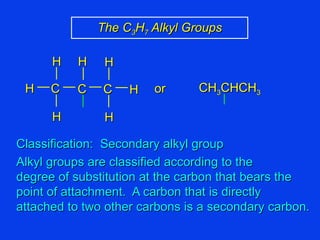
Classification:  Secondary alkyl group Alkyl groups are classified according to the degree of substitution at the carbon that bears the point of attachment.  A carbon that is directly attached to two other carbons is a secondary carbon. The C 3 H 7  Alkyl Groups CH 3 CHCH 3 C C H H H H C H H or H
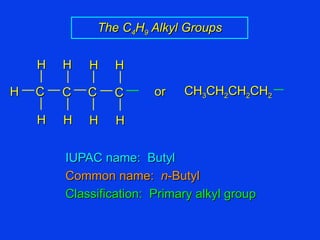
IUPAC name:  Butyl Common name:  n -Butyl Classification:  Primary alkyl group The C 4 H 9  Alkyl Groups CH 3 CH 2 CH 2 CH 2 C C H H H H H C C H H H H or
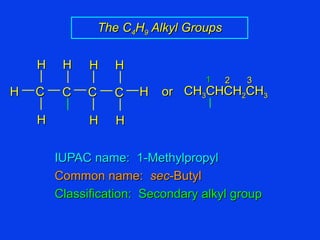
IUPAC name:  1-Methylpropyl Common name:  sec -Butyl Classification:  Secondary alkyl group The C 4 H 9  Alkyl Groups CH 3 CHCH 2 CH 3 C C H H H H H C C H H H H or 1 2 3
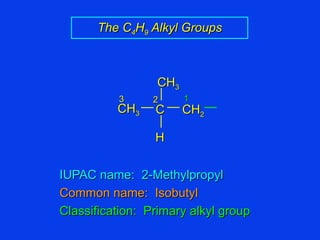
IUPAC name:  2-Methylpropyl Common name:  Isobutyl Classification:  Primary alkyl group The C 4 H 9  Alkyl Groups 1 2 3 C H CH 2 CH 3 CH 3
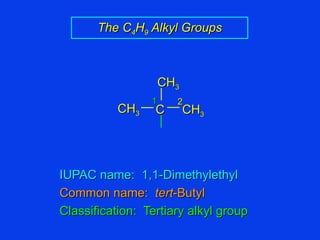
IUPAC name:  1,1-Dimethylethyl Common name:  tert -Butyl Classification:  Tertiary alkyl group The C 4 H 9  Alkyl Groups 1 2 C CH 3 CH 3 CH 3
Nombres IUPAC de Alcanos Altamente Ramificados
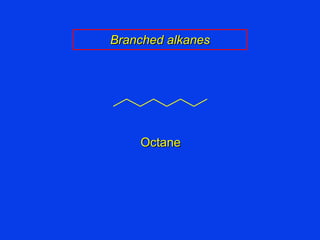
Branched alkanes Octane
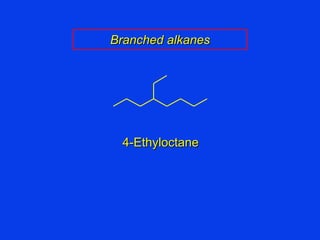
4-Ethyloctane Branched alkanes
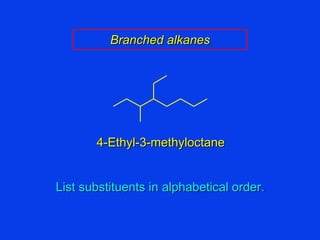
4-Ethyl-3-methyloctane Branched alkanes List substituents in alphabetical order.
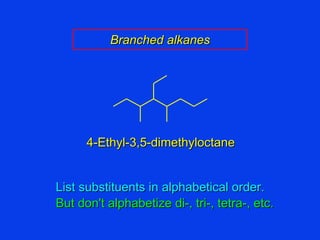
4-Ethyl-3,5-dimethyloctane Branched alkanes List substituents in alphabetical order. But don't alphabetize di-, tri-, tetra-, etc.
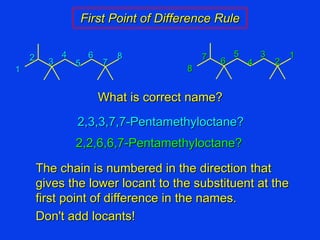
First Point of Difference Rule The chain is numbered in the direction that gives the lower locant to the substituent at the first point of difference in the names. Don't add locants! 2,2,6,6,7-Pentamethyloctane? 2,3,3,7,7-Pentamethyloctane? What is correct name? 1 2 3 4 5 6 7 8 8 7 6 5 4 3 2 1
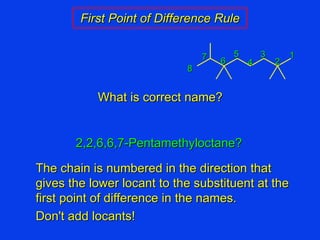
First Point of Difference Rule The chain is numbered in the direction that gives the lower locant to the substituent at the first point of difference in the names. Don't add locants! 2,2,6,6,7-Pentamethyloctane? What is correct name? 8 7 6 5 4 3 2 1
Nomenclatura de  Cicloalcanos C n H 2 n
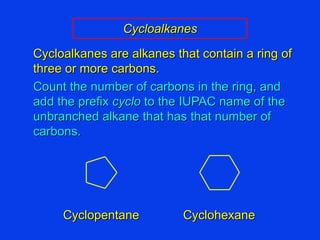
Cycloalkanes Cycloalkanes are alkanes that contain a ring of three or more carbons. Count the number of carbons in the ring, and add the prefix  cyclo  to the IUPAC name of the unbranched alkane that has that number of carbons. Cyclopentane Cyclohexane
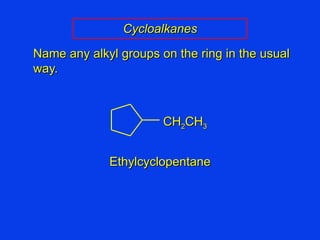
Cycloalkanes Name any alkyl groups on the ring in the usual way. Ethylcyclopentane CH 2 CH 3
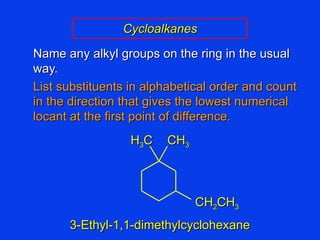
Name any alkyl groups on the ring in the usual way. List substituents in alphabetical order and count in the direction that gives the lowest numerical locant at the first point of difference. Cycloalkanes 3-Ethyl-1,1-dimethylcyclohexane CH 2 CH 3 H 3 C CH 3
Nomenclatura de Alquenos
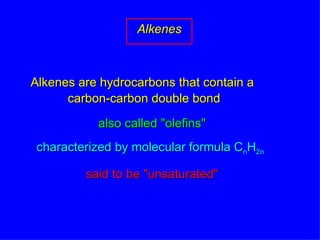
Alkenes Alkenes are hydrocarbons that contain a  carbon-carbon double bond also called "olefins" characterized by molecular formula C n H 2n   said to be "unsaturated"
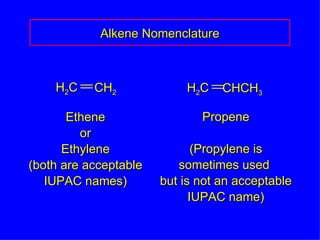
Alkene Nomenclature Ethene or Ethylene (both are acceptable IUPAC names) Propene (Propylene is sometimes used  but is not an acceptable IUPAC name) H 2 C CH 2 H 2 C CHCH 3
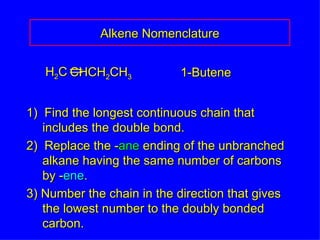
1)  Find the longest continuous chain that  includes the double bond. 2)  Replace the - ane  ending of the unbranched alkane having the same number of carbons by - ene . 3) Number the chain in the direction that gives the lowest number to the doubly bonded carbon. 1-Butene Alkene Nomenclature H 2 C CHCH 2 CH 3
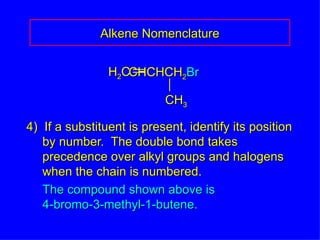
4)  If a substituent is present, identify its position by number.  The double bond takes precedence over alkyl groups and halogens when the chain is numbered. The compound shown above is 4-bromo-3-methyl-1-butene. Alkene Nomenclature H 2 C CHCHCH 2 Br CH 3
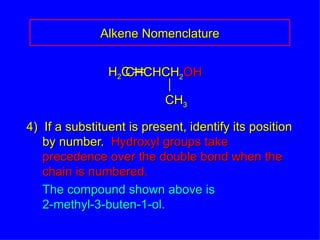
4)  If a substituent is present, identify its position by number.  Hydroxyl groups take precedence over the double bond when the chain is numbered. The compound shown above is 2-methyl-3-buten-1-ol. Alkene Nomenclature H 2 C CHCHCH 2 OH CH 3
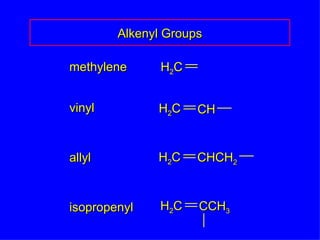
methylene vinyl allyl isopropenyl Alkenyl Groups CH H 2 C CHCH 2 H 2 C H 2 C CCH 3 H 2 C
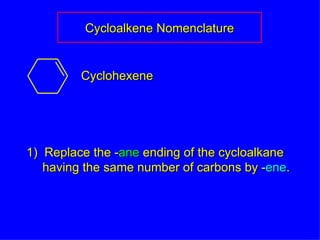
Cycloalkene Nomenclature 1)  Replace the - ane  ending of the cycloalkane having the same number of carbons by - ene . Cyclohexene
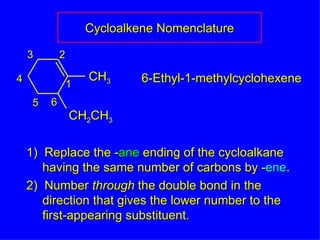
1)  Replace the - ane  ending of the cycloalkane having the same number of carbons by - ene . 2)  Number  through  the double bond in the direction that gives the lower number to the  first-appearing substituent. Cycloalkene Nomenclature 6-Ethyl-1-methylcyclohexene CH 3 CH 2 CH 3 1 2 3 4 5 6
Alquinos
Nomenclature
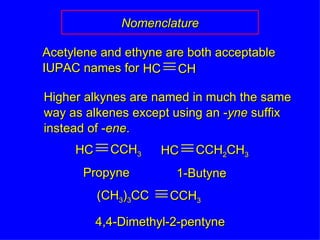
Nomenclature Higher alkynes are named in much the same way as alkenes except using an - yne  suffix instead of - ene . HC CH Acetylene and ethyne are both acceptable IUPAC names for HC CCH 3 Propyne HC CCH 2 CH 3 1-Butyne (CH 3 ) 3 CC CCH 3 4,4-Dimethyl-2-pentyne
Functional Groups
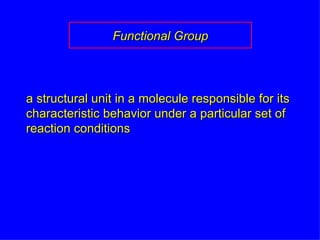
a structural unit in a molecule responsible for its characteristic behavior under a particular set of reaction conditions Functional Group
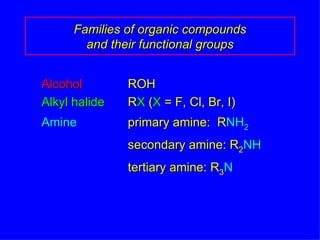
Alcohol ROH Alkyl halide R X  ( X  = F, Cl, Br, I) Amine primary amine:  R NH 2 secondary amine: R 2 NH tertiary amine: R 3 N Families of organic compounds and their functional groups
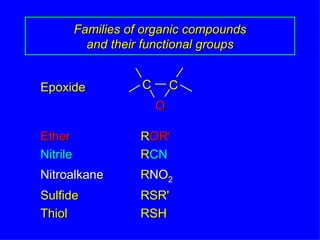
Ether R O R' Nitrile R CN Nitroalkane R NO 2 Sulfide RSR' Thiol RSH Families of organic compounds and their functional groups Epoxide C C O
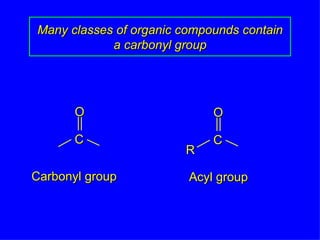
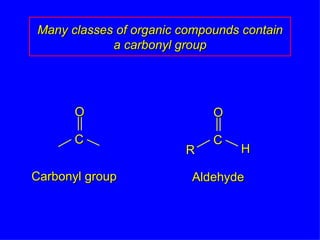
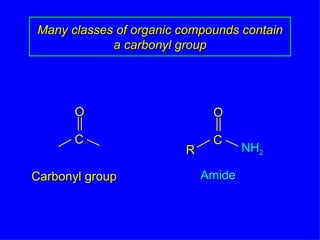
Many classes of organic compounds contain a carbonyl group Carbonyl group Acyl group R O C O C
Many classes of organic compounds contain a carbonyl group Carbonyl group Aldehyde R H O C O C
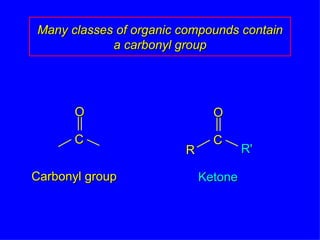
Many classes of organic compounds contain a carbonyl group Carbonyl group Ketone R R' O C O C
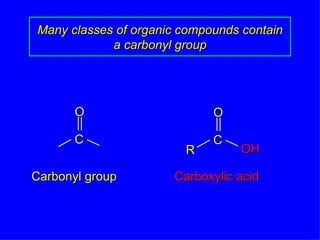
Many classes of organic compounds contain a carbonyl group Carbonyl group Carboxylic acid R OH O C O C
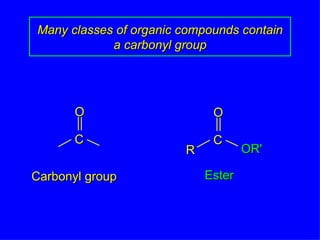
Many classes of organic compounds contain a carbonyl group Carbonyl group Ester R OR' O C O C
Many classes of organic compounds contain a carbonyl group Carbonyl group Amide R NH 2 O C O C
IUPAC Nomenclature of Alkyl Halides
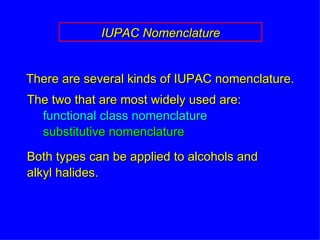
The two that are most widely used are: functional class nomenclature substitutive nomenclature Both types can be applied to alcohols and alkyl halides. IUPAC Nomenclature There are several kinds of IUPAC nomenclature.
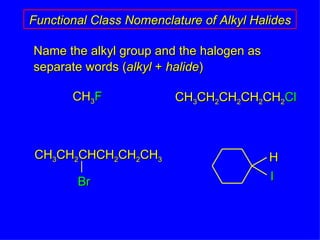
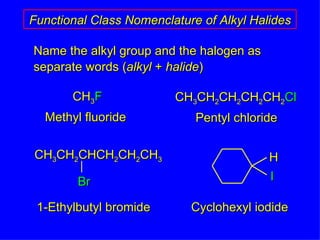
Name the alkyl group and the halogen as separate words ( alkyl  +  halide ) Functional Class Nomenclature of Alkyl Halides CH 3 F CH 3 CH 2 CH 2 CH 2 CH 2 Cl CH 3 CH 2 CHCH 2 CH 2 CH 3 Br H I
Name the alkyl group and the halogen as separate words ( alkyl  +  halide ) Functional Class Nomenclature of Alkyl Halides CH 3 F CH 3 CH 2 CH 2 CH 2 CH 2 Cl Methyl fluoride Pentyl chloride 1-Ethylbutyl bromide Cyclohexyl iodide CH 3 CH 2 CHCH 2 CH 2 CH 3 Br H I
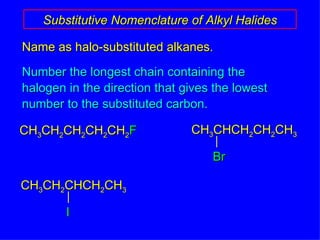
Name as halo-substituted alkanes. Number the longest chain containing the halogen in the direction that gives the lowest number to the substituted carbon. Substitutive Nomenclature of Alkyl Halides CH 3 CH 2 CH 2 CH 2 CH 2 F CH 3 CHCH 2 CH 2 CH 3 Br CH 3 CH 2 CHCH 2 CH 3 I
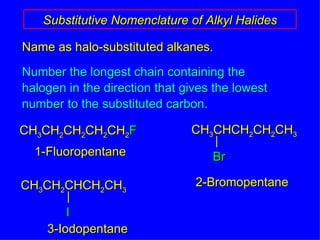
Name as halo-substituted alkanes. Number the longest chain containing the halogen in the direction that gives the lowest number to the substituted carbon. Substitutive Nomenclature of Alkyl Halides CH 3 CH 2 CH 2 CH 2 CH 2 F 1-Fluoropentane 3-Iodopentane 2-Bromopentane CH 3 CHCH 2 CH 2 CH 3 Br CH 3 CH 2 CHCH 2 CH 3 I
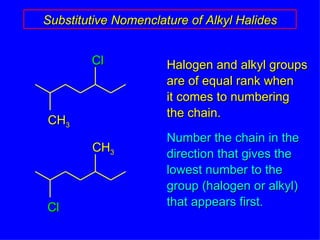
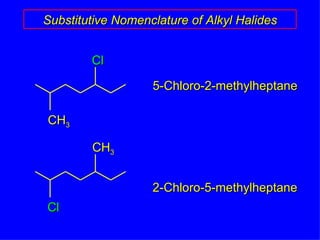
Substitutive Nomenclature of Alkyl Halides Halogen and alkyl groups are of equal rank when  it comes to numbering the chain. Number the chain in the direction that gives the  lowest number to the group (halogen or alkyl) that appears first. CH 3 Cl Cl CH 3
Substitutive Nomenclature of Alkyl Halides 5-Chloro-2-methylheptane 2-Chloro-5-methylheptane CH 3 Cl Cl CH 3
IUPAC Nomenclature of Alcohols
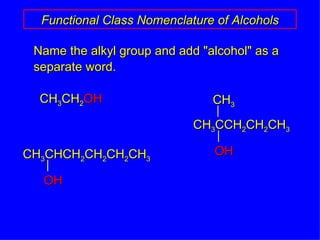
Name the alkyl group and add "alcohol" as a separate word. Functional Class Nomenclature of Alcohols CH 3 CH 2 OH CH 3 CHCH 2 CH 2 CH 2 CH 3 OH CH 3 CCH 2 CH 2 CH 3 OH CH 3
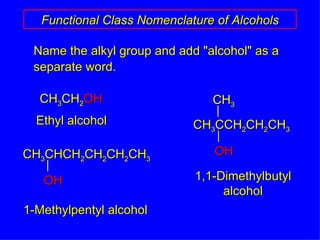
Name the alkyl group and add "alcohol" as a separate word. Functional Class Nomenclature of Alcohols CH 3 CH 2 OH Ethyl alcohol 1-Methylpentyl alcohol 1,1-Dimethylbutyl alcohol CH 3 CHCH 2 CH 2 CH 2 CH 3 OH CH 3 CCH 2 CH 2 CH 3 OH CH 3
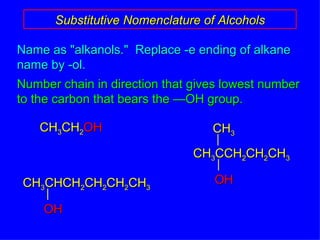
Name as "alkanols."  Replace -e ending of alkane name by -ol. Number chain in direction that gives lowest number to the carbon that bears the —OH group. Substitutive Nomenclature of Alcohols CH 3 CH 2 OH CH 3 CHCH 2 CH 2 CH 2 CH 3 OH CH 3 CCH 2 CH 2 CH 3 OH CH 3
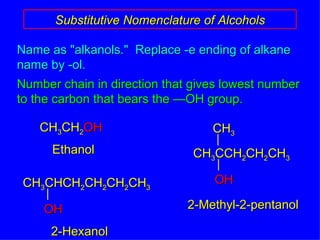
Name as "alkanols."  Replace -e ending of alkane name by -ol. Number chain in direction that gives lowest number to the carbon that bears the —OH group. Substitutive Nomenclature of Alcohols CH 3 CH 2 OH Ethanol 2-Hexanol 2-Methyl-2-pentanol CH 3 CHCH 2 CH 2 CH 2 CH 3 OH CH 3 CCH 2 CH 2 CH 3 OH CH 3
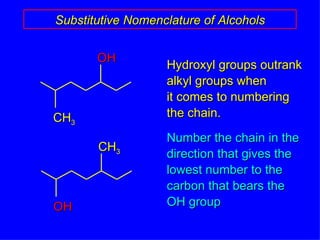
Substitutive Nomenclature of Alcohols Hydroxyl groups outrank  alkyl groups when  it comes to numbering the chain. Number the chain in the direction that gives the  lowest number to the carbon that bears the OH group OH CH 3 CH 3 OH
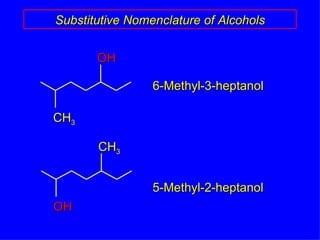
Substitutive Nomenclature of Alcohols 6-Methyl-3-heptanol 5-Methyl-2-heptanol OH CH 3 CH 3 OH
Classes of Alcohols and Alkyl Halides
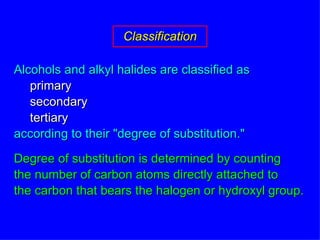
Alcohols and alkyl halides are classified as primary secondary tertiary according to their "degree of substitution." Degree of substitution is determined by counting the number of carbon atoms directly attached to the carbon that bears the halogen or hydroxyl group. Classification
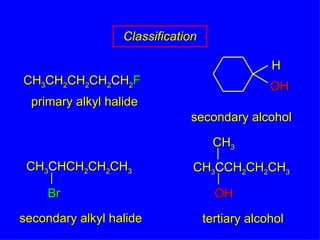
Classification CH 3 CH 2 CH 2 CH 2 C H 2 F primary alkyl halide secondary alkyl halide tertiary alcohol H OH secondary alcohol CH 3 C HCH 2 CH 2 CH 3 Br CH 3 C CH 2 CH 2 CH 3 OH CH 3
Ethers, Epoxides, and Sulfides
Nomenclature of Ethers, Epoxides, and Sulfides
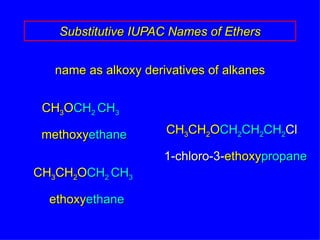
name as alkoxy derivatives of alkanes Substitutive IUPAC Names of Ethers CH 3 O CH 2  CH 3 methoxy ethane CH 3 CH 2 O CH 2  CH 3 ethoxy ethane CH 3 CH 2 O CH 2 CH 2 CH 2 Cl 1-chloro-3- ethoxy propane
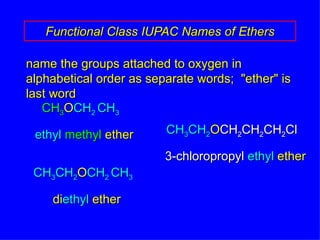
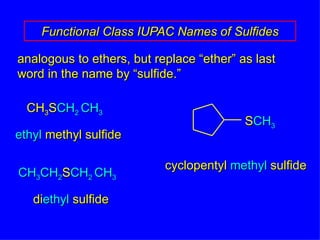
name the groups attached to oxygen in  alphabetical order as separate words;  "ether" is  last word Functional Class IUPAC Names of Ethers CH 3 O CH 2  CH 3 ethyl   methyl  ether CH 3 CH 2 O CH 2  CH 3 di ethyl  ether CH 3 CH 2 O CH 2 CH 2 CH 2 Cl 3-chloropropyl   ethyl  ether
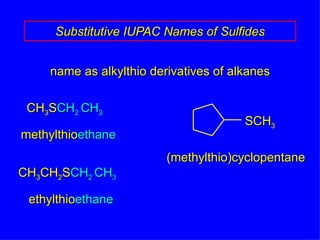
name as alkylthio derivatives of alkanes Substitutive IUPAC Names of Sulfides CH 3 S CH 2  CH 3 methylthio ethane CH 3 CH 2 S CH 2  CH 3 ethylthio ethane (methylthio)cyclopentane SCH 3
analogous to ethers, but replace “ether” as last word in the name by “sulfide.” Functional Class IUPAC Names of Sulfides cyclopentyl  methyl  sulfide CH 3 S CH 2  CH 3 ethyl  methyl sulfide CH 3 CH 2 S CH 2  CH 3 di ethyl  sulfide S CH 3
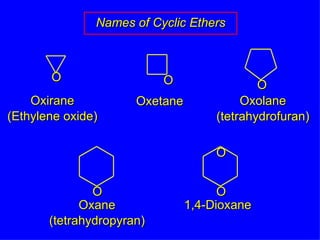
Names of Cyclic Ethers O O O O O O Oxirane (Ethylene oxide) Oxetane Oxolane (tetrahydrofuran) Oxane (tetrahydropyran) 1,4-Dioxane
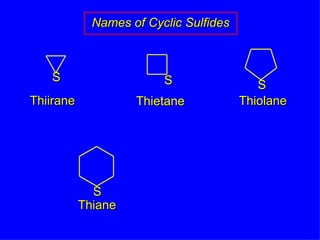
Names of Cyclic Sulfides S S S S Thiirane Thietane Thiolane Thiane
Amines
Amine Nomenclature
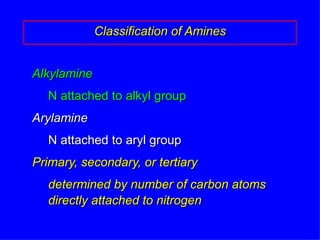
Alkylamine N attached to alkyl group Arylamine N attached to aryl group Primary, secondary, or tertiary determined by number of carbon atoms  directly attached to nitrogen Classification of Amines
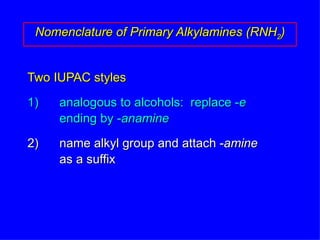
Two IUPAC styles 1) analogous to alcohols:  replace - e  ending by - anamine 2) name alkyl group and attach - amine as a suffix Nomenclature of Primary Alkylamines (RNH 2 )
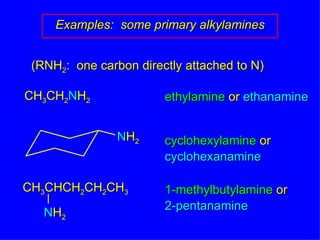
Examples:  some primary alkylamines (RNH 2 :  one carbon directly attached to N) CH 3 CH 2 N H 2 ethylamine  or  ethanamine cyclohexylamine  or cyclohexanamine 1-methylbutylamine  or 2-pentanamine CH 3 CHCH 2 CH 2 CH 3 N H 2 N H 2
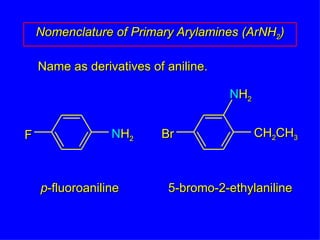
Name as derivatives of aniline. Nomenclature of Primary Arylamines (ArNH 2 ) p -fluoroaniline 5-bromo-2-ethylaniline N H 2 F N H 2 Br CH 2 CH 3
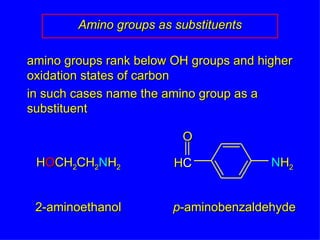
Amino groups as substituents amino groups rank below OH groups and higher oxidation states of carbon in such cases name the amino group as a substituent p -aminobenzaldehyde H O CH 2 CH 2 N H 2 2-aminoethanol N H 2 H C O
Name as  N -substituted derivatives of parent  primary amine. (N is a locant-it is not alphabetized, but is treated the same way as a numerical locant) Parent amine is one with longest carbon chain. Secondary and Tertiary Amines
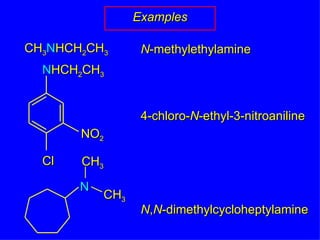
Examples CH 3 N HCH 2 CH 3 N -methylethylamine 4-chloro- N -ethyl-3-nitroaniline N , N -dimethylcycloheptylamine N HCH 2 CH 3 NO 2 Cl CH 3 N CH 3
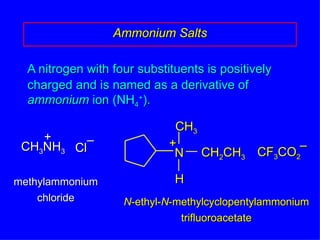
A nitrogen with four substituents is positively charged and is named as a derivative of  ammonium  ion (NH 4 + ). Ammonium Salts CH 3 NH 3 + methylammonium chloride N -ethyl- N -methylcyclopentylammonium trifluoroacetate Cl – N CH 3 H CH 2 CH 3 + CF 3 CO 2 –
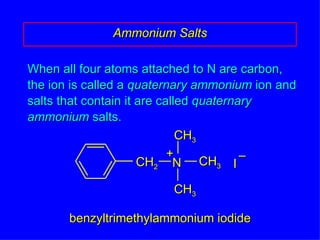
When all four atoms attached to N are carbon, the ion is called a  quaternary ammonium  ion and salts that contain it are called  quaternary   ammonium  salts. Ammonium Salts benzyltrimethylammonium iodide + CH 2 N CH 3 CH 3 CH 3 I –
Nomenclature
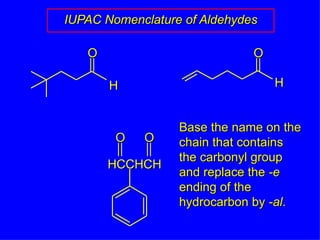
IUPAC Nomenclature of Aldehydes Base the name on the chain that contains the carbonyl group and replace the  -e  ending of the hydrocarbon by  -al . H O O H O HCCHCH O
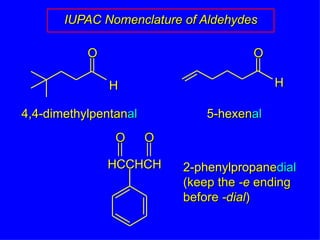
IUPAC Nomenclature of Aldehydes 4,4-dimethylpent an al 5-hex en al 2-phenylprop ane dial (keep the  -e  ending before  -dial ) H O O H O HCCHCH O
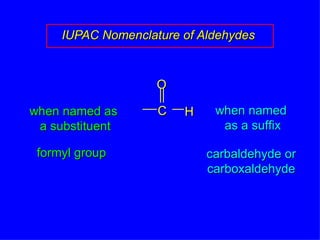
IUPAC Nomenclature of Aldehydes  when named as  a substituent formyl group carbaldehyde or carboxaldehyde when named  as a suffix C H O
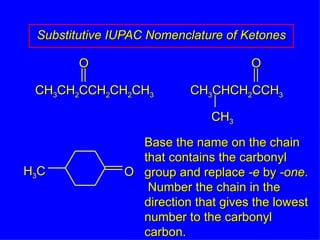
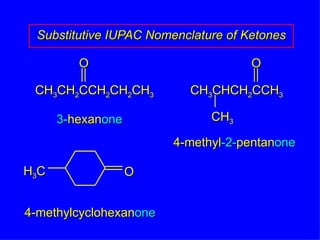
Substitutive IUPAC Nomenclature of Ketones Base the name on the chain that contains the carbonyl group and replace  -e  by  -one .  Number the chain in the direction that gives the lowest number to the carbonyl carbon. CH 3 CH 2 CCH 2 CH 2 CH 3 O CH 3 CHCH 2 CCH 3 O CH 3 H 3 C O
Substitutive IUPAC Nomenclature of Ketones 3- hexan one 4-methyl -2- pentan one 4-methylcyclohexan one CH 3 CH 2 CCH 2 CH 2 CH 3 O CH 3 CHCH 2 CCH 3 O CH 3 H 3 C O
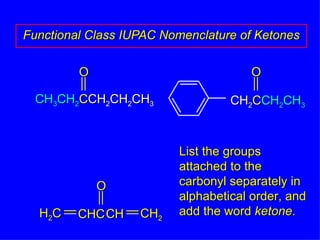
Functional Class IUPAC Nomenclature of Ketones List the groups attached to the carbonyl separately in alphabetical order, and add the word  ketone . CH 3 CH 2 C CH 2 CH 2 CH 3 O O CH 2 C CH 2 CH 3 CH CH 2 O H 2 C CHC
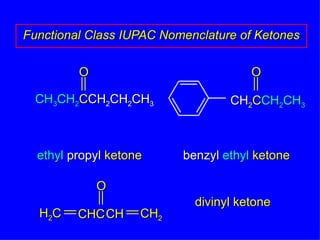
Functional Class IUPAC Nomenclature of Ketones ethyl   propyl  ketone benzyl   ethyl  ketone divinyl ketone CH 3 CH 2 C CH 2 CH 2 CH 3 O O CH 2 C CH 2 CH 3 CH CH 2 O H 2 C CHC
Carboxylic Acids
Carboxylic Acid Nomenclature
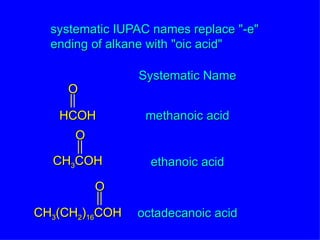
systematic IUPAC names replace "-e" ending of alkane with "oic acid" Systematic Name O HCOH O CH 3 COH O CH 3 (CH 2 ) 16 COH methanoic acid ethanoic acid octadecanoic acid
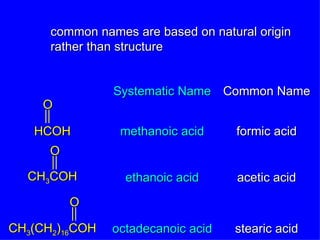
common names are based on natural origin rather than structure Systematic Name Common Name methanoic acid formic acid ethanoic acid acetic acid octadecanoic acid stearic acid O HCOH O CH 3 COH O CH 3 (CH 2 ) 16 COH
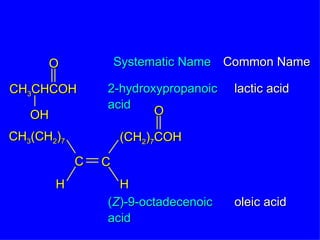
Systematic Name Common Name 2-hydroxypropanoic acid lactic acid ( Z )-9-octadecenoic acid oleic acid O CH 3 CHCOH OH O (CH 2 ) 7 COH C C H H CH 3 (CH 2 ) 7
Nomenclature of Carboxylic Acid Derivatives
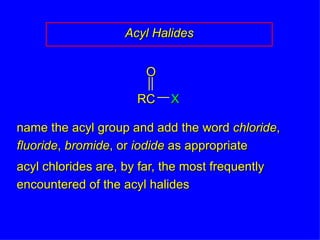
Acyl Halides name the acyl group and add the word  chloride ,  fluoride ,  bromide , or  iodide  as appropriate acyl chlorides are, by far, the most frequently encountered of the acyl halides RC O X
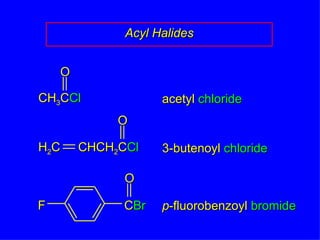
Acyl Halides acetyl  chloride 3-butenoyl  chloride p -fluorobenzoyl  bromide   CH 3 C Cl O O H 2 C CHCH 2 C Cl O C Br F
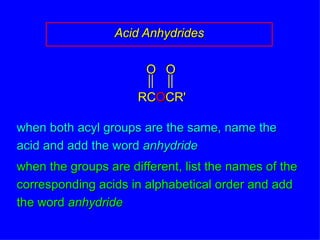
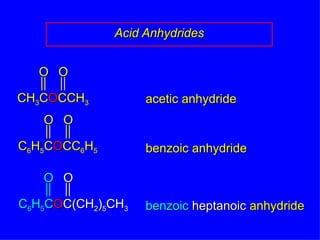
Acid Anhydrides when both acyl groups are the same, name the acid and add the word  anhydride when the groups are different, list the names of the corresponding acids in alphabetical order and add the word  anhydride RC O CR' O O
Acid Anhydrides acetic anhydride benzoic anhydride benzoic   heptanoic  anhydride CH 3 C O CCH 3 O O C 6 H 5 C O CC 6 H 5 O O C 6 H 5 C O C(CH 2 ) 5 CH 3 O O
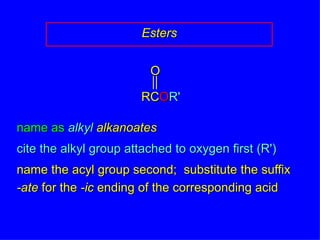
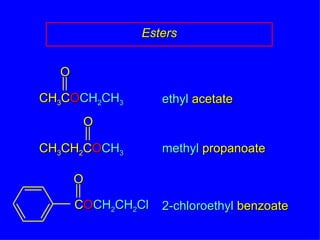
Esters name as  alkyl   alkanoates cite the alkyl group attached to oxygen first (R') name the acyl group second;  substitute the suffix -ate  for the  -ic  ending of the corresponding acid RC O R' O
Esters ethyl  acetate methyl  propanoate 2-chloroethyl  benzoate  CH 3 C O CH 2 CH 3 O O CH 3 CH 2 C O CH 3 C O CH 2 CH 2 Cl O
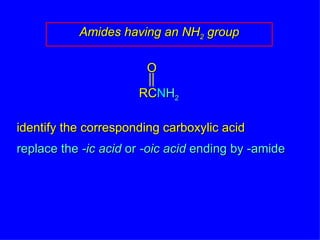
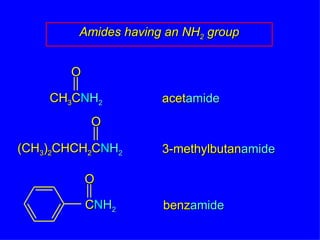
Amides having an NH 2  group identify the corresponding carboxylic acid replace the  -ic acid  or  -oic acid  ending by -amide RC N H 2 O
Amides having an NH 2  group acet amide 3-methylbutan amide benz amide CH 3 C N H 2 O O (CH 3 ) 2 CHCH 2 C N H 2 C N H 2 O
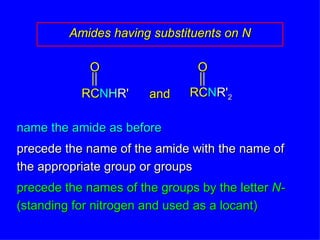
Amides having substituents on N name the amide as before precede the name of the amide with the name of the appropriate group or groups precede the names of the groups by the letter  N-  (standing for nitrogen and used as a locant) and RC N H R' O RC N R' 2 O
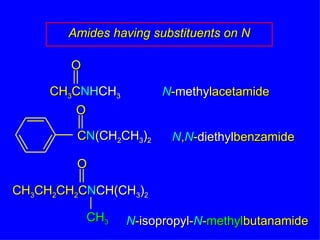
Amides having substituents on N N - methyl acetamide N - isopropyl - N - methyl butanamide N , N - diethyl benzamide CH 3 C N H CH 3 O C N (CH 2 CH 3 ) 2 O O CH 3 CH 2 CH 2 C N CH(CH 3 ) 2 CH 3
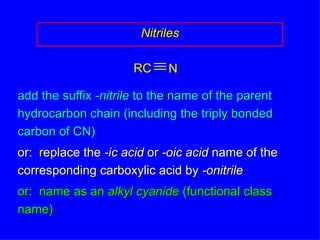
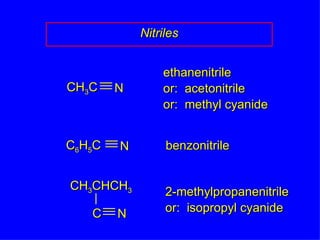
Nitriles add the suffix  -nitrile  to the name of the parent hydrocarbon chain (including the triply bonded carbon of CN) or:  replace the  -ic acid  or  -oic acid  name of the corresponding carboxylic acid by  -onitrile or:  name as an  alkyl cyanide  (functional class name) RC N
Nitriles ethanenitrile or:  acetonitrile or:  methyl cyanide benzonitrile 2-methylpropanenitrile or:  isopropyl cyanide CH 3 C N C 6 H 5 C N N C CH 3 CHCH 3

Nomenclatura

  • 1.
    QUÍMICA ORGANICA    ¿Qué es la química orgánica?   ¿Por qué la han estudiado tantas personas?   ¿Por qué debes estudiarla?       -organismos vivos... sustancias orgánicas   -proteínas... pelo, piel, músculos   -DNA... herencia genética   -alimentos   -prendas   -medicinas      Cualquiera que muestre cierta curiosidad por la vida y las cosas vivientes, debe tener un conocimiento básico de la química orgánica.
  • 2.
  • 3.
  • 4.
  • 5.
    QUÍMICA ORGÁNICA estudio de los compuestos de carbono
  • 6.
    Nomenclatura IUPAC de Alcanos NO Ramificados
  • 7.
    Recordar: metano CH4 etano CH 3 CH 3 propano CH 3 CH 2 CH 3 butano CH 3 CH 2 CH 2 CH 3 Nombres IUPAC de Alcanos No Ramificados
  • 8.
    Nombres IUPAC deAlcanos No Ramificados Nota: el prefijo n no es parte del nombre IUPAC de ningún alcano. Por ejemplo: n -butano es el “nombre común" para CH 3 CH 2 CH 2 CH 3 ; butano es el “nombre IUPAC." Otros: Prefijos Latinos o Griegos para el número de carbonos + el sufijo ano.
  • 9.
    # de carbonos Nombre Estructura 5 pentano CH 3 (CH 2 ) 3 CH 3 6 hexano CH 3 (CH 2 ) 4 CH 3 7 heptano CH 3 (CH 2 ) 5 CH 3 8 octano CH 3 (CH 2 ) 6 CH 3 9 nonano CH 3 (CH 2 ) 7 CH 3 10 decano CH 3 (CH 2 ) 8 CH 3 Nombres IUPAC de Alcanos No Ramificados
  • 10.
    # de carbonos Nombre Estructura 11 undecano CH 3 (CH 2 ) 9 CH 3 12 dodecano CH 3 (CH 2 ) 10 CH 3 13 tridecano CH 3 (CH 2 ) 11 CH 3 14 tetradecano CH 3 (CH 2 ) 12 CH 3 15 pentadecano CH 3 (CH 2 ) 7 CH 3 16 hexadecano CH 3 (CH 2 ) 8 CH 3 Nombres IUPAC de Alcanos No Ramificados
  • 11.
    # de carbonos Nombre Estructura 17 heptadecano CH 3 (CH 2 ) 15 CH 3 18 octadecano CH 3 (CH 2 ) 16 CH 3 19 nonadecano CH 3 (CH 2 ) 17 CH 3 20 icosano CH 3 (CH 2 ) 18 CH 3 25 pentacosano CH 3 (CH 2 ) 22 CH 3 30 triacontano CH 3 (CH 2 ) 28 CH 3 Nombres IUPAC de Alcanos No Ramificados
  • 12.
    Aplicación de lasReglas de la IUPAC: Los Nombres de los Isómeros C 6 H 14
  • 13.
    Los Isómeros C6 H 14 CH 3 CH 2 CH 2 CH 2 CH 2 CH 3 (CH 3 ) 2 CHCH 2 CH 2 CH 3 (CH 3 CH 2 ) 2 CHCH 3 (CH 3 ) 2 CHCH(CH 3 ) 2 (CH 3 ) 3 CCH 2 CH 3
  • 14.
    El nombre IUPACdel alcano no ramificado con una cadena de 6 carbonos es hexano. Los Isómeros C 6 H 14 CH 3 CH 2 CH 2 CH 2 CH 2 CH 3 Hexano
  • 15.
    Nomenclatura IUPAC deAlcanos Ramificados 1) Selecciona la cadena de carbonos continua más larga y usar el nombre IUPAC del alcano no ramificado como base. 2) Identifica los grupos sustituyentes unidos a la cadena base. 3) Enumera la cadena continua más larga en la dirección que da el número más bajo al grupo sustituyente en el primer punto de ramificación.
  • 16.
    Los Isómeros C6 H 14 (CH 3 ) 2 CHCH 2 CH 2 CH 3 (CH 3 CH 2 ) 2 CHCH 3 2-Metilpentano 3-Metilpentano
  • 17.
    Usa prefijos multiplicadores(di-, tri-, tetra-, etc.) de acuerdo al número de sustituyentes idénticos unidos a la cadena principal. Los Isómeros C 6 H 14 (CH 3 ) 2 CHCH(CH 3 ) 2 (CH 3 ) 3 CCH 2 CH 3 2,3-Dimetilbutano 2,2-Dimetilbutano
  • 18.
  • 19.
    Grupos Metilo yEtilo Metilo Etilo o o C C H H H H H CH 3 CH 2 C H H H CH 3
  • 20.
    Grupos Alquilo noRamificados Si el punto de unión está en un extremo de la cadena, en la nomenclatura IUPAC, se nombra reemplazando la terminación – ano por -i lo . R H R
  • 21.
    Grupos Alquilo noRamificados Butilo o Si el punto de unión está en un extremo de la cadena, en la nomenclatura IUPAC, se nombra reemplazando la terminación – ano por -i lo . R H R CH 3 CH 2 CH 2 CH 2 C C H H H H H C C H H H H
  • 22.
    Grupos Alquilo noRamificados Hexilo Heptilo Octadecilo CH 3 (CH 2 ) 4 CH 2 CH 3 (CH 2 ) 5 CH 2 CH 3 (CH 2 ) 16 CH 2
  • 23.
    Los GruposAlquilo C 3 H 7 CH 3 CH 2 CH 2 C C H H H H H C H H o y CH 3 CHCH 3 C C H H H H H C H H o
  • 24.
    Nombre IUPAC: Propilo Nombre común : n -Propilo Los Grupos Alquilo C 3 H 7 CH 3 CH 2 CH 2 C C H H H H H C H H o
  • 25.
    Nombrando a losGrupos Alquilo 1: Identifica la cadena contínua más larga comenzando en el punto de unión. 2: Drop - ane ending from name of unbranched alkane having same number of carbons as longest continuous chain and replace by - yl . 3: Identifica los sustituyentes en la cadena continua más larga. 4: La cadena siempre se numera comenzando en el punto de union.
  • 26.
    Nombre IUPAC : 1-Metiletilo Nombre común : Isopropilo Los Grupos Alquilo C 3 H 7 CH 3 CHCH 3 C C H H H H C H H o H
  • 27.
    Classification: Primaryalkyl group Alkyl groups are classified according to the degree of substitution at the carbon that bears the point of attachment. A carbon that is directly attached to one other carbon is a primary carbon. The C 3 H 7 Alkyl Groups CH 3 CH 2 CH 2 C C H H H H H C H H or
  • 28.
    Classification: Secondaryalkyl group Alkyl groups are classified according to the degree of substitution at the carbon that bears the point of attachment. A carbon that is directly attached to two other carbons is a secondary carbon. The C 3 H 7 Alkyl Groups CH 3 CHCH 3 C C H H H H C H H or H
  • 29.
    IUPAC name: Butyl Common name: n -Butyl Classification: Primary alkyl group The C 4 H 9 Alkyl Groups CH 3 CH 2 CH 2 CH 2 C C H H H H H C C H H H H or
  • 30.
    IUPAC name: 1-Methylpropyl Common name: sec -Butyl Classification: Secondary alkyl group The C 4 H 9 Alkyl Groups CH 3 CHCH 2 CH 3 C C H H H H H C C H H H H or 1 2 3
  • 31.
    IUPAC name: 2-Methylpropyl Common name: Isobutyl Classification: Primary alkyl group The C 4 H 9 Alkyl Groups 1 2 3 C H CH 2 CH 3 CH 3
  • 32.
    IUPAC name: 1,1-Dimethylethyl Common name: tert -Butyl Classification: Tertiary alkyl group The C 4 H 9 Alkyl Groups 1 2 C CH 3 CH 3 CH 3
  • 33.
    Nombres IUPAC deAlcanos Altamente Ramificados
  • 34.
  • 35.
  • 36.
    4-Ethyl-3-methyloctane Branched alkanesList substituents in alphabetical order.
  • 37.
    4-Ethyl-3,5-dimethyloctane Branched alkanesList substituents in alphabetical order. But don't alphabetize di-, tri-, tetra-, etc.
  • 38.
    First Point ofDifference Rule The chain is numbered in the direction that gives the lower locant to the substituent at the first point of difference in the names. Don't add locants! 2,2,6,6,7-Pentamethyloctane? 2,3,3,7,7-Pentamethyloctane? What is correct name? 1 2 3 4 5 6 7 8 8 7 6 5 4 3 2 1
  • 39.
    First Point ofDifference Rule The chain is numbered in the direction that gives the lower locant to the substituent at the first point of difference in the names. Don't add locants! 2,2,6,6,7-Pentamethyloctane? What is correct name? 8 7 6 5 4 3 2 1
  • 40.
    Nomenclatura de Cicloalcanos C n H 2 n
  • 41.
    Cycloalkanes Cycloalkanes arealkanes that contain a ring of three or more carbons. Count the number of carbons in the ring, and add the prefix cyclo to the IUPAC name of the unbranched alkane that has that number of carbons. Cyclopentane Cyclohexane
  • 42.
    Cycloalkanes Name anyalkyl groups on the ring in the usual way. Ethylcyclopentane CH 2 CH 3
  • 43.
    Name any alkylgroups on the ring in the usual way. List substituents in alphabetical order and count in the direction that gives the lowest numerical locant at the first point of difference. Cycloalkanes 3-Ethyl-1,1-dimethylcyclohexane CH 2 CH 3 H 3 C CH 3
  • 44.
  • 45.
    Alkenes Alkenes arehydrocarbons that contain a carbon-carbon double bond also called "olefins" characterized by molecular formula C n H 2n said to be "unsaturated"
  • 46.
    Alkene Nomenclature Etheneor Ethylene (both are acceptable IUPAC names) Propene (Propylene is sometimes used but is not an acceptable IUPAC name) H 2 C CH 2 H 2 C CHCH 3
  • 47.
    1) Findthe longest continuous chain that includes the double bond. 2) Replace the - ane ending of the unbranched alkane having the same number of carbons by - ene . 3) Number the chain in the direction that gives the lowest number to the doubly bonded carbon. 1-Butene Alkene Nomenclature H 2 C CHCH 2 CH 3
  • 48.
    4) Ifa substituent is present, identify its position by number. The double bond takes precedence over alkyl groups and halogens when the chain is numbered. The compound shown above is 4-bromo-3-methyl-1-butene. Alkene Nomenclature H 2 C CHCHCH 2 Br CH 3
  • 49.
    4) Ifa substituent is present, identify its position by number. Hydroxyl groups take precedence over the double bond when the chain is numbered. The compound shown above is 2-methyl-3-buten-1-ol. Alkene Nomenclature H 2 C CHCHCH 2 OH CH 3
  • 50.
    methylene vinyl allylisopropenyl Alkenyl Groups CH H 2 C CHCH 2 H 2 C H 2 C CCH 3 H 2 C
  • 51.
    Cycloalkene Nomenclature 1) Replace the - ane ending of the cycloalkane having the same number of carbons by - ene . Cyclohexene
  • 52.
    1) Replacethe - ane ending of the cycloalkane having the same number of carbons by - ene . 2) Number through the double bond in the direction that gives the lower number to the first-appearing substituent. Cycloalkene Nomenclature 6-Ethyl-1-methylcyclohexene CH 3 CH 2 CH 3 1 2 3 4 5 6
  • 53.
  • 54.
  • 55.
    Nomenclature Higher alkynesare named in much the same way as alkenes except using an - yne suffix instead of - ene . HC CH Acetylene and ethyne are both acceptable IUPAC names for HC CCH 3 Propyne HC CCH 2 CH 3 1-Butyne (CH 3 ) 3 CC CCH 3 4,4-Dimethyl-2-pentyne
  • 56.
  • 57.
    a structural unitin a molecule responsible for its characteristic behavior under a particular set of reaction conditions Functional Group
  • 58.
    Alcohol ROH Alkylhalide R X ( X = F, Cl, Br, I) Amine primary amine: R NH 2 secondary amine: R 2 NH tertiary amine: R 3 N Families of organic compounds and their functional groups
  • 59.
    Ether R OR' Nitrile R CN Nitroalkane R NO 2 Sulfide RSR' Thiol RSH Families of organic compounds and their functional groups Epoxide C C O
  • 60.
    Many classes oforganic compounds contain a carbonyl group Carbonyl group Acyl group R O C O C
  • 61.
    Many classes oforganic compounds contain a carbonyl group Carbonyl group Aldehyde R H O C O C
  • 62.
    Many classes oforganic compounds contain a carbonyl group Carbonyl group Ketone R R' O C O C
  • 63.
    Many classes oforganic compounds contain a carbonyl group Carbonyl group Carboxylic acid R OH O C O C
  • 64.
    Many classes oforganic compounds contain a carbonyl group Carbonyl group Ester R OR' O C O C
  • 65.
    Many classes oforganic compounds contain a carbonyl group Carbonyl group Amide R NH 2 O C O C
  • 66.
    IUPAC Nomenclature ofAlkyl Halides
  • 67.
    The two thatare most widely used are: functional class nomenclature substitutive nomenclature Both types can be applied to alcohols and alkyl halides. IUPAC Nomenclature There are several kinds of IUPAC nomenclature.
  • 68.
    Name the alkylgroup and the halogen as separate words ( alkyl + halide ) Functional Class Nomenclature of Alkyl Halides CH 3 F CH 3 CH 2 CH 2 CH 2 CH 2 Cl CH 3 CH 2 CHCH 2 CH 2 CH 3 Br H I
  • 69.
    Name the alkylgroup and the halogen as separate words ( alkyl + halide ) Functional Class Nomenclature of Alkyl Halides CH 3 F CH 3 CH 2 CH 2 CH 2 CH 2 Cl Methyl fluoride Pentyl chloride 1-Ethylbutyl bromide Cyclohexyl iodide CH 3 CH 2 CHCH 2 CH 2 CH 3 Br H I
  • 70.
    Name as halo-substitutedalkanes. Number the longest chain containing the halogen in the direction that gives the lowest number to the substituted carbon. Substitutive Nomenclature of Alkyl Halides CH 3 CH 2 CH 2 CH 2 CH 2 F CH 3 CHCH 2 CH 2 CH 3 Br CH 3 CH 2 CHCH 2 CH 3 I
  • 71.
    Name as halo-substitutedalkanes. Number the longest chain containing the halogen in the direction that gives the lowest number to the substituted carbon. Substitutive Nomenclature of Alkyl Halides CH 3 CH 2 CH 2 CH 2 CH 2 F 1-Fluoropentane 3-Iodopentane 2-Bromopentane CH 3 CHCH 2 CH 2 CH 3 Br CH 3 CH 2 CHCH 2 CH 3 I
  • 72.
    Substitutive Nomenclature ofAlkyl Halides Halogen and alkyl groups are of equal rank when it comes to numbering the chain. Number the chain in the direction that gives the lowest number to the group (halogen or alkyl) that appears first. CH 3 Cl Cl CH 3
  • 73.
    Substitutive Nomenclature ofAlkyl Halides 5-Chloro-2-methylheptane 2-Chloro-5-methylheptane CH 3 Cl Cl CH 3
  • 74.
  • 75.
    Name the alkylgroup and add "alcohol" as a separate word. Functional Class Nomenclature of Alcohols CH 3 CH 2 OH CH 3 CHCH 2 CH 2 CH 2 CH 3 OH CH 3 CCH 2 CH 2 CH 3 OH CH 3
  • 76.
    Name the alkylgroup and add "alcohol" as a separate word. Functional Class Nomenclature of Alcohols CH 3 CH 2 OH Ethyl alcohol 1-Methylpentyl alcohol 1,1-Dimethylbutyl alcohol CH 3 CHCH 2 CH 2 CH 2 CH 3 OH CH 3 CCH 2 CH 2 CH 3 OH CH 3
  • 77.
    Name as "alkanols." Replace -e ending of alkane name by -ol. Number chain in direction that gives lowest number to the carbon that bears the —OH group. Substitutive Nomenclature of Alcohols CH 3 CH 2 OH CH 3 CHCH 2 CH 2 CH 2 CH 3 OH CH 3 CCH 2 CH 2 CH 3 OH CH 3
  • 78.
    Name as "alkanols." Replace -e ending of alkane name by -ol. Number chain in direction that gives lowest number to the carbon that bears the —OH group. Substitutive Nomenclature of Alcohols CH 3 CH 2 OH Ethanol 2-Hexanol 2-Methyl-2-pentanol CH 3 CHCH 2 CH 2 CH 2 CH 3 OH CH 3 CCH 2 CH 2 CH 3 OH CH 3
  • 79.
    Substitutive Nomenclature ofAlcohols Hydroxyl groups outrank alkyl groups when it comes to numbering the chain. Number the chain in the direction that gives the lowest number to the carbon that bears the OH group OH CH 3 CH 3 OH
  • 80.
    Substitutive Nomenclature ofAlcohols 6-Methyl-3-heptanol 5-Methyl-2-heptanol OH CH 3 CH 3 OH
  • 81.
    Classes of Alcoholsand Alkyl Halides
  • 82.
    Alcohols and alkylhalides are classified as primary secondary tertiary according to their "degree of substitution." Degree of substitution is determined by counting the number of carbon atoms directly attached to the carbon that bears the halogen or hydroxyl group. Classification
  • 83.
    Classification CH 3CH 2 CH 2 CH 2 C H 2 F primary alkyl halide secondary alkyl halide tertiary alcohol H OH secondary alcohol CH 3 C HCH 2 CH 2 CH 3 Br CH 3 C CH 2 CH 2 CH 3 OH CH 3
  • 84.
  • 85.
    Nomenclature of Ethers,Epoxides, and Sulfides
  • 86.
    name as alkoxyderivatives of alkanes Substitutive IUPAC Names of Ethers CH 3 O CH 2 CH 3 methoxy ethane CH 3 CH 2 O CH 2 CH 3 ethoxy ethane CH 3 CH 2 O CH 2 CH 2 CH 2 Cl 1-chloro-3- ethoxy propane
  • 87.
    name the groupsattached to oxygen in alphabetical order as separate words; "ether" is last word Functional Class IUPAC Names of Ethers CH 3 O CH 2 CH 3 ethyl methyl ether CH 3 CH 2 O CH 2 CH 3 di ethyl ether CH 3 CH 2 O CH 2 CH 2 CH 2 Cl 3-chloropropyl ethyl ether
  • 88.
    name as alkylthioderivatives of alkanes Substitutive IUPAC Names of Sulfides CH 3 S CH 2 CH 3 methylthio ethane CH 3 CH 2 S CH 2 CH 3 ethylthio ethane (methylthio)cyclopentane SCH 3
  • 89.
    analogous to ethers,but replace “ether” as last word in the name by “sulfide.” Functional Class IUPAC Names of Sulfides cyclopentyl methyl sulfide CH 3 S CH 2 CH 3 ethyl methyl sulfide CH 3 CH 2 S CH 2 CH 3 di ethyl sulfide S CH 3
  • 90.
    Names of CyclicEthers O O O O O O Oxirane (Ethylene oxide) Oxetane Oxolane (tetrahydrofuran) Oxane (tetrahydropyran) 1,4-Dioxane
  • 91.
    Names of CyclicSulfides S S S S Thiirane Thietane Thiolane Thiane
  • 92.
  • 93.
  • 94.
    Alkylamine N attachedto alkyl group Arylamine N attached to aryl group Primary, secondary, or tertiary determined by number of carbon atoms directly attached to nitrogen Classification of Amines
  • 95.
    Two IUPAC styles1) analogous to alcohols: replace - e ending by - anamine 2) name alkyl group and attach - amine as a suffix Nomenclature of Primary Alkylamines (RNH 2 )
  • 96.
    Examples: someprimary alkylamines (RNH 2 : one carbon directly attached to N) CH 3 CH 2 N H 2 ethylamine or ethanamine cyclohexylamine or cyclohexanamine 1-methylbutylamine or 2-pentanamine CH 3 CHCH 2 CH 2 CH 3 N H 2 N H 2
  • 97.
    Name as derivativesof aniline. Nomenclature of Primary Arylamines (ArNH 2 ) p -fluoroaniline 5-bromo-2-ethylaniline N H 2 F N H 2 Br CH 2 CH 3
  • 98.
    Amino groups assubstituents amino groups rank below OH groups and higher oxidation states of carbon in such cases name the amino group as a substituent p -aminobenzaldehyde H O CH 2 CH 2 N H 2 2-aminoethanol N H 2 H C O
  • 99.
    Name as N -substituted derivatives of parent primary amine. (N is a locant-it is not alphabetized, but is treated the same way as a numerical locant) Parent amine is one with longest carbon chain. Secondary and Tertiary Amines
  • 100.
    Examples CH 3N HCH 2 CH 3 N -methylethylamine 4-chloro- N -ethyl-3-nitroaniline N , N -dimethylcycloheptylamine N HCH 2 CH 3 NO 2 Cl CH 3 N CH 3
  • 101.
    A nitrogen withfour substituents is positively charged and is named as a derivative of ammonium ion (NH 4 + ). Ammonium Salts CH 3 NH 3 + methylammonium chloride N -ethyl- N -methylcyclopentylammonium trifluoroacetate Cl – N CH 3 H CH 2 CH 3 + CF 3 CO 2 –
  • 102.
    When all fouratoms attached to N are carbon, the ion is called a quaternary ammonium ion and salts that contain it are called quaternary ammonium salts. Ammonium Salts benzyltrimethylammonium iodide + CH 2 N CH 3 CH 3 CH 3 I –
  • 103.
  • 104.
    IUPAC Nomenclature ofAldehydes Base the name on the chain that contains the carbonyl group and replace the -e ending of the hydrocarbon by -al . H O O H O HCCHCH O
  • 105.
    IUPAC Nomenclature ofAldehydes 4,4-dimethylpent an al 5-hex en al 2-phenylprop ane dial (keep the -e ending before -dial ) H O O H O HCCHCH O
  • 106.
    IUPAC Nomenclature ofAldehydes when named as a substituent formyl group carbaldehyde or carboxaldehyde when named as a suffix C H O
  • 107.
    Substitutive IUPAC Nomenclatureof Ketones Base the name on the chain that contains the carbonyl group and replace -e by -one . Number the chain in the direction that gives the lowest number to the carbonyl carbon. CH 3 CH 2 CCH 2 CH 2 CH 3 O CH 3 CHCH 2 CCH 3 O CH 3 H 3 C O
  • 108.
    Substitutive IUPAC Nomenclatureof Ketones 3- hexan one 4-methyl -2- pentan one 4-methylcyclohexan one CH 3 CH 2 CCH 2 CH 2 CH 3 O CH 3 CHCH 2 CCH 3 O CH 3 H 3 C O
  • 109.
    Functional Class IUPACNomenclature of Ketones List the groups attached to the carbonyl separately in alphabetical order, and add the word ketone . CH 3 CH 2 C CH 2 CH 2 CH 3 O O CH 2 C CH 2 CH 3 CH CH 2 O H 2 C CHC
  • 110.
    Functional Class IUPACNomenclature of Ketones ethyl propyl ketone benzyl ethyl ketone divinyl ketone CH 3 CH 2 C CH 2 CH 2 CH 3 O O CH 2 C CH 2 CH 3 CH CH 2 O H 2 C CHC
  • 111.
  • 112.
  • 113.
    systematic IUPAC namesreplace "-e" ending of alkane with "oic acid" Systematic Name O HCOH O CH 3 COH O CH 3 (CH 2 ) 16 COH methanoic acid ethanoic acid octadecanoic acid
  • 114.
    common names arebased on natural origin rather than structure Systematic Name Common Name methanoic acid formic acid ethanoic acid acetic acid octadecanoic acid stearic acid O HCOH O CH 3 COH O CH 3 (CH 2 ) 16 COH
  • 115.
    Systematic Name CommonName 2-hydroxypropanoic acid lactic acid ( Z )-9-octadecenoic acid oleic acid O CH 3 CHCOH OH O (CH 2 ) 7 COH C C H H CH 3 (CH 2 ) 7
  • 116.
  • 117.
    Acyl Halides namethe acyl group and add the word chloride , fluoride , bromide , or iodide as appropriate acyl chlorides are, by far, the most frequently encountered of the acyl halides RC O X
  • 118.
    Acyl Halides acetyl chloride 3-butenoyl chloride p -fluorobenzoyl bromide CH 3 C Cl O O H 2 C CHCH 2 C Cl O C Br F
  • 119.
    Acid Anhydrides whenboth acyl groups are the same, name the acid and add the word anhydride when the groups are different, list the names of the corresponding acids in alphabetical order and add the word anhydride RC O CR' O O
  • 120.
    Acid Anhydrides aceticanhydride benzoic anhydride benzoic heptanoic anhydride CH 3 C O CCH 3 O O C 6 H 5 C O CC 6 H 5 O O C 6 H 5 C O C(CH 2 ) 5 CH 3 O O
  • 121.
    Esters name as alkyl alkanoates cite the alkyl group attached to oxygen first (R') name the acyl group second; substitute the suffix -ate for the -ic ending of the corresponding acid RC O R' O
  • 122.
    Esters ethyl acetate methyl propanoate 2-chloroethyl benzoate CH 3 C O CH 2 CH 3 O O CH 3 CH 2 C O CH 3 C O CH 2 CH 2 Cl O
  • 123.
    Amides having anNH 2 group identify the corresponding carboxylic acid replace the -ic acid or -oic acid ending by -amide RC N H 2 O
  • 124.
    Amides having anNH 2 group acet amide 3-methylbutan amide benz amide CH 3 C N H 2 O O (CH 3 ) 2 CHCH 2 C N H 2 C N H 2 O
  • 125.
    Amides having substituentson N name the amide as before precede the name of the amide with the name of the appropriate group or groups precede the names of the groups by the letter N- (standing for nitrogen and used as a locant) and RC N H R' O RC N R' 2 O
  • 126.
    Amides having substituentson N N - methyl acetamide N - isopropyl - N - methyl butanamide N , N - diethyl benzamide CH 3 C N H CH 3 O C N (CH 2 CH 3 ) 2 O O CH 3 CH 2 CH 2 C N CH(CH 3 ) 2 CH 3
  • 127.
    Nitriles add thesuffix -nitrile to the name of the parent hydrocarbon chain (including the triply bonded carbon of CN) or: replace the -ic acid or -oic acid name of the corresponding carboxylic acid by -onitrile or: name as an alkyl cyanide (functional class name) RC N
  • 128.
    Nitriles ethanenitrile or: acetonitrile or: methyl cyanide benzonitrile 2-methylpropanenitrile or: isopropyl cyanide CH 3 C N C 6 H 5 C N N C CH 3 CHCH 3