

You Need To Be Proficient
with Both
Jeffrey W. Moses, MD
Columbia University Medical Center
The Cardiovascular Research Foundation
Disclosure Statement of Financial Interest
I, Jeffrey Moses DO NOT have a financial
interest/arrangement or affiliation with
one or more organizations that could be
perceived as a real or apparent conflict of
interest in the context of the subject of
this presentation.
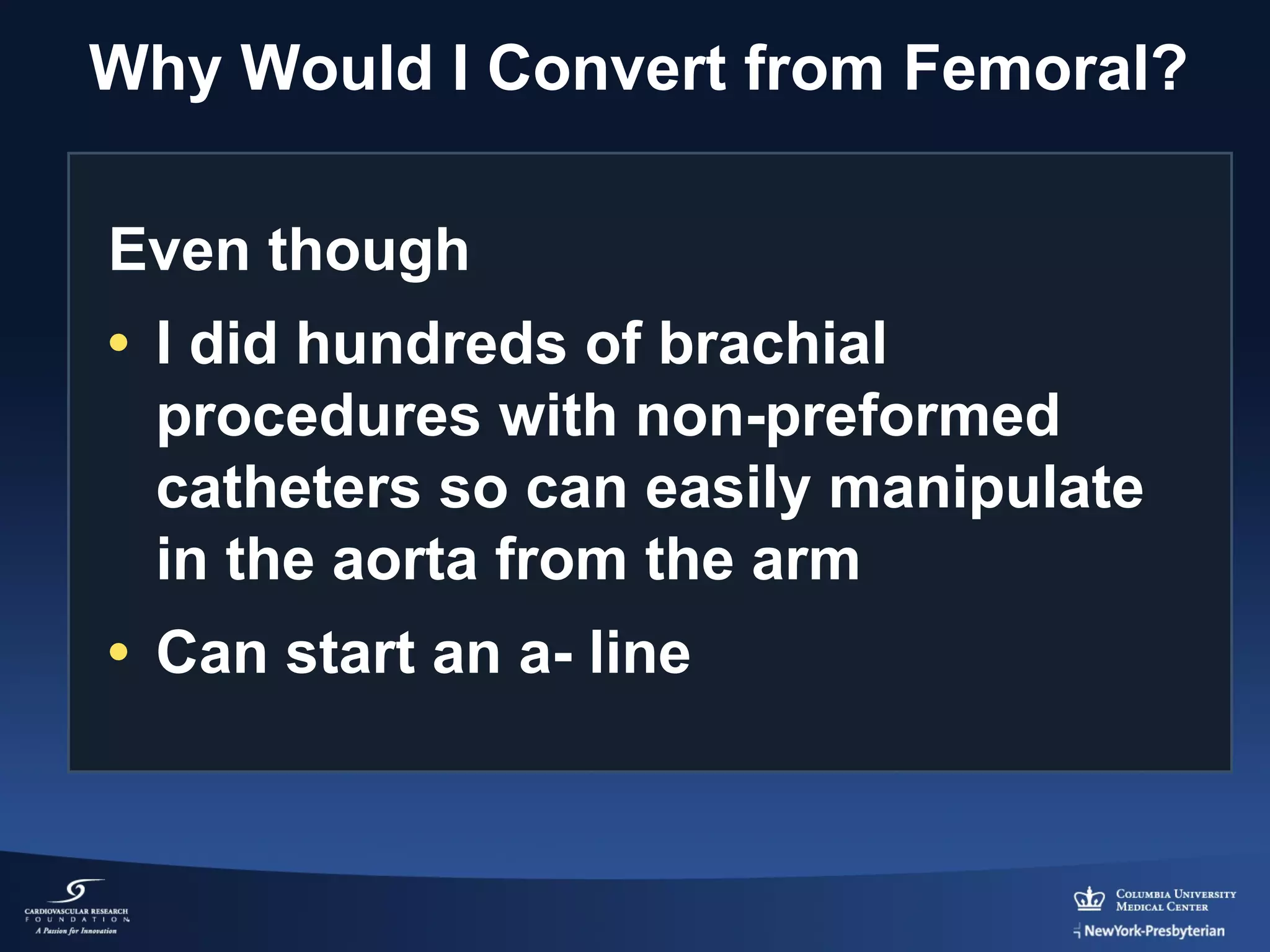
Why Would I Convert from Femoral?
Even though
• I did hundreds of brachial
procedures with non-preformed
catheters so can easily manipulate
in the aorta from the arm
• Can start an a- line
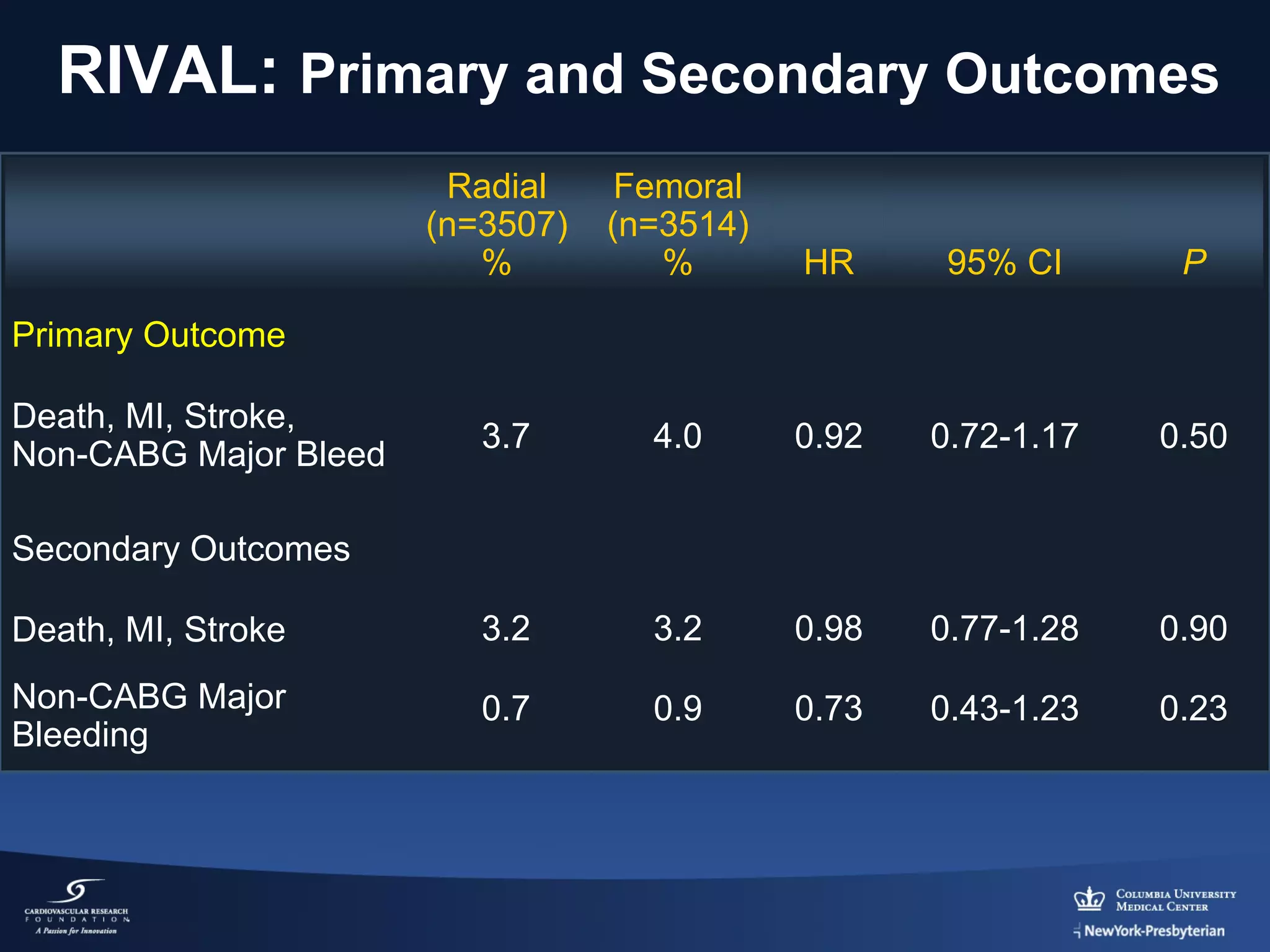
RIVAL: Primary and Secondary Outcomes
Radial
(n=3507)
%

Femoral
(n=3514)
%

HR

95% CI

P

3.7

4.0

0.92

0.72-1.17

0.50

Death, MI, Stroke

3.2

3.2

0.98

0.77-1.28

0.90

Non-CABG Major
Bleeding

0.7

0.9

0.73

0.43-1.23

0.23

Primary Outcome
Death, MI, Stroke,
Non-CABG Major Bleed
Secondary Outcomes
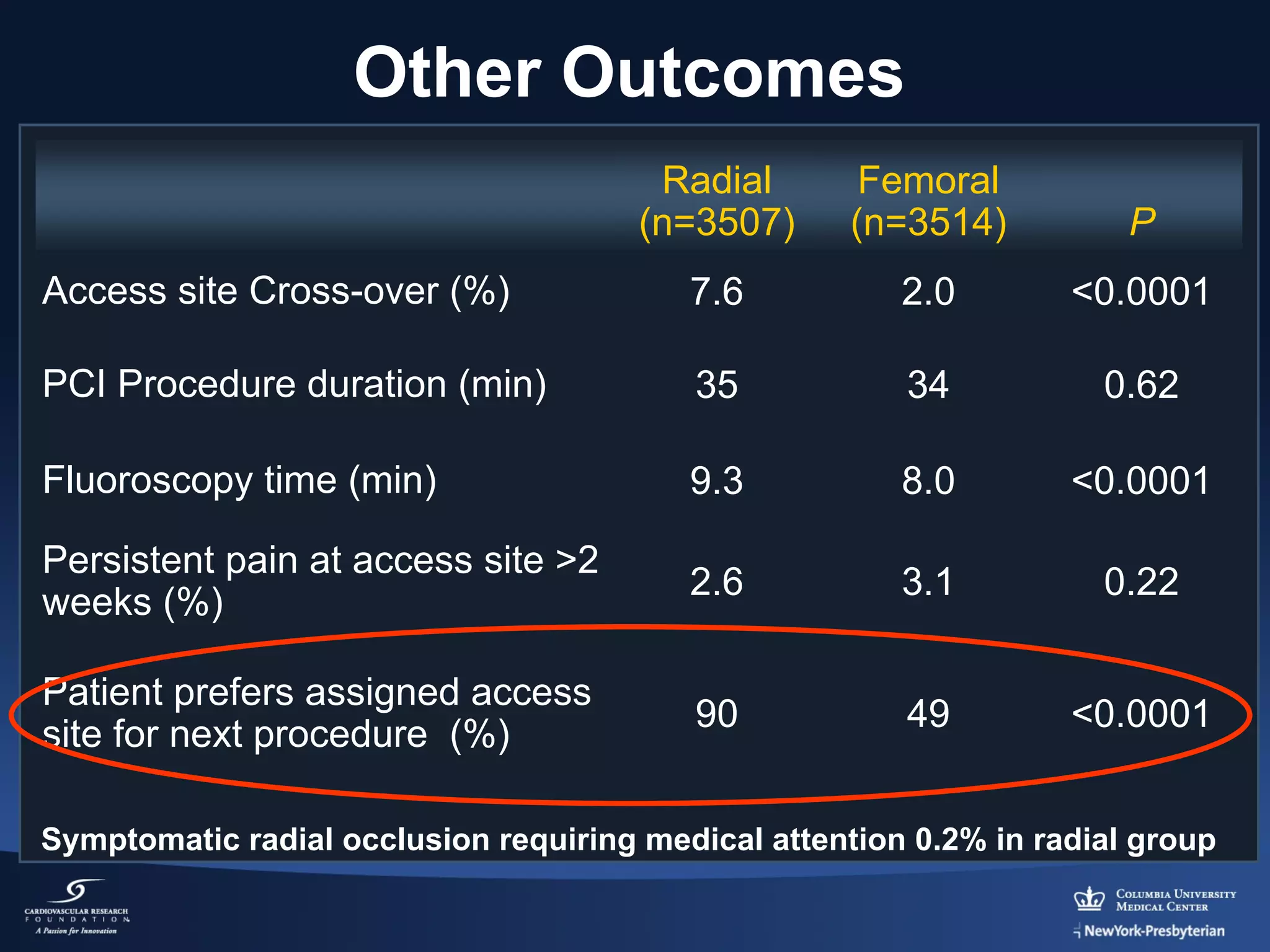
Other Outcomes
Radial
(n=3507)

Femoral
(n=3514)

P

Access site Cross-over (%)

7.6

2.0

<0.0001

PCI Procedure duration (min)

35

34

0.62

Fluoroscopy time (min)

9.3

8.0

<0.0001

Persistent pain at access site >2
weeks (%)

2.6

3.1

0.22

Patient prefers assigned access
site for next procedure (%)

90

49

<0.0001

Symptomatic radial occlusion requiring medical attention 0.2% in radial group
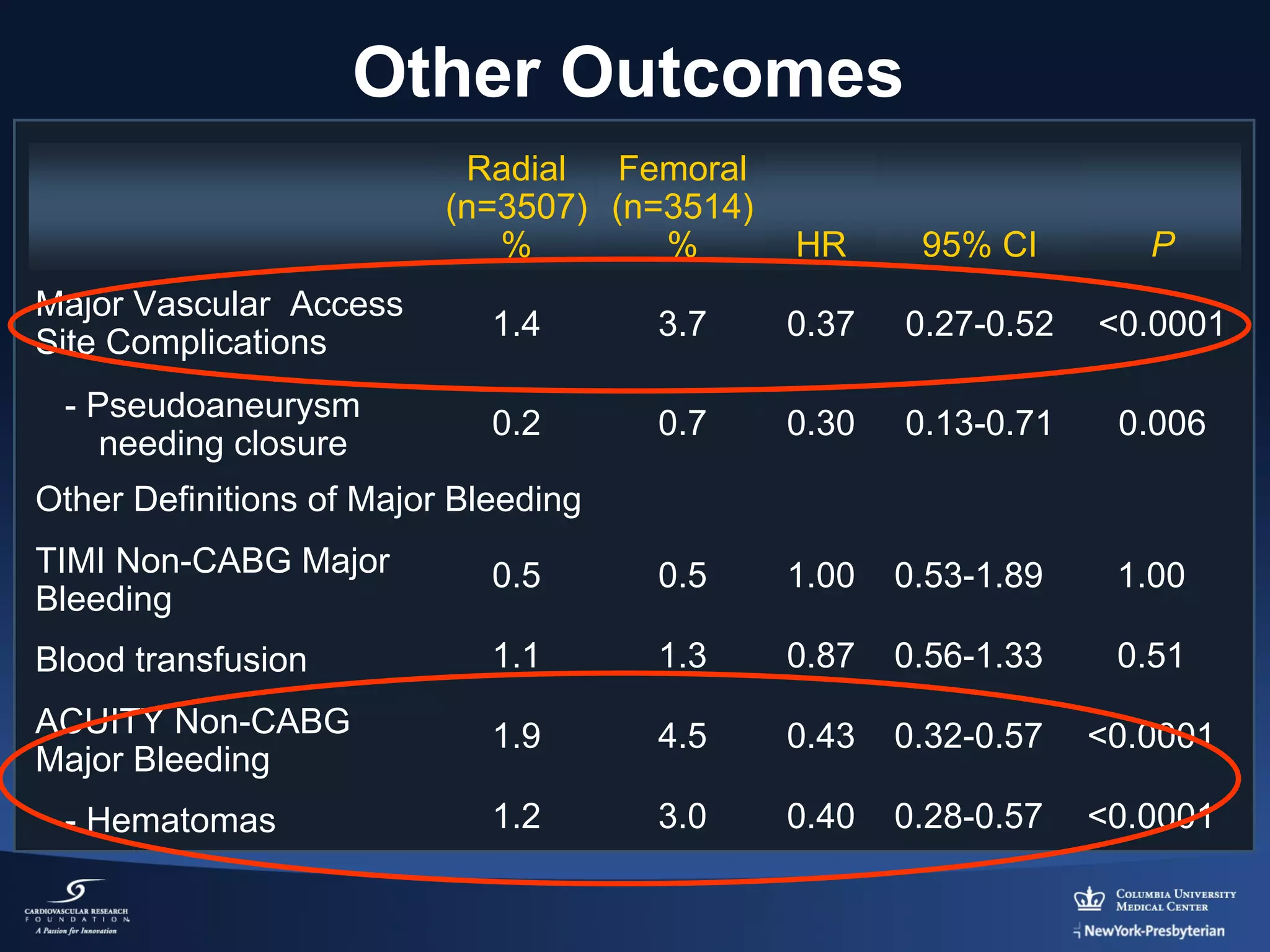
Other Outcomes
Radial Femoral
(n=3507) (n=3514)
%
%

HR

95% CI

P

Major Vascular Access
Site Complications

1.4

3.7

0.37

0.27-0.52

<0.0001

- Pseudoaneurysm
needing closure

0.2

0.7

0.30

0.13-0.71

0.006

Other Definitions of Major Bleeding
TIMI Non-CABG Major
Bleeding

0.5

0.5

1.00

0.53-1.89

1.00

Blood transfusion

1.1

1.3

0.87

0.56-1.33

0.51

ACUITY Non-CABG
Major Bleeding

1.9

4.5

0.43

0.32-0.57

<0.0001

1.2

3.0

0.40

0.28-0.57

<0.0001

- Hematomas
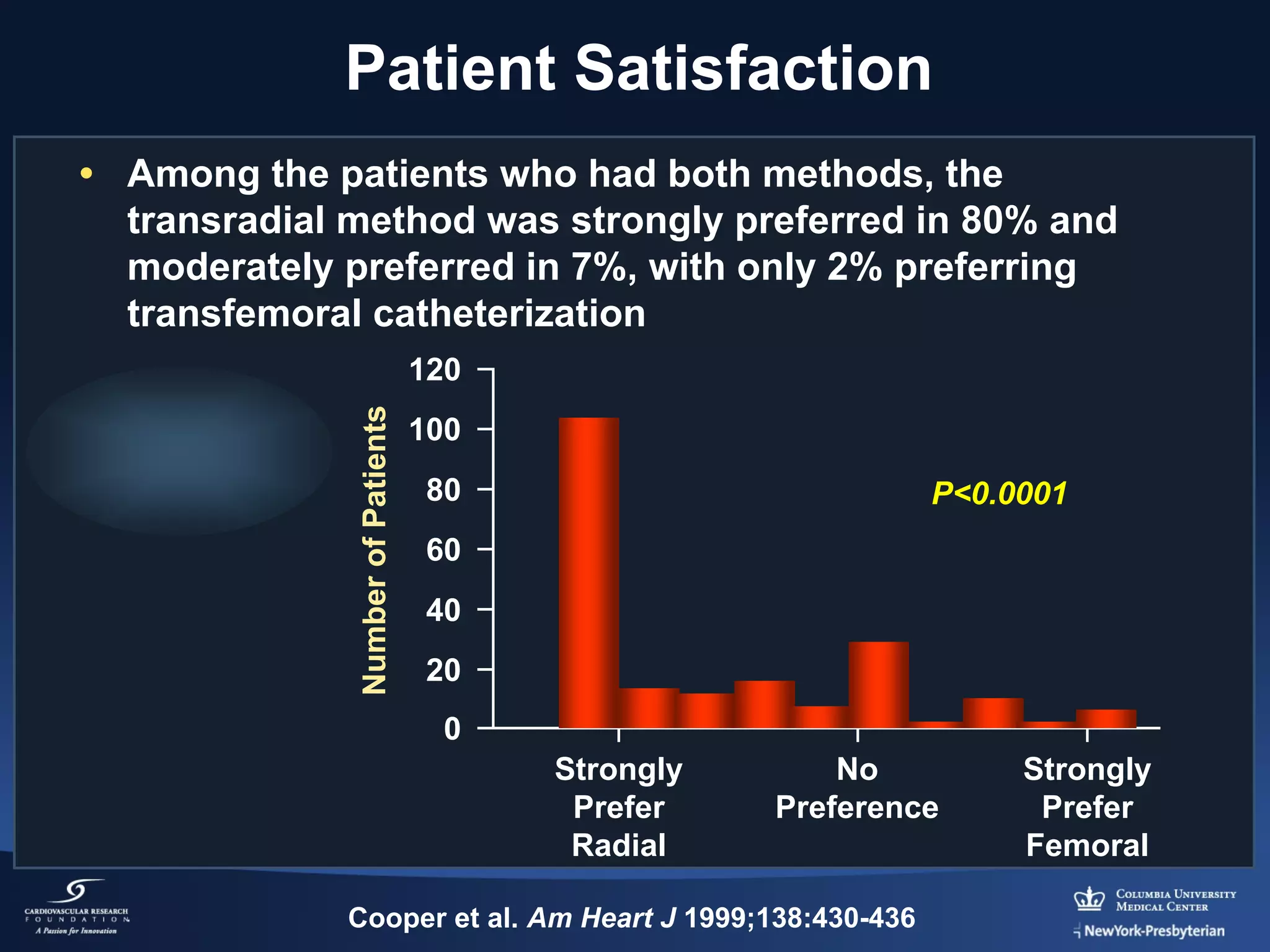
Patient Satisfaction
• Among the patients who had both methods, the
transradial method was strongly preferred in 80% and
moderately preferred in 7%, with only 2% preferring
transfemoral catheterization
Number of Patients

120
100
80

P<0.0001

60
40
20
0
Strongly
Prefer
Radial

No
Preference

Cooper et al. Am Heart J 1999;138:430-436

Strongly
Prefer
Femoral
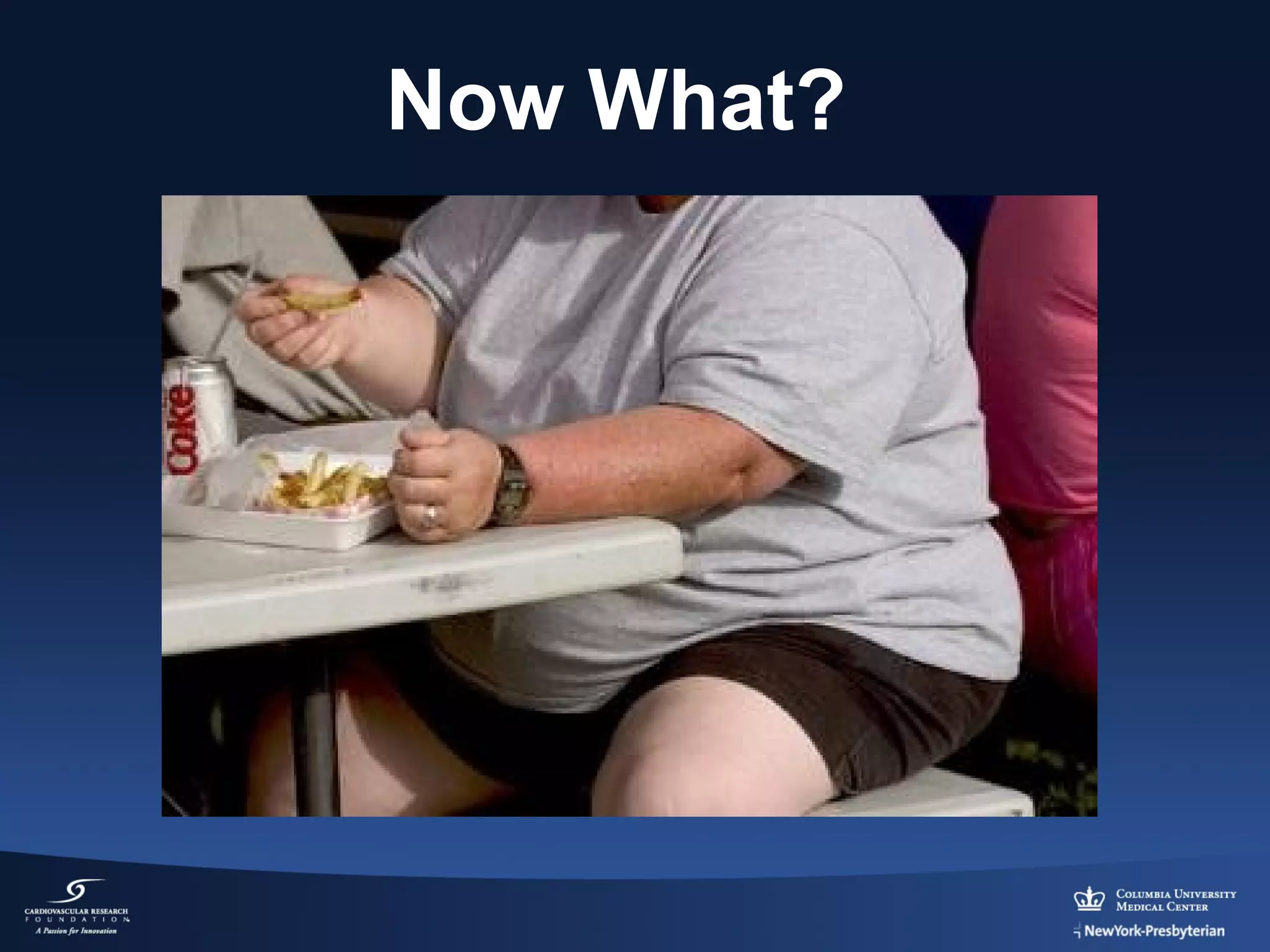
Now What?
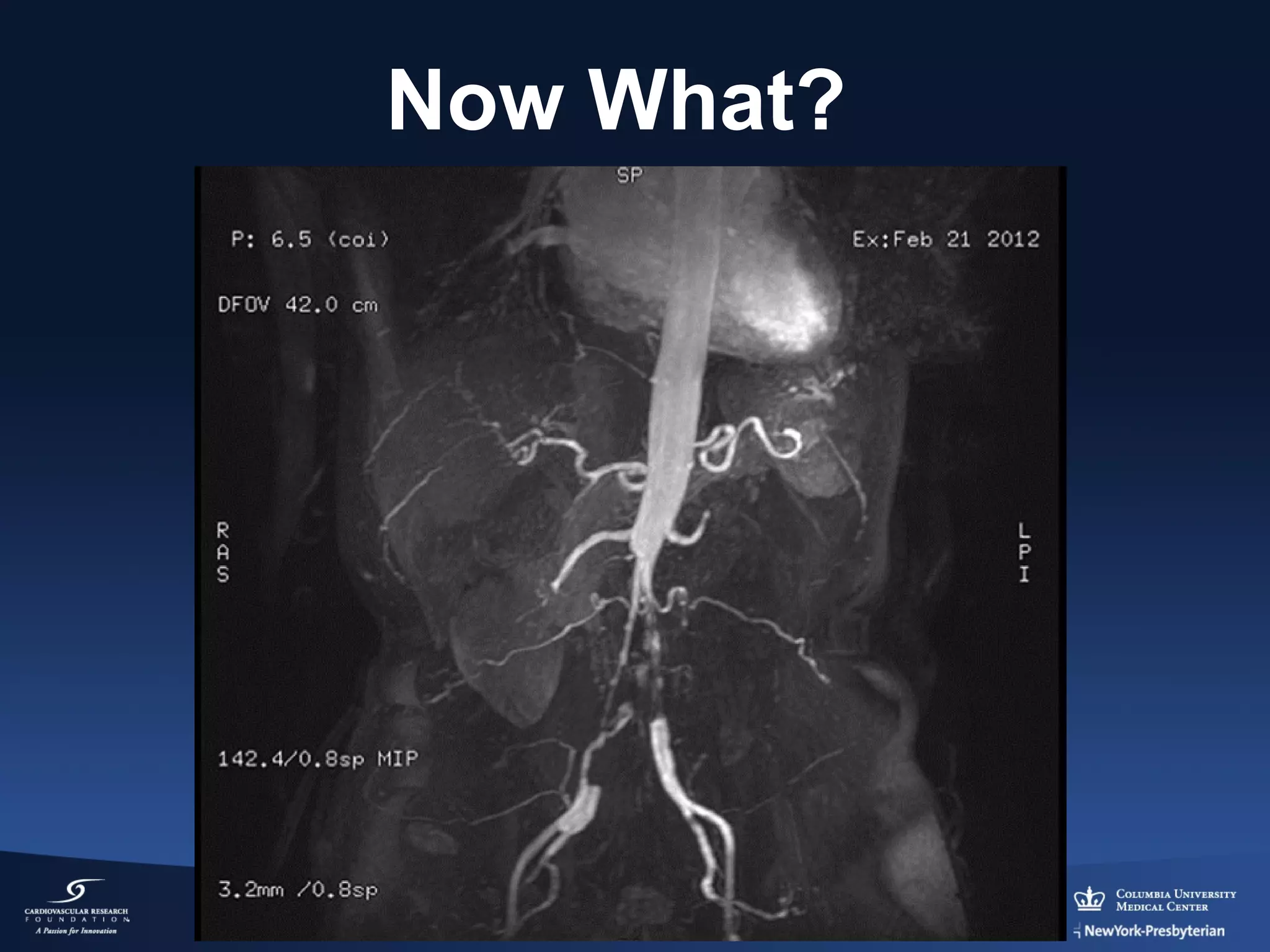
Now What?
Financial Savings
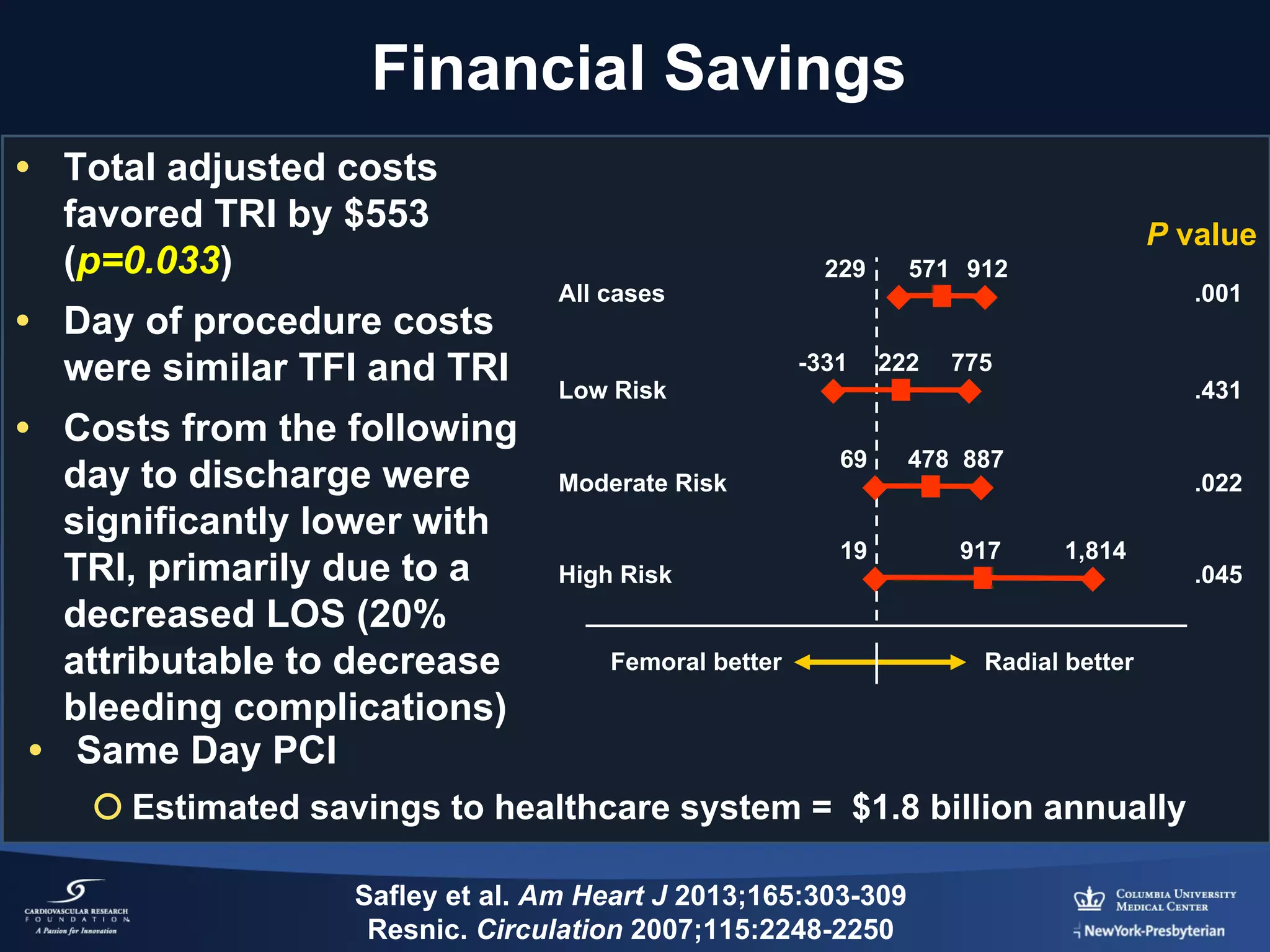
• Total adjusted costs
favored TRI by $553
(p=0.033)
• Day of procedure costs
were similar TFI and TRI
• Costs from the following
day to discharge were
significantly lower with
TRI, primarily due to a
decreased LOS (20%
attributable to decrease
bleeding complications)
• Same Day PCI

P value
All cases

229

-331

571 912

222

.001

775

Low Risk

Moderate Risk

High Risk

.431
69

478 887

19

917

Femoral better

.022
1,814

Radial better

¡ Estimated savings to healthcare system = $1.8 billion annually
Safley et al. Am Heart J 2013;165:303-309
Resnic. Circulation 2007;115:2248-2250

.045
“Dabbling” in one or the
other is a disservice to
the patients
Radiation Exposure
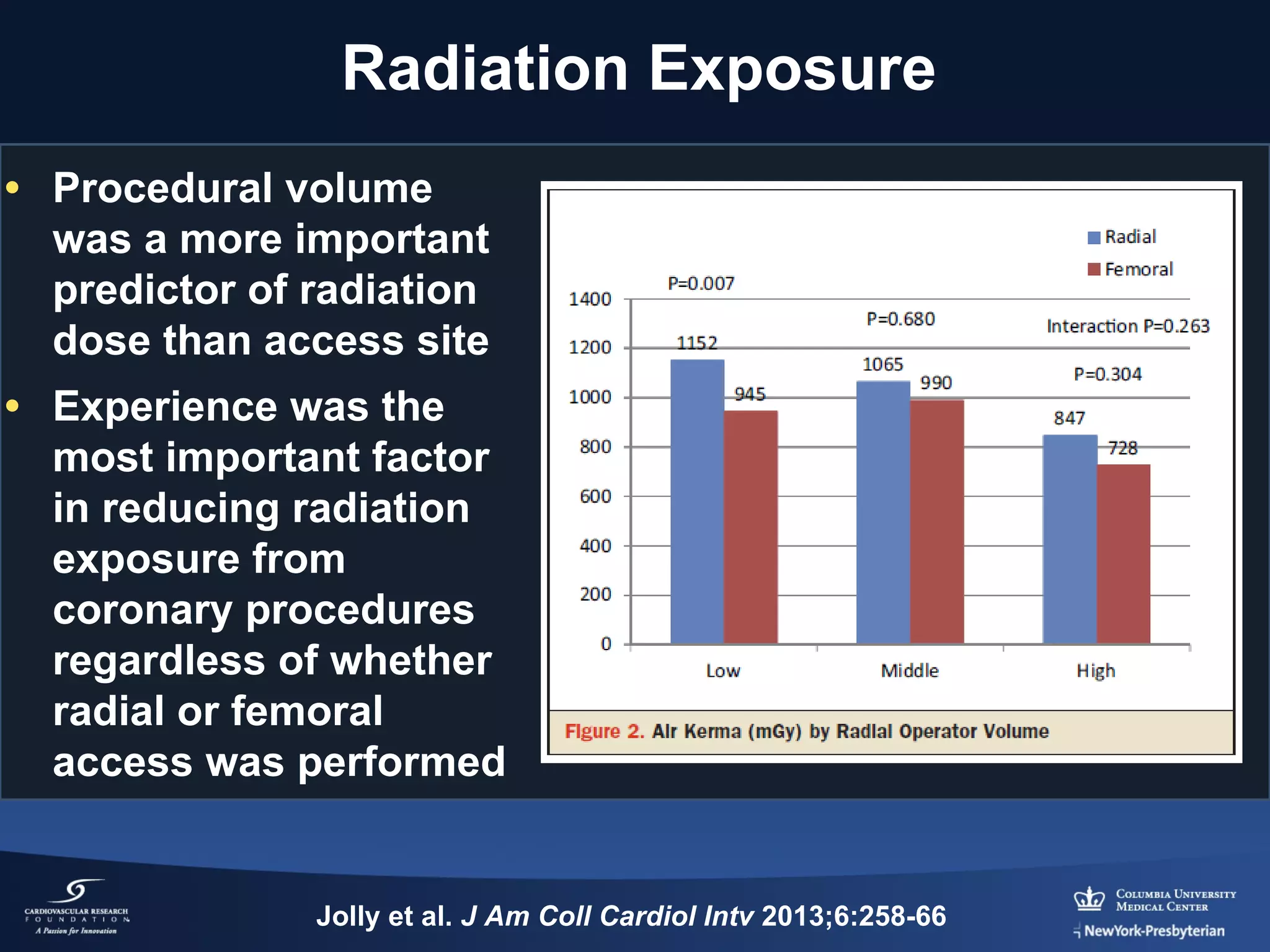
• Procedural volume
was a more important
predictor of radiation
dose than access site
• Experience was the
most important factor
in reducing radiation
exposure from
coronary procedures
regardless of whether
radial or femoral
access was performed

Jolly et al. J Am Coll Cardiol Intv 2013;6:258-66
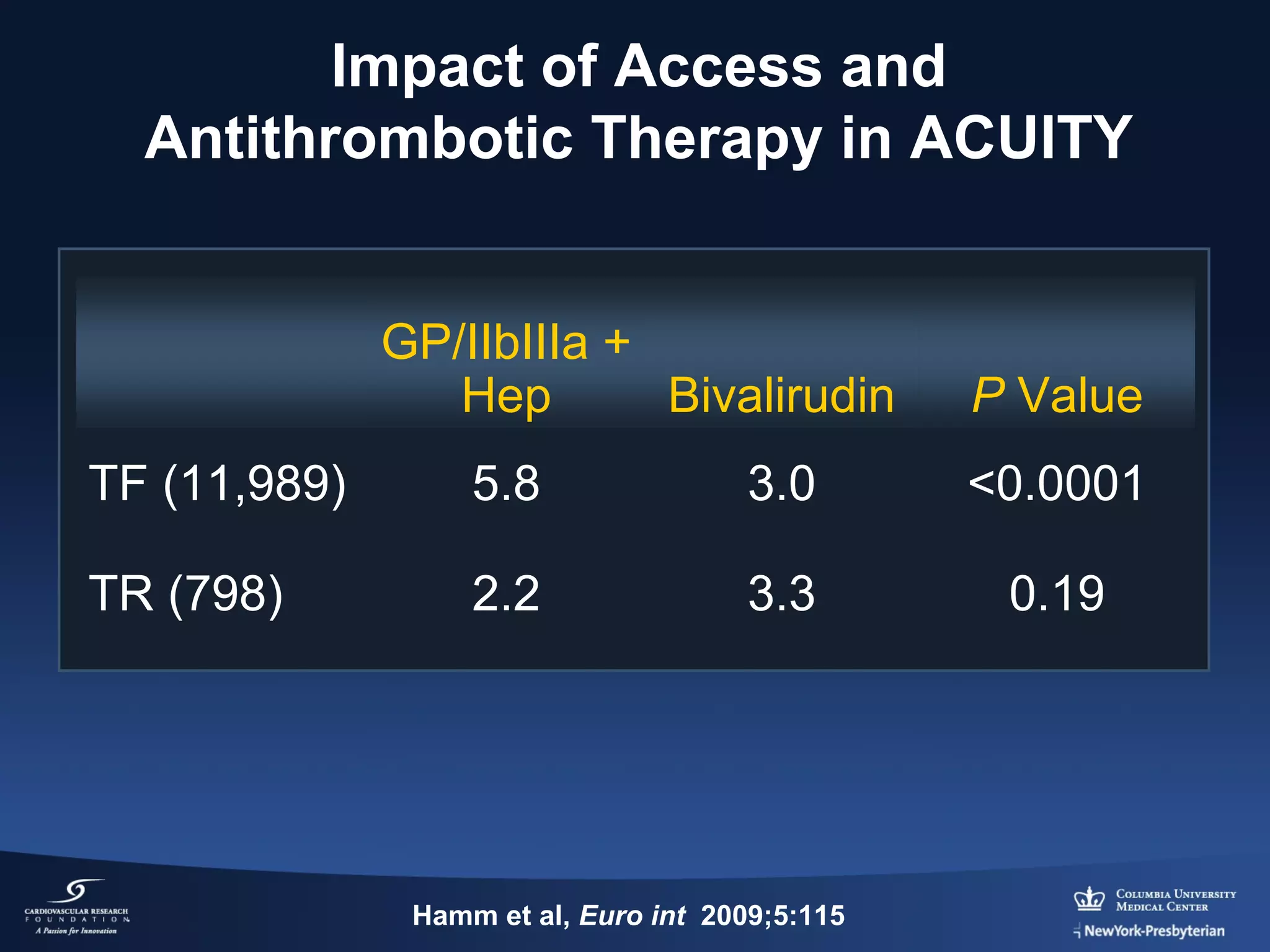
Impact of Access and
Antithrombotic Therapy in ACUITY
GP/IIbIIIa +
Hep
Bivalirudin

P Value

TF (11,989)

5.8

3.0

<0.0001

TR (798)

2.2

3.3

0.19

Hamm et al, Euro int 2009;5:115
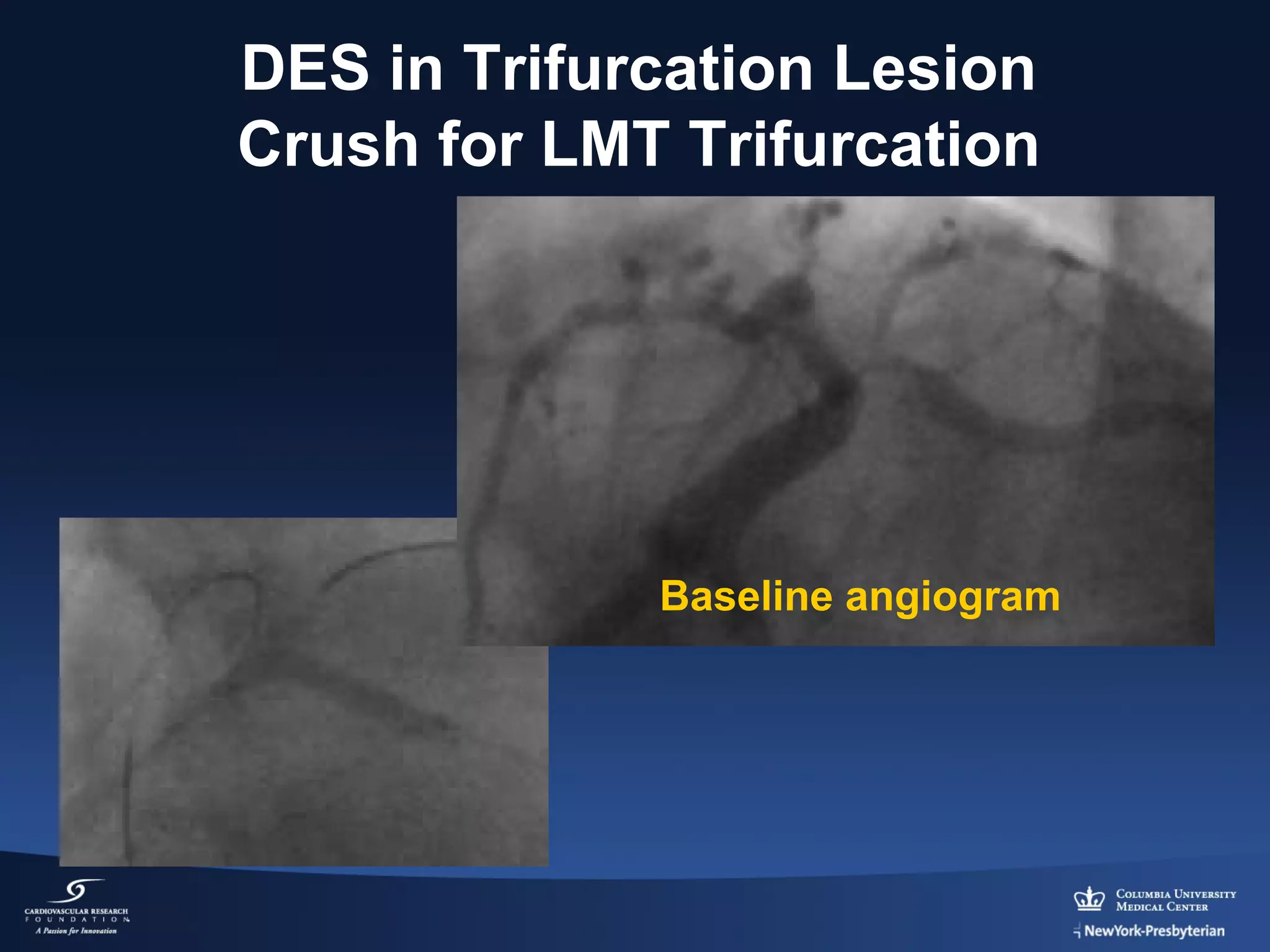
DES in Trifurcation Lesion
Crush for LMT Trifurcation

Baseline angiogram
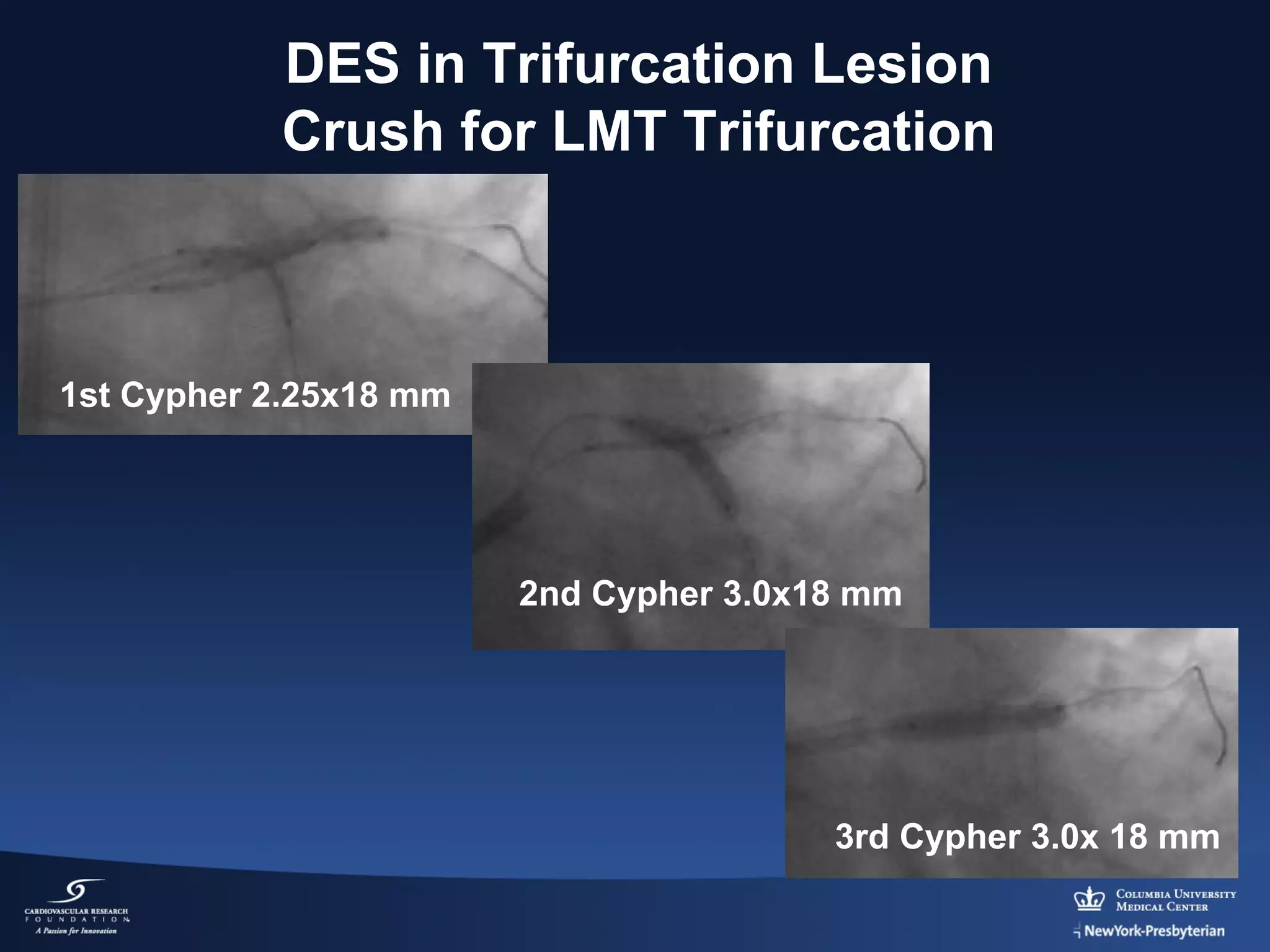
DES in Trifurcation Lesion
Crush for LMT Trifurcation

1st Cypher 2.25x18 mm

2nd Cypher 3.0x18 mm

3rd Cypher 3.0x 18 mm
• Sure you can do complex
anatomy (sheathless guides,
guidelines etc.)
• But why push it?
Ultra Complex Transradial Access and
Dog Walking…….

Yeah You Can do it……but…..why?
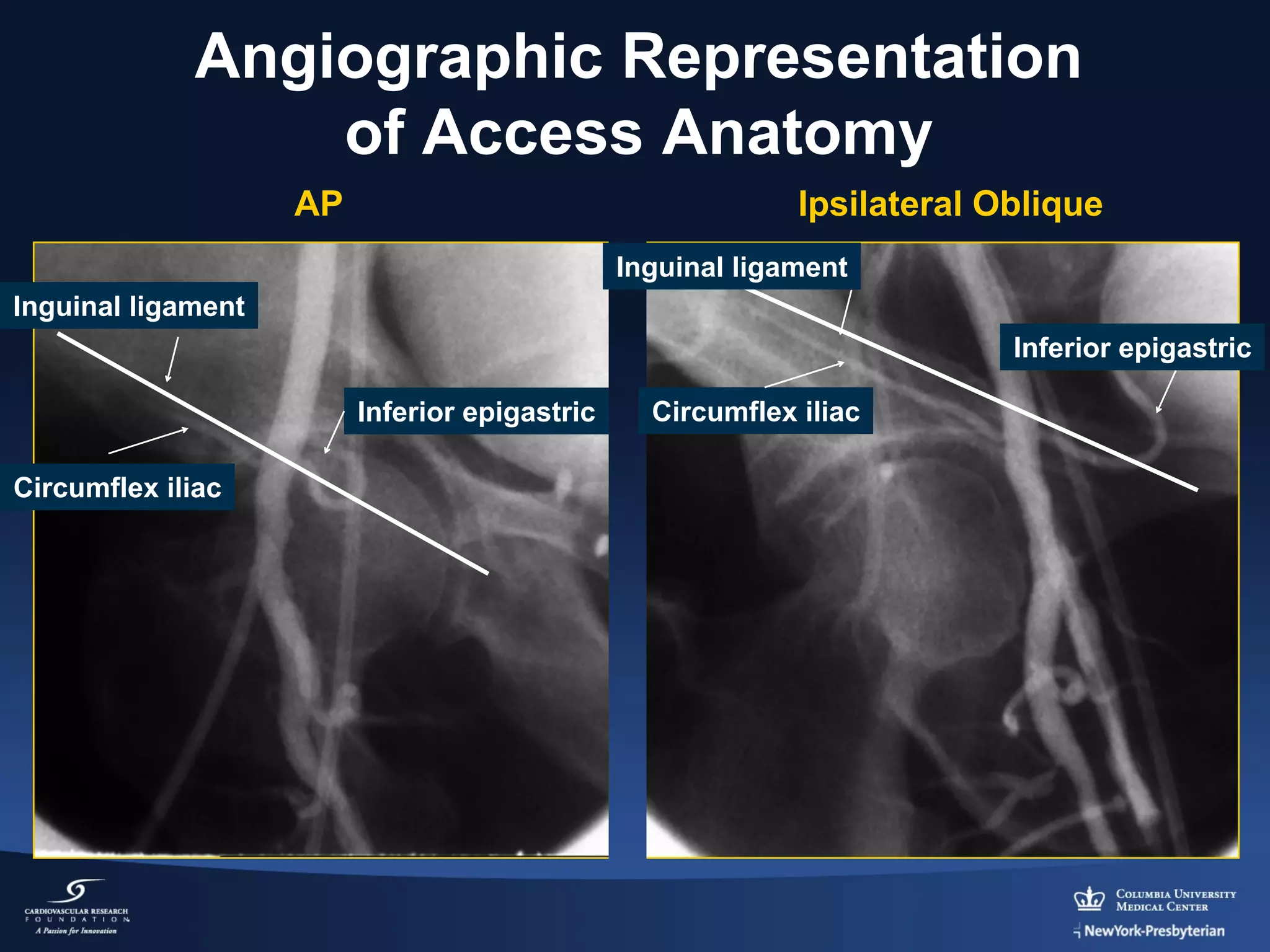
Angiographic Representation
of Access Anatomy
AP

Ipsilateral Oblique
Inguinal ligament

Inguinal ligament
Inferior epigastric
Inferior epigastric
Circumflex iliac

Circumflex iliac
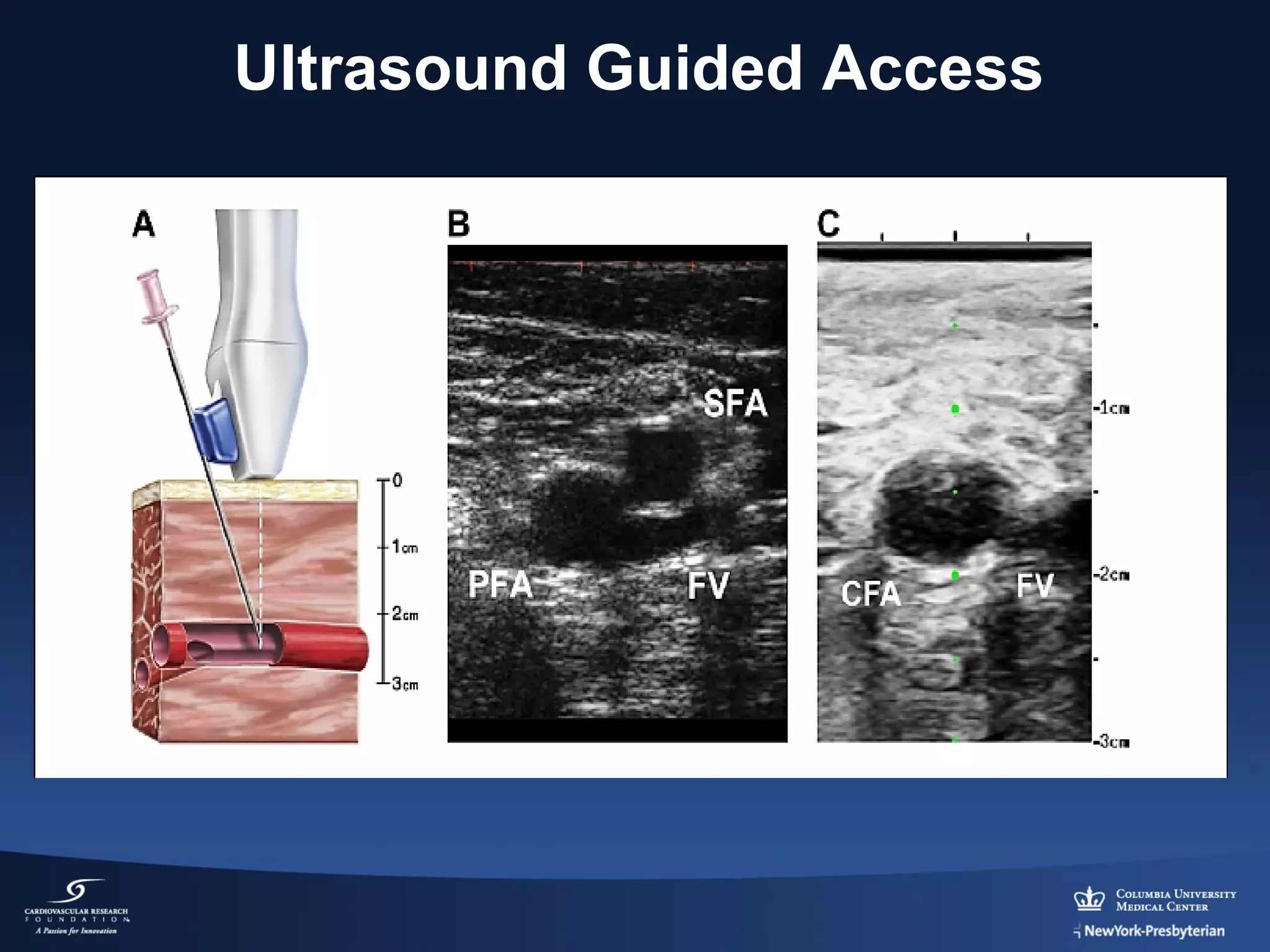
Ultrasound Guided Access
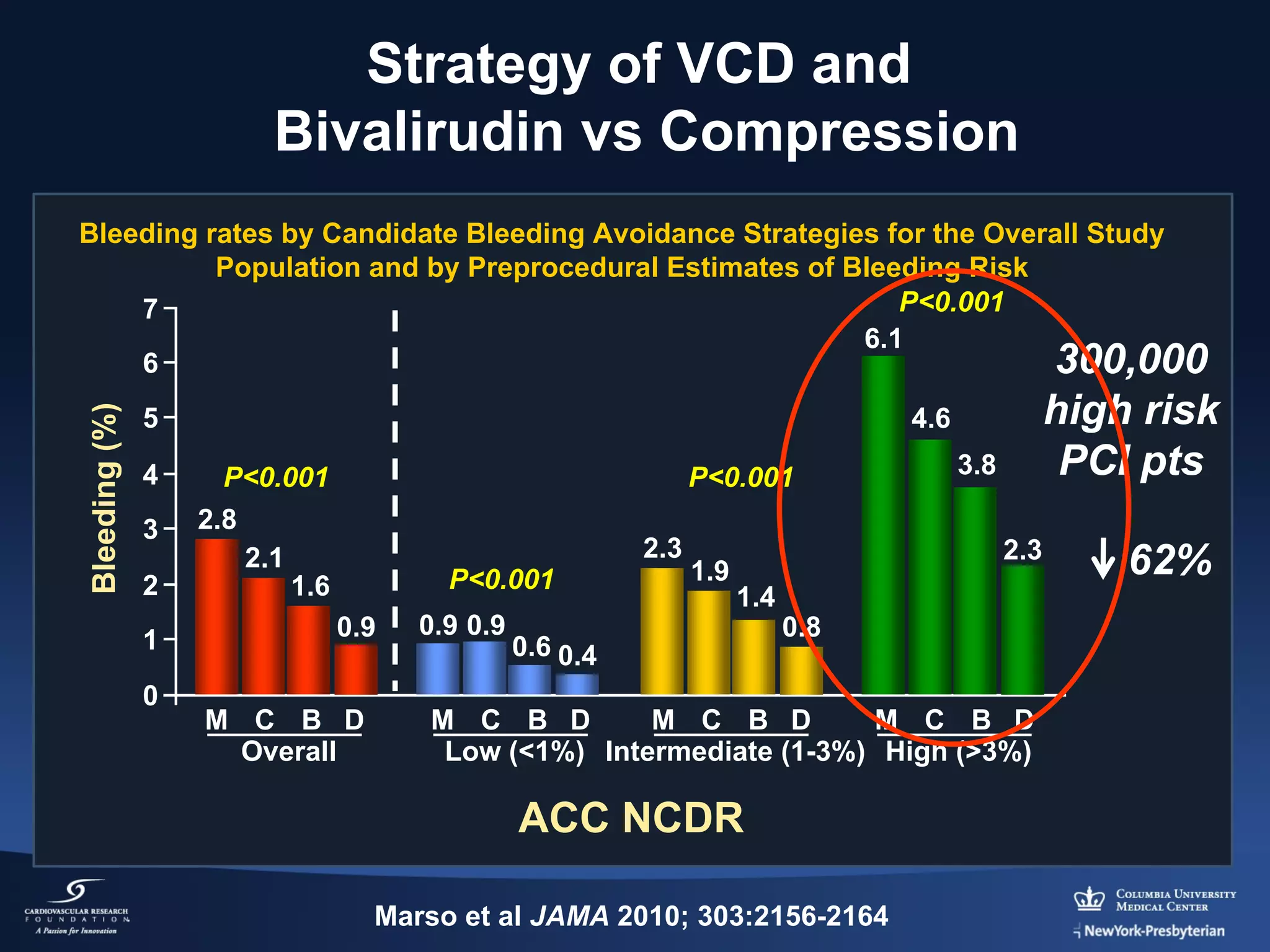
Strategy of VCD and
Bivalirudin vs Compression

Bleeding (%)

Bleeding rates by Candidate Bleeding Avoidance Strategies for the Overall Study
Population and by Preprocedural Estimates of Bleeding Risk
P<0.001
7
6.1
6
300,000
5
4
3
2
1
0

high risk
PCI pts

4.6
P<0.001
2.8
2.1
1.6

P<0.001

P<0.001
0.9

M C B D
Overall

0.9 0.9

2.3

1.9

3.8
2.3

1.4

0.6 0.4

0.8

M C B D
M C B D
M C B D
Low (<1%) Intermediate (1-3%) High (>3%)

ACC NCDR
Marso et al JAMA 2010; 303:2156-2164

62%
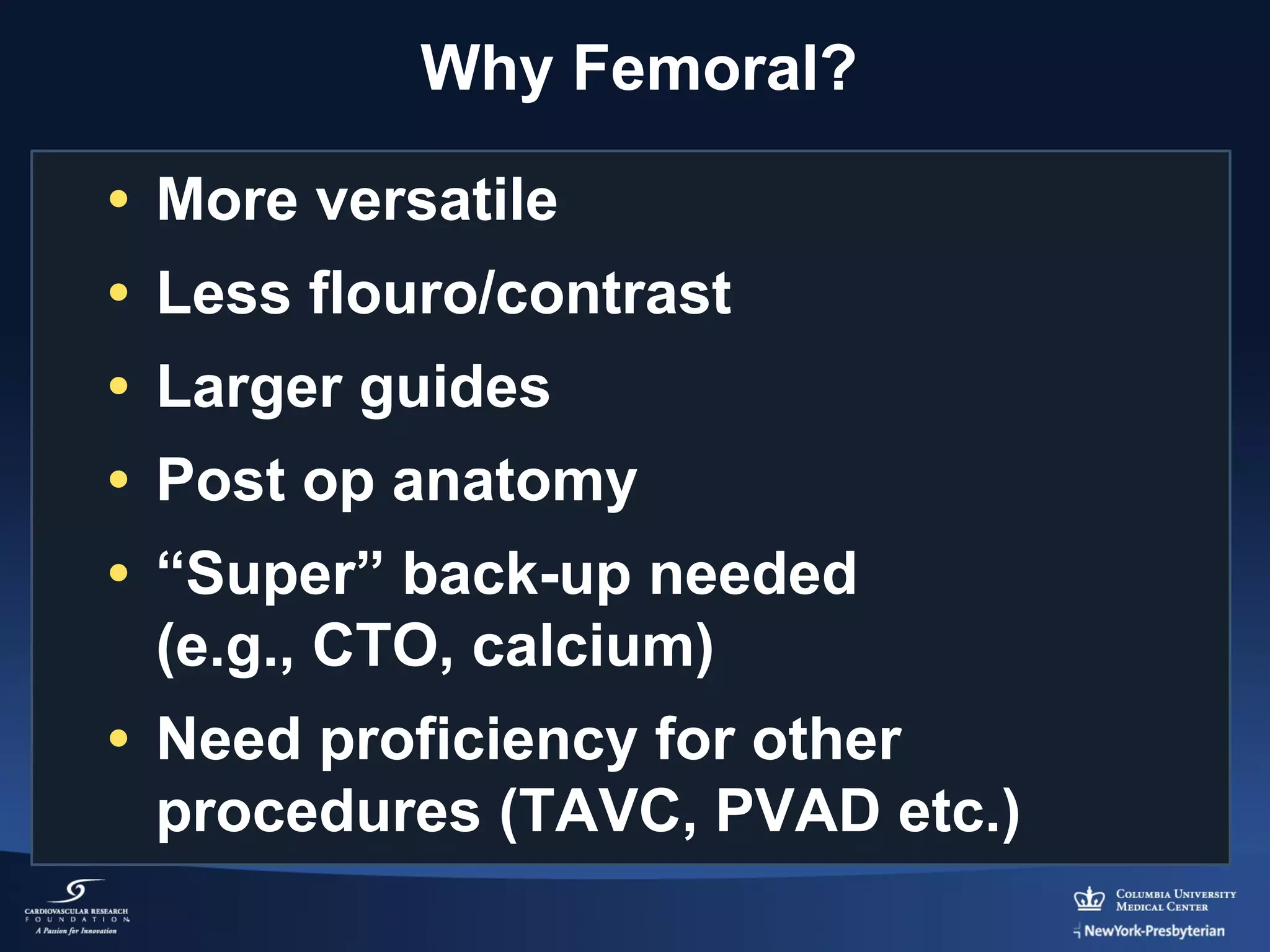
Why Femoral?
• More versatile
• Less flouro/contrast
• Larger guides
• Post op anatomy
• “Super” back-up needed
(e.g., CTO, calcium)
• Need proficiency for other
procedures (TAVC, PVAD etc.)
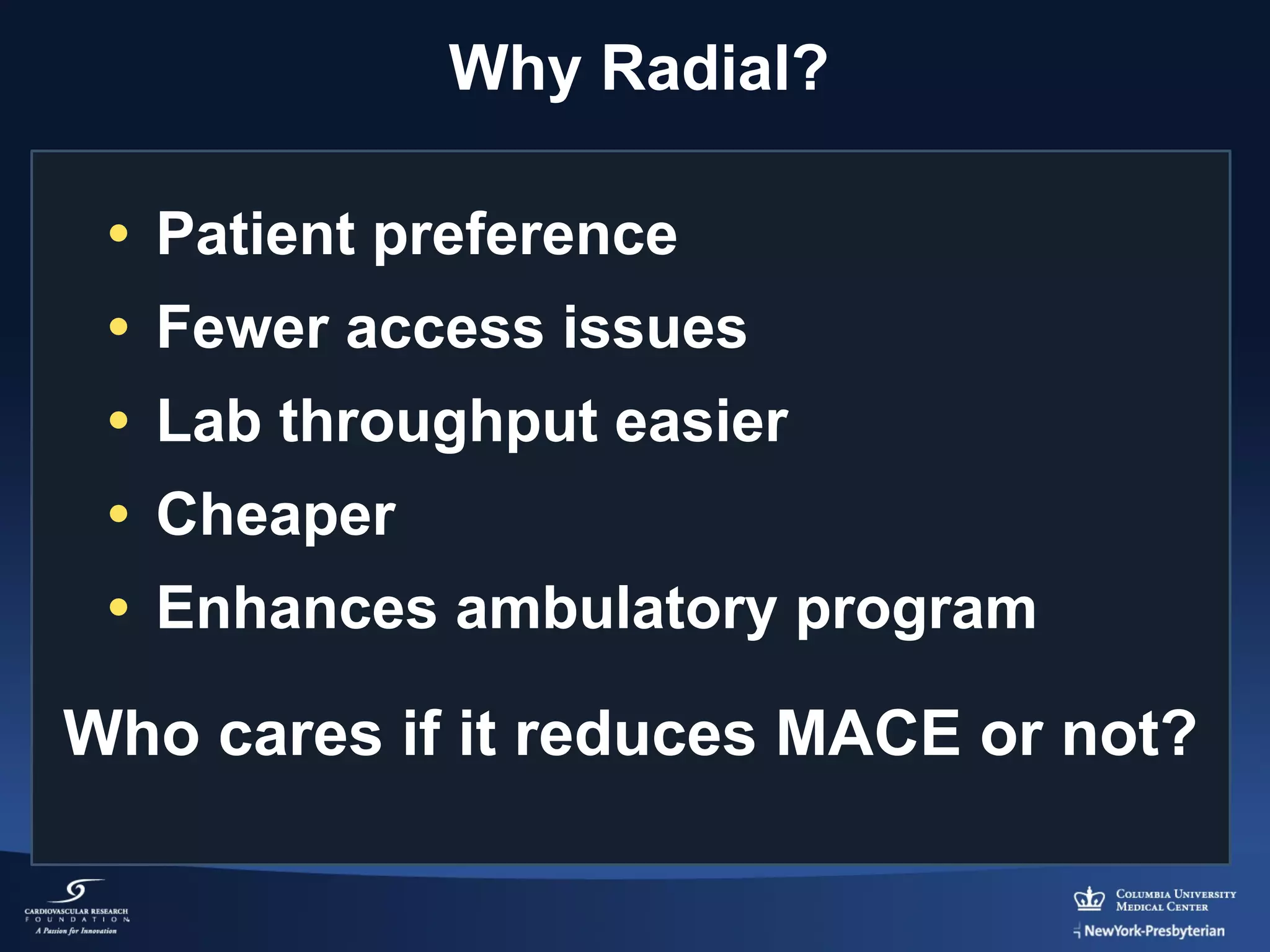
Why Radial?
• Patient preference
• Fewer access issues
• Lab throughput easier
• Cheaper
• Enhances ambulatory program

Who cares if it reduces MACE or not?
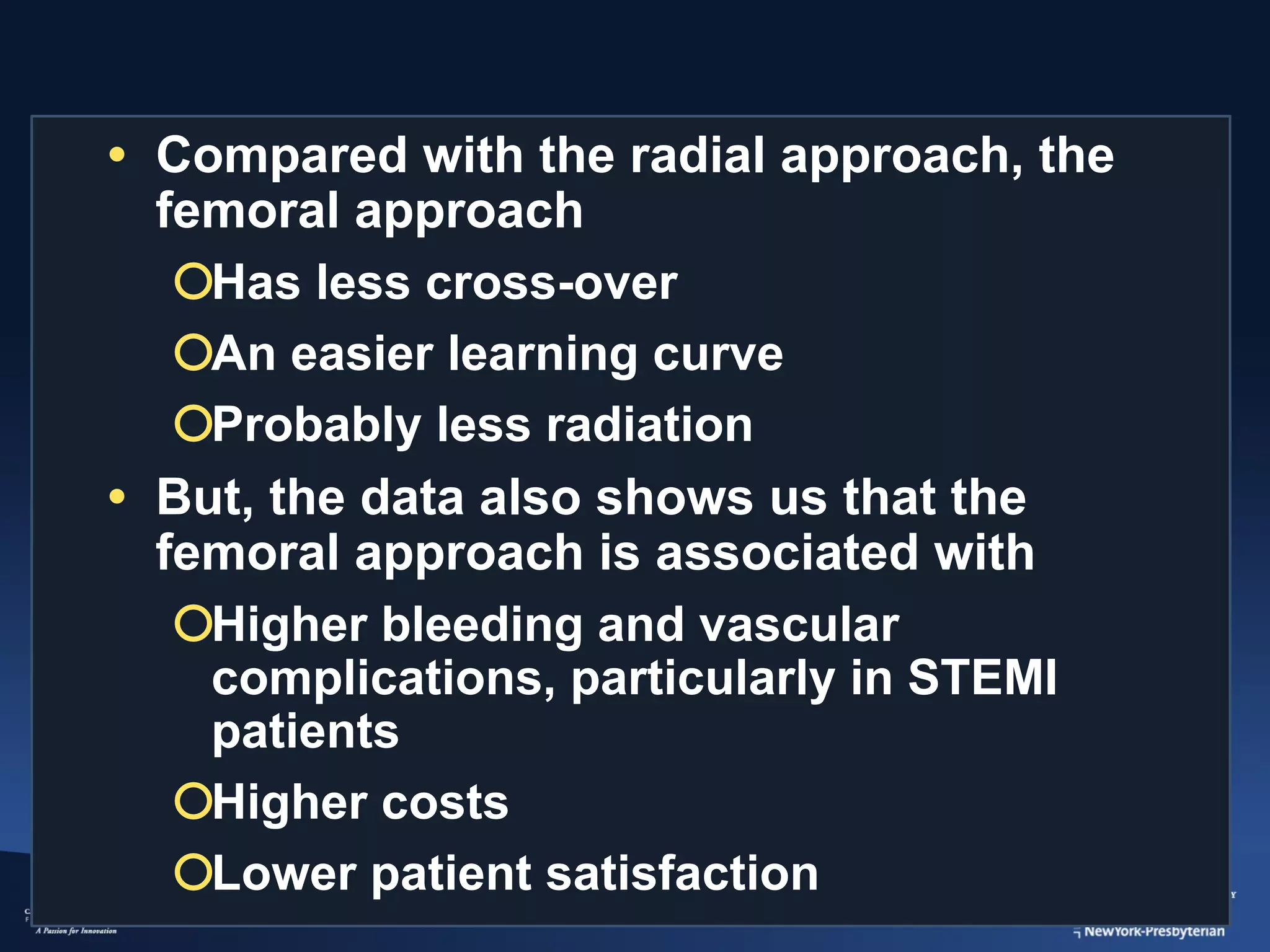
• Compared with the radial approach, the
femoral approach
¡Has less cross-over
¡An easier learning curve
¡Probably less radiation
• But, the data also shows us that the
femoral approach is associated with
¡Higher bleeding and vascular
complications, particularly in STEMI
patients
¡Higher costs
¡Lower patient satisfaction
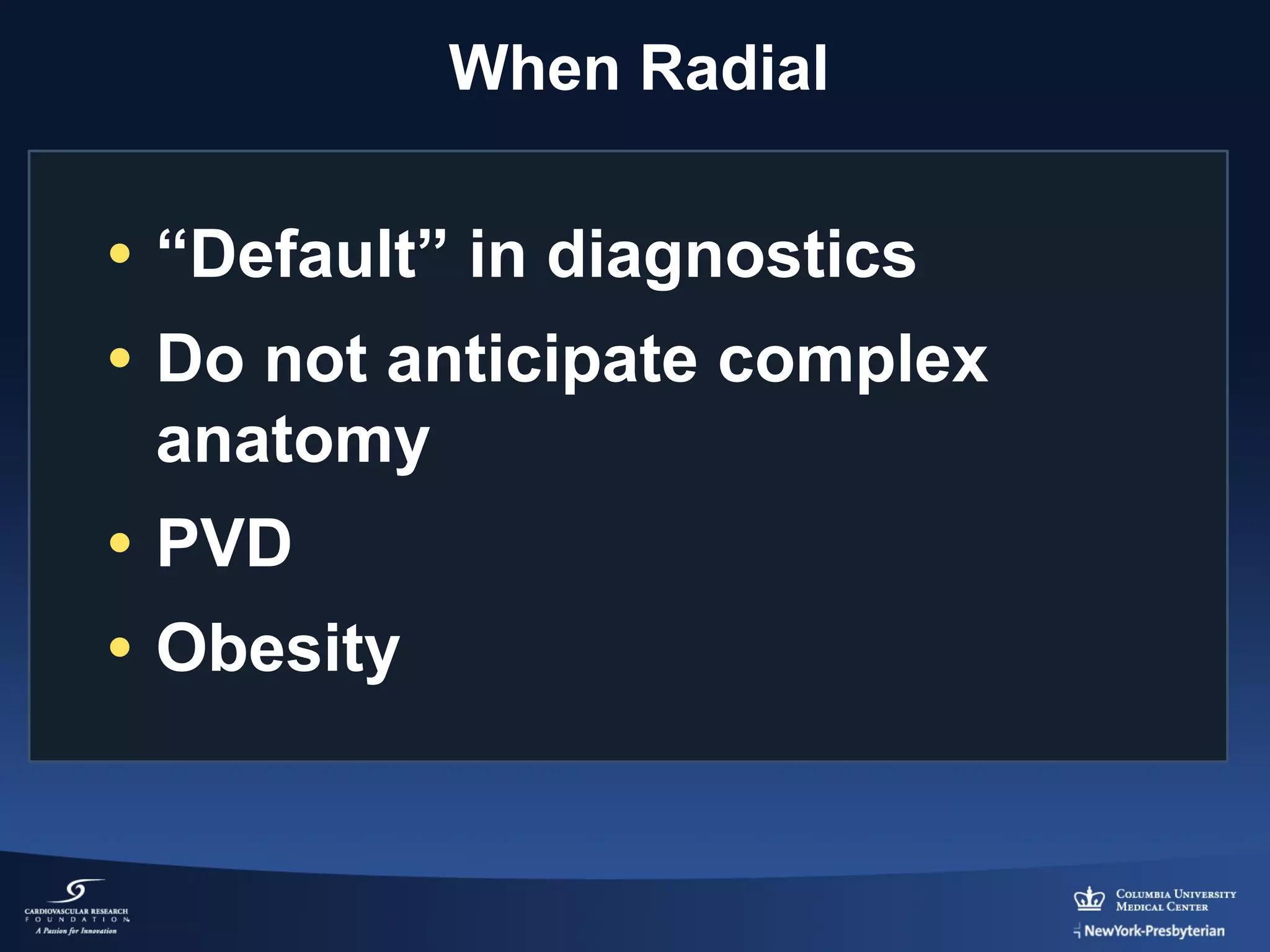
When Radial

• “Default” in diagnostics
• Do not anticipate complex
anatomy
• PVD
• Obesity
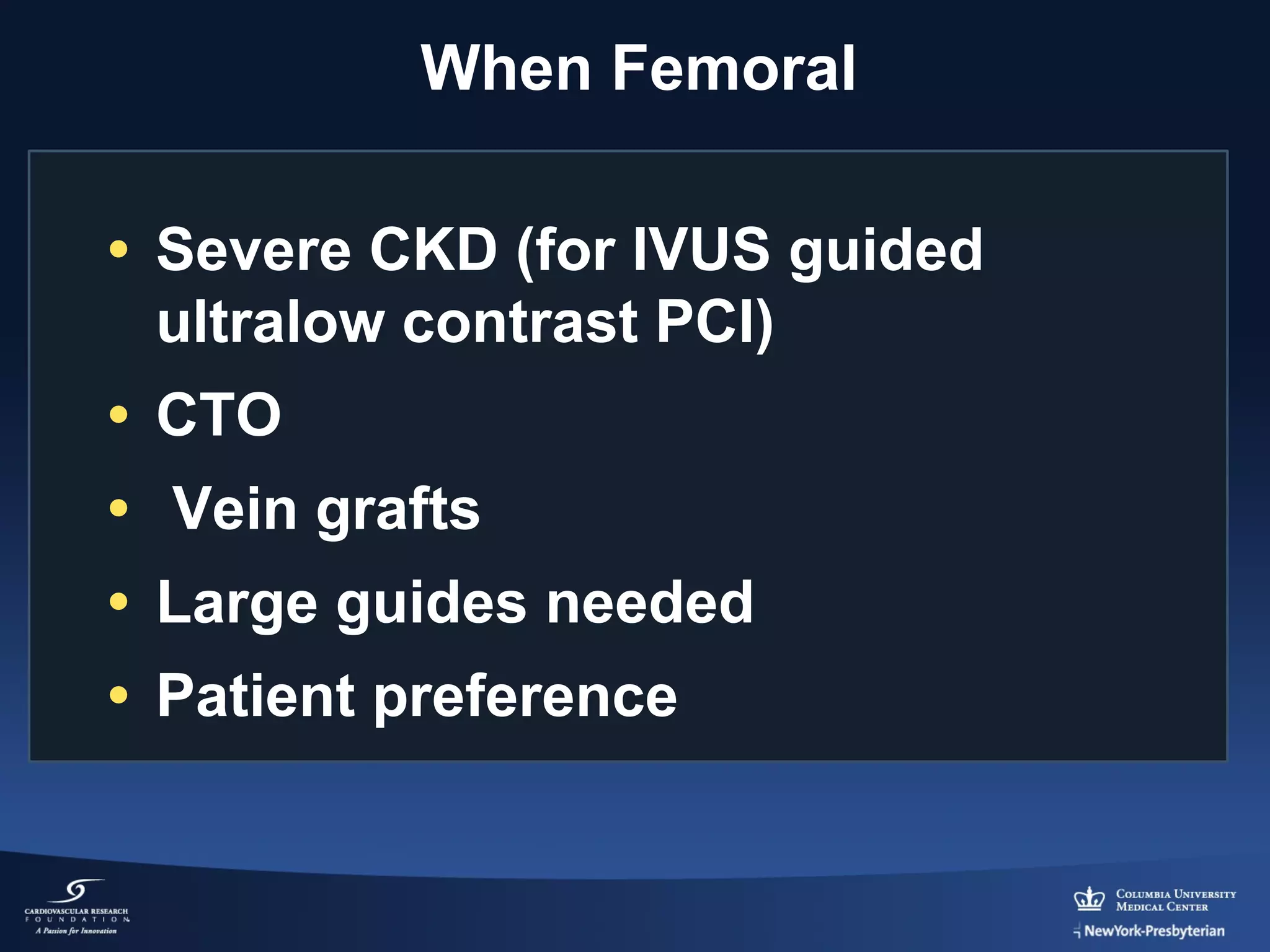
When Femoral
• Severe CKD (for IVUS guided
ultralow contrast PCI)
• CTO
• Vein grafts
• Large guides needed
• Patient preference
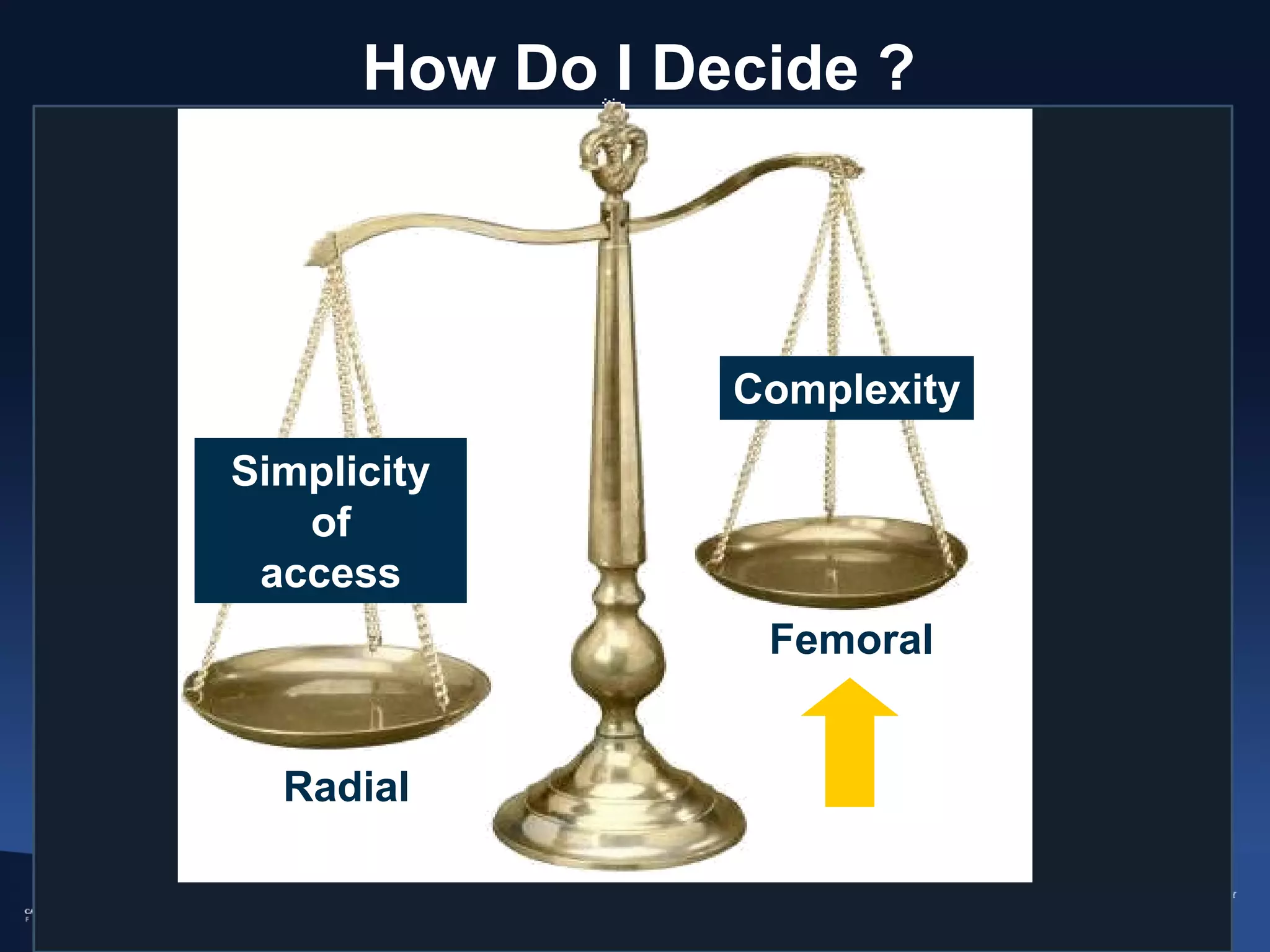
How Do I Decide ?

Complexity
Simplicity
of
access
Femoral
Radial

Moses JW - Transradial and transfemoral approach

  • 1.
    You Need ToBe Proficient with Both Jeffrey W. Moses, MD Columbia University Medical Center The Cardiovascular Research Foundation
  • 2.
    Disclosure Statement ofFinancial Interest I, Jeffrey Moses DO NOT have a financial interest/arrangement or affiliation with one or more organizations that could be perceived as a real or apparent conflict of interest in the context of the subject of this presentation.
  • 3.
    Why Would IConvert from Femoral? Even though • I did hundreds of brachial procedures with non-preformed catheters so can easily manipulate in the aorta from the arm • Can start an a- line
  • 4.
    RIVAL: Primary andSecondary Outcomes Radial (n=3507) % Femoral (n=3514) % HR 95% CI P 3.7 4.0 0.92 0.72-1.17 0.50 Death, MI, Stroke 3.2 3.2 0.98 0.77-1.28 0.90 Non-CABG Major Bleeding 0.7 0.9 0.73 0.43-1.23 0.23 Primary Outcome Death, MI, Stroke, Non-CABG Major Bleed Secondary Outcomes
  • 5.
    Other Outcomes Radial (n=3507) Femoral (n=3514) P Access siteCross-over (%) 7.6 2.0 <0.0001 PCI Procedure duration (min) 35 34 0.62 Fluoroscopy time (min) 9.3 8.0 <0.0001 Persistent pain at access site >2 weeks (%) 2.6 3.1 0.22 Patient prefers assigned access site for next procedure (%) 90 49 <0.0001 Symptomatic radial occlusion requiring medical attention 0.2% in radial group
  • 6.
    Other Outcomes Radial Femoral (n=3507)(n=3514) % % HR 95% CI P Major Vascular Access Site Complications 1.4 3.7 0.37 0.27-0.52 <0.0001 - Pseudoaneurysm needing closure 0.2 0.7 0.30 0.13-0.71 0.006 Other Definitions of Major Bleeding TIMI Non-CABG Major Bleeding 0.5 0.5 1.00 0.53-1.89 1.00 Blood transfusion 1.1 1.3 0.87 0.56-1.33 0.51 ACUITY Non-CABG Major Bleeding 1.9 4.5 0.43 0.32-0.57 <0.0001 1.2 3.0 0.40 0.28-0.57 <0.0001 - Hematomas
  • 7.
    Patient Satisfaction • Amongthe patients who had both methods, the transradial method was strongly preferred in 80% and moderately preferred in 7%, with only 2% preferring transfemoral catheterization Number of Patients 120 100 80 P<0.0001 60 40 20 0 Strongly Prefer Radial No Preference Cooper et al. Am Heart J 1999;138:430-436 Strongly Prefer Femoral
  • 8.
  • 9.
  • 10.
    Financial Savings • Totaladjusted costs favored TRI by $553 (p=0.033) • Day of procedure costs were similar TFI and TRI • Costs from the following day to discharge were significantly lower with TRI, primarily due to a decreased LOS (20% attributable to decrease bleeding complications) • Same Day PCI P value All cases 229 -331 571 912 222 .001 775 Low Risk Moderate Risk High Risk .431 69 478 887 19 917 Femoral better .022 1,814 Radial better ¡ Estimated savings to healthcare system = $1.8 billion annually Safley et al. Am Heart J 2013;165:303-309 Resnic. Circulation 2007;115:2248-2250 .045
  • 11.
    “Dabbling” in oneor the other is a disservice to the patients
  • 12.
    Radiation Exposure • Proceduralvolume was a more important predictor of radiation dose than access site • Experience was the most important factor in reducing radiation exposure from coronary procedures regardless of whether radial or femoral access was performed Jolly et al. J Am Coll Cardiol Intv 2013;6:258-66
  • 13.
    Impact of Accessand Antithrombotic Therapy in ACUITY GP/IIbIIIa + Hep Bivalirudin P Value TF (11,989) 5.8 3.0 <0.0001 TR (798) 2.2 3.3 0.19 Hamm et al, Euro int 2009;5:115
  • 14.
    DES in TrifurcationLesion Crush for LMT Trifurcation Baseline angiogram
  • 15.
    DES in TrifurcationLesion Crush for LMT Trifurcation 1st Cypher 2.25x18 mm 2nd Cypher 3.0x18 mm 3rd Cypher 3.0x 18 mm
  • 16.
    • Sure youcan do complex anatomy (sheathless guides, guidelines etc.) • But why push it?
  • 17.
    Ultra Complex TransradialAccess and Dog Walking……. Yeah You Can do it……but…..why?
  • 18.
    Angiographic Representation of AccessAnatomy AP Ipsilateral Oblique Inguinal ligament Inguinal ligament Inferior epigastric Inferior epigastric Circumflex iliac Circumflex iliac
  • 19.
  • 20.
    Strategy of VCDand Bivalirudin vs Compression Bleeding (%) Bleeding rates by Candidate Bleeding Avoidance Strategies for the Overall Study Population and by Preprocedural Estimates of Bleeding Risk P<0.001 7 6.1 6 300,000 5 4 3 2 1 0 high risk PCI pts 4.6 P<0.001 2.8 2.1 1.6 P<0.001 P<0.001 0.9 M C B D Overall 0.9 0.9 2.3 1.9 3.8 2.3 1.4 0.6 0.4 0.8 M C B D M C B D M C B D Low (<1%) Intermediate (1-3%) High (>3%) ACC NCDR Marso et al JAMA 2010; 303:2156-2164 62%
  • 21.
    Why Femoral? • Moreversatile • Less flouro/contrast • Larger guides • Post op anatomy • “Super” back-up needed (e.g., CTO, calcium) • Need proficiency for other procedures (TAVC, PVAD etc.)
  • 22.
    Why Radial? • Patientpreference • Fewer access issues • Lab throughput easier • Cheaper • Enhances ambulatory program Who cares if it reduces MACE or not?
  • 23.
    • Compared withthe radial approach, the femoral approach ¡Has less cross-over ¡An easier learning curve ¡Probably less radiation • But, the data also shows us that the femoral approach is associated with ¡Higher bleeding and vascular complications, particularly in STEMI patients ¡Higher costs ¡Lower patient satisfaction
  • 24.
    When Radial • “Default”in diagnostics • Do not anticipate complex anatomy • PVD • Obesity
  • 25.
    When Femoral • SevereCKD (for IVUS guided ultralow contrast PCI) • CTO • Vein grafts • Large guides needed • Patient preference
  • 26.
    How Do IDecide ? Complexity Simplicity of access Femoral Radial