Noise Error Calculation, Difference Between Taking Average and The
Noise Formula
Gan Chun Chet (MSc, BEng, P. Eng)
Averaging the noise source in a quick way shall requires a correction to be “added-in” or “multiplied
by a factor” to obtain a predicted or simulated value based on industrial noise calculations. The
approach of average the noise source provides an indicative value for quick diagnostics. In addition,
a rough approximation, which in real situation, is less than the calculated value can be quickly
referred to as averaging the noise source herein this paper states.
However, for more accurate reading, a derivation of industrial noise calculation is as shown below;
this is noted as noise erroring calculation, difference between the average noise source and the
calculated noise based on industrial standards/regulations.
Table 1 : Sound Intensity Level IL at respective frequencies
IL1 IL2 IL3 (IL1 + IL2 + IL3)/3
2000 Hz 3000 Hz 4000 Hz AVERAGE
As for industrial standards/regulations, the Sound Intensity Level IL is calculated based on;
IL = 10 log( ) [dB] ; 𝐼 = 10 𝑊/ 𝑚
𝐼𝐿 = 10 log ( ) = 10 log ( 10 ( )/
+ 10 /
)
where 𝐼𝐿 = 10 log ( ) , = + = 10 /
+ 10 /
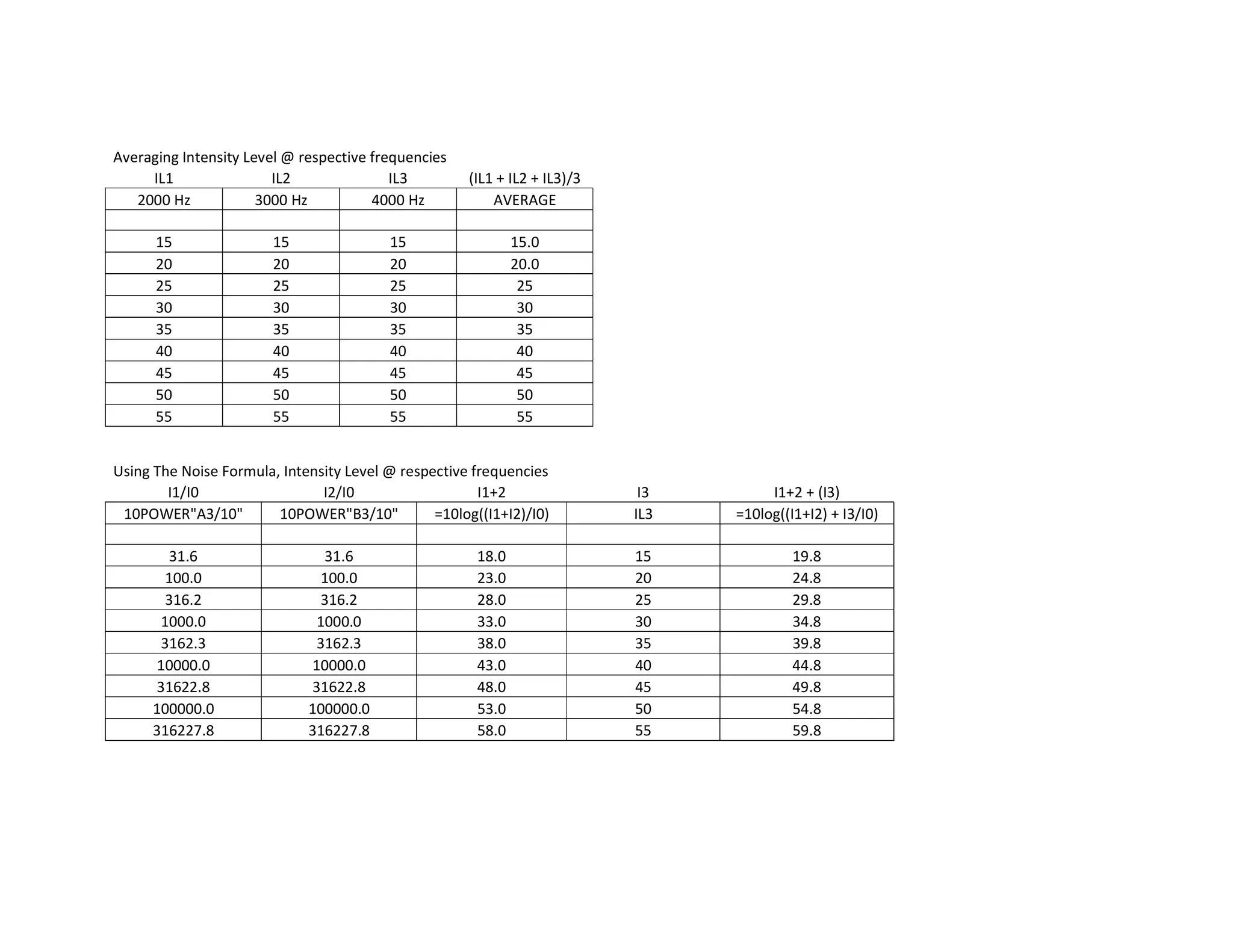
Averaging Intensity Level @ respective frequencies
IL1 IL2 IL3 (IL1 + IL2 + IL3)/3
2000 Hz 3000 Hz 4000 Hz AVERAGE
15 15 15 15.0
20 20 20 20.0
25 25 25 25
30 30 30 30
35 35 35 35
40 40 40 40
45 45 45 45
50 50 50 50
55 55 55 55
Using The Noise Formula, Intensity Level @ respective frequencies
I1/I0 I2/I0 I1+2 I3 I1+2 + (I3)
10POWER"A3/10" 10POWER"B3/10" =10log((I1+I2)/I0) IL3 =10log((I1+I2) + I3/I0)
31.6 31.6 18.0 15 19.8
100.0 100.0 23.0 20 24.8
316.2 316.2 28.0 25 29.8
1000.0 1000.0 33.0 30 34.8
3162.3 3162.3 38.0 35 39.8
10000.0 10000.0 43.0 40 44.8
31622.8 31622.8 48.0 45 49.8
100000.0 100000.0 53.0 50 54.8
316227.8 316227.8 58.0 55 59.8
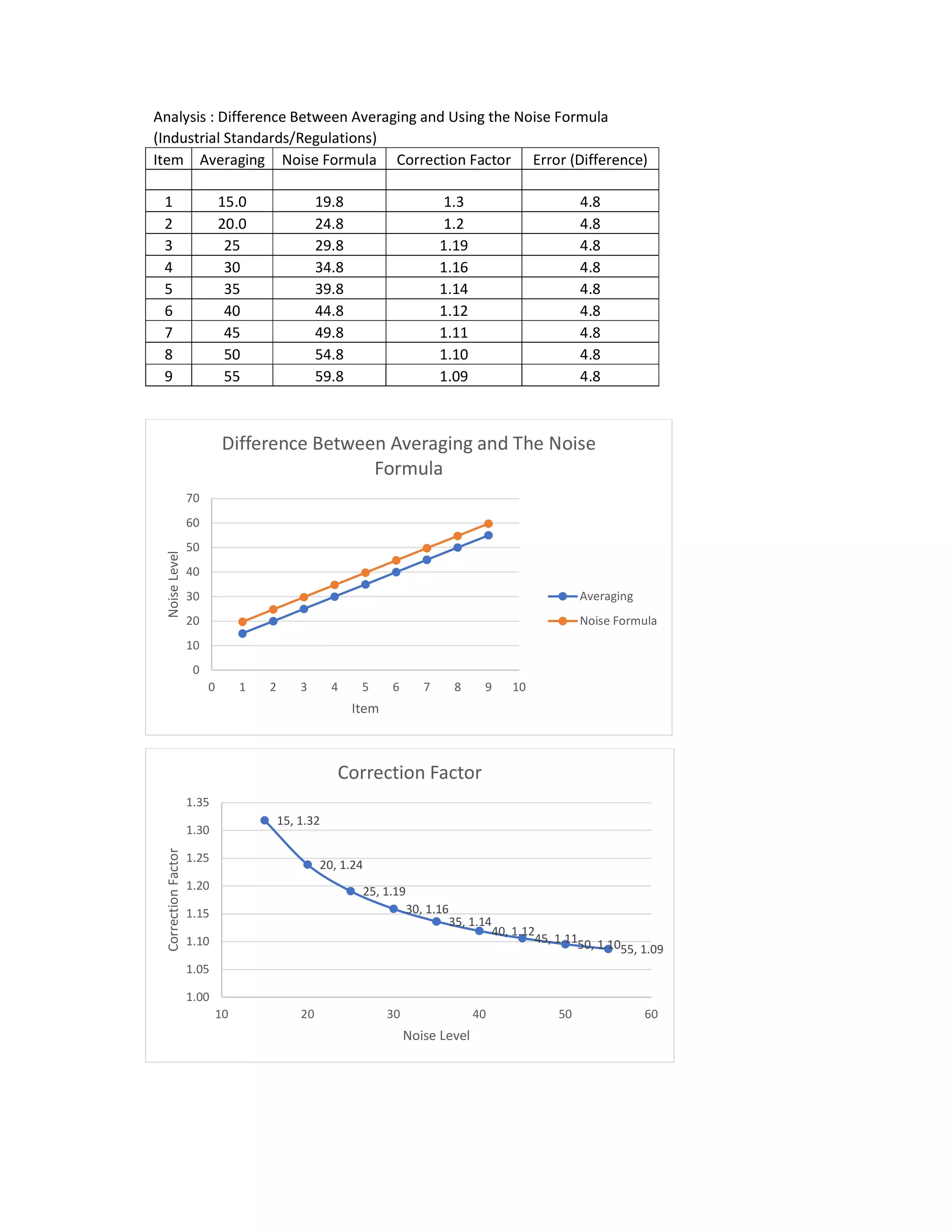
Analysis : Difference Between Averaging and Using the Noise Formula
(Industrial Standards/Regulations)
Item Averaging Noise Formula Correction Factor Error (Difference)
1 15.0 19.8 1.3 4.8
2 20.0 24.8 1.2 4.8
3 25 29.8 1.19 4.8
4 30 34.8 1.16 4.8
5 35 39.8 1.14 4.8
6 40 44.8 1.12 4.8
7 45 49.8 1.11 4.8
8 50 54.8 1.10 4.8
9 55 59.8 1.09 4.8
0
10
20
30
40
50
60
70
0 1 2 3 4 5 6 7 8 9 10
Noise
Level
Item
Difference Between Averaging and The Noise
Formula
Averaging
Noise Formula
15, 1.32
20, 1.24
25, 1.19
30, 1.16
35, 1.14
40, 1.12
45, 1.1150, 1.1055, 1.09
1.00
1.05
1.10
1.15
1.20
1.25
1.30
1.35
10 20 30 40 50 60
Correction
Factor
Noise Level
Correction Factor

Noise Error Calculation : Averaging and Industrial Standards (Formula)

  • 1.
    Noise Error Calculation,Difference Between Taking Average and The Noise Formula Gan Chun Chet (MSc, BEng, P. Eng) Averaging the noise source in a quick way shall requires a correction to be “added-in” or “multiplied by a factor” to obtain a predicted or simulated value based on industrial noise calculations. The approach of average the noise source provides an indicative value for quick diagnostics. In addition, a rough approximation, which in real situation, is less than the calculated value can be quickly referred to as averaging the noise source herein this paper states. However, for more accurate reading, a derivation of industrial noise calculation is as shown below; this is noted as noise erroring calculation, difference between the average noise source and the calculated noise based on industrial standards/regulations. Table 1 : Sound Intensity Level IL at respective frequencies IL1 IL2 IL3 (IL1 + IL2 + IL3)/3 2000 Hz 3000 Hz 4000 Hz AVERAGE As for industrial standards/regulations, the Sound Intensity Level IL is calculated based on; IL = 10 log( ) [dB] ; 𝐼 = 10 𝑊/ 𝑚 𝐼𝐿 = 10 log ( ) = 10 log ( 10 ( )/ + 10 / ) where 𝐼𝐿 = 10 log ( ) , = + = 10 / + 10 /
  • 2.
    Averaging Intensity Level@ respective frequencies IL1 IL2 IL3 (IL1 + IL2 + IL3)/3 2000 Hz 3000 Hz 4000 Hz AVERAGE 15 15 15 15.0 20 20 20 20.0 25 25 25 25 30 30 30 30 35 35 35 35 40 40 40 40 45 45 45 45 50 50 50 50 55 55 55 55 Using The Noise Formula, Intensity Level @ respective frequencies I1/I0 I2/I0 I1+2 I3 I1+2 + (I3) 10POWER"A3/10" 10POWER"B3/10" =10log((I1+I2)/I0) IL3 =10log((I1+I2) + I3/I0) 31.6 31.6 18.0 15 19.8 100.0 100.0 23.0 20 24.8 316.2 316.2 28.0 25 29.8 1000.0 1000.0 33.0 30 34.8 3162.3 3162.3 38.0 35 39.8 10000.0 10000.0 43.0 40 44.8 31622.8 31622.8 48.0 45 49.8 100000.0 100000.0 53.0 50 54.8 316227.8 316227.8 58.0 55 59.8
  • 3.
    Analysis : DifferenceBetween Averaging and Using the Noise Formula (Industrial Standards/Regulations) Item Averaging Noise Formula Correction Factor Error (Difference) 1 15.0 19.8 1.3 4.8 2 20.0 24.8 1.2 4.8 3 25 29.8 1.19 4.8 4 30 34.8 1.16 4.8 5 35 39.8 1.14 4.8 6 40 44.8 1.12 4.8 7 45 49.8 1.11 4.8 8 50 54.8 1.10 4.8 9 55 59.8 1.09 4.8 0 10 20 30 40 50 60 70 0 1 2 3 4 5 6 7 8 9 10 Noise Level Item Difference Between Averaging and The Noise Formula Averaging Noise Formula 15, 1.32 20, 1.24 25, 1.19 30, 1.16 35, 1.14 40, 1.12 45, 1.1150, 1.1055, 1.09 1.00 1.05 1.10 1.15 1.20 1.25 1.30 1.35 10 20 30 40 50 60 Correction Factor Noise Level Correction Factor