The Create Space Program


Sapient Santa Monica No Right Brain Left Behind Submission 02.12.11
OVERVIEW


There exist enough teachers and methods to solve
the creativity crisis. What’s missing? Space – in the
curriculum and for support.

So let’s create space – open up the curriculum
and testing system a little for creative learning,
open an agency to support it.

A little space could lead to big changes.
DESCRIPTION


Overloaded teachers. Tightly-packed, strictly-mandated curriculums. Restrictive
testing-based methodologies. Lack of support and resources for creativity-oriented
learning. These are the roots of the creativity crisis.


But there is a way to get more creativity into classroom – and do it without radically
deforming or destroying the system. All it takes is a little space.


The “Create Space” program combines two simple approaches into the first steps
toward offering students more creative learning experiences: open up space in the
current system, then offer teachers support in filling it.


“Create Space” can be implemented nearly immediately. It doesn’t break with current
systems, it encourages participation without making it mandatory or detrimental to
opt in or out. And it brings forward philosophies and methods already in existence,
ready to be used.
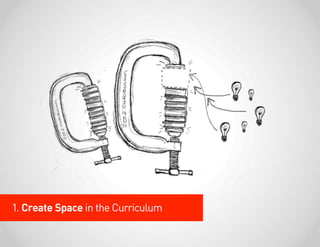
1. Create Space in the Curriculum
CREATE SPACE IN THE CURRICULUM


Open up the curriculum and testing system for creative learning. Offer up to four
weeks of “Creative Flex Time” annually for teachers to supplement their curriculum
with creative teaching on an ongoing basis, or to undertake independent exercises.


As this “space” replaces regular curriculum time, participating students receive an
additional grade-weighting factor to their final standardized test scores to mitigate
the “loss” of standardized test-oriented learning time. This is based on how much
Flex Time the students participate in, offering positive impact on their scores,
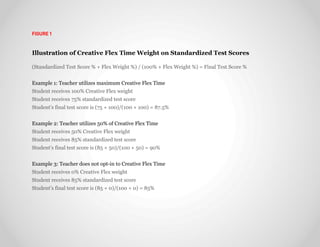
without affecting students who don’t participate (See fig. 1).


Teachers decide what to do with this “Creative Space,” but they’re supported,
overseen and administered by a dedicated, centralized resource…
2. The Create Space Agency
THE CREATE SPACE AGENCY


Establish a Creative Learning Agency (within the Department of Education)
as a resource and oversight center for the “Space Program, with these objectives:

a) Act as “open source” curator with input from teachers, students, academics and
experts to collect, evaluate, distribute and advise on implementing creative
learning methods.

b) Oversee Flex Time participation to ensure quality and responsibility.

c) Stimulate awareness of the “Space Program” to the public, educators, and
corporate supporters.

d) Pursue financial support from corporate and business contributions; offer
“incubation program” where selected students thinking can be applied to
contributor’s needs.
DESCRIPTION


Pilot Program: Prove the Value

Creative learning is obviously controversial, especially within established systems
where testing is a priority, so to facilitate the “Create Space” Program’s acceptance
and funding a study should be undertaken with the hypothesis
that students who participate will show a growth in creative thinking skills.


The study can give students Divergent Thinking tests before and after
participating, as well as giving Divergent Thinking tests to a non-participating (but
otherwise similar) set of students.
DESCRIPTION


Big Things Always Start Small

Big changes can occur when something small creates the ripple. This program
is purposefully modest so as to be acceptable, implementable, and expandable:

   It doesn’t replace, but works with the existing system
   It doesn’t penalize anyone for participating or not
   It regulates and evolves itself
   It builds support and awareness of itself
Create Space. It’s one first small step for the
system, but one giant leap for creative thinking.
FIGURE 1


Illustration of Creative Flex Time Weight on Standardized Test Scores

(Standardized Test Score % + Flex Weight %) / (100% + Flex Weight %) = Final Test Score %


Example 1: Teacher utilizes maximum Creative Flex Time
Student receives 100% Creative Flex weight
Student receives 75% standardized test score
Student’s final test score is (75 + 100)/(100 + 100) = 87.5%


Example 2: Teacher utilizes 50% of Creative Flex Time
Student receives 50% Creative Flex weight
Student receives 85% standardized test score
Student’s final test score is (85 + 50)/(100 + 50) = 90%


Example 3: Teacher does not opt-in to Creative Flex Time
Student receives 0% Creative Flex weight
Student receives 85% standardized test score
Student’s final test score is (85 + 0)/(100 + 0) = 85%
Thank You.

No Right Brain Left Behind: The Create Space Program

  • 1.
    The Create SpaceProgram Sapient Santa Monica No Right Brain Left Behind Submission 02.12.11
  • 2.
    OVERVIEW There exist enoughteachers and methods to solve the creativity crisis. What’s missing? Space – in the curriculum and for support. So let’s create space – open up the curriculum and testing system a little for creative learning, open an agency to support it. A little space could lead to big changes.
  • 3.
    DESCRIPTION Overloaded teachers. Tightly-packed,strictly-mandated curriculums. Restrictive testing-based methodologies. Lack of support and resources for creativity-oriented learning. These are the roots of the creativity crisis. But there is a way to get more creativity into classroom – and do it without radically deforming or destroying the system. All it takes is a little space. The “Create Space” program combines two simple approaches into the first steps toward offering students more creative learning experiences: open up space in the current system, then offer teachers support in filling it. “Create Space” can be implemented nearly immediately. It doesn’t break with current systems, it encourages participation without making it mandatory or detrimental to opt in or out. And it brings forward philosophies and methods already in existence, ready to be used.
  • 4.
    1. Create Spacein the Curriculum
  • 5.
    CREATE SPACE INTHE CURRICULUM Open up the curriculum and testing system for creative learning. Offer up to four weeks of “Creative Flex Time” annually for teachers to supplement their curriculum with creative teaching on an ongoing basis, or to undertake independent exercises. As this “space” replaces regular curriculum time, participating students receive an additional grade-weighting factor to their final standardized test scores to mitigate the “loss” of standardized test-oriented learning time. This is based on how much Flex Time the students participate in, offering positive impact on their scores, without affecting students who don’t participate (See fig. 1). Teachers decide what to do with this “Creative Space,” but they’re supported, overseen and administered by a dedicated, centralized resource…
  • 6.
    2. The CreateSpace Agency
  • 7.
    THE CREATE SPACEAGENCY Establish a Creative Learning Agency (within the Department of Education) as a resource and oversight center for the “Space Program, with these objectives: a) Act as “open source” curator with input from teachers, students, academics and experts to collect, evaluate, distribute and advise on implementing creative learning methods. b) Oversee Flex Time participation to ensure quality and responsibility. c) Stimulate awareness of the “Space Program” to the public, educators, and corporate supporters. d) Pursue financial support from corporate and business contributions; offer “incubation program” where selected students thinking can be applied to contributor’s needs.
  • 8.
    DESCRIPTION Pilot Program: Provethe Value Creative learning is obviously controversial, especially within established systems where testing is a priority, so to facilitate the “Create Space” Program’s acceptance and funding a study should be undertaken with the hypothesis that students who participate will show a growth in creative thinking skills. The study can give students Divergent Thinking tests before and after participating, as well as giving Divergent Thinking tests to a non-participating (but otherwise similar) set of students.
  • 9.
    DESCRIPTION Big Things AlwaysStart Small Big changes can occur when something small creates the ripple. This program is purposefully modest so as to be acceptable, implementable, and expandable:   It doesn’t replace, but works with the existing system   It doesn’t penalize anyone for participating or not   It regulates and evolves itself   It builds support and awareness of itself
  • 10.
    Create Space. It’sone first small step for the system, but one giant leap for creative thinking.
  • 11.
    FIGURE 1 Illustration ofCreative Flex Time Weight on Standardized Test Scores (Standardized Test Score % + Flex Weight %) / (100% + Flex Weight %) = Final Test Score % Example 1: Teacher utilizes maximum Creative Flex Time Student receives 100% Creative Flex weight Student receives 75% standardized test score Student’s final test score is (75 + 100)/(100 + 100) = 87.5% Example 2: Teacher utilizes 50% of Creative Flex Time Student receives 50% Creative Flex weight Student receives 85% standardized test score Student’s final test score is (85 + 50)/(100 + 50) = 90% Example 3: Teacher does not opt-in to Creative Flex Time Student receives 0% Creative Flex weight Student receives 85% standardized test score Student’s final test score is (85 + 0)/(100 + 0) = 85%
  • 12.