Natural Language Processing(NLP)
• It is a branch of artificial intelligence that deals with the
interaction between computers and humans using the natural
language. The ultimate objective of NLP is to read, decipher,
understand, and make sense of the human languages in a manner
that is valuable.
• Natural Language Processing is the technology used to aid
computers to understand the human’s natural language.
• It’s not an easy task teaching machines to understand how we
communicate.
Cont.
In fact, a typical interaction between humans and
machines using Natural Language Processing
could go as follows:
1. A human talks to the machine
2. The machine captures the audio
3. Audio to text conversion takes place
4. Processing of the text’s data
5. Data to audio conversion takes place
6. The machine responds to the human by playing
the audio file
Applications
• Language translation applications such as Google Translate
• Word Processors such as Microsoft Word and Grammarly that
employ NLP to check grammatical accuracy of texts.
• Interactive Voice Response (IVR) applications used in call centers to
respond to certain users’ requests.
• Personal assistant applications such as OK Google, Siri, and Alexa.
1. Speech Recognition
2. Sentimental analysis
3. Machine Translation
4. Chat bots etc
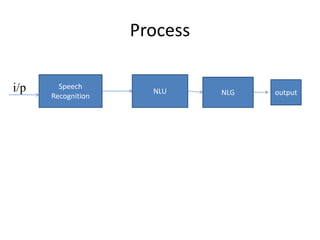
Process
i/p Speech
Recognition
NLU NLG output
1. Autimatic Speech Recognition( Speech to
text)
2. NLU-Challenges
• Lexical Ambiguity- (token wise)
Example-The tank was full of water
• Syntactic ambiguity (structure)
Example- Old men and (old) women were taken to safe
place
• Semantic-Meaning
Example – The car hit the pole while it was moving
• Pragmatic – cotext o phrase gives multiple
interpretation
Example-The police are coming
Natural Language Generation
• What we say to user
• It should be intelligent and conversational
• Deals with structural data
• Text/ sentence planning
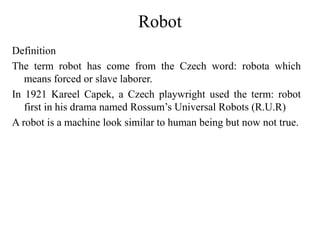
Robot
Definition
The term robot has come from the Czech word: robota which
means forced or slave laborer.
In 1921 Kareel Capek, a Czech playwright used the term: robot
first in his drama named Rossum’s Universal Robots (R.U.R)
A robot is a machine look similar to human being but now not true.
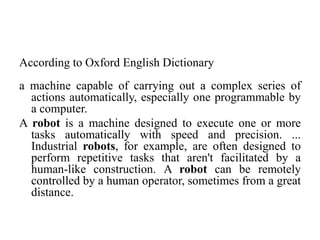
According to Oxford English Dictionary
a machine capable of carrying out a complex series of
actions automatically, especially one programmable by
a computer.
A robot is a machine designed to execute one or more
tasks automatically with speed and precision. ...
Industrial robots, for example, are often designed to
perform repetitive tasks that aren't facilitated by a
human-like construction. A robot can be remotely
controlled by a human operator, sometimes from a great
distance.
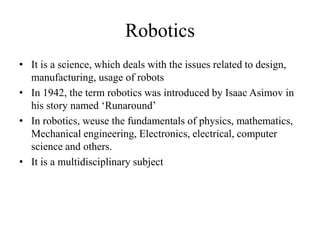
Robotics
• It is a science, which deals with the issues related to design,
manufacturing, usage of robots
• In 1942, the term robotics was introduced by Isaac Asimov in
his story named ‘Runaround’
• In robotics, weuse the fundamentals of physics, mathematics,
Mechanical engineering, Electronics, electrical, computer
science and others.
• It is a multidisciplinary subject
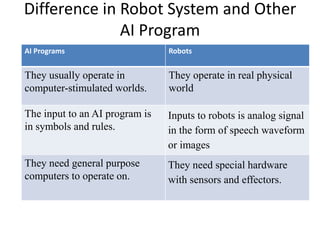
Difference in Robot System and Other
AI Program
AI Programs Robots
They usually operate in
computer-stimulated worlds.
They operate in real physical
world
The input to an AI program is
in symbols and rules.
Inputs to robots is analog signal
in the form of speech waveform
or images
They need general purpose
computers to operate on.
They need special hardware
with sensors and effectors.
Motivation
• To cope with increasing demands of a dynamic and
competitive market, modern manufacturing method should
satisfy the following requirements:
• Reduced production cost
• Increased productivity
• Improved product quality(Automation)
Components
Robots are constructed with the following −
• Power Supply − The robots are powered by batteries, solar
power, hydraulic, or pneumatic power sources.
• Actuators − They convert energy into movement.
• Electric motors (AC/DC) − They are required for rotational
movement.
• Pneumatic Air Muscles − They contract almost 40% when air
is sucked in them.
• Muscle Wires − They contract by 5% when electric
current is passed through them.
• Piezo Motors and Ultrasonic Motors − Best for
industrial robots.
• Sensors − They provide knowledge of real time
information on the task environment. Robots are equipped
with vision sensors to be to compute the depth in the
environment. A tactile sensor imitates the mechanical
properties of touch receptors of human fingertips
Applications
• Industries − Robots are used for handling material,
cutting, welding, color coating, drilling, polishing, etc.
• Military − Autonomous robots can reach inaccessible and
hazardous zones during war. A robot named Daksh,
developed by Defense Research and Development
Organization (DRDO), is in function to destroy life-
threatening objects safely.
• Medicine − The robots are capable of carrying out
hundreds of clinical tests simultaneously, rehabilitating
permanently disabled people, and performing complex
surgeries such as brain tumors.
•
• Exploration − The robot rock climbers used for space
exploration, underwater drones used for ocean exploration are
to name a few.
• Entertainment − Disney’s engineers have created hundreds of
robots for movie making.
Expert System
• The expert systems are the computer applications developed to
solve complex problems in a particular domain, at the level of
extra-ordinary human intelligence and expertise.
Characteristics of Expert Systems
• High performance
• Understandable
• Reliable
• Highly responsive
Capabilities of Expert Systems
The expert systems are capable of −
• Advising
• Instructing and assisting human in decision making
• Demonstrating
• Deriving a solution
• Diagnosing
• Explaining
• Interpreting input
• Predicting results
• Justifying the conclusion
• Suggesting alternative options to a problem
They are incapable of −
• Substituting human decision makers
• Possessing human capabilities
• Producing accurate output for inadequate
knowledge base
• Refining their own knowledge
Components of Expert Systems
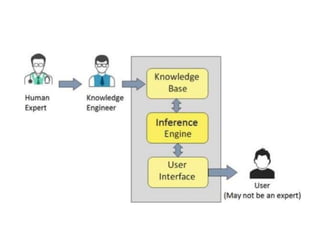
The components of ES include −
• Knowledge Base
• Inference Engine
• User Interface
• Let us see them one by one briefly −
Knowledge Base
• It contains domain-specific and high-quality knowledge.
• Knowledge is required to exhibit intelligence. The success of
any ES majorly depends upon the collection of highly accurate
and precise knowledge.
What is Knowledge?
• The data is collection of facts. The information is organized as
data and facts about the task domain. Data,
information, and past experience combined together are
termed as knowledge.
Components of Knowledge Base
• The knowledge base of an ES is a store of both, factual
and heuristic knowledge.
• Factual Knowledge − It is the information widely
accepted by the Knowledge Engineers and scholars in the
task domain.
• Heuristic Knowledge − It is about practice, accurate
judgment, one’s ability of evaluation, and guessing.
Knowledge representation
• It is the method used to organize and formalize the
knowledge in the knowledge base. It is in the form of IF-
THEN-ELSE rules.
Knowledge Acquisition
• The success of any expert system majorly depends on the
quality, completeness, and accuracy of the information stored
in the knowledge base.
• The knowledge base is formed by readings from various
experts, scholars, and the Knowledge Engineers. The
knowledge engineer is a person with the qualities of empathy,
quick learning, and case analyzing skills.
• He acquires information from subject expert by recording,
interviewing, and observing him at work, etc. He then
categorizes and organizes the information in a meaningful
way, in the form of IF-THEN-ELSE rules, to be used by
interference machine. The knowledge engineer also monitors
the development of the ES.
Inference Engine
• Use of efficient procedures and rules by the Inference
Engine is essential in deducting a correct, flawless
solution.
• In case of knowledge-based ES, the Inference Engine
acquires and manipulates the knowledge from the
knowledge base to arrive at a particular solution.
In case of rule based ES, it −
• Applies rules repeatedly to the facts, which are obtained
from earlier rule application.
• Adds new knowledge into the knowledge base if required.
• Resolves rules conflict when multiple rules are applicable
to a particular case.
• To recommend a solution, the Inference Engine uses the
following strategies −
• Forward Chaining
• Backward Chaining
Forward Chaining
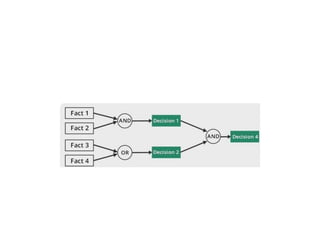
• It is a strategy of an expert system to answer the
question, “What can happen next?”
• Here, the Inference Engine follows the chain of conditions and
derivations and finally deduces the outcome. It considers all
the facts and rules, and sorts them before concluding to a
solution.
• This strategy is followed for working on conclusion, result, or
effect. For example, prediction of share market status as an
effect of changes in interest rates
Backward Chaining
• With this strategy, an expert system finds out the answer to the
question, “Why this happened?”
• On the basis of what has already happened, the Inference
Engine tries to find out which conditions could have happened
in the past for this result. This strategy is followed for finding
out cause or reason. For example, diagnosis of blood cancer in
humans.
User Interface
User interface provides interaction between user of the ES and
the ES itself. It is generally Natural Language Processing so as
to be used by the user who is well-versed in the task domain.
The user of the ES need not be necessarily an expert in
Artificial Intelligence.
It explains how the ES has arrived at a particular
recommendation. The explanation may appear in the following
forms −
• Natural language displayed on screen.
• Verbal narrations in natural language.
• Listing of rule numbers displayed on the screen.
The user interface makes it easy to trace the credibility of the
deductions.
Requirements of Efficient ES User
Interface
• It should help users to accomplish their goals in shortest
possible way.
• It should be designed to work for user’s existing or desired
work practices.
• Its technology should be adaptable to user’s requirements; not
the other way round.
• It should make efficient use of user input.
Expert Systems Limitations
No technology can offer easy and complete solution. Large systems
are costly, require significant development time, and computer
resources. ESs have their limitations which include −
• Limitations of the technology
• Difficult knowledge acquisition
• ES are difficult to maintain
• High development costs
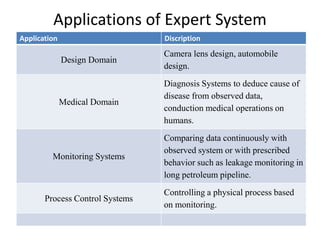
Applications of Expert System
Application Discription
Design Domain
Camera lens design, automobile
design.
Medical Domain
Diagnosis Systems to deduce cause of
disease from observed data,
conduction medical operations on
humans.
Monitoring Systems
Comparing data continuously with
observed system or with prescribed
behavior such as leakage monitoring in
long petroleum pipeline.
Process Control Systems
Controlling a physical process based
on monitoring.
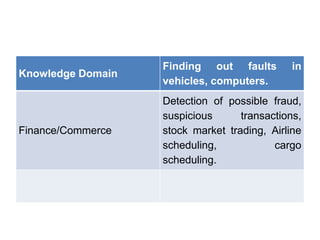
Knowledge Domain
Finding out faults in
vehicles, computers.
Finance/Commerce
Detection of possible fraud,
suspicious transactions,
stock market trading, Airline
scheduling, cargo
scheduling.
Development of Expert Systems:
General Steps
Iterative steps in developing the ES include −
1. Identify Problem Domain
• The problem must be suitable for an expert system to solve it.
• Find the experts in task domain for the ES project.
• Establish cost-effectiveness of the system.
2. Design the System
• Identify the ES Technology
• Know and establish the degree of integration with the other
systems and databases.
• Realize how the concepts can represent the domain knowledge
best.
3. Develop the Prototype
• From Knowledge Base: The knowledge engineer works to
−
• Acquire domain knowledge from the expert.
• Represent it in the form of If-THEN-ELSE rules.
4. Test and Refine the Prototype
• The knowledge engineer uses sample cases to test the
prototype for any deficiencies in performance.
• End users test the prototypes of the ES.
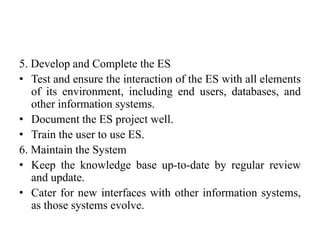
5. Develop and Complete the ES
• Test and ensure the interaction of the ES with all elements
of its environment, including end users, databases, and
other information systems.
• Document the ES project well.
• Train the user to use ES.
6. Maintain the System
• Keep the knowledge base up-to-date by regular review
and update.
• Cater for new interfaces with other information systems,
as those systems evolve.
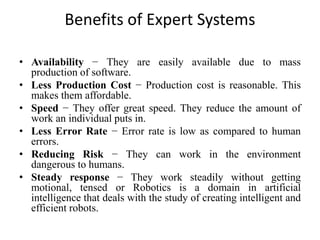
Benefits of Expert Systems
• Availability − They are easily available due to mass
production of software.
• Less Production Cost − Production cost is reasonable. This
makes them affordable.
• Speed − They offer great speed. They reduce the amount of
work an individual puts in.
• Less Error Rate − Error rate is low as compared to human
errors.
• Reducing Risk − They can work in the environment
dangerous to humans.
• Steady response − They work steadily without getting
motional, tensed or Robotics is a domain in artificial
intelligence that deals with the study of creating intelligent and
efficient robots.
Nlp, robotics and expert system

Nlp, robotics and expert system

  • 1.
    Natural Language Processing(NLP) •It is a branch of artificial intelligence that deals with the interaction between computers and humans using the natural language. The ultimate objective of NLP is to read, decipher, understand, and make sense of the human languages in a manner that is valuable. • Natural Language Processing is the technology used to aid computers to understand the human’s natural language. • It’s not an easy task teaching machines to understand how we communicate.
  • 2.
    Cont. In fact, atypical interaction between humans and machines using Natural Language Processing could go as follows: 1. A human talks to the machine 2. The machine captures the audio 3. Audio to text conversion takes place 4. Processing of the text’s data 5. Data to audio conversion takes place 6. The machine responds to the human by playing the audio file
  • 3.
    Applications • Language translationapplications such as Google Translate • Word Processors such as Microsoft Word and Grammarly that employ NLP to check grammatical accuracy of texts. • Interactive Voice Response (IVR) applications used in call centers to respond to certain users’ requests. • Personal assistant applications such as OK Google, Siri, and Alexa. 1. Speech Recognition 2. Sentimental analysis 3. Machine Translation 4. Chat bots etc
  • 4.
  • 5.
    1. Autimatic SpeechRecognition( Speech to text) 2. NLU-Challenges • Lexical Ambiguity- (token wise) Example-The tank was full of water
  • 6.
    • Syntactic ambiguity(structure) Example- Old men and (old) women were taken to safe place • Semantic-Meaning Example – The car hit the pole while it was moving • Pragmatic – cotext o phrase gives multiple interpretation Example-The police are coming
  • 7.
    Natural Language Generation •What we say to user • It should be intelligent and conversational • Deals with structural data • Text/ sentence planning
  • 8.
    Robot Definition The term robothas come from the Czech word: robota which means forced or slave laborer. In 1921 Kareel Capek, a Czech playwright used the term: robot first in his drama named Rossum’s Universal Robots (R.U.R) A robot is a machine look similar to human being but now not true.
  • 9.
    According to OxfordEnglish Dictionary a machine capable of carrying out a complex series of actions automatically, especially one programmable by a computer. A robot is a machine designed to execute one or more tasks automatically with speed and precision. ... Industrial robots, for example, are often designed to perform repetitive tasks that aren't facilitated by a human-like construction. A robot can be remotely controlled by a human operator, sometimes from a great distance.
  • 10.
    Robotics • It isa science, which deals with the issues related to design, manufacturing, usage of robots • In 1942, the term robotics was introduced by Isaac Asimov in his story named ‘Runaround’ • In robotics, weuse the fundamentals of physics, mathematics, Mechanical engineering, Electronics, electrical, computer science and others. • It is a multidisciplinary subject
  • 11.
    Difference in RobotSystem and Other AI Program AI Programs Robots They usually operate in computer-stimulated worlds. They operate in real physical world The input to an AI program is in symbols and rules. Inputs to robots is analog signal in the form of speech waveform or images They need general purpose computers to operate on. They need special hardware with sensors and effectors.
  • 12.
    Motivation • To copewith increasing demands of a dynamic and competitive market, modern manufacturing method should satisfy the following requirements: • Reduced production cost • Increased productivity • Improved product quality(Automation)
  • 13.
    Components Robots are constructedwith the following − • Power Supply − The robots are powered by batteries, solar power, hydraulic, or pneumatic power sources. • Actuators − They convert energy into movement. • Electric motors (AC/DC) − They are required for rotational movement. • Pneumatic Air Muscles − They contract almost 40% when air is sucked in them.
  • 14.
    • Muscle Wires− They contract by 5% when electric current is passed through them. • Piezo Motors and Ultrasonic Motors − Best for industrial robots. • Sensors − They provide knowledge of real time information on the task environment. Robots are equipped with vision sensors to be to compute the depth in the environment. A tactile sensor imitates the mechanical properties of touch receptors of human fingertips
  • 15.
    Applications • Industries −Robots are used for handling material, cutting, welding, color coating, drilling, polishing, etc. • Military − Autonomous robots can reach inaccessible and hazardous zones during war. A robot named Daksh, developed by Defense Research and Development Organization (DRDO), is in function to destroy life- threatening objects safely. • Medicine − The robots are capable of carrying out hundreds of clinical tests simultaneously, rehabilitating permanently disabled people, and performing complex surgeries such as brain tumors. •
  • 16.
    • Exploration −The robot rock climbers used for space exploration, underwater drones used for ocean exploration are to name a few. • Entertainment − Disney’s engineers have created hundreds of robots for movie making.
  • 17.
    Expert System • Theexpert systems are the computer applications developed to solve complex problems in a particular domain, at the level of extra-ordinary human intelligence and expertise. Characteristics of Expert Systems • High performance • Understandable • Reliable • Highly responsive
  • 18.
    Capabilities of ExpertSystems The expert systems are capable of − • Advising • Instructing and assisting human in decision making • Demonstrating • Deriving a solution • Diagnosing • Explaining • Interpreting input • Predicting results • Justifying the conclusion • Suggesting alternative options to a problem
  • 19.
    They are incapableof − • Substituting human decision makers • Possessing human capabilities • Producing accurate output for inadequate knowledge base • Refining their own knowledge
  • 20.
    Components of ExpertSystems The components of ES include − • Knowledge Base • Inference Engine • User Interface • Let us see them one by one briefly −
  • 22.
    Knowledge Base • Itcontains domain-specific and high-quality knowledge. • Knowledge is required to exhibit intelligence. The success of any ES majorly depends upon the collection of highly accurate and precise knowledge. What is Knowledge? • The data is collection of facts. The information is organized as data and facts about the task domain. Data, information, and past experience combined together are termed as knowledge.
  • 23.
    Components of KnowledgeBase • The knowledge base of an ES is a store of both, factual and heuristic knowledge. • Factual Knowledge − It is the information widely accepted by the Knowledge Engineers and scholars in the task domain. • Heuristic Knowledge − It is about practice, accurate judgment, one’s ability of evaluation, and guessing. Knowledge representation • It is the method used to organize and formalize the knowledge in the knowledge base. It is in the form of IF- THEN-ELSE rules.
  • 24.
    Knowledge Acquisition • Thesuccess of any expert system majorly depends on the quality, completeness, and accuracy of the information stored in the knowledge base. • The knowledge base is formed by readings from various experts, scholars, and the Knowledge Engineers. The knowledge engineer is a person with the qualities of empathy, quick learning, and case analyzing skills. • He acquires information from subject expert by recording, interviewing, and observing him at work, etc. He then categorizes and organizes the information in a meaningful way, in the form of IF-THEN-ELSE rules, to be used by interference machine. The knowledge engineer also monitors the development of the ES.
  • 25.
    Inference Engine • Useof efficient procedures and rules by the Inference Engine is essential in deducting a correct, flawless solution. • In case of knowledge-based ES, the Inference Engine acquires and manipulates the knowledge from the knowledge base to arrive at a particular solution. In case of rule based ES, it − • Applies rules repeatedly to the facts, which are obtained from earlier rule application. • Adds new knowledge into the knowledge base if required. • Resolves rules conflict when multiple rules are applicable to a particular case.
  • 26.
    • To recommenda solution, the Inference Engine uses the following strategies − • Forward Chaining • Backward Chaining
  • 27.
    Forward Chaining • Itis a strategy of an expert system to answer the question, “What can happen next?” • Here, the Inference Engine follows the chain of conditions and derivations and finally deduces the outcome. It considers all the facts and rules, and sorts them before concluding to a solution. • This strategy is followed for working on conclusion, result, or effect. For example, prediction of share market status as an effect of changes in interest rates
  • 29.
    Backward Chaining • Withthis strategy, an expert system finds out the answer to the question, “Why this happened?” • On the basis of what has already happened, the Inference Engine tries to find out which conditions could have happened in the past for this result. This strategy is followed for finding out cause or reason. For example, diagnosis of blood cancer in humans.
  • 30.
    User Interface User interfaceprovides interaction between user of the ES and the ES itself. It is generally Natural Language Processing so as to be used by the user who is well-versed in the task domain. The user of the ES need not be necessarily an expert in Artificial Intelligence. It explains how the ES has arrived at a particular recommendation. The explanation may appear in the following forms − • Natural language displayed on screen. • Verbal narrations in natural language. • Listing of rule numbers displayed on the screen. The user interface makes it easy to trace the credibility of the deductions.
  • 31.
    Requirements of EfficientES User Interface • It should help users to accomplish their goals in shortest possible way. • It should be designed to work for user’s existing or desired work practices. • Its technology should be adaptable to user’s requirements; not the other way round. • It should make efficient use of user input.
  • 32.
    Expert Systems Limitations Notechnology can offer easy and complete solution. Large systems are costly, require significant development time, and computer resources. ESs have their limitations which include − • Limitations of the technology • Difficult knowledge acquisition • ES are difficult to maintain • High development costs
  • 33.
    Applications of ExpertSystem Application Discription Design Domain Camera lens design, automobile design. Medical Domain Diagnosis Systems to deduce cause of disease from observed data, conduction medical operations on humans. Monitoring Systems Comparing data continuously with observed system or with prescribed behavior such as leakage monitoring in long petroleum pipeline. Process Control Systems Controlling a physical process based on monitoring.
  • 34.
    Knowledge Domain Finding outfaults in vehicles, computers. Finance/Commerce Detection of possible fraud, suspicious transactions, stock market trading, Airline scheduling, cargo scheduling.
  • 35.
    Development of ExpertSystems: General Steps Iterative steps in developing the ES include − 1. Identify Problem Domain • The problem must be suitable for an expert system to solve it. • Find the experts in task domain for the ES project. • Establish cost-effectiveness of the system. 2. Design the System • Identify the ES Technology • Know and establish the degree of integration with the other systems and databases. • Realize how the concepts can represent the domain knowledge best.
  • 36.
    3. Develop thePrototype • From Knowledge Base: The knowledge engineer works to − • Acquire domain knowledge from the expert. • Represent it in the form of If-THEN-ELSE rules. 4. Test and Refine the Prototype • The knowledge engineer uses sample cases to test the prototype for any deficiencies in performance. • End users test the prototypes of the ES.
  • 37.
    5. Develop andComplete the ES • Test and ensure the interaction of the ES with all elements of its environment, including end users, databases, and other information systems. • Document the ES project well. • Train the user to use ES. 6. Maintain the System • Keep the knowledge base up-to-date by regular review and update. • Cater for new interfaces with other information systems, as those systems evolve.
  • 38.
    Benefits of ExpertSystems • Availability − They are easily available due to mass production of software. • Less Production Cost − Production cost is reasonable. This makes them affordable. • Speed − They offer great speed. They reduce the amount of work an individual puts in. • Less Error Rate − Error rate is low as compared to human errors. • Reducing Risk − They can work in the environment dangerous to humans. • Steady response − They work steadily without getting motional, tensed or Robotics is a domain in artificial intelligence that deals with the study of creating intelligent and efficient robots.