Dr. Jack Driscoll
      PID Analyzers, LLC
        Seoul,Korea 2010
          copyright 2000-2011 PID


PID Analyzers, LLC   8/13/2011
 In 1974, Dr. Jack Driscoll developed the first
  portable PID (> 25,000 sold worldwide)
 In 1976, Dr. Jack Driscoll developed the first PID
  for gas chromatography (> 15,000 sold)
 The IR100 award was won for the PID in 1978
 Dr Driscoll has published > 80 papers on
  photoionization
 Dr. Driscoll was awarded the Outstanding
  Achievement Award by the Northeastern Section
  of the ACS 2011 for developing the first hand
  held PID for industrial hygiene
                      PID Analyzers, LLC   8/13/2011
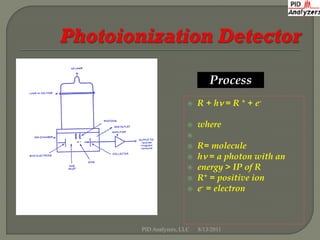
h


                         Process
                    R + h = R + + e -

                    where
                 
                    R= molecule
                    h = a photon with an
                    energy > IP of R
                    R+ = positive ion
                    e- = electron


PID Analyzers, LLC   8/13/2011
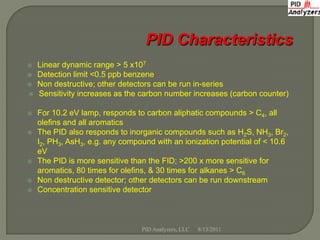
   Linear dynamic range > 5 x10⁷
   Detection limit <0.5 ppb benzene
   Non destructive; other detectors can be run in-series
   Sensitivity increases as the carbon number increases (carbon counter)

   For 10.2 eV lamp, responds to carbon aliphatic compounds > C4, all
    olefins and all aromatics
   The PID also responds to inorganic compounds such as H2S, NH3, Br2,
    I2, PH3, AsH3, e.g. any compound with an ionization potential of < 10.6
    eV
   The PID is more sensitive than the FID; >200 x more sensitive for
    aromatics, 80 times for olefins, & 30 times for alkanes > C6
   Non destructive detector; other detectors can be run downstream
   Concentration sensitive detector


                                 PID Analyzers, LLC   8/13/2011
 ppb Levels of VOC’s in Plant Atmospheres
 Process control of VOC’s
 ppb to ppt Levels of BTX in ambient air
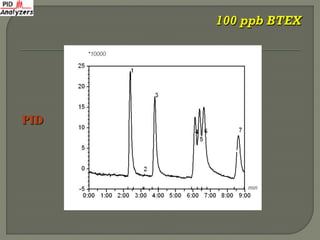
 ppb Levels of BTX in beverage grade CO2
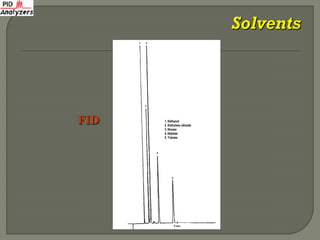
 Detection of VOCs under Texas Chapter 115
 Carbon bed breakthrough for toxic
  compounds at ppb levels
 ppb levels of S in process streams GC-
  FPD


                  PID Analyzers, LLC   8/13/2011
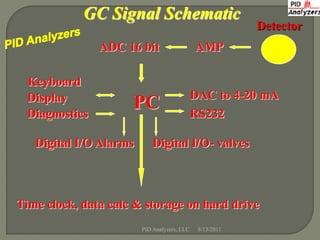
GC Signal Schematic
                                                          Detector
               ADC 16 bit                    AMP

 Keyboard
 Display                                     DAC to 4-20 mA
 Diagnostics
                     PC                      RS232

   Digital I/O Alarms       Digital I/O- valves


Time clock, data calc & storage on hard drive
                        PID Analyzers, LLC    8/13/2011
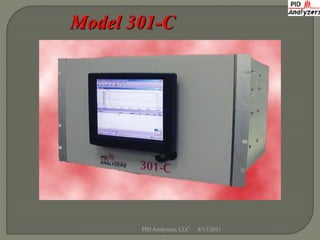
Model 301-C


                   mouse


                USB Port


       PID Analyzers, LLC   8/13/2011
PID Analyzers, LLC   8/13/2011
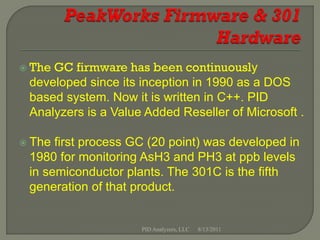
 TheGC firmware has been continuously
 developed since its inception in 1990 as a DOS
 based system. Now it is written in C++. PID
 Analyzers is a Value Added Reseller of Microsoft .

 The first process GC (20 point) was developed in
 1980 for monitoring AsH3 and PH3 at ppb levels
 in semiconductor plants. The 301C is the fifth
 generation of that product.


                     PID Analyzers, LLC   8/13/2011
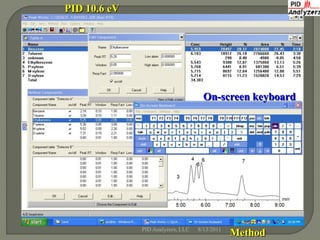
PID 10.6 eV


                                     On-screen keyboard


              PID Analyzers, LLC   8/13/2011
                                               Method
PID Analyzers, LLC   8/13/2011
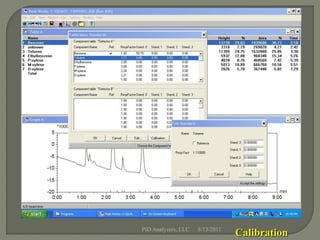
                                 Calibration
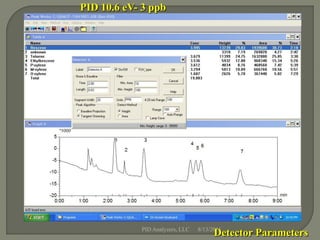
PID 10.6 eV- 3 ppb


            PID Analyzers, LLC   8/13/2011
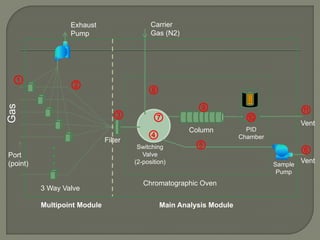
                                       Detector Parameters
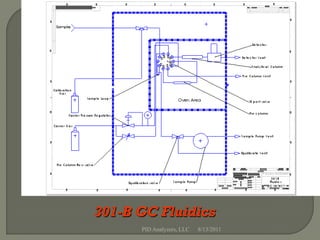
Exhaust                    Carrier
                  Pump                       Gas (N2)


  ①               ②                         ⑧
                                                          ⑨                               ⑪
Gas


                                 ③            ⑦                         ⑩                 Vent
                                            ④
                                                        Column           PID
                                                                       Chamber
                                                         ⑤
                              Filter

Port
                                        Switching
                                          Valve
                                                                                          ⑥
(point)                                (2-position)                              Sample
                                                                                          Vent
                                                                                  Pump
                                          Chromatographic Oven
          3 Way Valve

          Multipoint Module                     Main Analysis Module
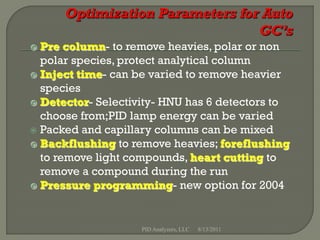
 Pre column- to remove heavies, polar or non
  polar species, protect analytical column
 Inject time- can be varied to remove heavier
  species
 Detector- Selectivity- HNU has 6 detectors to
  choose from;PID lamp energy can be varied
 Packed and capillary columns can be mixed
 Backflushing to remove heavies; foreflushing
  to remove light compounds, heart cutting to
  remove a compound during the run
 Pressure programming- new option for 2004


                    PID Analyzers, LLC   8/13/2011
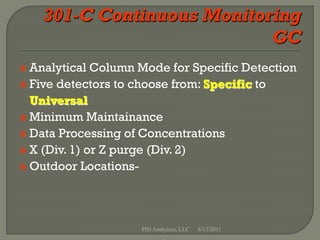
 Analytical  Column Mode for Specific Detection
 Five detectors to choose from: Specific to
  Universal
 Minimum Maintainance
 Data Processing of Concentrations
 X (Div. 1) or Z purge (Div. 2)
 Outdoor Locations-


                     PID Analyzers, LLC   8/13/2011
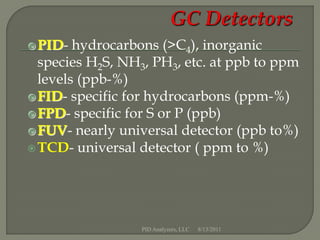
 PID-  hydrocarbons (>C4), inorganic
  species H2S, NH3, PH3, etc. at ppb to ppm
  levels (ppb-%)
 FID- specific for hydrocarbons (ppm-%)
 FPD- specific for S or P (ppb)
 FUV- nearly universal detector (ppb to%)
 TCD- universal detector ( ppm to %)


                  PID Analyzers, LLC   8/13/2011
 Photoionization     Detector
    • 1st commercial introduction in 1976 by HNU
      (Driscoll)- 50x more sensitive than FID for
      aromatics- low ppb
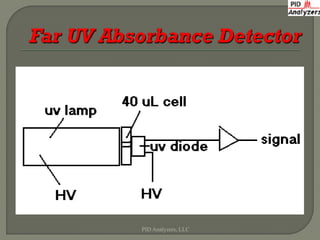
 Far   UV Absorbance Detector
    • 1st commercial introduction in 1985 by HNU
      (Driscoll)-low ppm sensitivity- nearly
      universal
 Flame    Ionization Detector
   1st commercial introduction in late 1950s-
    hydrocarbons- sub ppm

                         PID Analyzers, LLC   8/13/2011
 PID
  • Mechanical, chromatographic, electronic &
   software-results: improved detection limits
   from 2 ppb to < 0.5 ppb
 FUV
  • Electronic, chromatographic, & software-
   results: improved detetion limits from 1-2
   ppm to 25-100 ppb
 FID
  • Electronic, chromatographic, & software-
   results: from 100 ppb to 25-50 ppb


                      PID Analyzers, LLC   8/13/2011
PID Analyzers, LLC
 Measures   absorbance @ 124 nm-log
  signal
 Nearly Universal Response
 Linear (Log) Range > 105
 Low dead volume < 40 uL- fast response
 Non- destructive
 Environmental applications: freons, landfill
  gases, O2, CO2, CH4 at same detection limit
  as FID (0.1 ppm), VOCs


                    PID Analyzers, LLC   8/13/2011
h


PID Analyzers, LLC   8/13/2011
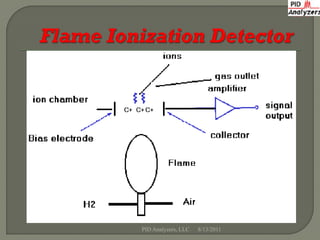
h


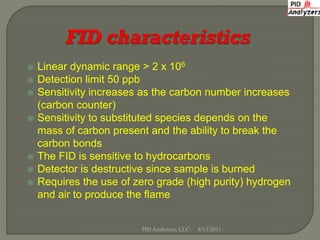
   Linear dynamic range > 2 x 10⁶
   Detection limit 50 ppb
   Sensitivity increases as the carbon number increases
    (carbon counter)
   Sensitivity to substituted species depends on the
    mass of carbon present and the ability to break the
    carbon bonds
   The FID is sensitive to hydrocarbons
   Detector is destructive since sample is burned
   Requires the use of zero grade (high purity) hydrogen
    and air to produce the flame


                         PID Analyzers, LLC   8/13/2011
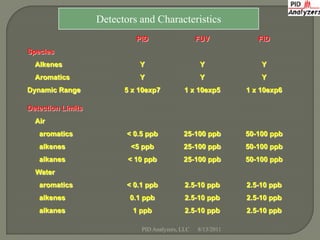
Detectors and Characteristics
                            PID                    FUV            FID
Species
  Alkenes                    Y                      Y              Y
  Aromatics                  Y                      Y              Y
Dynamic Range            5 x 10exp7           1 x 10exp5       1 x 10exp6

Detection Limits
  Air
   aromatics              < 0.5 ppb          25-100 ppb        50-100 ppb
   alkenes                 <5 ppb            25-100 ppb        50-100 ppb
   alkanes                < 10 ppb           25-100 ppb        50-100 ppb
  Water
   aromatics              < 0.1 ppb           2.5-10 ppb       2.5-10 ppb
   alkenes                0.1 ppb             2.5-10 ppb       2.5-10 ppb
   alkanes                 1 ppb              2.5-10 ppb       2.5-10 ppb

                              PID Analyzers, LLC   8/13/2011
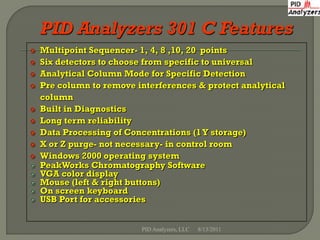
   Multipoint Sequencer- 1, 4, 8 ,10, 20 points
   Six detectors to choose from specific to universal
   Analytical Column Mode for Specific Detection
   Pre column to remove interferences & protect analytical
    column
   Built in Diagnostics
   Long term reliability
   Data Processing of Concentrations (1 Y storage)
   X or Z purge- not necessary- in control room
   Windows 2000 operating system
   PeakWorks Chromatography Software
   VGA color display
   Mouse (left & right buttons)
   On screen keyboard
   USB Port for accessories


                          PID Analyzers, LLC   8/13/2011
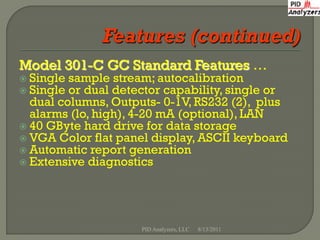
Model 301-C GC Standard Features …
 Single sample stream; autocalibration
 Single or dual detector capability, single or
  dual columns, Outputs- 0-1V, RS232 (2), plus
  alarms (lo, high), 4-20 mA (optional), LAN
 40 GByte hard drive for data storage
 VGA Color flat panel display, ASCII keyboard
 Automatic report generation
 Extensive diagnostics


                     PID Analyzers, LLC   8/13/2011
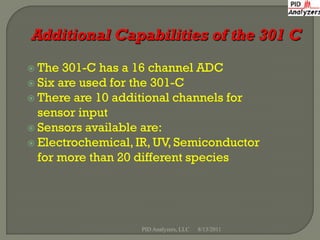
 The  301-C has a 16 channel ADC
 Six are used for the 301-C
 There are 10 additional channels for
  sensor input
 Sensors available are:
 Electrochemical, IR, UV, Semiconductor
  for more than 20 different species


                   PID Analyzers, LLC   8/13/2011
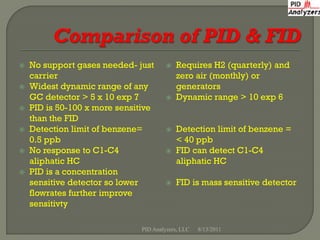
   No support gases needed- just          Requires H2 (quarterly) and
    carrier                                 zero air (monthly) or
   Widest dynamic range of any             generators
    GC detector > 5 x 10 exp 7             Dynamic range > 10 exp 6
   PID is 50-100 x more sensitive
    than the FID
   Detection limit of benzene=            Detection limit of benzene =
    0.5 ppb                                 < 40 ppb
   No response to C1-C4                   FID can detect C1-C4
    aliphatic HC                            aliphatic HC
   PID is a concentration
    sensitive detector so lower            FID is mass sensitive detector
    flowrates further improve
    sensitivty

                               PID Analyzers, LLC   8/13/2011
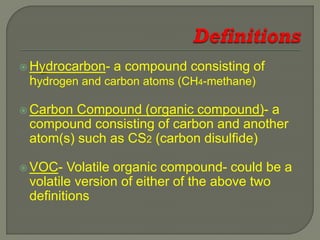
 Hydrocarbon-   a compound consisting of
 hydrogen and carbon atoms (CH4-methane)

 Carbon Compound (organic compound)- a
 compound consisting of carbon and another
 atom(s) such as CS2 (carbon disulfide)

 VOC-  Volatile organic compound- could be a
 volatile version of either of the above two
 definitions
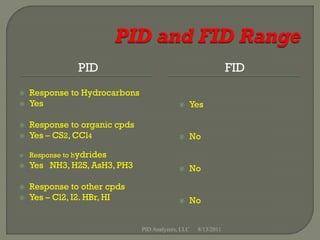
PID                                             FID
   Response to Hydrocarbons
   Yes                                         Yes

   Response to organic cpds
   Yes – CS2, CCl4                             No

   Response to hydrides
   Yes NH3, H2S, AsH3, PH3                     No

   Response to other cpds
   Yes – Cl2, I2. HBr, HI                      No


                               PID Analyzers, LLC   8/13/2011
PID Analyzers, LLC   8/13/2011
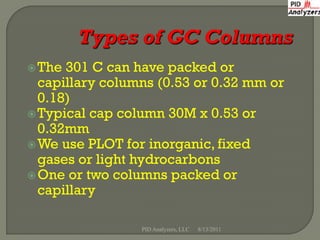
 The 301 C can have packed or
  capillary columns (0.53 or 0.32 mm or
  0.18)
 Typical cap column 30M x 0.53 or
  0.32mm
 We use PLOT for inorganic, fixed
  gases or light hydrocarbons
 One or two columns packed or
  capillary

                 PID Analyzers, LLC   8/13/2011
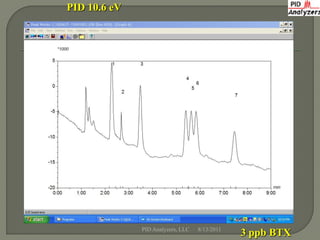
PID 10.6 eV


              PID Analyzers, LLC   8/13/2011
                                               3 ppb BTX
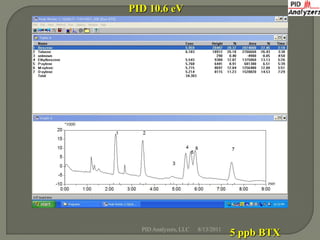
PID 10.6 eV


  PID Analyzers, LLC   8/13/2011
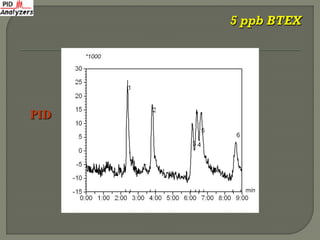
                                   5 ppb BTX
PID
PID
PID
PID
FID
PID
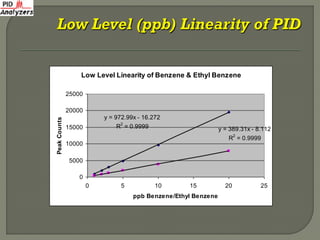
Low Level Linearity of Benzene & Ethyl Benzene

              25000

              20000
                          y = 972.99x - 16.272
Peak Counts


              15000            R2 = 0.9999                      y = 389.31x - 8.112
                                                                       2
                                                                   R = 0.9999
              10000

               5000

                  0
                      0         5           10      15            20           25
                                    ppb Benzene/Ethyl Benzene
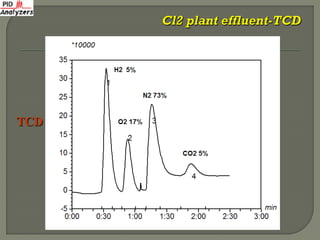
TCD
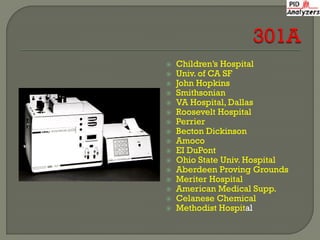
   Children’s Hospital
   Univ. of CA SF
   John Hopkins
   Smithsonian
   VA Hospital, Dallas
   Roosevelt Hospital
   Perrier
   Becton Dickinson
   Amoco
   EI DuPont
   Ohio State Univ. Hospital
   Aberdeen Proving Grounds
   Meriter Hospital
   American Medical Supp.
   Celanese Chemical
   Methodist Hospital
   EtO from sterilization chemical production
   Multicomponent monitoring of hazardous waste site
    fencelines
   H2S and mercaptans in air & stacks
   Silicone compounds in process streams
   Carbon breakthrough break detection of toxic gases
   ppb levels of chlorinated HC’s
   Fenceline monitoring from chemical & petrochemical
    plants
   Single point monitoring
   Four point monitoring
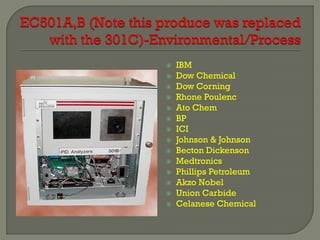
   IBM
   Dow Chemical
   Dow Corning
   Rhone Poulenc
   Ato Chem
   BP
   ICI
   Johnson & Johnson
   Becton Dickenson
   Medtronics
   Phillips Petroleum
   Akzo Nobel
   Union Carbide
   Celanese Chemical
 Solvents (PGMEA etc) in semiconductor plants
  EtO from sterilization chemical production
 Multicomponent monitoring of hazardous waste
  sites
 H2S and mercaptans in air & stacks
 Carbon bed breakthrough of specific VOC’s
 Silicone compounds in process streams
 Carbon breakthrough break detection of toxic
  gases
 ppb levels of chlorinated HC’s
 Fenceline monitoring from chemical &
  petrochemical plants
 Multipoint monitoring 10-20 point
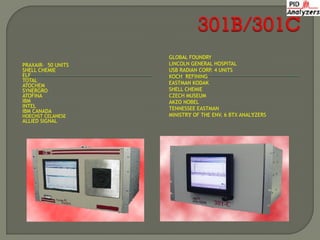
GLOBAL FOUNDRY
PRAXAIR- 50 UNITS   LINCOLN GENERAL HOSPITAL
SHELL CHEMIE        USB RADIAN CORP. 4 UNITS
ELF                 KOCH REFINING
TOTAL               EASTMAN KODAK
ATOCHEM
SYNERGRO            SHELL CHEMIE
ATOFINA             CZECH MUSEUM
IBM                 AKZO NOBEL
INTEL               TENNESSEE EASTMAN
IBM CANADA
HOECHST CELANESE    MINISTRY OF THE ENV. 6 BTX ANALYZERS
ALLIED SIGNAL
   In the early 1980’s we developed a “Quickscan” method
    to reduce the time to sequence 20 points of AsH3 & PH3
    from 30 min to <10 min. We did this by eliminating the
    column and when a preset level was exceeded, the
    svstem would go into the chromatographic mode.

   When many of the PELs were dropped to 1 ppm,
    quickscan was dropped because we had no way to do
    ppb levels, ony ppm.

   Several years ago, we developed ppb capability for the
    PID, now it is possible to have quickscan again, this time
    with ppb measurements
                            PID Analyzers, LLC   8/13/2011
   Quickscan is like having a Model 201 (no column) and
    a Model 301 incorporated into the same instrument
    with the best features of both incorporated.

   It requires two separate detectors. The 201 can scan
    each point in 20-30 sec. The analysis time is expected to
    be 6-10 minutes for a 10 component system or, at best, 2
    hours to scan a 20 point system. This compared to 10
    minutes for the quickscan.

   If a preset alarm level is exceeded, the system goes into
    the chromatographic mode to analyze all the components.
                           PID Analyzers, LLC   8/13/2011
 1. The
       PID is the most sensitive GC
 detector available for VOCs and it has the
 widest range of response for VOC’s

 2. The
       incorporation of Quickscan in this
 unique PID GC would provide
 semiconductor workers with the safest
 work environment possible.

                  PID Analyzers, LLC   8/13/2011

Pid and process_gc_instrumentation_jack_driscoll

  • 1.
    Dr. Jack Driscoll PID Analyzers, LLC Seoul,Korea 2010 copyright 2000-2011 PID PID Analyzers, LLC 8/13/2011
  • 2.
     In 1974,Dr. Jack Driscoll developed the first portable PID (> 25,000 sold worldwide)  In 1976, Dr. Jack Driscoll developed the first PID for gas chromatography (> 15,000 sold)  The IR100 award was won for the PID in 1978  Dr Driscoll has published > 80 papers on photoionization  Dr. Driscoll was awarded the Outstanding Achievement Award by the Northeastern Section of the ACS 2011 for developing the first hand held PID for industrial hygiene PID Analyzers, LLC 8/13/2011
  • 3.
    h Process  R + h = R + + e -  where   R= molecule  h = a photon with an  energy > IP of R  R+ = positive ion  e- = electron PID Analyzers, LLC 8/13/2011
  • 4.
    Linear dynamic range > 5 x10⁷  Detection limit <0.5 ppb benzene  Non destructive; other detectors can be run in-series  Sensitivity increases as the carbon number increases (carbon counter)  For 10.2 eV lamp, responds to carbon aliphatic compounds > C4, all olefins and all aromatics  The PID also responds to inorganic compounds such as H2S, NH3, Br2, I2, PH3, AsH3, e.g. any compound with an ionization potential of < 10.6 eV  The PID is more sensitive than the FID; >200 x more sensitive for aromatics, 80 times for olefins, & 30 times for alkanes > C6  Non destructive detector; other detectors can be run downstream  Concentration sensitive detector PID Analyzers, LLC 8/13/2011
  • 5.
     ppb Levelsof VOC’s in Plant Atmospheres  Process control of VOC’s  ppb to ppt Levels of BTX in ambient air  ppb Levels of BTX in beverage grade CO2  Detection of VOCs under Texas Chapter 115  Carbon bed breakthrough for toxic compounds at ppb levels  ppb levels of S in process streams GC- FPD PID Analyzers, LLC 8/13/2011
  • 6.
    GC Signal Schematic Detector ADC 16 bit AMP Keyboard Display DAC to 4-20 mA Diagnostics PC RS232 Digital I/O Alarms Digital I/O- valves Time clock, data calc & storage on hard drive PID Analyzers, LLC 8/13/2011
  • 7.
    Model 301-C mouse USB Port PID Analyzers, LLC 8/13/2011
  • 8.
  • 9.
     TheGC firmwarehas been continuously developed since its inception in 1990 as a DOS based system. Now it is written in C++. PID Analyzers is a Value Added Reseller of Microsoft .  The first process GC (20 point) was developed in 1980 for monitoring AsH3 and PH3 at ppb levels in semiconductor plants. The 301C is the fifth generation of that product. PID Analyzers, LLC 8/13/2011
  • 10.
    PID 10.6 eV On-screen keyboard PID Analyzers, LLC 8/13/2011 Method
  • 11.
    PID Analyzers, LLC 8/13/2011 Calibration
  • 12.
    PID 10.6 eV-3 ppb PID Analyzers, LLC 8/13/2011 Detector Parameters
  • 13.
    Exhaust Carrier Pump Gas (N2) ① ② ⑧ ⑨ ⑪ Gas ③ ⑦ ⑩ Vent ④ Column PID Chamber ⑤ Filter Port Switching Valve ⑥ (point) (2-position) Sample Vent Pump Chromatographic Oven 3 Way Valve Multipoint Module Main Analysis Module
  • 14.
     Pre column-to remove heavies, polar or non polar species, protect analytical column  Inject time- can be varied to remove heavier species  Detector- Selectivity- HNU has 6 detectors to choose from;PID lamp energy can be varied  Packed and capillary columns can be mixed  Backflushing to remove heavies; foreflushing to remove light compounds, heart cutting to remove a compound during the run  Pressure programming- new option for 2004 PID Analyzers, LLC 8/13/2011
  • 15.
     Analytical Column Mode for Specific Detection  Five detectors to choose from: Specific to Universal  Minimum Maintainance  Data Processing of Concentrations  X (Div. 1) or Z purge (Div. 2)  Outdoor Locations- PID Analyzers, LLC 8/13/2011
  • 16.
     PID- hydrocarbons (>C4), inorganic species H2S, NH3, PH3, etc. at ppb to ppm levels (ppb-%)  FID- specific for hydrocarbons (ppm-%)  FPD- specific for S or P (ppb)  FUV- nearly universal detector (ppb to%)  TCD- universal detector ( ppm to %) PID Analyzers, LLC 8/13/2011
  • 17.
     Photoionization Detector • 1st commercial introduction in 1976 by HNU (Driscoll)- 50x more sensitive than FID for aromatics- low ppb  Far UV Absorbance Detector • 1st commercial introduction in 1985 by HNU (Driscoll)-low ppm sensitivity- nearly universal  Flame Ionization Detector  1st commercial introduction in late 1950s- hydrocarbons- sub ppm PID Analyzers, LLC 8/13/2011
  • 18.
     PID • Mechanical, chromatographic, electronic & software-results: improved detection limits from 2 ppb to < 0.5 ppb  FUV • Electronic, chromatographic, & software- results: improved detetion limits from 1-2 ppm to 25-100 ppb  FID • Electronic, chromatographic, & software- results: from 100 ppb to 25-50 ppb PID Analyzers, LLC 8/13/2011
  • 19.
  • 20.
     Measures absorbance @ 124 nm-log signal  Nearly Universal Response  Linear (Log) Range > 105  Low dead volume < 40 uL- fast response  Non- destructive  Environmental applications: freons, landfill gases, O2, CO2, CH4 at same detection limit as FID (0.1 ppm), VOCs PID Analyzers, LLC 8/13/2011
  • 21.
  • 22.
    h  Linear dynamic range > 2 x 10⁶  Detection limit 50 ppb  Sensitivity increases as the carbon number increases (carbon counter)  Sensitivity to substituted species depends on the mass of carbon present and the ability to break the carbon bonds  The FID is sensitive to hydrocarbons  Detector is destructive since sample is burned  Requires the use of zero grade (high purity) hydrogen and air to produce the flame PID Analyzers, LLC 8/13/2011
  • 23.
    Detectors and Characteristics PID FUV FID Species Alkenes Y Y Y Aromatics Y Y Y Dynamic Range 5 x 10exp7 1 x 10exp5 1 x 10exp6 Detection Limits Air aromatics < 0.5 ppb 25-100 ppb 50-100 ppb alkenes <5 ppb 25-100 ppb 50-100 ppb alkanes < 10 ppb 25-100 ppb 50-100 ppb Water aromatics < 0.1 ppb 2.5-10 ppb 2.5-10 ppb alkenes 0.1 ppb 2.5-10 ppb 2.5-10 ppb alkanes 1 ppb 2.5-10 ppb 2.5-10 ppb PID Analyzers, LLC 8/13/2011
  • 24.
    Multipoint Sequencer- 1, 4, 8 ,10, 20 points  Six detectors to choose from specific to universal  Analytical Column Mode for Specific Detection  Pre column to remove interferences & protect analytical column  Built in Diagnostics  Long term reliability  Data Processing of Concentrations (1 Y storage)  X or Z purge- not necessary- in control room  Windows 2000 operating system  PeakWorks Chromatography Software  VGA color display  Mouse (left & right buttons)  On screen keyboard  USB Port for accessories PID Analyzers, LLC 8/13/2011
  • 25.
    Model 301-C GCStandard Features …  Single sample stream; autocalibration  Single or dual detector capability, single or dual columns, Outputs- 0-1V, RS232 (2), plus alarms (lo, high), 4-20 mA (optional), LAN  40 GByte hard drive for data storage  VGA Color flat panel display, ASCII keyboard  Automatic report generation  Extensive diagnostics PID Analyzers, LLC 8/13/2011
  • 26.
     The 301-C has a 16 channel ADC  Six are used for the 301-C  There are 10 additional channels for sensor input  Sensors available are:  Electrochemical, IR, UV, Semiconductor for more than 20 different species PID Analyzers, LLC 8/13/2011
  • 27.
    No support gases needed- just  Requires H2 (quarterly) and carrier zero air (monthly) or  Widest dynamic range of any generators GC detector > 5 x 10 exp 7  Dynamic range > 10 exp 6  PID is 50-100 x more sensitive than the FID  Detection limit of benzene=  Detection limit of benzene = 0.5 ppb < 40 ppb  No response to C1-C4  FID can detect C1-C4 aliphatic HC aliphatic HC  PID is a concentration sensitive detector so lower  FID is mass sensitive detector flowrates further improve sensitivty PID Analyzers, LLC 8/13/2011
  • 28.
     Hydrocarbon- a compound consisting of hydrogen and carbon atoms (CH4-methane)  Carbon Compound (organic compound)- a compound consisting of carbon and another atom(s) such as CS2 (carbon disulfide)  VOC- Volatile organic compound- could be a volatile version of either of the above two definitions
  • 29.
    PID FID  Response to Hydrocarbons  Yes  Yes  Response to organic cpds  Yes – CS2, CCl4  No  Response to hydrides  Yes NH3, H2S, AsH3, PH3  No  Response to other cpds  Yes – Cl2, I2. HBr, HI  No PID Analyzers, LLC 8/13/2011
  • 30.
  • 31.
     The 301C can have packed or capillary columns (0.53 or 0.32 mm or 0.18)  Typical cap column 30M x 0.53 or 0.32mm  We use PLOT for inorganic, fixed gases or light hydrocarbons  One or two columns packed or capillary PID Analyzers, LLC 8/13/2011
  • 32.
    PID 10.6 eV PID Analyzers, LLC 8/13/2011 3 ppb BTX
  • 33.
    PID 10.6 eV PID Analyzers, LLC 8/13/2011 5 ppb BTX
  • 34.
  • 35.
  • 36.
  • 37.
  • 38.
  • 39.
  • 40.
    Low Level Linearityof Benzene & Ethyl Benzene 25000 20000 y = 972.99x - 16.272 Peak Counts 15000 R2 = 0.9999 y = 389.31x - 8.112 2 R = 0.9999 10000 5000 0 0 5 10 15 20 25 ppb Benzene/Ethyl Benzene
  • 41.
  • 42.
    Children’s Hospital  Univ. of CA SF  John Hopkins  Smithsonian  VA Hospital, Dallas  Roosevelt Hospital  Perrier  Becton Dickinson  Amoco  EI DuPont  Ohio State Univ. Hospital  Aberdeen Proving Grounds  Meriter Hospital  American Medical Supp.  Celanese Chemical  Methodist Hospital
  • 43.
    EtO from sterilization chemical production  Multicomponent monitoring of hazardous waste site fencelines  H2S and mercaptans in air & stacks  Silicone compounds in process streams  Carbon breakthrough break detection of toxic gases  ppb levels of chlorinated HC’s  Fenceline monitoring from chemical & petrochemical plants  Single point monitoring  Four point monitoring
  • 44.
    IBM  Dow Chemical  Dow Corning  Rhone Poulenc  Ato Chem  BP  ICI  Johnson & Johnson  Becton Dickenson  Medtronics  Phillips Petroleum  Akzo Nobel  Union Carbide  Celanese Chemical
  • 45.
     Solvents (PGMEAetc) in semiconductor plants  EtO from sterilization chemical production  Multicomponent monitoring of hazardous waste sites  H2S and mercaptans in air & stacks  Carbon bed breakthrough of specific VOC’s  Silicone compounds in process streams  Carbon breakthrough break detection of toxic gases  ppb levels of chlorinated HC’s  Fenceline monitoring from chemical & petrochemical plants  Multipoint monitoring 10-20 point
  • 46.
    GLOBAL FOUNDRY PRAXAIR- 50UNITS LINCOLN GENERAL HOSPITAL SHELL CHEMIE USB RADIAN CORP. 4 UNITS ELF KOCH REFINING TOTAL EASTMAN KODAK ATOCHEM SYNERGRO SHELL CHEMIE ATOFINA CZECH MUSEUM IBM AKZO NOBEL INTEL TENNESSEE EASTMAN IBM CANADA HOECHST CELANESE MINISTRY OF THE ENV. 6 BTX ANALYZERS ALLIED SIGNAL
  • 47.
    In the early 1980’s we developed a “Quickscan” method to reduce the time to sequence 20 points of AsH3 & PH3 from 30 min to <10 min. We did this by eliminating the column and when a preset level was exceeded, the svstem would go into the chromatographic mode.  When many of the PELs were dropped to 1 ppm, quickscan was dropped because we had no way to do ppb levels, ony ppm.  Several years ago, we developed ppb capability for the PID, now it is possible to have quickscan again, this time with ppb measurements PID Analyzers, LLC 8/13/2011
  • 48.
    Quickscan is like having a Model 201 (no column) and a Model 301 incorporated into the same instrument with the best features of both incorporated.  It requires two separate detectors. The 201 can scan each point in 20-30 sec. The analysis time is expected to be 6-10 minutes for a 10 component system or, at best, 2 hours to scan a 20 point system. This compared to 10 minutes for the quickscan.  If a preset alarm level is exceeded, the system goes into the chromatographic mode to analyze all the components. PID Analyzers, LLC 8/13/2011
  • 49.
     1. The PID is the most sensitive GC detector available for VOCs and it has the widest range of response for VOC’s  2. The incorporation of Quickscan in this unique PID GC would provide semiconductor workers with the safest work environment possible. PID Analyzers, LLC 8/13/2011